Multiple Generative Models Ensemble for Knowledge-Driven Proactive Human-Computer Dialogue Agent
Zelin Dai, Weitang Liu, Guanhua Zhan

TL;DR
This paper presents an ensemble of multiple generative models for proactive human-computer dialogue, achieving significant improvements in response quality through data augmentation and novel ensemble techniques.
Contribution
It introduces a rank-based ensemble approach combined with data augmentation and variant encoder-decoder structures for enhanced dialogue generation.
Findings
Single model improves F1-score and BLEU by 18.67% over baseline
Ensemble methods outperform baseline by 35.85%
Effective for multi-turn proactive dialogue generation
Abstract
Multiple sequence to sequence models were used to establish an end-to-end multi-turns proactive dialogue generation agent, with the aid of data augmentation techniques and variant encoder-decoder structure designs. A rank-based ensemble approach was developed for boosting performance. Results indicate that our single model, in average, makes an obvious improvement in the terms of F1-score and BLEU over the baseline by 18.67% on the DuConv dataset. In particular, the ensemble methods further significantly outperform the baseline by 35.85%.
Click any figure to enlarge with its caption.
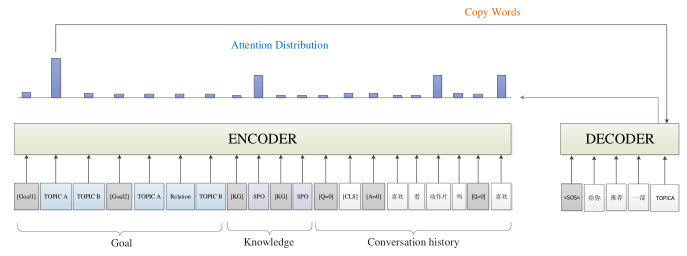 Figure 1
 Figure 2
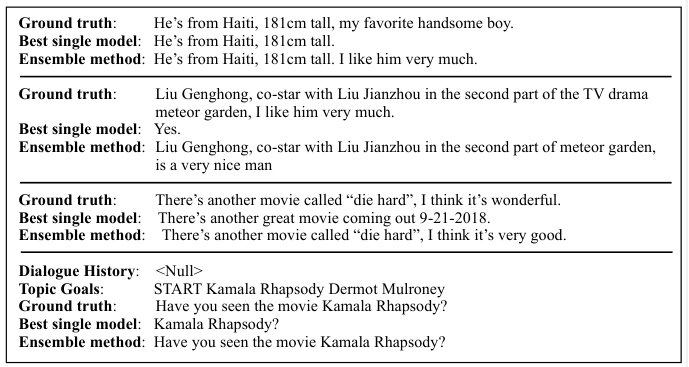 Figure 3
Peer Reviews
No public reviews on file for this paper yet. If you reviewed it on a platform where reviews are public (OpenReview, ICLR, NeurIPS, ICML), you can paste yours below so the community can read it here.
Code & Models
Videos
No videos yet. Explain this paper in a talk, walkthrough, or lecture? Add one.
Taxonomy
TopicsTopic Modeling · Natural Language Processing Techniques · Speech and dialogue systems