Spontaneous excitation of an accelerated atom coupled with quantum fluctuations of spacetime
Shijing Cheng, Jiawei Hu, Hongwei Yu

TL;DR
This paper investigates how a uniformly accelerated gravitationally polarizable atom interacts with quantum spacetime fluctuations, revealing that acceleration induces spontaneous excitations and breaks the equivalence with thermal field effects.
Contribution
It demonstrates that quantum gravitational vacuum fluctuations can cause spontaneous excitation of accelerated atoms, showing deviations from the Unruh effect predictions.
Findings
Accelerated atoms can spontaneously excite due to quantum spacetime fluctuations.
Transition rates include terms proportional to acceleration squared and quartic.
The equivalence between acceleration and thermal effects is not valid in this quantum gravity context.
Abstract
A direct consequence of quantization of gravity would be quantum gravitational vacuum fluctuations which induce quadrupole moments in gravitationally polarizable atoms. In this paper, we study the spontaneous excitation of a gravitationally polarizable atom with a uniform acceleration in interaction with a bath of fluctuating quantum gravitational fields in vacuum, and compare the result with that of a static one in a thermal bath of gravitons at the Unruh temperature. We find that, under the fluctuations of spacetime itself, transitions to higher-lying excited states from the ground state are possible for both the uniformly accelerated atom in vacuum and the static one in a thermal bath. The appearance of terms in the transition rates proportional to and indicates that the equivalence between uniform acceleration and thermal field is lost.
Click any figure to enlarge with its caption.
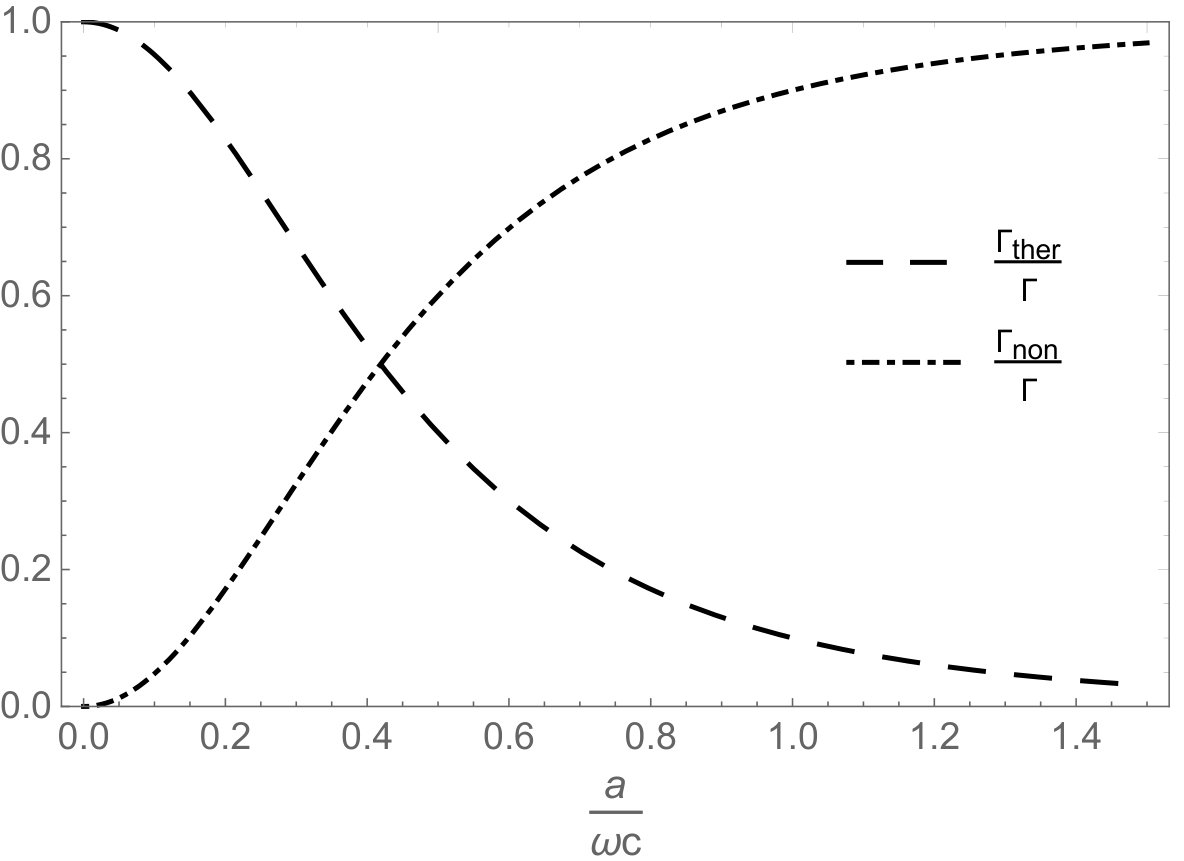 Figure 1
Peer Reviews
No public reviews on file for this paper yet. If you reviewed it on a platform where reviews are public (OpenReview, ICLR, NeurIPS, ICML), you can paste yours below so the community can read it here.
Videos
No videos yet. Explain this paper in a talk, walkthrough, or lecture? Add one.