Special cubic perturbations of the Duffing oscillator $x"=x-x^3$ near the eight-loop
Lubomir Gavrilov, Ameni Gargouri, Bassem Ben Hamed

TL;DR
This paper establishes an upper limit on the number of limit cycles emerging from the eight-loop of a Duffing oscillator under specific cubic perturbations, advancing understanding of nonlinear dynamic bifurcations.
Contribution
It provides the first explicit upper bound for limit cycles near the eight-loop of the Duffing oscillator with special cubic perturbations.
Findings
Upper bound for bifurcating limit cycles established
Limit cycles analyzed near the eight-loop of the oscillator
Perturbation effects on the oscillator's dynamics quantified
Abstract
We find an upper bound for the number of limit cycles, bifurcating from the 8-loop of the Duffing oscillator under the special cubic perturbation
Click any figure to enlarge with its caption.
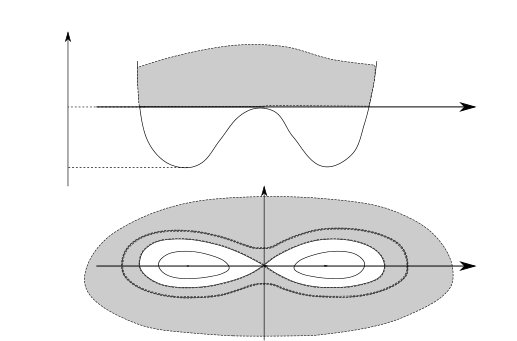 Figure 1
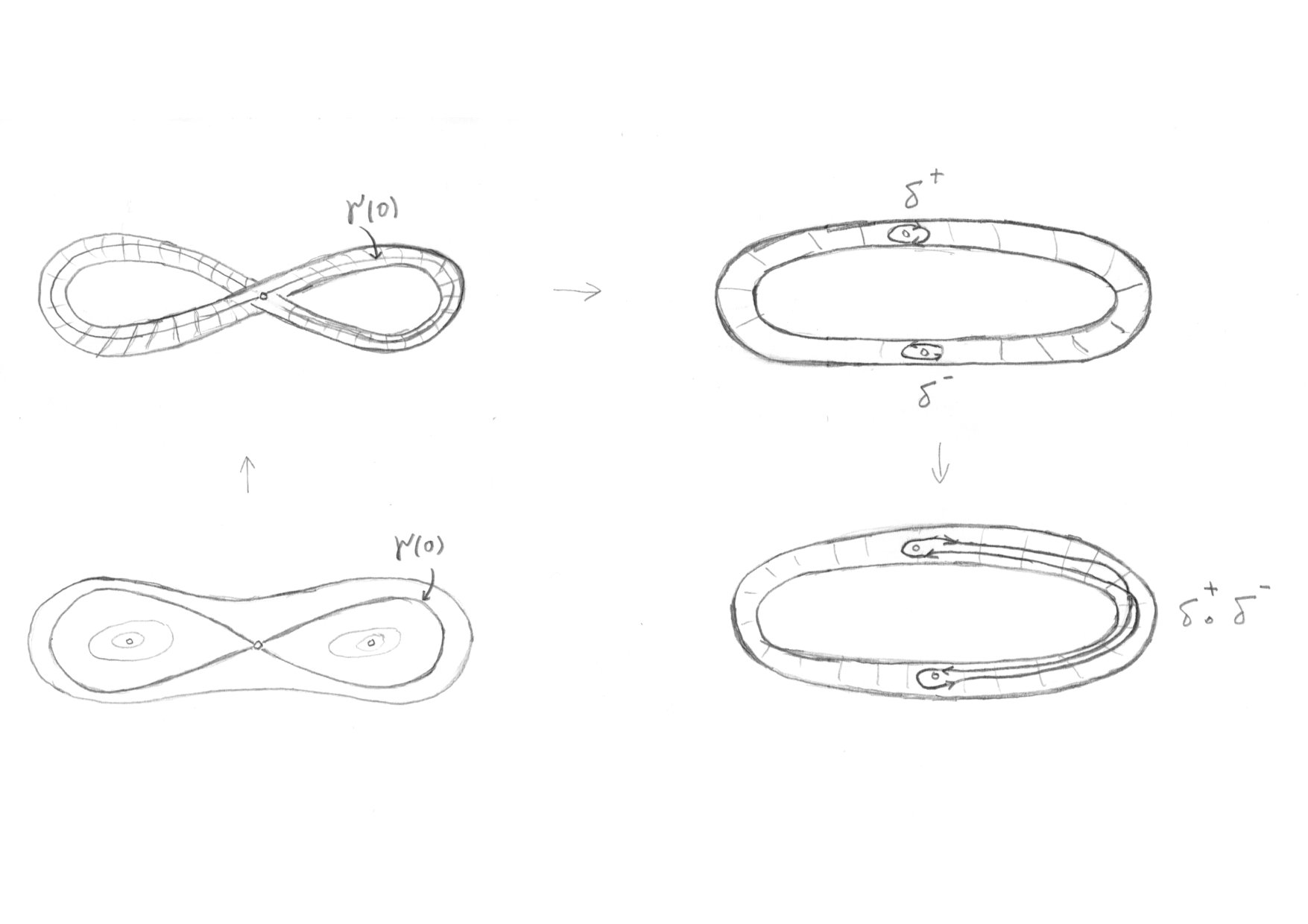 Figure 8
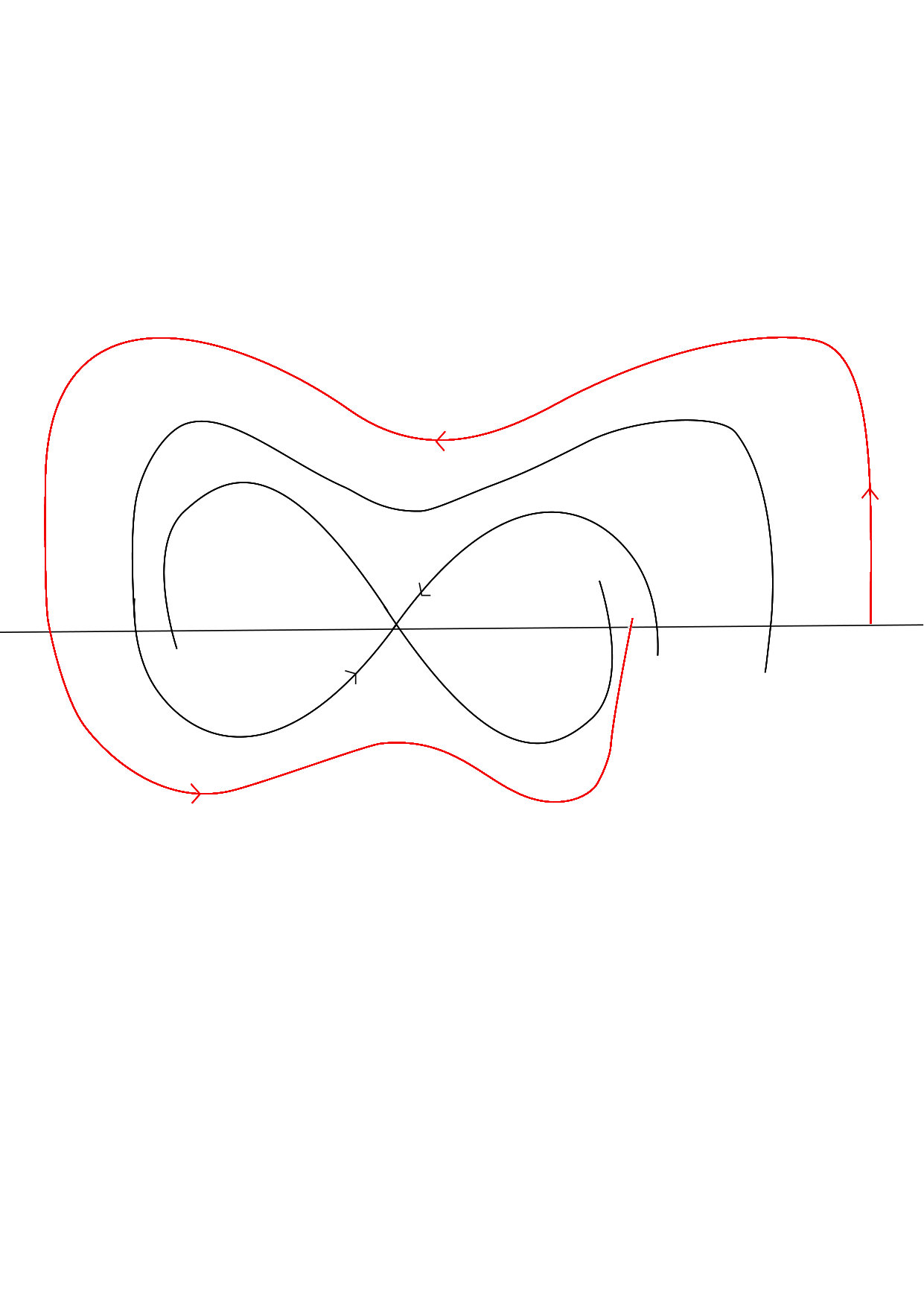 Figure 3
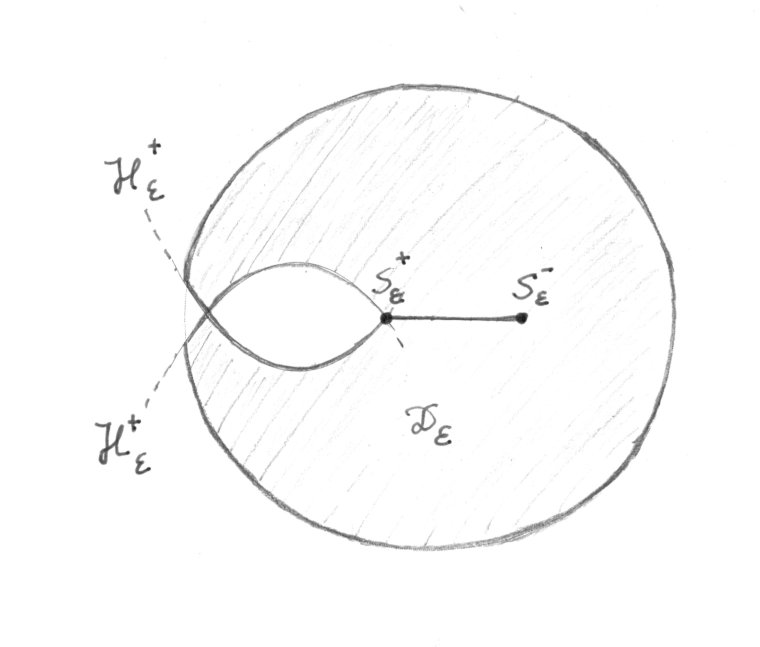 Figure 4
Peer Reviews
No public reviews on file for this paper yet. If you reviewed it on a platform where reviews are public (OpenReview, ICLR, NeurIPS, ICML), you can paste yours below so the community can read it here.
Videos
No videos yet. Explain this paper in a talk, walkthrough, or lecture? Add one.
Special cubic perturbations of the Duffing oscillator near the eight-loop
Lubomir Gavrilov
Institut de Mathématiques de Toulouse, UMR 5219
Université de Toulouse, 31062 Toulouse, France.
E-mail: [email protected]
Ameni Gargouri
Faculté des Sciences de Sfax, Département de Mathématiques,
BP 1171, 3000 Sfax, Tunisie.
E-mail: [email protected]
Bassem Ben Hamed
Ecole Nationale d’ Electronique et des Télécommunications de Sfax
Technopôle El Ons, Route de Tunis km 10, BP 1163, 3021 Sfax, Tunisie.
E-mail: [email protected]
Abstract
We find an upper bound for the number of limit cycles, bifurcating from the 8-loop of the Duffing oscillator under the special cubic perturbation
[TABLE]
.
1 Introduction
The perturbed Duffing oscillator
[TABLE]
where are small parameters, appears in a unavoidable way in the study of co-dimension two versal deformations of plane vector field with two zero eigenvalues and symmetry of order 2, [12, Horozov, 1979], [2, Carr, 1981]. For (3) has a figure eight loop (union of two homoclinic saddle connections) which is the level set of the first integral (7). It is shown in the above mentioned papers that the Melnikov function responsible for the bifurcations has at most one zero near the figure eight loop, respectively at most one limit cycle tends to the figure eight loop of the non-perturbed system (3) ( for a self-contained proof see [3, section 4.2.]). The simplicity of the the corresponding bifurcation diagrams hides at least two more complicated phenomena, which might appear in deformations of higher co-dimension.
- •
First, when the (first) Melnikov function vanishes, the system need not be "integrable".
Such is the case with the following more general deformation,
[TABLE]
where are small parameters. As we shall see, the Bautin ideal of the first return map related to the exterior period annulus is generated by and (Theorem 3). This implies that if but , the first Melnikov function is identically zero, but the exterior period annulus is destroyed. The higher Melnikov functions were computed by Iliev (1998) [13], and it follows from their analysis that at most two zeros can bifurcate near the 8-loop.
- •
Second, not all limit cycles near the 8 loop need to be "shadowed" by zeros of Melnikov function.
The existence of such "alien" limit cycles was discovered by Dumortier, Roussarie and Caubergh (2005) [5, 4]. Up to these papers, the one-to-one correspondance between zeros of the Melnikov function and limit cycles near polycycle more complicated than a homoclinic loop were sometime considered as granted, leaving some place for speculations.
In the present paper we bound the cyclicity of the 8-loop with respect to the deformation (6). In contrast to (3)we study here a co-dimension three deformation. The "expected" number of limit cycles bifurcating from the 8-loop is therefore two. Indeed, when the first Melnikov function we show that it is indeed the case. But when we show that this cyclicity is at most five. This bound is presumably bigger than the cyclicity of the 8-loop, but yet it is the only available bound.
The system (6) has been studied by many authors, see [13, 14, 16, 3] and the references given there. The phase portrait of , which has a first integral
[TABLE]
is shown on Fig.1. As a first approach one may consider one-parameter deformations of . More precisely, consider analytic arcs
[TABLE]
in the parameter space , and the corresponding one-parameter deformation .
To each annulus of and deformation one may associate the Poincaré return map
[TABLE]
where the zeros of the k-th order Melnikov function control the limit cycles of .
Zoladek and Jebrane and Iliev and Perko [14] computed the Melnikov functions and studied their zeros. Based on this they found the cyclicity of the three open period annuli (two interior and one exterior annulus) of with respect to the one-parameter deformation . Later Li, Mardesic and Roussarie [16] extended these results to multi-parameter deformations. Indeed, according to [8, Theorem 1], the study of one-parameter deformations is enough to estimate the cyclicity of the open annuli of the multi-parameter deformation . This is a general result, close to the way in which the Nash space of arcs of a singular variety is used to desingularize it, see [7] for details.
The results in the above mentioned papers provide estimates to the cyclicity not only of the period annuli, but also of the two homoclinic loops of , as it follows from a classical result of Roussarie [17].
The present paper is devoted to the study of the missing cyclicity of the 8-loop, see Fig. 2, e.g. [16, section 5].
We use complex methods, in the spirit of [10, 9, 11]. Our main result is that at most five limit cycles can bifurcate from eight-loop (Theorem 4), although we did not succeed to prove that this bound is exact. It is interesting to note, that even for a generic perturbation (6), two limit cycle can appear near a eight-loop, while at the same time the first Melikov function exhibits only one zero. Hence there is a limit cycle that is not covered by a zero of the related Abelian integral. Such a limit cycle were called "alien" in [5, 4]. Some partial results in this sense can be found in [18].
Instead of polynomial, one may consider general analytic families of analytic vector fields , such that has an eight loop. The finite cyclicity of the eight loop in this context follows from [9]. The main difficulty to prove this result is the case, when the return map associated to the eight-loop of is the identity map (eight-loop of infinite co-dimension). If the return map is not the identity map (the case of finite co-dimension) the finite cyclicity together with an explicit bound for the number of limit cycles has been found by Jebrane and Mourtada [15]. Their result remains true in the category.
The paper is organized as follows. In the next section 2 we describe the Bautin ideal associated to (6) and its exterior period annulus, as well the corresponding Melnikov functions. These results are classical. In section 3 we formulate our main result - Theorem 4, which says that the cyclicity of the eight-loop is at most five. Its proof is based on Theorem 5 in which we study one-parameter deformations of . The proof of Theorem 5 is carried out in section 3.1.
2 The Bautin ideal and the Melnikov functions
Define the complete elliptic integrals
[TABLE]
where
[TABLE]
Then the first return map , see (8), near an oval is well defined and for the first non-vanishing Poincaré-Pontryagin-Melnikov function we have
Theorem 1** (Iliev, [13]).**
If is not identically zero, then
[TABLE]
otherwise
[TABLE]
Let be a continuous family of closed loops, representing a cycle in which vanishe at the saddle point when tends to [math]. Note that can not be represented in a real domain. It is the variation of the real oval when makes one turn around in a complex domain. Define
[TABLE]
Similarly to , define to be the holonomy map of one of the separatrices of the saddle point and write
[TABLE]
Repeating the proof of Theorem 1 we obtain (see also [14])
Theorem 2**.**
If is not identically zero, then
[TABLE]
otherwise
[TABLE]
The next two Lemmas are proved in a standard way and can be found in [14, 1].
Lemma 1**.**
The complete elliptic integrals integrals , satisfy the following Picard-Fuchs system :
[TABLE]
Based on Lemma 1 it can be deduced
Lemma 2**.**
The complete elliptic integrals integrals allow convergent expansions near of the form
[TABLE]
where are constants.
Corollary 1**.**
The first non-vanishing Melnikov function , , allows a convergent expansion of the form
[TABLE]
Moreover, if and then . If and then .
Lemma 2 implies
Lemma 3**.**
The complete elliptic integrals integrals are analytic near and allow expansions of the form
[TABLE]
To define the Bautin ideal, we note that the first return map associated to the exterior annulus of is also defined for all close to [math]. Take any and expand the Poincaré return map
[TABLE]
where are suitable analytic functions which generate an ideal in the Noetherian ring of germes of analytic functions . It is known that the ideal does not depend on , and it is called the Bautin ideal associated to the deformed vector field and to the exterior period annulus.
Theorem 3**.**
The Bautin ideal is generated by the polynomials and .
The proof of this remarkable fact follows from Theorem 1, and can be also found in [16]. Indeed, the Poincaré return map is the identity map, if and only if . This implies that if the deformed vector field allows for all small a continuous band of periodic orbits on the exterior of a 8-loop if and only if
[TABLE]
The center variety defined by the Bautin ideal is a germ of analytic set centred at the origin , which combined with (20) implies
[TABLE]
This already shows that is polynomially generated, although it does not need to be radical. As the ideal of the center variety is generated by then we can divide the displacement map and write
[TABLE]
where are germs of analytic functions. Substituting and taking into consideration Theorem 1 we conclude that
[TABLE]
where, by abuse of notations, is a germ of analytic function in and which vanishes at .
3 Cyclicity of the 8-loop
The so called 8-loop is the union of the two homoclinic orbits of the Hamiltonian system having a first integral as on Fig.1. The cyclicity of the 8-loop is the maximal number of limit cycles of , which tend to to the 8-loop, when tends to [math], for rigorous definition see Roussarie [17]. The main result of the paper is
Theorem 4**.**
The cyclicity of the 8-loop of with respect to the four-parameter family of cubic deformations , defined by (6), is at most equal to five.
Following [14], instead of we consider first analytic arcs (one-parameter deformations)
[TABLE]
together with the corresponding one-parameter family of vector fields
[TABLE]
To the exterior period annulus of we associate a Poincaré first return map (the identity map) which is well defined also for close to [math]. As usual we parameterize this map by the restriction of on a cross section to the exterior period annulus of and write
[TABLE]
For such one-parameter deformation we can give a more precise result
Theorem 5**.**
The cyclicity of the 8-loop of with respect to the one-parameter deformation is at most equal to
- •
two, if
- •
five, otherwise .
3.1 Proof of Theorem 5
We adapt the proof given for the so called two-saddle loop in [10], where the reader will find more detailed theoretical justification of the method which we use. We outline first the plan of our proof.
Consider the Dulac maps , associated to the perturbed foliation, and to the cross sections and , see Fig. 2. We parameterize each cross-section by the restriction of the first integral f on it, and denote . Each function is multivalued and has a critical point at , . The points , depend analytically on . Without loss of generality we shall suppose that and , see Fig. 3. A limit cycle intersects the cross-section at if and only if . The Poincaré return map is defined as
[TABLE]
The limit cycles of correspond also to the fixed points of , the zeros of
[TABLE]
as well the zeros of the dispalacment map . Each of the Dulac maps has a single singular point corresponding to the saddle point of and otherwise allows an analytic continuation in a complex domain to a multivalued function. Assume that as on Fig. 3. To count the zeros of the displacement map on the interval we shall bound them by the number of the zeros of the displacement map in the larger complex domain which is shown on Fig. 3. We recall from [10] that the domain is bounded by a small circle of radius , by the segment , and by the zero locus of the imaginary part of
[TABLE]
Define similarly
[TABLE]
and recall from [10] that , as subsets of are (germs of) real analytic curves.
The number of the zeros of in is computed according to the argument principle: it equals the increase of the argument along the boundary of .
Along the circle and far from the critical points, the displacement function is "well" approximated by which allows one to estimate the increase of the argument.
Along the segment the zeros of the imaginary part of the displacement function coincide with the fixed points of the holomorphic holonomy map along the separatrix through . The zeros are therefore well approximated, by the Abelian integral , along the vanishing cycle .
Along the zero locus of the imaginary part of , the zeros of the imaginary part of the displacement map coincide with , which are in fact the fixed points of suitable holonomy map, which can be desribed by analogy to [9].
The last point needs some explication. Namely, to a closed loop contained in a leaf of we associate a holonomy map of the perturbed system . Let be two closed loops in the two local separatrices of through the saddle point , that is to say and let be a complex neighboorhood of the real eight-loop, which topologically is an annulus with two identified marked points identified to a single point, which is the saddle , shown on Fig. 1. The loops are considered up to a free homotopy and denote the composed loop as it is shown on Fig. 4. Note that the loops are contractible in , and that they allow a continuation to a family of loops which are homologous on . Therefore they define to a continuous family of vanishing cycles .
We have defined in such a way three holonomy maps
[TABLE]
The fixed points of coincide with , that is to say with the zeros of the imaginary part of along the the imaginary part of .
To the end of the section we follow the steps outlined above, by completing the missing estimates.
3.1.1 The case
In this section we consider the perturbed system (6) under the generic assumption that
[TABLE]
is not identically zero.
By Lemma 2 the Abelian integrals are linearly independent and hence if and only if . The Poincaré-Pontryagin function has a continuous limit at to whichis the classical Melnikov integral along the eight-loop . It is known that the vanishing of the Melnikov integral is a necessary condition for a bifurcation of a limit cycle :
Proposition 1**.**
If , then no limit cycles bifurcate from the eight-loop .
- Proof
Suppose that there is a sequence of limit cycles of which tend to the eigth-loop and when . Then
[TABLE]
which implies
[TABLE]
.
By Corollary 1 at most one zero of bifurcates from . It can be proved, however, that two limit cycles can bifurcate from the eight loop, when tend to zero. Thus, an alien limit cycle is present near the eight-loop, see [5, 4, 11]. We shall prove here the following weaker
Proposition 2**.**
If the first Melnikov function is not identically zero, then at most two limit cycles bifurcate from the eight-loop .
- •
By Proposition 1, if limit cycles bifurcate from the eight-loop, then and hence . As
[TABLE]
then the displacement map along the circle is approximated by which has as a leading term (because if then ). The increase of the argument of , and hence of the displacement map, along the circle is close to but strictly less than .
- •
The imaginary part of the displacement map, along the interval equals the imaginary part of . Its zeros equal the number of intersection points of with the real axes, that is to say the fixed points of the holonomy map , where
[TABLE]
and is an Abelian integral along the vanishing cycle , see Theorem 2. The Abelian integral has a simple zero at which is also a fixed point of the holonomy map. Therefore the imaginary part of the displacement map does not vanish along the open interval .
- •
The number of the zeros of the imaginary part of the displacement map, along the real analytic curve equals the number of the zeros of the imaginary part of along this curve, that is to say the number of intersection points of this curve with , which are the fixed points of the holonomy map .
We have
[TABLE]
[TABLE]
[TABLE]
[TABLE]
As , then has a simple zero at and we conclude that the imaginary part of the displacement map vanishes at most once.
We conclude that the displacement map can have at most two zeros in the domain which completes the proof of Proposition 2.
3.1.2 The case
In this section we suppose that the Melnikov function vanishes identically. The first return map has the form (8), where the Melnikov function is computed in Theorem 1.
Proposition 3**.**
If , then at most two limit cycles bifurcate from .
- Proof
Following the method of the preceding subsection, we evaluate the number of the zeros of the displacement map in the domain
[TABLE]
- –
Along the circle The displacement map is approximated by which has as a leading term: as , see Lemma 2. The increase of the argument of , and hence of the displacement map, along the circle is close to but strictly less than .
- –
The imaginary part of the displacement map, along the interval equals the imaginary part of . The number of its zeros is bounded by the multiplicity of the Abelian integral having at most a simple zero at the origin, see Theorem 2. Note, however, that the holonomy map has as a fixed point, and hence the cyclicity of the saddle point is zero. We conclude that the imaginary part of the displacement map does not vanish along the interval .
- –
The number of the zeros of the imaginary part of the displacement map, along the real analytic curve is bounded by the the cyclicity of the zero of the Abelian integral (see the proof of Proposition 2) and
Summing up the above information we conclude that at most two limit cycles bifurcate from the eight-loop.
Proposition 4**.**
If then at most five limit cycles bifurcate from .
Assuming that (otherwise no limit cycles bifurcate from the eight-loop), implies that up to multiplication by a non zero constant we have
[TABLE]
We repeat the three steps above.
- •
Along the circle , the displacement map is approximated by and hence the increase of the argument of the displacement map, along the circle is close to .
- •
The number of the zeros of the imaginary part of the displacement map, along the interval is bounded by the multiplicity of the Abelian integral having a double zero at the origin. Note, however, that the holonomy map has as a fixed point. We conclude that the imaginary part of the displacement map vanishes at most once along the interval .
- •
The number of the zeros of the imaginary part of the displacement map, along the real analytic curve is bounded by the cyclicity of the zero of the Abelian integral . Thus the imaginary part vanishes at most twice.
Summing up the above information we get at most five zeros.
4 Proof of Theorem 4
If the Bautin ideal were principal, with generator , then we can write for the displacement function
[TABLE]
which is the analogue of formula (8), and similar expressions hold true for the Dulac maps . Therefore we may repeat the arguments given in section 3.1, to produce exctly the same estimates for the zeros of the displacement map, as in the case of a one-parameter deformation. This would complete the proof of Theorem 4.
Of course, he Bautin ideal is not principal, even if we localize it at the origin. Following [8], we proceed to its principalization. Namely, consider the map
[TABLE]
which is well defined, except along the center variety . By definition, the blow up of is the Zarisky closure of the graph of the map (28). Clearly is a singular algebraic surface of dimension four coming with natural projection (analytic map)
[TABLE]
The exceptional divisor of the blow up is the divisor which is a three-dimensional algebraic set having two irreducible components. Obviously which is canonically identified to the the projectivized vector space of Melnikov functions , see [7, section 3]. The ideal defines an ideal sheaf , and les be the inverse image of which is also an ideal sheaf this time on . The main feature of the inverse ideal sheaf is that it is locally principal, see [7, section 2]. For instance, if with , then in a neighbourhood of on in which
[TABLE]
we may choose as a generator of the ideal and express
[TABLE]
for suitable analytic .
The above considerations show that for each point we can find a neighbourhood in for which at most five limit cycles bifurcate from the 8-loop. This completes the proof of Theorem 4.
The reference list from the paper itself. Each links out to its DOI / PubMed record.
- 1[1] B. Ben Hamed, A. Gargouri, L. Gavrilov, Perturbations of symmetric elliptic Hamiltonians of degree four in a complex domain, J. Math. Anal. Appl. 424 , 774–784 (2015).
- 2[2] Jack Carr. Applications of centre manifold theory , volume 35 of Applied Mathematical Sciences . Springer-Verlag, New York-Berlin, 1981.
- 3[3] Shui-Nee Chow, Cheng Zhi Li, and Duo Wang. Normal forms and bifurcation of planar vector fields . Cambridge University Press, Cambridge, 1994.
- 4[4] M. Caubergh, F. Dumortier, R. Roussarie, Alien limit cycle near a Hamiltonian 2-sadlle cycle. C. R. Math. Acad. Sci. Paris. 340(8) , 587–592 (2005).
- 5[5] F. Dumortier, R. Roussarie, Abelian integrals and limit cycles. J. Differential Equations. 227(1) , 116–165, (2006).
- 6[6] Freddy Dumortier and Chengzhi Li. Perturbation from an elliptic Hamiltonian of degree four. IV. Figure eight-loop. J. Differential Equations , 188(2):512–554, 2003.
- 7[7] J.-P. Françoise, L. Gavrilov, D.i Xiao, Hilbert’s 16th problem on a period annulus and Nash space of arcs, ar Xiv:1610.07582, to appear in Mathematical Proceedings of the Cambridge Philosophical Society.
- 8[8] L. Gavrilov, Cyclicity of period annuli and principalization of Bautin ideals. Ergodic Theory Dynam. Systems 28 (2008), no. 5, 1497-1507.