Study of Rate-Splitting Techniques with Block Diagonalization for Multiuser MIMO Systems
A. Flores, R. C. de Lamare

TL;DR
This paper explores rate-splitting combined with block diagonalization in multiuser MIMO systems, proposing new precoding techniques and analyzing their performance under imperfect channel information.
Contribution
It introduces a novel linear precoding scheme based on block diagonalization for rate-splitting in multiuser MIMO systems, with performance analysis and simulation results.
Findings
Proposed schemes outperform conventional precoding methods.
Closed-form sum rate expressions derived.
Enhanced common rate with combining techniques.
Abstract
In this work, we investigate Block Diagonalization (BD) techniques for multiuser multiple-antenna systems using rate-splitting (RS) multiple access. In RS multiple access the messages of the users are split into a common part and a private part in order to mitigate multiuser interference. We present the system model for a RS multiple access system operating in a broadcast channel scenario where the receivers are equipped with multiple antennas. We also develop linear precoders based on BD for the RS multiple access systems along with combining techniques, such as the min-max criterion and the maximum ratio combining criterion, to enhance the common rate. Closed-form expressions to describe the sum rate performance of the proposed scheme are also derived. The performance of the system is evaluated via simulations considering imperfect channel state information at the transmitter. The…
Click any figure to enlarge with its caption.
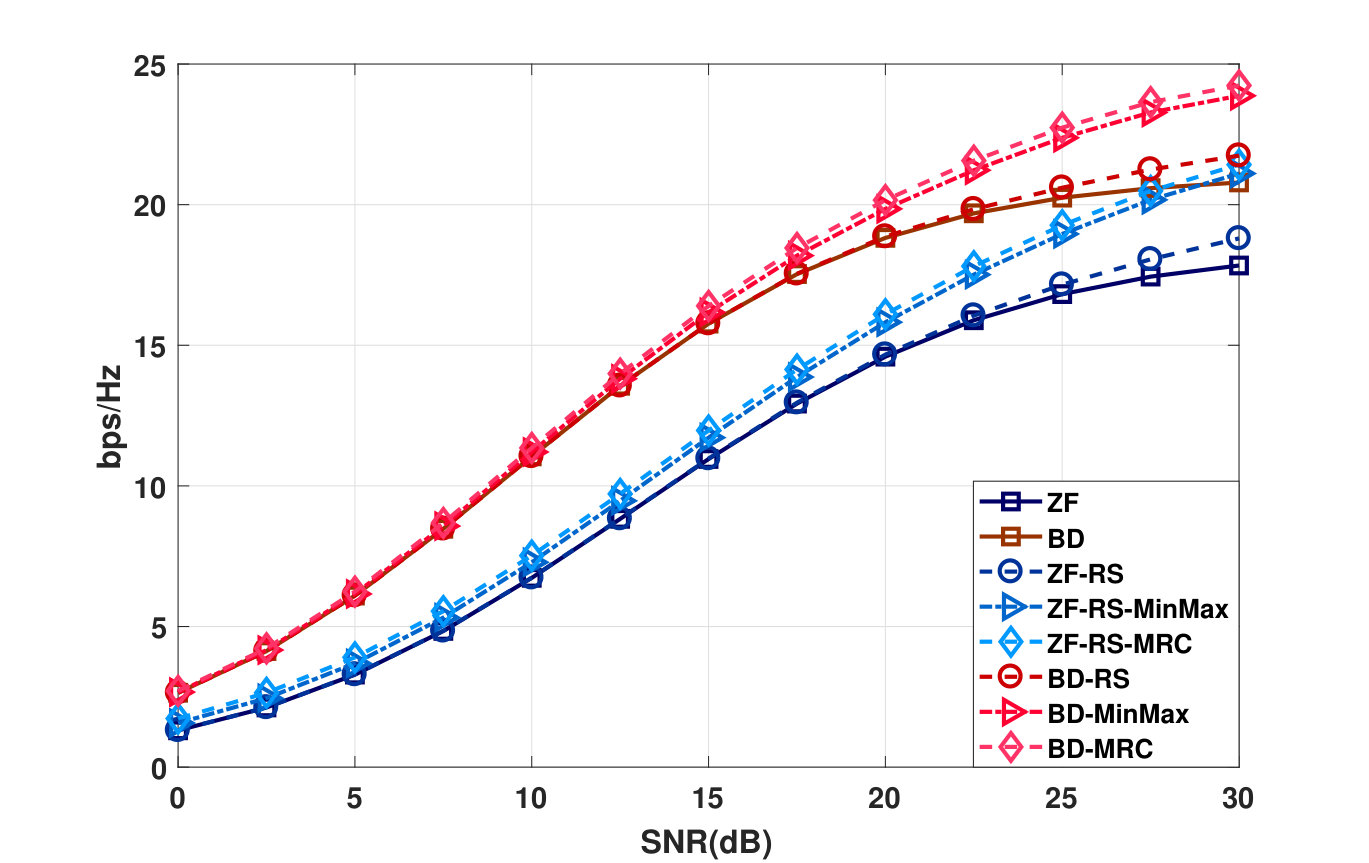 Figure 1
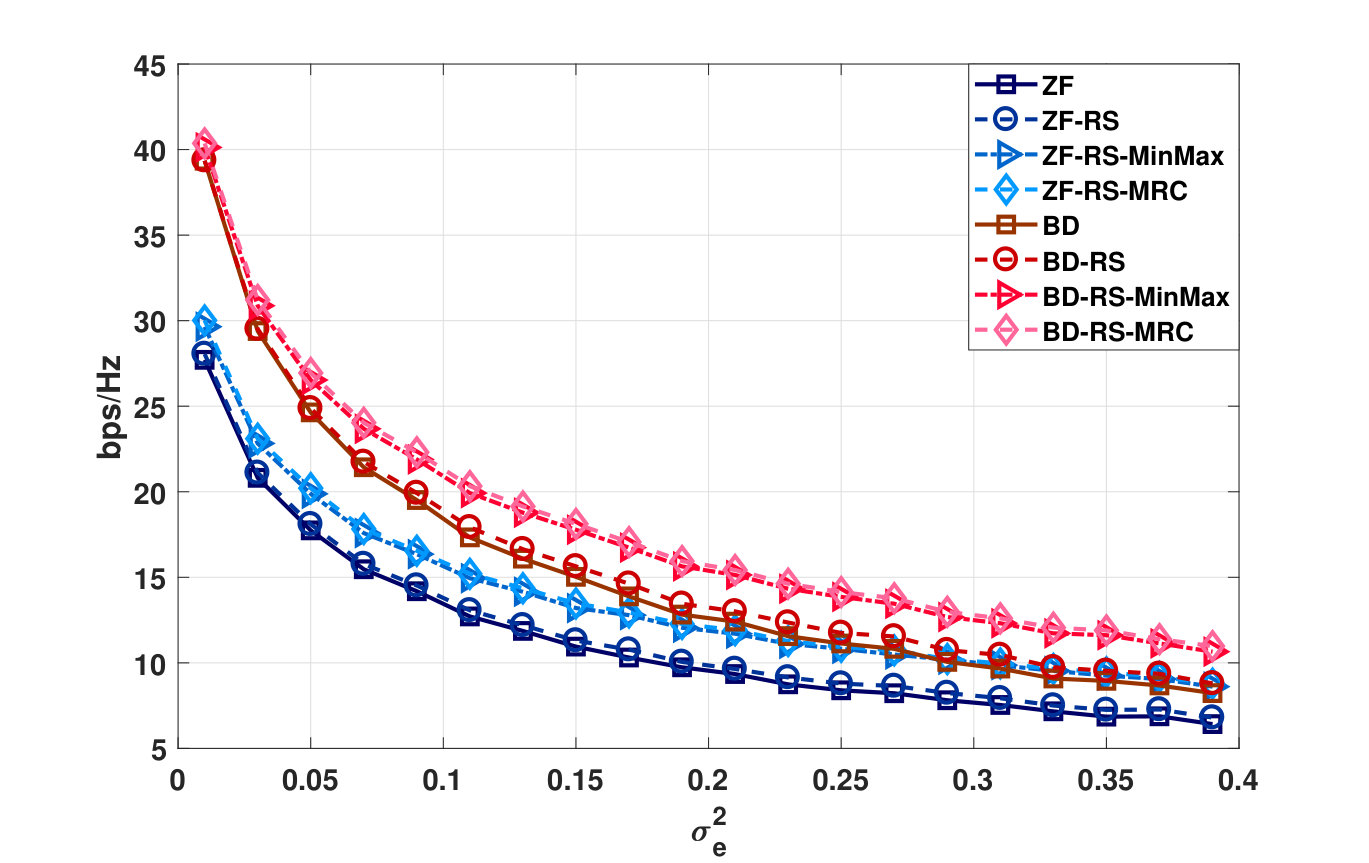 Figure 2
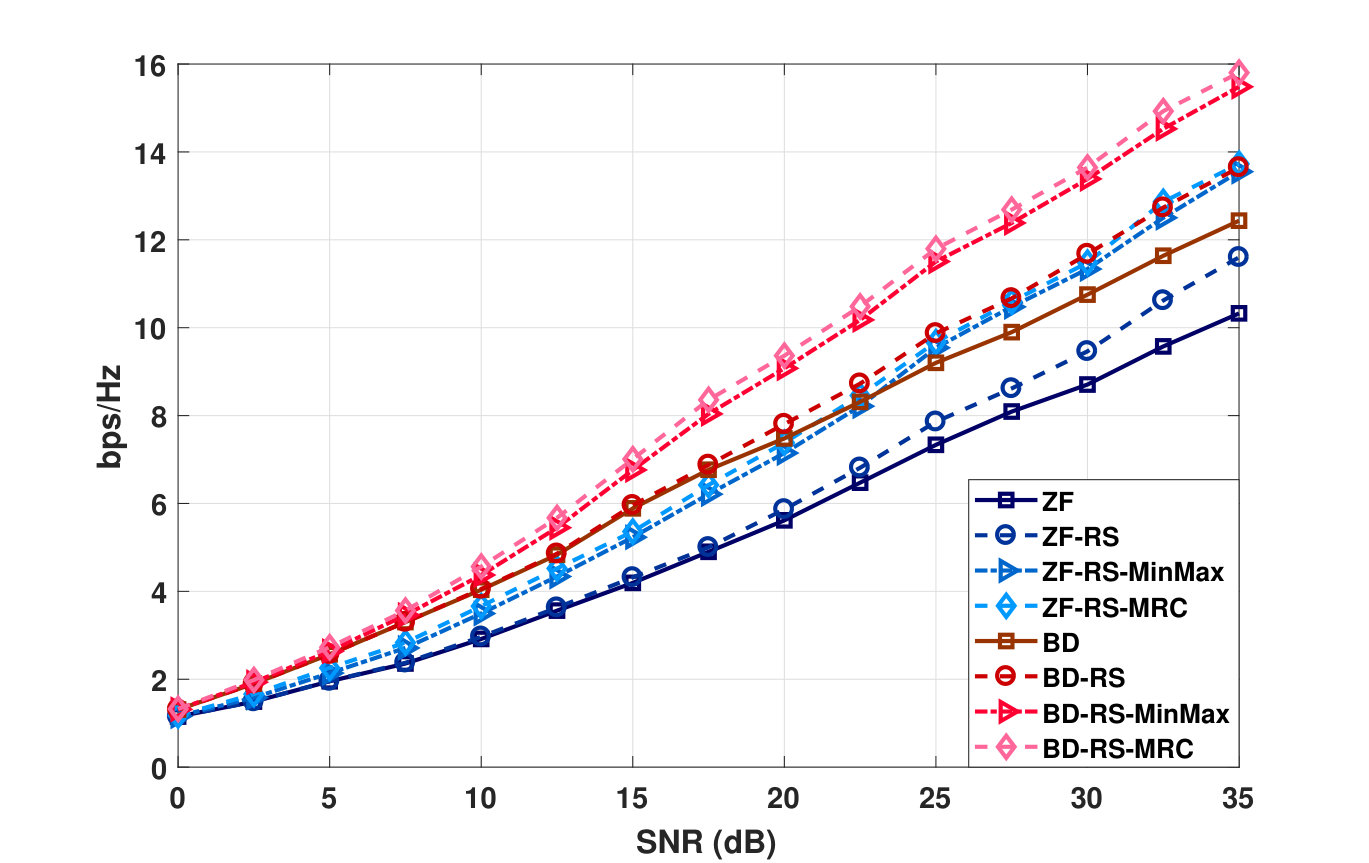 Figure 3
Peer Reviews
No public reviews on file for this paper yet. If you reviewed it on a platform where reviews are public (OpenReview, ICLR, NeurIPS, ICML), you can paste yours below so the community can read it here.
Videos
No videos yet. Explain this paper in a talk, walkthrough, or lecture? Add one.
Taxonomy
TopicsAdvanced MIMO Systems Optimization · Advanced Wireless Communication Techniques · Wireless Communication Networks Research
Study of Rate-Splitting Techniques with Block Diagonalization for Multiuser MIMO Systems
Andre R. Flores 1 and and Rodrigo C. de Lamare 1,2
1 Centre for Telecommunications Studies, Pontifical Catholic University of Rio de Janeiro, Brazil
2 Department of Electronic Engineering, University of York, United Kingdom
Emails: [email protected], [email protected] This work is partly funded by the CNPq and FAPERJ Brazilian agencies.
Abstract
In this work, we investigate Block Diagonalization (BD) techniques for multiuser multiple-antenna systems using rate-splitting (RS) multiple access. In RS multiple access the messages of the users are split into a common part and a private part in order to mitigate multiuser interference. We present the system model for a RS multiple access system operating in a broadcast channel scenario where the receivers are equipped with multiple antennas. We also develop linear precoders based on BD for the RS multiple access systems along with combining techniques, such as the min-max criterion and the maximum ratio combining criterion, to enhance the common rate. Closed-form expressions to describe the sum rate performance of the proposed scheme are also derived. The performance of the system is evaluated via simulations considering imperfect channel state information at the transmitter. The results show that the proposed schemes outperform conventional linear precoding methods.
Index Terms:
Multiple-antenna systems, ergodic sum-rate, rate-splitting, block diagonalization .
I Introduction
Multiple-Input Multiple-Output (MIMO) technology enhances the information and error rates performance of wireless communications systems by exploiting multipath propagation through multiple transmit and receive antennas [1]. Modern wireless communications systems deal with multiple users distributed geographically, making multiuser MIMO (MU-MIMO) the focus of many research works over the last decade. Among the key problems of MU-MIMO are the multi-user interference (MUI) and acquisition of channel state information at the transmitter (CSIT), which can decrease dramatically the overall system performance [2, 3]. In order to deal with MUI, many transmit processing techniques have been proposed in the literature [4, 5, 6, 7]. Most of these techniques rely on the quality of CSIT. Nevertheless, obtaining highly accurate CSIT in practice is still an open problem [8].
Rate-splitting (RS) multiple access schemes, proposed in [9], have been adopted in the last years as a promising approach to enhance the sum-rate performance of MIMO systems working under imperfect CSIT. Basically, RS splits the data before transmission into a common stream and private streams. The common stream should be decoded by all users. In contrast, the private streams are decoded only by its corresponding user. The main advantage of RS schemes is that they can adjust the content and the power of the common message in order to partially decode interference and partially treat interference as noise. RS has the ability to control how much interference should be decoded through the common message and how much should be treated as noise [10].
In the literature, RS has been used in conjunction with several linear precoding techniques [8, 11], working under perfect and imperfect CSIT assumption. RS with non-linear precoders has been studied in [12]. Other scenarios of interest, such as massive MIMO and MISO networks with RS have been considered in [13] and [14], respectively. RS has also been studied for robust transmission under bounded CSIT errors [15]. However, most of the works on RS consider only multiple-input single-output (MISO) scenarios and zero-forcing and minimum mean-squared error (MMSE) channel inversion-type precoders. MIMO scenarios have been studied in [16] from a DoF perspective. In [17] a MIMO RS architecture has been proposed for millimetre waves using a ZF precoding. However, the design of linear precoders for RS schemes has not considered Block Diagonalization (BD) type linear precoders, which have the potential to significantly enhance the sum rate performance of ZF and MMSE linear precoders.
In this paper, we generalize linearly precoded RS multiple access schemes to MU-MIMO systems where the users are equipped with multiple antennas. We present BD linear precoder for RS multiple access schemes in MU-MIMO systems. Furthermore, we propose techniques based on the min-max and the maximum ratio combining criteria to enhance the common rate at the receivers with multiple antennas. The performance of the proposed schemes is evaluated using the sum rate figure of merit in a Broadcast Channel (BC) under imperfect CSIT assumption.
The rest of this paper is organized as follows. Section II presents the mathematical model of the system and briefly reviews linear precoding techniques. Section III describes the proposed combining strategies to compute the common rate. Section IV present the analysis of the sum rate performance. Section V shows the simulation results. Finally, Section VI draws the conclusions of this work.
Matrices are denoted by boldface uppercase letters, whereas boldface lower case letters denote column vectors. Standard letters represent scalars. The supperscripts and are the transpose and Hermitian operators respectively. The cardinality operator is given by and represents a diagonal matrix with the entries of vector in the main diagonal. The trace of a matrix is denoted by . stands for the expectation operator, for the Euclidean norm and for the Hadamard product.
II System Model and Linear Precoding
We consider a MIMO BC with users, where user is equipped with antennas. The total number of receive antennas is then given by . The number of antennas at the transmitter is denoted by and remains in the range . The group of data streams intended for user form a set denoted by . Then, the th stream sent to the th user is expressed by . The total number of transmitted data streams is with . The model satisfies the transmit power constraint , where the vector represents the transmitted signal and denotes the total transmit power.
The system employs the RS scheme, which splits the messages into a common part and a private part [18, 9]. Since we focus on the sum rate analysis, it suffices to consider that only one stream is split. The common part is encoded into one common stream and the private parts into private streams. The receivers share a codebook since the common message has to be decoded by all the users with zero error probability. In contrast, each private stream is decoded only by its corresponding user. This means that each receiver must decode data streams, namely the common stream (decoded by all but intended to only one user) and a set of private streams (decoded by its respective user). This is possible if we apply successive interference cancellation (SIC) techniques [19, 20, 21, 22, 23, 24, 25, 26, 27, 28]. The common stream is first decoded using SIC and all private messages are considered as interference and treated as noise. At the end, the message sent via the private streams is decoded. The strength of RS is its ability to adjust the content and the power of the common message to control how much interference should be decoded by all users (through the common message) and how much interference is treated as noise.
The information sequences in the data streams are modulated and then the splitting process is performed over the message, resulting in a vector of data symbols . Specifically, the vector of the transmitted symbols is given by , where is used to designate the symbol of the common stream and contains the private streams of the th user. We assume uncorrelated symbols with zero mean and covariance matrix equal to . The transmitter processes the symbols using a linear precoder, which maps the symbols to the transmit antennas. A common precoder, is introduced in order to map the common symbols to the transmit antennas. Then, the precoder is given by , where is the precoder of the th user. Moreover, the vector denotes the th column of matrix . The transmitted signal is expressed by
[TABLE]
where is a general diagonal power loading matrix and the vector consists of the coefficients in the main diagonal of the matrix . The vector contains the power assigned to the symbols intended for the th user. The coefficient denotes the power distributed to the common message. In other words, the total transmit power is allocated partially to the common and private streams. The transmit power constraint is expressed by . Assuming normalized precoders, the transmit power constraint is reduced to
After the precoding operation, the data are sent to the receiver over the channel , where each coefficient in the channel matrix represents the link between the th transmit antenna and the th receive antenna. The matrix represents the estimate of the channel and the matrix takes into account the quality of the channel estimate by modelling the error produced by the estimation procedure. The channel of the th user is given by . It follows that . The vector represents the th row of matrix . For simplicity, we consider a flat fading channel which remains fixed during a transmission block.
The received signal obtained following the model in (1) is given by
[TABLE]
where is a block diagonal receive filter since there is no cooperation between users. Moreover, the matrix denotes the receive filter of the th user. The vector is the additive noise modelled as a circularly symmetric complex Gaussian random vector, i.e., . Without loss of generality, we will consider that the noise is uncorrelated and has the same statistical properties at each antenna, i.e., , , reducing the covariance matrix to . The SNR is defined as .
Given a channel state and considering an imperfect CSIT scenario, the received signal at the th terminal can be written as
[TABLE]
Let us define the matrix and the matrix . The mean power of the th received stream at user can be expressed as follows:
[TABLE]
When working under a perfect CSIT scenario, the term is reduced to zero and equations (3) and (4) remain the same with .
Suppose that we allocate no power to the common stream, i.e., we set . In such cases the model represents a conventional MU-MIMO system where no RS is performed. It turns out that the model established is a general framework and conventional MU-MIMO can be seen as a particular case where no power is assigned to the common stream.
In what follows we review the main concepts about the ZF and BD precoding techniques. We consider that the precoder of the private stream is defined as .
II-A Linear ZF Precoding
The ZF precoder [4] defined by
[TABLE]
where is a scaling factor introduced to satisfy the transmit power constraint that is defined as
[TABLE]
II-B Linear BD Precoding
BD precoding has been proposed in [5] and [29] for wireless communications systems, and further studied in [30, 31, 32] due its potential to increase the sum rate performance. This technique is based on Singular Value Decomposition (SVD). The precoding matrix for the th user can be written in two parts as follows:
[TABLE]
The filter is used to completely eliminate the MUI, whereas the filter allows parallel symbol detection. Let us form the matrix by excluding the channel matrix of the th user, i.e. . By using SVD we get . The matrix is a unitary matrix with dimensions . Let us suppose that the rank of is given by . The vector contains the last singular vectors and forms an orthogonal basis for the null space of . Therefore, we can set the first part of the precoder to
[TABLE]
The first precoder separates the MU-MIMO channel into parallel independent channels. Consider the effective channel matrix defined as \underaccent{\ddot}{\mathbf{H}}_{k}=\mathbf{H}_{k}\mathbf{P}^{a}_{k}. Performing a second SVD over the effective channel \underaccent{\ddot}{\mathbf{H}}_{k}, i.e. \underaccent{\ddot}{\mathbf{H}}_{k}=\underaccent{\ddot}{\mathbf{U}}_{k}\underaccent{\ddot}{\mathbf{\Psi}}_{k}\left[\underaccent{\ddot}{\mathbf{V}}_{k}^{\left(1\right)}\underaccent{\ddot}{\mathbf{V}}_{k}^{\left(0\right)}\right]^{H} we obtain the second precoder and the receive filter as given by
[TABLE]
The matrices and allow us to perform symbol-by-symbol detection.
III RS Common and Private Rates
The sum rate performance of a system employing an RS architecture and assuming Gaussian signalling consists of a common rate and a private rate , where denotes the private rate of the th user. The common rate represents the contribution of the common stream, whereas the private rate takes into account all private streams. In general for the instantaneous rate, we have .
In contrast to conventional RS in MISO systems, the th receiver in a MIMO system has a total of copies of the common symbol available. These copies can be used to enhance the common rate of the system. In this section, we propose combining strategies to improve the common rate performance and also derive an expression for the private rate.
III-A Min-Max Criterion
Let us consider (4) from the model described in section II. The th user receives streams each one containing a copy of the common symbol. When decoding the common stream, all private messages are considered additional noise. The common rate of the th stream intended for user can be computed by
[TABLE]
It is important to note that in equation (10) we consider an imperfect CSIT scenario, i.e., . The error in the channel estimate modelled by originates MUI, which limits the overall performance of the system. Moreover, (10) be used in a perfect CSIT scenario with reduced to .
When employing the Min-Max criterion, the th receiver picks the stream in that leads to the highest achievable common rate. This is possible because we assume perfect CSI available at the receiver. Mathematically, this can be expressed by
[TABLE]
Let us consider the vector , containing all the maximums rates from all users i.e. containing all the rates computed. The common stream should be decoded by all users. In order to satisfy this condition we set the common rate equal to the minimum rate stored in , which leads us to
[TABLE]
Finally, the receiver decodes and subtracts the common stream from the received signal using SIC in order to decode the private stream.
III-B Maximum Rate Combining
Another possibility to enhance the common rate by exploiting the multiple streams at the receiver is to use the maximum rate combining (MRC). Let us consider the received vector of (3) and define the combined signal , where the vector represents the combining filter used to maximize the SNR. Then, the average power of is
[TABLE]
where we introduce the row vector in order to simplify the notation. By evaluating the noise term we obtain
[TABLE]
Let us also define the common and private vectors and with . Substituting these terms in (13) we get
[TABLE]
From the last equation we obtain the SINR for the common message, which is given by
[TABLE]
Using the property of the dot product and simplifying terms, the SINR can be expressed as follows:
[TABLE]
where is the angle between the vectors and and is the angle between and .
The maximum value of the numerator is achieved when and is obtained when the vectors and are parallel. By setting the vectors and become parallel which lead us to the following SINR expression:
[TABLE]
Since all users should decode the common message, the transmitter set the common rate equal to the minimum rate found across all users i.e., the common rate is given by
[TABLE]
III-C Private Rate
After decoding the common stream, the system performs SIC to remove the common symbol from the received signal. Considering that the precoder reduces the interference to the noise level we have that the covariance matrix of the effective noise is given by
[TABLE]
Then, the achievable rate for the th user is [33]
[TABLE]
IV Rate Analysis
In this section, we carry out the sum rate analysis of the proposed strategies combined with the BD precoder.
IV-A RS Min-Max Criterion with the BD precoder
The BD precoder partially removes the MUI interference. However, residual interference remains due to the imperfect CSIT, which lead us to the following received vector:
[TABLE]
where the matrix \mathbf{\tilde{T}}^{\left(k,j\right)}=\underaccent{\ddot}{\mathbf{U}}_{k}^{H}\mathbf{\tilde{H}}_{k}\mathbf{\bar{V}}_{j}^{\left(0\right)}\underaccent{\ddot}{\mathbf{V}}_{j}^{\left(1\right)} represents the residual interference. Let us also consider the index . Evaluating the expected value of the received signal power we can obtain the common rate of the th stream intended for user , which is given by
[TABLE]
where
[TABLE]
In a perfect CSIT scenario, the precoder and the receiver remove completely the interference and the previous equation is reduced to
[TABLE]
IV-B RS MRC criterion with the BD precoder
Let us consider the th user and evaluate the vector with . We also define the column index . When the squared module of vector is reduced to:
[TABLE]
The BD precoder should reduce the vector to zero when due to the zero inter-user interference restriction imposed. However, the imperfect CSIT assumption originates residual MUI, which leads us to
[TABLE]
Substituting (26) and (27) in (18) we get the SINR expression, which is given by
[TABLE]
where
[TABLE]
Under perfect CSIT assumption the MUI interference, which is given by \underaccent{\ddot}{\mathbf{\tilde{H}}}_{k}\underaccent{\ddot}{\mathbf{v}}^{\left(k\right)\left(1\right)}_{m} and with , is eliminated and the expression in (28) is reduced to
[TABLE]
IV-C RS BD private streams sum rate
Let us consider the matrix \mathbf{\Phi_{k}}=\underaccent{\ddot}{\mathbf{\Psi}}_{k}+\mathbf{\tilde{F}}_{k}. After the SIC process we get the equations for the private rate
[TABLE]
Under perfect CSIT assumption we have
[TABLE]
V Simulations
In this section we assess the performance of the proposed MIMO RS schemes employing ZF and BD precoders. A total of 12 transmit antennas was used at the BS for all simulations. We also consider 6 users where each is equipped with 2 receive antennas. The inputs follow a Gaussian distribution with zero mean and variance equal to one. We consider additive white Gaussian noise with the same statistics for all users, such that all users experience the same SNR. The ESR was computed averaging 100 independent channel realizations. For each channel realization we obtained the ASR employing 100 error matrices. The common precoder was set to where we use a singular value decomposition of the channel matrix . The power allocated to the common precoder was found through exhaustive search, where we keep the proportion of power allocated to the private precoders fixed. Conventional RS, which uses the minimum common rate available, was also considered. We termed this strategy as RS in the simulation results.
Fig. 1 summarizes the sum rate performance of the ZF precoder and the BD precoder, both operating in a MU-MIMO system. For this simulation we consider a fixed error variance in the channel equal to 0.1. The proposed techniques achieve a better results because they exploit the multiple antennas at the receiver, enhancing the common stream. The BD precoder allows not only the enhancement of the common stream but also of the private stream obtaining a better performance in terms of sum rate. The best performance is achieved by the BD-RS-MRC due to the use and combination of all available signals at the receive antennas. The curves obtained exhibit saturation because of the imperfect CSIT assumption, which originates MUI that scales with the SNR.
For the second scenario we evaluate the performance of the proposed schemes operating at different noise levels as depicted in Fig. 2 The SNR was set to 25 dB. The results show that the RS strategies increase the robustness of the system across all error variances. The proposed MIMO BD-RS-MRC strategy achieves the highest sum-rate, which is up to 35% higher when compared to the conventional BD precoder.
For the last example, we consider that the quality of the channel estimate improves with the SNR, i.e. . The parameters and were set to 0.94 and 0.2 respectively. Fig. 3 shows that the proposed schemes are more robust than conventional precoding schemes. MIMO BD-RS-MRC shows a sum rate improvement of 33,33% when compared to conventional BD precoding, whereas the MIMO ZF-RS-MRC achieves a sum rate 35% higher than the conventional ZF-strategy.
VI Conclusion
In this paper, we have proposed MIMO RS strategies combined with the BD precoder and two criteria to enhance the common rate by taking advantage of the multiple antennas at the receivers. In general, all BD precoder schemes outperform their ZF precoder counterpart in terms of sum rate. Moreover, the BD-RS-MRC scheme achieves the best performance among all the proposed techniques, attaining an improvement of more than 30% when compared to conventional techniques. Simulation results have also shown that the BD-RS scheme is more robust when compared to ZF techniques under imperfect CSIT scenarios.
The reference list from the paper itself. Each links out to its DOI / PubMed record.
- 1[1] E. Telatar, “Capacity of multi-antenna Gaussian channels,” European Transactions on Telecommunications , vol. 10, no. 6, pp. 585–596, Nov. 1999.
- 2[2] L. Lu, G. Y. Li, A. L. Swinderlust, A. Ashikhmin, and R. Zhang, “An overview of massive MIMO: Benefits and challenges,” IEEE Journal of Selected Topics in Signal Processing , 2014.
- 3[3] R. C. de Lamare, “Massive mimo systems: Signal processing challenges and future trends,” URSI Radio Science Bulletin , vol. 2013, no. 347, pp. 8–20, Dec 2013.
- 4[4] M. Joham, W. Utschick, and J. A. Nossek, “Linear transmit processing in MIMO communications systems,” IEEE Transactions on Signal Processing , vol. 53, no. 8, pp. 2700–2712, Aug 2005.
- 5[5] Q. H. Spencer, A. L. Swindlehurst, and M. Haardt, “Zero-forcing methods for downlink spatial multiplexing in multiuser mimo channels,” IEEE Transactions on Signal Processing , vol. 52, no. 2, pp. 461–471, Jan. 2004.
- 6[6] K. Zu and R. C. de Lamare, “Low-complexity lattice reduction-aided regularized block diagonalization for mu-mimo systems,” IEEE Communications Letters , vol. 16, no. 6, pp. 925–928, June 2012.
- 7[7] W. Zhang, H. Ren, C. Pan, M. Chen, R. C. de Lamare, B. Du, and J. Dai, “Large-scale antenna systems with ul/dl hardware mismatch: Achievable rates analysis and calibration,” IEEE Transactions on Communications , vol. 63, no. 4, pp. 1216–1229, April 2015.
- 8[8] H. Joudeh and B. Clerckx, “Sum-rate maximization for linearly precoded downlink multiuser MISO systems with partial CSIT: A rate-splitting approach,” IEEE Transactions on Communications , vol. 64, no. 11, pp. 4847–4861, 2016.