A Note on Graphs of Dichromatic Number 2
Raphael Steiner

TL;DR
This paper explores the conjecture that all planar directed graphs are 2-colorable, demonstrating its equivalence to a broader statement involving oriented $K_5$-minor-free graphs.
Contribution
It establishes the equivalence between the planar digraph 2-colorability conjecture and a more general class of graphs, expanding the scope of the original problem.
Findings
Equivalence between planar digraph 2-colorability and oriented $K_5$-minor-free graphs.
Provides a new perspective on the conjecture by linking it to a broader class of graphs.
Advances understanding of graph coloring in directed graphs and minor-closed classes.
Abstract
Neumann-Lara and \v{S}krekovski conjectured that every planar digraph is -colourable. We show that this conjecture is equivalent to the more general statement that all oriented -minor-free graphs are -colourable.
Click any figure to enlarge with its caption.
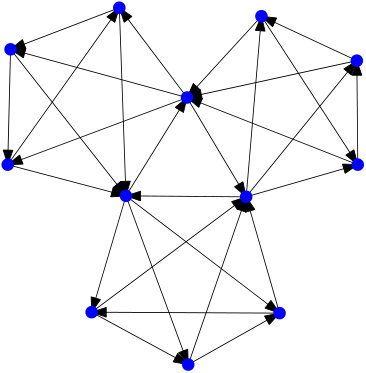 Figure 1
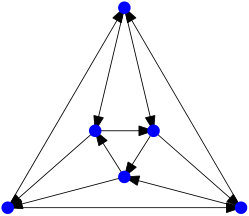 Figure 2
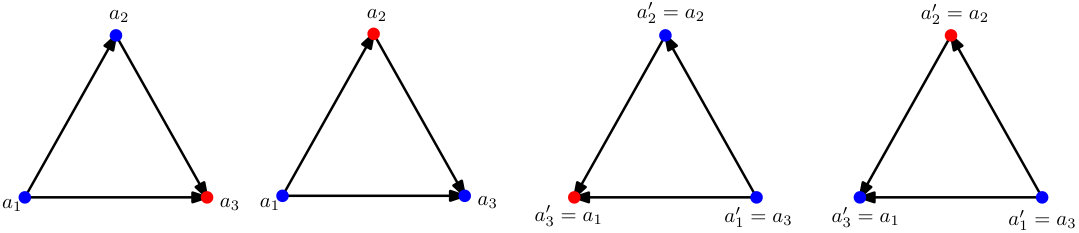 Figure 3
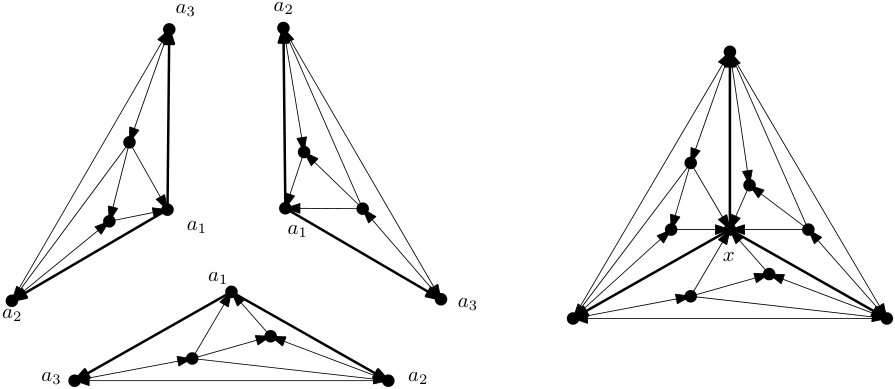 Figure 4
Peer Reviews
No public reviews on file for this paper yet. If you reviewed it on a platform where reviews are public (OpenReview, ICLR, NeurIPS, ICML), you can paste yours below so the community can read it here.
Videos
No videos yet. Explain this paper in a talk, walkthrough, or lecture? Add one.
A Note on Graphs of Dichromatic Number
Raphael Steiner
Institut für Mathematik
TU Berlin
Abstract
Neumann-Lara and S̆krekovski conjectured that every planar digraph is -colourable. We show that this conjecture is equivalent to the more general statement that all oriented -minor-free graphs are -colourable.
1 Introduction
Digraphs and graphs considered here are loopless, and without parallel or anti-parallel arcs. A directed edge starting in and ending in is denoted by , is called its tail while is its head. In a digraph , a vertex set is called acyclic if the induced subdigraph is acyclic. An acyclic colouring of with colours is a mapping such hat is acyclic for all . The dichromatic number is defined as the minimal for which such a colouring exists. For an undirected graph , the dichromatic number is defined as the maximum dichromatic number an orientation of can have.
This notion has been introduced in 1982 by Neumann-Lara [NL82], was rediscovered by Mohar [Moh03], and since then has received further attention, see [AH15, MW16, ACH*+*16, HM17, LM17, BHKL18, HLTW19] for some recent results.
In analogy to the famous Four-Colour-Theorem, the following intriguing conjecture was proposed by Neumann-Lara [NL85] and independently by S̆krekovski [BFJ*+*04].
Conjecture 1**.**
If is a planar graph, then .
The strongest partial result obtained so far is due to Li and Mohar who showed the following:
Theorem 1** ([LM17]).**
Every planar digraph without directed triangles admits an acyclic -colouring.
The purpose of this note is to show the following.
Theorem 2**.**
The following statements are equivalent:
- •
Every planar graph has .
- •
Every -minor-free graph fulfils . Moreover, any orientation of admits an acyclic -colouring without monochromatic triangles.
This strengthening is similar to the situation for undirected graph colourings, where it is known that all -minor-free graphs are -colourable [Wag37].
2 -Colourings of Planar Digraphs
In the following, we will use the term planar triangulation when we mean a maximal planar graph on at least three vertices. It is well-known that the latter (up to the choice of the outer face and reflections) admit combinatorially unique crossing-free embeddings in the plane or on the sphere, in which every face is bounded by a triangle (from now on called facial triangles). A frequent tool in our proof will be the following Lemma, which has already been used in [LM17].
Lemma 3** ([LM17]).**
Let and be digraphs which intersect in a tournament. Suppose that , are acyclic colourings such that . Then the common extension of and to defines an acyclic -colouring of .
In this section we prepare the proof of Theorem 2 with some strengthend but equivalent formulations of Neumann-Lara’s Conjecture.
Proposition 1**.**
The following statements are equivalent:
- (i)
Neumann-Lara’s Conjecture, i.e., every planar digraph has an acyclic -colouring. 2. (ii)
Every oriented planar triangulation admits an acyclic -colouring without monochromatic facial triangles. 3. (iii)
For any planar triangulation , any facial triangle in , and any non-monochromatic pre-colouring , every orientation of admits an acyclic -colouring without monochromatic facial triangles such that . 4. (iv)
For any planar triangulation , any triangle in , and any non-monochromatic pre-colouring , every orientation of admits an acyclic -colouring without monochromatic triangles such that .
Proof.
: Suppose that every planar digraph is -colourable and let be an arbitrary orientation of a planar triangulation . Looking at the orientation of the octahedron graph depicted in Figure 1, it is easily observed that in any acyclic -colouring the triangle bounding the outer face cannot be monochromatic. Now consider a crossing-free spherical embedding of . For every facial triangle in this embedding whose orientation is transitive, we take a copy of and glue this copy into the face in such a way that the outer three edges of are identified with the three edges of the facial triangle (to make the orientations of the identified edges compatible, it might be necessary to reflect and rotate the embedding of shown in Figure 1). This creates a crossing-free embedding of a planar oriented triangulation . By assumption, admits an acyclic -colouring. This colouring restricted to the vertices of the subdigraph clearly is still valid. Furthermore, no triangle in can be monochromatic: This follows by definition if the triangle forms a directed cycle. If the orientation is transitive, by definition of , a monochromatic colouring would contradict the fact that has no acyclic -colouring with the outer three vertices being coloured the same.
:
Suppose that holds. Let be an orientation of a planar triangulation and let be the vertices of a facial triangle of , equipped with a non-monochromatic pre-colouring .
Case 1: is not directed in .
By relabelling, we may assume the transitive orientation . Now consider a plane embedding of in which forms the bounding triangle of the outer face and where appear in clockwise order. We now define a new oriented planar triangulation as follows: We consider the embedding and orientation of the as shown in Figure 2, in which the outer face has a clockwise direction and the central vertex is a source. Into each of the three inner faces of this embedding, we can now glue a copy of with the described embedding in such a way that all orientations of identified edges agree. The vertex from each copy now is identified with the central vertex, which we call . This oriented planar triangulation according to assumption admits an acyclic -colouring without monochromatic facial triangles. By relabelling the colours, we may assume that . Because the outer triangle is not monochromatic, there have to be edges and on the outer triangle such that . To both we have a corresponding copy of , and the -colourings of which induces on these copies are still valid acyclic colourings. Furthermore, there are no monochromatic facial triangles in with respect to : Every bounded facial triangle of in the corresponding copy also forms a bounded facial triangle of , while the outer triangles of the copies contain respectively and are thus not monochromatic under respectively . From the way we glued the three copies of we conclude that and .
Now consider the oriented planar triangulation
\vec{\reflectbox{T}}
which is obtained from by reversing the orientations of all edges. Let us rename the vertices of according to . We have (a_{1}^{\prime},a_{2}^{\prime}),(a_{1}^{\prime},a_{3}^{\prime}),(a_{2}^{\prime},a_{3}^{\prime})\in E(\reflectbox{\vec{\reflectbox{}}}). We can therefore apply the same arguments as above to
\vec{\reflectbox{T}}
with the transitive labeling of the triangle . Hence, we obtain acyclic -colourings c_{1}^{\prime},c_{2}^{\prime}:V(\reflectbox{\vec{\reflectbox{}}})\rightarrow\{1,2\} of
\vec{\reflectbox{T}}
without monochromatic facial triangles such that and .
Finally, because the acyclic -colourings of and
\vec{\reflectbox{T}}
coincide, we conclude that all form acyclic -colourings of without monochromatic facial triangles. It is easy to see that the colourings together extend all possible non-monochromatic pre-colourings of the triangle with exactly one vertex of colour (see the illustration in Figure 2). Hence, after flipping all colours from to and to we have found extending colourings for all possible pre-colourings without monochromatic facial triangles, as desired.
Case 2: is directed in .
After relabelling (and possibly exchanging the colours and ), we may suppose that and . Consider the orientation obtained from by reversing the edge . By the first case, we know that admits an acyclic -colouring without monochromatic facial triangles which extends . Because the endpoints of receive different colours, it follows directly that also defines an acyclic -colouring of with the required properties, and the claim follows also in this case.
:
We prove the statement by induction on the number of vertices. In the base case, where is an oriented triangle, the statement clearly holds true. Now let , and assume that the statement holds for all triangulations with less than vertices. Let be an arbitrary orientation of some planar triangulation with vertices. If is -connected, then the only triangles in are the facial triangles and therefore the claim follows from . Therefore we may suppose that is not -connected, i.e., there exists a separating triangle in . Consider some plane crossing-free embedding of . Here, separates the vertices in its interior () from those in its exterior (). Let and . Both form oriented planar triangulations on less than vertices. To prove that satisfies the inductive claim, let be a given triangle in equipped with a non-monochromatic pre-colouring . We must either have or . Assume that we are in the first case, the second case is completely analogous. Then, by the induction hypothesis, there exists an acyclic colouring without monochromatic triangles such that . The restriction of to now defines a non-monochromatic pre-colouring for , and it follows from the induction hypothesis that there exists an acyclic -colouring of without monochromatic triangles which agrees with on . By Lemma 3, the common extension of to now defines an acyclic -colouring of , extending the given pre-colouring of and without monochromatic triangles. This verifies the inductive claim.
:
This follows since every planar graph is a subgraph of a planar triangulation. ∎* * Because any edge in a planar triangulation lies on a triangle, we directly obtain the following.
Corollary 4**.**
Under the assumption of Neumann-Lara’s Conjecture, every orientation of a planar graph admits an acyclic -colouring without monochromatic triangles which can be chosen to extend any given pre-colouring of an edge or any non-monochromatic pre-colouring of a triangle.
3 -Minor-Free Graphs
Given a pair of undirected graphs such that forms a clique of size in both and , and such that , the graph with and is called the proper -sum of and . A graph obtained from by deleting some (possibly all or none) of the edges in is said to be an -sum of and . The central tool in proving Theorem 2 is the following classical result due to Wagner. By we denote the so-called Wagner graph, that is the graph obtained from by joining any two diagonally opposite vertices by an edge.
Theorem 5** ([Wag37]).**
A simple graph is -minor-free if and only if it can be obtained from planar graphs and copies of by means of repeated -sums with .
is triangle-free and admits an acyclic -colouring for any orientation. Moreover, it can be easily checked that such a colouring can be chosen to extend any given pre-colouring of two adjacent vertices. We are now in the position to prove Theorem 2.
Proof of Theorem 2..
Assume that Neumann-Lara’s Conjecture holds true. We have to prove that every oriented -minor-free graph admits an acyclic -colouring without monochromatic triangles. In fact, we prove the following slightly stronger statement:
*Every orientation of a -minor-free graph admits an acyclic -colouring without monochromatic triangles which can be chosen to extend any given pre-colouring of an edge or any non-monochromatic pre-colouring of a triangle. *
Assume towards a contradiction that there exists a -minor-free graph which does not satisfy this claim and choose minimal with respect to the number of vertices, and among all such graphs maximal with respect to the number of edges.
By Corollary 4, we know that the claim is fulfilled by all planar graphs and by , and so it follows from Theorem 5 that is the -sum of two -minor-free graphs with fewer vertices, where . By the minimality assumption, we therefore know that satisfy the claim. Clearly, every super-graph of does not satisfy the assertion as well. Therefore, by the assumed edge-maximality, must in fact be the proper -sum of and .
Now choose some orientation of for which the above claim fails. Denote by the induced orientations on the subgraphs .
Let be an arbitrary edge with a given pre-colouring . W.l.o.g. assume that . Let be an acyclic -colouring of without monochromatic triangles which extends . The clique in is either empty, a single vertex, and edge or a triangle. In each case, the restriction (if non-empty) can be considered as a pre-colouring of a vertex, an edge or a triangle in with two colours. In the case where is a triangle, by the choice of , we furthermore know that the pre-colouring is not monochromatic. We therefore conclude that in any case, there is an acyclic -colouring of without monochromatic triangles which extends . Therefore and agree on and it follows from Lemma 3 that the common extension of to defines an acyclic -colouring of which extends . Because every triangle of is fully contained in or , we also have that there are no monochromatic triangles under .
Similarly, for any triangle in equipped with a non-monochromatic pre-colouring , we may assume w.l.o.g. that is fully contained in . Again, we find a pair of acyclic -colourings of such that extends , coincides with on the clique , and there are no monochromatic triangles in under for . Finally, the common extension of to by Lemma 3 defines an acyclic -colouring of with the desired properties.
From this we conclude that admits an extending acyclic -colouring without monochromatic triangles for any pre-colouring of an edge and for any non-monochromatic pre-colouring of a triangle. This is a contradiction to our choice of . This shows that the initial assumption was false and concludes the proof of the Theorem. ∎
4 Conclusion
A natural question that comes out from the discussion in this paper is the following.
Question 1**.**
What is the largest minor-closed class of undirected graphs with dichromatic number at most ?
While , it is known that . Therefore, is a subclass of the -minor-free graphs. However, seems to be a lot smaller than this class. In fact, there are examples of -minor-free graphs with dichromatic number greater than , see Figure 3 for a simple example of such a graph.
The reference list from the paper itself. Each links out to its DOI / PubMed record.
- 1[ACH + 16] P. Aboulker, N. Cohen, F. Havet, W. Lochet, P. Moura, and S. Thomassé. Subdivisions in digraphs of large out-degree or large dichromatic number. 2016. ar Xiv preprint, ar Xiv:1610.00876.
- 2[AH 15] S. D. Andres and W. Hochstättler. Perfect digraphs. Journal of Graph Theory , 79(1):21–29, 2015.
- 3[BFJ + 04] D. Bokal, G. Fijavz, M. Juvan, P. M. Kayll, and B. Mohar. The circular chromatic number of a digraph. Journal of Graph Theory , 46(3):227–240, 2004.
- 4[BHKL 18] J. Bensmail, A. Harutyunyan, and N. Khang Le. List coloring digraphs. Journal of Graph Theory , 87(4):492–508, 2018.
- 5[HLTW 19] A. Harutyunyan, T.-N. Le, S. Thomassé, and H. Wu. Coloring tournaments: From local to global. Journal of Combinatorial Theory, Series B , 2019.
- 6[HM 17] A. Harutyunyan and B. Mohar. Planar digraphs of digirth five are 2-colorable. Journal of Graph Theory , 84(4):408–427, 2017.
- 7[LM 17] Z. Li and B. Mohar. Planar digraphs of digirth four are 2-colorable. SIAM J. Discrete Math. , 31:2201–2205, 2017.
- 8[Moh 03] B. Mohar. Circular colourings of edge-weighted graphs. Journal of Graph Theory , 43:107–116, 2003.