5d Superconformal Field Theories and Graphs
Fabio Apruzzi, Craig Lawrie, Ling Lin, Sakura Schafer-Nameki, Yi-Nan, Wang

TL;DR
This paper introduces a graph-based method called Combined Fiber Diagrams to classify and analyze 5d superconformal field theories derived from 6d theories, revealing their flavor symmetries and BPS states.
Contribution
It develops a novel graph-theoretic framework to characterize 5d SCFTs and their flows from 6d theories, including predictions of unknown flavor symmetry enhancements.
Findings
Complete classification of 5d SCFTs descending from specific 6d theories.
Graph encoding of flavor symmetries and BPS states.
Predictions of new flavor symmetry enhancements.
Abstract
We propose a graph-theoretic description to determine and characterize 5d superconformal field theories (SCFTs) that arise as circle reductions of 6d SCFTs. Each 5d SCFT is captured by a graph, called a Combined Fiber Diagram (CFD). Transitions between CFDs encode mass deformations that trigger flows between SCFTs. In this way, the complete set of descendants of a given 6d theory are obtained from a single marginal CFD. The graphs encode key physical information like the superconformal flavor symmetry and BPS states. As an illustration, we ascertain the aforementioned data associated to all the 5d SCFTs descending from 6d minimal and conformal matter for any . This includes predictions for thus far unknown flavor symmetry enhancements.
Click any figure to enlarge with its caption.
 Figure 1
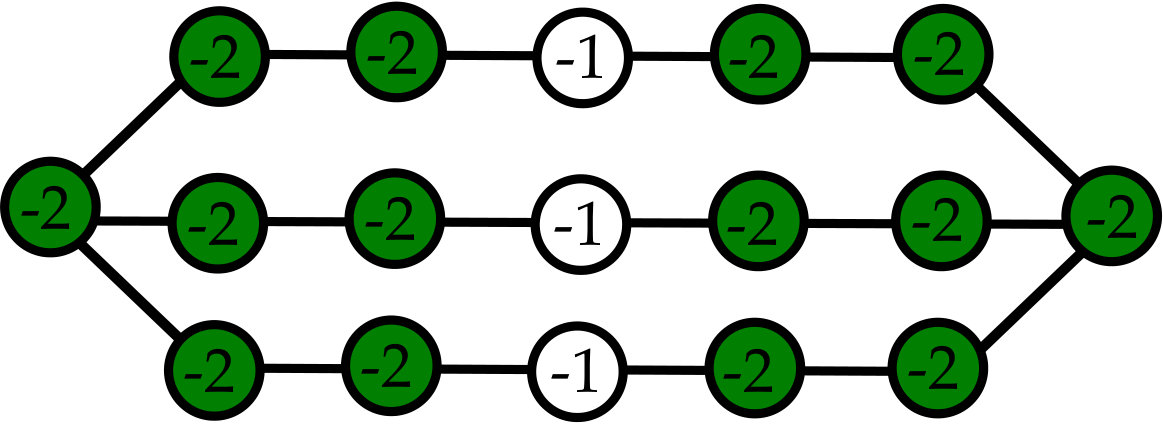 Figure 2
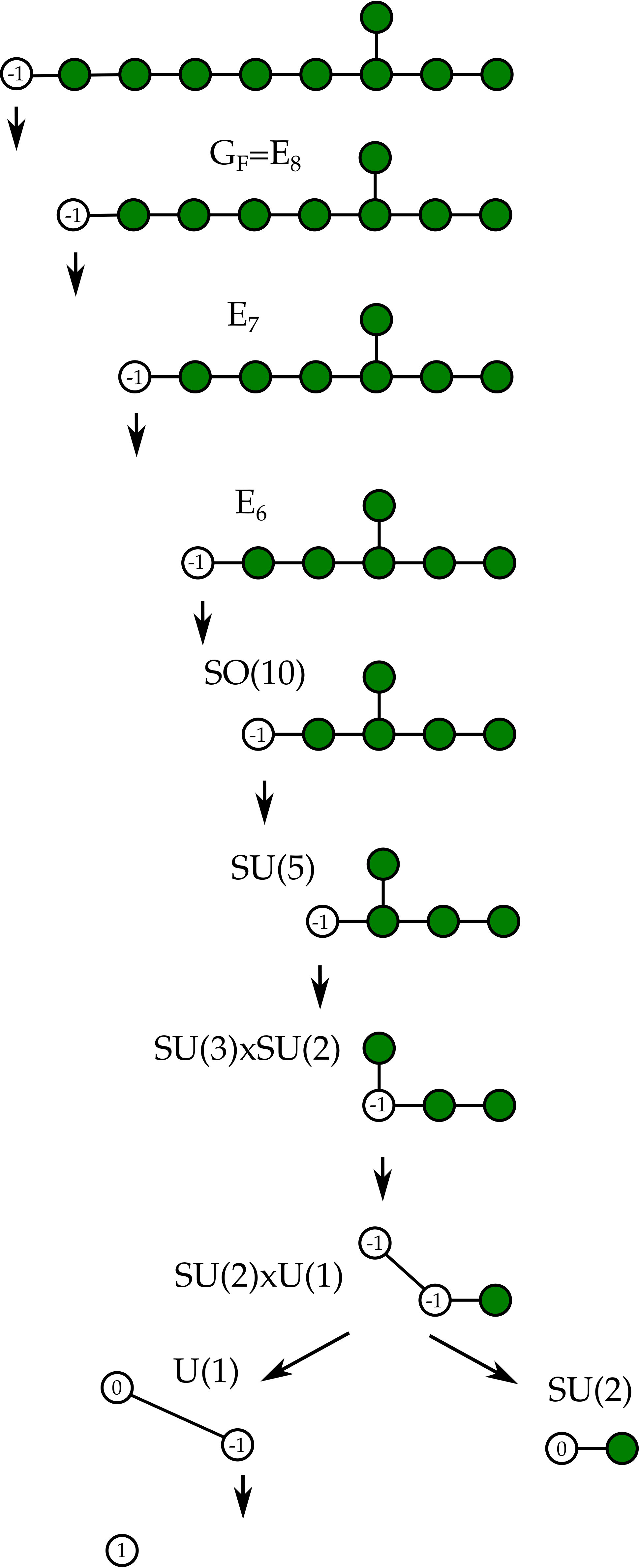 Figure 3
 Figure 4
 Figure 5
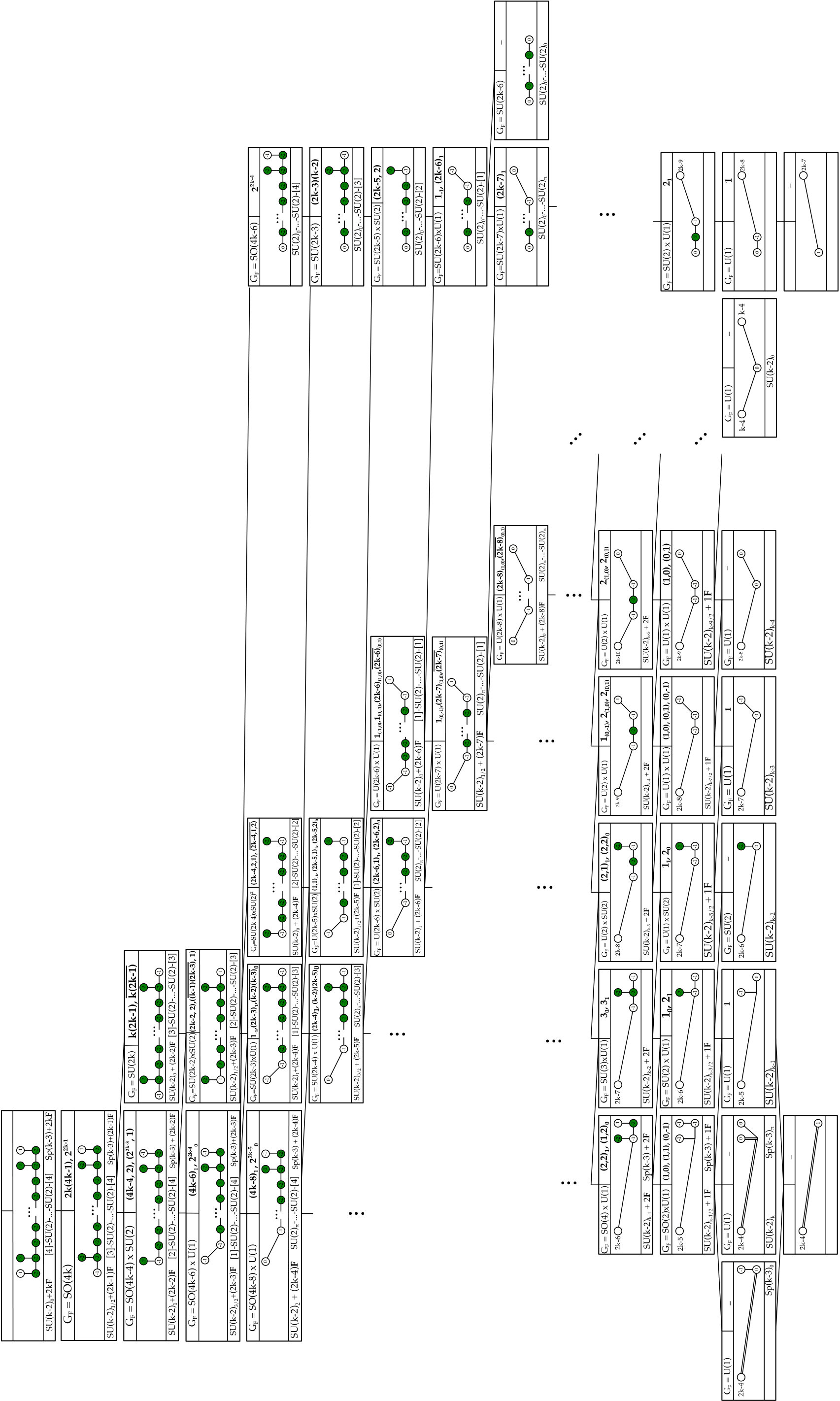 Figure 6
Peer Reviews
No public reviews on file for this paper yet. If you reviewed it on a platform where reviews are public (OpenReview, ICLR, NeurIPS, ICML), you can paste yours below so the community can read it here.
Videos
No videos yet. Explain this paper in a talk, walkthrough, or lecture? Add one.
5d Superconformal Field Theories and Graphs
Fabio Apruzzi
Mathematical Institute, University of Oxford, Woodstock Road, Oxford, OX2 6GG, United Kingdom
Craig Lawrie
Department of Physics and Astronomy, University of Pennsylvania, Philadelphia, PA 19104, USA
Ling Lin
Department of Physics and Astronomy, University of Pennsylvania, Philadelphia, PA 19104, USA
Sakura Schäfer-Nameki
Mathematical Institute, University of Oxford, Woodstock Road, Oxford, OX2 6GG, United Kingdom
Yi-Nan Wang
Mathematical Institute, University of Oxford, Woodstock Road, Oxford, OX2 6GG, United Kingdom
Abstract
We propose a graph-theoretic description to determine and characterize 5d superconformal field theories (SCFTs) that arise as circle reductions of 6d SCFTs. Each 5d SCFT is captured by a graph, called a Combined Fiber Diagram (CFD). Transitions between CFDs encode mass deformations that trigger flows between SCFTs. In this way, the complete set of descendants of a given 6d theory is obtained from a single, marginal, CFD. The graphs encode key physical information like the superconformal flavor symmetry and BPS states. As we demonstrate for the 5d descendants of 6d minimal and conformal matter (for any ), our proposal not only reproduces known results, but also makes predictions in particular for thus far unknown flavor symmetry enhancements.
Superconformal Field Theories, M-Theory on Calabi–Yau
I Introduction
5d SCFTs are intrinsically non-perturbative quantum field theories. At low energies these can have effective descriptions in terms of weakly coupled gauge theories, which allows one to probe certain aspects of the SCFTs. However, due to their strongly coupled nature, a more complete understanding of 5d SCFTs presents a challenge that necessitates methods beyond those of ordinary field theory, thus motivating a string-theoretic approach. This crucially incorporates an interpolation between the infrared (IR) and ultraviolet (UV) fixed point. 5d theories have been engineered in string theory by -fivebrane webs Aharony et al. (1998), or M-theory on non-compact Calabi–Yau threefolds with canonical singularities Morrison and Seiberg (1997); Intriligator et al. (1997). In the latter approach, there is a particularly elegant correspondence between geometry and physics, whereby the resolution of the singularity may be identified with an renormalization group (RG)-flow from the UV fixed point to an effective IR description.
The case we wish to make here is that string theory does not only provide examples, but lays out a framework to map out the full landscape of 5d SCFTs, including a characterization of their most salient properties. For example, singularities in the M-theory realization, where complex surfaces have collapsed to points, can correspond to SCFTs. In the smooth phase, when these surfaces have finite volume, their geometry determines the low-energy gauge theory descriptions for the SCFT, if one exists. Complex curves inside these surfaces determine the spectrum of matter hypermultiplets charged under the gauge algebra, as well as additional non-perturbative states. As one approaches the UV fixed point by collapsing the surfaces to a point, these states become part of the BPS spectrum of the SCFT.
Recent progress in identifying M-theory geometries related to 5d SCFTs has been made in Jefferson et al. (2017); Del Zotto et al. (2017); Jefferson et al. (2018); Apruzzi et al. (2019a); Bhardwaj and Jefferson (2018a, b); Closset et al. (2019). The approach in this letter is fundamentally different, as it intrinsically captures some of the strongly coupled physics and gives a surprisingly efficient way of characterizing and mapping out the landscape of 5d SCFTs.
We define a graph, associated to each 5d SCFT, the combined fiber diagram (CFD), which succinctly encodes the key properties of the geometry. Each such graph corresponds to an equivalence class of surface configurations inside a Calabi–Yau threefold, whose singular limit defines the same SCFT. This framework also captures UV dualities amongst distinct gauge theories. The vertices of each graph correspond to curves, which are contained within the surfaces, and give rise to BPS states in the UV.
Flows between two UV fixed points are encoded in transitions between CFDs. These are reflected in geometric transitions that modify the curve configuration on the surfaces, such that their collapse generates a different singularity. The graph theoretic description gives an efficient method to map out all SCFTs that can be obtained by mass deformations starting from a given CFD (and thus SCFT).
An intrinsically strongly coupled characteristic of a 5d SCFT is its flavor symmetry, which generally is larger than that of its low-energy description Seiberg (1996). Determining this enhanced flavor symmetry is notoriously difficult. While techniques such as the superconformal index require an effective gauge theory description to extract these symmetries Kim et al. (2012), these approaches are not applicable for examples without such an IR description. On the other hand, the CFD manifestly encodes the Dynkin diagram for the superconformal flavor symmetry in terms of a marked subgraph. The CFD-transitions correspond to precise rules how vertices are removed and marked or unmarked. Finally, by using the graph structure of the CFD, we can compute the representations of BPS states under the flavor symmetry.
Our approach is rooted in the duality between M- and F-theory on a singular, elliptically fibered Calabi–Yau threefold, . F-theory on determines a 6d SCFT, with flavor symmetry , whose -reduction with holonomies in the 6d flavor symmetry yields 5d SCFTs realized as M-theory on different geometric limits of . In these limits, we can manifestly track the unbroken subgroup of that constitutes the flavor symmetry Apruzzi et al. (2019a) and the BPS spectrum Tian and Wang (2018) in 5d. We develop the geometric foundation of this approach in the companion paper Apruzzi et al. (2019b). In a second companion paper Apruzzi et al. (2019c), the focus is the gauge theory description on the Coulomb branch of 5d SCFTs, using the methods developed in Hayashi et al. (2014), which complements the CFD approach in cases with an effective gauge theory description.
II SCFTs from Graphs
A collection of compact complex surfaces inside a Calabi–Yau threefold defines, under suitable assumptions Intriligator et al. (1997); Xie and Yau (2017); Jefferson et al. (2017, 2018), a 5d SCFT. While a precise knowledge of the surface geometries is required to determine an IR description, the SCFT limit is insensitive to many of the details of this geometry. It is this reduced set of properties, upon which the SCFT depends, that we encode in the Combined Fiber Diagram (CFD): a graph whose vertices are complex curves, , inside the collection of surfaces, , and the number of edges connecting two vertices and is given by the intersection number . The integer is the rank of the 5d SCFT. Each vertex has labels , the self-intersection number of inside and the genus of (if the label is ommitted). A detailed derivation of the CFDs from the geometry is subject of the companion paper Apruzzi et al. (2019b).
Vertices with will be marked (colored) and define a subgraph, which corresponds to the Dynkin diagram of the non-abelian part of the flavor group of the 5d SCFT, .111We discuss here only the simply-laced case and defer the more general case to Apruzzi et al. (2019b). The rank of is known, as discussed anon, and from this one can determine the abelian factors in . Vertices with encode possible mass deformations.
Given a CFD a new, descendant CFD, and thereby 5d SCFT, can be constructed by a (CFD-)transition: remove a vertex with and update the CFD data as follows:
[TABLE]
for . A marked vertex for which changes becomes unmarked after the transition. Geometrically, a transition is the collapse of a curve in . In the SCFT, this corresponds to a mass deformation and subsequent RG-flow to the descendant SCFT. Such a transition is not reversible, which reflects the nature of RG-flows, where one cannot flow “backwards” without knowing the correct decoupled degrees of freedom.
There are natural candidate starting points to construct descendant SCFTs, the so-called marginal theories, whose UV fixed points are 6d SCFTs. We define associated marginal or top CFDs, which have marked vertices forming affine Dynkin diagrams. Such theories and their CFDs provide the starting point, from which our transition rules (1) can generate all descendant CFDs/SCFTs.
For marginal theories, the rank of the flavor symmetry is . With each transition, i.e. mass deformation, the flavor rank drops by one, thus the superconformal flavor symmetry algebra is fully determined.
In the present letter, we consider marginal theories originating from 6d conformal matter (CM) theories Del Zotto et al. (2015). The marginal CFD contains the affine Dynkin diagram of as a marked subgraph, in addition to unmarked vertices with .
III Rank One Theories
In the following, we illustrate how CFD-transitions realize RG-flows between all the Seiberg and Morrison-Seiberg theories Seiberg (1996); Morrison and Seiberg (1997). This results in an alternative derivation of all rank one 5d SCFTs. The marginal theory is associated to the rank one E-string theory and has CFD, where the green nodes are the marked vertices,
[TABLE]
Applying a CFD-transition to this marginal CFD describes the theory that is related by mass deformation and RG-flow. The first transition yields
[TABLE]
which is a CFD for a 5d SCFT with flavor symmetry. This is in fact the UV fixed point of the theory with fundamental flavors. The complete tree of descendant CFDs is comprised of ten rank one 5d SCFTs with , as shown in figure 1. This is in agreement with the flavor enhancement in Seiberg (1996); Morrison and Seiberg (1997), including the distinction between and , as well as capturing the so-called “ theory”, which lacks a gauge description.
IV 5d SCFTs from CM
Next we consider examples of arbitrary rank, descending from 6d minimal conformal matter (CM) theory on , whose marginal CFD is
[TABLE]
The marked (green) -vertices form a affine Dynkin diagram and . There are descendant CFDs/SCFTs, which are shown in figure 2, including the strongly coupled flavor symmetry and spin 0 BPS states. In the supplementary material222The supplementary material is available here. we explicitly show all descendants for .
Three dual gauge theory descriptions for the marginal theory are known
[TABLE]
where is the linear quiver with gauge nodes connected by bifundamental hypermultiplets; the factors without flavors have Bergman et al. (2014); Hayashi et al. (2015). Giving mass to the flavors, populates a subtree in figure 2 of descendants that have a gauge theory description.
Any of the gauge theory descriptions is specified by the number of fundamental hypermultiplets and the Chern–Simons level, . Decoupling a flavor hypermultiplet shifts by Seiberg (1996). Moreover, is dual to . Overall, there are 5d SCFTs with this weakly coupled gauge theory description.
The CFDs predict the following superconformal flavor symmetries for theories that have an gauge theory description:
[TABLE]
These flavor symmetries agree with those recently obtained by independent methods in Hayashi et al. (2015); Ferlito et al. (2018); Cabrera et al. (2019).
By decoupling stepwise the fundamental hypermultiplets from the marginal theory in (5), we get descendants, where the lowest two have or , and no flavors; have a dual gauge description. There is thus a unique theory with only an gauge theory description, whose classical and superconformal flavor symmetry is .
For any , there are six SCFTs, which have only an effective gauge theory description in terms of the quivers
[TABLE]
The superconformal flavor symmetries are
[TABLE]
Our approach using CFDs does not only determine these flavor symmetries much more efficiently and purely combinatorially than approaches using a gauge theory description, we can even determine the flavor symmetry in cases when such a description is entirely absent, i.e., the SCFT is isolated and does not have a weakly coupled description. In the present case, there are SCFTs that do not have any known gauge theory description, but we can determine their superconformal flavor symmetry
[TABLE]
These CFDs and their associated geometries Apruzzi et al. (2019b) are evidence that such non-trivial 5d UV fixed points exist; these have been observed for rank two, i.e. , in Apruzzi et al. (2019b); Jefferson et al. (2018); Hayashi et al. (2018).
V 5d SCFTs from CM
Another class of higher rank theories, that have thus far not been studied in generality, are the SCFTs descending from the minimal CM theory, which are rank five. The marginal CFD is
[TABLE]
CFD-transitions applied to this yield 207 descendant CFDs/SCFTs, which are attached in the supplementary Mathematica notebook. This predicts a large class of new 5d SCFTs. The only known weakly coupled description of the marginal theory is the quiver Del Zotto et al. (2015)
[TABLE]
Decoupling the flavor hypermultiplets of each , step-by-step, yields descendants with quiver descriptions. As a shorthand, we denote these by a triple , where the is either the number of fundamentals under, or the theta angle of, each of the three factors in the quiver. For these quivers we find the following superconformal flavor symmetries:
[TABLE]
This populates only a small subtree of 12 elements in the CFD tree. It is notable that the CFDs are sensitive to the number of independent discrete parameters, e.g., they capture dualities between theories with different theta angles Zafrir (2014); Yonekura (2015). It would be interesting to determine the gauge theory descriptions, where they exist, for the remaining 195 CFD/SCFTs.
VI BPS States
BPS states, , of 5d gauge theories arise in M-theory from wrapped M2-branes on holomorphic curves in . We consider curves with genus here, where transform under the 5d massive little group as Witten (1996); Gopakumar and Vafa (1998)
[TABLE]
where is the dimension of the moduli space of . We will compute states with and refer to them as ‘spin 0’.
In the language of CFDs, the curve is a non-negative linear combination of the curves (i.e., vertices) shown in the CFD. The genus and self-intersection number is determined by recursively applying
[TABLE]
We enumerate the , spin 0 BPS states in terms of curves with . We write
[TABLE]
where are the nodes in the CFD, and , which are constrained by the genus and self-intersection number of . Each curve is associated to a weight of a representation of the flavor symmetry, where the highest weights under the non-abelian subalgebra, , are determined through the intersection numbers between and the marked curves, , in the CFD, by requiring
[TABLE]
The charges under the abelian subalgebra are determined through the intersection with specific combinations of unmarked vertices orthogonal to , the generators.
Applying this to the Seiberg theories reproduces the spin 0 BPS states in Huang et al. (2013). For the descendants, the spin [math] states are listed in figure 2, which are predictions for BPS states in 5d strongly coupled SCFTs.
Acknowledgements
We thank J. Distler, J. J. Heckman, N. Mekareeya, A. Tomasiello, G. Zafrir and in particular M. Weidner for discussions. The work of FA, SSN, YNW is supported by the ERC Consolidator Grant 682608 “Higgs bundles: Supersymmetric Gauge Theories and Geometry (HIGGSBNDL)”. CL is supported by NSF CAREER grant PHY-1756996; LL is supported by DOE Award DE-SC0013528Y. FA and CL thank the 2019 Pollica summer workshop, where part of this work was completed. YNW thanks the Aspen Center for Physics, which is supported by National Science Foundation grant PHY-1607611, where part of this work was finished. SSN thanks the Mainz Institute for Theoretical Physics, Milano Bicocca University and Kavli IPMU hospitality during the completion of this work. YNW was also partially supported by a grant from the Simons Foundation at the Aspen Center for Physics. The authors thank the 2019 String-Phenomenology Conference and CERN for hospitality during the final stages of this work.
The reference list from the paper itself. Each links out to its DOI / PubMed record.
- 1Aharony et al. (1998) O. Aharony, A. Hanany, and B. Kol, JHEP 01 , 002 (1998) , ar Xiv:hep-th/9710116 [hep-th] . · doi ↗
- 2Morrison and Seiberg (1997) D. R. Morrison and N. Seiberg, Nucl. Phys. B 483 , 229 (1997) , ar Xiv:hep-th/9609070 [hep-th] . · doi ↗
- 3Intriligator et al. (1997) K. A. Intriligator, D. R. Morrison, and N. Seiberg, Nucl. Phys. B 497 , 56 (1997) , ar Xiv:hep-th/9702198 [hep-th] . · doi ↗
- 4Jefferson et al. (2017) P. Jefferson, H.-C. Kim, C. Vafa, and G. Zafrir, (2017), ar Xiv:1705.05836 [hep-th] .
- 5Del Zotto et al. (2017) M. Del Zotto, J. J. Heckman, and D. R. Morrison, JHEP 09 , 147 (2017) , ar Xiv:1703.02981 [hep-th] . · doi ↗
- 6Jefferson et al. (2018) P. Jefferson, S. Katz, H.-C. Kim, and C. Vafa, JHEP 04 , 103 (2018) , ar Xiv:1801.04036 [hep-th] . · doi ↗
- 7Apruzzi et al. (2019 a) F. Apruzzi, L. Lin, and C. Mayrhofer, JHEP 05 , 187 (2019 a) , ar Xiv:1811.12400 [hep-th] . · doi ↗
- 8Bhardwaj and Jefferson (2018 a) L. Bhardwaj and P. Jefferson, (2018 a), ar Xiv:1811.10616 [hep-th] .