Similar early growth of out-of-time-ordered correlators in quantum chaotic and integrable Ising chains
Hua Yan, Jiaozi Wang, and Wen-ge Wang

TL;DR
This paper demonstrates through numerical simulations that out-of-time-ordered correlators exhibit similar early growth in both integrable and chaotic quantum Ising chains, challenging the expectation of distinct long-term behaviors.
Contribution
The study reveals that early growth of OTOC is similar in both integrable and chaotic quantum many-body systems, providing new insights into quantum dynamics.
Findings
OTOC shows similar early growth in integrable and chaotic systems
Numerical simulations support the early growth similarity
Challenges previous notions of long-term divergence
Abstract
Previous studies show that, in quantum chaotic and integrable systems, the so-called out-of-time-ordered correlator (OTOC) generically behaves differently at long times, while, it may show similar early growth in one-body systems. In this paper, by means of numerical simulations, it is shown that OTOC has similar early growth in two quantum many-body systems, one integrable and one chaotic.
Click any figure to enlarge with its caption.
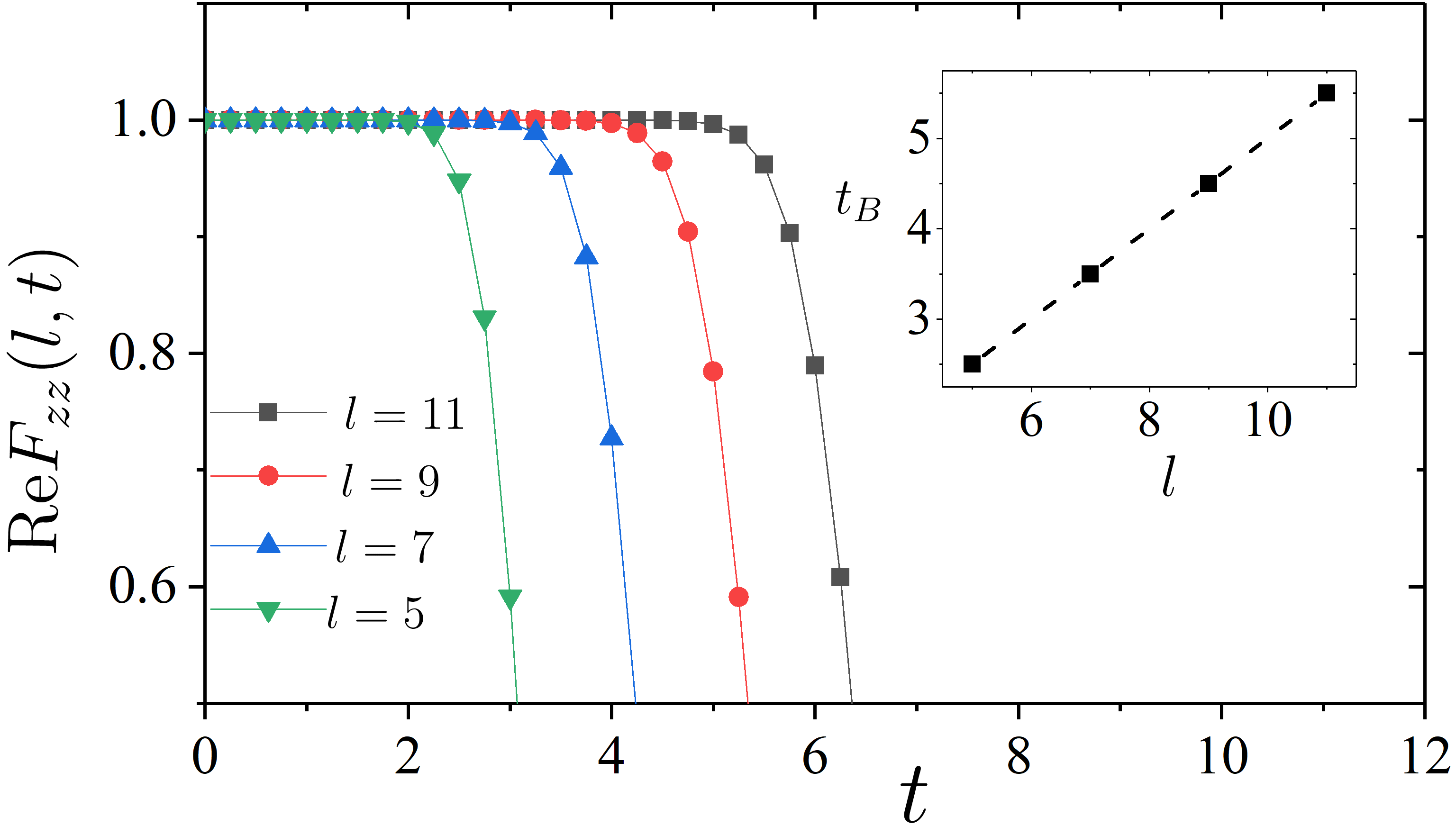 Figure 1
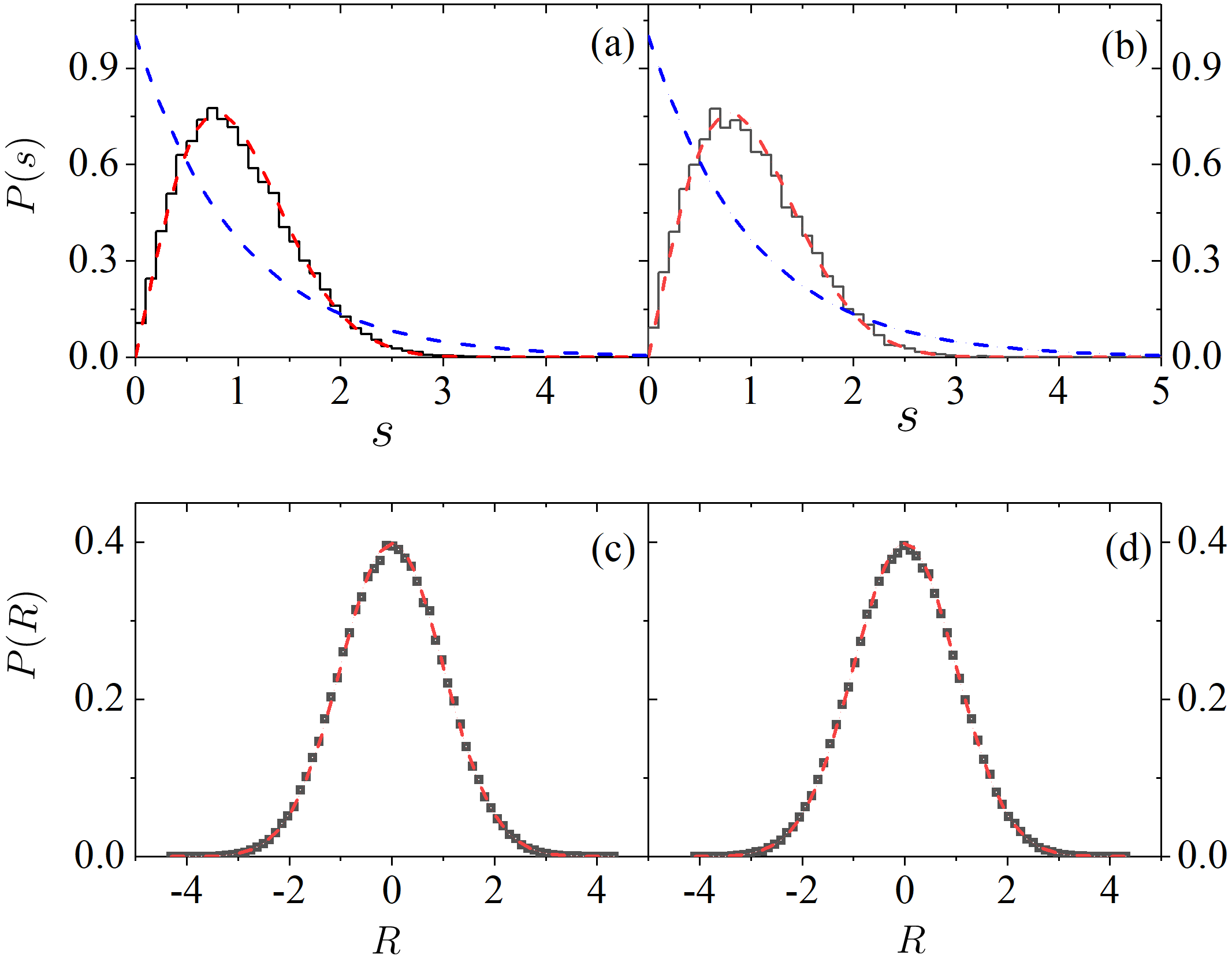 Figure 2
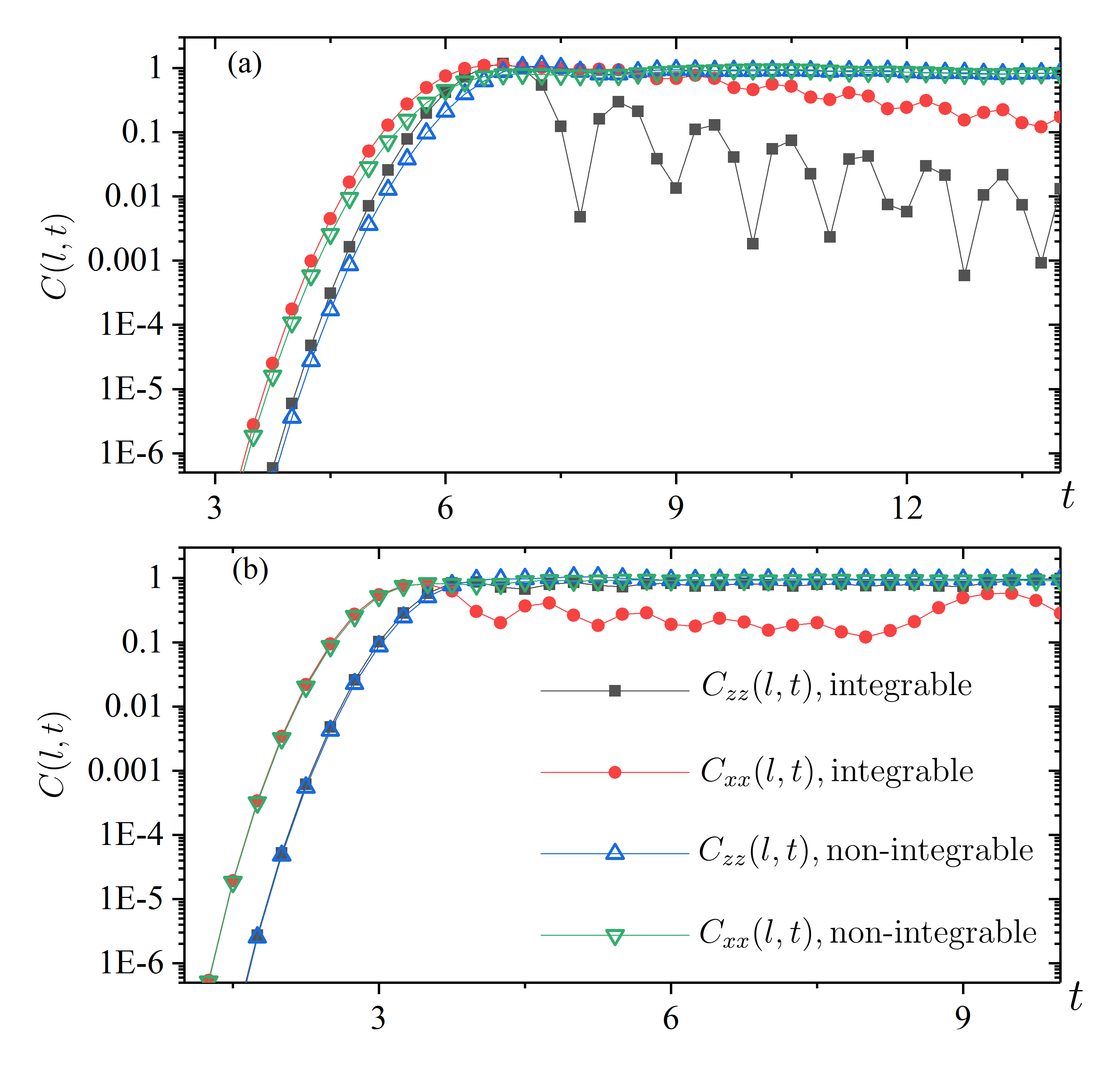 Figure 3
 Figure 4
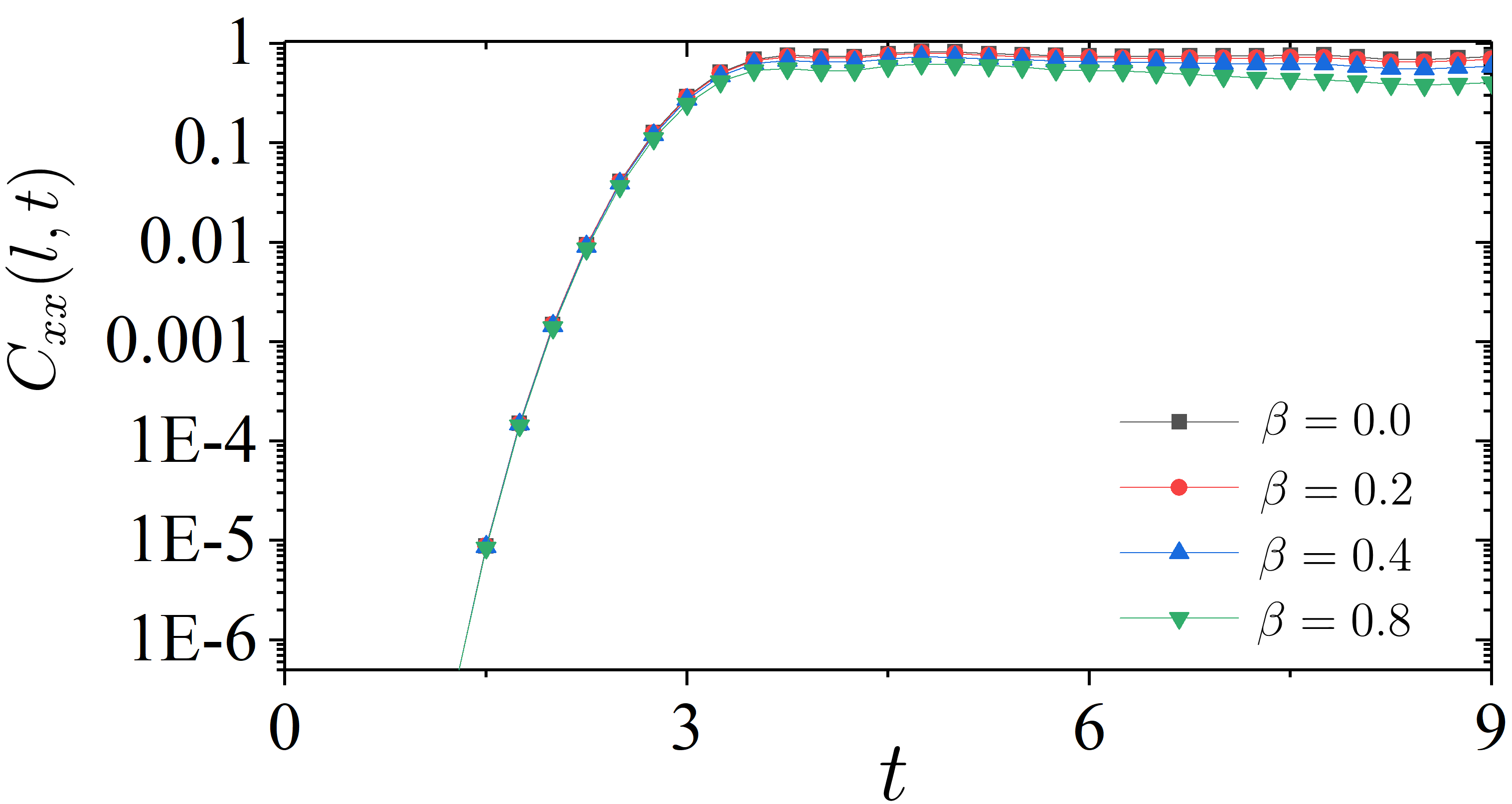 Figure 5
Peer Reviews
No public reviews on file for this paper yet. If you reviewed it on a platform where reviews are public (OpenReview, ICLR, NeurIPS, ICML), you can paste yours below so the community can read it here.
Videos
No videos yet. Explain this paper in a talk, walkthrough, or lecture? Add one.
Similar early growth of out-of-time-ordered correlators in quantum chaotic and integrable Ising chains
Hua Yan, Jiaozi Wang, and Wen-ge Wang 111 Email address: [email protected]
Department of Modern Physics, University of Science and Technology of China, Hefei 230026,China
(March 17, 2024)
Abstract
Previous studies show that, in quantum chaotic and integrable systems, the so-called out-of-time-ordered correlator (OTOC) generically behaves differently at long times, while, it may show similar early growth in one-body systems. In this paper, by means of numerical simulations, it is shown that OTOC has similar early growth in two quantum many-body systems, one integrable and one chaotic.
Introduction. In recent years, the so-called out-of-time-ordered correlator (OTOC) has attracted a lot of attention in several fields of physics, particularly high-energy physics, condensed matter physics, and quantum information Larkin and Ovchinnikov (1969); Shenker and Stanford (2014a, b); Shenker and Stanford (2015); Maldacena et al. (2016); Roberts and Stanford (2015); Roberts and Swingle (2016); Chen et al. (2017); Fan et al. (2017); Cotler et al. (2017, 2018); Lin and Motrunich (2018); Kukuljan et al. (2017); Scaffidi and Altman (2017); Chan et al. (2019). Experimentally, it has been studied via nuclear magnetic resonance Li et al. (2017) and ion traps Gärttner et al. (2017). Study of this quantity can be traced back to an earlier work by Larkin and Ovchinnikov in 1969 Larkin and Ovchinnikov (1969) in the context of superconductivity, as a measure for the instability of semi-classical trajectories of electrons scattered by impurities in a superconductor; its growth rate was found given by the classical Lyapunov exponent . Recently, it was proposed that OTOC may be used as a measure for quantum chaos in interacting quantum many-body systems Kitaev (2014).
Quantitatively, denoted by , OTOC is written as
[TABLE]
where indicates the Heisenberg evolution of an operator and indicates the initial thermal average at a temperature with . Here, represents a local operator at a site and is an operator at another site (usually fixed).
In the specific case that and are Hermitian and unitary (e.g., when they are Pauli operators), it was found that , where , and grows exponentially at early times
[TABLE]
where is a parameter and is the so-called butterfly velocity Maldacena et al. (2016); Cotler et al. (2018). Under nature assumptions, it was found that is bounded by in quantum systems Shenker and Stanford (2014a, b); Shenker and Stanford (2015); Roberts and Stanford (2015). Moreover, for local interactions in spatially extended lattice models, Eq.(2) is not valid for long times and is bounded according to the Lieb-Robinson theorem Lieb and Robinson (1972); Roberts and Swingle (2016),
[TABLE]
where is certain parameter.
One should note that, although is usually called the Lyapunov exponent, it is not necessarily the one that characterizes the sensitivity of chaotic motion in classical systems, namely, the parameter discussed above. In fact, in the kicked rotor model Rozenbaum et al. (2017); García-Mata et al. (2018) and in the Dicke model Chávez-Carlos et al. (2019), OTOC was found to grow as . Furthermore, early growth of OTOC was found to show similar behaviors in some integrable and chaotic one-body systems (billiards) Hashimoto et al. (2017); Rozenbaum et al. (2019); Jalabert et al. (2018). While, it is unclear whether OTOC may show this type of similar behavior in many-body systems.
It is known that, for systems such as an integrable quantum Ising chain Lin and Motrunich (2018), a Luttinger liquid Dóra and Moessner (2017), and some models exhibiting many-body localization Riddell and Sørensen (2019); Lee et al. (2019), OTOC shows early power-law growths. But, a comparison of these early behaviors and those in quantum chaotic systems has not been done. In this paper, we carry out this study and compare the early growth of OTOC in two Ising chains as quantum many-body systems, one being integrable and the other chaotic. These two chains have similar overall properties such as energy size and averaged density of states. This feature makes it sensible to give a quantitative comparison for the OTOC’s early growths. Our numerical simulations show that the two growths are very close, implying that the parameter has nothing to do with whether the system is integrable or chaotic.
Models employed. We study OTOC in two models of spin chain. One is the well-known quantum Ising chain in transverse field, which is integrable, with the following Hamiltonian,
[TABLE]
and the other is a defect Ising chain,
[TABLE]
with . We study under both the periodic boundary condition with and the open boundary condition. In both Ising chains, . In the defect Ising chain, the parameters and are adjusted, such that the chain is a quantum chaotic system, that is, the nearest-level-spacing distribution is close to the Wigner-Dyson distribution . Specifically, , , , and [see Fig.1].
Recently, based on semiclassical analysis it was found that certain statistical property of eigenfunctions can also be employed as a measure for quantum chaos, and this is also useful in systems without any classical counterpart Wang and Wang (2019, 2018). Let us consider eigenstates of the defect Ising chain, , and their expansions in the spin configuration basis , i.e., . The difference between the distribution of the following rescaled components of eigenfunctions,
[TABLE]
and the Gaussian distribution can be regarded as a measure to quantum chaos. Here, indicates the average shape of the eigenfunctions. As seen in Fig.1, this measure gives results in consistency with those given by the spectral measure discussed above.
Numerical simulations for OTOC. Below, we first discuss early growth of OTOC in the quantum chaotic system, namely in the defect Ising chain with parameters given above. Then, we compare growths of OTOC obtained in chaotic and integrable Ising chains.
In the computation of OTOC, the operators and are taken as Pauli matrices at the -th site and at the first site, respectively,
[TABLE]
where indicate directions for the Pauli operators. For these operators and , the OTOC has a relatively simple expression,
[TABLE]
where
[TABLE]
Below, we focus on the two cases of and . As discussed in Ref.Lin and Motrunich (2018), OTOC behaves differently in these two cases in the integrable Ising chain.
It is useful to give a brief discussion for behaviors of OTOC. Since , initially, is commutable with and, hence, . To get an idea about OTOC’s time evolution, let us consider a Baker-Campbell-Huasdorff expansion of Roberts and Swingle (2016), which gives
[TABLE]
For extremely short times , . With the increase of time, higher-order terms on the right-hand side (rhs) of Eq.(10) should be taken into account in the computation of OTOC. In the two spin chains discussed above, each site is coupled to its neighboring sites only. Hence, for sufficiently short time , is approximately commutable with and, hence, .
With further increase of the time , beyond some time scale denoted by , the -th term on the rhs of Eq.(10) becomes nonnegligible and, thus, the OTOC gets nonnegligible values. Clearly, the value of should increase with under the open boundary condition. These features can be seen in Fig.2, where the early evolution of is plotted. When Eq.(2) is valid, may be defined by the relation . Then, one can compute the butterfly velocity, which gives as shown in the inset of Fig.2, in agreement with the theoretical prediction given by Lin and Motrunich (2018).
Numerical simulations for the dependence of the time evolution of the OTOC on the initial condition, namely, on the temperature , is shown in Fig.3 for the defect Ising chain under the open boundary condition. It is seen that the early growth of OTOC is almost independent of the value of . In other words, the early growth is insensitive to the initial energy for initial states lying in the middle energy region of the model. We found that a common feature of the eigenfunctions in this region of the model is that they spread over almost all the spin configuration basis states Wang and Wang (2016, 2018, 2019). Perhaps, this wide-spreading feature plays an important role in the early growth of OTOC. For long times, OTOC behaves differently depending on the value of ; it drops faster for larger value of .
Under the periodic boundary condition, the early growth of OTOC was also studied. The obtained results are basically similar to those given in the above two figures, particularly, with similar Butterfly velocity but with different values of the growth-starting time .
Finally, we discuss a main observation of this paper. That is, in the two spin chains as quantum many-body systems, our numerical simulations show that OTOC shows similar early growth in integrable and chaotic systems. We have studied OTOC for two pairs of local operators, i.e., and , under both the periodic and open boundary conditions (Fig.4). Under the periodic boundary condition, in the early-growth region, the values of () in the integrable Ising model are very close to the corresponding values in the nonintegrable (chaotic) defect Ising model. For the open boundary condition, the values are also close, though not as close as in the above case.
The above-discussed closeness of early growth of OTOC in integrable and chaotic systems shows that early growth of OTOC can not be employed as a measure for quantum chaos. For relatively long times, the numerical results in Fig.4 show certain difference between integrable and chaotic systems, except for the squares in the lower panel which are close to the values of chaotic systems. To show the difference more clearly, one needs to compute for even longer times, at which OTOC has power-law decay in the integrable Ising chain Lin and Motrunich (2018). (See Ref.Fortes et al. (2019) for a recent study, which shows qualitative difference between OTOC’s long-time behaviors in integrable and chaotic systems.)
Concluding remarks. It is found by numerical simulations that the OTOC in two quantum many-body systems, one integrable and the other chaotic, show very close early growth under the periodic boundary condition, and close early growth under the open boundary condition. The early growth is important in quantum chaotic systems, because the OTOC approaches its saturation value after this early growth.
Theoretical understanding of the above observation is still lacking. One clue for future investigation is given by the following property of classical systems, that is, the early motion of an integrable system, which has many degrees of freedom with incommensurable frequencies, may exhibit quite irregular features. In fact, it is this behavior of integrable systems that leads to the so-called Fermi-golden-rule decay of quantum Loschmidt echo in integrable systems, which was first found in quantum chaotic systems Wang et al. (2010).
A note. After this work was finished, the authors got to know that a similar behavior of the early growth of OTOC was reported in Ref.Fortes et al. (2019), where a different chaotic Ising chain had been studied.
This work was partially supported by the National Natural Science Foundation of China under Grant Nos. 11535011 and 11775210.
The reference list from the paper itself. Each links out to its DOI / PubMed record.
- 1Larkin and Ovchinnikov (1969) A. Larkin and Y. N. Ovchinnikov, Sov. Phys. JETP 28 (1969) 1200.
- 2Shenker and Stanford (2014 a) S. H. Shenker and D. Stanford, JHEP 2014 (2014 a) 67.
- 3Shenker and Stanford (2014 b) S. H. Shenker and D. Stanford, JHEP 2014 (2014 b) 46.
- 4Shenker and Stanford (2015) S. H. Shenker and D. Stanford, JHEP 2015 (2015) 132.
- 5Maldacena et al. (2016) J. Maldacena, S. H. Shenker, and D. Stanford, JHEP 2016 (2016) 106.
- 6Roberts and Stanford (2015) D. A. Roberts and D. Stanford, Phys. Rev. Lett. 115 (2015) 131603.
- 7Roberts and Swingle (2016) D. A. Roberts and B. Swingle, Phys. Rev. Lett. 117 (2016) 091602.
- 8Chen et al. (2017) X. Chen, T. Zhou, D. A. Huse, and E. Fradkin, Ann. Phys. 529 (2017) 1600332.