Upper limits on protolunar disc masses using ALMA observations of directly-imaged exoplanets
Sebasti\'an P\'erez, Sebasti\'an Marino, Simon Casassus, Cl\'ement, Baruteau, Alice Zurlo, Christian Flores, Gael Chauvin

TL;DR
This study uses ALMA observations to set upper limits on dust masses in circumplanetary discs around young exoplanets, suggesting rapid dust growth into moonetesimals within 10 million years.
Contribution
It provides the first constraints on circumplanetary dust masses for a sample of directly-imaged exoplanets, indicating efficient dust growth and moon formation processes.
Findings
All systems have dust mass upper limits below the threshold for satellite formation.
Non-detections imply dust growth beyond metre sizes within 10 Myr.
Sample increases the number of ALMA non-detections by 50%.
Abstract
The Solar System gas giants are each surrounded by many moons, with at least 50 prograde satellites thought to have formed from circumplanetary material. Just like the Sun is not the only star surrounded by planets, extrasolar gas giants are likely surrounded by satellite systems. Here, we report on ALMA observations of four <40 Myr old stars with directly-imaged companions: PZ Tel, AB Pic, 51 Eri, and And. Continuum emission at 1.3 mm is undetected for any of the systems. Since these are directly-imaged companions, there is knowledge of their temperatures, masses and locations. These allow for upper limits on the amount of circumplanetary dust to be derived from detailed radiative transfer models. These protolunar disc models consider two disc sizes: 0.4 and 0.04 times the exoplanet's Hill radius. The former is representative of hydrodynamic simulations of circumplanetary…
Click any figure to enlarge with its caption.
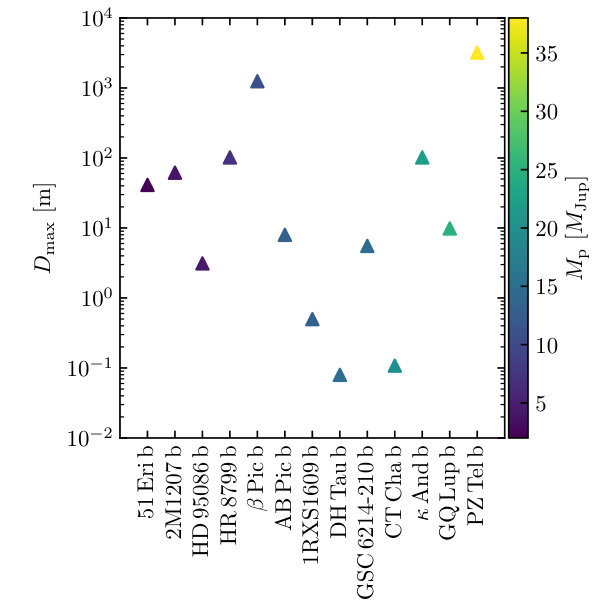 Figure 1
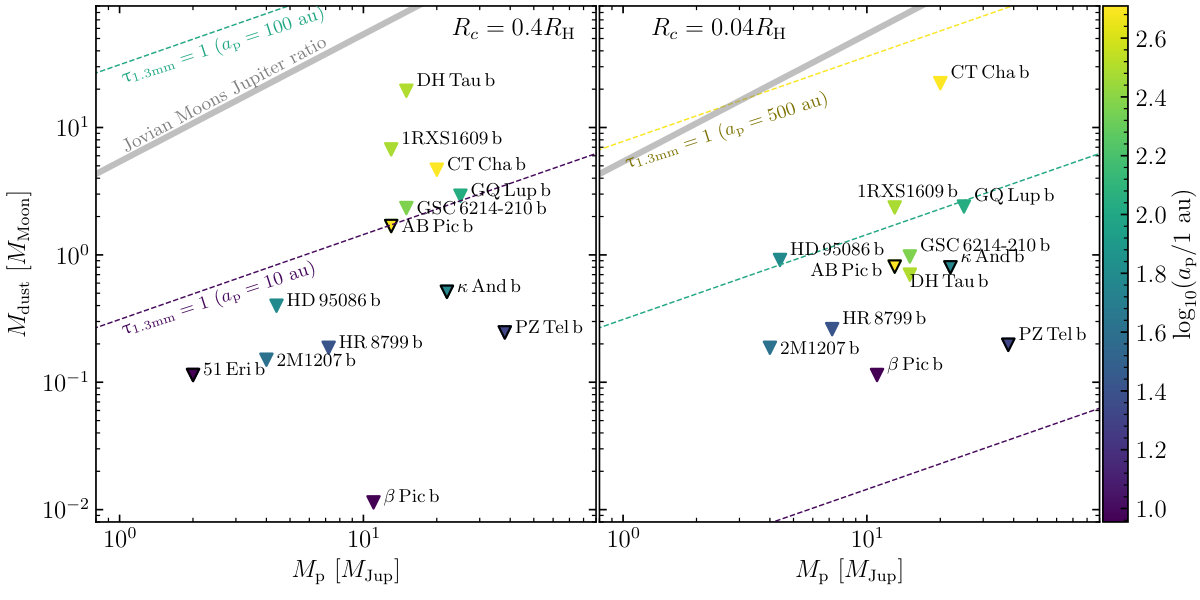 Figure 2
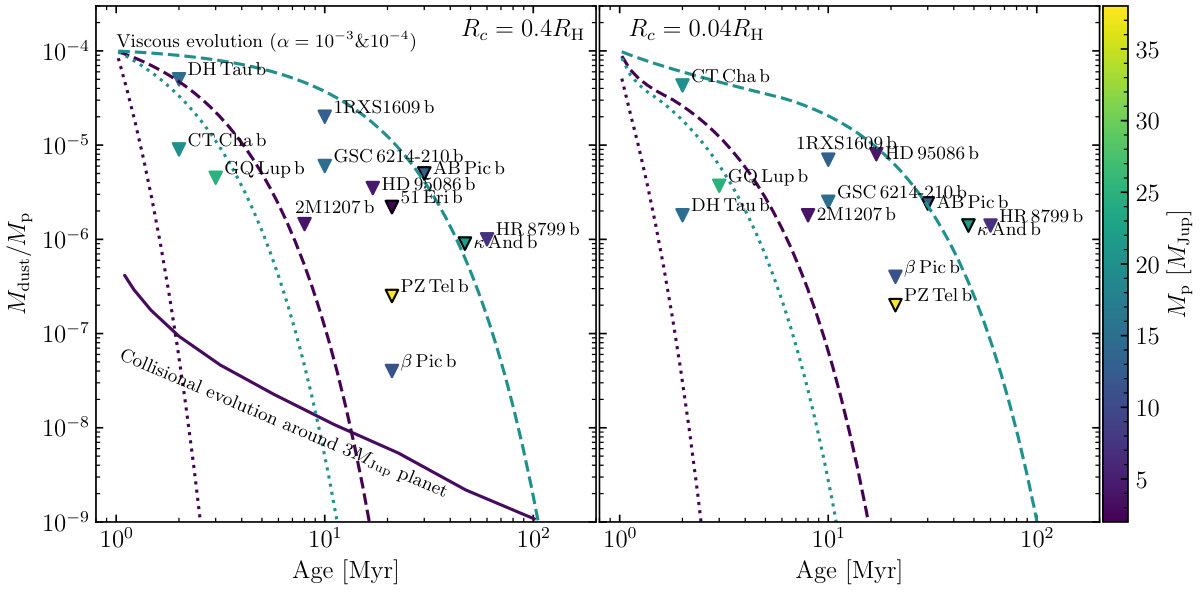 Figure 3
Peer Reviews
No public reviews on file for this paper yet. If you reviewed it on a platform where reviews are public (OpenReview, ICLR, NeurIPS, ICML), you can paste yours below so the community can read it here.
Videos
No videos yet. Explain this paper in a talk, walkthrough, or lecture? Add one.
Upper limits on protolunar disc masses
using ALMA observations of directly-imaged exoplanets
Sebastián Pérez,1,2 Sebastián Marino,3 Simon Casassus,1 Clément Baruteau,4 Alice Zurlo,5,6 Christian Flores7 and Gael Chauvin8,9
1Universidad de Santiago de Chile, Av. Ecuador 3659, Santiago
2Departamento de Astronomía, Universidad de Chile, Casilla 36-D, Santiago
3Max Planck Institute for Astronomy, Königstuhl 17, 69117 Heidelberg, Germany
4IRAP, Université de Toulouse, CNRS, UPS, Toulouse, France
5Núcleo de Astronomía, Facultad de Ingeniería y Ciencias, Universidad Diego Portales, Av. Ejercito 441, Santiago, Chile
6Escuela de Ingeniería Industrial, Facultad de Ingeniería y Ciencias, Universidad Diego Portales, Av. Ejercito 441, Santiago, Chile
7Institute for Astronomy, University of Hawaii at Manoa, 640 N. Aohoku Place, Hilo, HI 96720, USA
8Unidad Mixta Internacional Franco-Chilena de Astronomía, CNRS/INSU UMI 3386
9Univ. Grenoble Alpes, CNRS, IPAG, F-38000 Grenoble, France Corresponding author 1: [email protected] author 2: [email protected]
Abstract
The Solar System gas giants are each surrounded by many moons, with at least 50 prograde satellites thought to have formed from circumplanetary material. Just like the Sun is not the only star surrounded by planets, extrasolar gas giants are likely surrounded by satellite systems. Here, we report on ALMA observations of four <40 Myr old stars with directly-imaged companions: PZ Tel, AB Pic, 51 Eri, and And. Continuum emission at 1.3 mm is undetected for any of the systems. Since these are directly-imaged companions, there is knowledge of their temperatures, masses and locations. These allow for upper limits on the amount of circumplanetary dust to be derived from detailed radiative transfer models. These protolunar disc models consider two disc sizes: 0.4 and 0.04 times the exoplanet’s Hill radius. The former is representative of hydrodynamic simulations of circumplanetary discs while the latter a case with significant radial drift of solids. The more compact case is also motivated by the semi-major axis of Callisto, enclosing Jupiter’s Galilean satellites. All upper limits fall below the expected amount of dust required to explain regular satellite systems (10*-4* times the mass of their central planet). Upper limits are compared with viscous evolution and debris disc models. Our analysis suggests that the non detections can be interpreted as evidence of dust growth beyond metre sizes to form moonetesimals in timescales Myr. This sample increases by 50% the number of ALMA non-detections of young companions available in the literature.
keywords:
planets and satellites: formation, detection – submillimetre: planetary systems
††volume: in press††pubyear: 2019††pagerange: Upper limits on protolunar disc masses using ALMA observations of directly-imaged exoplanets–References
1 Introduction
Regular satellites around giant planets are thought to form in circumplanetary discs (CPD) of gas and dust as by-products of planet formation (Ruskol, 1961; Lunine & Stevenson, 1982). In our Solar system alone, a total of at least 50 regular satellites orbit the gas giants, including all major moons. These satellite orbits are close to co-planar with the host planet’s equatorial plane, much like a miniature version of a planetary system. This is true even for Uranus which has an obliquity of almost 98 degrees. Although the masses and numbers of regular satellite systems vary from planet to planet, all regular satellite systems contain a total mass that is 10*-4* times the mass of their central planet. For instance, there is 210*-4* MJup worth of regular satellite mass around Jupiter (Canup & Ward, 2006). The same holds for Saturn and Uranus111Neptune’s late capture of Triton likely disrupted its circumplanetary rings making it an exception. Is this relation a common trait for gas giant exoplanetary systems? It also holds for close-in rocky planetary systems around late-type stars such as Trappist 1 (e.g., Gillon et al., 2017), and in protoplanetary discs around a variety of stars (e.g., Williams & Cieza, 2011).
In analogy with the minimum mass Solar nebula (MMSN) concept (Hayashi, 1981), a minimum mass subnebula or circumjovian disc can be invoked to study the formation of regular satellites, such as the Galilean moons. In the earlier picture (Lunine & Stevenson, 1982; Canup & Ward, 2002), all the ingredients for the satellites are present from the initial stage. The gases are eventually dispersed while solids are incorporated into the satellites.
Initially, the material within the CPD builds up progressively, supplied by a near constant inflow of gas and solids from dust traps in the outer circumstellar disc (Canup & Ward, 2002; Cilibrasi et al., 2018). Three dimensional hydrodynamical simulations agree that CPD radii are truncated between a third or half of the planet’s Hill radius (e.g. Ayliffe & Bate, 2009). Canup & Ward (2006) found that the overall properties of satellite systems develop naturally when satellites grow embedded in these actively supplied CPDs. This model also reproduces the 10*-4* mass fraction of total satellite mass, as due to a competition between the supply of solids and satellite loss due to orbital decay in presence of circumplanetary gas. Upon entering the CPD, the mm-sized dust quickly drifts inwards. The dust may eventually stall if gas moves radially outwards in the inner parts of the CPD due to meridional circulation linking the circumplanetary and protoplanetary discs (Morbidelli et al., 2014). If so, the mm-sized dust may then form a dense narrow ring where the streaming instability could set in and form the km-sized bodies that will later form satellites (Drążkowska & Szulágyi, 2018).
The gas in circumstellar discs is thought to dissipate after just a few million years (e.g., Williams & Cieza, 2011). The details of what happens next are not well constrained due to lack of observational evidence. CPDs may remain gravitationally bound to the planet for a timescale of a few million years to allow enough time to fully develop Galilean-type satellites (Canup & Ward, 2002). Turner et al. (2014) reports timescales for full planet growth of 5-50 Myr, during which the CPD slowly depletes and a last generation of satellites arises from the protolunar disc phase, generalizing the term “circumjovian” to a broader sense. Crida & Charnoz (2012) suggests that moons can still form in massive primordial rings when they spread beyond the Roche radius. Kenworthy & Mamajek (2015) reported a system with unusual transits, which they interpret as circumplanetary rings filling most of the Hill radius.
In this work, we report on ALMA observations (Sec. 2) of four directly-imaged exoplanets222Although some bodies considered in this work are in the brown dwarf mass regime, we sometimes refer to them as ‘exoplanets’ as this distinction does not impact our analysis. with separations 300 au: PZ Tel b, AB Pic b, 51 Eri b, and And b. The ages of these systems are between 21 Myr and 47 Myr, i.e. not much older than the CPD depletion timescale (10 Myr, Canup & Ward, 2002) after the dissipation of the circumstellar gas. These exoplanets are undetected in our 1.3 mm observations but the RMS levels provide upper limits to the mass reservoir available for satellite formation (Sec. 3). These upper limits are put into context with previous non detections from the literature (Sec. 4).
2 Data description
We used the Atacama Large Millimeter/Submillimeter Array (ALMA) to observe four directly-imaged exoplanets. We obtained observations at 1.3 millimeter wavelength using the 12m array with baselines ranging from 19 metres to up to 3.0 kilometres, resulting in an angular resolution of 015 (using natural weights), sensitive to spatial scales of up 20. These observations were performed during Cycles 3 and 4 (project IDs 2015.1.01210.S and 2016.1.00358.S). The cycling time for phase calibration was set to 2 min. Time on science source varies for each target depending on the exoplanet system properties. On average, each observing block was integrated for 38 minutes in total (including calibrations). The ALMA correlator was configured in Frequency Division Mode (FDM). Three spectral windows with 2.0 GHz bandwidth were set up for detecting the dust continuum, centred at 232.469, 217.871, and 215.371 GHz respectively. A fourth spectral window centred at 230.507 is aimed at probing for 12CO gas emission (1.875 GHz in bandwidth with 960 channels). Searching for low-level gas in these systems is beyond the scope of this paper, and will likely require sophisticated analysis to produce a detection (e.g., by stacking after correcting by Doppler shifts, Marino, et al., 2016). Proper motions were accounted for when more than one observing blocks were used to produce a concatenated Measurement Set.
All data were calibrated by the ALMA staff using the ALMA Pipeline in the CASA package (McMullin et al., 2007), including offline Water Vapour Radiometer (WVR) calibration, system temperature correction, as well as bandpass, phase, and amplitude calibrations. Image reconstruction was performed using the CLEAN algorithm (CASA v.5.2, task tclean) with ‘natural’ weights. All spectral windows were combined in the imaging. No sources were detected in our observations. The RMS value for each dataset was calculated from the CLEANed images and are reported in Table 1.
3 CPD models and dust mass upper limits
For all selected candidates, we modelled the protolunar discs as dusty discs with a surface density profile equivalent to a self-similar solution for a viscous accretion disc (Lynden-Bell & Pringle, 1974). We used a power-law slope of and an exponential cutoff radius of 0.4 times the planet’s Hill radius () as our fiducial model (Ayliffe & Bate, 2009). An alternative model with (about the size of the Galilean moon system) is also considered to show how sensitive the derived mass is to the disc radius. The minimum radius of the grid is . If dust temperatures rise above the sublimation temperature, the disc inner radius is increased. A constant disc vertical aspect ratio of 0.1 is assumed.333Dust vertical scale-heights are dependent on Stokes number and viscosity. We tested how our approximation compares for the case of PZ Tel and found that a more realistic scale-height only affects the emitted fluxes by 10% when compared to a constant aspect ratio for all species. A finite relative inclination of between the orbit of each planet and its CPD is used, motivated by regular satellites in the Solar system which have orbital inclinations ranging from less than a degree up to .
The dust is assumed to follow a size distribution from 1 m to 1 cm (following a power law exponent of ) and it is composed of a mix of astrosilicates, amorphous carbon and water ice. This yields an absorption opacity of 2.3 cm2 g*-1* at 1.3 mm. We input our model into the radmc3d radiative transfer (RT) code to calculate the total flux expected at 1.3 mm (Dullemond et al., 2012). Both dust thermal emission and scattering (anisotropic) are considered in the RT calculation. The star and planet luminosities are included as energy sources that set the dust temperature. Finally, in order to derive an upper limit for the total dust mass, we varied the disc mass until the 3 flux upper limit is matched for each disc. When computing images and observed fluxes we assumed disc inclinations of from face on for all systems, except for Pic b, which we assumed to be inclined by and co-planar with the circumstellar debris disc (Lagrange et al., 2018; Matrà et al., 2019). We note that this inclination only makes a difference if the discs are massive enough to become optically thick in the radial direction at 1.3 mm. The RMS value for Pic b is calculated as the thermal noise in a region devoid of circumstellar emission. We interpret this as an upper limit since upon subtraction of a parametric model for the disc, there is no point-like emission above 3 (Matrà et al., 2019).
In Table 1 and Figure 1 we present the dust mass upper limits derived from the RT calculations. The limits are lower for the closest systems as expected, and the ones with shorter planet semi-major axis since this makes discs warmer and brighter for the same dust mass. The lowest of these limits is for Pic b because it has the deepest ALMA observations, it is the closest system from our sample, and has the highest temperature field since it is the closest to its central star. For all systems, the dust mass upper limits lie below the expected total mass in solids if exoplanets have the same mass ratio between the total mass in satellites and planet (, where is the mass of the exoplanet, see grey band in Fig. 1). This means that there is not enough mass in dust to form Jovian-like systems, or that satellites must have already formed or grown to planetesimal sizes which are transparent at 1 mm.
In Fig. 1 we overlay (dashed lines) the dust masses at which discs become optically thick (assuming constant surface densities). We find that for cutoff radii of , all discs are optically thin at 1.3 mm (left panel). However, if discs are an order of magnitude smaller in radius, the protolunar discs around 51 Eri b and Pic b become optically thick at 1.3 mm. In fact, the upper limit for 51 Eri b is higher than the maximum possible flux of a circumplanetary disc in this system (in the compact case the disc is highly optically thick). Therefore, our flux upper limit for 51 Eri b does not place a constraint on the disc mass in the small disc scenario.
The limits derived here can be compared to results by Ricci et al. (2017) that assumed optically thin emission and a single dust temperature scaling with stellar luminosity. We find limits for DH Tau b, GSC 6214-210 B and GQ Lup b that are consistent within a factor of a few when assuming a large cutoff radius, but much lower for DH Tau b if its disc is compact and thus warmer as the heat from the planet has a larger impact. For 2M1207 b we find a mass that is a factor of two lower, which can be explained by the higher temperature in our models compared to the one used by Ricci et al. (2017). In our RT model both the stellar and planet luminosities are included as heating sources, thus the large dust grains have temperatures of 30 K (between 1 and 10 au), versus the 8 K assumed in the previous study.
4 Discussion
The upper limits derived in the previous section are put into context of two simple evolution models: 1) viscous evolution of a gas disc, and 2) collisional evolution of a planetesimal disc replenishing a population of mm-sized dust. These provide order of magnitude estimates for the expected dust mass in circumplanetary discs as a function of age, planet and stellar mass, and semi-major axis.
4.1 Viscous evolution
For the viscous evolution scenario we assume an disc model where each planet is initially surrounded by an accretion disc rich in gas and dust (gas-to-dust ratio of 100), with an initial solid mass of , where dust particles are smaller than the molecular mean-free path, i.e. the Epstein regime, where dust and gas are well coupled (this might not be valid for low gas densities as large dust grains experience radial drift due to aerodynamics drag). The dimensionless stopping time or Stokes number () is proportional to the dust size over the gas surface density, for a given grain internal density. For a vertically isothermal disc, can be written as
[TABLE]
where we assume a grain internal density of 1 g cm3. Millimetre-sized dust would only be well coupled to the gas () if disc masses are 10 or discs have . Otherwise, large dust grains containing the bulk of the solid mass will quickly migrate inwards. Therefore the model presented here provides only an upper limit for the expected dust masses if the only loss process is the viscous accretion.
For the viscous evolution we assumed an -disc model (Lynden-Bell & Pringle, 1974) where viscosity scales linearly with radius, such that:
[TABLE]
where and is the viscous timescale evaluated at (the initial cutoff radius). The CPD viscous evolution is calculated after the protoplanetary disc starts dissipating (we assume a dissipation timescale of 1 Myr). For the disc viscosity we used equation 18 from Zhu et al. (2018), assuming a disc temperature of 40 K (this value is consistent with the temperature at 1 au from the planet in our models). Then, the disc surface density and mass should decrease with time as and , with the gas cutoff radius increasing linearly with time as is the case for a freely expanding disc. However, this spreading does not happen perpetually since the CPD must be truncated. Here, we choose a truncation radius , motivated by 3D hydrodynamic simulations of CPDs (e.g., Ayliffe & Bate, 2009), and assume that at Myr the gas cutoff radius is already equal to . Therefore, for the evolution after 1 Myr instead we used equation 5 in Rosotti & Clarke (2018) that describes the exponential decay of a viscous disc around a companion (in the context of binary interactions). The characteristic timescale of the evolution is , where is the viscosity evaluated at . In this manner then, the gas and dust mass evolve as
[TABLE]
In Fig. 2, we compare the dust mass upper limits with the expected viscous evolution of the dust mass as a function of system’s age. Note that the age of these systems is uncertain and could vary by 50%. The dashed and dotted lines represent models with and , respectively. The green and purple lines correspond to models for planet masses of 20 and 2 , respectively. Note that even if we had considered a smaller initial cutoff radius, the viscous evolution would be very similar since an initially small disc will spread quickly until reaching the truncation radius, after which it will decay exponentially. We find that, for the high viscosity case, all our upper limits are above the model predictions by orders of magnitude for both disc sizes and (left and right panels, respectively), except for CT Cha when , DH Tau when and GQ Lup in both cases. This is because these systems are the youngest, thus they are more likely to have a large dust mass in this scenario. In the low case, the disc evolution is slower and our upper limits for planets with masses above 10 lie below the model curves. On the other hand, the viscous timescale around lower mass planets is shorter and thus our model predicts masses which are orders of magnitude lower than the upper limits. Based on our upper limits we conclude that either CPDs around the more massive of our companions evolve faster than models with , or mm-size grains are lost through radial drift or grow into larger objects with very low opacities at millimeter wavelengths.
4.2 Collisional evolution
An alternative scenario for the presence of dust in circumplanetary discs is to consider secondary origin dust created from collisions of planetesimals, i.e. like a debris disc (for a detailed discussion see Kennedy, Wyatt, Su & Stansberry, 2011). Such a disc will collisionally evolve and its mass will decrease with time as planetesimals are ground down to the size of small grains blown out by radiation from the planet or perturbed to by the stellar radiation (Burns et al., 1979). In order to compute predictions for the evolution of the disc mass in dust smaller than 1 cm, we used the model presented in Marino et al. (2017). This model requires several input parameters, e.g. the initial mass in solids, planetesimal strength, level of stirring. We used standard values used to model circumstellar debris discs for the planetesimal strength and density, and we set the rest of the parameters to extremes to obtain the most favourable condition to detect such disc, i.e. slow evolution and high initial mass. We assumed a planetesimal mean eccentricity and inclination of 0.01 and 0.005; disc radius of 0.4 with a fractional width of 0.5 to maximise the volume; planet semi-major axis 30 au; and a planet mass of 3 (at the lower end of the distribution) such that the orbital frequency and collisional rates are low. Finally we considered a large maximum planetesimal size of 100 km to slow down the collisional evolution, and an extreme initial solid mass of (or in mm-sized dust assuming a size distribution with an exponent of -3.5) to estimate the maximum mass of collisionally produced dust that could be present.
In the left panel of Fig. 2 the evolution of the dust mass in a massive planetesimal disc is shown assuming planetesimals are stirred at 1 Myr (purple line). The dust mass predicted by this model is orders of magnitude lower than our upper limits. Higher planet masses, smaller discs in units of , higher planetesimal eccentricities or inclinations would make this evolution even faster. Therefore we do not expect to observe debris disc like dust around directly-imaged planets, unless the solid mass is being replenished (e.g. from a circumstellar planetesimal belt) or large amounts of dust were recently produced is a stochastic collision between moon embryos.
4.3 Maximum grain sizes
Given the derived upper limits on the solid mass in the form of dust smaller than 1 cm presented in Section 3, and by assuming a size distribution and a total mass of solids, we can derive a lower limit on the maximum size of particles in these circumplanetary or protolunar discs. In particular, here we assume a power law size distribution with an exponent of and a total solid mass equivalent to . The solid size lower limits are then simply
[TABLE]
where is the diameter of the largest object in the disc. In Figure 3 we show lower limits on based on the derived upper limits on 444We consider the largest upper limit on between both dust disc sizes (0.4 and 0.04 ).. The non detections translate to a value of 1 metre for most sources. Therefore, we conclude that dust growth beyond metre sizes must happen in timescales Myr. After this timescale, the solid material is likely in moonetesimal form.
The working hypothesis that motivated the observations and the analysis presented here assumed that satellite formation is a common occurrence. Although common in the Solar System, the lack of detection of circumplanetary material around young exoplanets could also imply that these planets do not form satellites.
5 Concluding remarks
We presented ALMA observations of four young systems host to directly-imaged exoplanets and sub-stellar companions. Upper limits to the mass in mm dust around these planets have been drawn from the RMS levels using detailed RT modelling. All upper limits fall below the expected amount of dust and debris required to explain regular satellite systems (10*-4* ). We interpret this as likely evidence for rapid growth of dust into 1 metre planetesimals (or rather moonetesimals), which lowers the protolunar disc opacity at mm wavelengths.
The detection of protolunar discs in dust emission at radio wavelengths needs deep observations of the youngest exoplanets (e.g., DH Tau, CT Cha, GQ Lup) that reach several times higher sensitivities than current reported observations.
Ongoing observations of dust around accreting planets still embedded in their protoplanetary discs (e.g., HD 100546, Pérez, et al. 2019, and PDS 70, Christiaens, et al. 2019; Isella et al. 2019) could provide further constraints on the timescales for satellites formation.
Acknowledgements
We thank the anonymous referee for their constructive comments. We acknowledge support from the Millennium Science Initiative (Chile) through grant RC130007, and CONICYT-FONDECYT grant numbers 1171624, 1171246 and 1191934. S.P acknowledges support from the Joint Committee of ESO and the Government of Chile. This work used the Brelka cluster, financed by Fondequip project EQM140101, hosted at DAS/U. de Chile. A.Z. acknowledges support from the CONICYT-PAI, Convocatoria nacional subvención a la instalación en la academia, convocatoria 2017, Folio PAI77170087.
The reference list from the paper itself. Each links out to its DOI / PubMed record.
- 1Ayliffe & Bate (2009) Ayliffe, B. A., & Bate, M. R. 2009, MNRAS, 397, 657
- 2Bonnefoy et al. (2010) Bonnefoy, M., Chauvin, G., Rojo, P., et al. 2010, A&A, 512, A 52
- 3Bonnefoy et al. (2014) Bonnefoy, M., Currie, T., Marleau, G.-D., et al. 2014, A&A, 562, A 111
- 4Bonnefoy et al. (2016) Bonnefoy, M., Zurlo, A., Baudino, J. L., et al. 2016, A&A, 587, A 58
- 5Booth et al. (2016) Booth, M., Jordán, A., Casassus, S., et al. 2016, MNRAS, 460, L 10
- 6Bowler et al. (2015) Bowler, B. P., Andrews, S. M., Kraus, A. L., et al. 2015, Ap J, 805, L 17
- 7Burns et al. (1979) Burns, J. A., Lamy, P. L., & Soter, S. 1979, Icarus, 40, 1
- 8Canup & Ward (2006) Canup, R. M., & Ward, W. R. 2006, Nature, 441, 834