Signatures of the orbital angular momentum of an infrared light beam in the two-photon transition matrix element: A step toward attosecond chronoscopy of photoionization
Sucharita Giri, Misha Ivanov, Gopal Dixit

TL;DR
This paper develops a theoretical framework for time-resolved photoionization using vortex beams with orbital angular momentum, revealing how this property influences electron dynamics during ionization in pump-probe experiments.
Contribution
It introduces a novel theory linking vortex beam orbital angular momentum to electron dynamics in photoionization, advancing attosecond chronoscopy techniques.
Findings
Orbital angular momentum affects electron dynamics independently of initial and final states.
The theory enables new insights into ultrafast photoionization processes.
Potential applications in attosecond chronoscopy of photoionization.
Abstract
We present a theory of time-resolved photoionisation in the presence of a vortex beam. In a pump-probe setup, an extreme ultraviolet or an x-ray pump pulse triggers ionization, which is probed by a synchronized infrared pulse with non-zero orbital angular momentum. We show, how this property of the probe pulse affects the electron dynamics upon ionization, in a way that is independent of the initial and final angular momentum states of the ionizing system.
Click any figure to enlarge with its caption.
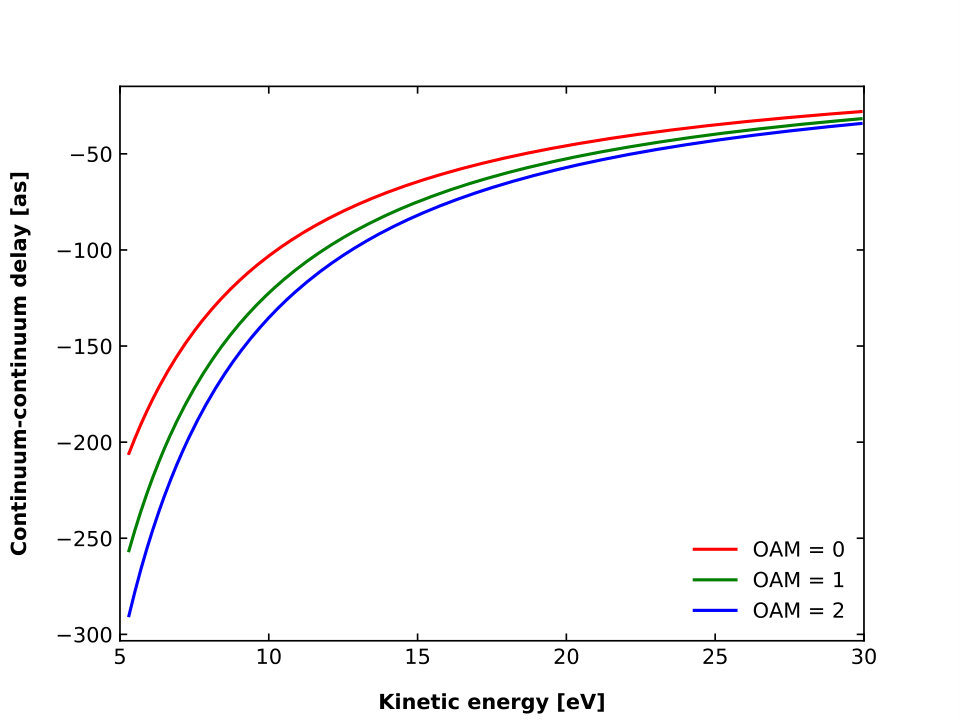 Figure 1
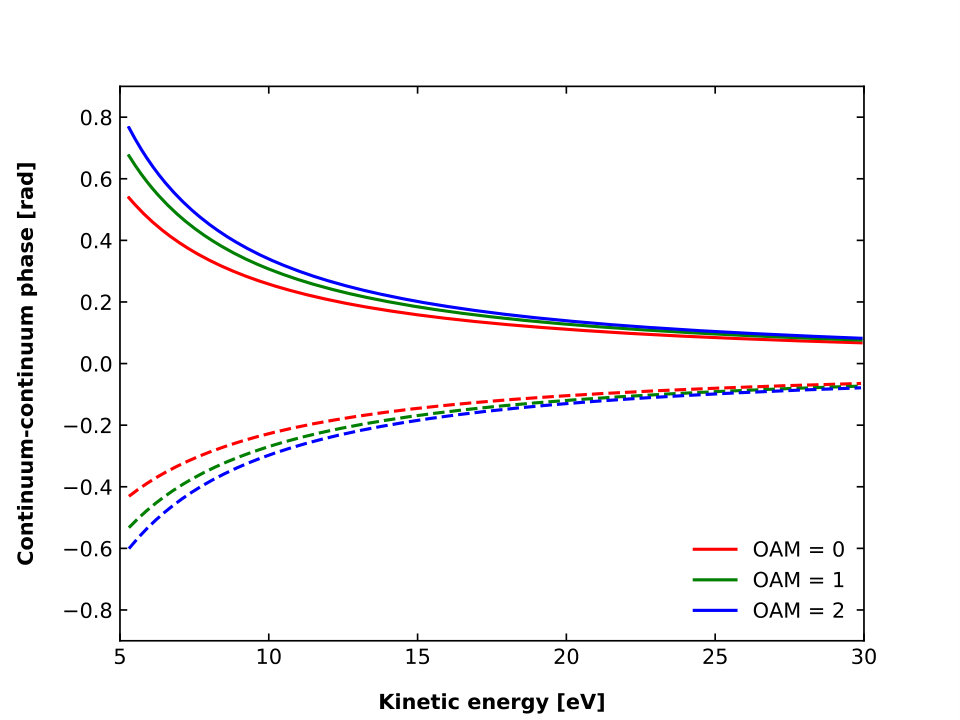 Figure 2
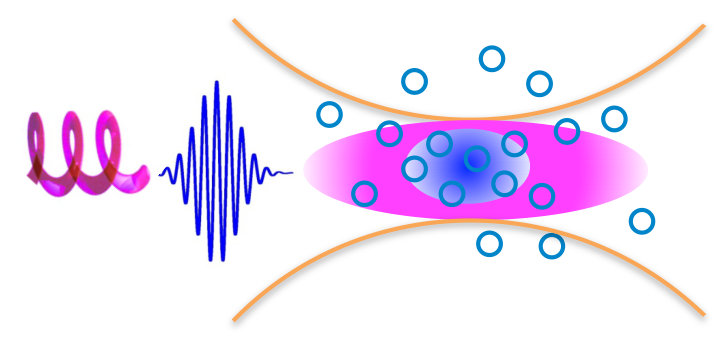 Figure 1
Peer Reviews
No public reviews on file for this paper yet. If you reviewed it on a platform where reviews are public (OpenReview, ICLR, NeurIPS, ICML), you can paste yours below so the community can read it here.
Videos
No videos yet. Explain this paper in a talk, walkthrough, or lecture? Add one.
Signatures of the orbital angular momentum of an infrared light beam in the two-photon transition matrix element: A step toward attosecond chronoscopy of photoionization
Sucharita Giri
Department of Physics, Indian Institute of Technology Bombay, Powai, Mumbai 400076 India
Misha Ivanov
Max-Born-Institut, Max Born Strasse 2A, 12489 Berlin, Germany
Blackett Laboratory, Imperial College London, South Kensington Campus, SW7 2AZ London, United Kingdom
Department of Physics, Humboldt University, Newtonstrasse 15, 12489 Berlin, Germany
Gopal Dixit
Department of Physics, Indian Institute of Technology Bombay, Powai, Mumbai 400076 India
Abstract
We present a theory of time-resolved photoionisation in the presence of a vortex beam. In a pump-probe setup, an extreme ultraviolet or an x-ray pump pulse triggers ionization, which is probed by a synchronized infrared pulse with non-zero orbital angular momentum. We show, how this property of the probe pulse affects the electron dynamics upon ionization, in a way that is independent of the initial and final angular momentum states of the ionizing system.
I Introduction
In their pioneering work, Allen and co-workers have shown the existence of the orbital angular momentum (OAM) of a light beam, along with its spin angular momentum allen1992orbital . The OAM of light is related to the spatial profile of the light beam and is characterized by the topological charge , which can have only integer values from 0 to , whereas the spin angular momentum is related to the polarization properties of light. Since its first demonstration, the OAM of light has found numerous macroscopic applications in different fields cardano2015spin ; torres2011twisted ; babiker2018atoms including quantum information processing wang2012terabit , optical interferometry furhapter2005spiral , chiral recognition in molecules forbes2019raman ; brullot2016resolving ; forbes2018optical , manipulation of nanoparticles yao2011orbital and in quantum gases andersen2006quantized ; inoue2006entanglement . While it is relatively straightforward to generate beams with non-zero orbital angular momentum in the infrared (IR) and visible range, similar technology is much more difficult in the extreme ultraviolet (XUV) and x-ray range. This has stimulated recent works on using high-harmonic generation to up-convert OAM beams from the IR to the XUV and soft x-ray energy range zurch2012strong ; hernandez2013attosecond ; gariepy2014creating ; geneaux2016synthesis ; rego2016nonperturbative ; turpin2017extreme ; hernandez2017extreme ; paufler2018tailored ; gauthier2019orbital . An elegant non-collinear scheme has been employed to generate linearly polarized twisted light beams with relatively low OAM gauthier2017tunable ; kong2017controlling ; dorney2019controlling via high-harmonic generation. These breakthroughs have opened a door to synthesize coherent attosecond XUV and x-ray pulses with desirable OAM properties, adding an additional knob to the attosecond light generation toolbox.
It may appear that, apart from the space-dependent amplitude and phase modulation, the macroscopic OAM properties of an IR or visible light beam will hardly manifest at the single-atom, microscopic level due to the difference in the spatial scales. As long as the dipole approximation dominates the atomic response, each atom sees a local field at a given spatial position inside the OAM beam. However, this general impression is not always accurate, as shown in particular in schmiegelow2016transfer , using a Bose-Einstein condensate with naturally delocalized centre-of-mass atomic wavefunction. Here we analyse an alternative possibility and show how the topological charge of an incident OAM IR beam can be encoded via attosecond chronoscopy of photoionisation pazourek2015attosecond by a pair of time-synchronized x-ray pump and IR probe pulses. Attosecond streaking and RABBITT (reconstruction of attosecond beating by interference of two-photon transitions) are the most common experimental methods to perform attosecond chronoscopy of photoionization pazourek2015attosecond .
In our proposed scheme, an attosecond x-ray pump pulse ionises atoms (shown in blue colour in Fig. 1). The liberated photoelectrons are probed by a twisted IR probe pulse (shown in pink). The short wavelength of the pump pulse allows one to focus it tightly into the centre of the OAM doughnut, where the amplitude and the phase structure of the twisted IR probe can be experienced by the photoelectrons. In the generalised theory of time-resolved photoionisation, both the pump and probe pulses can carry OAM. However, for our purpose, we limit the analysis to the case when the X-ray pump pulse has no OAM but the IR probe can carry OAM. The fact that the X-ray pump pulse does not have to carry OAM, simplifies practical realisation of the proposed setup using currently developing X-ray sources.
As shown by Picon and co-workers picon2010transferring ; picon2010photoionization , when the phase and amplitude inhomogeneity of a twisted beam becomes important, the standard dipolar selection rules are no longer adequate babiker2002orbital . Exchange of angular momentum larger than one unit has been found during photoionisation picon2010transferring ; picon2010photoionization and photoexcitation of valence electrons with twisted beams peshkov2017photoexcitation ; schmiegelow2016transfer ; giammanco2017influence ; babiker2018atoms . Attosecond time-delay in photoionisation has been predicted to be sensitive to the magnetic sublevels of a spherically symmetric atom ionised by a twisted XUV beam watzel2016discerning .
There is an important difference between all-optical setups, which detect light generated by matter interacting with OAM beams, and setups detecting photoelectrons. In the former case, the OAM properties of the incident light are recorded across a macroscopic sample and affect the measurement via coherent addition of the optical response from different parts of the interaction region. While measuring photoelectrons, OAM-sensitive signal arises when an atom is placed near the centre of the twisted beam, where amplitude and phase modulation is maximised (at the expense of low incident field intensity).
II Theory
In the time-resolved photoionization, within the pump-probe scenario, the pump pulse liberates an electron from the ground state with negative energy . The electron is promoted to a continuum state with energy . The photoelectron is probed by the twisted IR pulse, which induces a transition from a continuum state to another continuum state with energy . In the following, we present the theory of time-resolved photoionization.
First, we write the two-photon transition amplitude corresponding to the absorption of both one pump and one probe photons,
[TABLE]
Here, the energy of the final continuum state is , where and are the photon energies of the pump and IR probe pulses, respectively. The pump photon energy is larger than the ionization potential of the atomic system.
The interaction Hamiltonian is where is the vector potential of the pump and IR probe pulses. The vector potential corresponding to the probe vortex pulse, which induces a transition from to , has the following form picon2010photoionization
[TABLE]
Here, is the amplitude (including polarization state), is the beam waist of the pulse, is the envelope of the pulse, is a carrier wave vector, is carrier frequency and is the Laguerre-Gaussian modes of the pulse, which contains the transverse spatial structure of the vortex pulse with and corresponding to the topological charge and the radial node of the LG mode, respectively. In the present work, we have used the expression of as given in Eq. (2) of Ref. picon2010photoionization .
The ground state wavefunction is written as a product of the radial and angular parts, . The final continuum state wavefunction is expressed in terms of the partial wave expansion as . The phase is the scattering phase, i.e., the difference between the phase of the photoelectron ejected from the atom and that of a free-electron.
We substitute these expressions in the total two-photon amplitude Eq. (1), which reduces to the product of radial and angular parts
[TABLE]
where and are, respectively, the amplitudes of the vector potentials of the pump and probe pulses and is the radial part of the two-photon amplitude. The quantum numbers , and are the angular momenta of the initial ground, intermediate continuum and final continuum states. The range of accessible angular momenta for intermediate and final continuum states is decided by the selection rules. For vortex pulses, the selection rules are significantly different compared to the standard dipole selection rules picon2010transferring ; picon2010photoionization ; babiker2002orbital ; babiker2018atoms . Here we assume that both pulses are linearly polarised along the quantization axis .
The radial part of the two-photon transition amplitude is
[TABLE]
where is the radial part of the interaction Hamiltonian. We first compute the continuum-continuum (CC) transition amplitude, , and then substitute the result for into the energy integral of Eq. (4), to obtain the compact form of . We use the standard asymptotic form of the radial continuum wavefunction,
[TABLE]
where is the scattering phase-shift. It can be written as with , the Coulomb phase-shift and originating from the short-range deviations of the ionic potential from a purely Coulombic form. In the asymptotic region, the phase of the continuum wavefunction also exhibits the standard logarithmic divergence characteristic for the Coulomb potential of the ionic core with charge . Note that the chosen form of the continuum wavefunction is not a good choice at low energy as shown in Ref. dahlstrom2013theory .
By using the expression of radial continuum wavefunction from Eq. (5), the CC radial matrix element is
[TABLE]
Here, is responsible for the CC transitions and depends on , which is the topological charge of the vortex IR pulse. In the calculations, we have only retained the dominant term proportional to and ignored the term proportional to . The simplified expression for the CC radial matrix element is
[TABLE]
Here, and .
Substituting Eq. (7) in Eq. (4) and performing the complex energy integral near the pole corresponding to the energy yields the compact expression for
[TABLE]
In the above equation, the amplitude and phase terms are separated. The first line contains bound-continuum one-photon transition amplitude, whereas the second line contains the phase term of the CC transition amplitude whose strength is controlled by the exponential term.
After substituting the result of Eq. (8) in Eq. (3), the total two-photon transition amplitude reduces as
[TABLE]
The phase of the total amplitude in the asymptotic limit is
[TABLE]
where, and are the phases of the pump and probe pulses; respectively. The quantum phase associated with the CC transition is
[TABLE]
Note that, originates from the absorption of the vortex IR pulse in the presence of the Coulomb potential . It is important to notice that the vortex nature of the IR pulse appears in the argument of the Gamma function, independently of the initial atomic state. If one substitutes , the expression of reduces to the known expression as reported in Eq. (22) in Ref. dahlstrom2013theory .
The calculation of the two-photon transition matrix element corresponding to the emission of the IR photon is similar, only the phase of the CC transition is opposite to the case of the IR absorption.
The CC-phases for the different values of the OAM of the IR pulse are presented in Fig. 2. The solid and dotted lines correspond to the absorption and emission of an IR photon, for the same final kinetic energy, respectively. The phases are positive for absorption and negative for emission; whereas the magnitudes of the CC-phases are not exactly equal as evident from the figure. For low kinetic energies of the photoelectron, the phases increase with increasing the OAM. For high energies, the phases become insensitive to the OAM and approach those for regular light with zero OAM, as reflected in the figure.
The insensitivity of to OAM for high kinetic energies follows from the fact that the dominant complex-valued and energy-dependent part of the two-photon transition amplitude comes from the phase of the Gamma-function. Since as , in the argument of the Gamma function, which becomes real-valued.
III Results and Discussion
An experimental way to probe the quantum phase associated with CC-transition is offered by the RABBITT method. In this method, an XUV or x-ray attosecond pulse train is used as a pump pulse, with the photoelectron probed by the IR pulse. The pump-probe delay-dependent changes in the photoelectron spectrum give access to the sub-IR-cycle temporal resolution. In RABBITT, the same final state can be reached by two paths: either an absorption of pump photon [()-th harmonic] followed by an absorption of an IR photon () or an absorption of pump photon [()-th harmonic] followed by an emission of an IR photon with phase (). Both quantum paths lead to the same final ‘sideband’ state at the energy of the -th harmonics. The phase-dependent interferences of the two paths yield the oscillations in the intensity of the sideband, which is written in terms of the interference of the two-photon transition amplitudes corresponding to absorption and emission of an IR photon as . The interference-term of encodes the phase as
[TABLE]
Here ()-term contains the phase of the field. The finite-difference version of the Wigner-Smith time-delay is expressed in terms of the scattering phase: and the time-delay corresponding to the CC-phase is
[TABLE]
The CC time delay is the finite difference approximation for the derivative of with respect to 2 in RABBITT. It can be seen that is universal and independent of the initial and final angular momenta states of the atom. Here, and are the energies of the two quantum paths.
Figure 3 presents for different values of OAM of vortex IR pulse. In general, increases monotonically as a function of kinetic energy but remains negative: the photoelectron appears to be ahead compared to the electron moving in the absence of the core potential. In the relatively low kinetic energy regime, becomes more negative for a larger value of OAM. The delays merge to a constant value as the kinetic energy increases.
IV Conclusion
In conclusion, we have developed the theory of time-resolved photoionization induced by a vortex pulse carrying OAM. The main finding of this study is the impact of the OAM of the probe beam on photoionization delays. As in a standard RABBITT setup, the total phase associated with the ionization process is a sum of the two phases, the scattering phase associated with the bound-free transition induced by the pump pulse and the CC phase associated with the transition induced by the IR pulse. The CC phase depends parametrically on the OAM of the vortex pulse and the charge of the remaining ionic core. The CC phase does not depend on the angular momentum states of the system and the short-range behaviour of the atomic potential. Our theory can also be used for other interferometric photoionization measurement methods such as the attosecond streaking camera for relatively low IR intensity as discussed in Ref. dahlstrom2013theory . The present work provides a step towards attosecond chronoscopy of photoionisation in twisted light beams. Other important effects such as spatial sampling for specific focusing conditions, better description of the continuum wavefunction to include electron-electron correlations (e.g., in the vicinity of autoionizing states) etc. need to be incorporated in specific experiments for simulations of RABBITT and streaking spectra.
V Acknowledgements
G.D. acknowledges support from Science and Engineering Research Board (SERB) India (Project No. ECR/2017/001460) and Max-Planck India visiting fellowship. M.I. acknowledges DFG QUTIF program, Grant IV 152/6-2.
The reference list from the paper itself. Each links out to its DOI / PubMed record.
- 1(1) L. Allen, M. W. Beijersbergen, R. J. C. Spreeuw, and J. P. Woerdman, Phys. Rev. A 45 , 8185 (1992).
- 2(2) F. Cardano and L. Marrucci, Nature Photonics 9 , 776 (2015).
- 3(3) J. P. Torres and L. Torner, Twisted photons: applications of light with orbital angular momentum , John Wiley & Sons, 2011.
- 4(4) M. Babiker, D. L. Andrews, and V. E. Lembessis, Journal of Optics 21 , 013001 (2018).
- 5(5) J. Wang et al., Nature Photonics 6 , 488 (2012).
- 6(6) S. Fürhapter, A. Jesacher, S. Bernet, and M. Ritsch-Marte, Optics Letters 30 , 1953 (2005).
- 7(7) K. A. Forbes, Phys. Rev. Letts. 122 , 103201 (2019).
- 8(8) W. Brullot, M. K. Vanbel, T. Swusten, and T. Verbiest, Science advances 2 , e 1501349 (2016).