Tight fibred knots without L-space surgeries
Filip Misev, Gilberto Spano

TL;DR
This paper constructs infinitely many fibred, strongly quasipositive knots of any fixed genus that do not admit L-space surgeries, despite resembling algebraic and L-space knots.
Contribution
It demonstrates the existence of infinitely many knots with fixed genus that are fibred, strongly quasipositive, algebraically concordant to torus knots, yet do not admit L-space surgeries.
Findings
Existence of infinitely many such knots for each genus g ≥ 2.
These knots are algebraically concordant to torus knots T(2,2g+1).
They do not admit surgeries to L-spaces.
Abstract
We show there exist infinitely many knots of every fixed genus which do not admit surgery to an L-space, despite resembling algebraic knots and L-space knots in general: they are algebraically concordant to the torus knot of the same genus and they are fibred and strongly quasipositive.
Click any figure to enlarge with its caption.
 Figure 1
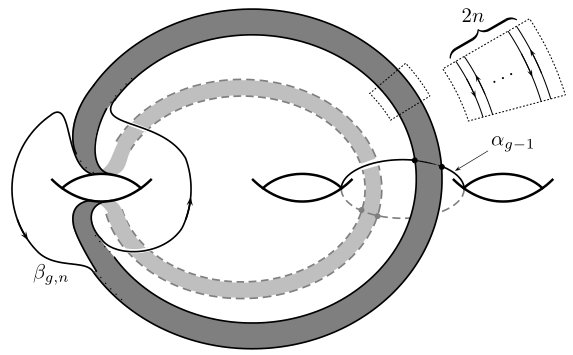 Figure 2
Peer Reviews
No public reviews on file for this paper yet. If you reviewed it on a platform where reviews are public (OpenReview, ICLR, NeurIPS, ICML), you can paste yours below so the community can read it here.
Videos
No videos yet. Explain this paper in a talk, walkthrough, or lecture? Add one.
Tight fibred knots without L-space surgeries
Filip Misev
Max Planck Institute for Mathematics, Bonn, Germany
and
Gilberto Spano
LMNO, Université de Caen-Normandie, Caen, France
Abstract.
We show there exist infinitely many knots of every fixed genus which do not admit surgery to an L-space, despite resembling algebraic knots and L-space knots in general: they are algebraically concordant to the torus knot of the same genus and they are fibred and strongly quasipositive.
1. Introduction and statement of result
Algebraic knots, which include torus knots, are L-space knots: they admit Dehn surgeries to L-spaces, certain -manifolds generalising lens spaces which are defined in terms of Heegaard-Floer homology [8].
The first author recently described a method to construct infinite families of knots of any fixed genus which all have the same Seifert form as the torus knot of the same genus, and which are all fibred, hyperbolic and strongly quasipositive. Besides all the classical knot invariants given by the Seifert form, such as the Alexander polynomial, Alexander module, knot signature, Levine-Tristram signatures, the homological monodromy (in summary, the algebraic concordance class), further invariants such as the and concordance invariants from Heegaard-Floer and Khovanov homology fail to distinguish these knots from the torus knot (and from each other). This is described in the article [10], where a specific family of pairwise distinct knots , , with these properties is constructed for every fixed genus .
Here we show that none of the is an L-space knot (except , which is the torus knot by construction). This implies our main result:
Theorem 1**.**
For every integer , there exists an infinite family of pairwise distinct genus knots , , with the following properties.
- (1)
* is algebraically concordant to the torus knot * 2. (2)
* is fibred, hyperbolic and strongly quasipositive* 3. (3)
* does not admit any nontrivial Dehn surgery to a Heegaard-Floer L-space*
We show in fact that the knots constructed in [10] do not have the same knot Floer homology as .
Below we briefly introduce the notions of L-spaces, L-space knots, quasipositivity and fibredness and relate our result to recent work by Boileau, Boyer and Gordon on the subject of L-space knots. Section 2 contains a description of the fibred knots via their monodromy (taken from [10]) and collects the main ingredients from Heegaard-Floer theory and Lagrangian Floer homology used in the proof of our result, which is given in Section 3.
1.1. L-spaces, quasipositivity and fibredness
L-spaces are named after lens spaces, three-dimensional manifolds formed by glueing two solid tori along their boundaries. By definition, a closed -manifold is an L-space if it is a rational homology sphere, that is, , and its Heegaard Floer homology has the smallest possible rank: . Every lens space (except , which fails to be a rational homology sphere) is in fact an L-space. More generally, -manifolds with finite fundamental group (the manifolds with elliptic geometry, certain Seifert fibred manifolds) are known to be L-spaces [16, Proposition 2.3].
A knot is an L-space knot if some non-trivial integral Dehn surgery on yields an L-space. Basic examples include the torus knots and the Berge knots, since they admit lens space surgeries; see [12, 2, 6]. In addition, all algebraic knots (the connected links of plane curve singularities, which include all positive torus knots) are L-space knots. This follows from a theorem of Hedden stating that certain cables of L-space knots are again L-space knots [8, Theorem 1.10], combined with the classical description of algebraic knots as iterated cables of torus knots, involving the Puiseux inequalities (see for example [3]).
By work of Ghiggini [5] and Ni [13, Corollary 1.3], [14], all L-space knots are known to be fibred: they arise as the bindings of open book decompositions of . In addition, Hedden proved that the open book associated to an L-space knot (or to its mirror) supports the tight contact structure of , under Giroux’ correspondence (see [7, Theorem 1.2, Proposition 2.1] and Ozsváth-Szabó [16, Corollary 1.6]). In summary, L-space knots are tight fibred knots.
Besides Dehn surgery, another important construction of -manifolds, starting from a knot , is given by branched covering of branched along . The -fold cyclic branched covering, branched along , is denoted . For example, if is an alternating knot, is always an L-space [17].
Recently, Boileau, Boyer and Gordon [1] considered L-space knots with the additional property that is also an L-space for some , . They deduced strong restrictions on such knots. In order to state their results, we briefly recall the notion of strongly quasipositive knots, which were introduced and first studied by Rudolph in the 80s [19]. Let the symbols denote the standard positive generators of the braid group on strands, corresponding to the braid in which the -th strand crosses over the -st strand in the direction of the braid’s orientation (and no other crossings). A braid is called strongly quasipositive if it can be written as a product of conjugates of the :
[TABLE]
where , and the conjugating words are of the special form
[TABLE]
for some (depending on ). Accordingly, such braids are called strongly quasipositive. Hedden showed that a fibred knot is tight if and only if it is strongly quasipositive [7]. Fibredness is important here: there do exist non-fibred strongly quasipositive knots.
Theorem 2** (Boileau, Boyer, Gordon [1]).**
Let be a strongly quasipositive knot with monic Alexander polynomial. Then
- (1)
* is not an L-space for .* 2. (2)
If is an L-space for , then has maximal signature and its Alexander polynomial is a product of cyclotomic polynomials.
Corollary 1** (Boileau, Boyer, Gordon [1]).**
Let be an L-space knot such that is an L-space for some . Then
- (1)
* implies that is the trefoil knot.* 2. (2)
* implies that is either the trefoil knot or its Alexander polynomial is equal to , the Alexander polynomial of the cinquefoil knot. If it is neither the trefoil nor the cinquefoil, it is a hyperbolic knot.*
These results suggest that the two properties, admitting an L-space surgery and admitting an L-space branched cover are orthogonal in the sense that only few knots seem to satisfy both properties simultaneously. When applied to genus knots satisfying the properties of Theorem 1 (and described in the next section), the above Corollary 1 implies that is not an L-space for and :
Corollary 2**.**
Fix and let denote the genus knot described below. If and , the -fold cyclic branched cover of , branched along is not an L-space.
For , the knots have the same Alexander polynomial as the cinquefoil knot . The following (open) question was brought to our attention by Ken Baker, Michel Boileau, Marco Golla and Arunima Ray, independently.
Question*.*
Is the double branched cover an L-space for any of the knots , (mentioned in Theorem 1 and described below)? Is an L-space for any of the genus knots ?
Acknowledgements
The authors would like to thank Michel Boileau and Paolo Ghiggini for many useful discussions. FM thanks the Max Planck Institute for Mathematics, Bonn, for its support and hospitality, where part of this work was completed. GS thanks the Laboratoire de Mathématiques Nicolas Oresme, Caen, for its support and hospitality.
2. Monodromies, L-spaces and exact triangles
2.1. The monodromy of the fibred knots
Let us recall the construction of the knots from the article [10]. Throughout, we fix an integer , the genus of the knots to be constructed. The fibred knots are given in terms of their monodromies: has a genus fibre surface . Since the topological type of does not depend on , we can identify with a fixed abstract (non-embedded) surface and consider the monodromy of as a mapping class . Given a simple closed curve , we denote the right Dehn twist on . Using this notation, the monodromy , , is defined as the following composition of Dehn twists:
[TABLE]
where
[TABLE]
and and are the simple closed curves shown in Figure 1.
The curve , shown in blue, is the boundary of a neighbourhood of in . In particular, it is nullhomologous, intersects and in exactly two points each, and does not intersect any of the remaining curves. It follows that consists of points (see Figure 2). Since and intersect in exactly one point and , are disjoint, is a singleton. Moreover, all pairs of curves involved in the construction realise their minimal geometric intersection number in their homotopy classes. This is clear whenever two curves are disjoint or intersect transversely in a single point. For the remaining cases, use the bigon criterion [4, Proposition 1.7]. In particular, this applies to the curves and , whose minimal geometric intersection number is used in the proof of our Theorem 1. These two curves are represented in Figure 2 (the shaded band represents parallel strands with alternating orientations which are part of ).
2.2. Floer homology of L-space knots
The proof of our result, Theorem 1, relies on the following theorem by Ozsváth-Szabó, which implies that the knot Floer homology groups of an L-space knot are at most one-dimensional in each Alexander degree.
Theorem 3** (Ozsváth-Szabó, Theorem 1.2 in [16]).**
Let be a knot which admits a positive integral L-space surgery. Then, there exists a sequence of integers such that
[TABLE]
where the supporting dimensions only depend on the , according to the recursive formula
[TABLE]
We make use of two exact triangles in knot Floer homology and in Lagrangian Floer homology to bound the rank of the knot Floer homology groups of our knots from below. Since the are all fibred of genus , their knot Floer homology groups in Alexander degree have rank one. To prove that is not L-space for we will show that
[TABLE]
which contradicts the condition of last theorem. Note also that it does not suffice to consider the coefficients of the Alexander polynomial of the genus knot , since it equals the Alexander polynomial of the torus knot , whose coefficients are all .
2.3. Two exact triangles in knot Floer homology and in Lagrangian Floer homology
Let be a closed oriented –manifold and let be a genus fibred knot with associated monodromy , so that, if is a tubular neighbourhood of , is homeomorphic to the mapping torus . An essential simple closed curve can then be identified with a knot .
Fix and assume that is non-trivial. Let and, respectively, be the knots determined by in the manifolds obtained via and, respectively, [math]-surgery on . is also a genus fibred knot, with associated fiber and monodromy . On the other hand is not fibred and has genus . If is a genus Seifert surface of , then it is easy to see that is a sutured Heegaard diagram for the sutured manifold (see the definitions 2.4 and 2.10 of [9]). Theorem 1.5 of [9] and the definition of sutured Floer homology imply that
[TABLE]
where the latter is the Lagrangian Floer homology of . This is a homology whose generators of the chain complex are intersection points of and (which are assumed to be transverse; see for example [20] for the details of the definition). We recall also that if two curves and are homotopic then
[TABLE]
and if they are not homotopic then
[TABLE]
where denotes the geometric intersection number of the curves and .
Lemma 1**.**
There is an exact triangle
[TABLE]
Proof.
This is a direct consequence of (1) and Ozsváth and Szabó’s exact sequence for knot Floer homology. ∎
The second lemma we are going to use is a special case of a theorem due to Seidel. It generalises the well-known identity for essential simple closed curves on a surface [4, Proposition 3.2].
Lemma 2** (Seidel [20]).**
Let be a compact oriented surface with boundary and the Dehn twist on a simple closed curve . For any pair of simple closed curves , there is an exact triangle of Lagrangian Floer cohomology groups
[TABLE]
3. Proof of the main theorem
Proof of Theorem 1.
Let , so that . Let be given by the open book . That is, is a fibred knot with monodromy . Note that both the -manifold and the knot are independent of , since only depends on and is also independent of . Now consider the open book associated to the fibred knot , which is the knot of interest. It is obtained from by -Dehn surgery along the curve . We can therefore apply Lemma 1 to this situation, where .
[TABLE]
Exactness and the rank-nullity formula for and imply
[TABLE]
To calculate the rank of , we apply Lemma 1 again, now taking to be the open book obtained from by -Dehn surgery along . We obtain and . The exact triangle from Lemma 1 now reads as follows.
[TABLE]
Since , we know that . Further, the curve intersects in exactly one point, whence . Because the above triangle is exact, we deduce
[TABLE]
The missing piece of information is . To compute it, observe first that
[TABLE]
because does not intersect any of the curves for . We could, in principle, directly compute the intersection number by studying the curves and on the surface . But Lemma 2 conveniently helps to simplify the calculation. First let us apply it to the curves , which gives
[TABLE]
because (so that the lower term of the exact triangle has rank [math]) and and intersect in a single point.
Now apply Lemma 2 three times to estimate :
First apply the lemma to . Since , the lower corner of the exact triangle vanishes and we get:
[TABLE] 2. 2.
Next choose . The lower term in the exact triangle is which has rank by (5). The exactness of the triangle implies that:
[TABLE] 3. 3.
Finally, choose . The upper right term in the corresponding triangle is which has rank by equation (2). It follows that:
[TABLE]
Summing up we get
[TABLE]
On the other hand the computation in Section 2.1 gives , so that:
[TABLE]
Finally, substituting the last estimation and the one in (4) in the rank inequality obtained at the beginning of this section we get:
[TABLE]
If this quantity is strictly grater than and Theorem 3 implies that cannot be an L-space knot. This establishes the third property stated in the Theorem. Properties (1) and (2) are proven in [10]. ∎
The reference list from the paper itself. Each links out to its DOI / PubMed record.
- 1[1] M. Boileau, S. Boyer, C. Gordon: Branched covers of quasipositive links and L-spaces , Journal of Topology 12 (2019), 536-576, ar Xiv:1710.07658.
- 2[2] J. Berge: Some knots with surgeries yielding lens spaces , (2018), facsimile of an unpublished manuscript from circa 1990, ar Xiv:1802.09722.
- 3[3] D. Eisenbud, W. Neumann: Three-dimensional link theory and invariants of plane curve singularities , Annals of Math. Studies 110 (1985), Princeton Univ. Press, Princeton, NJ, ISBN: 0-691-08380-0; 0-691-08381-9.
- 4[4] B. Farb, D. Margalit: A Primer on Mapping Class Groups , Princeton University Press, 2012.
- 5[5] P. Ghiggini: Knot Floer homology detects genus-one fibred knots , Amer. J. Math. 130 (2008), no. 5, 1151-1169, ar Xiv:math/0603445.
- 6[6] J. E. Greene: The lens space realization problem , Ann. Math. (2) 177 (2013), no. 2, 449-511, ar Xiv:1010.6257.
- 7[7] M. Hedden: Notions of positivity and the Ozsváth-Szabó concordance invariant , J. Knot Theory Ramifications 19 (2010), no. 5, 617-629, ar Xiv:math/0509499.
- 8[8] M. Hedden: On knot Floer homology and cabling: 2 , International Mathematics Research Notices, Vol. 2009, no. 12, 2248-2274, ar Xiv:0806.2172.