The homotopy groups of the {\eta}-periodic motivic sphere spectrum
Kyle Ormsby, Oliver R\"ondigs

TL;DR
This paper computes the homotopy groups of the {\
Contribution
It introduces a method to determine {\
Findings
Homotopy groups computed for {\
{\
The {\
Abstract
We compute the homotopy groups of the {\eta}-periodic motivic sphere spectrum over a finite-dimensional field k with characteristic not 2 and in which -1 a sum of four squares. We also study the general characteristic 0 case and show that the {\eta}-periodic slice spectral sequence over Q determines the {\eta}-periodic slice spectral sequence over all extensions of Q. This leads to a speculation on the role of a "connective Witt-theoretic J-spectrum" in {\eta}-periodic motivic homotopy theory.
Click any figure to enlarge with its caption.
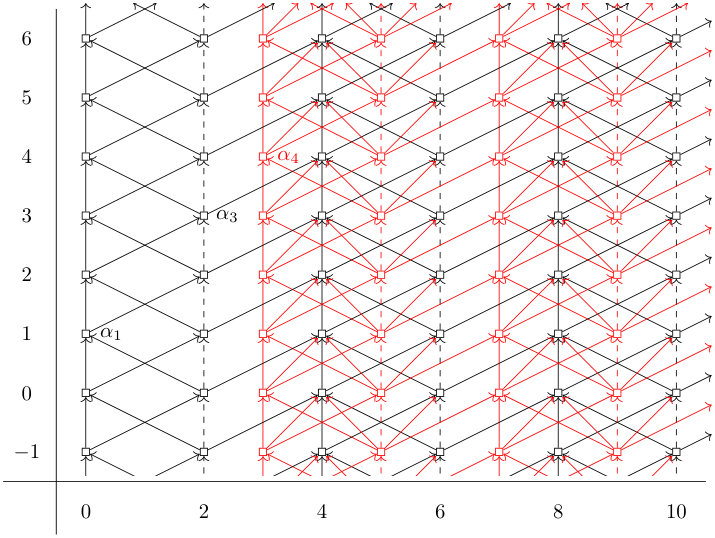 Figure 1
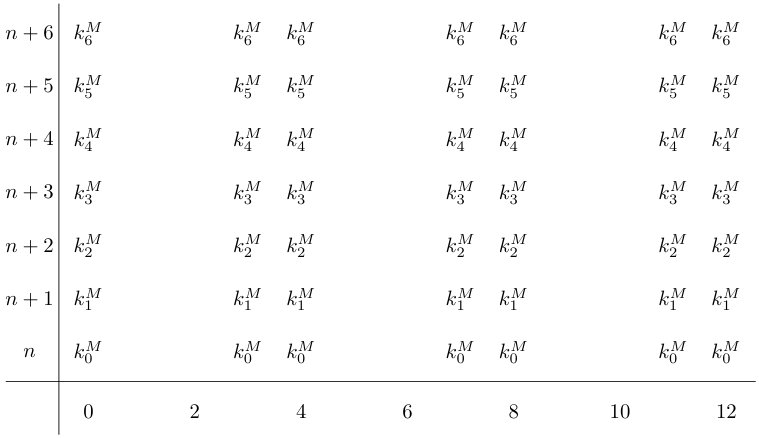 Figure 2
Peer Reviews
No public reviews on file for this paper yet. If you reviewed it on a platform where reviews are public (OpenReview, ICLR, NeurIPS, ICML), you can paste yours below so the community can read it here.
Videos
No videos yet. Explain this paper in a talk, walkthrough, or lecture? Add one.
\newaliascnt
theoremequation \aliascntresetthetheorem
\newaliascntpropequation \aliascntresettheprop
\newaliascntlemmaequation \aliascntresetthelemma
\newaliascntcorollaryequation \aliascntresetthecorollary
\newaliascntclaimequation \aliascntresettheclaim
\newaliascntconjectureequation \aliascntresettheconjecture
\newaliascntquestionequation \aliascntresetthequestion
\newaliascntdefnequation \aliascntresetthedefn
\newaliascntexampleequation \aliascntresettheexample
\newaliascntremarkequation \aliascntresettheremark
\newaliascntconventionequation \aliascntresettheconvention
The homotopy groups of the -periodic motivic sphere spectrum
Kyle Ormsby
Reed College
and
Oliver Röndigs
Universität Osnabrück
Abstract.
We compute the homotopy groups of the -periodic motivic sphere spectrum over a field of finite cohomological dimension with characteristic not and in which a sum of four squares. We also study the general characteristic [math] case and show that the -periodic slice spectral sequence over determines the -periodic slice spectral sequence over all extensions . This leads to a speculation on the role of a “connective Witt-theoretic -spectrum” in -periodic motivic homotopy theory.
Key words and phrases:
Motivic homotopy theory, stable motivic homotopy sheaves
2010 Mathematics Subject Classification:
14F42
K.O. was partially supported by NSF grant DMS-1709302; O.R. was partially supported by the DFG SPP 1786.
1. Introduction
The motivic sphere spectrum is the unit object in the tensor triangulated stable homotopy category of motivic spectra over a field . In this category, both the simplicial circle and the punctured affine line are -invertible, so it is crucial that we understand the bigraded homotopy groups where . See the introduction to [17] for a more complete discussion of the importance of this ring.
The motivic Hopf map represented by the canonical -torsor plays an especially important role in . This class is non-nilpotent over all fields [14] and thus represents a first example of exotic behavior in , differentiating it from the classical stable stems. (Recall that classically, and that the Nishida Nilpotence Theorem [15] tells us that all classes of nonzero degree in the classical stable stems are nilpotent.) Let
[TABLE]
denote the -periodic sphere spectrum.111Other authors have referred to this object as the -local or -inverted sphere. We have chosen our terminology to match the language of classical -periodic homotopy theory, which seems appropriate given the emerging role of in motivic nilpotence and periodicity [3, 7]. We have (where the latter term represents the localization of the ring at the multiplicative set ), so inverting annihilates and induces an injection .
A number of authors have studied over particular fields, including M. Andrews and H. Miller [2] over , B. Guillou and D. Isaksen [8, 9] over and , and G. Wilson [23] over finite fields, local fields, and . Over , for nonnegative congruent to [math] or mod , whereas more complicated “image of ”-style patterns occur in (the bigraded homotopy groups of the -periodic -complete sphere) over and . These authors work with either the motivic Adams-Novikov or motivic Adams spectral sequence in order to produce their results. In addition to these results, Röndigs [20] has shown that over all fields of characteristic different from .
In this note, we use the -periodic slice spectral sequence to completely determine over finite-cohomological dimension fields with characteristic different from in which as a sum of four squares.222The smallest such that is a sum of squares in is called the level of and is often denoted . (The is for Stufe). By a theorem of Pfister [18], is always a power of . See [11, Examples XI.2.4] for examples of fields of various levels. Let denote the Witt ring of quadratic forms over modulo the hyperbolic plane.
Main Theorem** (see Section 4).**
Let be a field of finite cohomological dimension with characteristic not . If is a sum of four squares in , then
[TABLE]
where and . In particular, the bigraded homotopy groups of are
[TABLE]
In Section 4 (see also [17, Theorem 5.5]), we see that for fields satisfying the same hypotheses, for , so we have also computed a bi-infinite range of homotopy groups of the motivic sphere spectrum.
The picture is less clear for fields of characteristic [math] with cohomological dimension greater than , but we are able to produce some partial results in Section 4. Let denote the -periodic slice spectral sequence over . In Section 4, we show that determines for any field extension . This leads to a conjecture on the differentials in and some speculations regarding the structure of in general.
Acknowledgments
The first named author thanks Paul Arne Østvær, Glen Wilson, and participants at the conference Motivic Homotopy Groups of Spheres III who gave particularly helpful feedback during an early stage of this project. Both authors thank Tom Bachmann for a helpful discussion regarding Section 4.
The spectral sequence diagrams in this paper were produced with Hood Chatham’s LaTeX package spectralsequences.
2. The -periodic slice spectral sequence
In this section, we set up the -periodic slice spectral sequence and discuss its convergence properties and first two pages over a general field of characteristic different from .
We refer to [22] for the setup of the slice spectral sequence, and only briefly recall some pertinent facts here. The sphere spectrum is effective and thus has a slice tower of the form
[TABLE]
where is the -th effective cover of and is the -th slice of . Associated with this tower is the slice spectral sequence with -page . (If we need to refer to the base field, then we will denote this spectral sequence .) The differentials take the form .
The following theorem states the basic convergence properties of ; it is a concatenation of [22, Theorem 3.50] and [17, Theorem 1.3]. Recall that the -complete sphere spectrum is where is the cofiber of .
Theorem \thetheorem.
The slice spectral sequence for conditionally converges to . Moreover, if , then and the slice spectral sequence for converges conditionally to .
We also have control over via the following slice computation. We let denote the cohomology of the -Hopf algebroid in cohomological degree and internal degree . (Recall that this is the -page of the Novikov, i.e., -Adams, spectral sequence from topology.)
Theorem \thetheorem ([22, Theorem 2.2]).
The -th slice of the motivic sphere spectrum is
[TABLE]
at least after inverting the exponential characteristic of the base field.
We refer to [19] for basic facts about , and we use its naming conventions for elements. Importantly, there is a single nonzero class that represents . Multiplication by induces a map of spectral sequences . Taking the colimit of the tower given by iterating this map produces the -periodic slice spectral sequence, . We will analyze the target and convergence properties of momentarily, but it certainly appears that this construction ought to say something about or a related object.
There is another obvious spectral sequence we could consider, namely the slice spectral sequence for , but it turns out that the two spectral sequences are the same. For a motivic spectrum , recall from [22, Definition 3.1] that is the slice completion of .
Theorem \thetheorem.
The slice spectral sequence for and are isomorphic as spectral sequences. They both have first page additively isomorphic to and conditionally converge to in the sense of [6]. If , then and the isomorphic spectral sequences conditionally converge to .
Remark \theremark.
In Section 2 and Section 3, we will see that convergence is in fact strong if has odd characteristic or . In Section 4, we will see that convergence over characteristic [math] fields to is strong.
Remark \theremark.
As a ring object, is not an -algebra [22, Remark 2.33], and our identification of in Section 2 is not multiplicative. By a bi-degree argument and the general properties of slice multiplicativity given in [22, Section 2.4], the multiplication on agrees with the “naive” multiplication up to addition of some terms involving . Our determination of does not depend on the precise multiplicative structure, and we will see in Section 2 that the multiplication on is fairly simple.
Proof of Section 2.
Let denote the slice spectral sequence for . Then
[TABLE]
by [22, Theorem 2.35].333Although Section 2 holds after inverting the exponential characteristic, the slices are known without inverting the exponential characteristic. The reason is that if is a field of odd characteristic , then multiplication with is an isomorphism on the Witt ring of , and hence on . In particular, the canonical map takes to a unit and hence induces a map . By [2, Corollary 6.2.3], . Given this result and the form of in Section 2, we conclude that is an isomorphism, and it follows that .
Our first convergence statement is formal given the construction of the slice spectral sequence (see [22, §3.1]). For the second convergence statement, Section 2 tells us that when . Given the conditional convergence conditions of [6, Definition 5.10], our result follows as long as the sequential colimit that inverts commutes with the limit defining slice completion. Our assumption on cohomological dimension implies a vanishing line parallel to -multiplication, and hence the limit in question is finite and commutes with sequential colimits. ∎
This leads us to the main theorem of this section, a determination of the first slice differentials and :
Theorem \thetheorem.
Over any field of characteristic different from , the first slice differential for has the form
[TABLE]
Here the -th column, , gives the first slice differential restricted to the summand of (the summand is [math] if ). The -th row, , describes the incoming first slice differential for the summand of (the summand is [math] if ).
This results in an isomorphism of -algebras
[TABLE]
where and has degree .
Remark \theremark.
The factor of in the definition of is not strictly necessary, but is there so that under the localization map .
Remark \theremark.
The determination of the first slice differential for complements the occurrences of multiplications with , which were used on p.11 of [17] to deduce vanishing columns in the in the Andrews-Miller range of the unlocalized slice spectral sequence.
The pattern of differentials indicated by Section 2 is represented graphically in Figure 1. The form of also implies an important convergence result, which we state presently.
Corollary \thecorollary.
If , then collapses at its -th page and converges strongly to .
Proof.
The form of (which is presented graphically in Figure 2) and the fact that imply that . This collapse along with the conditional convergence of Section 2 imply the strong convergence portion of the corollary. ∎
Our proof of Section 2 requires a fascinating detour through connective Witt -theory. Let denote the motivic spectrum representing Hermitian -theory,444The is for uadratic. let denote the -periodization of , which is the motivic spectrum representing Balmer’s higher Witt groups, and let denote the connective cover of (in the sense of Morel’s homotopy -structure).
The slices of , the -differentials of its slice spectral sequence, and the effect of on the unit map are known.
Theorem \thetheorem ([1, Theorem 19]).
Suppose the base scheme is a scheme over . Then
[TABLE]
where , , and the first slice differential takes the form
[TABLE]
(with the same conventions as Section 2). Moreover, there is a splitting of such that the unit induces an inclusion on every even summand, and on every odd summand.
Proof.
The description of the slices, as well as their multiplicative structure, is given in [1, Theorem 19]. The behaviour of the unit map follows from [22, Lemmas 2.28, 2.29]. ∎
Note that and the pattern of differentials is precisely the black portion of Figure 1. The remaining portion of (the red part of Figure 1) is handled by the following theorem.
Theorem \thetheorem.
Over , there is a unique homotopy class inducing an isomorphism on . This map induces on every summand of a slice.
Proof.
Fix . Recall from [20, Section 4] that there is a cell presentation of over of the following form. Namely, there is a sequence of cellular motivic spectra factoring the unit of as
[TABLE]
such that for every the map is -connective and the composition induces isomorphisms on . For every , there is a unique nontrivial class in such that
[TABLE]
is a homotopy cofiber sequence with inducing an isomorphism on whenever . Taking the colimit as gives a cell presentation of .
We now construct . Consider the map . Assume for induction that for some a map is given such that
- (1)
and 2. (2)
is an isomorphism.
Then the cofiber sequence above induces a long exact sequence
[TABLE]
The Andrews-Miller theorem on [2] implies
[TABLE]
showing that lifts to a map such that .
Now note that assumption (2) implies that
[TABLE]
is surjective; furthermore, the composition
[TABLE]
is the map sending to , hence an isomorphism. It follows that the map is an isomorphism, as desired. (In fact, we also get that there is a unique such that .)
Induction and the universal property of colimits now produces a map sending to . The uniqueness of follows from the Milnor exact sequence and the vanishing of (every group beging finite of order ).
Since is a map of -modules, it induces isomorphisms on for every integer . The statement on slices follows from the behaviour of the unit map on slices given in Section 2. ∎
Proof of Section 2.
As and are invariant under base change, it suffices to determine the first slice differential over . On a summand , it is of the form
[TABLE]
with elements in , and square classes of units in . The behavior of the unit map on slices from Section 2 provides immediate restrictions:
[TABLE]
The map on slices from Section 2 imposes further restrictions:
[TABLE]
Base change and the previous equations then provide the following equations:
[TABLE]
Since the composition , Adem relations imply further coefficients. Considering the component
[TABLE]
implies that . Considering the component
[TABLE]
provides that , and hence . The similar component
[TABLE]
gives only , and hence . Resorting to provides the solution and as follows. Consider the summand in generated by . The first slice differential maps it via to the top degree summand in by [22, Lemma 4.1]; here is the order of a cyclic group and divisible by four. The map
[TABLE]
induced by is the projection . Hence already after one multiplication with , the degree part of the first differential is zero on that summand. It follows that .
Given the form of the differentials, the additive calculation of is nearly the same as the proof of [21, Theorem 6.3]. The exotic multiplication on mentioned in Section 2 reduces to in the subquotient since is only potentially nonzero on terms involving an odd power of , and there are no ’s in . ∎
3. Computations for fields with odd characteristic or cohomological dimension at most 1
Given the form of and the spectral sequence’s convergence properties determined in the previous section, we can now make short work of the following computations.
Proposition \theprop.
If , then the -periodic slice spectral sequence for collapses with and converges strongly to .
Proof.
This is a specialization of Section 2. ∎
Theorem \thetheorem.
If has odd characteristic, then the -periodic slice spectral sequence for collapses with .
Proof.
Suppose has characteristic and write for the map . The essentially smooth base change functor induces a map of spectral sequences which is given by the extension of scalars map on and the identity on for . Given the form of , it suffices to show that for all , but , and by Section 3. ∎
At this point, we know that if has odd characteristic or if , then the -periodic slice spectral sequence collapses with . Paired with the conditional convergence portion of Section 2, this implies that the spectral sequence in fact converges strongly to . In order to completely determine for such , we must resolve extension problems and understand the multiplicative structure.
Suppose that or , and consider the short exact sequences
[TABLE]
obtained from the slice filtration and the determination of for a field of odd characteristic. Choose a lift of the nontrivial element in , compatible with field extensions from the prime field. If , is known to be the Witt ring by Morel’s theorem, and should be chosen as the unit. The slice filtration on coincides with the filtration by powers of the fundamental ideal , as one deduces for example from [12]. The multiplicative structure on the slice filtration then supplies a natural transformation to the sequence (3.1) from the short exact sequence
[TABLE]
solving Milnor’s conjecture on quadratic forms [16]. The convergence statement Section 2 shows that this natural transformation is an isomorphism for fields of finite cohomological dimension. Since the constructions involved commute with filtered colimits of fields, it is thus an isomorphism for any field of odd characteristic. In particular, the slice filtration is Hausdorff by the main result of [4].
Proposition \theprop.
If has odd characteristic or if , then, as a ring,
[TABLE]
where , , and . If additionally , then and this is a computation of the -periodic homotopy groups of the motivic sphere spectrum.
Proof.
The additive structure (which is simply a copy of in nonnegative simiplicial degrees congruent to [math] or mod ) follows from the above filtration considerations. There is no room for hidden extensions, so the result follows. ∎
4. Characteristic [math] fields
We now consider the -periodic slice spectral sequence over a general field of characteristic [math]. We prove that for any this spectral sequence converges strongly to . Moreover, the spectral sequence over completely determines the spectral sequence over in a manner that we make precise in Section 4. This allows us to extend the conclusion of Section 3 to fields with and to extensions of , resulting in Section 4. We conclude with a conjectural description of the differentials which we hope will inspire further work on this problem.
The structure of our argument is somewhat surprising. After proving that , we are able to put strong restrictions on the form of the differentials which may appear in . We then employ a theorem of Orlov-Vishik-Voevodsky [16] to show that for arbitrary , the differentials in are of the same form. The proscribed form of the differentials guarantees that Boardman’s , whence strong convergence follows. The primary obstruction to computing the differentials seems to be the lack of a good description of .
We make some preliminary definitions in order to start our arguments. Recall that . For , set , and for set . These classes are chosen so that under the localization map for all . Note that as a -module, is generated by . Also note (for the purposes of applying the Leibniz rule) that, up to multiplication by a unit, is the square of .
Lemma \thelemma.
The differential in is trivial.
Proof.
It suffices to prove that . We know that . Base change to provides a comparison map . Since , Section 2 implies that converges strongly to . Furthermore, every class in is detected in some .555Indeed, [13, Lemma A.1] tells us that the map is injective and computed on components by quadratic Hilbert symbols. Hilbert reciprocity then implies that is injective as well. As such, the computations of Wilson [23] over imply that . ∎
Theorem \thetheorem.
There is a nondecreasing666In fact, the sequence is strictly increasing unless it is eventually constant at . sequence of extended integers for such that if then , and if then is a permanent cycle in . The rest of the differentials in are determined by the Leibniz rule.
Remark \theremark.
The above theorem may be thought of in the following terms. In the weight -periodic slice spectral sequence, the -column of is, up to multiplication by some power of the unit , generated by , and the -column is generated by in the same sense. These columns are connected by on , where is -adic valuation.
Proof.
By Section 4 and Section 2, . If the spectral sequence does not collapse, then the first nonzero differential is necessarily of the form for some and . Since for , we in fact have . Set equal to this . The -page then has in positive stems congruent to mod and in positive stems congruent to mod (where is the -torsion in ); the -page also continues to have in nonnegative stems congruent to [math] or mod , and is [math] otherwise.
The potential targets of the terms are all [math], hence these classes are permanent. Thus the next nonzero differential in the spectral sequence (if one exists) is necessarily of the form . The -torsion terms in the -page are again permanent, and the next differential is of the form . Proceeding inductively proves the theorem. ∎
We now abstract the behavior observed in Section 4 and show that it is in fact generic.
Definition \thedefn.
For a given field , suppose that there is a nondecreasing sequence of extended integers for such that the differentials and the Leibniz rule determine . In this case, we call the profile of and say that is determined by the profile .
Theorem \thetheorem.
Let denote the profile of (guaranteed to exist by Section 4). Then for any characteristic [math] field , is also determined by the profile .
Proof.
Consider the map of map of spectral sequences induced by essentially smooth base change along . We have
[TABLE]
It remains to show that supports no higher differentials. Invoking [16, Theorem 3.3], we see that is generated in degree as a -module, so it suffices to show that for all and such that . Fix such a and consider the subextension . Let denote the corresponding map with associated map of spectral sequences . Our argument now splits into two cases: algebraic, and transcendental.
First suppose that is algebraic, in which case is a number field. Tate’s theorem [13, Theorem A.2] implies that or [math] for and we have already seen that . Recall that , so this differential kills classes at and above degree . In particular, for the target group for is [math] and hence the differential is [math]. Finally, we see that
[TABLE]
as well, as desired.
Now suppose that is transcendental, in which case [13, Theorem 2.3] implies that there is a split short exact sequence
[TABLE]
where ranges over monic irreducible polynomials in and is the residue map taking to . In particular, for , has -basis consisting of and for monic irreducible. Thus the differential kills in Milnor-degree and above. It follows that for and the same base change trick as in the previous paragraph implies that . We conclude that is determined by the profile . ∎
Theorem \thetheorem.
Let be any field of characteristic different from . Then converges strongly to . If , this target is isomorphic to .
Proof.
We have already verified this result for odd characteristic fields and fields with finite cohomological dimension. It remains to check characteristic [math] fields of arbitrary cohomological dimension. By Section 2, we have weak convergence to , so it suffices to check vanishing of Boardman’s term (for ). By [6, Remark after Theorem 7.1], it in turn suffices to check that for each tri-degree there are at most finitely many nonzero differentials . By Section 4, has profile where is the profile of . In particular, the finiteness condition on nonzero differentials is met, and we may conclude that we indeed have strong convergence. ∎
Theorem \thetheorem.
Suppose is a field of characteristic [math] which has profile . Let denote -adic valuation. If for all , then
[TABLE]
If eventually takes the value with first instance , then
[TABLE]
Proof.
This all follows from the slice filtration being the -adic filtration, representing in , the structure of the differentials in Section 4, and strong convergence in Section 4. ∎
Theorem \thetheorem.
Suppose that is not of characteristic and that is a sum of four squares in . Then, as a ring,
[TABLE]
where , , and . If additionally , then and this is a computation of the -periodic homotopy groups of the motivic sphere spectrum.
Proof.
By Section 3, we may assume without loss of generality that and that is a sum of four squares in . It is standard that the latter condition is equivalent to (see [11, Corollary X.6.20]). By Section 4, we see that the spectral sequence collapses (regardless of the profile of ). By Section 4, this proves the theorem. ∎
Corollary \thecorollary.
If and , then ; if, additionally, is not of characteristic and is a sum of four squares in , then these groups are [math] or according to whether or , respectively.
Proof.
All but the final statement was already observed in [17, Theorem 5.5]. ∎
We certainly do not expect that the -periodic slice spectral sequence collapses at its page in general. Indeed, inspired by the computations of by Guillou-Isaksen [9] over and Wilson [23] over , we make the following conjecture.
Conjecture \theconjecture.
The -periodic slice spectral sequence over has profile i.e., for all .
If Section 4 holds, then over of characteristic [math],
[TABLE]
Curiously, this makes it appear as if might fit into a “connective image of fiber sequence” of the form where is the connective cover of the -complete Witt -theory spectrum. Over , one may show that the cone on the map of Section 2 coincides with . In fact, the composition is zero, as one may deduce inductively, starting with the triviality of
[TABLE]
and continuing along the cell presentation of given in the proof of Section 2. Hence there is an induced map from the cone of to . This map induces an isomorphism on homotopy groups, hence is an equivalence by cellularity. In particular, one may express over the complex numbers as the fiber of a map .
The Adams operations on the -complete algebraic -theory spectrum consitute an action of , the units in the -adic integers. When has finite virtual cohomological dimension, the results of [10] imply that inherits an action of by Adams operations. Inverting and taking the connective cover results in Adams operations on . For any such , the difference of ring maps lifts to a map . (This can be seen by observing that is the -connective cover of and the cofiber of is the Eilenberg-MacLane spectrum associated with the homotopy module .)
The -periodic unit factors through the fiber of because is a difference of ring maps. This leads to the following conjecture, which is similar in spirit to Mahowald’s presentation of the -periodic sphere in topology.
Conjecture \theconjecture.
The map induced by the -periodic unit is an equivalence.
Work in progress of Tom Bachmann and Mike Hopkins suggests that the action of on is such that the unit map smashed with induces an equivalence . Since is -complete, this would immediately prove that . It is presumably also the case that on , in which case a comparison of slice spectral sequences would prove Section 4.
Remark \theremark.
The equivalence would also lead to a complete determination of the homotopy type and groups of . Let denote the Harrison space of orderings of . Then , which can be seen by the results of [5], a descent spectral sequence, and the fact that is a Stone space. The 2-primary arithmetic fracture square would then imply that
[TABLE]
The reference list from the paper itself. Each links out to its DOI / PubMed record.
- 1[1] A. Ananyevskiy, O. Röndigs, and P. A. Østvær. On very effective hermitian K 𝐾 {K} -theory. Math. Z. , published online:14pp., 2019. https://doi.org/10.1007/s 00209-019-02302-z.
- 2[2] M. Andrews and H. Miller. Inverting the Hopf map. J. Topol. , 10(4):1145–1168, 2017.
- 3[3] M.J. Andrews. New families in the homotopy of the motivic sphere spectrum. Proc. Amer. Math. Soc. , 146(6):2711–2722, 2018.
- 4[4] J.K. Arason and A. Pfister. Beweis des Krullschen Durchschnittsatzes für den Wittring. Invent. Math. , 12:173–176, 1971.
- 5[5] T. Bachman. Motivic and real étale stable homotopy theory. Compos. Math. , 154(5):883–917, 2018.
- 6[6] J.M. Boardman. Conditionally convergent spectral sequences. In Homotopy invariant algebraic structures (Baltimore, MD, 1998) , volume 239 of Contemp. Math. , pages 49–84. Amer. Math. Soc., Providence, RI, 1999.
- 7[7] B. Gheorghe. Exotic motivic periodicities. 2017. ar Xiv:1709.00915.
- 8[8] B.J. Guillou and D.C. Isaksen. The η 𝜂 \eta -local motivic sphere. J. Pure Appl. Algebra , 219(10):4728–4756, 2015.