Constraining the scalar-tensor gravity theories with and without screening mechanisms by combined observations
Xing Zhang, Rui Niu, Wen Zhao

TL;DR
This paper combines multiple observational tests to place new, stringent constraints on scalar-tensor gravity theories, including screened modified gravity and Brans-Dicke models, showing their deviations from general relativity are tightly limited.
Contribution
It provides the first comprehensive analysis of observational constraints on scalar-tensor theories with screening mechanisms, improving bounds by over seven orders of magnitude in some cases.
Findings
LLR measurements set the strongest constraints on SMG.
Cassini experiment provides the tightest bounds on Brans-Dicke theories.
All tests are consistent with general relativity, tightening limits on deviations.
Abstract
Screened modified gravity (SMG) and Brans-Dicke (BD) gravity are typical examples of scalar-tensor theories with and without screening mechanisms, which can suppress the scalar field in dense regions. In this paper, we investigate the tests of time-varying gravitational constant , gravitational dipole radiation, and Nordtvedt effect in BD and SMG theories, respectively. We place new constraints on these theories by combining Cassini experiment, lunar laser ranging (LLR) measurements, and pulsar observations from PSRs J17380333 and J03480432. We find that screening mechanism has important influence on theoretical constraints. The strongest, second, and weakest constraints on BD are from Cassini, pulsar, and LLR tests, respectively. The most stringent constraint on SMG comes from LLR measurements and improves the previous best constraint by more than seven orders of magnitude. We…
Click any figure to enlarge with its caption.
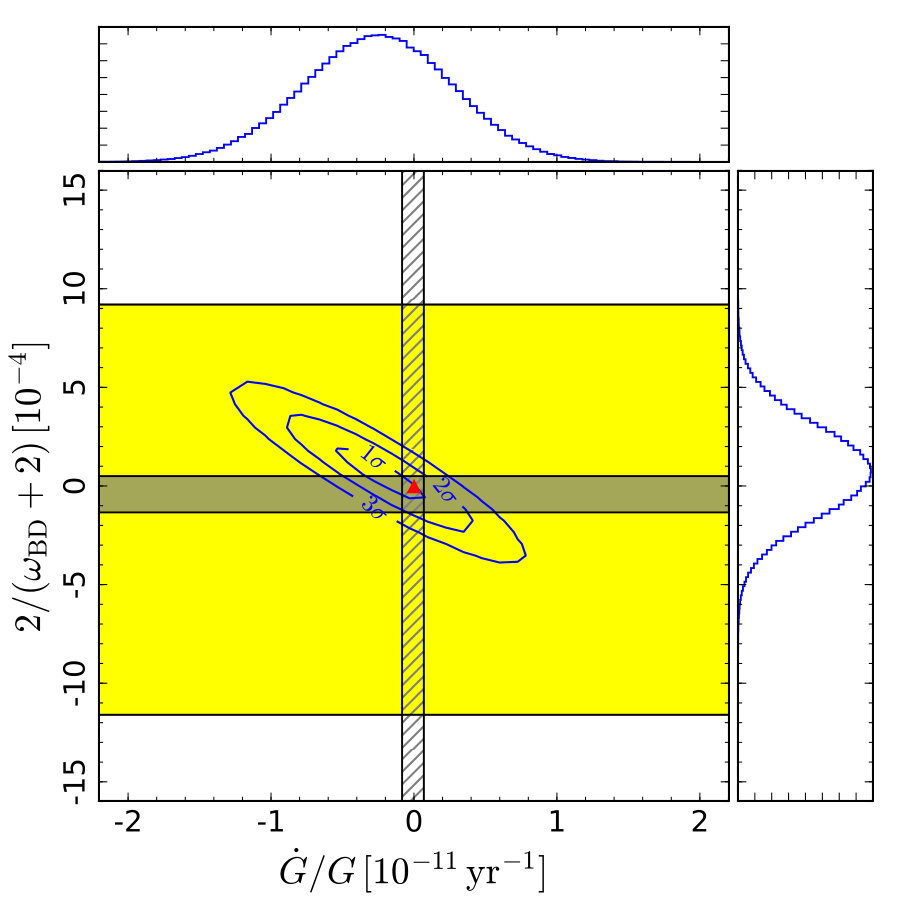 Figure 1
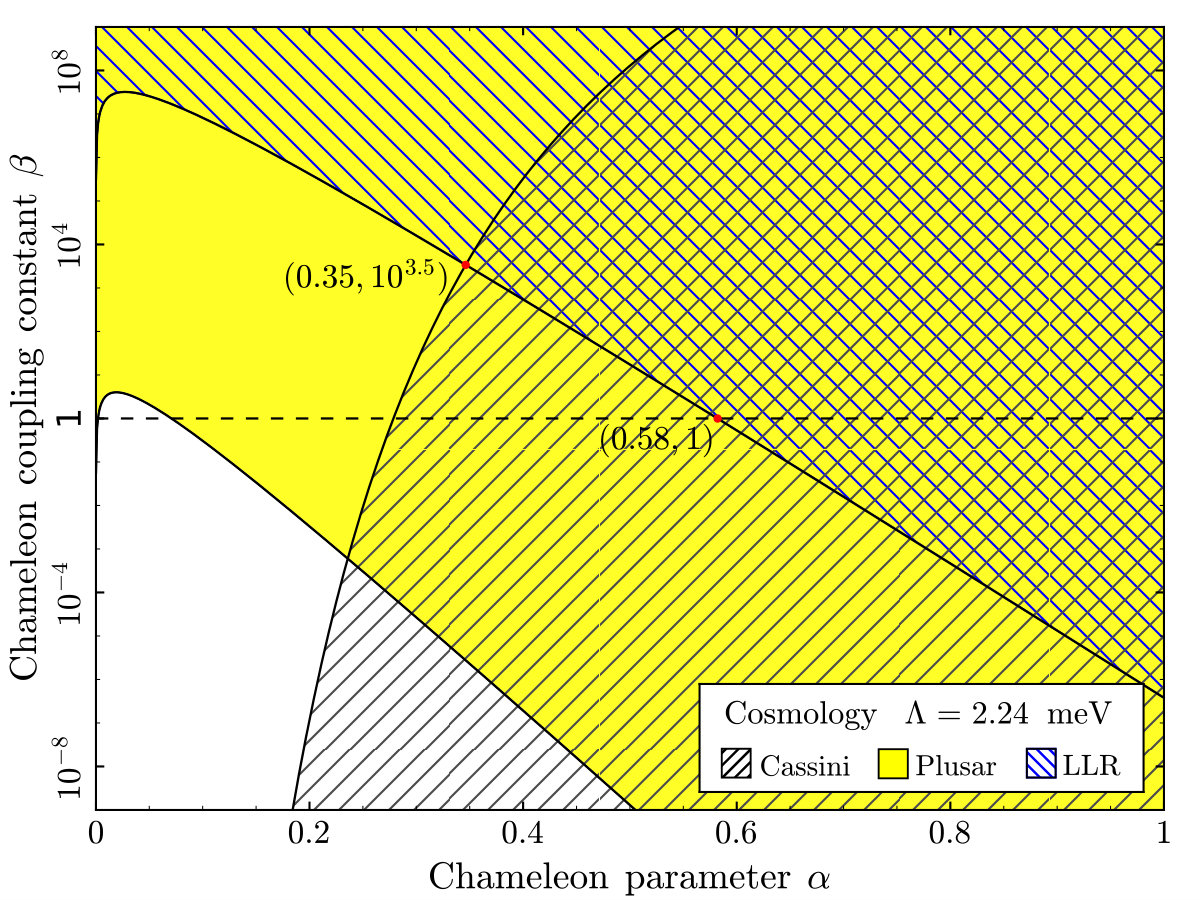 Figure 2
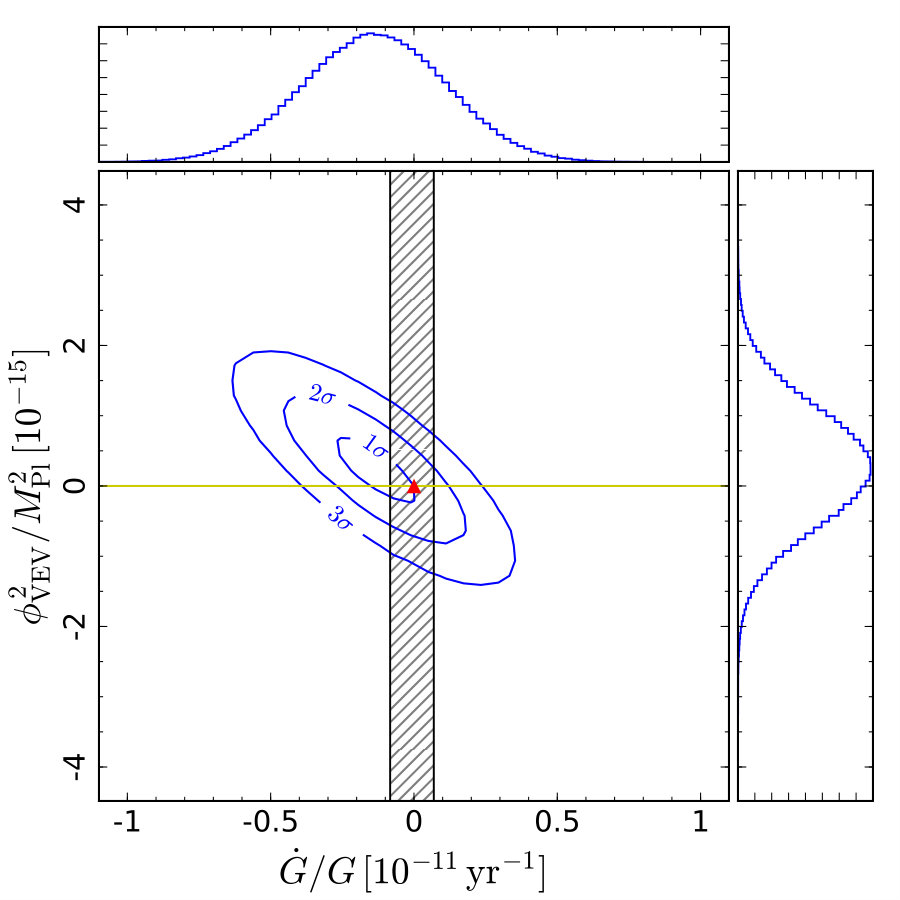 Figure 3
Peer Reviews
No public reviews on file for this paper yet. If you reviewed it on a platform where reviews are public (OpenReview, ICLR, NeurIPS, ICML), you can paste yours below so the community can read it here.
Videos
No videos yet. Explain this paper in a talk, walkthrough, or lecture? Add one.
Constraining the scalar-tensor gravity theories with and without screening mechanisms by combined observations
Xing Zhang1,2
Rui Niu1,2
Wen Zhao1,2
1 CAS Key Laboratory for Researches in Galaxies and Cosmology, Department of Astronomy,
University of Science and Technology of China, Chinese Academy of Sciences, Hefei, Anhui 230026, China
2 School of Astronomy and Space Science, University of Science and Technology of China, Hefei 230026, China
Abstract
Screened modified gravity (SMG) and Brans-Dicke (BD) gravity are typical examples of scalar-tensor theories with and without screening mechanisms, which can suppress the scalar field in dense regions. In this paper, we investigate the tests of time-varying gravitational constant , gravitational dipole radiation, and Nordtvedt effect in BD and SMG theories, respectively. We place new constraints on these theories by combining Cassini experiment, lunar laser ranging (LLR) measurements, and pulsar observations from PSRs J17380333 and J03480432. We find that screening mechanism has important influence on theoretical constraints. The strongest, second, and weakest constraints on BD are from Cassini, pulsar, and LLR tests, respectively. The most stringent constraint on SMG comes from LLR measurements and improves the previous best constraint by more than seven orders of magnitude. We derive the bounds on the cosmological evolution of the scalar background in these theories using the time variation of . The results of all tests agree well with general relativity (GR) and give more stringent constraints on the deviations from GR. Finally, as an example, we consider the chameleon model and derive the constraints on the model parameters.
I Introduction
Einstein’s general relativity (GR) is one of the two pillars in modern physics. Nevertheless, it suffers from the dark matter and dark energy problems Cline (2013); Sahni (2004), and cannot be quantized as other field theories Kiefer (2007); DeWitt (1967). Therefore, there are countless attempts to develop alternative theories of gravity. One of the most simple and popular alternative theories is scalar-tensor theory Fujii and Maeda (2007); Damour and Esposito-Farese (1992); Gannouji et al. (2006), in which the gravitational interaction is mediated by an underlying scalar field and the tensor field of GR.
In scalar-tensor theory, the gravitational constant is controlled by the background scalar field which can vary with the expansion of the Universe Uzan (2011). The time variation of generally indicates a violation of strong equivalence principle (SEP) Will (1993, 2014), and leads to an important contribution to the time change in the orbital period of the binary systems Nordtvedt (1990). The SEP violation causes the two centers of gravitational and inertial masses of compact system to separate from each other, which induces a mass dipole moment. As binaries orbit each other, the mass dipole moment will emit gravitational dipole radiation, which dominates the orbital decay of asymmetric binary systems. Therefore, one often has to consider both the variation of and the dipole radiation in a strong-field testing gravity with binary pulsars Nice et al. (2005); Lazaridis et al. (2009); Freire et al. (2012); Zhu et al. (2015, 2018). Moreover, because of the SEP violation, compact objects with different gravitational self-energy feel different accelerations in the additional field, which is called the Nordtvedt effect Nordtvedt (1990) and has been tightly constrained by lunar laser ranging (LLR) experiment Hofmann et al. (2010).
Both Brans-Dicke (BD) gravity C. Brans (1961) and screened modified gravity (SMG) Brax et al. (2012) are examples of a scalar-tensor theory. BD gravity is the earliest and most widely studied scalar-tensor theory of gravity, and it predicts stronger non-GR effects in strong-field regime Will (1993, 2014). Therefore, the strong-field tests of scalar-tensor gravity are mostly based on BD gravity. SMG is a kind of scalar-tensor theories of gravity with screening mechanisms, including chameleon Khoury and Weltman (2004), symmetron Hinterbichler and Khoury (2010), dilaton Damour and Polyakov (1994), and Sotiriou and Faraoni (2010); De Felice and Tsujikawa (2010) theories. SMG theories operate an environment-dependent scalar field and suppress the scalar force in dense regions, therefore the deviations from GR become smaller and weaker in strong-field regime, which is completely different from BD gravity (without screening mechanism).
In this paper, we study the gravitational dipole radiation, the time variation of , and the Nordtvedt effect in BD and SMG theories, respectively, which allows us to test the violation of SEP with current observations. We place new constraints on dipole radiation and time-varying by performing Monte Carlo simulations and combining the Solar system tests (LLR measurements and Cassini experiment) and the pulsar observations (from PSRs J17380333 and J03480432). It turns out that there are huge differences between the constraints on theories with and without screening mechanisms. The Cassini experiment, pulsar observations, and LLR measurements are the strongest, second, and weakest constraints on BD gravity, respectively. We find that the most stringent constraint on SMG from LLR measurements in the Earth-Moon system is several order of magnitude more stringent than the pulsar observations, because in this theory the binary pulsar is a strong screening system relative to the Earth-Moon system. The LLR constraint on in the two theories is also more stringent than the pulsar observations. Using the constraints on , we derive the constraints on the time evolution of the scalar background in the two theories, which differ by several orders of magnitude because of screening mechanism. The results about SMG are generically applicable, as an example, we consider the exponential chameleon model and derive the constraints on this model. In this paper all tests show good agreement with GR and all the previous works and yield very stringent constraints on the strong-field deviations from GR.
The plan of the paper is as follows. In Sec. II, we study the orbital period decay effect and the Nordtvedt effect in SMG and BD gravities, respectively. In Sec. III, we place the constraints on the two theories by combining the observations of the Solar system and the binary pulsars. In Sec. IV, we apply our results to the exponential chameleon model and derive the constrains on the model parameters. Our conclusions are summarised in Sec. V.
II BD and SMG
In this section we investigate the orbital period decay of binary pulsars caused by dipole radiation and time-varying in BD and SMG theories, then discuss the Nordtvedt effect due to the violation of SEP in these theories. These will allow us to place constraints on these theories.
II.1 Orbital Period Decay
The change in the orbital period of the binary pulsars is related to the damping of the orbital energy due to the emission of gravitational waves (GWs). In fact, the monitoring of the orbital period led to the first indirect detection of GWs Hulse and Taylor (1975); Taylor and Weisberg (1982, 1989). The orbital period decay caused by dipole radiation in an elliptical binary system is given by Will (1993, 2014); Zhang et al. (2019, 2019)
[TABLE]
where is a model-dependent constant that quantifies the contribution of the dipole radiation induced by self-gravity, in GR, but it is generally not the case in SEP-violating theories of gravity. The quantity is the -th object’s sensitivity, defined by Eardley (1975), which describes the response of the gravitational binding energy to the external gravitational field. In general, and take different values for different theories of gravity. In these theories under consideration, and for BD Will (1993, 2014), and and for SMG Zhang et al. (2019). Here, is a dimensionless parameter of BD gravity, and is the scalar background111In this paper, the scalar background in BD is labeled as . in SMG (i.e., the vacuum expectation value (VEV) of the scalar field). The quantity () is the negative of the gravitational self-energy per unit mass, is the -th object’s compactness (i.e., negative gravitational potential at the surface), and they are of the same order of magnitude. Note that in BD is positively correlated to the compactness, but on the contrary in SMG, is inversely proportional to the compactness, which is the most important difference between the theories with and without screening mechanisms.
In scalar-tensor theory, the gravitational constant can become time-dependent and vary with the expansion of the Universe. Nordtvedt Nordtvedt (1990) first pointed out that a time-varying leads to an additional contribution to the change in the orbital period of the binary system. To leading order, the change rate in the orbital period due to is given by Nordtvedt (1990)
[TABLE]
where is the body-dependent quantity, defined by Nordtvedt (1990). In these theories under consideration, for in BD Will (1993, 2014), and for in SMG Zhang et al. (2017).
In most alternative theories of gravity, both dipole radiation and time-varying appear simultaneously. Therefore, one often has to consider both effects for testing GR using binary pulsars.
II.2 Nordtvedt Effect
Most alternative theories of gravity predict that strongly self-gravitating bodies do not follow geodesics of the background spacetime, massive bodies with different gravitational binding energy feel different accelerations, which leads to the violation of SEP in these theories. This is known as the Nordtvedt effect Nordtvedt (1968a, b), usually parametrized by the Nordtvedt parameter (also called the SEP violation parameter),
[TABLE]
where is the negative of the gravitational self-energy per unit mass, and and are the inertial and gravitational masses of bodies, respectively. In GR , but it is generally nonzero in alternative theories that violate the SEP. The relative acceleration of two bodies and in an external gravitational potential is then
[TABLE]
where for a source of spherically symmetric mass distribution. This leads to detectable effects in the Solar system. Most notably, it leads to an Earth-Moon range oscillation in the gravitational field of the Sun Nordtvedt (1968b, 1982), which can be constrained by using LLR experiment Hofmann et al. (2010).
In BD gravity, is a body-independent constant, given by Will (1993, 2014). Below let us derive the Nordtvedt parameter in SMG. The Nordtvedt effect results in an anomalous difference in the accelerations of two different objects in an external gravitational field. Therefore, the Nordtvedt parameter can be extracted from the equations of motion. In the previous work Zhang et al. (2019), we have derived in detail the -body equations of motion in SMG, and up to Newtonian order, given by
[TABLE]
with
[TABLE]
where is the acceleration of the -th object, is the unit direction vector from the -th object to the -th object, and . The quantity is the effective gravitational constant between two objects and , is the scalar charge of the -th object, defined by Zhang et al. (2019). Now, considering a pair of bodies and moving in the gravitational field of a third body , in the case of and , from Eq. (5) the relative acceleration is
[TABLE]
By comparing with (4), yields
[TABLE]
Note that, unlike in BD (body-independent constant), in SMG is the three-body-dependent parameter. The results of this section will allow us to test these theories of gravity with current observations in the next section.
III Constraints
The tests of dipole radiation and time-varying need any two binary pulsars with different orbital periods to break the degeneracy between Eqs. (1) and (2), because of and . We use two different pulsar-white dwarf binaries, namely PSRs J17380333 Freire et al. (2012) and J03480432 Antoniadis et al. (2013), with the system parameters shown in Table 1. Note that the intrinsic value of has been given by subtracting the kinematic effect Damour and Taylor (1991) and Shklovskii effect Shklovskii (1970) from its observed value. The excess orbital period change can be obtained by subtracting predicted by GR’s quadrupole radiation from the intrinsic . The excess comes from the contributions of the below physical effects, Damour and Taylor (1991), where and are the contributions from mass loss and tidal effects, respectively. In the two systems under consideration, and can be neglected, because they are much smaller than the uncertainty in the measurement of the excess .
Each pulsar system provides a constraint on , which allows us to test the dipole radiation and time-varying over the time span of the observation. Using this and Eqs. (1) and (2), and performing Monte Carlo simulations, yields the constraints on dipole radiation and time-varying as shown in Figure 1. The individual constraints at 68.3% confidence level (CL) are for BD
[TABLE]
and for SMG
[TABLE]
These yield the bounds on the theoretical parameters at 95.4% CL,
[TABLE]
and
[TABLE]
LLR test of the Nordtvedt effect and a variation in the gravitational constant are given by and at 68.3% CL in the literature Hofmann et al. (2010). Using the LLR constraint on , we obtain the two following bounds at 95.4% CL,
[TABLE]
and
[TABLE]
which improves the previous best constraint on . The above results are also shown by the yellow region in Figure 1. Comparing the pulsar and LLR constraints, we can see that the pulsar constraint is more stringent than the LLR constraint for BD gravity, but for SMG the LLR constraint is around seven order of magnitude more stringent than the pulsar constraint. This is because in SMG the binary pulsar is a strong screening system relative to the Solar system.
For BD gravity, combining the LLR constraint on and the pulsar constraint on from PSR J17380333, we obtain a better bound of (95.4% CL), which is still weaker than the limit 40000 from the Cassini experiment Bertotti et al. (2003); Perivolaropoulos (2010). Using the parametrized post-Newtonian (PPN) parameter in BD Will (1993, 2014), and combining the Cassini constraint on Bertotti et al. (2003) and the pulsar constraint on from PSR J17380333, we obtain a better bound of (68.3% CL) relative to the constraint from two pulsars (9).
For in BD Will (1993, 2014) and in SMG Zhang et al. (2017), the constraint on can be translated directly to a bound on the time variation of the scalar background. Using the LLR constraint on , we obtain the two following bounds at 68.3% CL,
[TABLE]
and
[TABLE]
Note that, we would like to emphasize that above all results about SMG are generically applicable to all SMG theories, which includes chameleon Khoury and Weltman (2004), symmetron Hinterbichler and Khoury (2010), dilaton Damour and Polyakov (1994), and Sotiriou and Faraoni (2010); De Felice and Tsujikawa (2010) theories. In the next section we consider the chameleon model as an example.
IV Application to Chameleon
The most important one of the SMG theories is the chameleon model, introduced as a screening mechanism by Khoury and Weltman Khoury and Weltman (2004). The chameleon operates an environment-dependent scalar field, which can acquire a large mass in dense regions to suppress the fifth force. The original model has already been ruled out by the combined constraints from the Solar system and cosmology Hees and Fuzfa (2012); Zhang et al. (2016). However, the idea of chameleon can be resurrected by an exponential potential and an exponential coupling function Brax et al. (2004),
[TABLE]
where , , and are a dimensionless constant index, a dimensionless coupling constant between chameleon and matter, and the energy scale of the theory, respectively.
The cosmological constraints require that the energy scale is close to the dark energy scale of Zhang et al. (2016); Hamilton et al. (2015). The chameleon VEV is given by (Zhang et al., 2016), where is the background matter density. Using this and the best constraint on (16) from LLR, we present the allowed region of the parameter space , marked as the blue shaded region in Figure 2. The pulsar constraint (14) from PSRs J17380333 and J03480432 is illustrated in Figure 2 by the yellow region. In addition, the PPN parameter is given by Zhang et al. (2016), from the Cassini constraint Bertotti et al. (2003), the allowed region is shown by the gray shaded region in Figure 2. We can see from this figure that if the chameleon is weakly coupled to matter (). Combining the LLR and Cassini constraints gives a stringent bound of , which improves slightly on the previously published limit of Zhang et al. (2017).
V Conclusion
As a simple generalization of GR, SMG and BD gravities are scalar-tensor theories of gravity with and without screening mechanisms, respectively. In this paper, we investigated the tests of the existence of dipole radiation and time-varying and the Nordtvedt effect in BD and SMG theories using Cassini experiment, LLR measurements, and pulsar observations from PSRs J17380333 and J03480432, respectively. We derived new constraints on dipole radiation and time-varying in these theories by combining these tests. We found that screening mechanism has significant impact on the model constraints. For BD gravity, the strongest, second, and weakest constraints are from Cassini experiment, pulsar observations, and LLR measurements, respectively. Because of the existence of screening mechanism in SMG, the LLR constraint on SMG is several order of magnitude more stringent than the pulsar observations, which also improves the previous best constraint on the scalar background. The LLR constraint on is also more stringent than the pulsar observations. We translated the constraint on into the bounds on the time evolution of the scalar background in these theories, which differ by several orders of magnitude.
As an application, we applied our results to the exponential chameleon model. We derived the combined constraints on the model parameters from Cassini, LLR, and pulsar tests, and obtained a new bound on the chameleon parameter of . Finally, we would like to emphasize that the results of all tests show good agreement with GR and all the previous works and give more stringent constraints on the deviations from GR.
Acknowledgements.
This work is supported by NSFC No. 11603020, 11633001, 11173021, 11322324, 11653002, 11421303, project of Knowledge Innovation Program of Chinese Academy of Science, the Fundamental Research Funds for the Central Universities and the Strategic Priority Research Program of the Chinese Academy of Sciences Grant No. XDB23010200.
The reference list from the paper itself. Each links out to its DOI / PubMed record.
- 1Cline (2013) D. Cline, Springer Proc. Phys. 148 , pp.1 (2013) . · doi ↗
- 2Sahni (2004) V. Sahni, The physics of the early universe. Proceedings, 2nd Aegean School, Ermoupolis, Greece, September 22-30, 2003 , Lect. Notes Phys. 653 , 141 (2004) , [,141(2004)], ar Xiv:astro-ph/0403324 [astro-ph] . · doi ↗
- 3Kiefer (2007) C. Kiefer, Quantum Gravity (Oxford University Press, 2007). · doi ↗
- 4De Witt (1967) B. S. De Witt, Phys. Rev. 160 , 1113 (1967) , [3,93(1987)]. · doi ↗
- 5Fujii and Maeda (2007) Y. Fujii and K. Maeda, The scalar-tensor theory of gravitation , Cambridge Monographs on Mathematical Physics (Cambridge University Press, 2007). · doi ↗
- 6Damour and Esposito-Farese (1992) T. Damour and G. Esposito-Farese, Class. Quant. Grav. 9 , 2093 (1992) . · doi ↗
- 7Gannouji et al. (2006) R. Gannouji, D. Polarski, A. Ranquet, and A. A. Starobinsky, JCAP 2006 , 016 (2006) . · doi ↗
- 8Uzan (2011) J.-P. Uzan, Living Rev. Rel. 14 (2011), 10.12942/lrr-2011-2 . · doi ↗