Generalized Stieltjes and other integral operators on Sobolev-Lebesgue spaces
Pedro J. Miana, Jes\'us Oliva-Maza

TL;DR
This paper investigates generalized Stieltjes operators on Sobolev-Lebesgue spaces, establishing their boundedness, spectral properties, and relationships with other integral transforms, expanding understanding of their functional analysis characteristics.
Contribution
It provides explicit spectral descriptions, norm calculations, and factorization properties of generalized Stieltjes operators on Sobolev spaces, using innovative subordinate operator techniques.
Findings
Operators are bounded under certain conditions on parameters.
Spectra of the operators are explicitly characterized.
Connections with Fourier, Hilbert transforms, and convolution are established.
Abstract
For , the generalized Stieltjes operators defined on Sobolev spaces (where is the fractional order of derivation and these spaces are embedded in for ) are studied in detail. If , then operators are bounded (and we compute their operator norms which depend on ); commute and factorize with generalized Ces\'{a}ro operator on . We calculate and represent explicitly their spectrum set . The main technique is to subordinate these operators in terms of -groups and transfer new properties from some special functions to Stieltjes operators. We also prove some…
Click any figure to enlarge with its caption.
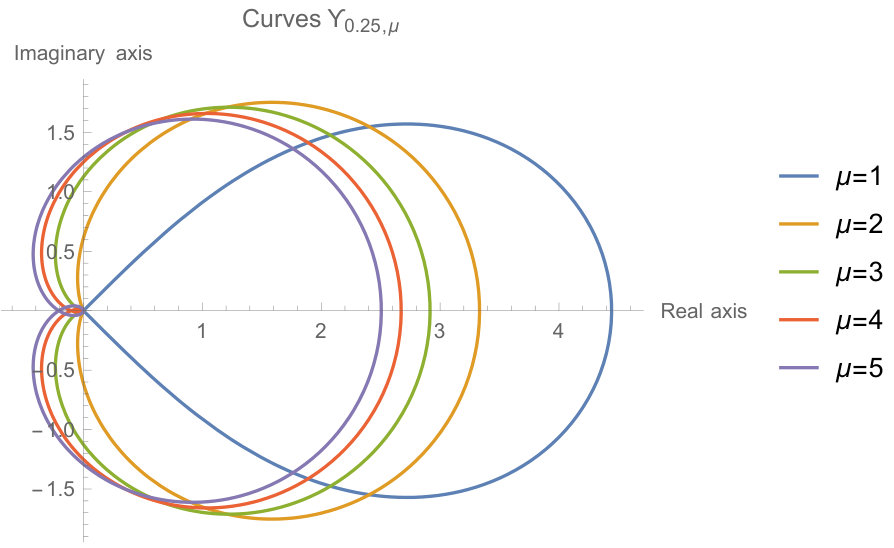 Figure 1
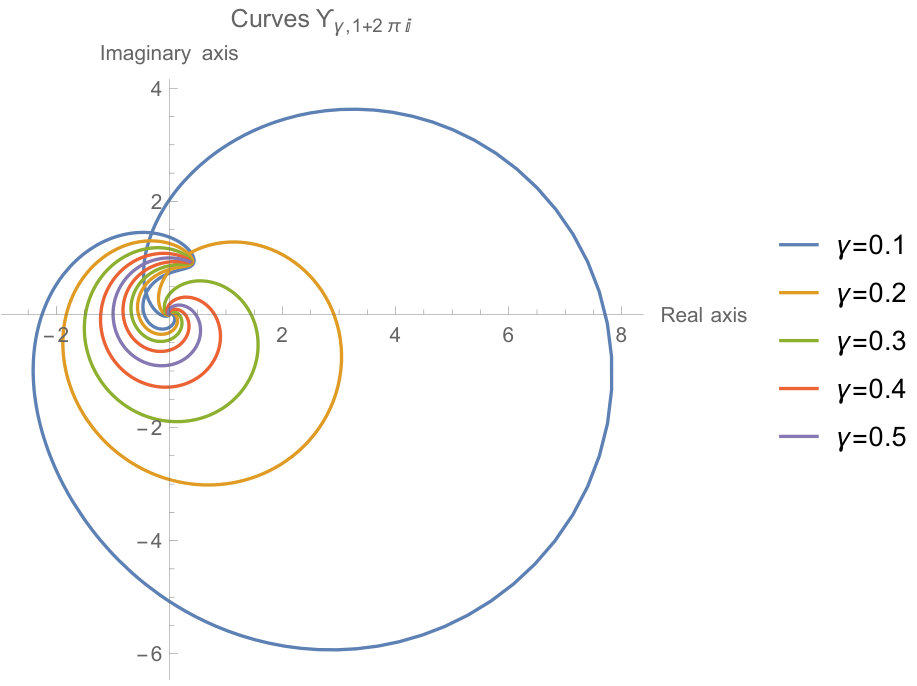 Figure 2
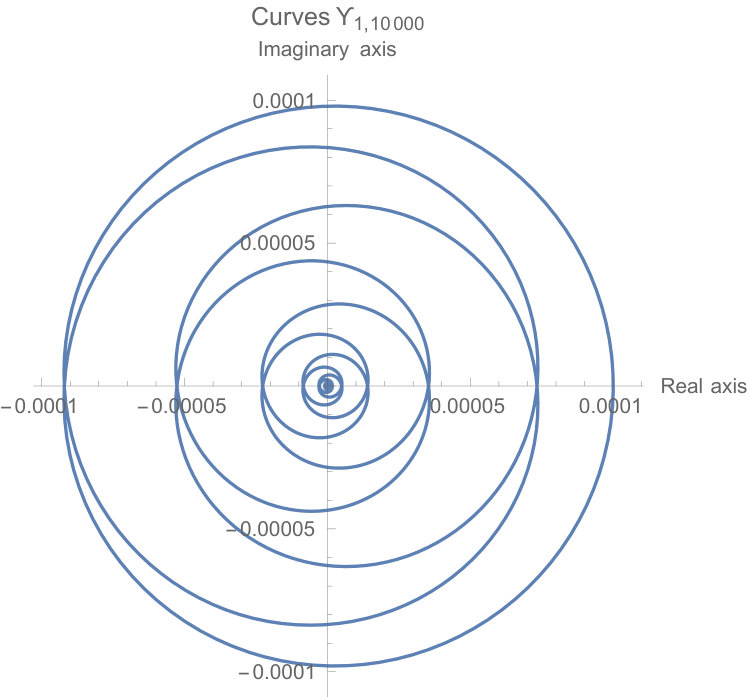 Figure 3
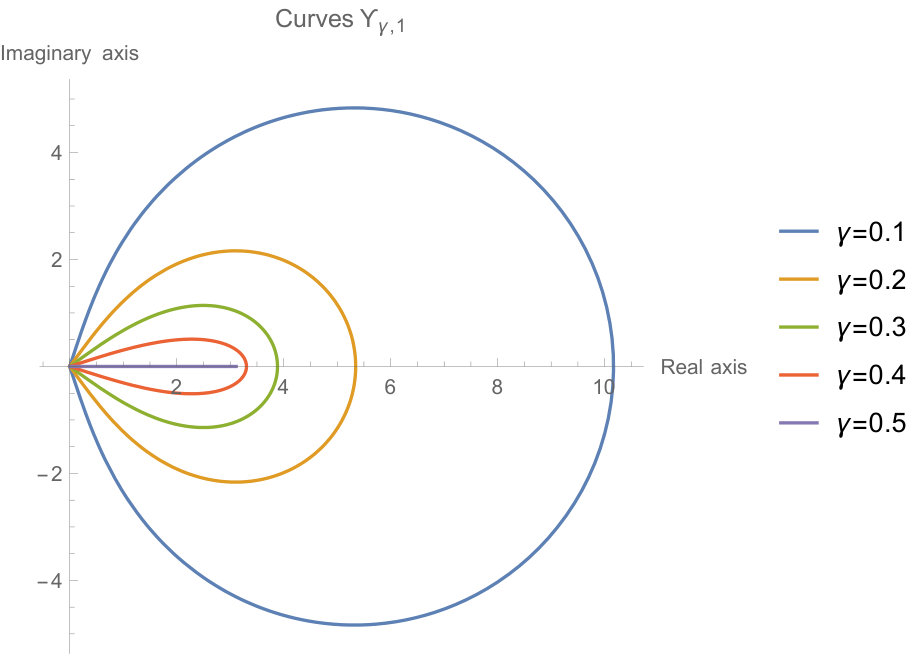 Figure 4
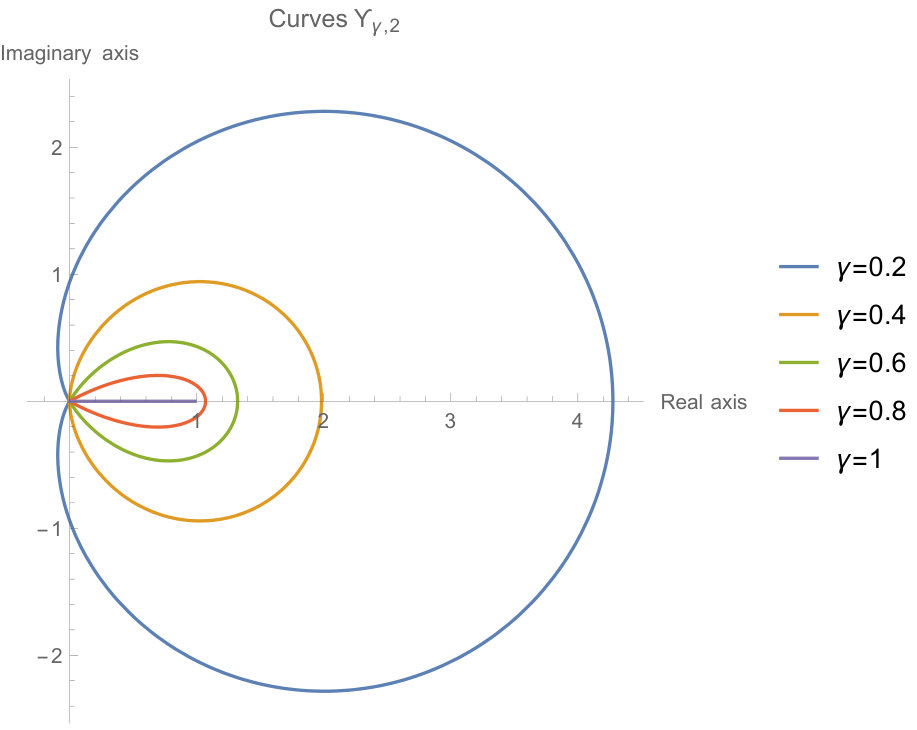 Figure 5
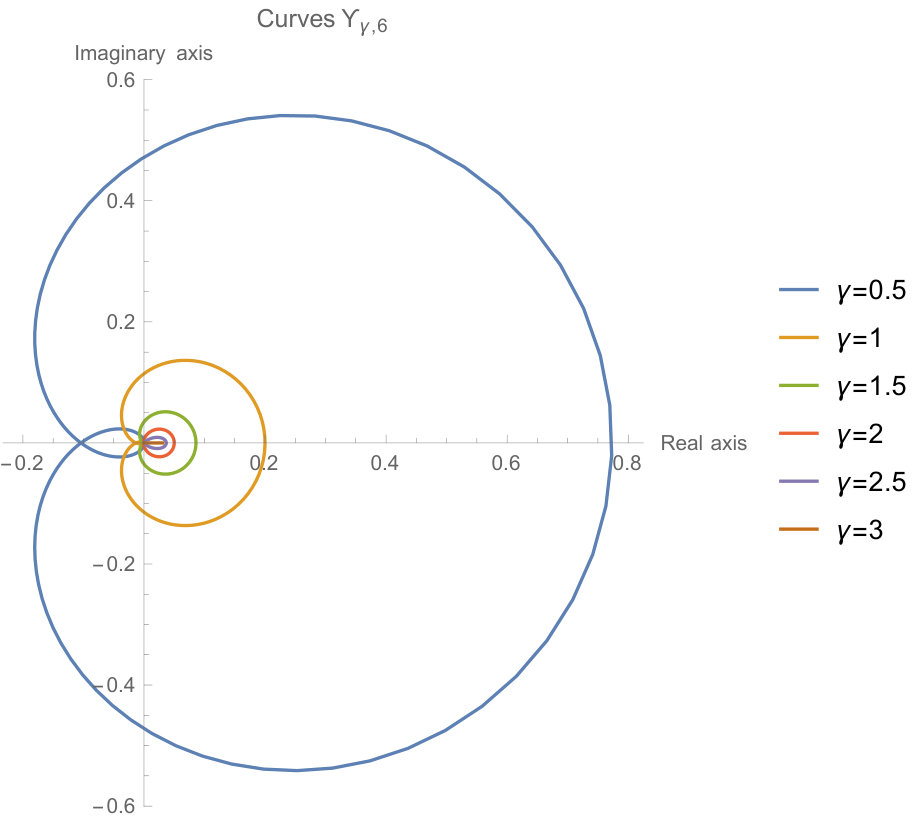 Figure 6
Peer Reviews
No public reviews on file for this paper yet. If you reviewed it on a platform where reviews are public (OpenReview, ICLR, NeurIPS, ICML), you can paste yours below so the community can read it here.
Videos
No videos yet. Explain this paper in a talk, walkthrough, or lecture? Add one.
Taxonomy
TopicsAdvanced Harmonic Analysis Research · Mathematical Analysis and Transform Methods · Differential Equations and Boundary Problems
Generalized Stieltjes and other integral operators on Sobolev-Lebesgue
spaces
Pedro J. Miana and Jesús Oliva-Maza
Departamento de Matemáticas
Instituto Universitario de Matemáticas y Aplicaciones
Universidad de Zaragoza
50009 Zaragoza, Spain
[email protected], [email protected] Authors have been partially supported by Project MTM2016-77710-P, DGI-FEDER, of the MCYTS and Project E26-17R, D.G. Aragón, Spain.
Abstract
For , the generalized Stieltjes operators
[TABLE]
defined on Sobolev spaces (where is the fractional order of derivation and these spaces are embedded in for ) are studied in detail. If , then operators are bounded (and we compute their operator norms which depend on ); commute and factorize with generalized Cesáro operator on . We calculate and represent explicitly their spectrum set . The main technique is to subordinate these operators in terms of -groups and transfer new properties from some special functions to Stieltjes operators. We also prove some similar results for generalized Stieltjes operators in the Sobolev-Lebesgue defined on the real line . We show connections with the Fourier and the Hilbert transform and a convolution product defined by the Hilbert transform.
Keywords: Stieltjes operators, Hilbert transform; Sobolev spaces; beta function; spectrum sets; convolution product.
2010 Mathematics Subject Classification: Primary 44A15, 47A10; Secondary 26A33, 44A35.
1 Introduction
The integral operator , where
[TABLE]
is the origin of different theories in many areas of Mathematical Analysis and Differential Equations in real and complex variable. For example, this operator arises naturally from the twice iteration of the classical Laplace transform.
Perhaps, T.J. Stieltjes was one of the first who studied deeply this integral operator. He treated the distribution of a measure of density on the real positive axis and the problem of the inversion, i.e. to calculate known , by means of contour integration ([38, p.473]). Later D.V. Widder proved a real inversion theorem depending only on a knowledge of and its derivatives on the positive real axis ([43]).
Given two real sequences and such that , the celebrated Hilbert’s double serie inequality states that
[TABLE]
In [37], I. Schur proved that is the best possible constant and also discovered the integral analogue of this inequality which became known as the Hilbert integral inequality in the form
[TABLE]
i.e. is a linear and bounded operator and .
H. Weyl ([42]) and T. Carleman ([9]) continued the study of integral equations
[TABLE]
Here the kernel is the quotient of two positive polynomials and of degree and respectively; in particular the case is included. This point of view was followed in [22, Theorem 319], where under the same conditions about the kernel , is proved that the integral operator
[TABLE]
is bounded on for . In particular for , the generalized Stieltjes operator where
[TABLE]
is bounded on and for (we write ). The operator is also bounded in under the restriction . Other generalization of Stieltjes operators (depends on three paremeters) are considered in [31, Exercise (4.6.12)]. Recently a explicit formula for the resolvent of the Carleman operator has been calculated in [46, Theorem 2.3]. Note also that the generalized Stieltjes transform is an iterative Laplace transform in sense that
[TABLE]
for and is the usual Laplace transform.
In this paper, our main idea is to subordinate the generalized Stieltjes operator in terms of a -group of isometries defined on two families of Sobolev-Lebesgue spaces and , which are Banach spaces continuously contained respectively in and , , where
[TABLE]
This strategy has been pursued by other authors. This -group of isometries was considered in [10] to study the property of subnormality of the Cesàro operator on . Later in [5], the Cesàro operator on the Hardy spaces of the half plane was considered again and finally in [25] the generalized Cesàro operator where
[TABLE]
with was also considered on the spaces and for and . Recently in [1], authors have applied this -group to the Stieltjes operator on the Hardy spaces of the half plane.
This subordination process can be described as an extension of the Fourier transform in abstract Banach spaces. Let be a Banach space, the set of all linear and bounded operators on a Banach space , and a -group of uniformly bounded operators on , i.e., , for ; for and ([3, Definition 3.1.19]). Let denote the map: such that
[TABLE]
Then, the map is actually well defined, is a linear and bounded operator, for and ([13, Lemma IV.3.17]). Also, is commutative in its range , because equalities hold for . Moreover, we may identify spectrum sets of bounded operators by the spectral mapping theorem,
[TABLE]
where is the Fourier transform of and is the infinitesimal generator of the -group (see for example [36, Theorem 3.1]).
The Sobolev-Lebesgue spaces and were introduced and studied in detail for in [18] and for in [32]; see also [25, Section 2 and 4]. In particular, and , so every result obtained in this article for is also applicable to spaces. Moreover, the subspace (and ) is a module for the algebra (and for ) for the convolution product given respectively by
[TABLE]
These algebras are canonical to define some algebra homomorphisms (defined by integral representations) into See further details in [18]. The parameter denotes the fractional order of derivation of the Lebesque space; for is the iterative usual derivation and for , the usual -Lebesgue spaces.
Let’s focus back on the generalized Stieltjes operators . Since the above described Sobolev-Lebesgue spaces are (continuously) contained in , a natural question arises: are these operator actually bounded in these spaces and ? And in that case, which properties may they have as bounded operators? These questions depict the main motivation of this paper, which therefore is the study of the generalized Stieltjes operators acting on and . The powerful theory of subordination to -groups of operators given in (1.3) allows us to get results regarding the boundedness, show commutative and factorization properties with the generalized Cesàro operator or to describe the spectrum set via a spectral mapping theorem. Also, we present some results involving the Hilbert and the Fourier transform, a new Hlder inequality on , and a convolution-type theorem.
Outline and main results
To present these results of the family of operators , the outline of this paper has been set as follows. In Section 2, two family of exponential functions and which belong to for properly chosen parameters, are considered. Some of their properties are derived, especially those regarding their norms on spaces, its Fourier transform (some Beta functions) as well as the calculation of some useful convolutions, in particular, for and , we have that
[TABLE]
(Proposition 2.4). These functions will play a main role to subordinate both generalized Stieltjes and Cesàro operators in terms of -groups.
In Section 3, we revisit some basic properties of the Sobolev-Lebesgue for and included in some previous papers, mainly in [25]. We prove a new Hölder inequality in Theorem 3.2: with , and conjugate exponents.
The generalized Stieltjes operator acting on the Sobolev-Lebesgue is analyzed in section 4. First of all, we are able to subordinate in terms of the -group , via the exponential functions (Section 2), as an operator on , that is
[TABLE]
This immediately shows that is bounded on and whenever and (Theorem 4.3). Its spectrum set, as operators on for , is obtained in Theorem 4.5,
[TABLE]
This result extends the following ones, both cases stated as operators on . First, , which was originally proved by Carleman in [9, p. 169], and second, for in [16, Proposition 1.1].
We are also able to give the adjoint of , which is precisely , where , obtaining an elegant relation of the generalized Stieltjes operator with its adjoint (Theorem 4.7). Finally, we give an explicit expression for the composition involving the hypergeometric Gaussian function , see details in Theorem 4.10.
In section 5, we study some properties of the generalized Stieltjes operator regarding other operators, specifically the generalized Cesáro operator and the Hilbert transform on . First, note that in [25, Theorem 3.3], one can write the generalized Cesàro operator as . Then we deduce straightforwardly that . We are also able to find an explicit expression of in terms again of the hypergeometric Gaussian function . Moreover, if , the following elegant factorization holds
[TABLE]
which it seems to be new (Theorem 5.1). The (semifinite) Hilbert transform , given by
[TABLE]
has been studied as a bounded operator on (see for example [24, Section 6.1]). Then, we prove that it is also a bounded operator on which commutes with the generalized Stieltjes transform for and , see Theorem 5.2.
In Section 6, we introduce generalized Stieltjes operators on the Sobolev-Lebesgue spaces on Again, it is relevant to mention that the -group of isometries on , is the main tool to prove the some of main results in this section (Theorem 6.4).
Note that Stieltjes operator is closer to Hilbert transform , for , a.e. where
[TABLE]
is a bounded operator from onto for and an isometry for , see a real proof in [11]. We prove that this also holds in for , that is, the operator is bounded on for , an isometry for (Theorem 6.2), and that it commutes with . Finally the connection with Fourier transform is presented,
[TABLE]
for and , (Theorem 6.5).
In section 7, we take a look at the convolution defined from to ,
[TABLE]
which can be found in [41, 44, 45], and where the following interesting relation involving the Stieltjes transform is proven. We wonder if the generalized Stieltjes operator also behaves in such elegant way. In fact, we are able to obtain a nice-looking formula for , involving a sum of products of different generalized Stieltjes operators, whenever and both are natural numbers (Theorem 7.2).
Finally in the last section, we use the software Mathematica to visualize the spectrum set of the generalized Stieltjes operators, on in some particular cases. We also present some ideas to continue this research in subspaces of for or some problems which remain open after this research.
Notation. For recall that the Banach space is the set of Lebesgue -integrable functions, that is, is a measurable function and
[TABLE]
The space be the set of measurable functions such that
[TABLE]
In the case that is a continuous function, then
Recall that the Gamma and Beta functions, also called the Euler integrals of the first kind, are defined by:
[TABLE]
and satisfy the property , where denotes the Gamma function.
2 Two families of exponential funtions on
Let introduce two families of parametrized functions, which will be denoted by and . Our interest in these functions is due to that they appear in the integral representations of the generalized Stieltjes operator and generalized Cesàro operator respectively, as we shall se in Sections 4 and 5.
We define the set of functions by
[TABLE]
Note that for and for . It is direct to check that
[TABLE]
and, in general, where is a polynomial of degree whose coefficients depends on and , that is, with
[TABLE]
To show this, note that , and one can derive the subsequent recursive formula:
[TABLE]
and , , for . Then, one can show by induction on that the given closed-form expression of coefficients is the (unique) solution of this recursive formula.
The Gaussian hypergeometric function will be needed for our next result involving the family of functions . As usual, we denote it by , and it is given by
[TABLE]
([21, Section 9.1]). A special case occurs when , then: . Even more, for it can be analytically extended via the integral
[TABLE]
([21, Formula 9.111]). We will also make use of the following identity:
[TABLE]
([21, Formula 9.131 (1)]).
Theorem 2.1
Fixed .
- (i)
* if and only if and ,*
[TABLE]
for .
- (ii)
For , if and only if and
[TABLE]
- (iii)
For , we have that
[TABLE]
- (iv)
Let be such that . Then
[TABLE]
for
Proof. (i) It is straightforward to conclude that if and only if . In this case, we have that for . Therefore . If , then if and only if , which is the point where reaches its maximum value, , claimed in the statement.
(ii) By (i), it is clear that implies that . Under this latter assumption, straightforward calculations show that actually ) and
[TABLE]
(iii) For , we have that
[TABLE]
(iv) Let , and . Then, by [21, p. 317, 3.197(1)] and 2.6, we have that
[TABLE]
for and we conclude the proof.
Some particular cases of are given in the next result. The equality in part (ii) is given in [21, p. 317, 3.197(7)].
Corollary 2.2
- (i)
For , we have
[TABLE]
in particular for and .
- (ii)
Let . Then
[TABLE]
For , we consider a second family of functions,
[TABLE]
where is the characteristic funtion on the interval . Note where for . In the last part of this section, we give first an analogous result to Theorem 2.1 for the family of functions . After that, we provide explicitly some useful convolutions involving the two families and .
Proposition 2.3
Fixed .
- (i)
* if and only if , . In that case, , and*
[TABLE]
if , .
- (ii)
For , if and only if and also, either , or for ; in both cases
[TABLE]
- (iii)
For , we have that
[TABLE]
Proof. (i) It is clear that if and only if , . Moreover, since under these assumptions , we have that . If we consider , and , then if and only if , where it reaches the maximum given in the statement.
(ii) For , we apply the change of variable to get
[TABLE]
whenever and , that is, either or and .
(iii) Applying the change of variable and assuming :
[TABLE]
for and we conclude the proof.
Proposition 2.4
Fixed . Then
[TABLE]
In particular,
- (i)
for and , we have that
[TABLE]
- (ii)
for and ,
[TABLE]
Proof. We apply the change of variable , and by identities (2.5) and (2.6), we get that
[TABLE]
for any . Since, as pointed out at the beginning of this section, , we have that:
[TABLE]
for any and we show (i). Both equalities in (ii) can be directly obtained as particular cases of the integral at the beginning of this proof.
3 Sobolev-Lebesgue spaces
Let be the class of -functions with compact support on and the Schwartz class on . For a function and , the Weyl fractional integral of order , , is defined by
[TABLE]
The Weyl fractional derivative of order is defined by
[TABLE]
where and denotes the integer part of It is proved that for any where is the identity operator, and holds with , see more details in [27, 35].
Take and define by for and . It is direct to check that
[TABLE]
for .
Now we recall a family of subspaces which are contained in with . For , the Banach space is defined as the completion of the Schwartz class in the norm
[TABLE]
[25, Definition 2.1]. As usual, We write and . The case and where introduced in [4] and for in [18].
These spaces have similar properties than the Lebesgue spaces , see [32] and [25, Proposition 2.2]. In fact the operator defined by
[TABLE]
is an isometry, i.e., and the inverse operator is given by
[TABLE]
For and , we also have that
- (i)
, with the inclusions being continuous maps.
- (ii)
for , where
[TABLE]
- (iii)
If and satisfies , then the dual of is , where the duality is given by
[TABLE]
for , .
If and then
(i) for
(ii) for ([25, Lemma 2.3]).
Remark 3.1
For , the nature of the space is different than for . One might think to define
[TABLE]
Consider (; note that and . However in the case that , note that for ,
[TABLE]
and we conclude for in the Schwarz class on . Due to, we will skip the case on this paper, although some of next results are also valid in this particular case. **
In the next theorem, we extend the Hlder inequality in Lebesgue spaces to the case of fractional Sobolev-Lebesgue spaces . Note that in the integer case , it a straightforward consequence of Leibnitz formula. To attack the general case we use the following Leibnitz formula
[TABLE]
for and [17, Proposition 2.5], where the function is given by
[TABLE]
for ; for and let in all other cases ([17, p. 313]).
Theorem 3.2
(Hlder inequality) Take and conjugate exponents. Given and then and
[TABLE]
where is a positive constant.
Proof. Take . By the Leibniz formula, we have that
[TABLE]
First, notice that by classical Hölder inequality, and the continuous inclusion , we have that
[TABLE]
For convenience and clarity of writing, we will denote all these constants by . The argument above let us bound the first two terms in the above sum by , so it is sufficient that the inequality holds for the third one, which will be the aim for the rest of the proof. We apply twice Fubini theorem in the third addend, labelled as , to get
[TABLE]
We now need to split the proof depending on . First, in the case that , is nonnegative and
[TABLE]
for , where we have applied [17, Lemma 2.2]; similarly
[TABLE]
for . Then we conclude that
[TABLE]
where for . Note that , with . Then, by the same reasoning as in 3.4, we have that
[TABLE]
So, if , the proof is finished. In the case that , the function is nonpositive and
[TABLE]
for ([17, Lemma 2.2]); similarly
[TABLE]
for . Now we consider the following inequalities,
[TABLE]
to conclude that, by the first one, for
[TABLE]
Finally for , second inequality leads to
[TABLE]
and the proof is finished.
To finish this section, we recall that the family of operators on , indicated in 1.2, which are defined by
[TABLE]
is a -group of isometries on ([25, Theorem 2.5]). The infinitesimal generator is given by
[TABLE]
with domain ; the point spectrum and the usual ([25, Proposition 2.6]). Finally the semigroups and are adjoint operators of each other acting on and with ([25, Proposition 2.7]).
As it is commented in the Introduction, the -group will be key to subordinate the generalized Stieltjes operator on the spaces , which will be done in the next section.
4 Generalized Stieltjes operators on Sobolev spaces
For , the generalized Stieltjes operator on is defined by
[TABLE]
for functions defined on , whenever the expression above may be well defined. First of all, we check how these operators act on some particular functions.
Example 4.1
(i) For , we define by
[TABLE]
Then for . Under these conditions, functions are eigenfunctions of . In particular for .
(ii) For , we get
[TABLE]
[21, p. 317, 3197(1)]; in particular, for , we have that
[TABLE]
where the function stands for the complete elliptic integral of the first kind, see for example [21, p. 255, 3.131(8)].
(iii) Take for and . For , we have that
[TABLE]
In particular for and ,
[TABLE]
where these equalities and special functions and the incomplete Gamma function may be found in [21, p. 348, 3.383]. **
As we have commented in the Introduction, the operator defines a bounded operator on for and , obtaining that ; in particular, ([22, Section 9.5, p. 232]). To extend this result in the family of spaces for and , we need the next lemma which shows a key commutativity property.
Lemma 4.2
Take and . Then , i.e.,
[TABLE]
where for and .
Proof. By the equality (3.1), we have that
[TABLE]
for , and we conclude the proof.
The first main result in this section is the following theorem.
Theorem 4.3
The operator is a bounded operator on and
[TABLE]
for and . If , then
[TABLE]
where the group is defined in (3.5), and the set of functions in (2.4).
Proof. Let , and be given. We apply the change of variable to get that
[TABLE]
and the equality (4.2) is proved. Observe that by this equality, the operator is well defined and is a bounded operator on for . Indeed, we have
[TABLE]
where we apply Theorem 2.1 (ii). To check the exact value of , we apply Lemma 4.2, the isometry (see Section 3) and the boundedness of on , to get
[TABLE]
Finally we conclude the proof.
Remark 4.4
In the case and we remark that the Stieltjes operator does not take in . Hence, the function , given by for , belongs to and
[TABLE]
Since does not belong to and , we obtain that .
In the next result, we are able to describe for suitable .
Theorem 4.5
Let and the generalized Stieltjes operator with . Then
[TABLE]
Proof. Recall is an uniformly bounded -group whose infinitesimal generator is and , see Theorem 4.3. By [36, Theorem 3.1], we obtain
[TABLE]
As (see Section 3), we apply Theorem 2.1 (iii) to conclude
[TABLE]
where we have applied that for .
Remark 4.6
In the case that and , we obtain that
[TABLE]
where we apply the Euler’s reflection formula , . For and , we have that
[TABLE]
In the last section we draw some of these families of spectrum sets.**
Now we identify the adjoint generalized Stieltjes operator on .
Theorem 4.7
For and , the adjoint generalized Stieltjes operator of on is on , i.e.
[TABLE]
where is given in Section 3 and . Note that is an injective, non-surjective and of dense range on .
Proof. First, as the operator intertwines with the operator (Lemma 4.2), we apply the Fubini theorem to get that
[TABLE]
Secondly, the injectivity of the Laplace transform and (1.1) implies the injectivity of on and then in . By Theorem 4.5, and is not invertible so, by the open mapping theorem, cannot be surjective. Moreover, as the adjoint of is injective since it is another generalized Stieltjes operator, we conclude that is of dense range on .
Then, the fact that generalized Stieltjes operators commute, immediately leads us to the following corollary.
Corollary 4.8
Let and be generalized Stieltjes operators on and respectively for . Then, . As a consequence, is a normal operator on , while is also self-adjoint for
Remark 4.9
As the operator is self-adjoint on for then the spectrum is a subset of real numers,
[TABLE]
where we have used that . This result was proved in for the operator in [9, p. 169] and finally for for in [16, Proposition 1.1].**
To finish this section, we give an explicit formula for the composition of two generalized Stieltjes operators involving the Gaussian hypergeometric function .
Theorem 4.10
Let and be the generalized Stieltjes operators on for . Then
[TABLE]
In particular, if and is a generalized Stieltjes operator on the dual space , where , we have that
[TABLE]
for and almost everywhere on .
Proof. Describing the generalized Stieltjes operators with the Sinclair map (see (4.2)) and the functions given in (2.4), it follows that . This convolution has already been obtained in Theorem 2.1 (iv). Then, applying the change of variable one concludes that
[TABLE]
Then, one can split the domain into and , and then apply the formula (2.6) to in the integral over , obtaining the first formula of the theorem.
The second formula, involving , is obtained directly from the first one and applying the expression for its adjoint operator given in Theorem 4.7.
5 Composition of generalized Stieltjes, Cesàro operators and Hilbert transform
In this section, we recall the definitions of the Cesáro operators and the Hilbert transform, and give a handful of results involving both of them and the generalized Stieltjes operators on the family of spaces. Let’s begin with the first one.
In [25] other family of bounded operators of , namely the generalized Cesàro operators , given by
[TABLE]
with are considered in detail. They define bounded operators on ,
[TABLE]
for and . Similarly to the Stieltjes operators, a key tool on the proof is to subordinate Cesàro operators in terms of the -group and write
[TABLE]
([25, Theorem 3.3]), where are the family of functions given by (2.7) in Section 2. In [25, Theorem 3.5], authors also describe the spectrum set of , i.e.,
[TABLE]
Then, after this short introduction to generalized Cesàro operators, we give a handful of results concerning the composition of these generalized Cesàro operators with the generalized Stieltjes operators. In some cases, note that the generalized Cesàro operators factorize the Stieltjes operators.
Theorem 5.1
Let , and . Then and
[TABLE]
for and . In particular,
- (i)
for , the following factorization holds
[TABLE]
- (ii)
for ,
[TABLE]
for and
Proof. As and , where is given by (1.3), we have that
[TABLE]
and both operators commute.
We consider the expression of given in Proposition 2.4, to get
[TABLE]
where we have applied the change of variable .
To show the part (i), we apply the identity (2.8) for to get
[TABLE]
Finally we apply Proposition 2.4 (ii) to conclude the proof of the last two equalities.
Now we turn to a semifinite Hilbert transform, given by
[TABLE]
for . It is known that the operator is linear, bounded and where see [24, Section 6.1]. Then, we give the following theorem about the behaviour of on and with the generalized Stieltjes operator.
Theorem 5.2
Let and be. Then
- (i)
.
- (ii)
, the operator is a bounded on , and
[TABLE]
- (iii)
* on for .*
Proof. (i) Let and be. Then
[TABLE]
Now, recall that the maximal operator defined as is -strong (see for example [12]), where
[TABLE]
Fixed and , the following inequality holds
[TABLE]
As the last function belongs to , we apply the dominated convergence theorem to conclude the proof.
(ii) By the part (i), we have that To check the norm on we have that
[TABLE]
The proof of the part (iii) is similar to (i) and is left to the reader.
To conclude this section, we detail a study of on from the rich point of view of the UMD property.
Remark 5.3
The geometric property UMD (Unconditional Martingale Difference property) was first introduced by Maurey and Pisier in the study of vector valued martingale theory ([29]) in Banach spaces . Later Burkholder together with some other authors developed a rich theory on the UMD property, and in particular the characterization of the UMD-property in terms of the vector-valued Hilbert transform: let the following bounded operator defined on for all , ,
[TABLE]
The family admits a strong limit as goes to and goes to in all , if and only if has the UMD-property ([6, 7]).
The classical examples of UMD spaces include all the finite dimensional Banach spaces and any space of the form for . If is any UMD-space, then is reflexive and is also a UMD-space; if is a closed subspace then is also a UMD-space. See, for example, [34, Section II]. In particular all spaces (and considered in the next section) are UMD-spaces for and .
In UMD-spaces, singular integrals of uniformily bounded -groups, , converges strongly to a bounded operators, i.e.,
[TABLE]
([30, Proposition 5.2]), which includes the Hilbert transform where , for , and . We show how to subordinate also the operator via the -group . As a consequence is a bounded operator on for and .
Take and and consider operators
[TABLE]
Now we change the variable to obtain
[TABLE]
where the -group is defined in (3.5). As is a -group of contractions in , the first integral defines a bounded operator. Now note that the second integral is written as
[TABLE]
The first summand defines a bounded operator due to the function is continuous on . As is a UMD-space, the second summand admits a strong limit in when goes to ([30, Lemma 4.1]). The same proof runs on the space , which will be introduced in the next section.
6 Generalized Stieltjes operators on and Fourier transform
In [25, Section 4], a family of spaces (which are contained in ) are presented in a similar way than spaces (embedded into ). Now we mention the main properties of these spaces. After that, we will study the generalized Stieltjes operator , which first has to be extended to the whole real line , on these spaces in a similar fashion we have done on .
Let be the Schwartz class on and we set
[TABLE]
, for and a natural number . Putting , it is readily seen that for all , and . Equalities and hold for each natural number and .
For , put
[TABLE]
For , we have that , where for .
For , the Banach space is defined as the completion of the Schwartz class on in the norm
[TABLE]
see [25, Definition 4.1]
Properties similar to those of hold for . For example, the subspace is a subalgebra of for the convolution product
[TABLE]
see [18, Theorem 1.8] and also [26, Theorem 2] and for , the subspace is a Hilbert space, see similar ideas in [20, Section 2]. For , the Banach space is a module for the algebra ([25, Theorem 4.3]).
Take and , then and the operator defined by
[TABLE]
is an isometry. Similarly we also define involving . For and satisfies , then the dual of is , where the duality is given by
[TABLE]
for , , see more details in [25, Proposition 4.2].
As a matter of a fact, we have that where is a copy of supported on , see the case in [19, Section 2].
Now we focus our attention on the Hilbert transform on , . As we mention in the Introduction, it is given by
[TABLE]
and it defines a bounded operator on for . Moreover, it is an isometry for . Before giving our next result, we need the following useful Lemma.
Lemma 6.1
For in the Schwartz class on and , we have
[TABLE]
Proof. Note that for , we have that
[TABLE]
and similarly
[TABLE]
and we conclude the equality.
Then, as
[TABLE]
for and ([11, Formula (2.2)]), we apply Lemma 6.1 to get
[TABLE]
We conclude that is also an isometry on for . In fact, similar properties hold on for as next result shows.
Theorem 6.2
For and .
- (i)
The Hilbert transform verifies that
[TABLE]
where for and .
- (ii)
The equality holds, and as a consequence the Hilbert transform is a bounded on , and
[TABLE]
where . In particular is an isometry on .
Proof. (i) Take . Then where for . Note that
[TABLE]
for and similarly for
(ii) Take . By the part (i), Lemma 4.2 and Theorem 5.2 (ii) we have that
[TABLE]
We prove a similar equality for . The proof of the last part is similar to the proof of Theorem 5.2 (ii).
We remark that, as in the case of , it is easy to verify that where
[TABLE]
is a -group of isometries on . Its is infinitesimal generator is given by
[TABLE]
with domain and . The semigroups and are adjoint operators of each other acting on and with for ([25, Theorem 4.4]).
For we define the generalized Stieltjes operator by
[TABLE]
for We are interested in the extension of on . Note that we may write
[TABLE]
We use this integral representation to prove the next lemma.
Lemma 6.3
Take and . Then i.e.,
[TABLE]
where for and .
Proof. Since for , we have that , where for the proof follows similarly to Lemma 4.2.
Similar results of on hold for on . The proof of next result is analogous to the proof of Theorems 4.3, 4.5 and 4.7.
Theorem 6.4
Let , and and the generalized Stieltjes operator on . Then
- (i)
The operator is bounded on and
[TABLE]
- (ii)
If , then
[TABLE]
where the -group is defined in (6.3) and the set of functions in (2.4).
- (iii)
[TABLE]
- (iv)
The adjoint operator of generalized Stieltjes operator on is on . In particular, the operator is self-adjoint on for
Moreover, same reasoning used to show that in Theorem 6.2 (ii), combined with the fact that on (Theorem 5.2 (iii)), shows that in fact the Hilbert transform and the generalized Stieltjes operator commute as operators on , that is, .
We now turn to study the Fourier transform on , as well as its composition with the generalized Stieltjes operator. We first remind the reader that the Fourier transform of a function in is defined by
[TABLE]
It is well-known that is continuous on and when (the Riemann-Lebesgue lemma). In the case that for some , the Fourier transform of is defined in terms of a limit in the norm of of truncated integrals:
[TABLE]
i.e., and where and is the characteristic function of the interval , see for example [47, Vol 2, p.254]. Then the existence of is guaranteed only at almost every and may be non continuous and the Riemann-Lebesgue lemma could not hold (unlike the case when .
In case that for some , the Fourier transform cannot be defined as an ordinary function although can be defined as a tempered distribution, see for example [39, pp 19-30].
We also may consider the Fourier transform on the Sobolev spaces , where is a natural number. Take , then it is known that for , and ([25, Theorem 6.1]). In the same work it is shown the following interesting property, about the -group of operators defined by (6.3): given then
[TABLE]
In the next theorem, we show that the generalized Sieltjes operator and Fourier transform commute. Our proof is based in the integral representations of given in Theorem 6.4 (ii).
Theorem 6.5
For and , the following equality holds
[TABLE]
in particular for almost every on . In the case , for .
Proof. Take for . By Theorem 6.4 (ii) and formula (6.4) we have that
[TABLE]
for a.e. in , where we used that for . Finally, given , then , and we conclude that .
7 Stieltjes convolution product
In [44] (see also [45]) authors introduced an interesting convolution operator
[TABLE]
where both integrals are indeed improper integrals . The following convolution-type identity for Stieltjes transform,
[TABLE]
holds in a class of functions, which is associated with the Mellin transform; stands for pointwise multiplication, and for the Stieltjes transform.
Later these results were extended on -spaces, in the case that and when ([41]). Then they are applied to a class of singular integral equations of convolution type.
Note that the equality (7.1) may be written as
[TABLE]
where the operator is defined in Theorem 6.2 (i). Recall that , and a natural question arises: does the generalized Stieljes operator (defined on Lebesgue spaces and more generally in Sobolev-Lebesgue spaces, for ) satisfy a similar convolution-type identities to (7.2) for arbitrary positive ? We give a partial answer (for natural numbers) on the next theorem, but first we will need the Lemma below:
Lemma 7.1
Let and be such that and . Then
[TABLE]
where for and .
Proof. By the classical Hlder inequality, given and , then . Then for .
Now take and consider the function
[TABLE]
Note that , for a.e. and when ([8, Theorem 8.1.12]). By the boundedness of the Hilbert transform, we conclude that
[TABLE]
Fixed , we consider the function for . Now we apply the Hölder inequality for three functions and to conclude that and
[TABLE]
On the other hand for a.e. where is the maximal operator defined as . By Lebesgue dominated convergence theorem, we have that
[TABLE]
By Fubini theorem, and putting the improper integrals simply as
[TABLE]
Now we use this identity to get
[TABLE]
where and we obtain the result.
Theorem 7.2
Let be such that and be such that , and Then, for any , , we have that
[TABLE]
where .
Proof. As , we apply the Newton binomial and cyclotomic formula in the numerator of the rational function (Lemma 7.1) to get
[TABLE]
Combining all these identities in Lemma 7.1, one finally gets that
[TABLE]
and the proof is concluded.
Remark 7.3
- (i)
An alternative expression of is the following
[TABLE]
Some particular expression of this general formula for are the following
[TABLE]
By Theorem 4.7 and and
[TABLE] 2. (ii)
Since for , and by Theorem 3.2, classical Hölder inequality also holds in spaces , then the identity given in Theorem 7.2 above it is also valid as a closed expression on spaces when either , or and (see Section 8.3 (ii)).**
8 Spectral pictures, final comments
The main aim of this last section is to illustrate and visualize some results which were proved in the paper. We also give some ideas, comments and open problems to continue our research.
8.1 Spectral pictures
We will draw the spectrum sets of the Stieltjes operators, on in some particular cases. We will use the software Mathematica in order to present these spectrum sets. In [2, Section 8] the spectrum of generalized discrete Cesàro operators pictures have been represented. As it is commented there, those curves are also the spectrum of continuous Cesàro operators on .
By simplicity, for each and we consider the curve
[TABLE]
As we mention in Theorem 4.5, the spectrum of the Stieltjes operator on is the curve , i.e.,
[TABLE]
For each and the curve is symmetrical with respect to the OX axis, takes the point on the complex plane (doing ). Moreover note that the curve is contained in the circle of center and radio , due to,
[TABLE]
On the other hand, when due to
[TABLE]
see, for example, [14].
Fixed , note that the function , has a minimum at ,
[TABLE]
and when .
Fixed , note that when (we write ) and in the case that .
The special case has special properties. Since , then for and . From here, we may consider the extreme cases and Note that, as we comment in the Remark 4.9, for , the spectrum of is , and in particular for , .
However this is not the only case that the spectrum set is a bounded positive interval on for with . Take , and . By Theorem 4.5, the spectrum set of operator is equal on the space for , in particular, on .
For , and note that
[TABLE]
and we conclude that , (Figure 3). For , we have that
[TABLE]
For , and note that
[TABLE]
and we do not conclude that . In particular for , we obtain that,
[TABLE]
and , see Figure 4.
When , the curve cuts to the real axis several times. Except the first cut , at the point every cut to the real axis has double multiplicity, see Figure 5. Note that the curve collapses into when .
Finally we may consider the curves with . Note that . However it is more difficult to describe in terms of , compare and (Figures 1 and 6).
8.2 Stieltjes operator of analytic functions
Let denote the space of analytic functions satisfying condition
[TABLE]
For , we denote by the space of all bounded analytic functions on with the supremum norm. The spaces , are Banach spaces and for , is a Hilbert space, used called the Hardy space on the half plane, see more details in [23, Chapter 8].
The classical Paley-Wiener theorem states that the Laplace transform ,
[TABLE]
is an isometric isomorphism; i.e., if and only if there exist unique such that and and , see for example [33, Theorem 9.13].
The Stietjes operator (called the continuous Hilbert operator in [1]) given by
[TABLE]
is a bounded operator on , , and
[TABLE]
see [1].
In [20], fixed , the subspaces which are formed by all analytic functions on such that
[TABLE]
are introduced. These spaces are of reproducing kernels, and are obtained as ranges of the Laplace transform in extended versions of the Paley-Wiener theorem, ([20, Theorem 3.3]).
It seems natural to introduce the subspaces for , and consider the generalized Stieltjes operador given by
[TABLE]
on the spaces for . This will be the focus of a forthcoming paper.
8.3 Open questions
In this paper we have presented a complete study of generalized Stieltjes operator on fractional Sobolev-Lebesgue spaces. However some of these results might be improved.
- (i)
The case in the Sobolev-Lebesgue spaces is commented in Remark 3.1. It seems natural to conjecture that the operator is bounded on these spaces , for and
- (ii)
In Theorem 3.2 we have proved a Hölder inequality in for conjugate exponents and . As in the classical case, we may conjecture that given and then and
[TABLE]
where is a positive constant and such that . Note that for , the statement holds in a straightforward way from the usual Leibniz formula and Hölder inequality.
- (iii)
In Theorem 7.2 we give a expression of in terms of sums and products of different Stieltjes transform and with . It is natural to conjecture that a expression of in terms of integrals of and holds with . We will need a decomposition of the function in product of separate variable functions on and , where
[TABLE]
see Lemma 7.1.
Acknowledgements
Authors thank Aristos Siskakis and José E. Galé for several ideas, comments and usual references which have led to obtain some of these results and the final improvement of the paper.
The reference list from the paper itself. Each links out to its DOI / PubMed record.
- 1[1] A. Aleman, A. G. Siskakis and D. Vukotic, On the Hilbert matrix (tentative title). Work in progress.
- 2[2] L. Abadias and P.J. Miana, Generalized Cesaro operators, fractional finite differences and Gamma functions . J. of Funct. Analysis, 274 (5) (2018), 1424–1465.
- 3[3] W. Arendt, C. J. K. Batty, M. Hieber and F. Neubrander, Vector-valued Laplace transforms and Cauchy problems , Monographs in Math. 96 , Birkhäuser, 2001.
- 4[4] W. Arendt and H. Kellerman, Integrated solutions of Volterra integrodifferential equations and applications, in: Volterra Integrodifferential Equations in Banach spaces and Applications, Trento, 1987, in: Pitman Res. Notes Math. Ser., vol. 190, Longman sci. Tech., Harlow, 1989, pp. 21-51.
- 5[5] A.G. Arvanitidis and A.G. Siskakis. Cesàro operators on the Hardy spaces of the half-plane. Canad. Math. Bull. 56 (2013), 229–240.
- 6[6] J. Bourgain, Some remarks on Banach spaces in which martigale difference sequences are unconditional, Ark. Math. 22 (1983) 163–168.
- 7[7] D.L. Burkholder, A geometric condition that implies the existence of certain singular integrals of Banach-spaces-valued functions. In: W. Beckner, A. Calderón, R. fefferman and P.W. Jones editors, Conference on Harmonic Analysis in Honor of Antoni Zygmund, pp. 270-286, Wadsworth, Belmont, California, 1983.
- 8[8] P.L. Butzer and R.J. Nessel, Fourier Analysis and Aproximation, Birkh a ¨ ¨ a \ddot{\hbox{a}} user Verlag, Basel, 1971.