Quantum two-photon emission in a photonic cavity
Y. Muniz, D. Szilard, W. J. M. Kort-Kamp, F. S. S. da Rosa, C. Farina

TL;DR
This paper derives a comprehensive expression for two-photon spontaneous emission rates near arbitrary bodies, analyzing effects like Purcell enhancement and suppression, with implications for quantum emitter control in photonic environments.
Contribution
It introduces a new general formula for TPSE rates in complex environments and links it to Purcell factors, extending understanding of emission control near various materials.
Findings
TPSE rate expression matches Green's function approach.
Near-field dielectric media significantly enhance TPSE.
Complete suppression of TPSE in certain configurations is impossible.
Abstract
We derive a new expression for the two-photon spontaneous emission (TPSE) rate of an excited quantum emitter in the presence of arbitrary bodies in its vicinities. After investigating the influence of a perfectly conducting plate on the TPSE spectral distribution (Purcell effect), we demonstrate the equivalence of our expression with the more usual formula written in terms of the corresponding dyadic Green's function. We establish a general and convenient relation between the TPSE spectral distribution and the corresponding Purcell factors of the system. Next, we consider an emitter close to a dielectric medium and show that, in the near field regime, the TPSE spectral distribution is substantially enhanced and changes abruptly at the resonance frequencies. Finally, motivated by the suppression that may occur in the one-photon spontaneous emission of an excited atom between two parallel…
Click any figure to enlarge with its caption.
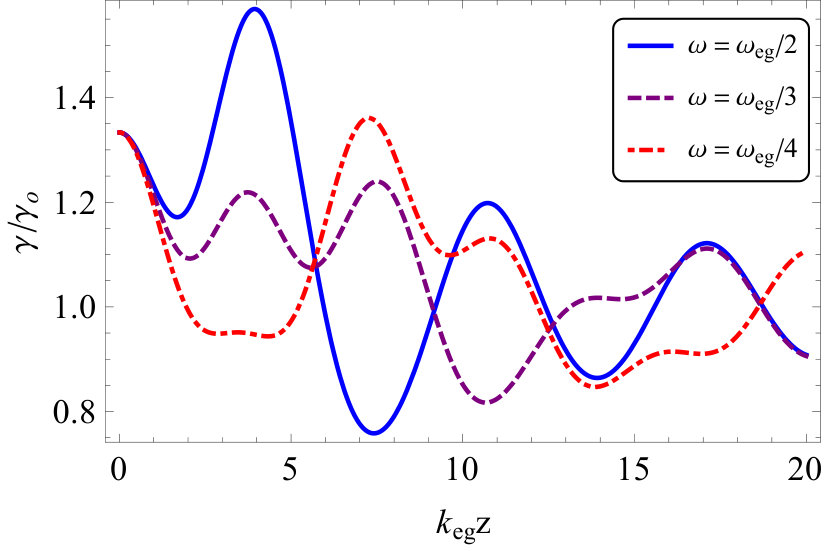 Figure 1
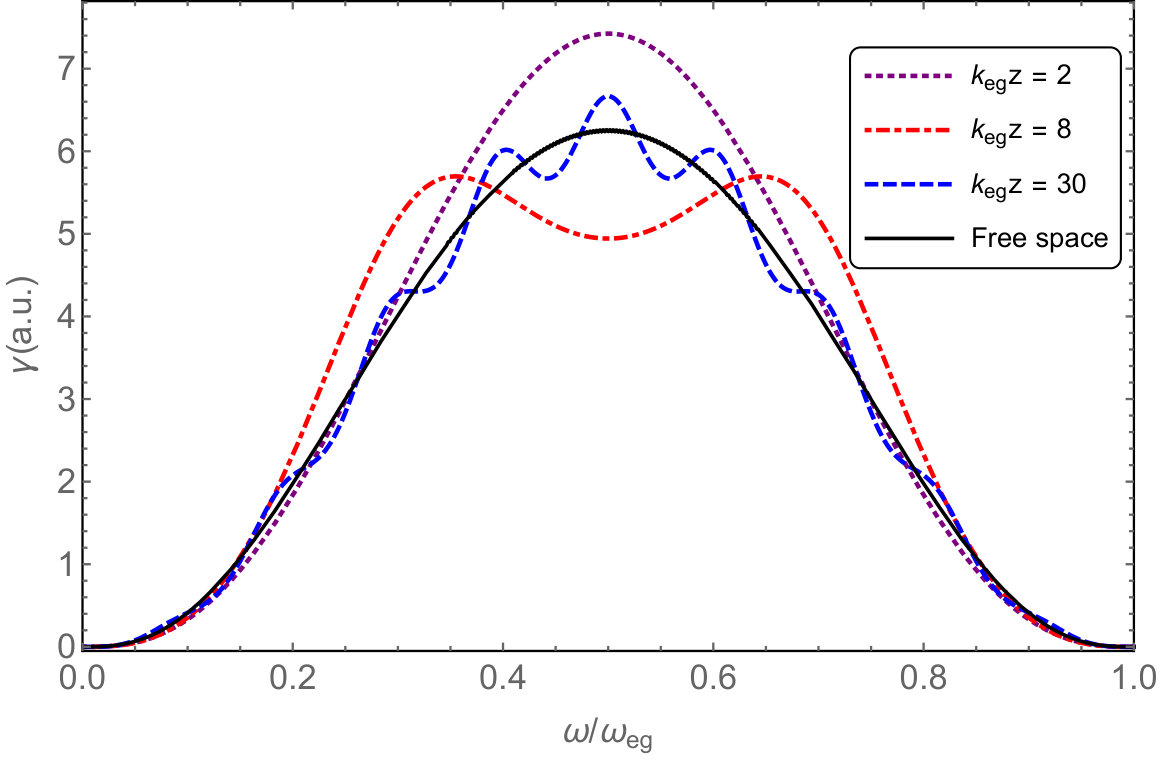 Figure 2
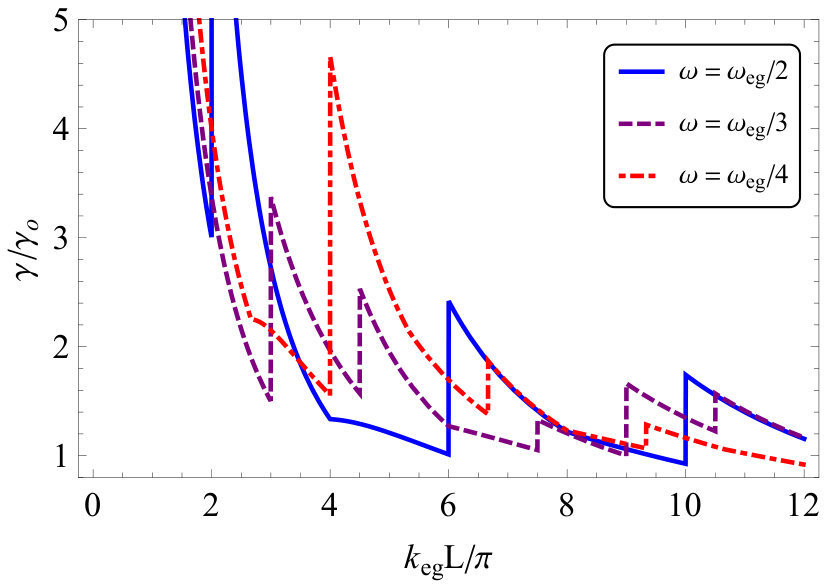 Figure 3
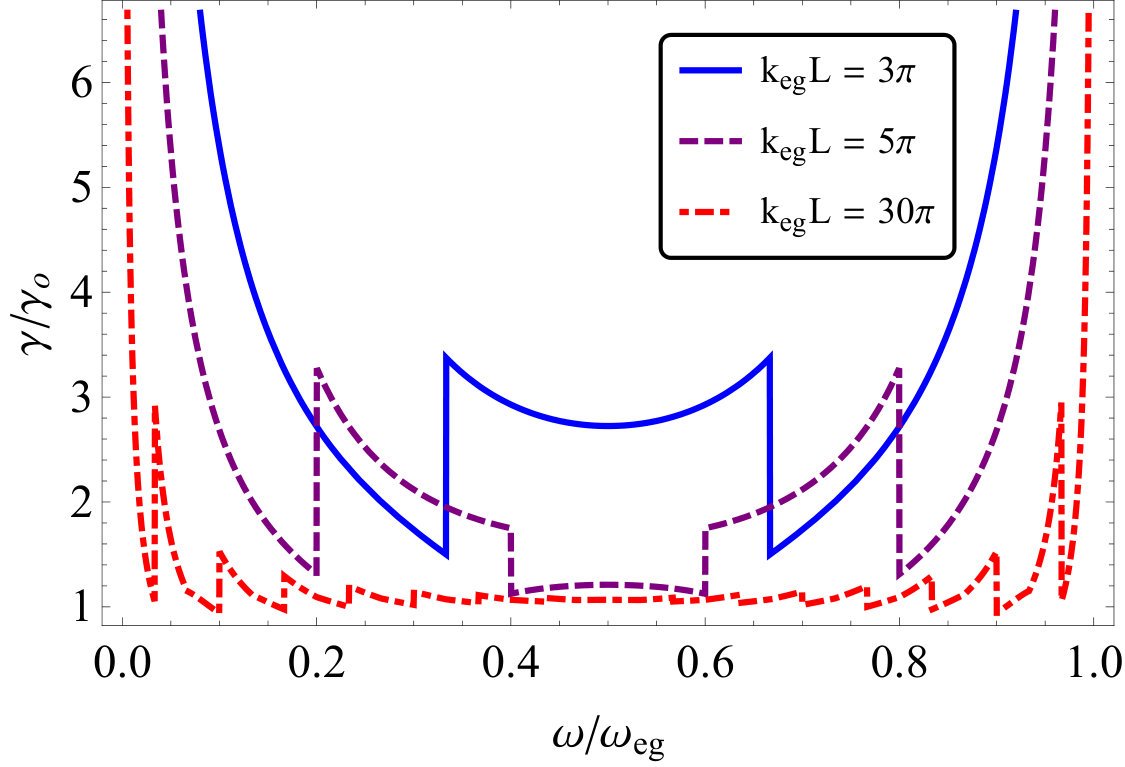 Figure 4
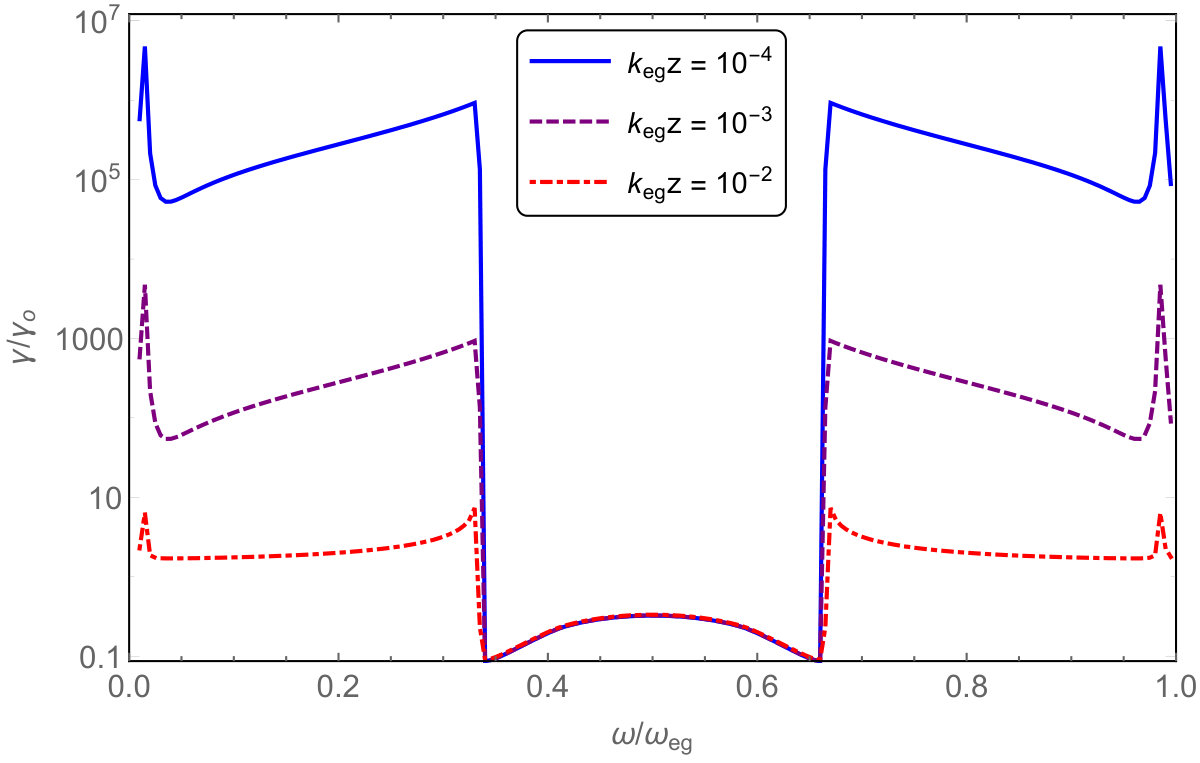 Figure 5
Peer Reviews
No public reviews on file for this paper yet. If you reviewed it on a platform where reviews are public (OpenReview, ICLR, NeurIPS, ICML), you can paste yours below so the community can read it here.
Videos
No videos yet. Explain this paper in a talk, walkthrough, or lecture? Add one.
Quantum two-photon emission in a photonic cavity
Y. Muniz
Instituto de Física, Universidade Federal do Rio de Janeiro, Caixa Postal 68528, Rio de Janeiro 21941-972, RJ, Brazil
D. Szilard
Centro Brasileiro de Pesquisas Físicas, Rua Dr. Xavier Sigaud, 150, 22.290-180, Rio de Janeiro-RJ, Brazil
W. J. M. Kort-Kamp
Theoretical Division, Los Alamos National Laboratory, MS B262, Los Alamos, New Mexico 87545, United States
F. S. S. da Rosa
Instituto de Física, Universidade Federal do Rio de Janeiro, Caixa Postal 68528, Rio de Janeiro 21941-972, RJ, Brazil
C. Farina
Instituto de Física, Universidade Federal do Rio de Janeiro, Caixa Postal 68528, Rio de Janeiro 21941-972, RJ, Brazil
Abstract
We derive a new expression for the two-photon spontaneous emission (TPSE) rate of an excited quantum emitter in the presence of arbitrary bodies in its vicinities. After investigating the influence of a perfectly conducting plate on the TPSE spectral distribution (Purcell effect), we demonstrate the equivalence of our expression with the more usual formula written in terms of the corresponding dyadic Green’s function. We establish a convenient relation between the TPSE spectral distribution and the corresponding Purcell factors of the system. Next, we consider an emitter close to a dielectric medium and show that, in the near field regime, the TPSE spectral distribution is substantially enhanced and changes abruptly at the resonance frequencies. Finally, motivated by the suppression that may occur in the one-photon spontaneous emission of an excited atom between two parallel conducting plates, we discuss the TPSE for this same situation and show that complete suppression can never occur for transitions.
I Introduction
Just a few years after Dirac’s seminal paper on Quantum Electrodynamics (QED)dirac1927 , M. Göppert-Mayer investigated elementary processes involving two quantum transitionsgoppert1931 . Since then, these processes have attracted the attention of many researchers and have shown to be relevant in many branches of physics. An important example is the role played by the two-photon absorption process in the study of the 1S-2S transition in hydrogen. The corresponding transition frequency has been measured recently with an accuracy of a few parts in , a remarkable achievement parthey2011 . This kind of investigation is relevant, for instance, in setting limits on possible time variations of fundamental constants fischer2004 or in the investigation of possible violations of Lorentz invariance altschul2010 . Two-photon absorption processes are equally important in the study of the 1S-2S transition in antihydrogen ahmadi2018 , since its comparison with the same transition in hydrogen provides valuable information to test charge, parity, and time reversal (CPT) symmetry gabrielse1987 ; andresen2011 .
In this work, instead of two-photon absorption processes, we shall be concerned with the calculation of two-photon spontaneous emission (TPSE) rates. Though the theoretical developments of such processes had already been made in the pioneering paper by Göppert-Mayergoppert1931 , it took approximately one decade until Breit and Teller made explicit numerical estimates for the TPSE rates in hydrogen and helium breit1940 . Another decade was necessary until TPSE was used to give the correct explanation of the continuous emission of planetary nebulae, presented by Spitzer and Greenstein in 1951 spitzer1951 . Subsequently, many theoretical papers were published in the field with better numerical calculations of the TPSE rate for hydrogenic atomsshapiro1959 . However, only in 1965 a first direct measurement of this phenomenon was performed by Lipeles et al using ionized Heliumlipeles1965 , and an experiment with hydrogen atoms came up only in 1975kruger1975 . Since then, TPSE has been investigated in many other systems, such as many-electron atomsbannett1982 , semiconductorshayat2007 ; hayat2008 ; driel2008 and quantum dotsota2011 . Recently, due to the new technological developments and the growing progress in near-field optics, plasmonics, and materials science in general, TPSE has attracted new interests. These are mainly connected to the possibility of controlling TPSE generation and its properties with external agentshayat2010 ; kivshar2012 , in what could be called a two-photon Purcell effectpurcell1946 .
Since TPSE plays a key role in many important topics, such as quantum cryptography and computing, controlling it is of extreme interest both theoretically and experimentally. In recent work, it has been shown that TPSE processes may occur at very short time scales in comparison to those of conventionally fast transitions rivera2016 and can even dominate the one-photon spontaneous emission (SE)rivera2017 . For instance, due to the high confinement offered by phonon polariton modes of a polar dielectric over a sufficiently narrow frequency band, an excited emitter prefers to decay via the simultaneous emission of two quanta, despite the possibility of allowed single-photon decay pathways.
In this work we have two main purposes: a general theoretical discussion of the two-photon Purcell effect and the study of this phenomenon in some simple but interesting systems. Initially, we establish a new formula for computing the Purcell effect in TPSE processes. In this framework, the TPSE rate is written in terms of the electromagnetic field modes satisfying the boundary conditions imposed by the environment of the emitter. There are many motivations for doing that. First of all, such a formula for TPSE was lacking in the literature, despite the fact that an approach based on the field modes can be very useful in situations where they are explicitly known, as for instance, in multilayered mediaaleksander1995 ; reyes2009 ; contreras2009 ; eberlein2010 , photonic crystalsjoannopoulos2008 ; li2000 ; johnson1999 , among otherswu1999 ; klimov2004 ; eberlein2009 ; kort2013 . Moreover, this approach is more suited for computing the angular distribution of the emitted photons when compared to the usual one based on the Green’s function. We illustrate this formula by considering an emitter close to a perfectly conducting plate. We then demonstrate its equivalence with the Green’s function method and compare both methods by reobtaining the TPSE rate of the emitter-mirror system. We also establish a connection between the TPSE rate of an emitter near an arbitrary object and the one-photon SE Purcell factors in the same situation. As we will show, this allows one to calculate straightforwardly the TPSE rate once the corresponding one-photon SE rates are known. With this approach, we investigate the TPSE of an emitter near a semi-infinite homogeneous dielectric material as well as the case of an atom between two perfectly conducting plates. For the latter case, we show that, in contrast to the one-photon SE, complete suppression of the TPSE can never occur in this situation.
This paper is organised as follows. In Section II we establish the formula for the TPSE rate based on the electromagnetic field modes and illustrate it in a specific example. In Section III we demonstrate its equivalence with the Green’s function method and, with the purpose of comparing both of them, we reobtain the same results calculated in the previous section. In Section IV we show how the TPSE rate can be written in terms of the one-photon SE Purcell factors. In Section V we consider a quantum emitter inside an open cavity formed by two parallel mirrors and show that suppression of TPSE can never occur for transitions. Section VI is left for final remarks and conclusions. For convenience, an appendix was included.
II TPSE rate: field modes approach
Here we present a simple way to compute the TPSE rate of an atom close to a surface of arbitrary shape. The Hamiltonian of the system is given by , where is the emitter’s hamiltonian, is the field hamiltonian, and describes the emitter-field interaction, to be treated by perturbative methods. The second-order transition rate between an initial state and a final state is given by Fermi’s golden rule sakurai2014 ; thiru1984 ,
[TABLE]
where
[TABLE]
The dominant transition wavelengths are assumed to be much larger than the emitter dimensions, so that the electric dipole approximation is valid and we can writemilonni2013
[TABLE]
where is the dipole moment operator, is the emitter’s position and is a complete set of solutions of the Helmholtz equation subjected to the boundary conditions imposed by the surface. Initially, the emitter is in an excited state and the field in the vacuum state, so that the emitter-field initial state is written as . Since we are interested in TPSE processes, the final state must be constituted by the emitter in a lower energy state and the field in a two-photon state, namely, . The intermediate states that connect the initial and final states are or , where indexes the emitter states. Summing over all possible final states and defining
[TABLE]
where and , we obtain
[TABLE]
This formula can be viewed as a second-order equivalent of
[TABLE]
which can be found in the literaturemilonni2013 ; novotny2012 ; kort2013 and gives the one-photon SE rate of an atom near an arbitrary surface.
As an immediate application of Eq. (6), we shall first reobtain the TPSE rate in free spacegoppert1931 ; thiru1984 . In this case, the field modes can be chosen as , where is a box quantization volume and are the unit polarization vectors. Taking the limit to the continuum, we make the replacement , and find
[TABLE]
where is the free space spectral distribution of the emitted photons, given by
[TABLE]
with . Essentialy, gives the number of emitted photons per unit time in the interval . A few comments are in order here. First, due to the homogeneity of space, note that is independent of the position of the emitter. Second, in contrast to the one-photon SE, which is a narrow band phenomenon, TPSE is a broadband phenomenon. Another important feature of the above spectral distribution is its symmetry with respect to , namely, , which is a direct consequence of energy conservation since the sum of the frequencies of the two emitted photons must equal the emitter’s transition frequency (recoil is being neglected in the present calculations).
II.1 An emitter near a perfectly conducting plate
As another application of Eq. (6), let us compute the Purcell effect in the TPSE rate by considering an emitter separated by a distance from a perfectly conducting plate placed at . The electromagnetic field modes satisfying the boundary conditions {{\bf E}\times{\bf\hat{z}}\big{|}_{z=0}=0} and {{\bf B}\cdot{\bf\hat{z}}\big{|}_{z=0}=0} are given bymilonni2013 ; milonni1973
[TABLE]
Substituting Eqs. (10) and (12) into Eq. (6) and performing the integrals in the azimuthal angles and we obtain
[TABLE]
where is the angular distribution of emitted photons with respect to the axis and is given by
[TABLE]
For an observer in the far field, the angular distribution gives the number of emitted photon-pairs with frequencies between and and within the angular intervals and . Integrating the angular distribution in and it is straightforward to show that the TPSE rate can be written in the form
[TABLE]
where the spectral distribution is now given by
[TABLE]
with
[TABLE]
being the Purcell factors associated with the one-photon SE of an emitter with a transition dipole moment oriented parallel or perpendicular to the plate, respectivelymorawitz1969 ; milonni2013 , and . Since the presence of the plate breaks the translational symmetry along the direction, the spectral distribution function depends not only on the frequency but also on the distance from the emitter to the surface.
In a wide variety of two-photon transitions, the initial and final atomic states have spherical symmetry. This is due to the fact that one-photon electric dipole transitions between states are forbidden by selection rules, and in usual experimental conditions other two-photon transitions are in disadvantage with respect to single photon ones.
In Figure 1 we plot versus for different distances between the emitter and the plate. We considered a transition and only one intermediate state in Eq. (5). As expected, note the symmetry of all spectral distributions with respect to . Observe, also, that the spectral distribution may acquire forms quite different from the parabolical shape of the corresponding one in free space and its local maxima may not necessarily occur at . Moreover, as the distance between the emitter and the plate increases, the spectral distribution tends to the free space one.
In order to consider all the intermediate states in Eq. (5), it is convenient to work with the ratio , sometimes referred to as spectral enhancement rivera2017 . For transitions, we show that (see appendix)
[TABLE]
In Figure 2 we plot the spectral enhancement as a function of the distance between the emitter and the mirror for three given frequencies. As in the one-photon SE rate of an emitter near a perfectly conducting plate, also exhibits oscillations with the distance between the emitter and the plate. However, since in the TPSE there is an additional length scale, the oscillations are not as regular as in the one-photon SE, except when , a particular case in which the two emitted photons have the same wavelength.
We finish this section by emphasizing that the TPSE spectral density function was written in terms of the one-photon Purcell factors of an emitter near a perfectly conducting mirror. Although this has been done in this particular case, this can be generalized, as we show in section IV.
III Green’s function method
Another scheme for obtaining SE rates is by using the Green’s function formalism. It is widely known that the one-photon SE rate of an emitter near any real material can be written as novotny2012
[TABLE]
where is the one-photon SE rate in free space, and the Green’s dyadic satisfies the generalized Helmholtz equation
[TABLE]
where is the unit tensor, subjected to the appropriate boundary conditions. Here we shall rewrite the TPSE rate given by Eq. (6) in terms of the Green’s function, thus establishing an equivalence between our result and the literarurekivshar2012 ; rivera2016 . With this purpose, first we recall that the dyadic Green’s function admits a spectral representation where its imaginary part is given bynovotny2012
[TABLE]
Noting that from Eq. (6) the TPSE rate can be written as
[TABLE]
and using, for convenience, a simplified notation in which the dependence in the arguments of , and is implicit, we obtain from Eqs. (30) and (31)
[TABLE]
Using that we get
[TABLE]
where we used again Eq. (30) and constrained the limits of integration since for . This equation can be viewed as an equivalent of (28) for the case of TPSE.
Although Eq. (39) has been derived from (6), which depends on the existence of a complete set of field modes, it is completely general and can be used to calculate the TPSE of an atom near any real material. It is important to notice that Eq. (39) also gives a general formula for the spectral density function .
III.1 Green’s function approach to the emitter-mirror system
In order to compare the field modes approach with the Green’s function method, we reobtain in this subsection the TPSE spectral density of an emitter close to a perfect mirror. With this purpose, it is convenient to write the Green function as , where is the free space Green function and is a homogeneous solution of (29) satisfying the appropriate boundary conditions at the conducting surface. The calculation of the TPSE rate demands only the knowledge of the imaginary part of the Green’s function at coincident points (). In this case, the free space Green function is given by and due to the translational symmetry of the system along any direction parallel to the plane, the scattered Green’s function can be written asnovotny2012
[TABLE]
where for , for and and are the Fresnel reflection coefficients for p-polarized and s-polarized waves, respectively. For a perfect reflector, the Fresnel coefficients are given by and . Taking the imaginary part of the previous equation and performing the integration in , we obtain
[TABLE]
Plugging previous expressions into Eq. (39) and identifying the integrand as the spectral density function, we recover the result given by equation (23).
Though the two methods are equivalent, it is worth noting that to identify the angular distribution of the emitted photons by using the Green’s function method is not an easy task as it is in the framework of the field modes approach. Besides, although the calculation of the TPSE rate by using the Green’s function method is in principle straightforward, this procedure may obscure the basic underlying physics of the problem. For some systems, the field modes approach may even emphasize some physical aspects that are not evident in the Green’s function method, as for instance when the system supports different types of modes and the emitter might de-excite by different pathways.
IV Relation between the TPSE and the Purcell factors
Now, we shall relate the TPSE spectral density function of an emitter near a surface to the one-photon SE rate in the same situation. In a previous work, this has been shown by considering the emitter near a planar interfacerivera2017 . In the following derivation we shall not assume this restriction and shall consider the emitter near a surface with an arbitrary shape. This is possible by noting that is a real and symmetric matrixbuhmann2012 , which means it can be diagonalized. For systems where the basis which diagonalizes the imaginary part of the Green’s function does not depend on frequency, one can write
[TABLE]
where we defined the Purcell factors ’s, , as
[TABLE]
Note that the Purcell factors coincide with the ratio (28) if we choose , i.e., the transition dipole moment oriented along one of the basis vectors. It is important to note that when the basis which diagonalizes the Green’s function is frequency-dependent Eq. (47) becomes inappropriate. On the other hand, this equation establishes an explicit relation between TPSE and one-photon SE, hence, showing in a very clear way the dependence of the TPSE rate on the local density of states (LDOS).
IV.1 An emitter near a half-space dielectric medium
Using the Purcell factors relation just presented, we shall determine as an example the spectral enhancement of the TPSE of an emitter near a semi-infinite homogeneous dielectric dispersive medium (). It is clear that Eq. (47) gives a straightforward way to compute since, in this situation, the cartesian basis diagonalizes the Green’s function and we already know the corresponding formulas for the one-photon SE rates. Moreover, as before, we shall consider only transitions. The corresponding spectral enhancement is given by equation (27) with the following Purcell factorsnovotny2012
[TABLE]
where , and and are the Fresnel coefficients for s-polarized and p-polarized waves, respectively. We have two important regimes, the far-field regime () and the near-field regime (). In the latter, the Purcell factors are very high in comparison to the former due to the coupling with evanescent modes. Here, we restrict ourselves to the near-field regime. Evoking the Lorentz model for dielectricszangwill2013 , we expect a strong dependence of the LDOS on the dielectric resonance frequencies, as a dielectric reflects like a metal for waves with frequencies close to the resonances. Hence, applying Eq. (47) we expect a substantial enhancement in the spectral density function near the resonance frequencies.
In Figure 3 we plot the spectral enhancement for three given distances between the emitter and the dielectric for an transition. We considered a Polystyrene medium described by a Lorentz model with two resonance frequencies. The adjusted parameters were taken from referencehough1980 . First, note the huge changes on the spectral density function near the resonances frequencies and . Since , the transition between the two frequency regimes (before and after each resonance) occurs in a very narrow interval. Due to the symmetry of the spectral distribution with respect to , the same behavior occurs near the complementary frequencies and . As it is evident from the figure, the spectral distribution may be orders of magnitude greater than its free space value, since we are in the near field regime. Furthermore, as the frequency of the emitted photon approaches a given resonance frequency from below, the spectral density increases monotonically until it reaches a maximum value, and then suffers an abrupt decrease as it crosses the resonance frequency. This result may open a possibility of controlling the spectral distribution of TPSE by tuning the resonance frequencies of a medium.
V TPSE of an emitter between two parallel mirrors
The suppression of spontaneous emission is a remarkable phenomenon which opens the possibility of manipulating excited atoms for large time intervals. However, what is known as suppression of spontaneous emission is, in fact, the suppression of the dipolar one-photon emission. As the TPSE is a second order process, the ratio between the lifetimes of an emitter which decays by two-photon emission and by the emission of a single photon is about . Hence, when the one-photon SE is supressed, in practice, the atom has an infinite lifetime.
The suppression of the one-photon SE is achieved when the partial LDOS vanishes at the transition frequency. Without a one-photon decay channel, in principle, the emitter can decay by the emission of a photon pair (in this work we are ignoring magnetic dipole transitions, quadrupolar transitions and so on). The suppression of the one-photon SE was first predicted by Bartonbarton1970 and observed only 15 years later by Hulet et alhulet1985 . They considered atoms going through two perfectly conducting plates and also prepared the atoms so that they had a transition electric dipole moment parallel to the plates. They showed that, for distances between the plates smaller than half the transition wavelength, the atom does not decay by the emission of a single photon.
In this section we investigate the TPSE in the same situation, namely, with the atom between two conducting parallel plates, by using the Purcell factors relation presented in the previous section. First, we recall that the Purcell factors in the cartesian basis are given bymilonni2013 ; barton1970
[TABLE]
where is the distance between the atom and the first mirror (located at ), is the distance between the two mirrors and means the greatest integer smaller than . We notice that and vanish for , which means that the one-photon emission will be suppressed if the transition dipole moment is parallel to the plates. However, Eq. (47) shows that also depends on , which increases for small values of . Therefore, it is clear that the TPSE is not completely suppressed in this situation unless . For and transitions, which are the most common two-photon transitions, this can not be true due to the general form of florescu1987 . Consequently, for these type of transitions complete suppression of the TPSE can never occur for an emitter between two parallel conducting plates.
In Figure 4 we plot the spectral enhancement for a transition with the emitter equidistant from both plates, , as a function of for different values of . Observe that complete suppression never occurs. Note also that the spectral enhancement diverges for and . This is a consequence of the fact that both and go to zero at these frequencies, but with different power laws. Further, note that as increases the spectral density function tends to the free space spectral density function (dotted-dashed line), as expected, since in this case the plates do not influence the emitter anymore.
In Figure 5 we plot the spectral enhancement with the emitter equidistant from both plates, , as a function of for three given values of frequency. In analogy to what happens in the one-photon SE, as the distance between the plates crosses certain multiples of , the number of available modes changes abruptly, giving rise to the discontinuities in the spectral density function. However, contrary to what happens with the one-photon SE rate when the transition dipole moment is parallel to the plates, total suppression never occurs.
The non-suppression of the TPSE in this situation is a consequence of the fact that the spectral density function is not proportional to the partial LDOS, in contrast to what happens in the one-photon SEnovotny2012 . As we can see from Eq. (5), the TPSE rate does not depend explictly on the transition dipole moment, but on the intermediate transition dipole moments. However, the enhancement or suppression of the TPSE at a given frequency, say , can occur. It suffices that the LDOS is enhanced or vanishes at this frequency (or at the complementary frequency ).
VI Conclusions and final remarks
In this work we presented an alternative formula for computing the TPSE rate of an excited emitter near a surface of arbitrary shape which is written in terms of the electromagnetic field modes. As a check of self-consistency, we used this formula to reobtain the TPSE rate in free space as well as with the emitter near a perfectly conducting plate. We showed explicitly the equivalence of our formula with the one usually found in the literature which is written in terms of the dyadic Green’s function, Eq. (39). We did that in a simple and straightforward way, providing an alternative demonstration of Eq. (39). We compared both methods and showed that, although the TPSE rate calculation by using the Green’s function method is straightforward, the field modes approach has the advantage of clarifying the physics of the problem and provides an easier way to compute the angular distribution of the emitted photons. We have also related the TPSE spectral density function of an emitter near an arbitrary object to the corresponding one-photon SE Purcell factors. This allowed us to identify the general dependence of the TPSE rate on the field LDOS and also provided us a very simple way to compute the spectral density function in any situation where the one-photon SE rate is known. We applied this formalism for an emitter near a homogeneous semi-infinite dielectric medium and verified that an interesting behaviour of the TPSE spectral distribution shows up near the resonance frequencies of the dielectric. This result opens the possibility of controlling the frequencies of the two emitted photons by tuning the resonance frequencies of the medium through an external agent. Finally, we analyzed the TPSE of an emitter between two parallel perfect mirrors and showed that the TPSE can not be completely suppressed for transitions. This is to be contrasted to the suppression of the one-photon SE that may occur for an atom between two parallel perfect mirrors if the atom is appropriately preparedhulet1985 .
VII Acknowledgements
The authors thank to L. Davidovich and M. Lima for enlightening discussions. Y.M., D.S., F.S.S.R. and C.F. acknowledge the brazilian agencies CAPES, CNPq and FAPERJ for partially financing this research. W.K.-K thanks LANL LDRD program for financial support.
VIII Appendix
VIII.1 Transition between isotropic states
In this appendix we investigate the functional form of when the initial and final states are states. This was already investigated in previous worksbreit1940 ; florescu1987 even for others transitions such as . Considering the one electron states and , the intermediate states which the matrix elements of do not vanish are states and can be written as . The corresponding wave functions can be written as a product of a radial function by the spherical harmonics. We have , and , so the intermediate transition dipole moments are given by
[TABLE]
From these expressions, we note that the directions of these vectors depend only on the angular integrals, while their modula depend on the quantum numbers , and . As is fixed, the directions depend only on . Using the expansion
[TABLE]
and calculating explicitly the angular integral for all values of , we obtain
[TABLE]
where the set is an orthonormal basis in three dimensions given by
[TABLE]
With this result, we obtain
[TABLE]
Due to the fact that the vectors form a basis, we have and takes the form , where
[TABLE]
Finally, we can rewrite equations (6), (39) and (47) respectively as
[TABLE]
The reference list from the paper itself. Each links out to its DOI / PubMed record.
- 1(1) P. A. M. Dirac, “The quantum theory of the emission and absorption of radiation,” Proceedings of the Royal Society of London. Series A: Mathematical Physical and Engineering Sciences , vol. 114, no. 767, pp. 243–265, 1927.
- 2(2) M. Göppert-Mayer, “Über elementarakte mit zwei quantensprüngen,” Annalen der Physik , vol. 401, no. 3, pp. 273–294, 1931.
- 3(3) C. G. Parthey et al. , “Improved measurement of the hydrogen 1 s–2 s transition frequency,” Physical Review Letters , vol. 107, no. 20, p. 203001, 2011.
- 4(4) M. Fischer et al. , “New limits on the drift of fundamental constants from laboratory measurements,” Physical Review Letters , vol. 92, no. 23, p. 230802, 2004.
- 5(5) B. Altschul, “Testing electron boost invariance with 2 s- 1 s hydrogen spectroscopy,” Physical Review D , vol. 81, no. 4, p. 041701, 2010.
- 6(6) M. Ahmadi et al. , “Characterization of the 1s–2s transition in antihydrogen,” Nature , vol. 557, no. 7703, p. 71, 2018.
- 7(7) G. Gabrielse, Fundamental symmetries . Plenum Press, 1987.
- 8(8) G. B. Andresen et al. , “Confinement of antihydrogen for 1,000 seconds,” Nature Physics , vol. 7, no. 7, p. 558, 2011.