Exceptional Super Yang-Mills in $D=27+3$ and Worldvolume M-Theory
Michael Rios, Alessio Marrani, and David Chester

TL;DR
This paper explores exceptional super Yang-Mills theories in high-dimensional spacetimes, revealing connections to M-theory, brane dynamics, and algebraic structures like Magic Star algebras and Cayley plane fibers.
Contribution
It introduces a new super Yang-Mills framework in 27+3 dimensions, linking it to M-theory, branes, and algebraic structures, and proposes a novel realization of spinors via brane cohomologies.
Findings
Super Yang-Mills in 27+3 dimensions with electric 11-brane
Reduction to 10+1 dimensions models M-theory
Spinors as cohomologies of extended branes
Abstract
Bars and Sezgin have proposed a super Yang-Mills theory in space-time dimensions with an electric 3-brane that generalizes the 2-brane of M-theory. More recently, the authors found an infinite family of exceptional super Yang-Mills theories in via the so-called Magic Star algebras. A particularly interesting case occurs in signature , where the superalgebra is centrally extended by an electric 11-brane and its 15-brane magnetic dual. The worldvolume symmetry of the 11-brane has signature and can reproduce super Yang-Mills theory in . Upon reduction to , the 11-brane reduces to a 10-brane with worldvolume signature. A single time projection gives a worldvolume signature and can serve as a model for M-theory as a reduction from the signature of the bosonic M-theory of Horowitz and Susskind; this is…
Click any figure to enlarge with its caption.
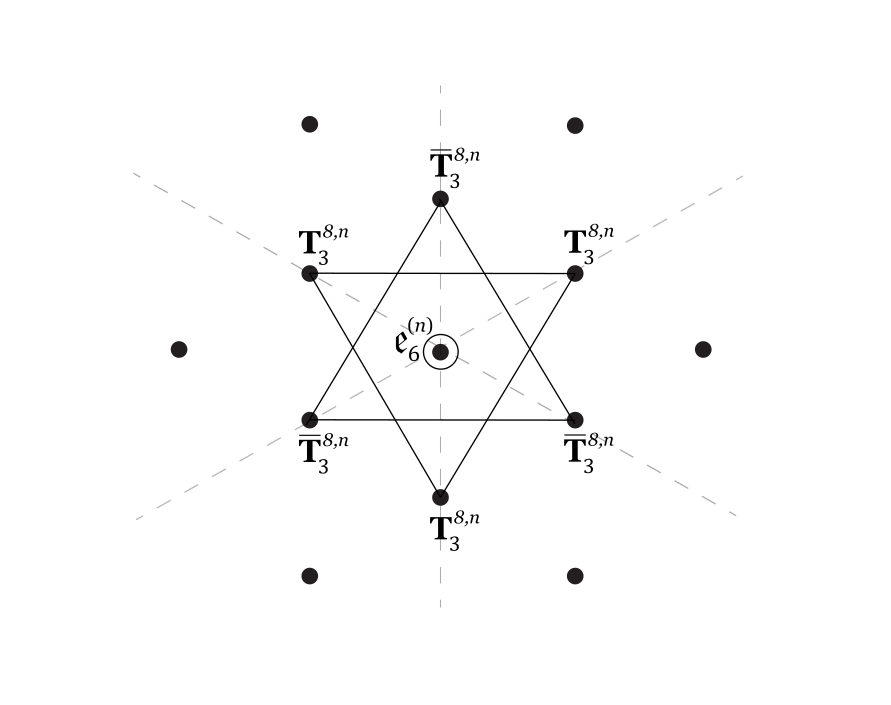 Figure 1
Peer Reviews
No public reviews on file for this paper yet. If you reviewed it on a platform where reviews are public (OpenReview, ICLR, NeurIPS, ICML), you can paste yours below so the community can read it here.
Videos
No videos yet. Explain this paper in a talk, walkthrough, or lecture? Add one.
Exceptional Super Yang-Mills in and Worldvolume M-Theory
Michael Rios
Dyonica ICMQG,
Los Angeles, CA, USA
Alessio Marrani
Centro Studi e Ricerche Enrico Fermi, Roma, Italy
and
Dipartimento di Fisica e Astronomia ’Galileo Galilei’, Univ. di Padova,
and
INFN, Sez. di Padova, Italy
David Chester
Department of Physics and Astronomy,
UCLA, Los Angeles, CA, USA
Abstract
Bars and Sezgin have proposed a super Yang-Mills theory in space-time dimensions with an electric 3-brane that generalizes the 2-brane of M-theory. More recently, the authors found an infinite family of exceptional super Yang-Mills theories in via the so-called Magic Star algebras. A particularly interesting case occurs in signature , where the superalgebra is centrally extended by an electric 11-brane and its 15-brane magnetic dual. The worldvolume symmetry of the 11-brane has signature and can reproduce super Yang-Mills theory in . Upon reduction to , the 11-brane reduces to a 10-brane with worldvolume signature. A single time projection gives a worldvolume signature and can serve as a model for M-theory as a reduction from the signature of the bosonic M-theory of Horowitz and Susskind; this is further confirmed by the reduction of chiral , superalgebra to the superalgebra in , as found by Rudychev, Sezgin and Sundell some time ago. Extending previous results of Dijkgraaf, Verlinde and Verlinde, we also put forward the realization of spinors as total cohomologies of (the largest spatially extended) branes which centrally extend the superalgebra underlying the corresponding exceptional super Yang-Mills theory. Moreover, by making use of an “anomalous” Dynkin embedding, we strengthen Ramond and Sati’s argument that M-theory has hidden Cayley plane fibers.
Super Yang-Mills, Exceptional Periodicity, 11-brane, M-theory.
Contents
- I Introduction
- II SYM in and M-theory
- III Exceptional Periodicity and Spinors as Brane Cohomologies
- IV Brane Actions and Hidden Fibers in M-Theory
- V Conclusion
I Introduction
After Witten’s introduction of M-theory WittenM in111“” and “” denote the number of spacelike resp. timelike dimensions throughout. space-time dimensions, Vafa proposed F-theory in VafaF . Bars went further, generalizing F-theory in and Hulld by studying S-theory in BarsS ; 2 and super Yang-Mills (SYM) theory in , with subsequent further investigations by Sezgin et al. 1 ; 1bis . Pushing beyond, Nishino defined SYM’s in signature , for arbitrary 6 . Using the algebraic structure of Exceptional Periodicity EP1 ; EP2 ; EP3 ; EP4 ; EP5 , in EYM the authors defined infinite families of exceptional SYM theories; among these, a family in that directly generalizes Sezgin’s SYM in . It is here worth recalling that the structure of SYM222It should be recalled that the Bars-Sezgin SYM theories in are not Lorentz covariant, and so are the generalizations presented here. in , with a -dimensional Majorana-Weyl (MW) semispinor333It is amusing to observe that the semispinor of recently appeared in the algebraic structure of the Vogel plane in Vogel ., interestingly arises in a certain 5-grading of “extended Poincaré type” of and has found use in unification models (see e.g. Percacci ).
In this work, we ascend to space-time dimensions, in which an electric 11-brane and its 15-brane magnetic dual arise as central extensions of the global supersymmetry algebra. In particular, the 11-brane gives rise to a worldvolume theory with signature, thus providing a worldvolume embedding for the chiral SYM in of Bars and Sezgin BarsS ; 2 ; 1 .
Following the 11-brane in the reduction from leads to the reduction of the worldvolume of the 11-brane to a worldvolume of a 10-brane, suggesting that M-theory may be a worldvolume theory; this is further confirmed by the fact that the reduction of the chiral superalgebra in down to contains the superalgebra pertaining to M-theory 1bis . This chain of reductions along the worldvolume of the electric 11-brane yields a natural map of the conjectured “bosonic M-theory” of Horowitz and Susskind BMT in down to M-theory in . Moreover, in the electric 10-brane has a 14-brane magnetic dual (both centrally extending the corresponding global superalgebra), and this implies, under reduction to , that there exists a “dual” (worldvolume-realized) M-theory in .
II SYM in and M-theory
The superalgebra in space-time dimensions (corresponding to the level of Exceptional Periodicity EP1 ; EP2 ; EP3 ; EP4 ; EP5 ) takes the form EYM
[TABLE]
Namely, the central extensions are given by a 3-brane, a 7-brane, an electric 11-brane and its dual, a magnetic 15-brane. Note that the magnetic duals of the 3-brane and 7-brane, i.e. the 23-brane resp. 19-brane, do not centrally extend the algebra (1); however, they can be found as the largest spatially extended central charges at resp. levels of Exceptional Periodicity EYM .
In , the electric 11-brane has a multi-time worldvolume, with signature , which can be used to provide a worldvolume realization for the SYM of Bars and Sezgin BarsS ; 2 ; 1 . In other words, the multi-time worldvolume of the electric 11-brane in can support a corresponding superalgebra in :
[TABLE]
whose reduction to lower dimensions contain both the type IIB chiral superalgebra and the () M-theory superalgebra, as discussed by Rudychev, Sezgin and Sundell in 1bis .
Hence, one can consider a reduction , and focus on the corresponding reduction of the 11-brane (multi-time) worldvolume down to the (single-time) 10-brane worldvolume (in ); this latter, also in light of the aforementioned reduction of the , chiral superalgebra (2) to the superalgebra in 1bis , can be used to provide a worldvolume realization of M-theory.
This simple reasoning yields the following consequences:
- •
it puts forward the realization of M-theory as a worldvolume theory of an electric 10-brane in a higher space-time (pertaining to bosonic M-theory of Horowitz and Susskind BMT );
- •
as such, it provides a map from the bosonic M-theory in to M-theory in ;
- •
we observe that bosonic M-theory can be completed to a two-time theory in , in which a exceptional SYM can be defined, with central extensions given by EYM
[TABLE]
i.e. by a 2-brane, a 6-brane, and by an electric 10-brane and its dual, a magnetic 14-brane. This implies that there exists a theory which is dual to the worldvolume-realized M-theory embedded in , namely the worldvolume-realized theory reduced to of the magnetic 13-brane embedded in ; we dub such a theory the “dual M-theory”, and we leave its study for future work.
While the superalgebra has been recovered, it is worth clarifying how this sheds light on M-theory, which contains M2 and M5 branes. The gravity dual of the M2 brane is described by the ABJM theory, which describes the near-horizon geometry with SO(8) R-symmetry Aharony:2008ug . The gravity dual of the M5 brane is described by the 6D (2,0) SCFT, which describes the near-horizon geometry Claus:1997cq . The near-horizon geometries stem from and , respectively, which both can be broken from , the signature of S-theory. While a generalization of M-theory with signature hasn’t been discussed, it is generally understood that supergravities as the low-energy limit of string theory comes from a double copy of super-Yang-Mills theories.
From the work above, we are also suggesting that S-theory could be recovered as a worldvolume theory from . This would give rise to near-horizon geometry with R-symmetry with a 10-brane source, which ultimately stems from an 11-brane in . Stacking these D-branes gives a super-Yang-Mills gauge symmetry, while a generalized ABJM theory would give symmetry. However, something more exotic than super-Yang-Mills theory would be anticipated in the full worldvolume theory. Higher-derivative terms would be anticipated to give a non-Abelian Dirac-Born-Infeld theory, similar to how the ABJM model has been extended with higher-derivative terms Sasaki:2009ij .
Also, it is worth mentioning that the higher Kaluza-Klein states stem from Kac-Moody and Virasoro extensions of Lie algebras Hohm:2006ud . The tower of graviton states comes from a tensor product or double copy of the Virasoro algebra. In particular, M-theory relates to the Kac-Moody algebra West:2001as . It can also be shown that contains , which is precisely . Therefore, it can be anticipated that EP algebras provide finite-dimensional, non-Lie truncations of infinite-dimensional Kac-Moody algebras, up to a rescaling of some roots in order to give a closed algebra. The theory that contains the full spectrum of M-theory as a worldvolume most likely would require either or a Virasoro and Kac-Moody extension of the EP algebra . We leave the investigation of this very interesting issues for future work.
III Exceptional Periodicity and Spinors as Brane Cohomologies
Through the algebraic structure of Exceptional Periodicity, let us consider the generalization of the split form of the largest finite-dimensional exceptional Lie algebra provided by , the corresponding, so-called Magic Star algebra at level EP1 ; EP2 ; EP3 ; EP4 ; EP5 :
[TABLE]
where is the MW semispinor in , while and denote the MW spinor and its conjugate in . (4) is the element of the countably, Bott-periodized infinite sequence of generalizations of . By denoting with and the chiral semispinor representations of , as well as with the rank- antisymmetric (-form) representation of , we recall that, as a vector space, the Clifford algebra in dimensions is isomorphic to the Hodge-de Rahm complex in dimensions :
[TABLE]
Thus, in the case under consideration, the -dimensional MW semispinor of , which branches as under , can be regarded as the total cohomology of a 15-brane, which in turn can be identified with the maximally spatially extended central charge of SYM (1) in space-time dimensions EYM :
[TABLE]
This is nothing but the case of a general fact, namely that the (chiral) spinor component of the so-called Magic Star algebra EP1 ; EP2 ; EP3 ; EP4 ; EP5 (see also Fig.1)
[TABLE]
can be realized as the total cohomology of a -brane, which in turn can be identified with the largest spatially extended central extension of the supersymmetry algebra in space-time dimensions EYM
[TABLE]
Therefore, the spinor generators of the algebra are realized, exploiting the central extensions of the supersymmetry algebra in , in terms of brane cohomology.
We stress that this realization extends the results found by Dijkgraaf, Verlinde and Verlinde DVV which, in the BPS quantization of the 5-brane, realized the components of the central charge as fluxes through the odd homology cycles on the five-brane itself :
[TABLE]
Since the spinor generators are the very ones responsible for the violation of the Jacobi identity in Magic Star algebras EP1 ; EP2 ; EP3 ; EP4 ; EP5 , this is a further hint that the Lie subalgebras of Magic Star algebras yield purely bosonic sectors. Moreover, it is worth here reminding that the (trivial) level of Exceptional Periodicity boils down to the fact the spinor component of can be realized as the total cohomology of the 7-brane which centrally extends the superalgebra in BarsS ; 1 ; 1bis ; 2 .
IV Brane Actions and Hidden Fibers in M-Theory
As resulting from the star-shaped algebraic structure of the Magic Star algebras EP1 ; EP2 ; EP3 ; EP4 ; EP5 (see also Fig.1), we note that the Hermitian part of the cubic Vinberg’s T-algebra444This has been named HT-algebra in EP5 . Vinberg at EP level (i.e., ) can be Peirce-decomposed (in a manifestly -covariant way) as
[TABLE]
where and respectively are the vector and MW semispinor irreprs. of . Adopting Sezgin et al.’s approach 1 ; 1bis , the larger symmetry can be considered as a multi-particle symmetry, for four particles, where putting all particles but one on-shell yields constant momenta that appear as null vectors 1bis ; a single particle (described by the algebra ) enjoys symmetry, while two and three particles acquire enhanced and symmetry, respectively. In such a perspective, bosonic M-theory in can be considered as a single time projection of a two-particle system with reduced symmetry and Horowitz and Susskind’s low energy action BMT
[TABLE]
captures a 2-brane in this background where , and this reduces to the bosonic string action in . As the superalgebra admits a 10-brane as well as a 2-brane, one can alternatively consider a low energy action in terms of a 12-form field strength
[TABLE]
suggesting a (10,1) signature worldvolume M-theory with sixteen transverse directions. A 2-brane can be immersed in the (10,1) worldvolume as an M2-brane or in the (26,1) signature bulk, reducing to either a type IIA string Duff87 or bosonic string BMT by compactification, respectively. The full worldvolume symmetry in for the 10-brane is , the signature of F-theory VafaF 555This might seem in contrast with the claim that F-theory has signature , made at the start of the paper. However, the signature of the two additional dimensions of F-theory with respect to string theory is somewhat ambiguous due to their infinitesimal character. For example, the supersymmetry of F-theory on a flat background corresponds to type IIB (i.e. ) supersymmetry with 32 real supercharges which may be interpreted as the dimensional reduction of the chiral real 12-dimensional supersymmetry if its signature is . On the other hand, the signature is needed for the Euclidean interpretation of the compactification spaces (e.g. the four-folds), and the latter interpretation prevailed in recent years.; intriguingly, in such a signature the null reduction of a (2,2) brane in yields to type IIB string theory in Duff88 .
The superalgebra permits an 11-brane with 13-form field strength, which one can use for worldvolume reduction to , whose superalgebra yields the superalgebra in as well as the IIA, IIB and heterotic superalgebras in 1bis , with sixteen dimensions transverse to the 11-brane. Moreover, reducing to allows an identification of the 3-brane with the type IIB D3-brane, as noted by Tseytlin Tseyt .
A non-compact real form of a theorem by Dynkin Dynkin yields the maximal and non-symmetric “anomalous”666This naming goes back to Ramond ramond3 . embedding ramond3
[TABLE]
under which the vector representation of stays irreducible, providing the fundamental representation of the minimally non-compact real form of . Since is the Lie algebra of the derivations of the Lorentzian version of the exceptional cubic Jordan algebra over the octonions GZ-5 ; Squaring-Magic ,
[TABLE]
it follows that the vector of may be regarded as the traceless part of :
[TABLE]
The threefold Pierce decomposition of , corresponding to the branching
[TABLE]
is geometrically realized as three transverse Hopf maps , and it yields to three cosets of type
[TABLE]
providing the charts of the (non-compact, Riemannian real form of the) Cayley plane . This, in the worldvolume picture, confirms and strengthens Ramond and Sati’s argument that M-theory has hidden Cayley plane fibers ramond ; ramond2 ; sati ; sati2 . Moreover, the worldvolume realization of M-theory proposed in this paper provides a natural realization of M-theory on a manifold with boundary, as it was considered by Horava and Witten in HW , in which the cancellation of anomalies selects the gauge symmetry of heterotic string theory.
Horowitz and Susskind noticed that M-theory predicts the existence of a CFT with symmetry BMT . Here, we confine ourselves to noting that the two-particle symmetry is the Lie algebra of the group , whose decomposition suggests the existence of an geometry, which in turn supports the existence of a CFT with symmetry. Along this line, the result that the fourth integral cohomology of Conway’s group wilsonMonster is a cyclic group of order 24 maths! , as well as the fact that is a maximal finite subgroup of maths!2 , seem to suggest that such a CFT could be related to Witten’s monster CFT construction for 3D gravity WittenMonster ; in the multi-particle picture, the twenty-four transverse directions would be discretized as the Leech lattice wilsonLeech ; riosLeech .
V Conclusion
Using the exceptional SYM theory in space-time dimensions, whose non-standard global superalgebra can be centrally extended by an electric 11-brane and its 15-brane magnetic dual EYM , we considered the (multi-time) worldvolume theory of the 11-brane itself as support for the SYM theory in space-time dimensions as introduced by Bars and Sezgin some time ago BarsS ; 2 ; 1 .
As the superalgebra in dimensions reduces to the superalgebra, as well as the type IIA, IIB and heterotic superalgebras in 1bis , we proposed the reduced (single-time) 10-brane worldvolume theory in as a worldvolume realization of M-theory (this also entails the existence of a would-be “dual worldvolume M-theory” realized as a worldvolume theory in ). In this framework, the space-time reduction yields a natural map from the conjectured bosonic M-theory of Horowitz and Susskind BMT in to M-theory. The worldvolume picture is essential in geometrically explaining the origin of the heterotic string; the Horava-Witten domain wall for heterotic M-theory requires a manifold with boundary in eleven dimensions, which occurs naturally if the eleven dimensional manifold is itself a brane worldvolume with boundary.
Moreover, extending the results of DVV , we have put forward the intriguing brane-cohomological interpretation of spinors, and in particular of the spinor generators of the recently discovered class of Magic Star algebras EP4 ; EP5 , thus entangling the algebraic structure of Exceptional Periodicity EP1 ; EP2 ; EP3 ; EP4 ; EP5 with the central extensions of exceptional super Yang Mills theories in higher dimensional space-times.
Last but not least, by recalling an “anomalous” Dynkin embedding Dynkin ; ramond3 , we identified the vector irrepr. in twenty-six Lorentzian dimensions as the traceless part of (the real, Lorentzian version of) the exceptional cubic Jordan algebra over the octonions, whose Peirce decomposition strengthens Ramond and Sati’s argument that M-theory has hidden Cayley plane fibers ramond ; ramond2 ; sati ; sati2 .
The reference list from the paper itself. Each links out to its DOI / PubMed record.
- 1(1) E. Witten, String Theory Dynamics In Various Dimensions , Nucl. Phys. B 443 , 85 (1995), ar Xiv:hep-th/9503124 .
- 2(2) C. Vafa, Evidence for F-Theory , Nucl. Phys. B 469 , 403 (1996), ar Xiv:hep-th/9602022 .
- 3(3) A. A. Tseytlin, Self-duality of Born-Infeld action and Dirichlet 3-brane of type IIB superstring theory , Nucl. Phys. B 469 , 51 (1996), ar Xiv:hep-th/9602064 .
- 4(4) M. P. Blencowe, M. J. Duff, Supermembranes and the signature of spacetime , Nucl. Phys. B 310 , 387 (1988).
- 5(5) M. J. Duff, P. S. Howe, T. Inami, K. S. Stelle, Superstrings in D = 10 𝐷 10 D=10 from supermembranes in D = 11 𝐷 11 D=11 , Phys. Lett. B 191 , 70 (1987).
- 6(6) C. M. Hull, Duality and the Signature of Space-Time , JHEP 9811 , 017 (1998), ar Xiv:hep-th/9807127 .
- 7(7) I. Bars, S-theory , Phys. Rev. D 55 , 2373 (1997), ar Xiv:hep-th/9607112 .
- 8(8) I. Bars, A case for 14 14 \mathit{14} dimensions , Phys. Lett. B 403 , 257 (1997), ar Xiv:hep-th/9704054 .