Experimental demonstration of tunable graphene hyperbolic metamaterial
Jeremy Brouillet, Georgia T. Papadakis, Harry A. Atwater

TL;DR
This paper demonstrates experimentally how doping graphene in a heterostructure can actively tune its hyperbolic optical properties, enabling dynamic control of dielectric responses for advanced photonic applications.
Contribution
First experimental demonstration of tunable hyperbolic metamaterials using graphene/dielectric heterostructures with doping control.
Findings
Achieved a wide tunability of dielectric properties via doping
Verified epsilon-near-zero crossing through spectroscopic measurements
Demonstrated active control of optical resonances in the metamaterial
Abstract
Tuning the macroscopic dielectric response on demand holds potential for actively tunable metaphotonics and optical devices. In recent years, graphene has been extensively investigated as a tunable element in nanophotonics. Significant theoretical work has been devoted on the tuning the hyperbolic properties of graphene/dielectric heterostructures, however, until now, such a motif has not been demonstrated experimentally. Here we focus on a graphene/polaritonic dielectric metamaterial, with strong optical resonances arising from the polar response of the dielectric, which are, in general, difficult to actively control. By controlling the doping level of graphene via external bias we experimentally demonstrate a wide range of tunability from a Fermi level of EF = 0 eV to EF = 0.5 eV, which yields an effective epsilon-near-zero crossing and tunable dielectric properties, verified through…
Click any figure to enlarge with its caption.
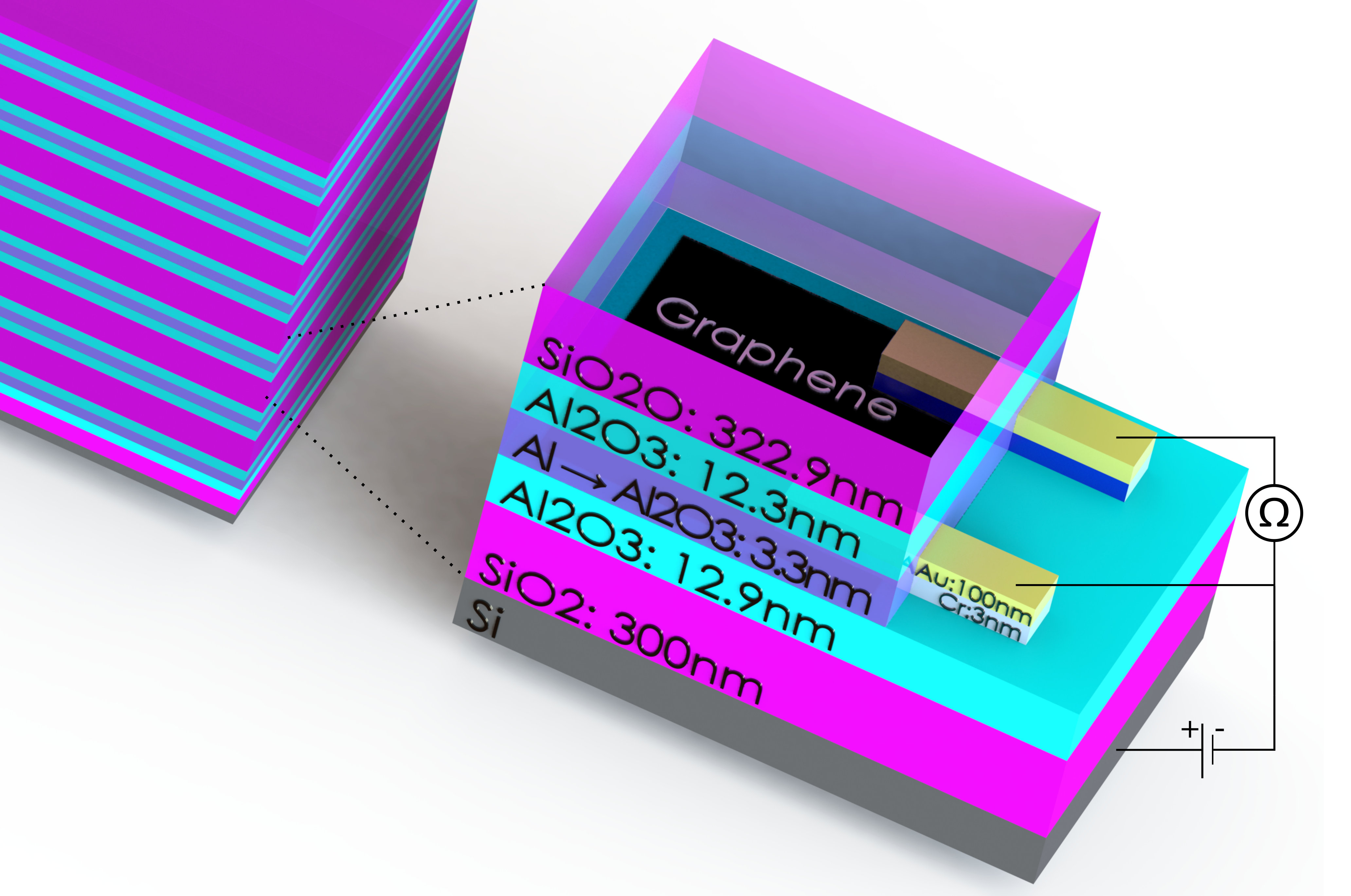 Figure 1
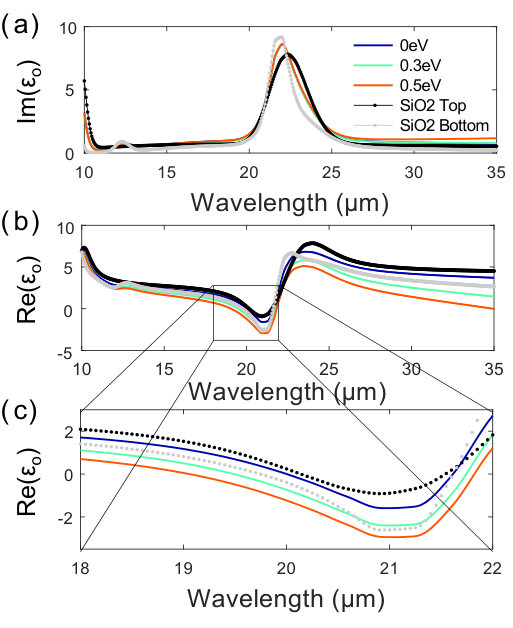 Figure 2
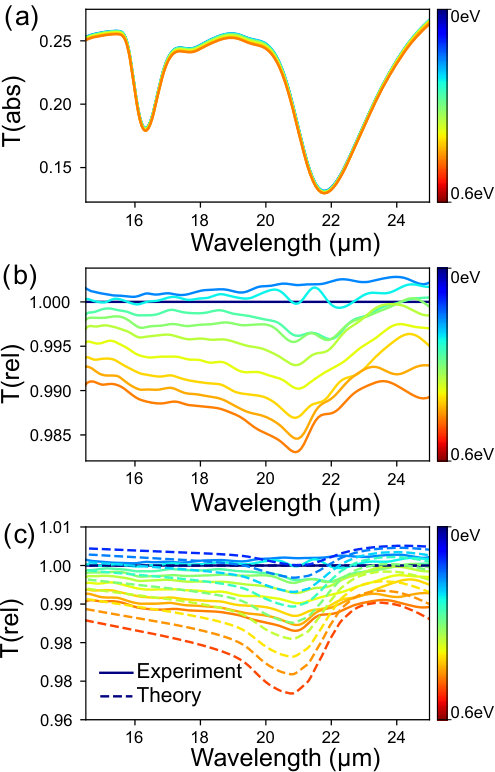 Figure 3
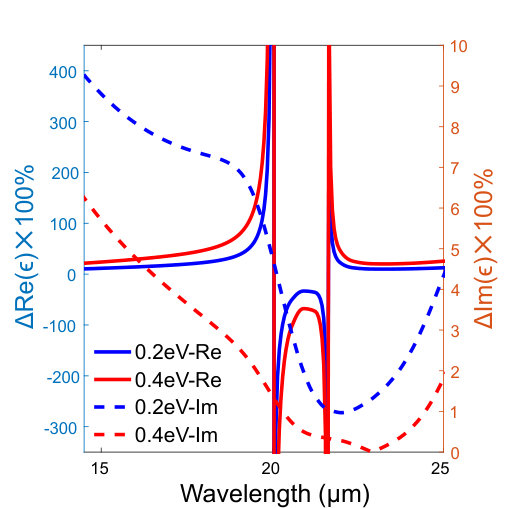 Figure 4
Peer Reviews
No public reviews on file for this paper yet. If you reviewed it on a platform where reviews are public (OpenReview, ICLR, NeurIPS, ICML), you can paste yours below so the community can read it here.
Videos
No videos yet. Explain this paper in a talk, walkthrough, or lecture? Add one.
Present address:] Department of Electrical Engineering, Ginzton Laboratory, Stanford University, California 94305, USA; [email protected]
Experimental demonstration of tunable graphene-polaritonic hyperbolic metamaterial
Jeremy Brouillet
Thomas J. Watson Laboratories of Applied Physics, California Institute of Technology, California 91125, USA
Georgia T. Papadakis
[
Thomas J. Watson Laboratories of Applied Physics, California Institute of Technology, California 91125, USA
Harry A. Atwater
Thomas J. Watson Laboratories of Applied Physics, California Institute of Technology, California 91125, USA
Abstract
Tuning the macroscopic dielectric response on demand holds potential for actively tunable metaphotonics and optical devices. In recent years, graphene has been extensively investigated as a tunable element in nanophotonics. Significant theoretical work has been devoted on the tuning the hyperbolic properties of graphene/dielectric heterostructures, however, until now, such a motif has not been demonstrated experimentally. Here we focus on a graphene/polaritonic dielectric metamaterial, with strong optical resonances arising from the polar response of the dielectric, which are, in general, difficult to actively control. By controlling the doping level of graphene via external bias we experimentally demonstrate a wide range of tunability from a Fermi level of eV to eV, which yields an effective epsilon-near-zero crossing and tunable dielectric properties, verified through spectroscopic ellipsometry and transmission measurements.
††preprint: AIP/123-QED
Spectral tunability is key for controlling light-matter interactions, critical for many applications including emission control, surface enhanced spectroscopy, sensing, and thermal control. Particularly in the subwavelength range, tuning plasmonic resonances has been essential in controlling color, typically achieved by controlling the size of plasmonic nanoparticles, antennas and metamaterials Lu et al. (2014); Zhou et al. (2014); Jacob et al. (2010); Schuller et al. (2010). In obtaining a large range of spectral tunability, it is preferable to operate near an optical resonance rather than a broadband plasmonic response. Nevertheless, it is in general easier to tune a broadband optical response rather than a resonant one since resonances in nanophotonics typically entail subwavelength-scale geometrical features.
From a very wide range of recently investigated metamaterials and heterostructures for spectral control, particular emphasis has been given to hyperbolic media, due to enhanced light-matter interactions arising from a larger range of wavenumbers available for propagating modes Smith et al. (2000). These media are in generally uniaxial and support a hyperbolic frequency dispersion given by the equation Jacob et al. (2010); Poddubny et al. (2013); Smith and Schurig (2003); Papadakis, Yeh, and Atwater (2015)
[TABLE]
where and refer to the ordinary (in-plane) and extraordinary (out-of-plane) dielectric permittivity, respectively. Due to the different sign in and , upon fixing the frequency , the isofrequency diagram of the relevant electromagnetic modes opens up into a hyperbola, giving rise to a very large density of optical states, promising for waveguiding Babicheva (2017), emission engineering and Purcell enhancement Cortes, Otten, and Gray (2019); Lu et al. (2014); Zhou et al. (2014) thermal photonics Biehs, Tschikin, and Ben-Abdallah (2012), lasing Fang, Koschny, and Soukoulis (2010), and imaging Liu et al. (2007); Weile (2007). Particularly, near the epsilon-near-zero frequency crossing of either or , many exciting phenomena can be supported, the most prominent of which is light propagation with near-zero phase advance Maas et al. (2013); Mahmoud and Engheta (2014); Engheta (2013).
There has been significant effort in frequency-tuning of the optical response of hyperbolic metamaterials Papadakis and Atwater (2015); Poddubny et al. (2013); Roberts et al. (2019); Lu, Simpson, and Valiyaveedu (2018). For this, particular interest holds the case of graphene, a well-studied monolayer material for electronics Novoselov et al. (2005) and in infrared photonics Andersen (2010). Namely, the dielectric properties of graphene can be dynamically tuned via optical pumping Ryzhii, Ryzhii, and Otsuji (2007), or with electrostatic modulation of its carrier concentration with field-effect gating Vakil and Engheta (2011); Polini et al. (2008), often targeting tunable plasmonic properties Hwang and Sarma (2007); Brar et al. (2013). The high degree of localization of graphene plasmons, together with the dielectric tunability of graphene provides a promising platform for investigating tunable graphene-based hyperbolic metamaterials. There has already been considerable theoretical effort in the past decade to understand the properties of tunable graphene metamaterials Linder and Halterman (2016); Andryieuski and Lavrinenko (2013); Xiong et al. (2018); Zainud-Deen, Mabrouk, and Malhat (2017); Al Sayem et al. (2014), with significant focus on the potential of tuning hyperbolic properties of graphene/dielectric planar heterostructures Poddubny et al. (2013); Iorsh et al. (2013); Othman, Guclu, and Capolino (2013); Janaszek, Tyszka-Zawadzka, and Szczepański (2016). There have previously been experimental demonstrations of graphene-based hyperbolic media Chang et al. (2016); Dai et al. (2015a), nevertheless, the reported properties have remained fixed at the time of fabrication. No post-fabrication way to control the dielectric permittivity tensor ( and in Eq. 1) has been reported until now.
Gating graphene when integrated with dielectric layers is difficult due to graphene’s two-dimensional nature with weak out-of-plane Van der Waals bonds that yield poor adhesion to most dielectric substrates. Furthermore, large-area graphene sheets on the order of mm2’s with gate-induced tunability are needed to perform metamaterial optical measurements at infrared frequencies. Exfoliated flakes are generally limited to sizes of 10s of m, so large-area graphene samples grown by chemical vapor deposition and subsequently transferred from their growth substrates, are necessary. Additionally, deposition of large-area thin dielectric layers on graphene is challenging. Films prepared by electron-beam evaporation exhibit thermal stress-induced delamination McNerny et al. (2014). Films grown by atomic layer deposition (ALD) with an H2O precursors exhibit difficulty in bonding to chemically-inert hydrophobic graphene Park et al. (2014), whereas ozone-based ALD processes oxidize graphene.
Here, we discuss how we overcome these challenges and are, thus, able to tune a graphene-based hyperbolic metamaterial unit cell for a wide range of doping levels in graphene translating to a Fermi level that ranges from eV to eV, without dielectric breakdown. Previous theoretical proposals have considered non-dispersive dielectric materials Poddubny et al. (2013); Iorsh et al. (2013); Othman, Guclu, and Capolino (2013); Janaszek, Tyszka-Zawadzka, and Szczepański (2016), thereby yielding a broadband hyperbolic response. By contrast, here, we consider a polaritonic dielectric material, namely SiO2. The polaritonic resonances that all polar materials exhibit at infrared frequencies, at their Reststrahlen band, are typically not tunable, as they constitute a fundamental material property. Nevertheless, we show here that, upon the integration of graphene, it is feasible to actively tune these polaritonic resonances. Graphene provides a tunable character to the in-plane response of the composite graphene/SiO2 heterostructure, and its plasmonic nature assigns a hyperbolic frequency region near the polar resonance of SiO2, at a free-space wavelength of m. We are therefore able to experimentally observe, through multi-angle spectroscopic ellipsometry and transmittance measurements, a tunable epsilon-near zero permittivity along the in-plane direction near the surface phonon polaritonic resonance while leaving the out-of-plane response unchanged (due to the two-dimensional nature of graphene), thereby yielding a widely tunable hyperbolic response.
The metamaterial under consideration is depicted in Fig. 1, and is composed of a graphene monolayer sandwitched in between two SiO2 layers of thickness nm. The alumina (Al2O) layers depicted in Fig. 1 have thickness thickness nm and are placed to prevent poor graphene adhesion. Particularly, a viable dielectric deposition method was developed consisting of functionalization of the surface by deposition of trimethylaluminium (TMA) Lee et al. (2010) or an aluminum nucleation layer Kim et al. (2009) to create a seed layer for additional deposition. A suitably thin layer of aluminum is needed so that it can fully oxidize and not compromise the electrical gating of the graphene. We found that deposition of AL2O3 via plasma-enhanced chemical vapor deposition (PECVD) resulted in reduced thermal stress and avoided delamination. The graphene is grown by chemical vapor deposition (CVD) and transferred onto the thermal oxide, whereas the top SiO2 film is deposited by plasma-enhanced chemical vapor deposition (PECVD). The thickness of the film layers were measured by both a thin film analyzer and visible ellipsometry with a qualitative agreement of 2nm. Lithographically-defined patterns were used to deposit 3nm/100nm of Cr/Au contacts on the graphene layer, and were used to gate the graphene monolayer against the silicon substrate, which serves as the back-side contact for field-effect tuning.
Since the composite in Fig. 1 is extremely subwavelength to infrared light, one can homogenize it and assign an effective in-plane and out-of-plane dielectric response, namely and Papadakis, Yeh, and Atwater (2015). The two-dimensional nature of graphene leaves the out-of-plane response unaffected, therefore in the out-of-plane direction, this metamaterial behaves to far-field radiation effectively as bulk SiO2. By striking contrast, by electrostatically tuning the graphene carrier we can shift the epsilon-near-zero point of , and therefore control the hyperbolicity of the heterostructure as shown in Fig. 2.
In estimating the Fermi level to which we can actively tune the doping level in graphene, we use a capacitor model based on the materials between the gate and the applied voltageLuxmoore et al. (2014).
[TABLE]
Experimentally, the location of the Dirac peak was determined via measuring change in sheet resistance. Furthermore, we use the Kubo formula Falkovsky (2008) calculate the sheet conductance from the Ef of graphene. This value can be used to compute the transfer matrix for graphene Papadakis (2018).
[TABLE]
We utilize the transfer matrix approach Pochi Yeh (1988), accounting for graphene via , and obtain the complex scattering amplitudes of the fields at different Fermi levels . In these calculations, fabrication and material imperfections are removed by having, a priori, measured experimentally the individual layer thicknesses and optical constants of all thin films in the metamaterial, with ellipsometry. For example, in Fig. 2(a) and (b) we show the experimentally determined dielectric permittivity of the top and bottom SiO2 films shown in Fig. 1, where their small differences are are expected since the top SiO2 is deposited via PECVD whereas the bottom one is thermally grown. The scattering amplitudes are fed into previously developed parameter retrieval approaches Papadakis, Yeh, and Atwater (2015), from which we obtain an effective uniaxial tensorial dielectric permittivity that characterizes the metamaterial composite. This process is repeated at different gating voltages , in other words for different Fermi levels .
By taking spectroscopic ellipsometry measurements of the full metamaterial stack of Fig. 1, we perform an ellipsometric fitting where we use the effective dielectric permittivity as a model to fit to the experimental data, namely the ellipsometric observables and . In Fig. 2(a) and (b) we show the imaginary and real part of the ellipsometrically-derived in-plane permittivity , at different Fermi levels . We note that the out-of-plane effective permittivity is not tunable as described above, and therefore is omitted. There resonant character of near the regime of m is attributed to the surface phonon polaritonic resonance of SiO2 at this wavelength, nevertheless this resonance has now become tunable via incorporation of a monolayer-thick graphene sheet in between SiO2 films. As can be clearly seen in 2(c), by gradually tuning the Fermi level of graphene from eV (blue curves) to eV (green curves) to eV, we redshift the infrared response of the metamaterial by approximately a micron, i.e. from a near-zero crossing at m under no bias to m under large applied bias. Redshifting is expected as a response of applied bias because the electrostatic doping induces additional charge carriers in the graphene sheet, hence making the composite medium more metallic.
In addition to spectroscopic ellipsometry, we perform Fourier-transform infrared spectroscopy (FTIR) to measure the sample transmission, and compare with the results of spectroscopic ellipsometry shown above, derived based on initial parameter retrieval-based derivation of . Electrostatically gating the graphene induces changes in the transmission of the composite metamaterial, as shown in Fig. 3. Namely, as mentioned above, gating the graphene monolayer makes the composite metamaterial more metallic and, therefore, less transmissive, as shown with the colormap in Figs. 3(b) and (c). The dips near the wavelengths of m and m correspond to the two surface phonon polariton resonances of SiO2, where the material absorbs resonantly, resulting in low transmittance. We note that, experimentally, graphene exhibits hysteresis, which is attributed to defects induced by the deposition of the aluminum layer, resulting in the discrepancies between experiment and theory. As the graphene is tuned, the Dirac peak shifts in the direction of applied bias, causing the sample to experience a reduced Ef, giving qualitative experimental agreement with theory without fitting parameters as can be seen in Fig. 3(c).
To further illustrate the epsilon-near-zero shifting and the resonant nature of the in-plane dielectric response of this metamaterial, i.e. , in Fig. 4 we show the relative change in dielectric permittivity, i.e. , for two different applied bias corresponding to eV and to eV, with blue and red color, respectively. These calculations were performed using the experimentally derived values for the optical properties and thicknesses of the constitutive components of the metamaterial, as described above. Near the surface phonon resonance of SiO2 at m, significant tuning of the real part of is observed, coming from the epsilon-near-zero tuning, which shifts by approximately micron. Bearing in mind that the out-of-plane response of this metamaterial ( in Eq. 1) is not tunable due to the two-dimensional nature of graphene, as explained above, the change in sign of on the left axis in Fig. 4 corresponds to a topological transition of the isofrequency surface of this metamaterial.
In summary, we have experimentally demonstrated a graphene/polaritonic dielectric metamaterial with tunable epsilon-near-zero permittivity response. By tuning the Fermi level of graphene by eV, we observe a shift of m in the near-zero response. Although previous theoretical proposals have focused on non-dispersive dielectric materials between graphene monolayers, here we showed that utilizing the polar response of dielectrics at infrared frequencies benefits tunability, and additionally provides means of tuning constitutive material properties of polar dielectrics and semiconductors, by incorporating graphene. Ellipsometry was used to determine the optical properties (dielectric response and thickness) of the constituent materials, and, based on effective parameter retrievals that homogenize the metamaterial, we experimentally characterized the full metamaterial stack. FTIR transmission measurements agree with our ellipsometric results, where transmission reduction is directly attributed to electrostatically induced charges in graphene and to epsilon-near-zero tuning.
Acknowledgements.
This work was supported by U.S. Department of Energy (DOE) Office of Science Grant No. DE-FG02-07ER46405 (G.T.P. and H.A.A.). JB acknowledges support from a National Science Foundation Graduate Research Fellowship under Grant No. 1144469. G.T.P. acknowledges support from the TomKat Postdoctoral Fellowship in Sustainable Energy at Stanford University.
The reference list from the paper itself. Each links out to its DOI / PubMed record.
- 1Lu et al. (2014) D. Lu, J. J. Kan, E. E. Fullerton, and Z. Liu, “Enhancing spontaneous emission rates of molecules using nanopatterned multilayer hyperbolic metamaterials,” Nature nanotechnology 9 , 48 (2014).
- 2Zhou et al. (2014) J. Zhou, A. F. Kaplan, L. Chen, and L. J. Guo, “Experiment and theory of the broadband absorption by a tapered hyperbolic metamaterial array,” ACS photonics 1 , 618–624 (2014).
- 3Jacob et al. (2010) Z. Jacob, J.-Y. Kim, G. V. Naik, A. Boltasseva, E. E. Narimanov, and V. M. Shalaev, “Engineering photonic density of states using metamaterials,” Applied physics B 100 , 215–218 (2010).
- 4Schuller et al. (2010) J. A. Schuller, E. S. Barnard, W. Cai, Y. C. Jun, J. S. White, and M. L. Brongersma, “Plasmonics for extreme light concentration and manipulation,” Nature materials 9 , 193 (2010).
- 5Smith et al. (2000) D. R. Smith, W. J. Padilla, D. Vier, S. C. Nemat-Nasser, and S. Schultz, “Composite medium with simultaneously negative permeability and permittivity,” Physical review letters 84 , 4184 (2000).
- 6Poddubny et al. (2013) A. Poddubny, I. Iorsh, P. Belov, and Y. Kivshar, “Hyperbolic metamaterials,” Nature Photonics 7 , 948 (2013).
- 7Smith and Schurig (2003) D. Smith and D. Schurig, “Electromagnetic wave propagation in media with indefinite permittivity and permeability tensors,” Physical Review Letters 90 , 077405 (2003).
- 8Papadakis, Yeh, and Atwater (2015) G. T. Papadakis, P. Yeh, and H. A. Atwater, “Retrieval of material parameters for uniaxial metamaterials,” Physical Review B 91 , 155406 (2015).