Graphene wormhole trapped by external magnetic field
G. Q. Garcia, P. J. Porf\'irio, D. C. Moreira, C. Furtado

TL;DR
This paper investigates how massless fermions behave in a graphene wormhole structure under an external magnetic field, revealing energy spectra similar to Landau levels through solving the Dirac equation.
Contribution
It introduces a detailed analysis of fermion behavior in a graphene wormhole with magnetic field, solving the Dirac equation in this unique geometry.
Findings
Energy spectra resemble Landau levels
Wave functions are analyzed in the wormhole geometry
External magnetic field influences fermion states
Abstract
In this work we study the behavior of massless fermions in a graphene wormhole and in the presence of an external magnetic field. The graphene wormhole is made from two sheets of graphene that play the roles of asymptotically flat spaces connected through a carbon nanotube with a zig-zag boundary. We solve the massless Dirac equation in this geometry and analyze its wave function. We show that the energy spectra of these solutions exhibit similar behavior to Landau levels.
Click any figure to enlarge with its caption.
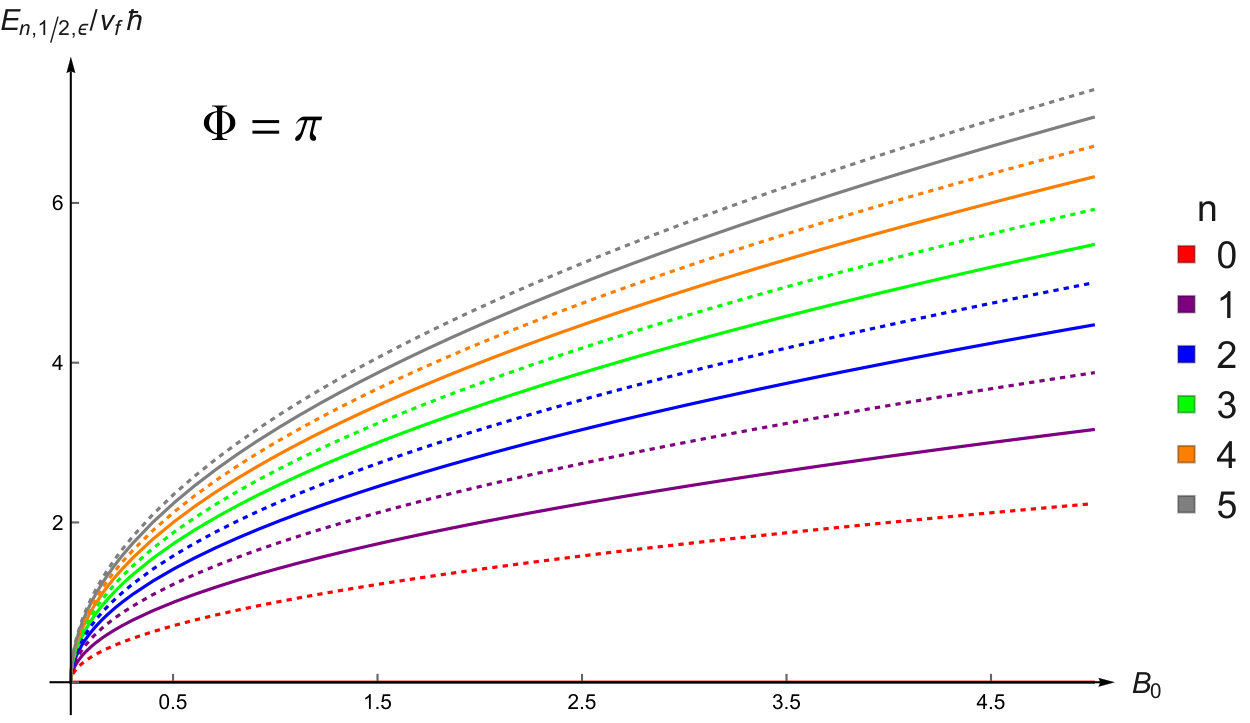 Figure 1
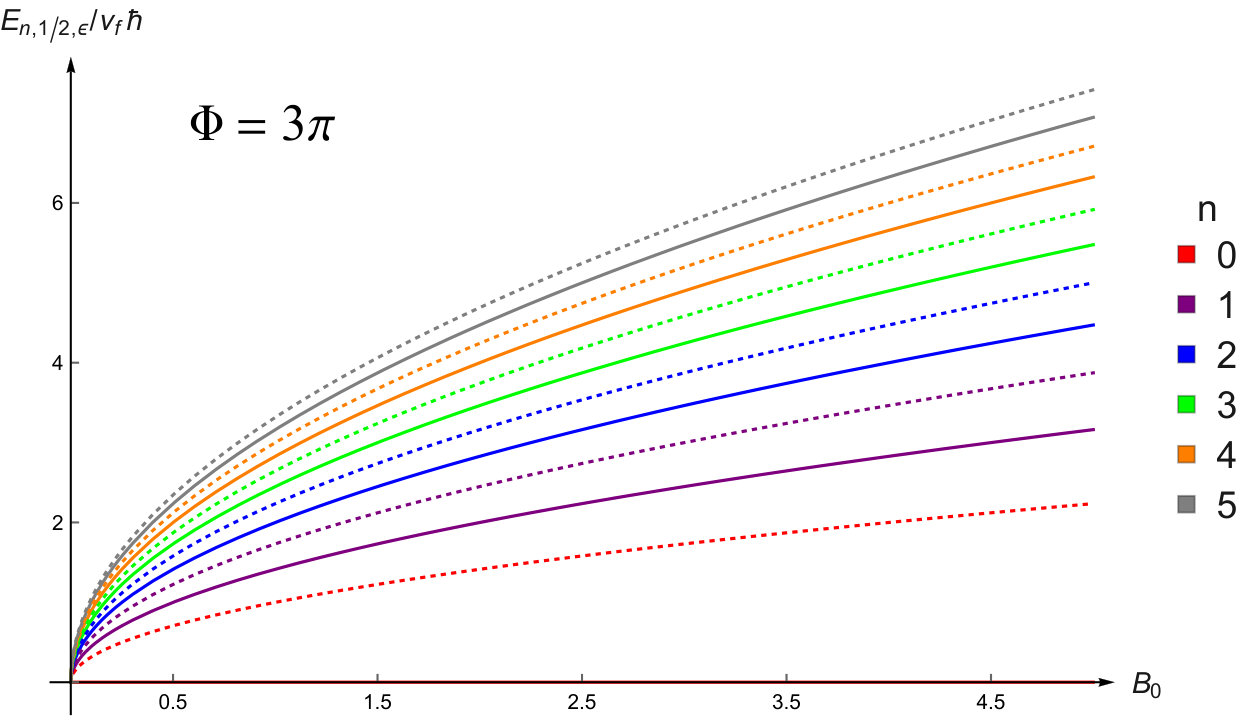 Figure 2
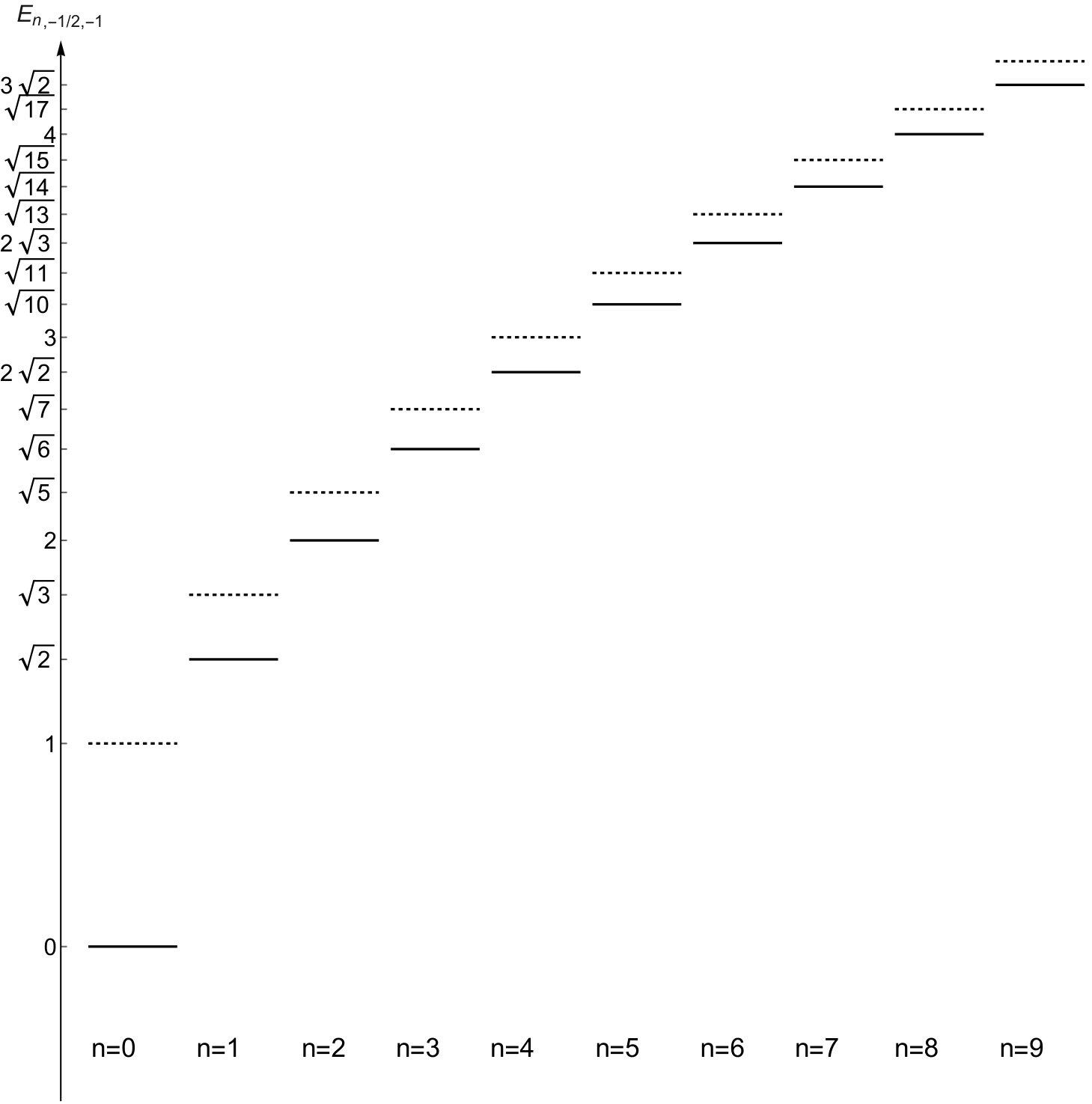 Figure 3
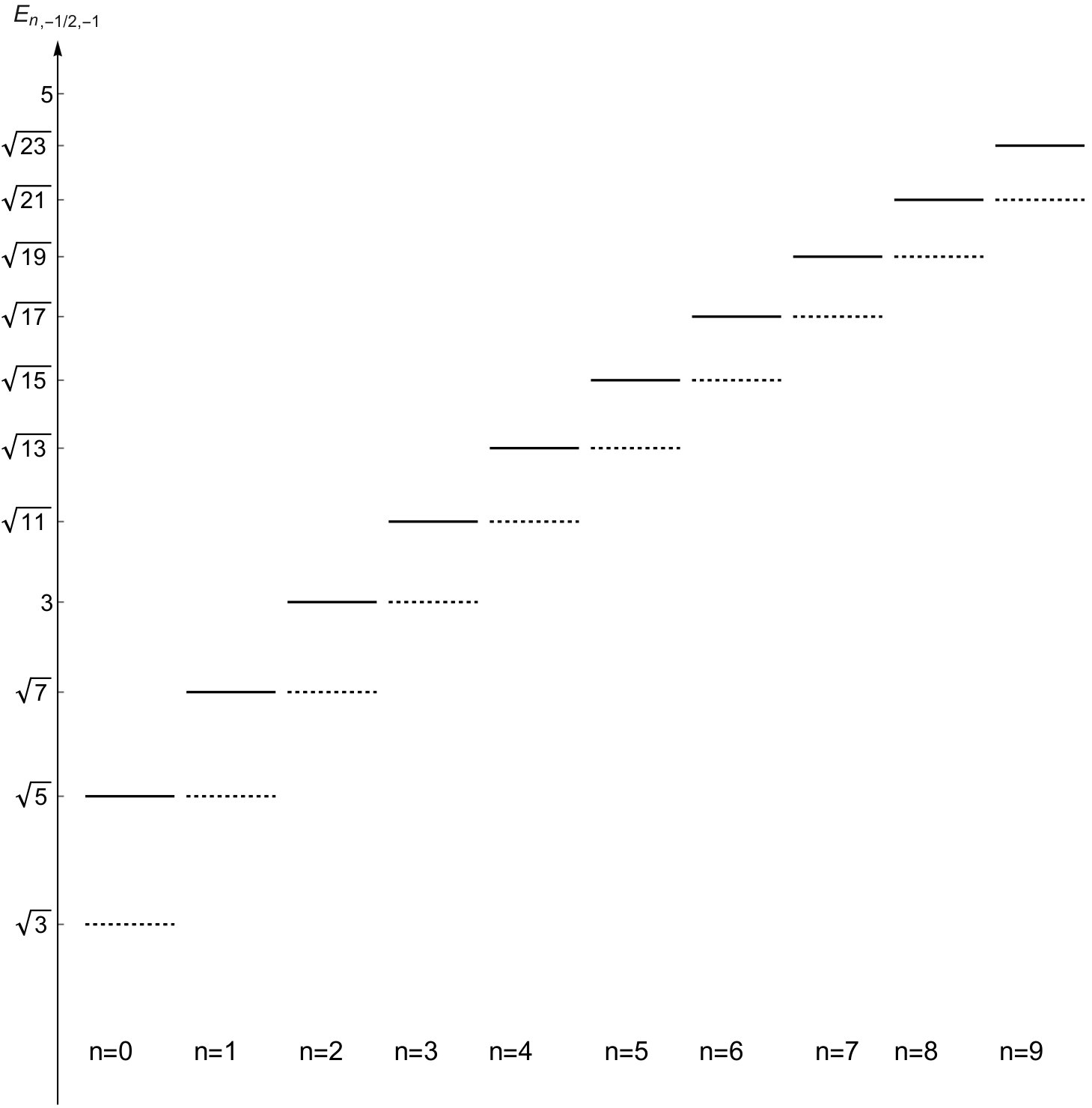 Figure 4
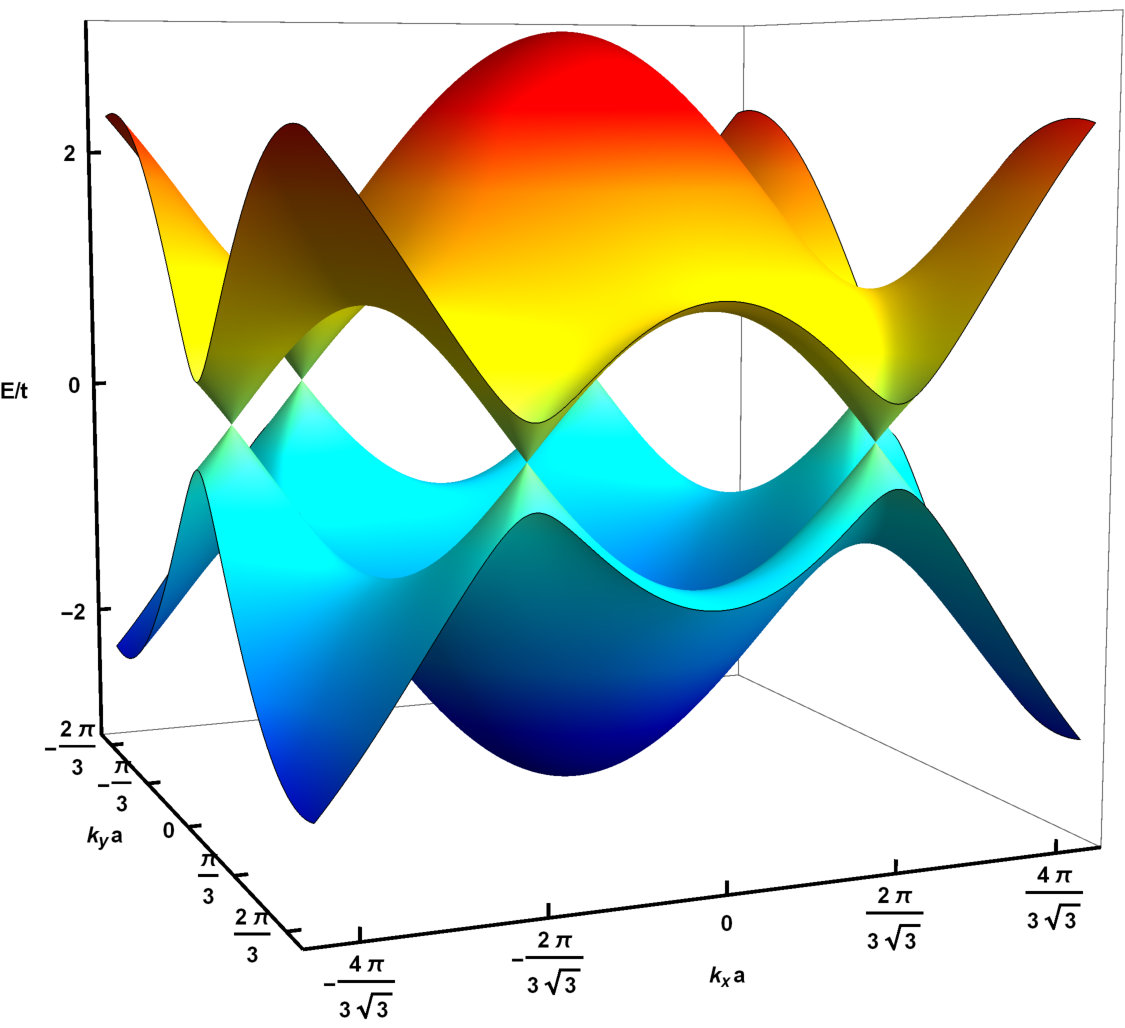 Figure 1
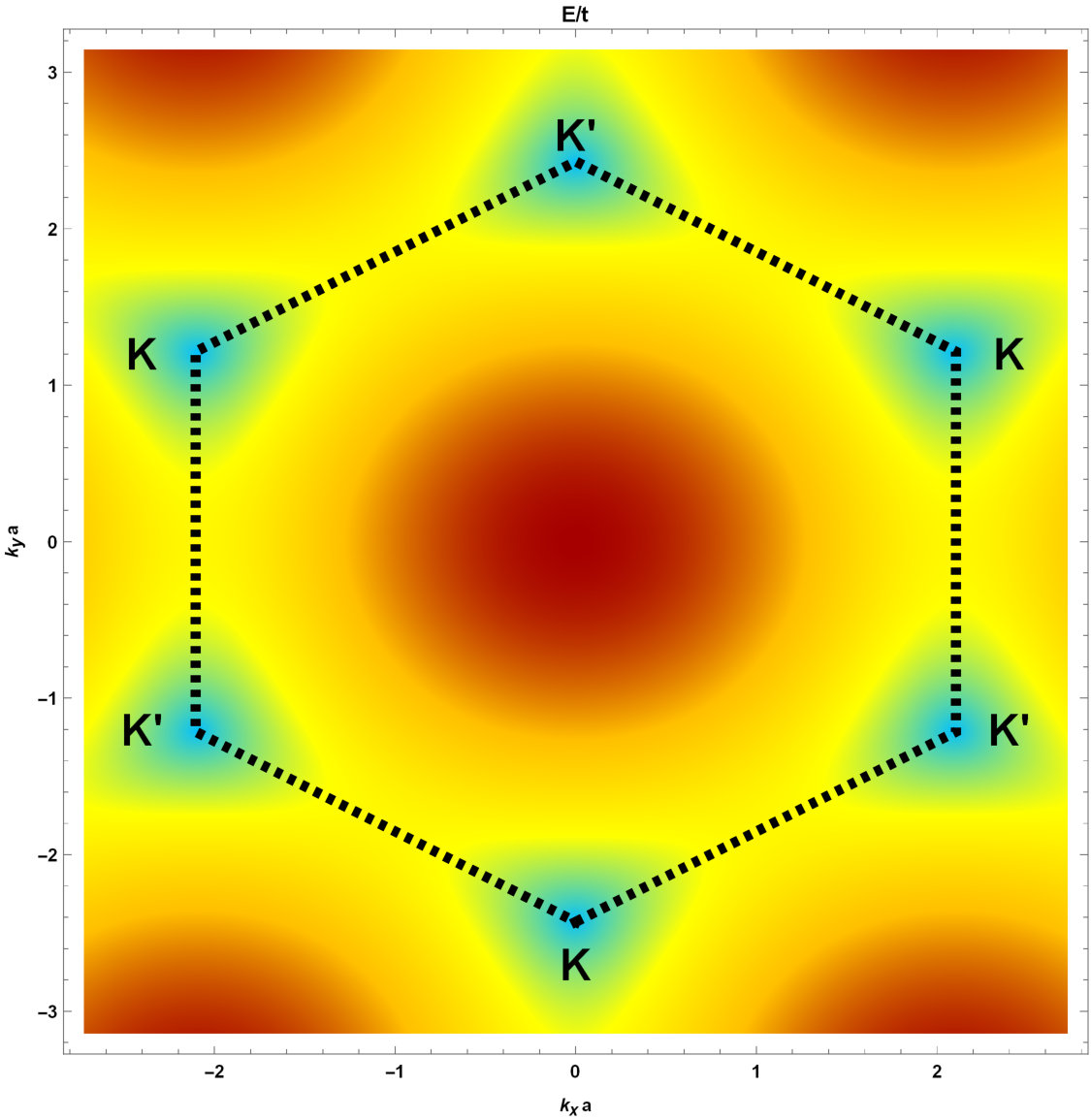 Figure 1
Peer Reviews
No public reviews on file for this paper yet. If you reviewed it on a platform where reviews are public (OpenReview, ICLR, NeurIPS, ICML), you can paste yours below so the community can read it here.
Videos
No videos yet. Explain this paper in a talk, walkthrough, or lecture? Add one.
Graphene wormhole trapped by external magnetic field
G. Q. Garcia1[email protected]
P. J. Porfírio2[email protected]
D. C. Moreira3[email protected]
C. Furtado4[email protected]
1Unidade Acadêmica de Física, Universidade Federal da Campina Grande, 58109-970 Campina Grande, PB, Brazil
2Departament of Physics and Astronomy, University of Pennsylvania, Philadelphia, PA 19104, USA
3Faculdade Uninassau Petrolina, 56308-210, Petrolina, PE, Brazil
4Departamento de Física, Universidade Federal da Paraíba, 58051-970, João Pessoa, PB, Brazil
Abstract
In this work we study the behavior of massless fermions in a graphene wormhole and in the presence of an external magnetic field. The graphene wormhole is made from two sheets of graphene which play the roles of asymptotically flat spaces connected through a carbon nanotube with a zig-zag boundary. We solve the massless Dirac equation within this geometry, analyze the corresponding wave function, and show that the energy spectra of these solutions exhibit behavior similar to Landau levels.
I Introduction
In recent years graphene has played a very important role in physics due to its incredible mechanical and electronic properties allowing for many technological applications geim2010rise ; geim2009graphene . Graphene has a carbon-honeycomb structure and constitutes the first really two-dimensional material developed due to its unusual conical band structure, where the electrons close the Fermi points have a conical band structure , being described by the massless Dirac equation (or Weyl equation) in (2 + 1)-dimensions bena2009remarks ; neto2009electronic . Therefore, a quasiparticle on graphene has a relativistic behavior, although it is not really a relativistic particle. Another interesting effect is the presence of topological defects in the graphene lattice, since it is virtually impossible to prepare a real solid crystal without them. By means of ”cut and glue” processes, Volterra studied these defects and their respective topological numbers, analyzing changes occurring in the graphene lattice in the presence of pentagon rings, heptagon rings or pentagon-heptagon pairs volterra1907equilibre ; moraes2000condensed ; puntigam1997volterra . Rings of pentagons or heptagons are related to disclinations, and pentagon-heptagon pairs are related to dislocations carpio2008dislocations ; vozmediano2010gauge . A geometric description of defects in 3D solids based on Riemann-Cartan geometry was presented in the works of Katanaev and Volovich katanaev1992theory ; katanaev2005geometric . They proved an equivalence between a three-dimensional gravitational theory with torsion and the theory of defects in solids, associating curvature with disclinations and torsion with dislocations. Therefore, in the continuum limit, topological defects in crystals can be described in terms of Riemann-Cartan geometry. It is well known that the presence of disclinations in graphene modifies its electronic properties and that these topological defects can be interpreted as a source of a non-abelian gauge field, while smooth deformations of graphene sheets produce a gauge field similar to an electromagnetic one vozmediano2010gauge ; gonzalez1993electronic ; garcia2017geometric . In addition, another direct consequence of the presence of topological defects in graphene is that the gauge fields affects the quantum particle response to magnetic fields, causing its energy spectrum to present degenerate levels analogous to Landau levels lammert2004graphene ; bueno2012landau . For all these aspects, we can say that graphene is a real laboratory for field theory with several possibilities to study the behavior of particles in -dimensional systems presenting topological defects.
Many gravitational analogue models based on using graphene in curved background geometries were constructed by exploring the geometric effects on the quantum dynamics of graphene quasiparticles. An interesting work on this subject was presented by González et al. gonzalez1993electronic , in which the quantum spectrum of a fullerene molecule is described through a graphene sheet folded in a polyhedra. In this case, the graphene lattice includes pentagonal rings, acting as a gauge field, and presents spherical symmetry. In 2007, Cortijo and Vozmediano proposed a model in which graphene is slightly curved and has pentagon-heptagon pairs and Stone-Wales defects in their structure, based on an analogy with cosmic strings cortijo2007electronic ; cortijo2007effects . In vozmediano2010gauge , Vozmediano discussed the physical properties of graphene, showing its connection with Quantum Field Theory (QFT) and Gauge Theory. An interesting link between topological defects in graphene and cosmic strings in General Relativity (GR) also was presented. The arising of geometric phases in graphitic nanocons was explored in furtado2008geometric , and recently some of the authors of furtado2008geometric have analyzed the effects of rotation on fullerenes molecules in background geometries given by Gödel-type universes garcia2017geometric ; garcia2017fermions ; garcia2018weyl . Some studies on dislocations and their relation to torsion theory have also been performed. In particular, the formation and stability of dislocations was studied by Carpio et al. carpio2008dislocations , and Mesaros demonstrated the emergence of a non-Abelian Berry phase due to the existence of dislocations in the graphene structure mesaros2009berry .
An important class of geometries arising in gravitational models are wormholes. They have a long history, and their properties deserve some discussion. The first wormhole solution was put forward by Einstein and Rosen in the seminar paper einstein1935particle . Such a solution is sometimes called Einstein-Rosen bridge. These solutions are obtained by making a suitable coordinate change on the Schwarzschild geometry. This coordinate change covers two asymptotically identical flat spaces connected by a ”bridge”. In particular, Einstein-Rosen bridge presents event horizons, and as a result, observers are not allowed to travel along the bridge from a particular flat space to the other. On the other hand, it is possible to construct traversable wormholes, so that the two-way travel of observers is permitted. For that, it is necessary to implement further conditions in order to prevent the emergence of the event horizons. As shown by Morris and Thorne in morris1988wormholes , once these conditions are fulfilled, the wormhole is traversable. However, in GR, traversable wormholes are supported by matter sources violating the energy conditions morris1988wormholes . In this way, a wormhole is defined geometrically as a bridge between two manifolds or between two distant parts of the same manifold. The wormholes can be Lorentzian (traversable or not), Euclidean, etc. It is well known in General Relativity that traversable Lorentzian wormholes can be obtained as solutions of Einstein equations that require so called exotic matter, i.e., matter violating the Null Energy Condition (NEC) morris1988wormholes ; visser1995lorentzian , which is a part of the Weak Energy Condition (WEC) whose physical meaning is that the energy density is nonnegative in any reference frame. In addition to aforementioned properties, it is worth to call attention to other remarkable issues, such as the construction of a time-machine from wormholes lobo2017wormholes and inherently their causality violation problems visser1995lorentzian , duality between wormholes and entangled states in quantum gravity maldacena2013cool and analogue models (condensed matter systems used to mimic wormholes), see visser2002analogue and references therein. Along these lines, analogue models have earned increased attention since the beginning of GR, mainly in the last decades, typically in condensed matter systems. Such models, in some sense, are attempts to describe the gravitational physics in terms of other physical systems. As pointed out in visser2002analogue , the analogue models mimic kinematic properties of GR but not the dynamical ones. In particular, we shall mainly concentrate on a particular analogue model called graphene wormhole gonzalez2010graphene ; gonzalez2009propagating whose properties will be given in details later. Furthermore, we focus on kinematic aspects of the graphene wormhole. In other words, we are concerned about recovering the geometrical properties of gravitational wormholes. Roughly speaking, the graphene wormhole should be comprised of two graphene sheets (play a role of asymptotically flat spaces) connect by a carbon nanotube (playing a role of the bridge) in order to mimic the gravitational wormhole geometry. On the other hand, dynamic properties are not mimicked. For example, it is well known that gravitational wormholes violate the energy conditions in GR, and an issue that could be raised would be: should graphene wormholes satisfy such conditions? The answer is obvious: no! Since the energy conditions are inherent to GR, the graphene wormhole does not mimic them. In park2013thermal , the stability of geometrical structure of graphene was studied and stable graphene wormhole structures were obtained by simulation procedure in the context of molecular dynamics.
In the last decade several papers have dealt with a number of models of wormholes in carbon structures and other condensed matter systems. One of the first models in this context was used to examine nanoporous carbon structures in margine2007theory . Gonzalez and Herrero, by connecting two graphene sheets through a graphene nanotube, constructed an interesting model where the continuum limit of the graphene lattice is associated with a wormhole metric gonzalez2010graphene ; gonzalez2009propagating . Pincak and Smotlacha (pincak2013analogies, ) have studied the electronic properties of a graphene wormhole in a perturbed nanocylinder (pincak2013analogies, ), and the electronic structure of a wormhole geometry in solid state models was investigated by Atanasov and Saxena atanasov2011electronic . Fernandes et al. have analysed the wormhole geometry for electron waves in graphene fernandes2014wormhole . Sepehri et al. proposed a model to describe the evolution of the free electron current density in graphene sepehri2017current and Capozziello et al. presented a model which simulates moving electrons in graphene structures and analyzed its properties in Chern-Simons wormholes capozziello2018constructing . One of the authors recently investigated the parallel transport of spinors in graphene wormhole and the Aharonov-Bohm analogue effect in this system carvalho2013holonomy . Dandoloff and colleagues analyzed a geometry-induced potential in a two-dimensional model of wormhole geometry dandoloff2010geometry , and another analogue wormhole model in porous carbon/magnetic composite particle was presented in fang2016wormhole .
In this work we focus on the study of wormhole-like geometries constructed from carbon nanostructures and on the exact solutions of the Dirac equation in -dimensions in this setup 555During the submission process we were informed about the work Rojjanason2018icy , which also gets Landau levels for fermions in a wormhole geometry. However, we must point out that our study is different.. In particular, we deal with the graphene wormhole model described by Gonzalez and Herrero gonzalez2010graphene ; gonzalez2009propagating and observe the presence of degenerate energy levels in the solution of the Dirac equation due to an external magnetic field. These degenerescences are similar to those ones arising for Landau levels, when the graphene quasiparticle is trapped by an external magnetic field. The wormhole is constructed from a system where one has two graphene-nanotube junctions which play the role of asymptotically flat spaces connected through a carbon nanotube with a zig-zag boundary mimicking a bridge. This wormhole-like geometry is called a wormbridge. In order set up a graphene wormbridge, first of all, it is necessary to make a hole in a graphene layer with an hexagonal shape. Then, new atoms are connecting with the atoms at the boundary in vertical direction, so that a zig-zag pattern is created, and hence it is possible to connect a graphene layer with a zig-zag nanotube. A direct consequence of this construction is the emergence of six heptagonal rings alternating with hexagonal rings in the junction. The construction described by González and Herrero gonzalez2010graphene can be extended for a hole with a large radius, keeping the same number of defects. For convenience, we take the continuum limit for the graphene wormhole considering the nanotube radius much larger than its length. In this way, we do not need to take into account soft variations in the curvature of the graphene-nanotube junction.
This work is organized as follows. In Section II we present a brief review of the general aspects of the problem. We draw some relevant points about the continuum limit approximation in graphene and on topological defects acting as gauge fields. We also present in this section the geometric description of a graphene wormhole. In Section III, we describe the quantum dynamics of a quasiparticle in the graphene wormhole in the presence of an external magnetic field. The magnetic field is introduced via minimal coupling. In Section IV, we solve the Weyl equation for the two charts of the graphene wormhole, obtaining the junction conditions between them in order to find the correct energy spectrum. Finally, in Section V we present the final discussions of our results.
II Generalities
II.1 Topological Defects in Graphene
In order to describe graphene within a wormhole geometry, where there are effects arising from the curvature of space, we need to understand how the presence of topological defects affect the physical properties of graphene. First of all, it is necessary to discuss its description in flat spaces, and then implement the curved spacetime elements. Graphene is a honeycomb structure composed of carbon atoms at each of its hexagonal vertices, where each unit cell has two carbon atoms bena2009remarks . In fact, one can consider the honeycomb lattice as a superposition of two triangular sublattices. Each carbon atom present in the graphene lattice has four valence electrons, where three of these electrons form -bonds and are responsible for the elasticity of the lattice. The remaining valence electron forms -bonds responsible for the electronic properties of graphene, which can be obtained through the tight-binding model. The tight-binding Hamiltonian provides the energy spectra taking into account that the valence electron can hop to the nearest carbon atoms neighbors, and can be expressed in real space as gonzalez1993electronic ; vozmediano2010gauge :
[TABLE]
where the creation and annihilation operators and , respectively, describe the probability of a valence electron to hop from site to nearest-neighbor site (or vice versa) by means of the hopping parameter .
In order to find the energy band of graphene, one can leave aside the unit cell representation in real space and move to the first Brillouin zone representation in momentum space. After diagonalizing the resulting Hamiltonian, the energy band of graphene becomes
[TABLE]
depicted in Fig.1(a), where the parameter is the interatomic distance between two carbon atoms in the graphene lattice. Since the graphene lattice is described by two atoms in its primitive cell, its reciprocal lattice is described by two moments, denoted by and , known as Fermi points, so that the first Brillouin zone must be hexagonal, as shown in Fig.1(b). When one considers in equation (2) the valence band is completely filled, and each corner connects the valence band with conduction band at six points, which are the Fermi points in the hexagon of the reciprocal lattice bena2009remarks ; neto2009electronic . In the continuum limit, when the electrons are close to the Fermi points (for any of the Fermi points or ), its dispersion relation in the low excitation regime is linear and has a conical shape. Thus, graphene in this regime can be described by the relativistic (2+1)-dimensional massless Dirac equation bena2009remarks ; gonzalez1993electronic
[TABLE]
where is the Fermi velocity and is a vector representation for the Pauli matrices. Thus, the interaction between the valence electron and the Fermi points is described in terms of a quasi-particle obeying the massless Dirac equation such that its eigenvector is a spinor with a pseudospin represented by the sublattices .
Due to the presence of pentagons and heptagons in the graphene lattice, the atoms cannot be distributed in two triangular sublattices. These types of defects are known as disclinations. The formation and counting of such defects in a graphene lattice was described by Volterra through ”cut and glue” processes volterra1907equilibre ; puntigam1997volterra . In a graphene lattice one can construct a pentagon defect by cutting a 60 degrees sector and gluing its borders. It is also possible to construct a heptagon defect by the insertion of a 60 degrees sector in the lattice. The existence of these kinds of defects is responsible for the non-zero curvature in the lattice and, in particular, the pentagon defects generate a positive curvature, whereas the heptagon defects correspond to a negative curvature. Previously, Katanaev and Volovich proposed a geometric formulation to describe defects in solids katanaev1992theory ; katanaev2005geometric . Several applications of geometric theory of defects to quantum dynamics in the presence of topological defect can be found in Refs. furtado1994landau ; furtado1999landau ; de2001landau ; bakke2009landau ; furtado1994binding . An important point to be drawn in order to show the equivalence between a gravity theory and the theory of defects in solids is that in the continuum description disclinations and dislocations are related to curvature and torsion respectively. It is also worth mentioning that the presence of pentagons and heptagons compels the connection between two sites of the same sublattice, i.e., for example, when the spinor is transported around the defect, at some point it hops from the site to another site of the same type . It implies the mixing of and components of the spinor and, therefore, it is necessary to introduce a gauge field, which acts in a way similar to that one occurring within the Aharonov-Bohm effect to compensate this mixing pachos2009manifestations . In polar coordinates, the effective gauge field is given by
[TABLE]
where the non-Abelian potential has the form
[TABLE]
is one of the Pauli matrices and . In this way, one can observe that the presence of pentagons and heptagons in the graphene lattice can be mimicked through the fictitious gauge flux in the topological defect.
II.2 Graphene Wormhole Geometry
Now let us discuss how wormhole geometry is constructed from carbon nanostructures. The graphene wormhole setup is obtained from two graphene sheets linked by carbon nanotube with zig-zag boundary playing the role of a bridge. To make such a construction, it is necessary to make a hole with a hexagonal shape on each sheet of graphene, and in this way it is possible to connect the atoms at the hexagonal edges with new atoms in the vertical direction, creating a zig-zag pattern, which provides a way to connect the graphene sheet with a zig-zag nanotube, which is known as graphene-nanotube junction. A direct consequence is the emergence of six heptagons rings at each junction gonzalez2009propagating . The geometry of the graphene wormhole arises when we take the continuum limit of this model. In particular, we consider the radius of the hole much larger than the nanotube length, so we discard soft curvature effects, i.e., the curvature is zero throughout the space except at the junction. As usual, these geometries are described by two coordinate charts to cover the upper and lower sheets. Following gonzalez2010graphene ; gonzalez2009propagating , the charts are chosen in such a way that the polar coordinates can be implemented as follows: the coordinates and covers the lower sheet with metric , and the upper one – with metric - branches of the geometry, respectively. The radial coordinates and cover the range , where represents the “throat” of the wormhole. By performing the coordinate transformation
[TABLE]
one can map the upper sheet over the hole defined by the wormhole throat to the lower sheet. Thus, the complete geometry of the problem can be described in terms of a single variable, denoted now by (by dropping the minus sign in ), which now runs from [math] to . In other words, it is possible to cover the whole wormhole space with a monotonic variable (one chart) instead of two, as a direct consequence of the metric having - symmetry visser1995lorentzian . After all this discussion, the resulting metric becomes
[TABLE]
Note that both sectors of the above expressed geometry coincide at , so the metric is regular everywhere. One can also rewrite the line element of the model in terms of a conformal geometry as follows
[TABLE]
where is a conformal factor defined by
[TABLE]
and is the Heaviside step function.
In this work we adopt the Cartan formalism for reasons already indicated in the Introduction and which also will be better clarified soon. Within this approach, we can define on the -dimensional manifold an ortonormal co-frame, sometimes called vielbein or zwelbein, given by , where capital Latin letters label flat indices. For the conformal metric presented in equation (8) one can take an orthonormal co-frame as follows:
[TABLE]
where , with . The next step is to find the spin connections by solving the Cartan structure equations . By using the torsionless gauge the non-vanishing components of the spin connections becomes
[TABLE]
The Cartan approach is the most natural way of coupling fermions to gravity, and from this viewpoint we look for solutions of the massless Dirac equation in 2 + 1 dimensions in the background geometry described in this section.
III Graphene wormhole trapped by external magnetic field
As it was pointed out in the previous sections, in the continuum limit it is possible to describe the behavior of graphene quasiparticles through a massless Dirac equation in dimensions. We are now interested in systems involving two gauge fields introduced via minimal coupling: the first one (denoted by ) is related to defects generated by the presence of heptagon rings in the graphene lattice, and the second one (denoted by ) comes from the imposing of an external magnetic field. The resulting Weyl equation is given by
[TABLE]
where is the Fermi velocity, is the covariant derivative, with denoting the spinorial connection, and are the Pauli matrices. By using expressions (11), a straightforward inspection shows that the non-vanishing components of the spinorial connection are
[TABLE]
The gauge field arising due to the presence of six heptagon rings at each junction of graphene nanotubes acts as the fictitious gauge field which, as discussed in the previous section, mimics the topological defects in the graphene lattice. In this way, it is necessary to introduce into the Weyl equation a term similar to that one present in the expression (5), but now the flux provides the global contribution of each topological defect in the graphene wormhole lattice. This gauge field is given by
[TABLE]
Therefore, equation (14) gives us the Abelian component of the the projection in space for the vector potential. The second gauge field is related to an external magnetic field and expressed as
[TABLE]
By using the gauge fields described so far we can explicitly write down the Weyl equation (12) for the wave functions inside and outside the wormhole throat to describe the quantum dynamics of graphene wormhole quasiparticle. They are given by
[TABLE]
The first step to solve the above system is to choose the following ansatz for the wave function:
[TABLE]
In this way, the system (16) can be rewritten as
[TABLE]
Note that in the system above we suggest different effective fluxes and for the regions inside and outside the wormhole throat, respectively, since the electron must be affected in different ways by these flows in those regions. In gonzalez2010graphene it is argued that one must have . We note that this relation arises as one of the junction conditions to be imposed on the wave function in order to obtain well-behaved solutions over the entire background geometry.
III.1 Solving the massless Dirac equation
We now present an approach to solve the Weyl equations in the background geometry of the graphene wormhole discussed in the previous section. We split this procedure into two parts referring to the two distinct regions of the space.
III.1.1 Outside of the throat ()
First, we solve the Weyl equation (20) describing the graphene in the region outside the throat of the wormhole. For this case, it is convenient to take a complementary ansatz for the wave function, given by
[TABLE]
thus, we have a pair of coupled first order differential equations,
[TABLE]
By decoupling the above system, we find another pair of differential equations, but now they are second order ones, being given in the following compact form:
[TABLE]
where the , and we have introduced the following parameters:
[TABLE]
We can rewrite equation (27) in a more convenient way if we perform the change of variable , so one finds
[TABLE]
Equation (29) has the asymptotic solution given by , where is a confluent hypergeometric function abramowitz1965handbook . The hypergeometric confluent equations is
[TABLE]
Note that here we have a dependence on , so we must be careful in dealing with values of . Thus, the wave function solution (Weyl spinor) found in the region is
[TABLE]
for and
[TABLE]
for , where and are normalization constants.
III.1.2 Inside of the throat ()
As a continuation, we now solve the Weyl equation (20), describing the behavior of graphene inside of the wormhole throat. Similarly to the previous subsection, we start from a specific choice for the wave function to find a system of first order differential equations which can be decoupled in two second order equations. By using the ansatz
[TABLE]
one finds the pair of coupled first order equations given by
[TABLE]
Now, before decoupling the above system, we need to perform a change of variables in order to find equations allowing to obtain hypergeometric functions. By using we find
[TABLE]
After decoupling this system and making some manipulations, we have
[TABLE]
where, again, and
[TABLE]
By performing a second coordinate change in the system (44), now given by , one finds
[TABLE]
and this equation has asymptotic solution given by with corresponding to the confluent hypergeometric function abramowitz1965handbook , which is a solution of the following confluent hypergeometric differential equation:
[TABLE]
Thus, the general solution for the Weyl spinor, with , is given by:
[TABLE]
for and
[TABLE]
for , and and are normalization constants.
III.2 Junction conditions, energy levels and complete wave function solution
In the previous sections we found the solutions for electrons in the inner and outer regions of the wormhole throat. Now it is necessary to check which junction conditions are required for consistency of these solutions. The junction conditions we use here for the Weyl spinors inside and outside of the wormhole throat are given by imposing that (i.e., the wave functions correspond to the same quantum numbers for both these cases) and
[TABLE]
By using the above constraints, we can find the other equivalences between parameters used in the solutions, given by
[TABLE]
These identifications and the requirement that the confluent hypergeometric function truncates, i. e., it becomes a degree polynomial, implies that the energy levels of the Weyl equation (12) become
[TABLE]
where is integer, is a half-integer and . The energy levels allowed by the equation (56) show that the presence of an external magnetic field is essential for the existence of bound states exhibiting effects analogous to relativistic Landau levels bakke2009relativistic in the graphene wormhole with a relation of type depicted in FIG.2(). In this analogy, the sublattices play the role of pseudospin, so that the presence of topological defects breaks the degeneracy in doublets. Thus, the behavior of the energy spectrum (56) as a function of the external magnetic field is similar to relativistic Landau levels, but with the difference that the the breaking of the degeneracy in doublets occurs now. Note that there is no -dependence on energy levels, which is due to the fact that we are dealing with massless fermions in a conformal geometry. The global effect due to the topological defects given by flux can emerge in two ways when one suggests that the topological defects are regularly spreaded out over the graphene-nanotube junction lammert2004graphene . When the distance between two heptagon rings is a multiple of 3, the overall effect is the sum of the individual fluxes given by equation (5) and then the total flux is . For the case where the distance between two heptagon rings is not multiple of 3, each pair of heptagon rings gives a contribution of and hence the total flux is . In FIG.3() we show the energy spectrum of (56) for fixed and and different values of and .For and one can see the degeneracy breaking for energy levels in doublets for and . In this case we do not observe degeneracy for different values . This effect is due the presence of topological defects and the ground state is observed and . For and there is also a degeneracy breaking in doublets similar to the previous case, but with the difference that the lowest energy level now occurs in the case where the fictitious flux is given by . In the figure FIG.3(b) there is a degeneracy between consecutive values, where the energy level of highest value for some () is equal to the energy level of lowest value for (). These emergent effects arise because of the way we organize the heptagones arising in the presence of negative disclinations in the construction of graphene wormhole. For both cases, there is zero mode only for a positive total flux. Finally, the complete wave function solutions becomes
[TABLE]
and
[TABLE]
which covers all graphene wormhole surface.
IV Ending comments
In this work we investigated the quantum dynamics of massless relativistic fermions in the geometric model of the graphene wormhole proposed in gonzalez2010graphene in the presence of an external magnetic field. We solved the Weyl equation for the wormhole metric describing connected graphene sheets in the continuum limit and found analytical expressions to its wave functions and eigenvalues. The curvature effects of the background geometry are related to the presence of disclinations in the graphene lattice, so we observed its influence on the energy levels along with the external magnetic field. The energy levels of this model are similar to relativistic Landau levels in the presence of topological defects bueno2012landau ; bakke2010relativistic and evolve as a function of the external magnetic field by a relation of type for any value of the orbital . The topological defects contribution denoted by the fictitious gauge flux also affects the behavior of energy levels, as can be noted in equation (56) and in the figure FIG.3(), acting along with the orbital numbers in the breaking of degeneracy and splitting the energy levels in doublets. A possible and natural extension of this work may be the study of the Quantum Hall Effect in a graphene wormhole. This work constitutes an additional effort to understand the behavior of graphene in curved surfaces and the role of topological defects and other auxiliary gauge fields in this context.
Acknowledgements.
G. Q. Garcia would like to thank the Brazilian development agencies CNPq and Fapesq-PB for the financial support (Fapesq-PB/CNPq grant, process 300354/2018-5), P. J. Porfírio would like to thank the Brazilian development agency CAPES for the financial support (PDE/CAPES grant, process 88881.171759/2018-01), D. C. Moreira would like to thank the Brazilian development agency CNPq for the financial support (PDJ/CNPq grant, process 405747/2017-9), and C. Furtado would like to thank Fapesq-PB, CNPq and CAPES.
The reference list from the paper itself. Each links out to its DOI / PubMed record.
- 1[1] Andrei K. Geim and Konstantin S. Novoselov. The rise of graphene. In Nanoscience and Technology: A Collection of Reviews from Nature Journals , pages 11–19. World Scientific, 2010.
- 2[2] Andre K. Geim. Graphene: status and prospects. science , 324(5934):1530–1534, 2009.
- 3[3] Cristina Bena and Gilles Montambaux. Remarks on the tight-binding model of graphene. New Journal of Physics , 11(9):095003, 2009.
- 4[4] A.H. Castro Neto, Francisco Guinea, Nuno M. R. Peres, Kostya S. Novoselov, and Andre K. Geim. The electronic properties of graphene. Reviews of modern physics , 81(1):109, 2009.
- 5[5] Vito Volterra. Sur l’équilibre des corps élastiques multiplement connexes. In Annales scientifiques de l’École normale supérieure , volume 24, pages 401–517, 1907.
- 6[6] Fernando Moraes. Condensed matter physics as a laboratory for gravitation and cosmology. Brazilian Journal of Physics , 30(2):304–308, 2000.
- 7[7] Roland A. Puntigam and Harald H. Soleng. Volterra distortions, spinning strings, and cosmic defects. Classical and Quantum Gravity , 14(5):1129, 1997.
- 8[8] Ana Carpio, Luis L Bonilla, Fernando de Juan, and María A. H. Vozmediano. Dislocations in graphene. New Journal of Physics , 10(5):053021, 2008.