Bosonic superfluid transport in a quantum point contact
Shun Uchino, Jean-Philippe Brantut

TL;DR
This paper develops a microscopic theory for heat and particle transport in a Bose-Einstein condensate through a quantum point contact, revealing unique tunneling processes and harmonic behaviors distinct from fermionic superconductors.
Contribution
It introduces the concept of condensate tunneling processes and anomalous tunneling in bosonic superfluids, highlighting their effects on AC Josephson currents and transport properties.
Findings
Presence of odd and even harmonics in AC Josephson current.
Dissipative and nondissipative components obeying different laws.
Breakdown of the bosonic Wiedemann-Franz law at zero temperature.
Abstract
We present a microscopic theory of heat and particle transport of an interacting, low temperature Bose-Einstein condensate in a quantum point contact. We show that, in contrast to charged, fermionic superconductors, bosonic systems feature tunneling processes of condensate elements, leading to the presence of odd-order harmonics in the AC Josephson current. A crucial role is played by an anomalous tunneling process where condensate elements are coherently converted into phonon excitations, leading to even-order harmonics in the AC currents as well as a DC contribution. At low bias, we find dissipative components obeying Ohm's law, and bias-independent nondissipative components, in sharp contrast to fermionic superconductors. Analyzing the DC contribution, we find zero thermopower and Lorenz number at zero temperature, a breakdown of the bosonic Wiedemann-Franz law. These results…
Click any figure to enlarge with its caption.
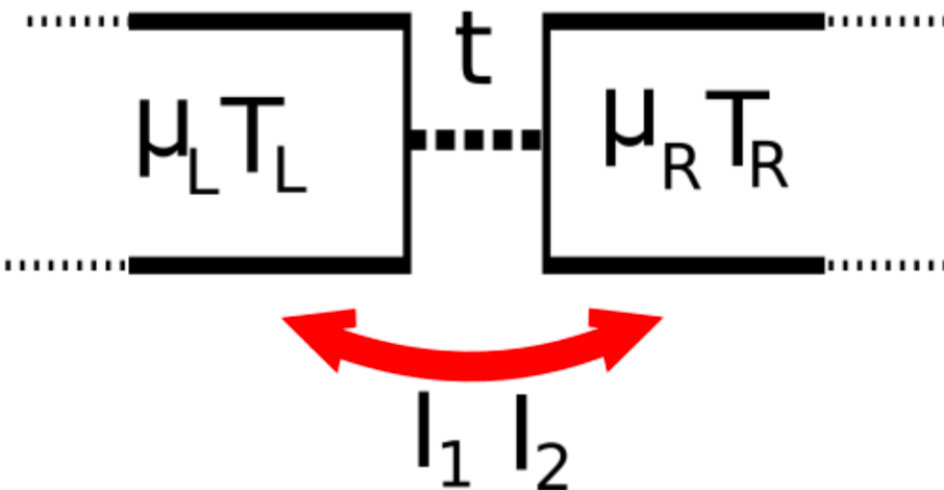 Figure 1
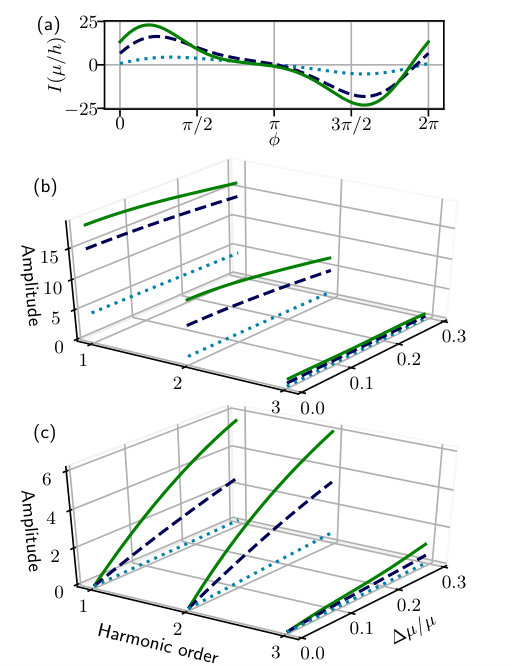 Figure 2
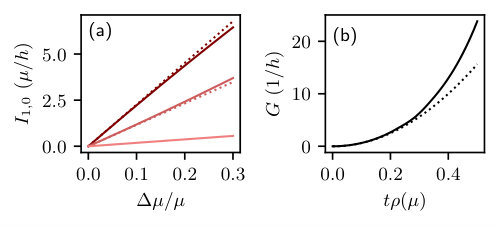 Figure 3
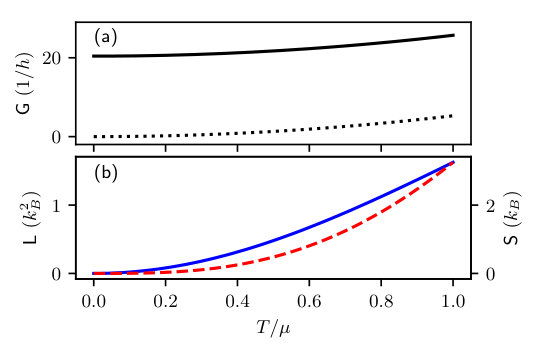 Figure 4
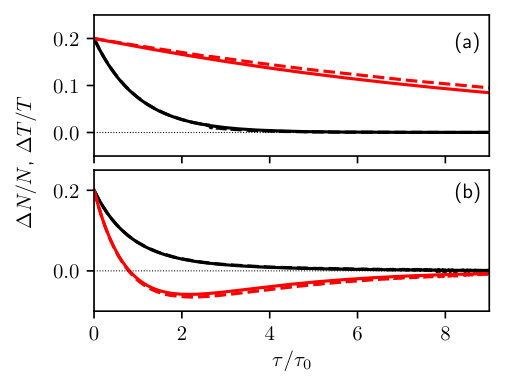 Figure 5
Peer Reviews
No public reviews on file for this paper yet. If you reviewed it on a platform where reviews are public (OpenReview, ICLR, NeurIPS, ICML), you can paste yours below so the community can read it here.
Videos
No videos yet. Explain this paper in a talk, walkthrough, or lecture? Add one.
Bosonic superfluid transport in a quantum point contact
Shun Uchino
Weseda Institute for Advanced Study, Waseda University, Shinjuku, Tokyo 169-0051, Japan
Jean-Philippe Brantut
Institute of Physics, EPFL, 1015 Lausanne, Switzerland
Abstract
We present a microscopic theory of heat and particle transport of an interacting, low temperature Bose-Einstein condensate in a quantum point contact. We show that, in contrast to charged, fermionic superconductors, bosonic systems feature tunneling processes of condensate elements, leading to the presence of odd-order harmonics in the AC Josephson current. A crucial role is played by an anomalous tunneling process where condensate elements are coherently converted into phonon excitations, leading to even-order harmonics in the AC currents as well as a DC contribution. At low bias, we find dissipative components obeying Ohm’s law, and bias-independent nondissipative components, in sharp contrast to fermionic superconductors. Analyzing the DC contribution, we find zero thermopower and Lorenz number at zero temperature, a breakdown of the bosonic Wiedemann-Franz law. These results highlight importance of the anomalous tunneling process inherent to charge-neutral superfluids. The consequences could readily be observed in existing cold-atom transport setups.
I Introduction
A mesoscopic system connected to reservoirs is one of the most important examples of nonequilibrium quantum statistical physics Nazarov and Blanter (2009). For a long time, such a system has mainly been discussed in electron systems, which revealed nontrivial outcomes absent in bulk systems such as conductance quantization Datta (1997), current noise Blanter and Büttiker (2000), and fluctuation relation Esposito et al. (2009). Recently, atomic quantum gases have emerged as an alternative route to investigate mesoscopic systems Chien et al. (2015); Krinner et al. (2017) in particular single-mode quantum point contacts (QPCs) Krinner et al. (2015). QPCs are the corner stone of mesoscopic quantum devices, as building blocks for quantum coherent devices such as quantum dots and interferometers. Their counterparts in atomic gases opens the perspective of complex, quantum coherent ’atom-tronic’ devices Seaman et al. (2007); Ramanathan et al. (2011); Jendrzejewski et al. (2014); Ryu and Boshier (2015) featuring controlled interactions Bloch et al. (2008) and the possibility to use fermionic or bosonic statistics Gutman et al. (2012); Chien et al. (2014); Kolovsky et al. (2018).
In contrast with superconductors which are charged, atomic quantum gases are charge neutral. As a result, in the superfluid phase, there always exist gapless collective modes which are not present in charged systems due to the Anderson-Higgs mechanism Altland and Simons (2010); Nagaosa (2013). The fact that the dominant low-energy excitations of superconductors are of pair-breaking type has spectacular consequences such as multiple Andreev reflections (MARs) in superconductor-normal interfaces Zagoskin (1998) or QPCs Averin and Bardas (1995), yet little is known concerning the role played by gapless collective excitations for quantum transport in charge-neutral superfluids. In the case of a Bose-Einstein condensate (BEC), relevant to two-terminal systems of cold atoms Eckel et al. (2016); Krinner et al. (2017), as well as superfluid helium in nano-pores Duc et al. (2015), a hydrodynamic description correctly predicts the Josephson dynamics Albiez et al. (2005); Levy (2007); LeBlanc et al. (2011); Xhani et al. (2019) and dissipation associated with topological excitations in wide junctions, but fails in the case of a QPC.
In this paper, we present a microscopic theory of low-temperature transport of interacting neutral bosons through a single-mode QPC. Modeling the system with the tunneling Hamiltonian Cuevas et al. (1996); Bolech and Giamarchi (2004, 2005); Uchino and Ueda (2017); Yao et al. (2018); Han et al. (2018) and the Bogoliubov theory of interacting condensates Andersen (2004); Pitaevskii and Stringari (2016), we use the Keldysh formalism Rammer (2007); Kamenev (2011) to derive a current formula applicable to heat and particle transport up to a nonlinear response regime. We elucidate the crucial role of bosonic enhancement and the gapless Bogoliubov modes for superfluid transport, which is revealed in the differences between odd and even harmonics of the AC Josephson current. We predict dissipative components obeying Ohm’s law even at zero temperature with a fully superfluid system, which is in sharp contrast with the case of charged superconductors Cuevas et al. (1996). Then, we consider the DC transport of heat and particle currents, which in spite of obeying Ohm’s law 111We note that transport coefficients depend on biases in non-Ohmic cases, where the Lorenz number cannot solely be expressed in terms of fundamental constants. shows a large breakdown of the bosonic Wiedemann-Franz law. Finally, we propose experiments to confirm our findings in existing two-terminal setups of ultracold atomic gases.
This paper is organized as follows. In Sec. II, we present the model and methods yielding an expression for the mesoscopic current, which is the basis of this work. In Sec. III we use this expression to obtain results for the AC and DC components of the current at fixed biases. In Sec. IV, we present predictions for cold-atom experiments, including the effect of the trapping potential, for the time evolution of thermodynamic quantities and Shapiro resonances. Section V summarize results and mentions possible applications of this work. In appendices, some technical details on the theoretical analyses are provided.
II Model and methods
We consider a two-terminal transport system, with two macroscopic reservoirs Gaunt et al. (2013) filled by a weakly-interacting BEC and connected by a mesoscopic channel, as shown in figure 1. We describe the channel as a single mode QPC, which is adequate when its width and lengths are much shorter than the coherence length of the BEC. In such a case, the details of the motion of atoms in the constriction become irrelevant Likharev (1979); Averin and Bardas (1995), which allows one to start with the following tunneling Hamiltonian Cuevas et al. (1996); Mahan (2013); Bolech and Giamarchi (2004, 2005); Berthod and Giamarchi (2011); Uchino and Ueda (2017); Yao et al. (2018); Han et al. (2018):
[TABLE]
where and are the field operator of the reservoir and the grand-canonical Hamiltonian of a Bose gas ( with the Hamiltonian operator and with the number operator ), respectively. The last two terms in Eq. (1) describe exchanges of particles between the reservoirs, where is the tunneling amplitude. In the two-terminal system, the particle and heat current operators can respectively be expressed as and .
We consider a regime of weak interaction and high degeneracy, and describe the BECs in the reservoirs with the Bogoliubov theory Andersen (2004); Pitaevskii and Stringari (2016). To construct a theory of heat and particle transport, we adopt the Keldysh formalism Rammer (2007); Kamenev (2011), allowing for a description of the dynamics in the presence of arbitrary bias and tunneling amplitude. Under fixed chemical potential bias () and temperature bias (), the particle and heat currents at time can be expanded as a Fourier series in harmonics of and be obtained as (see Appendix A for derivation),
[TABLE]
where or 2, and represents integration over the internal time variable from minus infinity to plus infinity. We note that in this paper we set except for plots of figures. In addition, , , and are uncoupled retarded, advanced, and lesser Green’s functions, which have structures conventionally employed in a BEC system Rammer (2007); Fetter and Walecka (2012). The Keldysh formalism incorporates the coherent sum of all processes by which atoms can traverse the channel. Such a beyond-linear-response effect is accumulated in the renormalized hopping matrix defined as
[TABLE]
where and . Although the structure is similar to that of superconducting QPCs, in that the reservoir Green’s functions are matrices, the emergence of is peculiar to the bosonic system. In fermionic systems and odd harmonics are absent, because fermionic superfluidity involves pairing. The current expression obtained above is the basis for the analysis of mesoscopic BEC systems. In the weak coupling regime, it describes in particular a BEC in a double-well Albiez et al. (2005); Levy (2007); LeBlanc et al. (2011) as long as motion along finite extension of the junction can be neglected.
III Results
In this section we consider the situation in which the chemical potential in the reservoirs is fixed, which is standard in the condensed-matter physics context. In order to connect to quantum gas experiments, in what follows we present figures for which an average chemical potential nK, the scattering length nm, and average density in reservoirs m*-3*.
III.1 AC component
A first outcome of our formalism is the structure of the AC components of the particle current at zero temperature. Due to bosonic enhancement, the dominant transport process is associated with the condensate elements. In the Bogoliubov prescription Fetter and Walecka (2012), the field operator is decomposed into the the c-number part describing the condensate and the rest describing the non-condensate elements, and so is Green’s function. In our formulation, such a c-number part (condensate element) appears in lesser Green’s function and is expressed as
[TABLE]
where L or R, and is the coupling constant of the interatomic interaction 222The c-number part of the field operator does not evolve in time and so is that of lesser Green’s function Fetter and Walecka (2012).. We note that in contrast to the phonon contribution of lesser Green’s function shown in Appendix A, Eq. (6) does not depend on the Bose distribution function being a function of temperature. Thus, the processes associated with the condensate survive at zero temperature.
In the tunneling limit where , the leading current term is linear in . It arises from the component, and the corresponding current is . This is the Josephson current associated with the tunneling of condensate elements between reservoirs and is consistent with the result in a double-well BEC Albiez et al. (2005); LeBlanc et al. (2011); Pitaevskii and Stringari (2016).
The replacement also allows to discuss the current component quadratic in . This corresponds to the linear response analysis Meier and Zwerger (2001), and yields a DC component and AC components . An analytic calculation discussed in Appendix B shows the presence of dissipative and non-dissipative terms proportional to , respectively. The dominant microscopic process in even harmonics is the tunneling of a condensate element coherently converted into phonon excitation. This anomalous tunneling process is fundamentally different from the tunneling process of the non-dissipative odd harmonics and from tunneling processes in the superconductor case.
To include systematically higher order tunneling effects with all the virtual processes, we numerically solve Eqs. (2)-(5) under the low-energy expression of shown in Appendix A. Figure 2 depicts the results of first three AC components for various tunneling amplitudes normalized by the density of states in the reservoirs at the chemical potential , as in the case of fermions Cuevas et al. (1996). As can be seen from Fig. 2(a), the AC current deviates from sinusoidal behavior with increasing , revealing the important role of higher harmonics.
Moreover, Fig. 2(c) demonstrates the presence of the dissipative term proportional to , which is absent at the linear response level. Remarkably, our calculation shows that the amplitudes in the dissipative components obey Ohm’s law at small , in contrast to the fermionic case where the nonlinear bias dependence appears Cuevas et al. (1996). This difference originates from , which is non-singular for bosons but is singular at the pairing gap frequency for fermions Cuevas et al. (1996). In contrast, we find that the non-dissipative components has a nonzero amplitude even at (Fig. 2(c)), comparable with the fermionic case up to the nonlinearity Cuevas et al. (1996).
III.2 DC component
We now focus on the DC component of the particle current as a function of at zero temperature. This is directly measurable in cold-atom experiments where all the AC components are averaged out Husmann et al. (2015). The resulting current-bias relations for different are shown in figure 3a. In all cases, Ohm’s law is obeyed in the low-bias regime. This again contrasts with the case of superconductors showing nonlinearities associated with MARs Averin and Bardas (1995). This also differs from the case with one-dimensional reservoirs described by the Luttinger liquid, where power-law current-bias relations are obtained due to critical fluctuations Giamarchi (2004).
Our formalism allows for a systematic investigation of the conductance in the linear regime as a function of the tunneling amplitude. The result is shown as solid line in figure 3b. Remarkably, even for moderate tunneling amplitudes of the order of , the conductance is ten times larger than that of the upper bound of non-interacting fermions van Houten and Beenakker (1996). In the tunneling regime, conductance shows a quadratic dependence on (dashed line in figure 3b), suggesting that the linear response theory accurately captures the physics.
To clarify the nature of the DC transport we now include the heat current, focusing again on the linear response regime. An analytic calculation derived in Appendix B shows that the DC particle and heat currents obey an Onsager matrix,
[TABLE]
Here, transport coefficients () depend on temperature . They are proportional to , by hypothesis. The conductance is expressed as with the speed of sound . It features a zero-temperature contribution of the condensate inversely proportional to the interaction strength, due to the gapless modes in the reservoirs, and a contribution quadratic in temperature which originates from the incoherent tunneling of Bogoliubov quasiparticles. Importantly, the zero temperature part dominates over the thermal component up to , where is the small parameter in the Bogoliubov theory.
We also find no contribution from the condensate to heat transport. As a result, the Lorenz number and Seebeck coefficient , which characterize the relation between entropy and particle currents, go to zero as temperature is reduced. The leading temperature dependence turns out to respectively be quadratic and cubic for the Lorenz number and Seebeck coefficient, again a consequence of the phonon Green’s function structure (see Appendix B). We note that this behavior of is quite different from the Wiedemann-Franz law where is given by a universal number. Normally, this law is obeyed when charge and entropy are carried by the same fundamental processes such as quasiparticles in Fermi liquids Ashcroft and Mermin (1976); van Houten and Beenakker (1996) and magnons in spin systems Nakata et al. (2015, 2018). Even in a BEC at , it is predicted due to dominant quasiparticle transport Papoular et al. (2014). Remarkably, we find that even though mass and heat transport originates from quasiparticles, the presence of the anomalous tunneling process yields a large violation of the Widemann-Franz law.
Figure 4 illustrates these results, where the conductance (on panel a), Seebeck coefficient and Lorenz numbers (on panel b) are presented as a function of . Over the whole range of temperatures, the results are dominated by the zero-temperature contribution to current originating from the phonon contribution. Note that the Bogoliubov theory fails around the critical temperature of a BEC, so we cannot extrapolate our results to the high temperature regime covered in particular in Papoular et al. (2014).
IV Experimental considerations
In this section, we discuss the situation of finite reservoirs yielding a finite charging energy, which is relevant to cold-atom experiments.
IV.1 Time evolution of thermodynamic quantities
Quantum gas two-terminal or double-well setups, for which our model directly applies, feature finite-sized reservoirs with a chemical potential self-consistently determined from the atom number. As a result, the coupling between the reservoirs competes with their finite compressibility, yielding the crossover between Josephson oscillations and non-linear self-trapping Smerzi et al. (1997). The presence of a finite DC conductance implies directly that the self-trapping regime is not stable, as a system initialized at large bias will slowly relax into the low bias, Josephson oscillation regime. Such a relaxation has been reported in Burchianti et al. (2018); Gauthier et al. (2019).
We now consider a similar scenario for single-channel point-contact transport accounting explicitly for the effects of finite-sized reservoirs. As mentioned before, we fix the parameters (nK, nm, and m*-3*). For such a parameter choice with , the ratio of the condensation energy to the Josephson coupling energy turns out to be of the order of . For a typical initial bias of 333In this case, the transition between Josephson oscillation and self-trapping regimes occurs when the ratio of the condensation energy to the Josephson coupling energy becomes ., expressed in terms of particle number relative imbalance, the system is initially deeply in the self-trapping regime Smerzi et al. (1997); Pitaevskii and Stringari (2016).
We start with a description of the thermodynamics of the reservoirs at equilibrium. The differences of thermodynamic quantities between the reservoirs obey the following Maxwell relations:
[TABLE]
where , , , , and are relative atom-number difference, relative entropy difference, compressibility, dilatation coefficient, and heat capacity at constant , respectively. We note that the thermodynamic coefficients (, , and ) are sensitive to geometry of reservoirs. In a box-type reservoir, they are calculated with the Bogoliubov theory as
[TABLE]
where is the volume in each reservoir. In contrast, in a harmonically trapped reservoir, we obtain
[TABLE]
where we assume that the trap is isotropic, in which case \Omega=\frac{4\pi}{3}\Big{(}\frac{2\mu}{M\omega_{\text{ho}}^{2}}\Big{)}^{3/2} with the trapping frequency . The temperature and chemical potential responses to variations of internal energy and particle number depend on the shape of the reservoirs, and are thus different for box and harmonic traps. As we show below, this causes different behaviors of the time evolutions of thermodynamic quantities.
We now describe the slow time evolution of the thermodynamic quantities characterizing the reservoirs resulting from quasi-steady state currents. The quasi-steady approximation, well verified in the experimentally relevant situations where DC transport is concerned, implies that the reservoirs are at thermal equilibrium at each point in time Krinner et al. (2017). This allows for a direct generalization of the linear response results reported above to the case of slow time evolution of biases.
To deal with the case where biases between the reservoirs can evolve slowly in time, we adopt the model in which is an independent dynamical variable Eckel et al. (2016); Burchianti et al. (2018). There, in addition to Eq. (8), we consider the following relations:
[TABLE]
which represent Kirchhoff’s law, applicable in the low-frequency regime consistent with the quasi-steady state hypothesis. By numerically solving Eqs. (8), and (15)-(17), the time evolution of the thermodynamic quantities can be determined.
To discuss the global structure of the time evolution, we also introduce an approximation that neglects the AC components of the currents. In this case, by combining Eq. (7) and Eq. (8), we obtain
[TABLE]
where is the transport time for mass transport, is the analog of the Lorenz number for the reservoirs, and is the effective Seebeck coefficient. Since the equation above is the first-order differential equation, the time evolutions can analytically be determined. The general solution is expressed as
[TABLE]
Here, the decay-time parameters are expressed as
[TABLE]
with
[TABLE]
In Figure 5 we present this result for initial conditions and , together with a numerical solution including the AC components. The parameters mentioned before are used with nK and . Under these parameters, regardless of trapped geometries, we obtain s similar to the case of a single mode conductor for fermionic atoms Krinner et al. (2017). The large conductance of the BEC compared with one expected for noninteracting fermions is compensated by the much larger compressibility of the reservoirs, yielding similar timescales. This illustrates the important role of the finite-size reservoirs in the interpretation of the experiments.
In the case of harmonically trapped reservoirs, the initial relative atom number difference decays in the time scale as shown in Fig. 5(a). However, the low values of Lorenz number and Seebeck coefficient at the low temperature, and the near cancellation of the effective Seebeck coefficient between the QPC and reservoir contributions Grenier et al. lead to the slower decay of the initial temperature difference. In the case of box reservoirs Gaunt et al. (2013); Mukherjee et al. (2017); Luick et al. (2019), on the other hand, both of and decays in the time scale despite the low values of Lorenz number and Seebeck coefficient. The faster decay of in box reservoirs is due to the fact that , that is, the small Lorenz number is compensated by the low value of the analog of Lorenz number for reservoirs. Finally, we note that in large times where and , the effect of the AC oscillations can be seen in the numerical calculations. Except for this effect, the overall differences between analytic solutions (dashed curve) and numerical solutions with the AC components (solid curve) are minuscule.
IV.2 Shapiro resonance as a probe of AC components
The effects of the phonon modes on the AC currents could be observed by direct Fourier analysis of the reservoirs population dynamics. This has been demonstrated at low frequency for wide junctions Levy (2007); LeBlanc et al. (2011), but might reveal difficult for weak harmonics at high frequencies. Therefore, we propose to circumvent this difficulty by leveraging the time-dependent control over trapping potentials and observe Shapiro resonances Barone and Paterno (1982); Tinkham (2004), mapping the harmonics of the Josephson current onto the DC component.
To this end, we consider the time-dependent hopping amplitude such that the phase parameter is given by
[TABLE]
where and are the oscillation frequency and its amplitude, respectively. By substituting the above into the particle current expression, we obtain
[TABLE]
which can be expressed in terms of the Bessel functions of order , as
[TABLE]
In the above, the second line in the right hand side always depends on time under , and therefore is typically averaged out in two-terminal setups of ultracold atomic gases. However, the first line becomes time independent and gives a nonzero DC contribution if the following condition is satisfied:
[TABLE]
This is the condition that the Shapiro resonance occurs. For instance, if
[TABLE]
third-order harmonics of the AC current is dominantly contributing to the DC current, since the lower harmonics are averaged out.
V Concluding remarks
Our work elucidates the relation between the dissipative current and the superfluid character of the BEC. The QPC implements a coherent coupling of the superfluid component with the phonon modes, in the spirit of the celebrated Landau argument on superfluidity. Even though the zero temperature DC component does not carry any entropy, as demonstrated by the zero value of the Seebeck coefficient, it cannot be identified with a superfluid current. This also illustrates the difficulty in modeling the dynamics of superfluids in mesoscopic structures using effective two-fluid models: in particular QPCs behave very differently from super-leaks in helium, and the fountain effect is not expected Karpiuk et al. (2012).
Charge neutral fermionic superfluids also feature a gapless mode resulting from the symmetry breaking. While we cannot extrapolate the bosonic results derived here to the fermionic case Uchino (2020), Bogoliubov theory is adequate for the far molecular side of the BEC-BCS crossover. The dependence of the zero temperature contribution suggests that it should become less relevant as the system approaches the Feshbach resonance. This is confirmed by the good agreement between low temperature transport experiments at unitarity and MAR theory observed in Husmann et al. (2015).
A direct generalization of our theory could describe spin transport in spinor BECs, or include spin-orbit coupling in the reservoirs and the contact. It also predicts coherent heat current oscillations at , encountered in superconductors Fornieri and Giazotto (2017), but never studied so far with cold atoms, as well as the current noise spectrum. While current noise in the two-terminal setup has never been measured in quantum gas experiments, we expect it to become accessible in future generations of experimental setups Uchino et al. (2018).
Acknowledgement
We thank Thierry Giamarchi and Martin Lebrat for careful reading of the manuscript and discussions, and also thank Masahito Ueda for discussions. S.U. is supported by JSPS KAKENHI Grant Number JP17K14366, Matsuo Foundation, and Waseda University Grant for Special Research Projects (No. 2019C-461). J.P.B. acknowledges funding from the European Research Council (ERC) under the European Union’s Horizon 2020 research and innovation program (grant agreement No 714309), the Sandoz Family Foundation-Monique de Meuron program for Academic Promotion, the SNSF (Project No. 184654) and EPFL.
Appendix A Current expression
Here we provide some details on derivation of the current formula (Eqs. (2)-(4)) underlying the results of this work. The notations are those of the main text. Using Heisenberg equations of motion, particle and heat currents in the tunneling Hamiltonian can be expressed as
[TABLE]
where the field operator in the momentum space satisfying , and is the average under the total Hamiltonian with the tunneling term. To go further, we rewrite the above expression as follows:
[TABLE]
where
[TABLE]
[TABLE]
and we perform the gauge transformation in the tunneling Hamiltonian Mahan (2013); Cuevas et al. (1996), where the chemical potential difference between the reservoirs is reflected in the phase factor of the tunneling amplitude. Since it is difficult to evaluate the nonequilibrium average directly, we perform the expansion in by means of the Keldysh formalism, which allows us to calculate the currents in terms of Green’s functions at equilibrium. Indeed, by using the so-called Langreth rules Rammer (2007), we can obtain the following Dyson equation:
[TABLE]
where , represents or , and is coupled retarded (advanced) Green’s function obeying
[TABLE]
Here, we introduce uncoupled retarded (advanced) Green’s function , which is evaluated at equilibrium. By using the low-frequency expansions in the Bogoliubov theory, this is expressed in frequency space as
[TABLE]
where L or R, , and is the cut-off frequency of the tunneling Hamiltonian and is chosen as the average chemical potential Meier and Zwerger (2001). Similarly, uncoupled lesser Green’s function in frequency space is obtained as
[TABLE]
where
[TABLE]
is the Bose distribution function. The peculiar feature of lesser Green’s function above is the presence of the contribution from BECs corresponding to the first term in the right-hand side of Eq. (10). This term is present even if , which leads to the presence of odd-order harmonics in the current. Indeed, by using uncoupled Green’s functions, we obtain
[TABLE]
where even (odd) in the superscript above represents the components of even (odd) harmonics in the current. As is clear from the expressions above, , since in the fermionic system.
For efficient numerics, as in the case of superconductors, it is convenient to introduce the renormalized tunneling matrix (5). By using this renormalized tunneling matrix, the current formula shown in Sec. II can be obtained.
Appendix B Current expressions up to linear response
We now derive several current expressions up to the linear response theory discussed in Sec. III. In this case, the substitution is allowed, and analytic expressions are obtained.
We first examine the current components linear in . The presence of such components allows nonzero . By substituting into Eq. (3), we obtain
[TABLE]
Thus, the particle current up to is given by . The similar calculation is allowed for the heat current. It is then straightforward to show , that is, absence of the Josephson heat current up to .
We next examine the current components quadratic in , which arise from and include both DC and AC parts. The DC part of the particle current is expressed as
[TABLE]
where we introduce
[TABLE]
with the density of state
[TABLE]
Physically, describes the contribution from the conversion process between condensate and phonon, and describes the contribution from the tunneling process of phonons, which is comparable to the tunneling current formula in fermionic quasiparticles Mahan (2013). Based on the above expressions, we next look at the regime up to linear in and , and determine transport coefficients in Onsager’s matrix. By using Eq. (38), is easily obtained as
[TABLE]
where we introduce the average chemical potential and average sound velocity . On the other hand, by using
[TABLE]
with the average temperature , is obtained as
[TABLE]
where
[TABLE]
To obtain above, we only keep the contributions with the leading temperature dependence. In , such a contribution arises from a term . Similarly, the leading order contribution in arises from a term 444We note .
In addition, can be obtained from the DC part of the heat current at , which is given by
[TABLE]
As in the case of and , can be obtained as
[TABLE]
Calculation of the AC components is done in a similar manner. At zero temperature, the AC components in the particle current are obtained as
[TABLE]
Therefore, in the low-bias regime, the harmonics proportional to is approximated as
[TABLE]
The result above shows that the AC components quadratic in yield both dissipative and non-dissipative terms. In addition, at the low bias, the amplitude of the dissipative term depends on and that of the non-dissipative term is independent of .
The reference list from the paper itself. Each links out to its DOI / PubMed record.
- 1Nazarov and Blanter (2009) Y. V. Nazarov and Y. M. Blanter, Quantum transport: introduction to nanoscience (Cambridge University Press, 2009).
- 2Datta (1997) S. Datta, Electronic transport in mesoscopic systems (Cambridge university press, 1997).
- 3Blanter and Büttiker (2000) Y. M. Blanter and M. Büttiker, Physics reports 336 , 1 (2000).
- 4Esposito et al. (2009) M. Esposito, U. Harbola, and S. Mukamel, Rev. Mod. Phys. 81 , 1665 (2009) . · doi ↗
- 5Chien et al. (2015) C.-C. Chien, S. Peotta, and M. Di Ventra, Nat Phys 11 , 998 (2015) . · doi ↗
- 6Krinner et al. (2017) S. Krinner, T. Esslinger, and J.-P. Brantut, Journal of Physics: Condensed Matter 29 , 343003 (2017).
- 7Krinner et al. (2015) S. Krinner, D. Stadler, D. Husmann, J.-P. Brantut, and T. Esslinger, Nature 517 , 64 (2015).
- 8Seaman et al. (2007) B. T. Seaman, M. Krämer, D. Z. Anderson, and M. J. Holland, Phys. Rev. A 75 , 023615 (2007) . · doi ↗