Addendum to: A Theoretical Study of Top-Mass Measurements at the LHC Using NLO+PS Generators of Increasing Accuracy
Silvia Ferrario Ravasio, Tomas Jezo, Paolo Nason, Carlo Oleari

TL;DR
This paper extends previous work on top-mass measurements at the LHC by comparing results from older and newer NLO+PS generators, confirming consistency across different simulation tools.
Contribution
It provides a comparative analysis of older Fortran-based and newer C++-based NLO+PS generators in top-mass extraction studies.
Findings
Results are consistent across different generator versions.
Older and newer generators yield similar top-mass measurement impacts.
Supports robustness of NLO+PS methods in top physics.
Abstract
This paper is a follow-up of Ref.~\cite{Ravasio:2018lzi}, where we studied the impact of next-to-leading order calculations merged with parton shower generators (NLO+PS) of increasing accuracy in the extraction of the top mass at hadron colliders. Here we examined results obtained with the older (fortran-based) shower generators Pythia6.4 and Herwig6.5. Our findings are in line with what we found in our previous paper with the new, c++-based, generators Pythia8.2 and Herwig7.1.
Click any figure to enlarge with its caption.
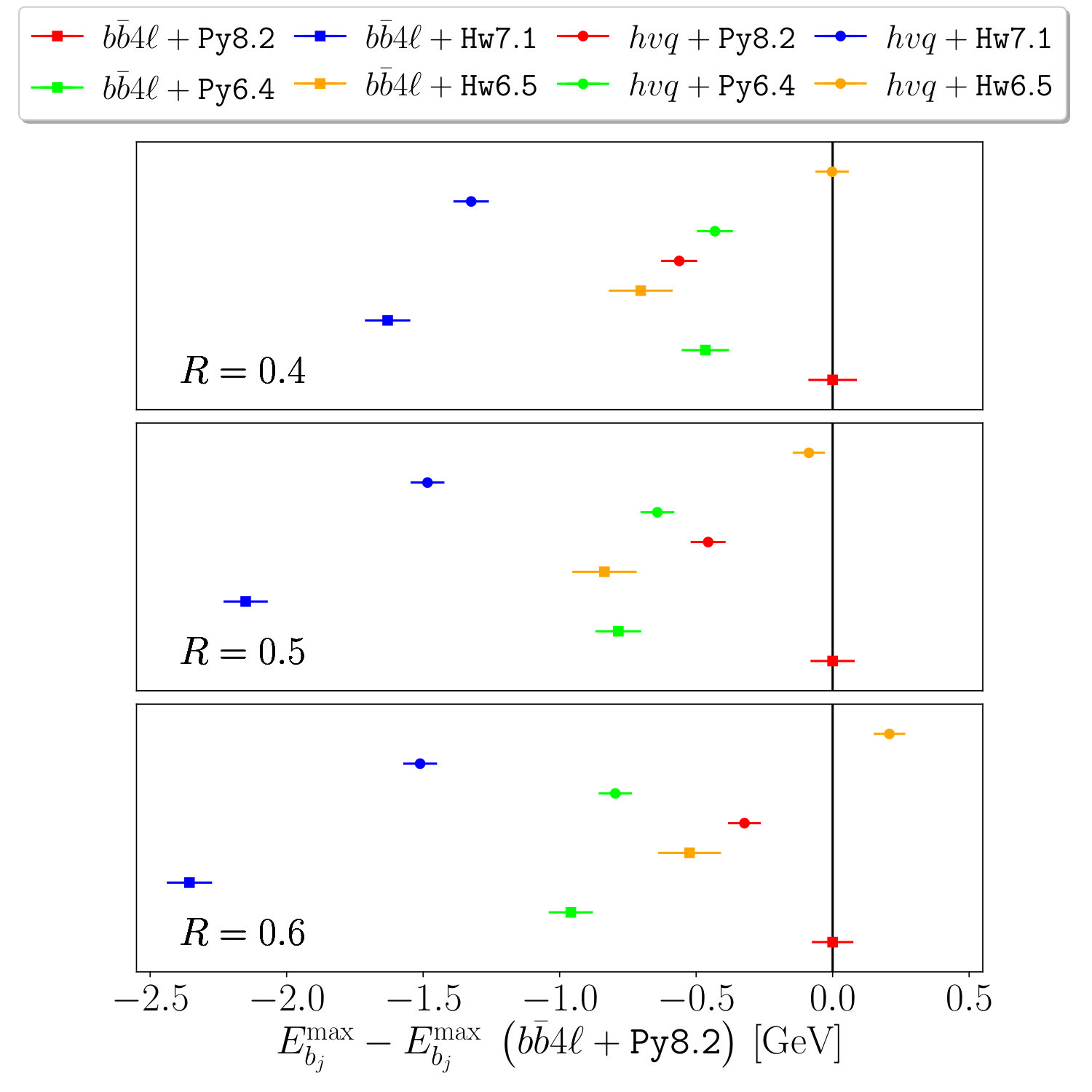 Figure 1
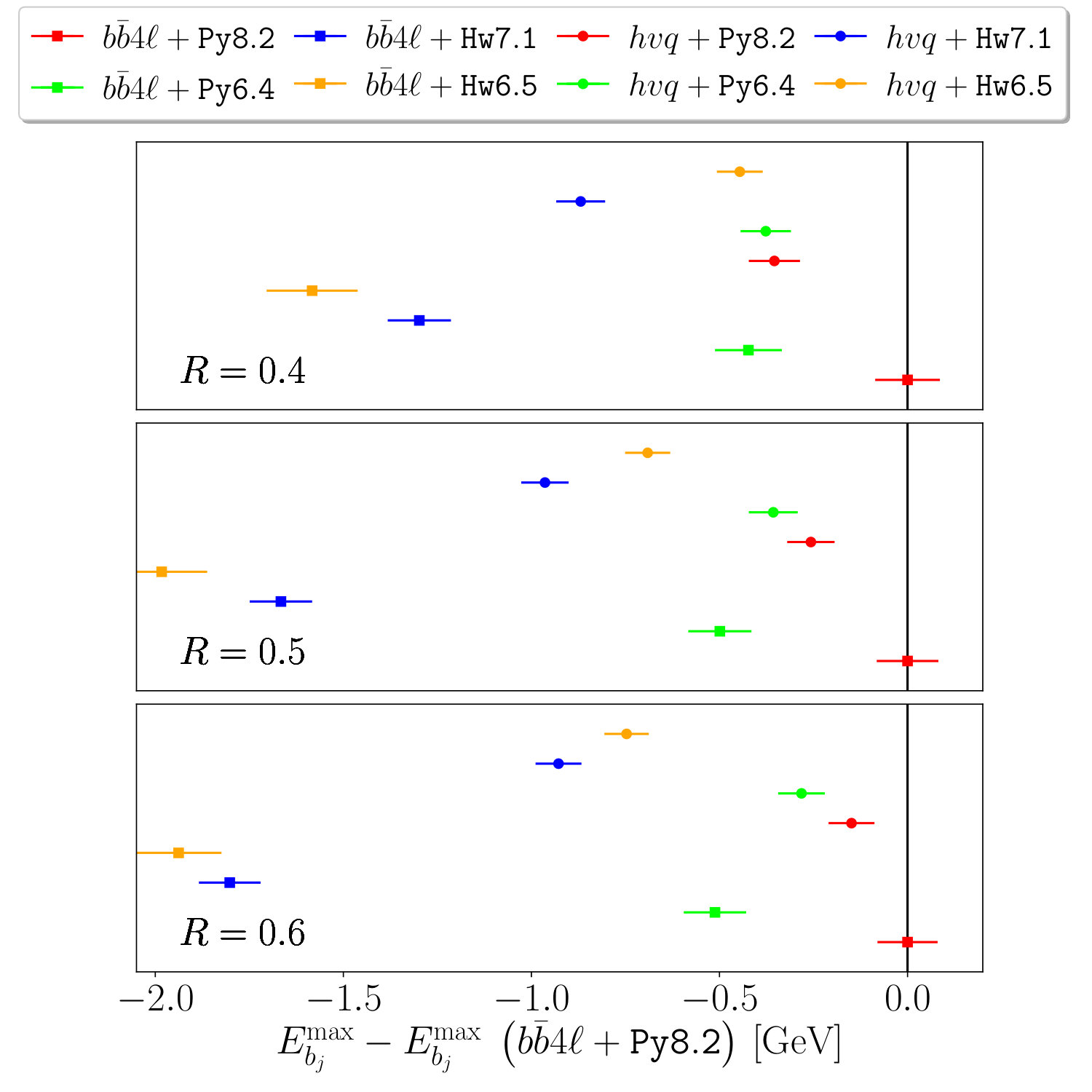 Figure 2
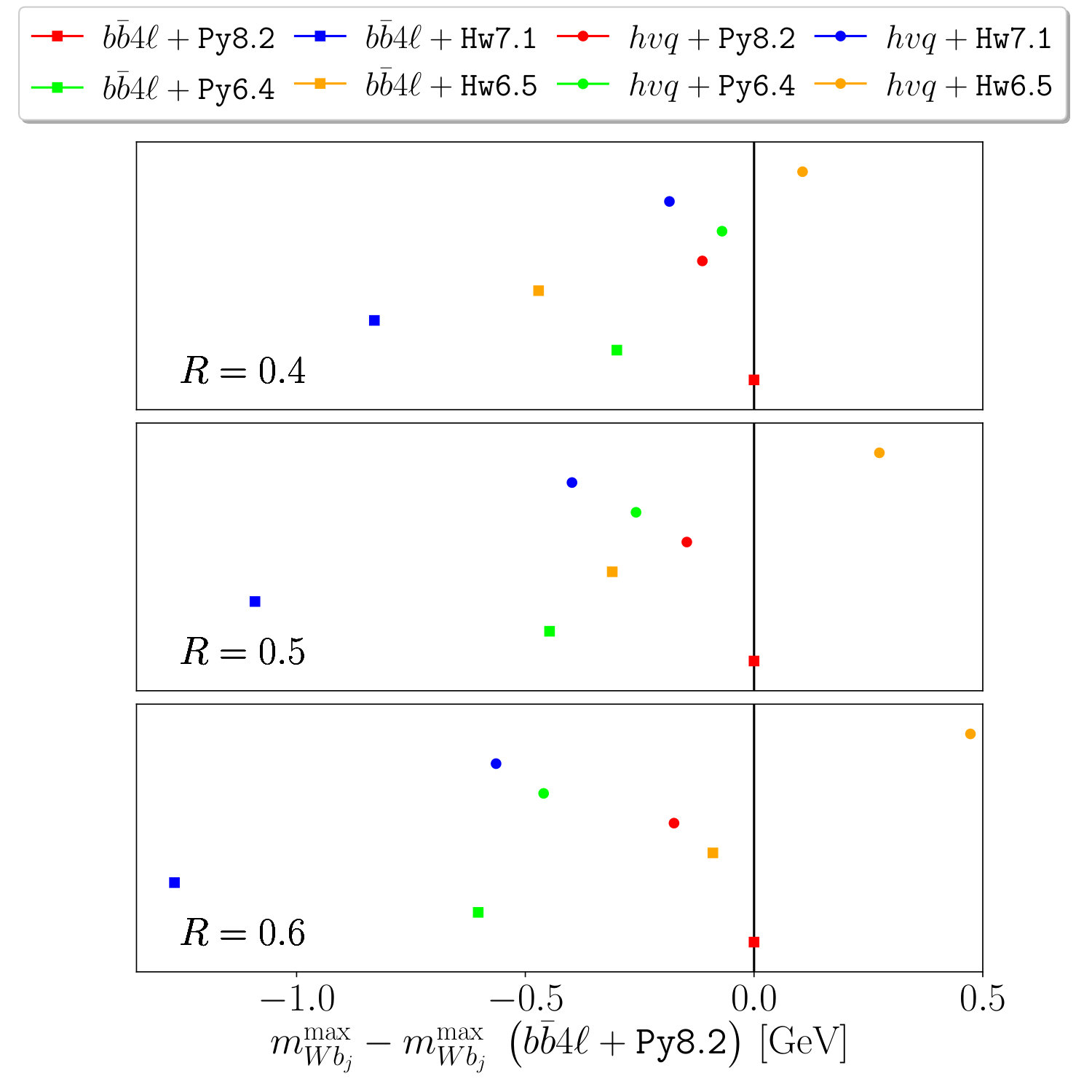 Figure 3
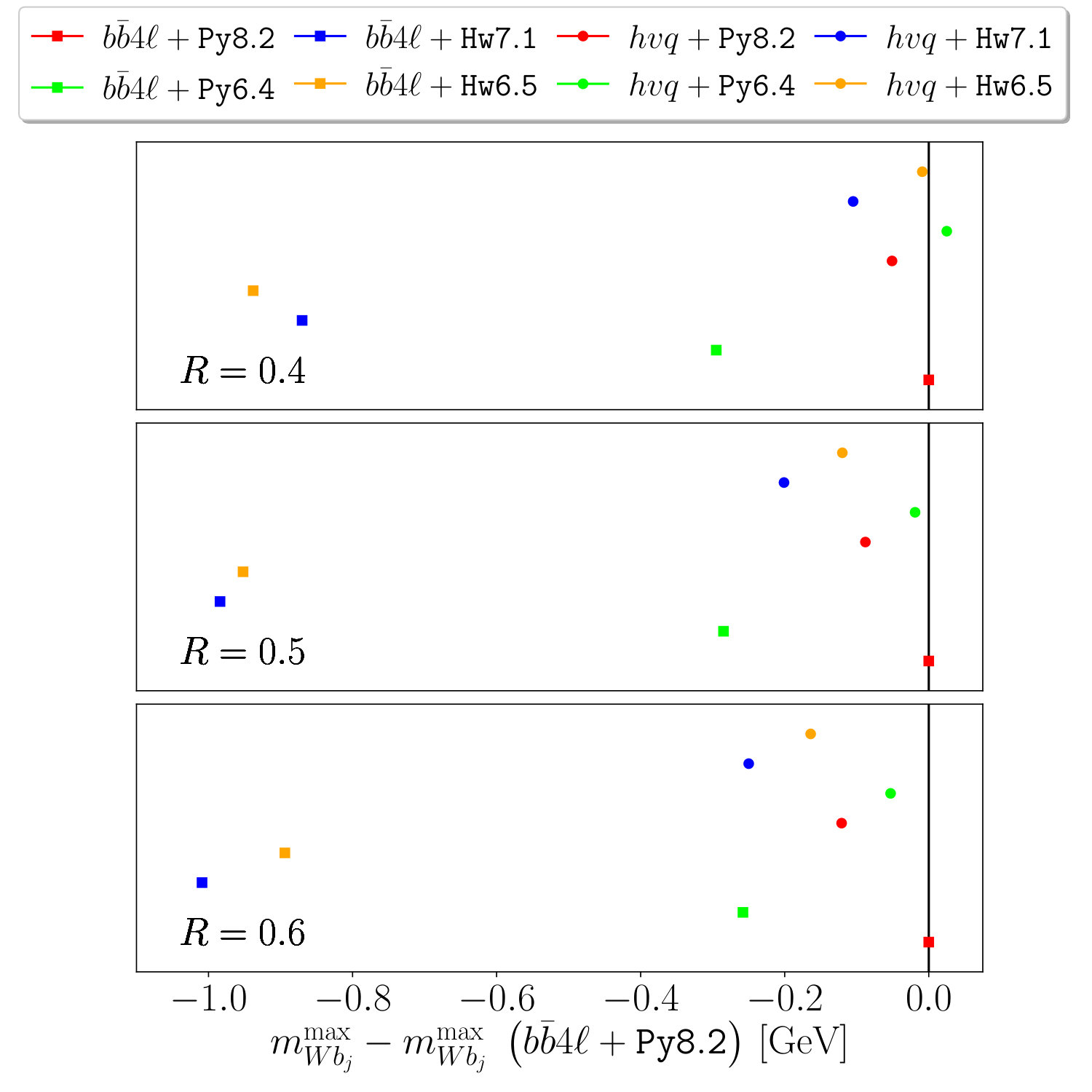 Figure 4
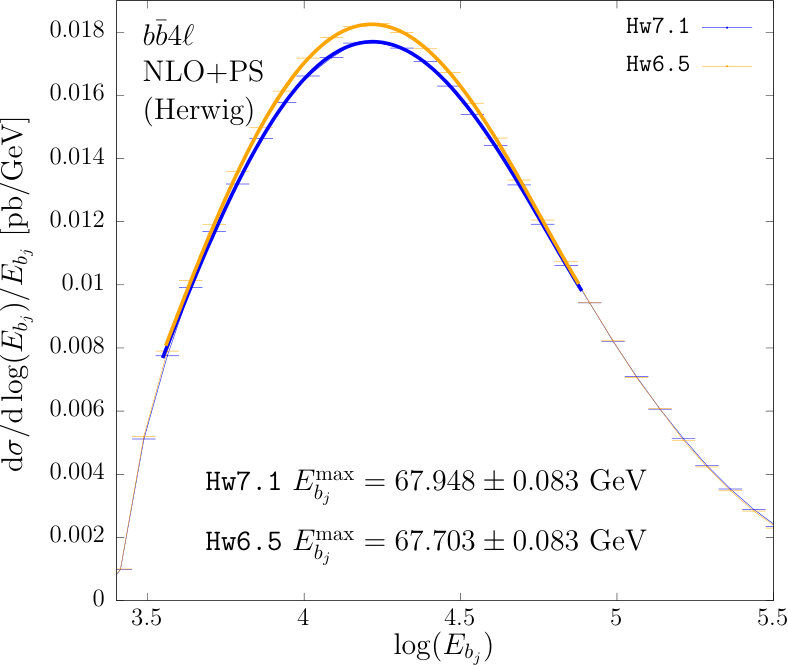 Figure 5
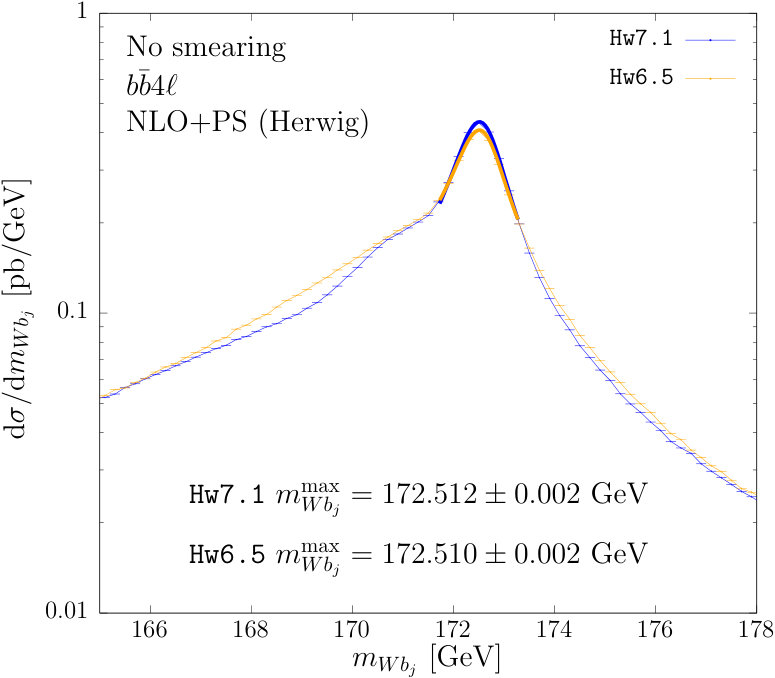 Figure 6
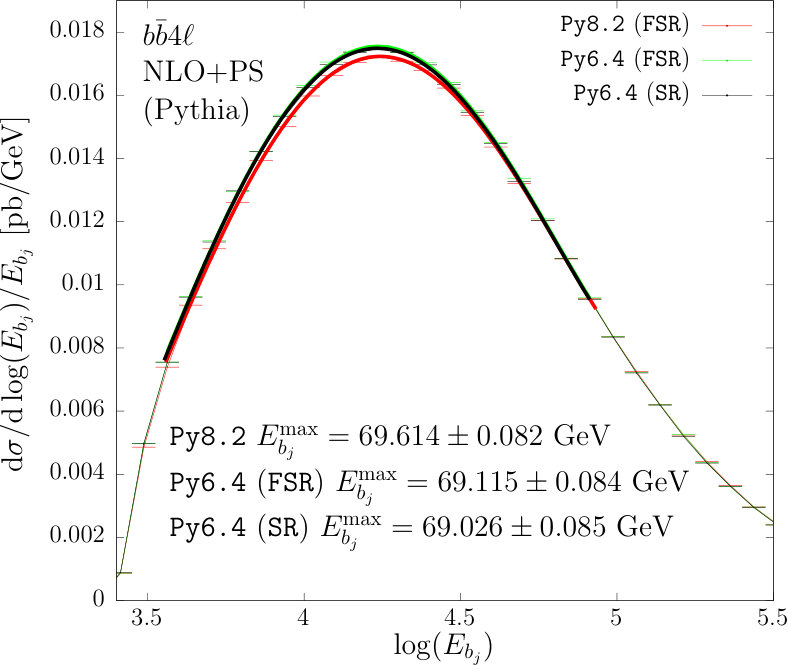 Figure 7
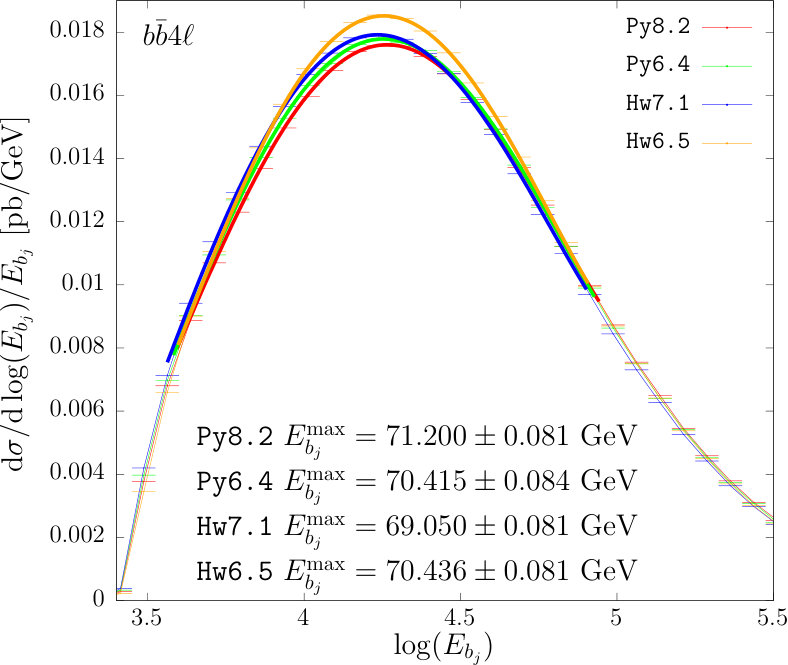 Figure 8
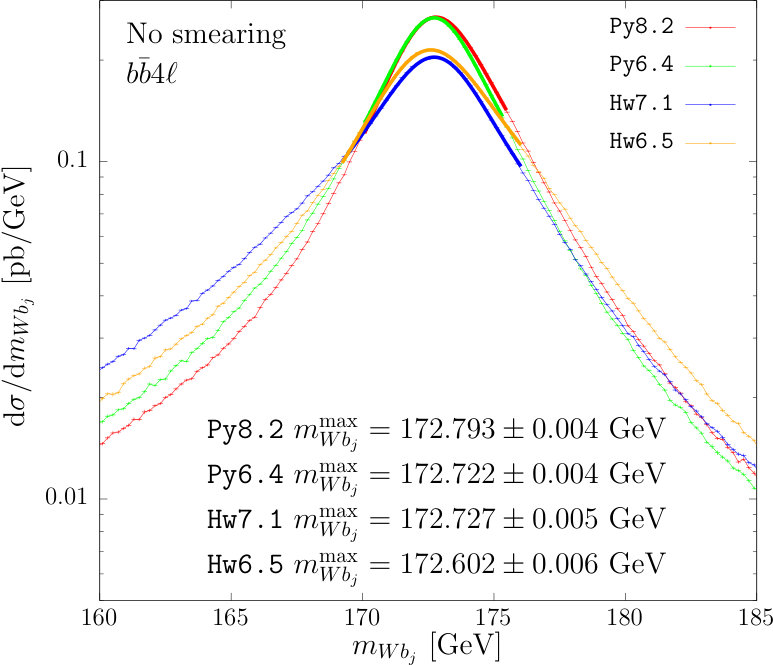 Figure 9
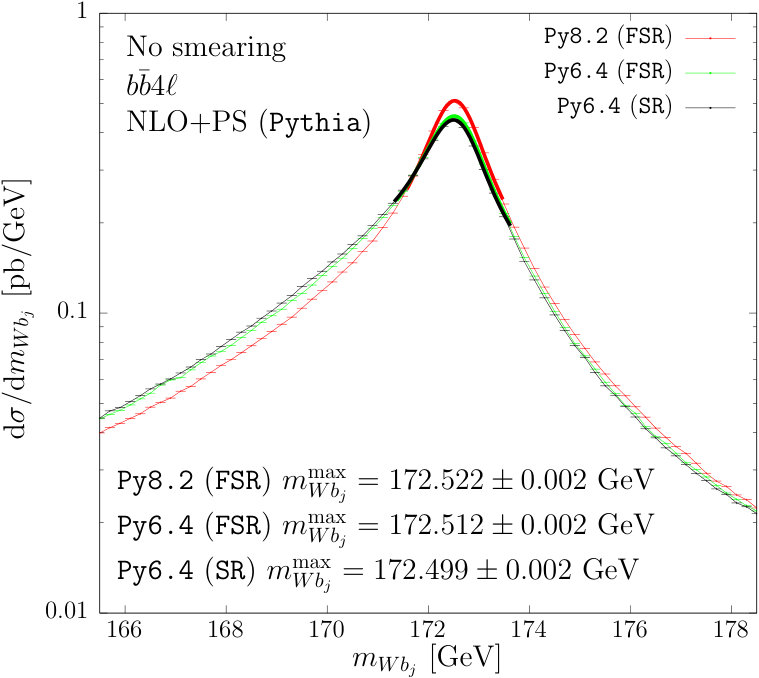 Figure 10
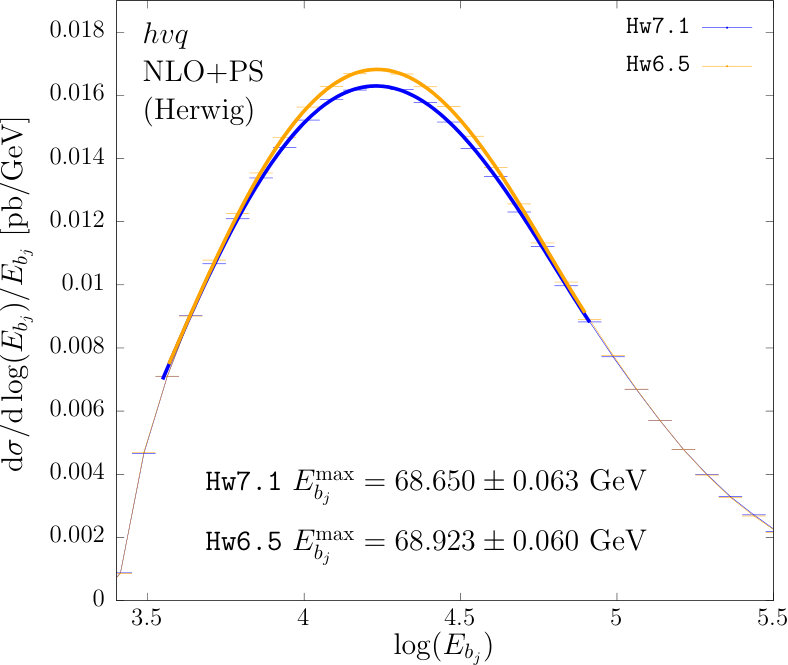 Figure 11
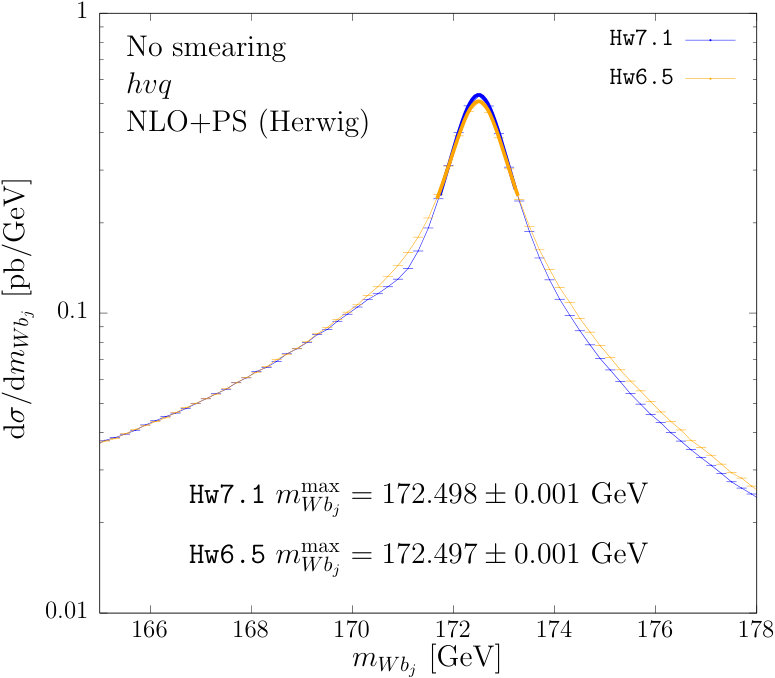 Figure 12
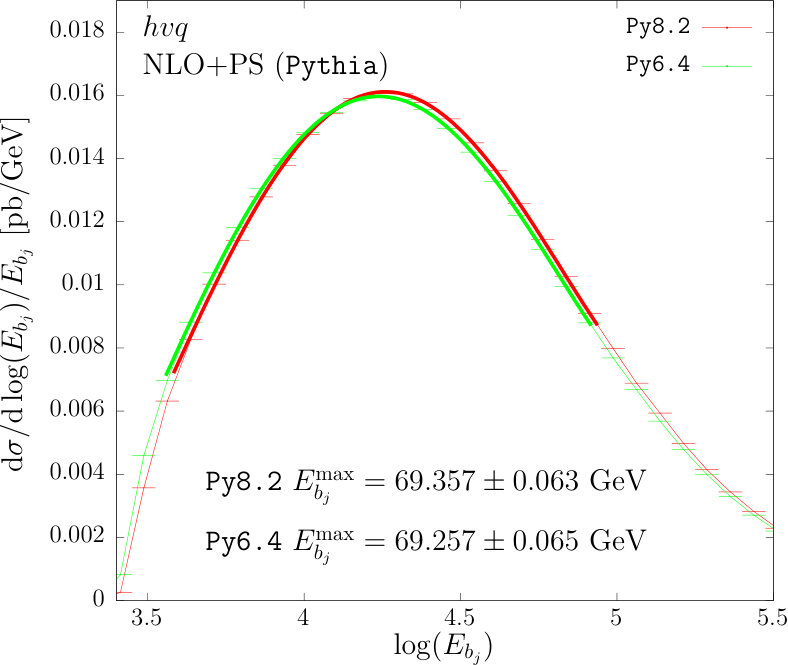 Figure 13
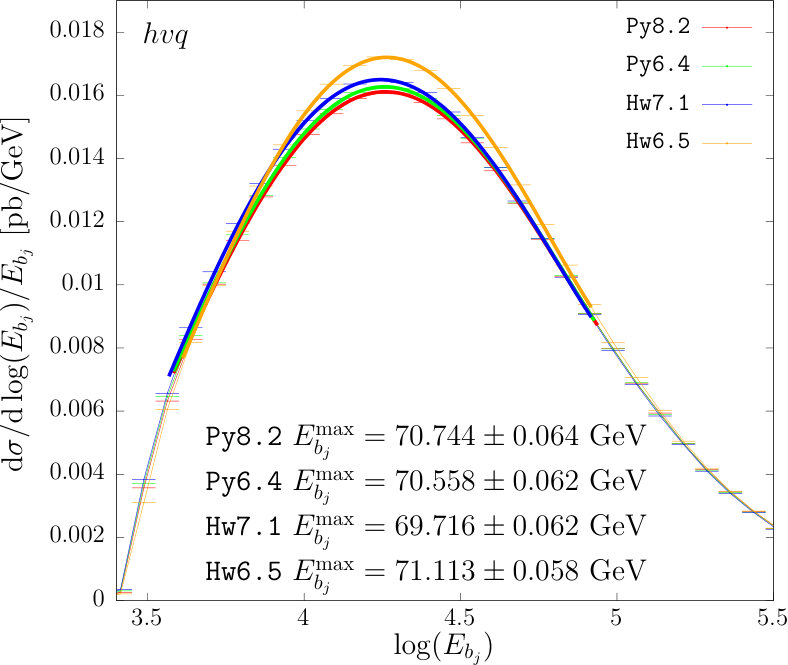 Figure 14
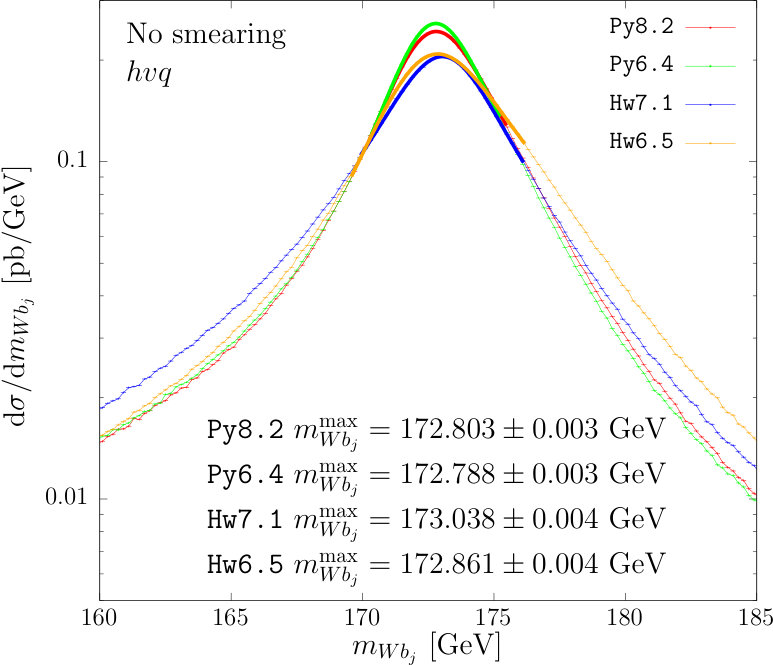 Figure 15
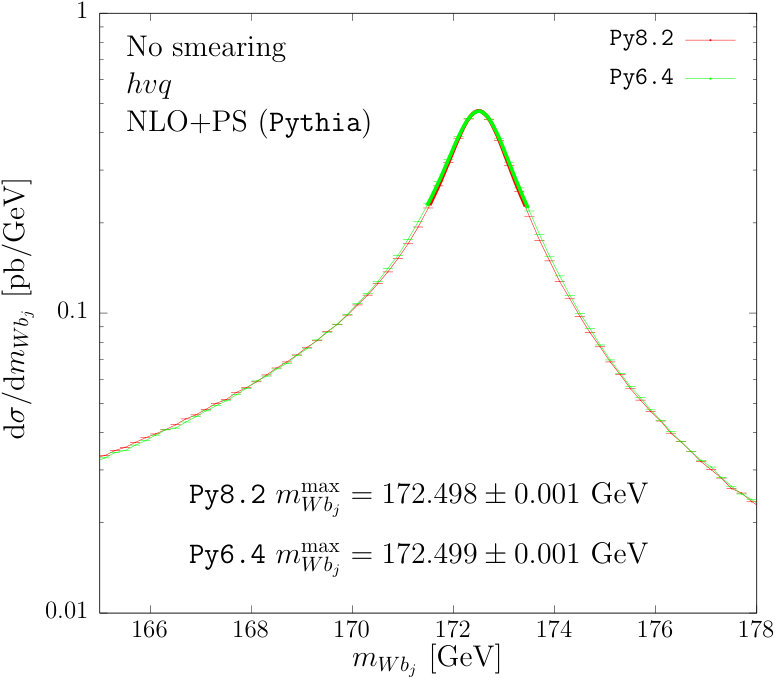 Figure 16
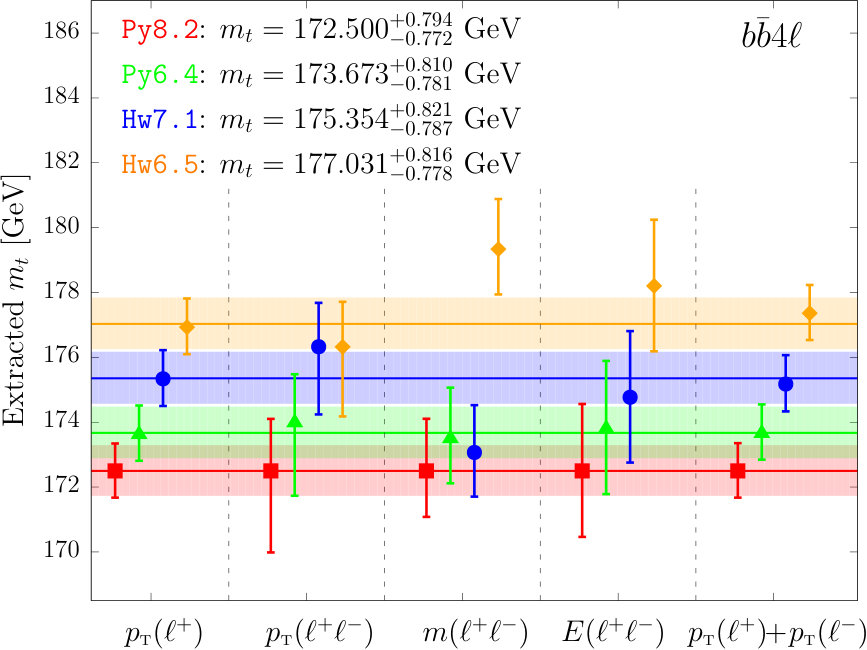 Figure 17
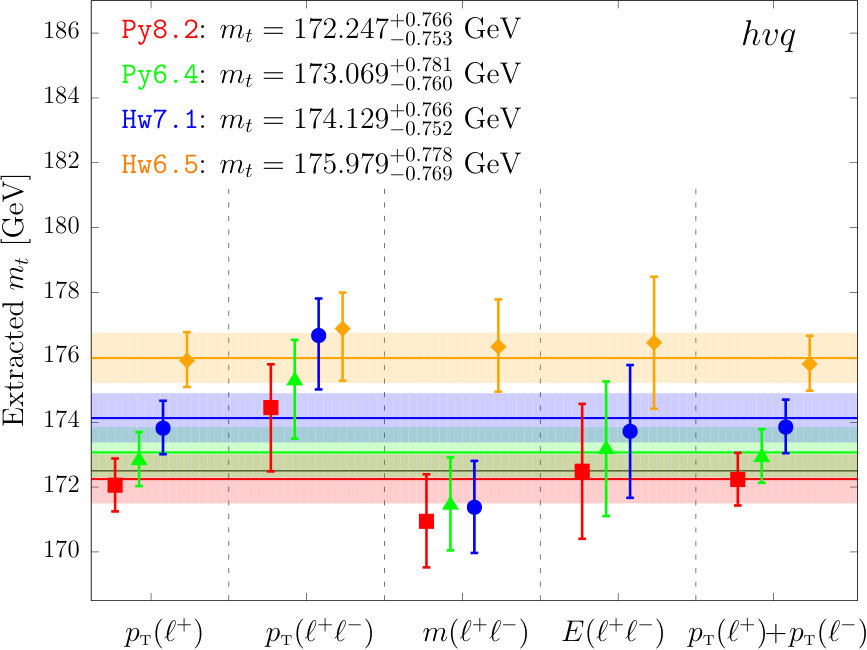 Figure 18
| | | | | | | ||||
| | No smearing | 15 GeV smearing | | No smearing | 15 GeV smearing | | No smearing | 15 GeV smearing | |
| |+Py8.2 (FSR) [GeV] | ||||||
| |+Py6.4 (FSR) +Py8.2 (FSR) | MeV | MeV | MeV | MeV | MeV | MeV |
| |+Py6.4 (SR) +Py8.2 (FSR) | MeV | MeV | MeV | MeV | MeV | MeV |
| |+Py8.2 [GeV] | ||||||
| |+Py6.4 +Py8.2 | MeV | MeV | MeV | MeV | MeV | MeV |
| | | | | | | |
| |+Py8.2 (FSR) [GeV] | |||
| |+Py6.4 (FSR) +Py8.2 (FSR) | MeV | MeV | MeV |
| |+Py6.4 (SR) +Py8.2 (FSR) | MeV | MeV | MeV |
| |+Py8.2 [GeV] | |||
| |+Py6.4 +Py8.2 | MeV | MeV | MeV |
| |, [MeV] | | |||
|---|---|---|---|
| (smear) | |||
| | Py8.2 (FSR) | | |||
| | Py6.4 (FSR) | | |||
| extracted with [GeV] | extracted with [GeV] | |||||||
| observable | Py8.2 | Py6.4 | Hw7.1 | Hw6.5 | Py8.2 | Py6.4 | Hw7.1 | Hw6.5 |
| average | ||||||||
| | Obs | | gen | shower | | | | | | |
|---|---|---|---|---|---|
| [GeV] | | Py8.2| | ||||
| | Py6.4| | |||||
| | Hw7.1| | |||||
| | Hw6.5| | |||||
| | Py8.2| | |||||
| | Py6.4| | |||||
| | Hw7.1| | |||||
| | Hw6.5| | |||||
| [GeV] smearing | | Py8.2| | ||||
| | Py6.4| | |||||
| | Hw7.1| | |||||
| | Hw6.5| | |||||
| | Py8.2| | |||||
| | Py6.4| | |||||
| | Hw7.1| | |||||
| | Hw6.5| | |||||
| [GeV] | | Py8.2| | ||||
| | Py6.4| | |||||
| | Hw7.1| | |||||
| | Hw6.5| | |||||
| | Py8.2| | |||||
| | Py6.4| | |||||
| | Hw7.1| | |||||
| | Hw6.5| |
| | Obs | | gen | shower | | | | | | |
|---|---|---|---|---|---|
| [GeV] | | Py8.2| | ||||
| | Py6.4| | |||||
| | Hw7.1| | |||||
| | Hw6.5| | |||||
| | Py8.2| | |||||
| | Py6.4| | |||||
| | Hw7.1| | |||||
| | Hw6.5| | |||||
| [GeV] smearing | | Py8.2| | ||||
| | Py6.4| | |||||
| | Hw7.1| | |||||
| | Hw6.5| | |||||
| | Py8.2| | |||||
| | Py6.4| | |||||
| | Hw7.1| | |||||
| | Hw6.5| | |||||
| [GeV] | | Py8.2| | ||||
| | Py6.4| | |||||
| | Hw7.1| | |||||
| | Hw6.5| | |||||
| | Py8.2| | |||||
| | Py6.4| | |||||
| | Hw7.1| | |||||
| | Hw6.5| |
Peer Reviews
No public reviews on file for this paper yet. If you reviewed it on a platform where reviews are public (OpenReview, ICLR, NeurIPS, ICML), you can paste yours below so the community can read it here.
Videos
No videos yet. Explain this paper in a talk, walkthrough, or lecture? Add one.
∎
\thankstext
e1e-mail: [email protected] \thankstexte2e-mail: [email protected] \thankstexte3e-mail: [email protected] \thankstexte4e-mail: [email protected]
11institutetext: IPPP, Department of Physics, Durham University, Durham, UK 22institutetext: Physics Institute, Universität Zürich, Zürich, Switzerland 33institutetext: Università di Milano-Bicocca and INFN, Sezione di Milano-Bicocca, Piazza della Scienza 3, 20126 Milano, Italy
Addendum to: A Theoretical Study of Top-Mass Measurements at the LHC
Using NLO+PS Generators of Increasing Accuracy
Silvia Ferrario Ravasio\thanksrefe1,addr1
Tomáš Ježo\thanksrefe2,addr2
Paolo Nason\thanksrefe3,addr3
Carlo Oleari\thanksrefe4,addr3
Abstract
This paper is a follow-up of Ref. Ravasio:2018lzi , where we studied the impact of next-to-leading order calculations merged with parton shower generators (NLO+PS) of increasing accuracy in the extraction of the top mass at hadron colliders. Here we examined results obtained with the older (fortran-based) shower generators Pythia6.4 and Herwig6.5. Our findings are in line with what we found in Ref. Ravasio:2018lzi with the new, c++-based, generators Pythia8.2 and Herwig7.1.
††journal: Eur. Phys. J. C
1 Introduction
In Ref. Ravasio:2018lzi we considered three NLO+PS generators for production, Frixione:2007nw , Campbell:2014kua , and Jezo:2016ujg , implemented in the POWHEG BOX Nason:2004rx ; Frixione:2007vw ; Alioli:2010xd ; Jezo:2015aia , interfaced with either Pythia8.2 (Py8.2) Sjostrand:2014zea or Herwig7.1 (Hw7.1) Bahr:2008pv ; Bellm:2015jjp . We focused particularly on an observable that mimics those used in direct top mass measurements, but also included in our study the proposed top mass measurements from the peak energy of the jet Agashe:2016bok and from the class of leptonic observables suggested in Ref. Frixione:2014ala . We found large differences between predictions obtained using the two parton shower programs. In particular, while results obtained with the three NLO+PS generators interfaced to Py8.2 are fairly consistent among each other, large differences are found if they are interfaced to Hw7.1.
In this addendum we discuss the results obtained with the older, fortran-based versions of the Pythia and Herwig codes. Our purpose is to see if the effects that we have seen are specific to the new implementations, or were already present in the old ones. We briefly recall the characteristics of the older generators:
- •
Pythia6.4 (Py6.4) Sjostrand:2006za : implements a -ordered shower, making use of the same algorithm adopted in Py8.2. The older and new codes have both an interleaved radiation scheme between the initial-state radiation and the multi-parton interactions (MPI). In Py8.2, final-state radiation is also interleaved, and different models of colour reconnection are also offered.
- •
Herwig6.5 Corcella:2000bw with Jimmy 4.31 Butterworth:1996zw (Hw6.5): implements an angular-ordered shower. However, the showering variables are different from those adopted in the Hw7.1 implementation Gieseke:2003rz . The two versions of Herwig implement the PS and the perturbative part of the MPI in a similar manner. The non-perturbative part of the MPI, instead, has been completely redesigned Bahr:2008dy . Similarly to Pythia, colour-reconnection effects are properly included only in the recent versions of Herwig Gieseke:2012ft .
In our previous work, we have seen that the two generators and yield fairly consistent results for the observables that we have considered. Thus, here we only compare and .
2 Interface to POWHEG BOX
In this section we briefly describe the matching of and to both Py6.4 and Hw6.5. The matching to Py8.2 and Hw7.1 is detailed in Ref. Ravasio:2018lzi .
2.1 Pythia6.4
Py6.4 implements both a and a virtuality-ordered PS. Here, we employ the -ordered shower with the Perugia tune (PYTUNE(320)) Skands:2010ak .
We setup Py6.4 in such a way that the of radiation in the shower is limited by the scalup parameter of the Les Houches Interface for User Processes Boos:2001cv , as is usually done in POWHEG. This is at variance with the Perugia tune settings, that requires to be smaller than scalup divided by .111We achieve this by setting the Py6.4 parameter PARP(71)=4 rather than the default Perugia value PARP(71)=2.
The matching of shower emissions in the production process relies on the default behaviour of POWHEG, i.e. the shower evolution starts at scalup. In the decays, a different scale must be adopted, and thus it requires a custom veto prescription in . We implement it using two methods, both analogous to what we did in order to match Py8.2 to in Ref. Ravasio:2018lzi :
Each time Pythia6.4 generates an emission off the top (or anti-top), we compute its transverse momentum according to the POWHEG definition. If it is larger than the transverse momentum of the emission generated by the POWHEG BOX, we abandon the current shower, and restart a shower from the same Les Houches event. This represents our default method. We label it as the “FSR” veto, in full analogy with the notation adopted for Py8.2. 2. 2.
Since we employ a -ordered shower, we can also simply require the shower to start at a given transverse momentum, that we set equal to the transverse momentum of the corresponding POWHEG emission. This veto procedure will be referred to as the “SR” method, as we did with the analogous method that we adopted in Py8.2.
2.2 Herwig6.5
For Hw6+Jimmy we adopted the ATLAS AUET2 tune ATLAS:2011gmi . The Herwig shower is ordered in angle and not in . Therefore all the emissions with transverse momentum larger than that of the POWHEG emission must be vetoed. Both Herwig versions already enforce this veto for the production part of the process. Similarly to Py6.4, extra care is required for emissions from the top-decay products, when interfaced with .
In our previous work, two procedures were devised to veto extra Hw7.1 emissions. Both of them use the of the POWHEG emission as an upper bound, either on the of each branching at the end of the showering phase (FullShowerVeto), or on the shower evolution scale during the showering phase (ShowerVeto). Unfortunately, the Hw6.5 event record (as for Py6.4) does not contain information regarding the branching of the partons, i.e. it is not possible to reconstruct the emission’s history after the shower is completed, in contrast to the new version of the code. Therefore, we only implemented the analogue of the Hw7.1 ShowerVeto method which proceeds as follows: when an emission off a top resonance is generated, if its (defined in terms of Herwig variables) is larger than that of the POWHEG emission, the branching is discarded and the evolution continues from the scale of this discarded emission.
3 Hadronic observables: NLO+PS results
In this section we compare predictions for hadronic observables at the NLO+PS level, i.e. without the inclusion of MPI and of hadronization effects. Our aim is to assess differences of perturbative origin and, in particular, due to the NLO+PS matching.
3.1 Pythia6.4 versus Pythia8.2
We begin by comparing the predictions obtained with Py6.4 and Py8.2, which both implement a dipole-like algorithm for final-state showers.
In Ref. Ravasio:2018lzi we made use of a smearing procedure to simulate experimental resolution effects. We begin by examining results obtained without applying any smearing.
The distributions of the reconstructed-top mass and of the -jet energy using matched to the two versions of Pythia are shown in the upper and lower panes of Fig. 1, respectively. The two curves for the reconstructed-top mass are almost indistinguishable. Also the peak positions of the -jet energy spectra agree remarkably well, despite some small differences in shape, leading to a displacement of the extracted top-mass for this observable of MeV.
In Fig. 2 we plot the distributions obtained using the generator. The results for the spectrum obtained with Py6.4 show an enhancement in the low-mass region with respect to the Py8.2 distribution, irrespective of the veto scheme used (upper pane). Nevertheless there is no appreciable shift in the peak-position.
The shape of the -jet energy spectrum in the proximity of the peak region is instead different for Py8.2 compared to the two results obtained by using Py6.4, with a shift in the maximum of the -jet energy of approximately +0.5 GeV of the former with respect to the latter two results. This shift induces a displacement in the extracted top-mass () of GeV.222See eqs. (7.2) and (7.4) of Ref. Ravasio:2018lzi .
In Tabs. 1 and 2 we summarize the and peak positions respectively, obtained for different values of the jet radius varied between 0.4 and 0.6. Table 1 also shows the distribution peak positions when the smearing is applied. An excellent agreement is found between +Py6.4 and +Py8.2 for , even after the smearing is applied, and the differences are small, nearly consistent with zero within their statistical errors for all values of .
The low-mass enhancement in the spectrum of the +Py6.4 generator, with respect to the +Py8.2 generator, leads to quite large displacements of the peak position once smearing is applied. For our default FSR-veto procedure, the differences between Py8.2 and Py6.4 are roughly 250-300 MeV. The differences of for the two showers used with are even larger, of the order of 0.5 GeV for all values of the jet radius.
The differences in and between the and generators for are reported in Tab. 3.
We notice that the level of agreement of predictions obtained using and gets worse in Py6.4 as compared to Py8.2, while the opposite is true for .
3.2 Herwig6.5 versus Herwig7.1
We now compare the predictions obtained by showering the NLO+PS results with Hw6.5 and Hw7.1.
In the upper panes of Figs. 3 and 4 we plot the results for obtained with and . The cross section under the peak is mildly suppressed in Hw6.5 with respect to Hw7.1. This is then compensated by enhancements in the low- and, to a smaller extent, high-tail regions. A small bump is also present at roughly 1 GeV below the peak position when using the generator with Hw7.1, also present to a smaller extent when using Hw6.5 instead.333Further studies suggest that this bump is a symptom of a minor shower cut-off mismatch between Hw7.1 and . These differences, present already at the shower level, could be ascribed to the fact that the two versions of Herwig adopt slightly different ordering variables.444In Hw6.5 the variable is interpreted as the energy fraction of the emitter after the emission, while in Hw7.1 it represents the light-cone momentum fraction. In both, the ordering variable in the collinear limit becomes , being the energy of the emitting parton and the angle between the two radiated partons. See Bahr:2008pv for further details. Despite the presence of these differences, the peak position (at the unsmeared level) in Hw6.5 or Hw7.1, in both and , is not changed.
In the lower panes of Figs. 3 and 4 we show the results for the -jet energy spectrum. The peak position, when is used, is 250 MeV bigger when showering with Hw6.5 than with Hw7.1, while in the case of it has the same magnitude but opposite sign. This affects the extracted top mass by 0.5 GeV.
3.3 Pythia versus Herwig
In Figs. 5 and 6 we plot the variation of and (relative to our reference generator combination, i.e. +Py8.2) obtained with and , showered by Py8.2, Hw7.1 Py6.4 and Hw6.5.
The shifts for , without any smearing, are small and comparable when using Hw7.1 or Hw6.5. These are not reported in the figures, and can be obtained from the tables in the appendix.
When the smearing is applied, Hw7.1 and Hw6.5 with give comparable negative shifts, around 1 GeV. Instead, with , the displacement of the peak position (with respect to the reference values) are around MeV for Hw7.1, and MeV for Hw6.5, for the different jet radii . Since no significant difference between the two Herwig versions was observed in the case (where POWHEG generates the hardest emission both in production and decay), and since does not handle radiation in decay, this behaviour is likely to be due to a different treatment of radiation in decay in the two Herwig versions with respect to Pythia.
As for predictions in Fig. 6, we find minor differences between Hw6.5 and Hw7.1 for , that go in the direction to amplify the difference with respect to our reference generator. Similarly to , also in this case the discrepancies between and interfaced to the same shower generator are larger for Herwig than for Pythia, both for the older and newer versions.
We interpret the relative consistency of the Hw7.1 and Hw6.5 predictions with the generator as a validation of our veto procedures and of the results presented in Ref. Ravasio:2018lzi .
4 Hadronic observables: full results
We now summarize the results obtained by showering and with the four PS programs at the full level, that is with the MPI and hadronization switched on. The +Py6.4 results shown here and in the following sections are obtained using the FSR veto.
For the generator (see Fig. 7)
we find that Py6.4 and Py8.2 yield very similar results. However, we find an appreciable disagreement between Hw7.1 and Hw6.5. We attribute it to different implementations of MPI in the two versions of Herwig, since the predictions agreed rather well at the NLO+PS level for .555We stress that, among other improvements over Hw6.5, Hw7.1 implements a model for the treatment of colour reconnection.
If the generator is employed (see Fig. 8) the same reasoning applies, but with one important difference: the discrepancy between Py8.2 and Py6.4 is not negligible and leads to a large displacement when smearing is applied, similar to what we found at the NLO+PS level.
The and shifts in peak positions obtained considering several values of the jet radius , with and without smearing in the case of the distribution, are summarized in Figs. 9 and 10. We notice a non-negligible dependence in the difference between Py6.4 and Py8.2, both in the and case. Something similar is observed in the case of Herwig7. A large dependence is also observed in the case of Hw6.5, but with an opposite slope when is used. The largest difference with respect to our reference result is given by the Hw7.1, that represent a major cause of concern. We stress that these large differences arise in the smeared case from the mass distribution away from the peak, i.e. cannot be consider as an irreducible uncertainty on the extracted mass.
Overall, we find that and showered with Pythia exhibit more consistency than those showered with both versions of Herwig. This is perhaps not surprising. Matrix-element corrections (MEC), that have a large impact on predictions (since this generator implements only LO top decay), as implemented in the context of angular ordered parton showers (i.e. in Herwig), are technically quite different from the way in which the hardest top radiation is generated in , at variance with MEC in transverse-momentum ordered showers (i.e. in Pythia). We find that it is difficult to use this difference to dismiss the Hw7.1 result, since the MEC formalism in Herwig has formally the same accuracy as the one in Pythia.
5 Leptonic observables
The last class of observables we consider are the leptonic ones. In Ref. Ravasio:2018lzi we found that these observables are only mildly affected by non-perturbative effects (i.e. the hadronization and the MPI), thus we present only the results obtained at the full level and with jet radius . However, they are likely to be strongly affected by the parton shower, since the boson, and thus the leptons arising from its decay, must absorb the radiation recoil to ensure four-momentum conservation.
We extract the top mass value from the following observables:
[TABLE]
The results are presented in Tab. 4
and their graphical display is given in Fig. 11.
As before, our pseudodata sample was generated with +Py8.2, and we used the other combinations of NLO+PS generators to extract a corresponding top mass value. We have included the standard theoretical uncertainties as described in Ref. Ravasio:2018lzi , and averaged the results obtained for the different leptonic observables also considering the statistical correlation among them, as suggested in Ref. Frixione:2014ala .
The Py6.4 predictions always give values roughly 1 GeV larger (1.2 GeV for and 0.8 GeV for ) than the corresponding Py8.2 ones. This variation is of the same order of the extracted total uncertainty on .
The average reconstructed top mass with Hw6.5 is nearly 2 GeV larger than Hw7.1 (1.8 GeV for and 2 GeV for ).
6 Conclusions
In this work we have extended the study performed in Ref. Ravasio:2018lzi by also considering the Py6.4 and Hw6.5 generators.
We find that, at the NLO+PS level, the Py6.4 and Py8.2 generators (both based upon a -ordered shower) are quite consistent among each other, and the same holds for Hw6.5 and Hw7.1 (both based upon an angular-ordered shower). When non-perturbative effects are included, we find larger differences between the old and the new Herwig versions of the PS programs, that yields a better agreement of the old Herwig version with respect to both Pythia versions (see Fig. 9).
If we compare predictions for the leptonic observables, we see that the old Herwig version is further away from our reference result then the new version.
Overall, inclusion of the older versions of the shower generators supports what was found in Ref. Ravasio:2018lzi , i.e. an indication of a large sensitivity to the shower generator in the extraction of the top mass.
Since we have now compared four different shower and hadronization models, it is worth asking what kind of estimate of irreducible non-perturbative effects, potentially due to the different implementation of the shower cut-off and the matching hadronization model. We thus consider the spread of the values obtained with all generators as a crude estimate of non-perturbative effects. Looking at Tab. 6, the unsmeared results from the generators, taking to avoid too large hadronization effects (for small ) and too large MPI contamination (for large ), we find a range from to , i.e. roughly a 200 MeV range. This result tells us that, after all, non-perturbative effects may be well contained within presently quoted errors for direct measurements from the experimental collaborations.
Acknowledgments
The authors would like to acknowledge Bryan Webber for the substantial help with the Hw6.5+Jimmy4.31 interface to POWHEG BOX and the useful discussions in the early stages of this project. The work of T.J. is supported in part by the University of Zürich under the contract K-72319-02-01 and in part by the Swiss National Science Foundation under contract BSCGI0-157722. P.N. acknowledges the support from Fondazione Cariplo and Regione Lombardia, grant 2017-2070. The work of S.F.R. received funding from the UK Science and Technology Facilities Council (grant numbers ST/P001246/1).
Appendix A Numerical results
In this section we give the numerical results for the hadronic observables and for both the and the generators, showered with Py8.2, Py6.4, Hw7.1 and Hw6.5. In Tab. 5 the results obtained without the inclusion of the hadronization and MPI effects are listed. The graphical representation of these data is given in Figs. 5 and 6.
The results obtained including the non-perturbative physics effects are instead reported in Tab. 6 and displayed in Figs. 9 and 10.
The reference list from the paper itself. Each links out to its DOI / PubMed record.
- 1(1) S. Ferrario Ravasio, T. Ježo, P. Nason and C. Oleari, A Theoretical Study of Top-Mass Measurements at the LHC Using NLO+PS Generators of Increasing Accuracy , Eur. Phys. J. C 78 (2018) 458 , [ 1801.03944 ]. · doi ↗
- 2(2) S. Frixione, P. Nason and G. Ridolfi, A Positive-weight next-to-leading-order Monte Carlo for heavy flavour hadroproduction , JHEP 09 (2007) 126 , [ 0707.3088 ]. · doi ↗
- 3(3) J. M. Campbell, R. K. Ellis, P. Nason and E. Re, Top-pair production and decay at NLO matched with parton showers , JHEP 04 (2015) 114 , [ 1412.1828 ]. · doi ↗
- 4(4) T. Ježo, J. M. Lindert, P. Nason, C. Oleari and S. Pozzorini, An NLO+PS generator for t t ¯ 𝑡 ¯ 𝑡 {{t\bar{t}}} and W t 𝑊 𝑡 {{Wt}} production and decay including non-resonant and interference effects , Eur. Phys. J. C 76 (2016) 691 , [ 1607.04538 ]. · doi ↗
- 5(5) P. Nason, A New method for combining NLO QCD with shower Monte Carlo algorithms , JHEP 11 (2004) 040 , [ hep-ph/0409146 ]. · doi ↗
- 6(6) S. Frixione, P. Nason and C. Oleari, Matching NLO QCD computations with Parton Shower simulations: the POWHEG method , JHEP 11 (2007) 070 , [ 0709.2092 ]. · doi ↗
- 7(7) S. Alioli, P. Nason, C. Oleari and E. Re, A general framework for implementing NLO calculations in shower Monte Carlo programs: the POWHEG BOX , JHEP 06 (2010) 043 , [ 1002.2581 ]. · doi ↗
- 8(8) T. Ježo and P. Nason, On the Treatment of Resonances in Next-to-Leading Order Calculations Matched to a Parton Shower , JHEP 12 (2015) 065 , [ 1509.09071 ]. · doi ↗