Quantum radiation reaction in aligned crystals beyond the local constant field approximation
T. N. Wistisen, A. Di Piazza, C. F. Nielsen, A. H. S{\o}rensen, U., I. Uggerh{\o}j

TL;DR
This paper presents experimental data on photon emission by high-energy positrons in aligned silicon crystals, revealing the limitations of existing models and proposing a new theoretical approach that accurately describes the observed quantum radiation reaction effects.
Contribution
The study introduces a novel theoretical framework that accounts for multiple photon emissions, recoil, and field variation, surpassing the local constant field approximation.
Findings
Experimental spectra show deviations from traditional models.
The new theory aligns well with observed data.
Quantum radiation reaction effects are significant in this regime.
Abstract
We report on experimental spectra of photons radiated by 50 GeV positrons crossing silicon single crystals of thicknesses 1.1 mm, 2.0 mm, 4.2 mm, and 6.2 mm at sufficiently small angles to the (110) planes that their motion effectively is governed by the continuum crystal potential. The experiment covers a new regime of interaction where each positron emits several hard photons, whose recoil are not negligible and which are formed on lengths where the variation of the crystal field cannot be ignored. As a result neither the single-photon semiclassical theory of Baier et al. nor the conventional cascade approach to multiple hard photon emissions (quantum radiation reaction) based on the local constant field approximation are able to reproduce the experimental results. After developing a theoretical scheme which incorporates the essential physical features of the experiments, i.e.,…
Click any figure to enlarge with its caption.
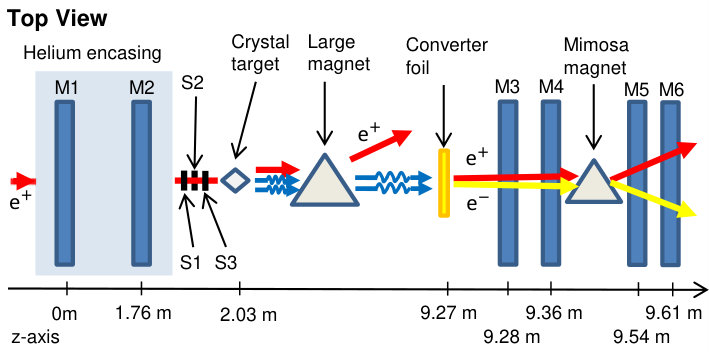 Figure 2017
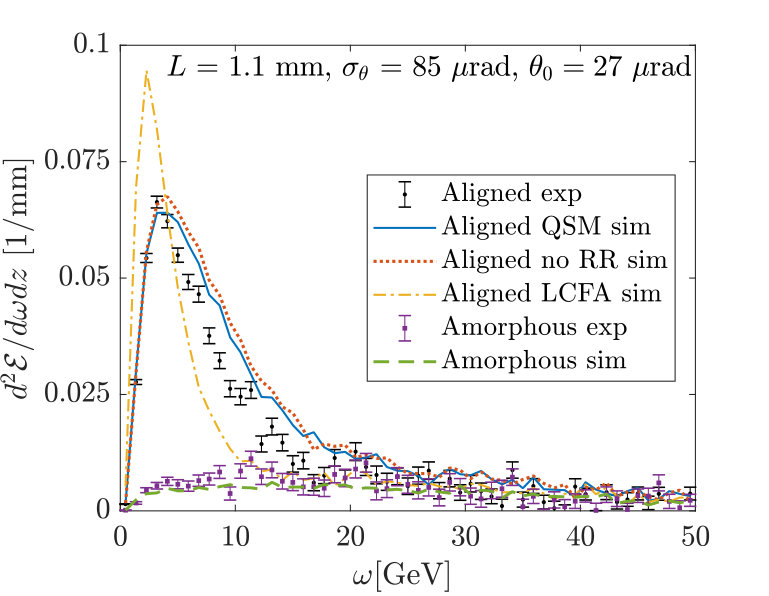 Figure 1
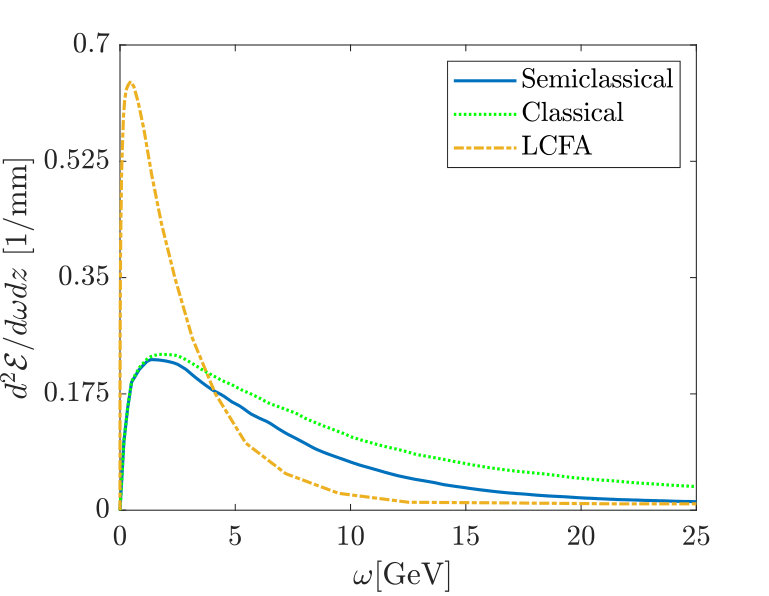 Figure 2
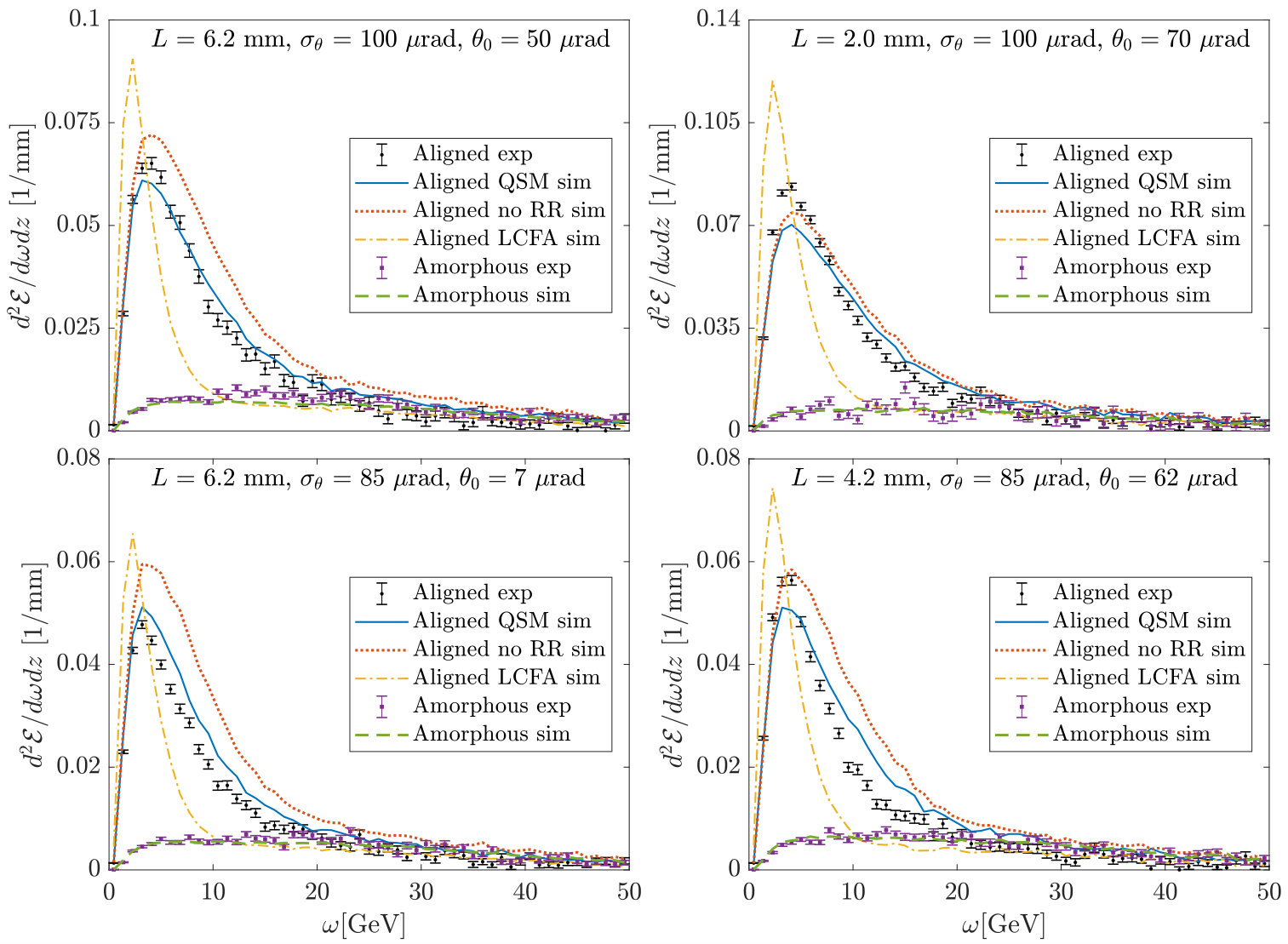 Figure 4
| 1.1 | 2.0 | 4.2 | 6.2 | 6.2 | |
|---|---|---|---|---|---|
| 85 | 100 | 85 | 85 | 100 | |
| 27 | 70 | 62 | 7 | 50 |
Peer Reviews
No public reviews on file for this paper yet. If you reviewed it on a platform where reviews are public (OpenReview, ICLR, NeurIPS, ICML), you can paste yours below so the community can read it here.
Videos
No videos yet. Explain this paper in a talk, walkthrough, or lecture? Add one.
Quantum radiation reaction in aligned crystals beyond the local constant field approximation
T. N. Wistisen2,1, A. Di Piazza2, C. F. Nielsen1, A. H. Sørensen1, and U. I. Uggerhøj1
1Department of Physics and Astronomy, Aarhus University, 8000 Aarhus, Denmark
2Max-Planck-Institut für Kernphysik, Saupfercheckweg 1, D-69117, Germany
Abstract
We report on experimental spectra of photons radiated by 50 GeV positrons crossing silicon single crystals of thicknesses 1.1 mm, 2.0 mm, 4.2 mm, and 6.2 mm at sufficiently small angles to the (110) planes that their motion effectively is governed by the continuum crystal potential. The experiment covers a new regime of interaction where each positron emits several hard photons, whose recoil are not negligible and which are formed on lengths where the variation of the crystal field cannot be ignored. As a result neither the single-photon semiclassical theory of Baier et al. nor the conventional cascade approach to multiple hard photon emissions (quantum radiation reaction) based on the local constant field approximation are able to reproduce the experimental results. After developing a theoretical scheme which incorporates the essential physical features of the experiments, i.e., multiple emissions, photon recoil and background field variation within the radiation formation length, we show that it provides results in convincing agreement with the data.
Strong electromagnetic fields as those produced by intense lasers and by crystals are a unique tool to test QED in the laboratory in unprecedented high-energy regimes, where nonlinear effects in the electromagnetic field energy density dominate the dynamics Mitter (1975); Ritus (1985); Baier et al. (1998); Di Piazza et al. (2012); Uggerhøj (2005); Fuchs et al. (2015). When electrodynamical processes occur in the presence of a sufficiently intense background electromagnetic field, the photon density of the latter is so high that charged particles like positrons (charge and mass , respectively) interact coherently with several background field photons. The theoretical description of this regime, known as strong-field QED (SFQED), relies on Lorentz- and gauge-invariant parameters, which depend on the structure of the external electromagnetic field Berestetskii et al. (1982).
When a high-energy positron impinges onto a crystal along a symmetry plane of the crystal lattice, its motion can become transversely bound between two adjacent planes, and the positron experiences an effectively static “continuum” potential varying only along the direction perpendicular to the planes (planar channeling), Lindhard (1965); Andersen (2014) and Baier et al. (1998); Uggerhøj (2005); Akhiezer and Shul’ga (1996). In planar channeling the transverse motion decouples from the motion along the - plane and the condition for a positron with initial energy to be channeled within two planes is that the total kinetic plus potential energy associated to the transverse motion is smaller than the potential energy height between the two planes, Lindhard (1965); Andersen (2014) and Baier et al. (1998); Uggerhøj (2005); Akhiezer and Shul’ga (1996). Here, we have assumed that is the coordinate perpendicular to the symmetry planes and that is the positron momentum along that direction (units with , are employed). The condition for planar channeling can be expressed as a bound on the maximal positron angle to the plane while in the crystal, that has to be smaller than , Baier et al. (1998). The continuum approximation also applies for if .
The study of SFQED processes in the background crystal field corresponding to the continuum potential, such as the emission of high-energy photons is complicated by the necessity of including the field exactly in the calculations. Now, in the case of planar channeling the crystal field has a dependence on the coordinate , which does not allow for an exact analytical solution of the Dirac equation Wistisen and Di Piazza (2019). For this reason the semiclassical method of Baier and Katkov Baier et al. (1989a, 1998), which allows for the computation of the probabilities of quantum processes using only the classical trajectory of the charged particles involved in the process, has been extremely useful in the study of SFQED processes. The semiclassical method is based on the observation that in the interaction of ultrarelativistic particles (we consider positrons here) the quantization of the motion is negligible such that one can still attribute physical meaning to the positron classical trajectory, whereas the main quantum effect in the process of radiation to be included is the recoil in the emission of high-energy photons Baier et al. (1998). The semiclassical method has been successfully employed to compute the probability of the basic SFQED processes like single photon emission and electron-positron photoproduction in aligned crystals (see Ref. Baier et al. (1998) also for studies on higher-order processes). However, when a positron crosses a crystal whose thickness corresponds to several radiation lengths, a potentially large number of photons can be emitted. The theoretical investigation of such high-order processes is a formidable task Wistisen (2019), and mainly kinetic approaches are employed, where it is assumed that multiple photon emissions arise from sequential (cascade) emissions of single photons, each single photon emission being well localized Baier et al. (1998). The localization of the emission is a crucial requirement of the method and it corresponds to assuming that the formation length of the photon emission process is much smaller than the typical length where the crystal field significantly varies, such that the local value of the probability per unit time, evaluated for a constant field, can be employed Baier et al. (1998); Ritus (1985). This “local constant field approximation (LCFA)” is another remarkable tool in strong-field physics and recent studies have been devoted to investigating its limitations especially in the realm of SFQED in beamstrahlung Blankenbecler and Drell (1996); Wistisen (2015), in intense laser fields Di Piazza et al. (2018); Blackburn et al. (2018); Di Piazza et al. (2019); Ilderton et al. (2019) and in space-time dependent electric fields Aleksandrov et al. (2019). The LCFA has previously been applied to high-energy radiation and pair-production processes in aligned single crystals. In Refs. Baier et al. (1989b); Khokonov and Nitta (2002) the leading-order correction in the field derivatives of the photon radiation probability has been found. In Refs. Belkacem et al. (1986); Bak et al. (1985) experimental results beyond the LCFA are presented but either quantum radiation reaction effects were negligible, i.e., each charge emits on average one photon or, in case of multiple photon emission, single-photon spectra were not measured. See Refs Bandiera et al. (2013); Shul’ga and Fomin (1978); Fomin and Shul’ga (1979) for other channeling related effects.
Here we report experimental single photon spectra emitted by high-energy (50 GeV) positrons crossing silicon crystals of different thicknesses (1.1 mm, 2.0 mm, 4.2 mm, and 6.2 mm) aligned to the planes. Depending on the crystal thickness, several photons are emitted by each positron with significant recoil, such that quantum radiation reaction effects have to be taken into account (see also the results of our previous experiment reported in Ref. (Wistisen et al., 2018)). By employing a conventional kinetic approach based on the emission probabilities evaluated within the LCFA, we show that such an approach is unable to explain the experimental results. Thus, we have developed a kinetic approach particularly suitable for SFQED processes in aligned crystals and where effects beyond the LCFA are implemented, see supplementary material sup . The theoretical spectra obtained with this method result in overall good agreement with the data, which in turn can be interpreted as the first experimental investigation of quantum radiation reaction beyond the LCFA.
The experiment was carried out at the CERN SPS H4 beamline employing a positron beam of GeV with an energy spread of a few percent (see Fig. 1).
Due to changed conditions of the accelerator which can occur during outages, the positron beam features varying initial angular distributions along the -direction (the crystal symmetry planes are defined to be parallel to the - planes). The experimental angular distributions were fitted with a Gaussian function and the resulting average angle relative to the crystal plane and standard deviation are reported in Table 1 for the crystal thicknesses used in the experiment. As the radiation spectra are highly sensitive to the entry angle of the positrons, the variation in the entry angles complicates a direct comparison between spectra for the different crystal thicknesses.
The scintillators S1, S2 and S3 are used to make the trigger signal, for which a signal must be present in S1 and S3 and absent in S2, as S2 has a hole to allow particles through. After the scintillators the positron enters a Helium chamber to reduce multiple Coulomb scattering. Here, the transverse position of the positron is measured, as it passes through the MIMOSA detectors M1 and M2, which allows to determine the incidence angle. The positron then enters the silicon crystal, where it emits radiation. A large magnet removes the charged particles exiting the crystal. The emitted photons, instead, continue forward and encounter a converter foil of 200\;\text{\mum} tantalum, corresponding to an approximately chance of being converted into an electron-positron pair. Note that when the photon energy exceeds the threshold of pair production, the pair production cross section quickly tends to a constant value for large photon energies. This approach of conversion is used to obtain a spectrum of individual photons, as opposed to a calorimeter setup, which would only measure the sum of energies of all the emitted photons. The produced electron and positron pair is tracked through detectors M3 and M4, are then deflected by another magnet, and then tracked again in M5 and M6. The deflection angle of the electron and the positron allows to determine their individual momenta, whose sum yields the momentum of the original photon (see Ref. (Wistisen et al., 2018) for a description of the employed tracking algorithm). The response of the experimental setup is complicated by multiple scattering through the setup, finite detector sizes etc. and therefore it should be simulated (Wistisen et al., 2018). In order to validate the simulation of the experiment, the crystal can be oriented far away from any low-index crystallographic direction, such that the emission of radiation essentially stems from Bethe-Heitler (BH) bremsstrahlung rather than showing coherence effects as in coherent bremsstrahlung or channeling radiation. BH bremsstrahlung is a well studied process, and the agreement between the simulation using the BH spectrum and the experimental spectra shows that the experimental setup is well understood and described by the simulation. An overall normalization constant is used on the simulation such that the BH simulation matches the experiment, and this accounts for the inherent efficiency in the MIMOSA detectors.
For the theoretical description of the experimental results it is useful to introduce the parameters and Mitter (1975); Ritus (1985); Baier et al. (1998); Di Piazza et al. (2012); Uggerhøj (2005). Here, is the positron energy at time , is the amplitude of the crystal electric field at the positron position at time , the symbol indicates the average over the positron trajectory, and is the maximum momentum transverse to the direction of the largest component of the momentum (note that for channeled positrons ). When is of the order of unity or larger, quantum effects such as spin and recoil during the emission are essential. The parameter differentiates between regimes of undulator-like () and synchrotron-like () radiation emission. Quantum radiation reaction is the emission of multiple photons while quantum effects in the emission is important, i.e. is not too small Di Piazza et al. (2010). When the calculation of the quantum radiation reaction process is simplified as one can assume that the multiple emissions mainly stem from a sequence of localized single-photon events and use the LCFA to calculate the corresponding single-photon radiation emission probability. This approach has been employed to explain recent experimental results on radiation reaction (Wistisen et al., 2018; Cole et al., 2018; Poder et al., 2018). When is on the order of unity, the above approach is no longer applicable, and a more general theory of radiation reaction is required. In the experiment reported here, we have that and , with the inequalities being due to different initial conditions of the positron yielding different values of the parameters. While the value of is smaller than unity, it is large enough that quantum effects are important in the experiment. This important point is illustrated in Fig. 2 by a direct comparison of classical and quantum spectra of radiation emission (average energy radiated per unit of photon energy and unit length) for a thin crystal, such that radiation reaction effects, i.e., multiple photon emission, can be neglected.
In Figs. 3 and 4 we show all the experimental data corresponding to five different settings of crystal thickness and beam distributions, see Table 1. In all figures we also report the simulation corresponding to the ‘amorphous’ orientation and we always find a very good agreement with the BH bremsstrahlung.
Since quantum effects are important, we compare the experimental data with three theoretical quantum models. In the first and most general model, called quantum stochastic model (QSM), the multiple photon emission is treated as a cascade of sequential single-photon emissions. Each single-photon emission event is implemented via a Monte Carlo approach based on positron spin- and photon polarization-averaged emission probabilities. The new feature of this model is the use of the semiclassical method of Baier and Katkov to calculate the differential single-photon emission rate (Baier and Katkov, 1968; Baier et al., 1998; Belkacem et al., 1985; Kimball et al., 1986; Wistisen, 2014, 2015) integrated over a finite section of the positron trajectory corresponding to a finite time interval . This approach is then able to handle quantum radiation reaction beyond the LCFA for planar channeling and takes advantage of the regular, oscillatory motion of positrons inside the crystal field. In fact, the value of has to be large enough such that the differential rate has converged, i.e. it no longer changes significantly when is further increased. This requires a value of on the order of several photon formation lengths (Baier et al., 1998), where is the Lorentz factor of the positron at the moment of emission. We refer to the supplemental material sup for more details on this scheme.
The second model is the “LCFA”, which is the usual approach to quantum radiation reaction, where multiple photon emissions are simulated via independent and random emission events, the emission probability being used within the LCFA (Wistisen et al., 2018). Finally, the third model is the “no RR”, where radiation reaction is ignored, which is the same as the first model, except that the momentum of the emitted photon is not subtracted from the radiating positron. The difference between the first and the third model, therefore, shows the size of radiation-reaction effects. In Ref. (Wistisen et al., 2018) we described how to use the constant field approximation in the case of channeling radiation and therefore we refer to this paper for additional details. The only difference in the LCFA model as compared to that employed in Ref. (Wistisen et al., 2018), is that here we also add the incoherent BH bremsstrahlung with a Monte Carlo approach. The reason is that this process is more important here than in Ref. (Wistisen et al., 2018).
Figures 3 and 4 show that the three models give three distinctive curves, which means that we are able to distinguish between the two models of radiation reaction (within and beyond the LCFA) as well as to establish that radiation reaction is present, as otherwise the “no RR” curve would coincide with the “QSM” curve. It is then clearly seen that the LCFA is not applicable in the parameter regime under investigation, while the QSM model is overall in good agreement with the experimental data.
The process of multiple elastic scattering of the positron with the nuclei as the positron propagates through the crystal plays an important role as this on average increases the otherwise conserved energy associated with the motion along the -direction. Since the radiation emission spectrum depends on this effect, we have implemented it in our numerical codes as described in (Babaev and Dabagov, 2012). The positron velocity at each timestep, as provided by the solver of the trajectory according to the Lorentz force, is additionally changed by an amount which is random and normal distributed, with a standard deviation depending on the local density of nuclei and electrons. In Ref. (Artru, 1990) a method similar to what we have described here was put forward. However, the method was compared to experimental results with , where the LCFA was a good approximation. Moreover, an important difference between the two methods is that in Ref. (Artru, 1990) the trajectory is divided into sections with length of the order of the period of motion which in general does not lead to convergence of the differential rate (this is, however, acceptable at , for which it was applied, because in this case the formation length is generally shorter than the oscillation period).
Acknowledgements.
T. Wistisen was supported by the Alexander von Humboldt-Stiftung except for the initial part of the project where he was supported by the VILLUM FONDEN (research grant VKR023371). Except for the first author, the author list is alphabetical and the contribution of each author was the following: T. N. Wistisen and U. I. Uggerhøj conceived and designed the experiment. C. F. Nielsen carried out the data analysis with assistance from U. I. Uggerhøj and A. H. Sørensen. C. F. Nielsen, U. I. Uggerhøj, A. H. Sørensen and T. N. Wistisen participated in the experiment. T. N. Wistisen proposed the theoretical models in collaboration with A. Di Piazza and carried out the numerical calculations. T. N. Wistisen and A. Di Piazza wrote the paper with input from the rest of the collaboration and C. F. Nielsen produced the figures with the experimental data.
The reference list from the paper itself. Each links out to its DOI / PubMed record.
- 1Mitter (1975) H. Mitter, Acta Phys. Austriaca XIV , 397 (1975).
- 2Ritus (1985) V. I. Ritus, J. Sov. Laser Res. 6 , 497 (1985).
- 3Baier et al. (1998) V. Baier, V. Katkov, and V. Strakhovenko, Electromagnetic Processes at High Energies in Oriented Single Crystals (World Scientific, 1998).
- 4Di Piazza et al. (2012) A. Di Piazza, C. Müller, K. Z. Hatsagortsyan, and C. H. Keitel, Rev. Mod. Phys. 84 , 1177 (2012).
- 5Uggerhøj (2005) U. I. Uggerhøj, Rev. Mod. Phys. 77 , 1131 (2005).
- 6Fuchs et al. (2015) M. Fuchs, M. Trigo, J. Chen, S. Ghimire, S. Shwartz, M. Kozina, M. Jiang, T. Henighan, C. Bray, G. Ndabashimiye, P. H. Bucksbaum, Y. Feng, S. Herrmann, G. A. Carini, J. Pines, P. Hart, C. Kenney, S. Guillet, S. Boutet, G. J. Williams, M. Messerschmidt, M. M. Seibert, S. Moeller, J. B. Hastings, and D. A. Reis, Nat. Phys. 11 , 964 (2015) . · doi ↗
- 7Berestetskii et al. (1982) V. B. Berestetskii, E. M. Lifshitz, and L. P. Pitaevskii, Quantum Electrodynamics (Elsevier Butterworth-Heinemann, Oxford, 1982).
- 8Lindhard (1965) J. Lindhard, K. Dan. Vidensk. Selsk. Mat. Fys. Medd. 34 , no. 14, 1 (1965).