Exploring the global symmetry structure of the Higgs potential via same-sign pair production of charged Higgs bosons
Masashi Aiko, Shinya Kanemura, Kentarou Mawatari

TL;DR
This paper introduces a new collider process involving same-sign charged Higgs pair production via vector boson fusion, which probes the global symmetry structure of the Higgs potential in two Higgs doublet models.
Contribution
It proposes a novel production process for charged Higgs pairs that directly relates to the Higgs potential's symmetry, with detailed feasibility analysis at colliders.
Findings
Process is feasible at the LHC and future colliders.
Charged Higgs decays into tau neutrino or top-bottom pairs.
Potential to explore Higgs potential's symmetry structure.
Abstract
We propose a novel process where singly charged Higgs bosons are produced in a same-sign pair via vector boson fusion at hadron colliders in two Higgs doublet models. The process directly relates to the global symmetry structure of the Higgs potential. The produced charged Higgs bosons predominantly decay into a tau lepton and the neutrino or into a pair of top and bottom quarks, depending on the type of Yukawa interactions. We evaluate the signal and the background for the both cases at the CERN Large Hadron Collider and future higher-energy hadron colliders. We find that the process can be feasible and useful to explore the nature of the Higgs potential.
Click any figure to enlarge with its caption.
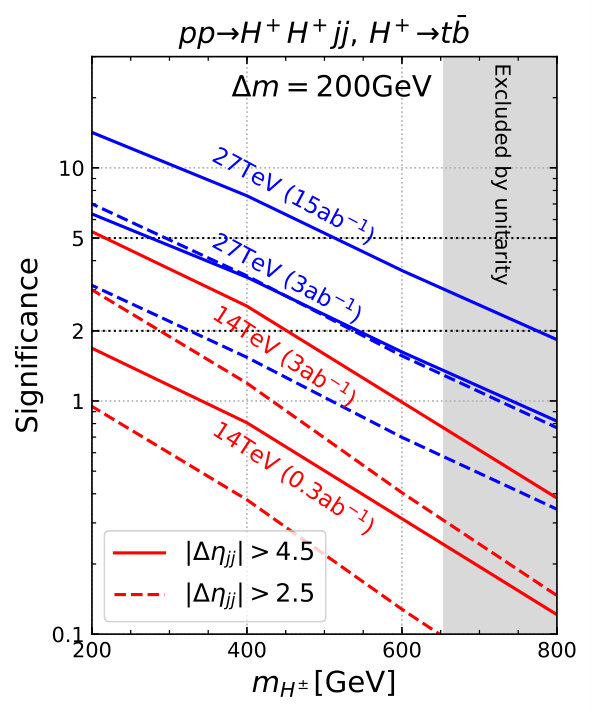 Figure 1
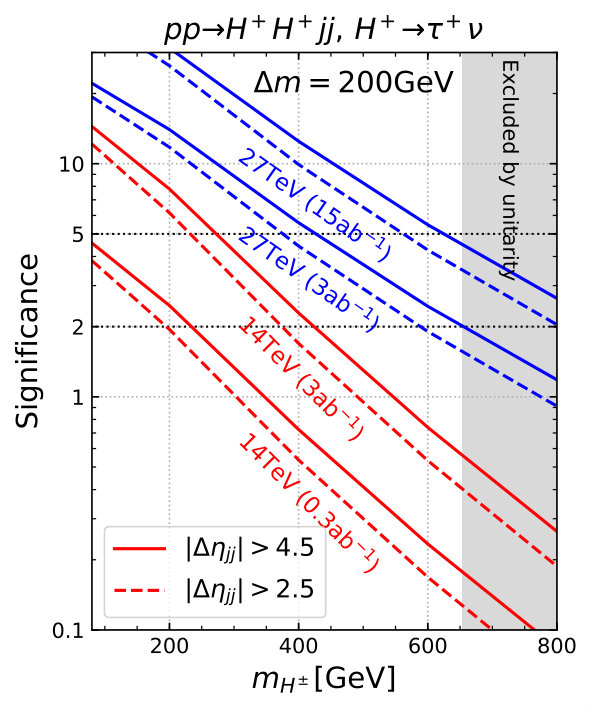 Figure 2
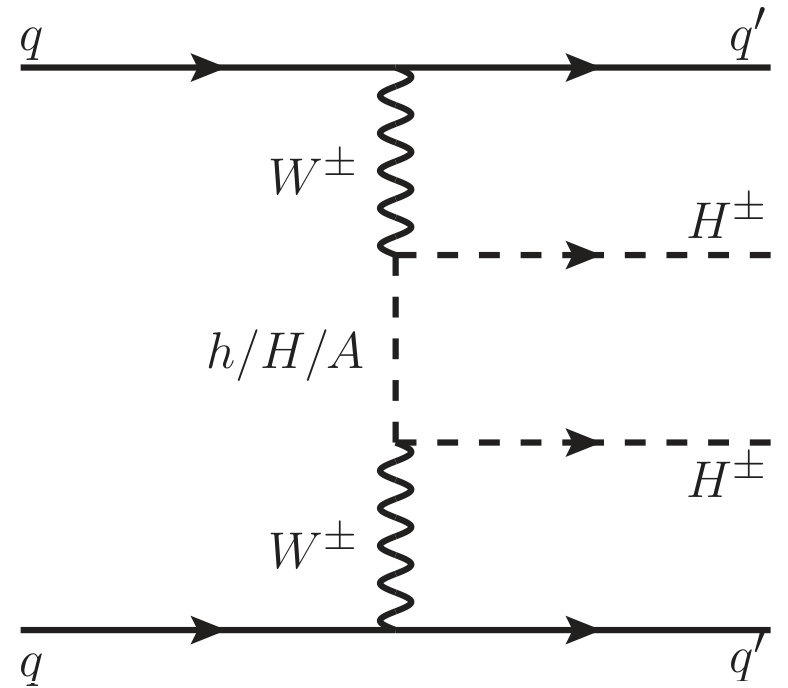 Figure 3
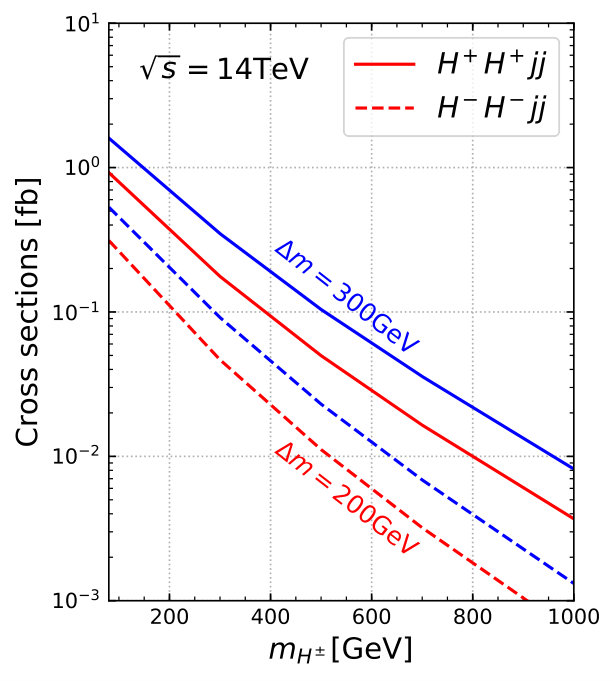 Figure 4
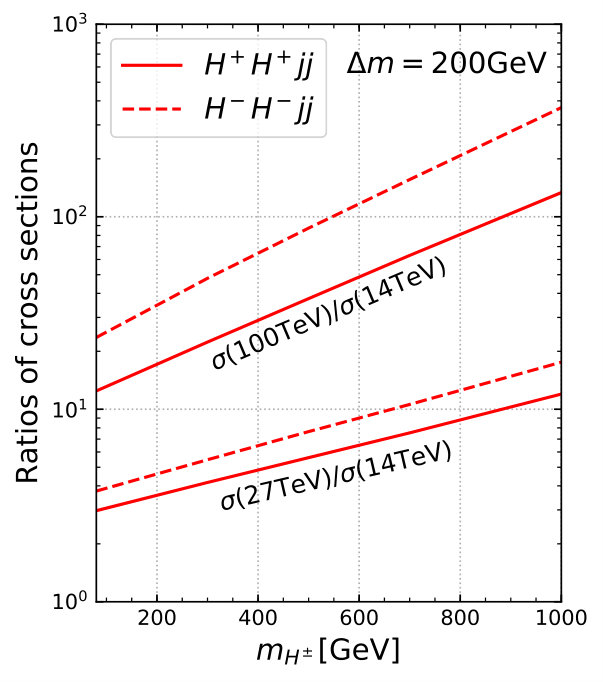 Figure 5
Peer Reviews
No public reviews on file for this paper yet. If you reviewed it on a platform where reviews are public (OpenReview, ICLR, NeurIPS, ICML), you can paste yours below so the community can read it here.
Videos
No videos yet. Explain this paper in a talk, walkthrough, or lecture? Add one.
Exploring the global symmetry structure of the Higgs potential
via same-sign pair production of charged Higgs bosons
Masashi Aiko
Department of Physics, Osaka University, Toyonaka, Osaka 560-0043, Japan
Shinya Kanemura
Department of Physics, Osaka University, Toyonaka, Osaka 560-0043, Japan
Kentarou Mawatari
Department of Physics, Osaka University, Toyonaka, Osaka 560-0043, Japan
Abstract
Abstract
We propose a novel process where singly charged Higgs bosons are produced in a same-sign pair via vector boson fusion at hadron colliders in two Higgs doublet models. The process directly relates to the global symmetry structure of the Higgs potential. The produced charged Higgs bosons predominantly decay into a tau lepton and the neutrino or into a pair of top and bottom quarks, depending on the type of Yukawa interactions. We evaluate the signal and the background for the both cases at the CERN Large Hadron Collider and future higher-energy hadron colliders. We find that the process can be feasible and useful to explore the nature of the Higgs potential.
pacs:
14.80.Cp, 13.85.-t
††preprint: OU-HET 995
Since the discovery of the Higgs boson, it has been empirically confirmed that the idea of mass generation in the standard model (SM), which is based on the electroweak symmetry breaking (EWSB), is correct. Measured Higgs boson couplings with various SM particles have turned out to be consistent with the predictions of the SM under the experimental and theoretical uncertainties Aad et al. (2016), while no other new particle has been found up to now. The SM is a good description of Nature below the EWSB scale.
Although the Higgs boson was found, the structure of the Higgs sector remains unknown, and physics behind the EWSB is still mysterious. In the SM, the Higgs sector is assumed to be composed of an isospin doublet scalar field as a minimal realization. However, the Higgs sector causes the hierarchy problem, and new physics beyond the SM is expected to appear at TeV scales. In addition, there are phenomena which cannot be explained in the SM, such as dark matter, baryon asymmetry of the Universe and tiny neutrino masses. Mechanisms to explain these phenomena would also be related to the Higgs sector.
Non-minimal Higgs sectors are often introduced in various new physics models motivated by the hierarchy problem or the above mentioned phenomena. They can be consistent with the current data like the SM. The multiplet structure is an important property; i.e., the number of additional scalars and their representations under the SM gauge symmetries Gunion et al. (2000). In addition, the global symmetry structure of the Higgs potential, whatever it is exact, approximate, softly broken or spontaneously broken, is also a key to physics beyond the SM. Therefore, in order to determine the nature of the EWSB and also to narrow dawn scenarios of physics beyond the SM, a detailed study of models with extended Higgs sectors is getting more and more important.
In this Letter, we discuss an interesting new process to approach the global symmetry structure of the Higgs potential, which is pair production of same-sign charged Higgs bosons via vector boson fusion (VBF) at hadron colliders. Recently, ATLAS and CMS observed production of same-sign W boson pairs via VBF Sirunyan et al. (2018a); Aaboud et al. (2019). Having ongoing and future experiments, extended Higgs sectors can also be explored by using VBF processes.
We consider the two Higgs doublet model (THDM) with isospin doublet scalar fields and with the hypercharge . It is one of the well-motivated simple extensions among many candidates. The most general potential is given by
[TABLE]
where and are real, while and are complex. Global symmetries of the potential in the THDM have been deeply investigated in Refs. Deshpande and Ma (1978); Pomarol and Vega (1994); Haber and O’Neil (2011); Pilaftsis (2012).
We here assume CP invariance, taking all parameters real. The fields are parameterized as
[TABLE]
where and are vacuum expectation values, which satisfy GeV with being the Fermi constant, and . Diagonalizing the mass matrix of CP-even neutral scalars by introducing the mixing angle , there are five mass eigenstates, two CP-even (, ), CP-odd () and charged states (). We here identify as the discovered Higgs boson.
Some important experimental constrains have been known on the Higgs potential Tanabashi et al. (2018); a) suppressed flavor changing neutral current, and b) the rho parameter being close to unity. In addition, as new knowledge after the Higgs boson discovery, we have c) Higgs boson couplings being SM like Aad et al. (2016). These facts would suggest that at least approximately the Higgs potential respectively has a’) a (softly-broken) discrete Z2 symmetry ( and ) Glashow and Weinberg (1977), b’) the custodial SU(2)V symmetry Sikivie et al. (1980), and c’) the alignment Gunion and Haber (2003); Bhupal Dev and Pilaftsis (2014) when additional Higgs bosons are relatively light. In the following discussion, we take these three conditions as guiding principles as the first approximation.
First, the condition a’) requires .
Second, natural realization of the alignment c’) would require that the off diagonal component of CP-even neutral scalars in the Higgs basis vanishes for all values of Bhupal Dev and Pilaftsis (2014), which implies and . The quartic coupling part of the potential in Eq. (1) is then written as
[TABLE]
where , , and .
Third, before the EWSB the term of in Eq. (5) is invariant under the maximal global symmetry O(8)111 For the entire Higgs sector of the THDM with the kinetic terms, SO(5) is maximal Pilaftsis (2012). , and that of is invariant under O(4) O(4)′ ( O(8)) Deshpande and Ma (1978). The term of either or is invariant under O(4), depending on the choice. After the EWSB, O(4) SU(2)L SU(2)R SU(2)V. Two choices for b’) the custodial SU(2)V symmetry in are described by Pomarol and Vega (1994); Haber and O’Neil (2011)
[TABLE]
where represents the mass of a field .
Finally, imposing simultaneously a’) the discrete Z2 symmetry, c’) the natural alignment, and b’) the custodial SU(2)V symmetry to the quartic coupling part of the Higgs potential, we obtain
[TABLE]
where GeV and . For both cases, is crucial for the global symmetry structure of . If , respects O(8), otherwise O(4). Therefore, measuring by experiments is extremely important.
One of the ways to determine is to separately measure and by directly discovering and . In this Letter, however, we discuss an interesting new process , whose amplitude is proportional to , by which we can directly extract the global symmetry structure of the potential at collider experiments. In the alignment limit c’), which implies , the helicity amplitudes are given by
[TABLE]
for all helicity set of the W bosons. This can be seen by the fact that, in the alignment limit, the diagrams of mediation and those of are destructive and exactly cancel for . Null amplitude implies that respects a higher global symmetry than O(4), having 222 On the contrary, the amplitudes for the opposite-sign process do not vanish for . . Therefore, at hadron colliders, we can directly measure by searching for the same sign pair production of charged Higgs bosons via W boson fusion, .
Relation between this process and the global symmetry of may also be understood partially as follows. In , the term of is given by , where are the Nambu-Goldstone bosons to be absorbed by longitudinal components of . At high energies , by the equivalence theorem Cornwall et al. (1974), we have
[TABLE]
where is the longitudinally polarized amplitude that dominates other polarizations in the high energy limit.
Charged Higgs bosons have been searched at LEP Abbiendi et al. (2013) and the CERN Large Hadron Collider (LHC) Aaboud et al. (2018). In Refs. Akeroyd et al. (2017); Arbey et al. (2018); Arhrib et al. (2018), the constraints on in THDMs are summarized for each type of Yukawa interaction (Type-I, II, X or Y Aoki et al. (2009)). The mass below 160 GeV is excluded from , searches for in the Type-I, -X and -Y THDM, respectively, while the same mass region is excluded irrespective of in Type II. Flavor experiments also give a strong constraint Misiak and Steinhauser (2017); e.g., GeV independently of in Type-II and Type-Y. Including measurements of Higgs boson coupling strengths and flavor physics observables, the constraints in THDMs are summarized in Ref. Haller et al. (2018).
We now investigate the feasibility of the process at the LHC as well as at future higher-energy hadron colliders. To evaluate cross sections and to generate events, we use the THDM UFO model file Degrande (2015), and employ MadGraph5_aMC@NLO Alwall et al. (2014). The partonic total amplitude for (see Fig. 1) is calculated using Ref. Hagiwara et al. (2009). Convoluting with the parton distribution functions, we obtain the total cross section shown in Fig. 2, where we required presence of at least two jets with the transverse momentum and the pseudorapidity as GeV and . In addition, we imposed an invariant mass cut and a rapidity separation cut on the two leading jets as the VBF baseline selection, and .
In Fig. 2 (left) we show cross sections for (solid) and (dashed) at TeV as a function of in the alignment limit with the custodial SU(2)V symmetry of Case II. The results are shown for GeV and 300 GeV. As expected, the cross sections is larger for larger , while it is zero for (). In Fig. 2 (right), we show the ratios of the cross sections evaluated at TeV and 100 TeV over those at 14 TeV for GeV.
We evaluate signal sensitivity for two decay modes of charged Higgs bosons, and , by taking into account the SM background. The decay mode is dominant for GeV or for in Type-X, otherwise the decay mode is dominant. Significance is defined by with and respectively being event numbers of the signal and the background Cowan et al. (2011).
First, signature for the signal with is a same-sign tau-lepton pair with two forward jets. The main SM background is same-sign W boson pairs via VBF, which was recently observed at the LHC Sirunyan et al. (2018a); Aaboud et al. (2019). We estimate and with the integrated luminosity in the final state with two jets and two same-sign hadronic tau-leptons, , as
[TABLE]
where is the cross section with the VBF selection. The signal cross sections are shown in Fig. 2, while the background rate is estimated at LO as 163 (568) fb at (27) TeV. The decay branching ratio is taken as . We obtain the selection efficiencies by requiring the presence of two same-sign tau leptons with GeV and as well as a larger rapidity separation between the leading jets. The efficiencies for the signal are 0.90–0.96 (0.80–0.93) for –1000 GeV with (4.5) at TeV, while the efficiency for the background is 0.57 (0.26). Those values are similar at TeV. We also take into account as the hadronic-tau branching ratio Tanabashi et al. (2018) and the efficiency of the identification Sirunyan et al. (2018b).
Second, signature for the signal with is a same-sign top-quark pair plus two forward jets. The main SM background would be four top-quark () production, whose cross section was recently measured at the LHC Sirunyan et al. (2018c). To identify the electric charge of the top quarks, we consider the leptonic decay of top quarks and the hadronic decay of anti-top quarks. We estimate the event numbers as
[TABLE]
where or . The four-top cross section at (27) TeV is estimated at NLO as 16 (144) fb Frederix et al. (2018). is taken. In addition to the VBF baseline selection for jets, we require two same-sign leptons with GeV and . Moreover, to suppress other backgrounds such as from multi-boson production, we also require the scalar sum of the transverse momenta of all jets to be GeV and at least two -tagged jets with the tagging efficiency Sirunyan et al. (2018c). The selection efficiency for the signal is 0.56–0.91 (0.49–0.88) for –1000 GeV with (4.5) at TeV, while that for the background is 0.031 (0.004).
Finally, in Fig. 3, we show signal significances of with the decay (left) and those with the decay (right) as a function of , where GeV is taken. The significances with the VBF baseline selection plus a larger rapidity separation cut are shown by dashed and solid lines, respectively, at the 14TeV LHC with and ab*-1* as well as at a future collider ( TeV) with and ab*-1*. For simplicity, we use the same kinematical cuts, and assume the same efficiencies of the hadronic tau and the -jet identifications for the collider with TeV. The shaded regions are excluded by unitarity bounds Kanemura et al. (1993). The sensitivities can be significant for smaller .
In summary, we discussed the new interesting process in THDMs, which is timely and useful to explore the global symmetry structure of the Higgs potential. We evaluated the sensitivities for and decays at the LHC and future higher-energy colliders. We found that the process can be feasible. The details are given elsewhere Aiko et al. .
The authors would like to thank H. E. Haber for useful discussions. This work was supported, in part, by MEXT Grants No. 16H06492 and No. 18H04587, and JSPS Grant No. 18K03648.
The reference list from the paper itself. Each links out to its DOI / PubMed record.
- 1Aad et al. (2016) G. Aad et al. (ATLAS, CMS), JHEP 08 , 045 (2016). · doi ↗
- 2Gunion et al. (2000) J. F. Gunion, H. E. Haber, G. L. Kane, and S. Dawson, Front. Phys. 80 , 1 (2000).
- 3Sirunyan et al. (2018 a) A. M. Sirunyan et al. (CMS), Phys. Rev. Lett. 120 , 081801 (2018 a). · doi ↗
- 4Aaboud et al. (2019) M. Aaboud et al. (ATLAS), (2019), ar Xiv:1906.03203 [hep-ex].
- 5Deshpande and Ma (1978) N. G. Deshpande and E. Ma, Phys. Rev. D 18 , 2574 (1978) . · doi ↗
- 6Pomarol and Vega (1994) A. Pomarol and R. Vega, Nucl. Phys. B 413 , 3 (1994). · doi ↗
- 7Haber and O’Neil (2011) H. E. Haber and D. O’Neil, Phys. Rev. D 83 , 055017 (2011). · doi ↗
- 8Pilaftsis (2012) A. Pilaftsis, Phys. Lett. B 706 , 465 (2012). · doi ↗