Goos-H\"{a}nchen effect of spin waves at heterochiral interfaces
Zhenyu Wang, Yunshan Cao, and Peng Yan

TL;DR
This paper theoretically analyzes the Goos-H"{a}nchen} effect of spin waves at heterochiral interfaces, deriving formulas for the GH shift, exploring its dependence on material parameters and strip width, and proposing a method to measure DMI strength in ultra-narrow magnetic strips.
Contribution
It provides an analytical formula for the GH shift of spin waves at heterochiral interfaces and demonstrates its independence from strip width, enabling DMI measurement in sub-50 nm magnetic strips.
Findings
GH shift occurs only during total reflection of spin waves.
The induced GH shift is independent of strip width down to 10 nm.
Micromagnetic simulations agree with theoretical predictions.
Abstract
We theoretically investigate the Goos-H\"{a}nchen (GH) effect of spin-wave beams reflected from the interface between two ferromagnetic films with different Dzyaloshinskii-Moriya interactions (DMIs). The formula of the GH shift as functions of the incident angle and material parameters is derived analytically. We show that the GH effect occurs only when spin waves are totally reflected at the interface and vanishes otherwise. We further explore the GH shift of spin waves by narrow DMI strips of different widths. It is found that the induced shift is independent of the strip width down to nm, offering a novel approach to measure the DMI strength of ultra-narrow magnetic strips which is out the scope of current technology. Full micromagnetic simulations compare well with our theoretical findings. Strong distortion of edge magnetizations for narrower strips however generates a width…
Click any figure to enlarge with its caption.
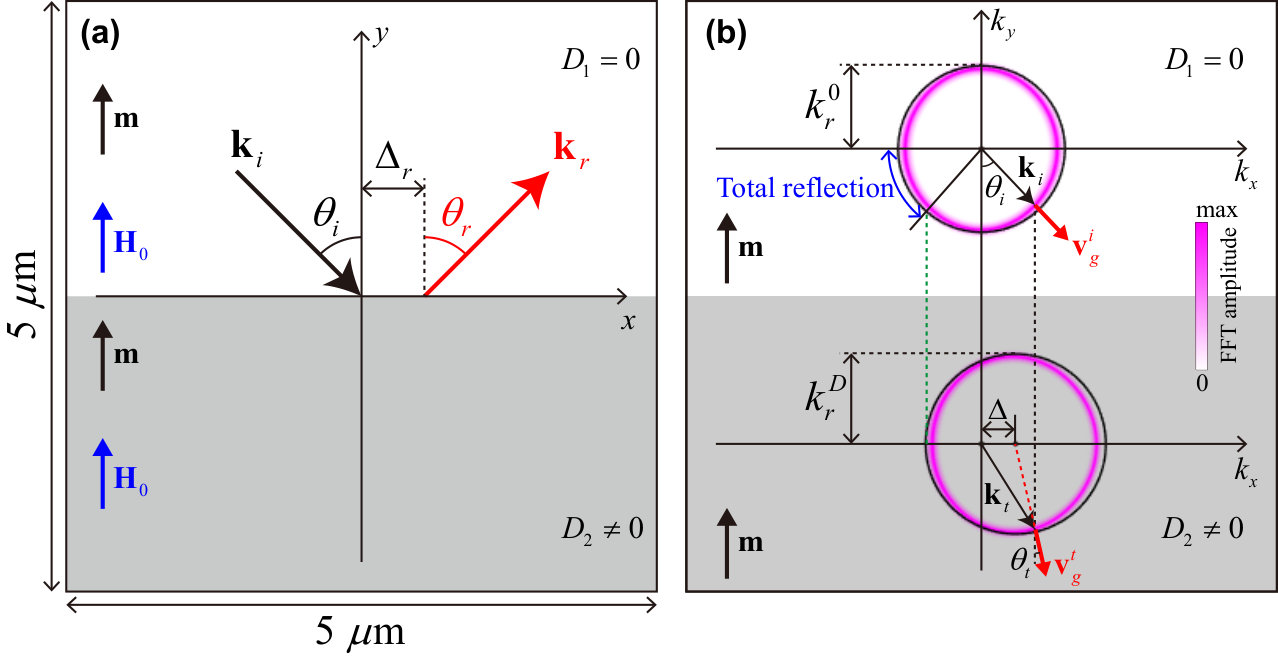 Figure 1
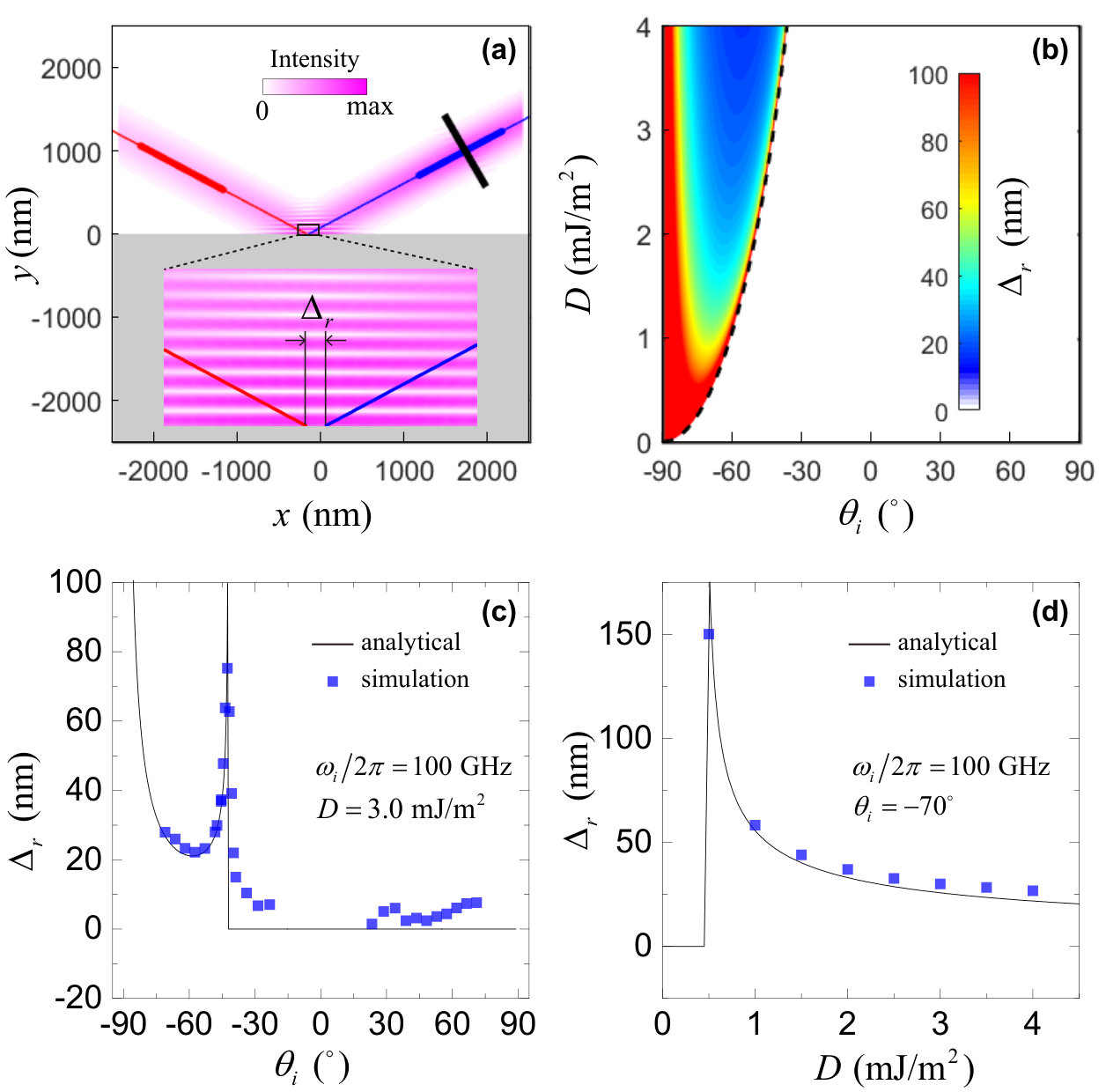 Figure 2
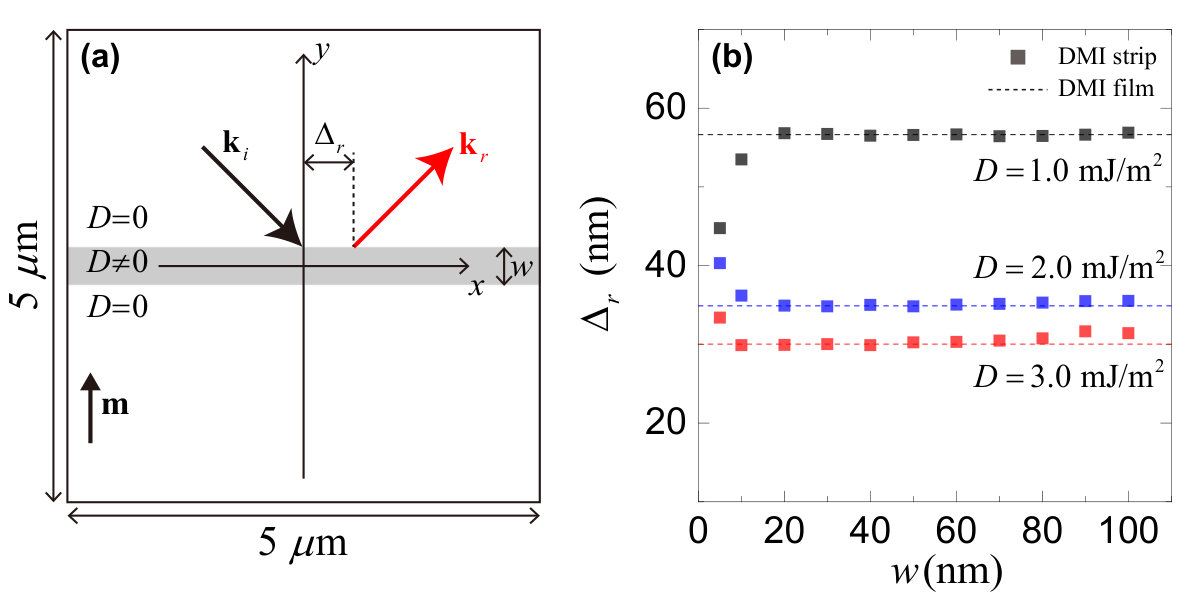 Figure 3
Peer Reviews
No public reviews on file for this paper yet. If you reviewed it on a platform where reviews are public (OpenReview, ICLR, NeurIPS, ICML), you can paste yours below so the community can read it here.
Videos
No videos yet. Explain this paper in a talk, walkthrough, or lecture? Add one.
Goos-Hänchen effect of spin waves at heterochiral interfaces
Zhenyu Wang
Yunshan Cao
Peng Yan
School of Electronic Science and Engineering and State Key Laboratory of Electronic Thin Films and Integrated Devices, University of Electronic Science and Technology of China, Chengdu 610054, China
Abstract
We theoretically investigate the Goos-Hänchen (GH) effect of spin-wave beams reflected from the interface between two ferromagnetic films with different Dzyaloshinskii-Moriya interactions (DMIs). The formula of the GH shift as functions of the incident angle and material parameters is derived analytically. We show that the GH effect occurs only when spin waves are totally reflected at the interface and vanishes otherwise. We further explore the GH shift of spin waves by narrow DMI strips of different widths. It is found that the induced shift is independent of the strip width down to nm, offering a novel approach to measure the DMI strength of ultra-narrow magnetic strips which is out the scope of current technology. Full micromagnetic simulations compare well with our theoretical findings. Strong distortion of edge magnetizations for narrower strips however generates a width dependence of the GH shift. The results presented in this work are helpful for understanding the GH effect in chiral magnets and for quantifying the DMI parameter in magnetic strips of sub- nm scales.
I Introduction
The Goos-Hänchen (GH) effect originally is a fundamental optical phenomenon in which a light beam reflecting from an interface is laterally shifted Goos1947 , but it is not limited to optics and can be regarded as a general property of waves, such as acoustics Declercq2008 , electronics Chen201301 , and neutron waves Haan2010 . For spin waves (or magnons), it has been shown that the GH shift can exist when reflecting from the interface between two ferromagnetic films or the edge of a single ferromagnet Dadoenkova2012 ; Gruszecki2014 ; Gruszecki2015 , the properties of which are crucial for the lateral shift of the spin-wave beam. The magnonic GH shift can be a useful tool in characterizing interfaces and edges of magnetic films.
The Dzyaloshinskii-Moriya interaction (DMI) Dzyaloshinsky1958 ; Moriya1960 , present in magnetic materials with broken inversion symmetry, has a chiral character and causes the nonreciprocal propagation of spin waves Zakeri2010 ; Landeros2013 ; Moon2013 ; Garcia2014 , which provides additional functionalities in magnonic devices Lan2015 ; Yu2016 ; Xing2016 ; Kim2016 ; Bracher2017 . Recent works found that magnonic crystals with a periodic DMI can efficiently modulate spin-wave propagations and give rise to a plethora of unique effects, such as the spin-wave amplification Lee2017 , the emergence of indirect gaps, the formation of flat bands, and an unconventional evolution of the standing spin waves around the gaps Gallardo2019 . Recently, it has been shown that total reflections and negative refractions can occur at the DMI interface and the spin-wave refraction is not symmetric for positive and negative incident angles Wang2018 ; Mulkers2018 . However, an in-depth understanding of spin-wave propagations at heterochiral interfaces is still lacking, particularly the magnonic GH effect at the DMI interface.
In this work we investigate theoretically the GH shift at heterochiral interfaces with inhomogeneous DMIs, which can be realized in experiments via engineering the substrate and/or the capping layer of thin ferromagnetic films Chen201310 ; Torrejon2014 ; Wells2017 ; Tacchi2017 . Here we focus on the high-frequency spin waves, in which the influence of the dipolar interaction can be neglected. We shown that the GH shift occurs only in the case of total reflection and disappears otherwise. Theoretical results are verified by full micromagnetic simulations. We further explore the GH shift at the DMI interface of a narrow magnetic strip. We demonstrate that the GH shift there is the same as that in heterochiral films, i.e., independent on the strip width down to nm. Our findings promote the heterochiral interface as an advanced platform for spin wave manipulations and enable us to measure the DMI for ultra-narrow (sub- nm) magnetic strips via the magnonic GH shift, which fills in the gap of current technology.
The paper is organized as follows. In Sec. II, we present the theoretical model describing the spin-wave propagation. An effective Schrödinger equation for spin waves is established to obtain spin-wave boundary conditions at the DMI interface. The analytical formula of the reflectance and the GH shift is derived. Section III gives the results of micromagnetic simulations to verify theoretical predictions. Discussion and conclusion are drawn in Sec. IV and V, respectively.
II Analytical Model
We first consider the GH shift at the interface of heterochiral magnetic films, i.e., for and for , as shown in Fig. 1(a). To capture the chiral effect solely, we assume the other magnetic parameters to be the same in the heterochiral system. The dynamics of spin-wave propagation in magnetic films is governed by the Landau-Lifshitz-Gilbert (LLG) equation
[TABLE]
where is the unit magnetization vector with the saturation magnetization , is the gyromagnetic ratio, is the vacuum permeability, and is the Gilbert damping constant. The effective field comprises the exchange field, the DM field, the external field, and the demagnetization field. The DMI considered here has the interfacial form Bogdanov2001 :
[TABLE]
where is the DMI constant. An in-plane static external field is applied to saturate the magnetization in the film plane (), see Fig. 1(a). We assume a small fluctuation of around , and express the magnetization as with and . The exchange spin wave with high frequency is considered and the dipolar interaction is ignored (wave lengths below 100 nm Lenk2011 ), so that the spin-wave dispersion relation reads Wang2018
[TABLE]
where with the exchange constant , , , and is the wave vector of the spin wave. The spin-wave propagation characteristic can be analyzed by the isofrequency curve, as illustrated in Fig. 1(b). In the region 1 without the DMI (), the spin-wave isofrequency curve at a given frequency is a circle centered at the origin with the radius . In the presence of the DMI (), the isofrequency circle is shifted by along the axis and its radius increases to . Micromagnetic simulations agree well with the analytical formula Eq. (3) [see Fig. 1(b)], which justifies the validity of the spin-wave dispersion relation.
The scattering behaviors of spin waves at the heterochiral interface can be described by the generalized Snell’s law Wang2018 ; Mulkers2018 :
[TABLE]
where and are the incident and refracted angles of spin-wave beams, respectively, with respect to the interface normal ( axis), see Fig. 1(b). According to Eq. (4), we obtain the critical angle for total reflection,
[TABLE]
corresponding to . The dependence of the critical angle on the DMI constant is plotted in Fig. 2(b) [dashed line]. One can see that increases with . Total reflection occurs only when the incident angle satisfies .
The evaluation of the reflection and transmission coefficients requires boundary conditions for spin waves at the heterochiral interface, which are derived below. By defining a spin-wave function and neglecting the damping, we linearize the LLG equation (1) and recast it into an effective Schrödinger equation Lee2017 :
[TABLE]
where is the momentum operator and is the effective mass of spin waves. From the continuity of the wave function and integrating Eq. (6) over the vicinity of the interface, we obtain the boundary conditions for the magnon wave function at the DMI interface between two regions as
[TABLE]
The incident and reflected waves in region 1 and the refracted wave in region 2 are assumed as plane waves:
[TABLE]
where and are the reflection and transmission coefficients, respectively. Due to the translational symmetry along the interface, the wave vector component tangential to the interface is conserved . Moreover, in region 1 where , the dispersion relation is isotropic which implies . A spin-wave beam incident at an angle has the wave vector with and . We therefore obtain the wave vector of the refracted spin wave with and .
Substituting Eq. (8) into the boundary conditions Eq. (7) gives the reflection and transmission coefficients:
[TABLE]
To calculate the GH shift, we use the stationary phase method Artmann1948 , which is based on the phase difference between the reflected and incident beams. If the incident spin wave is a wave packet of a Gaussian shape with the component of the wave vector variation , the GH shift of the reflected beam is given by Artmann’s formula Artmann1948 ; Gruszecki2015 ; Gruszecki2017 :
[TABLE]
where is the phase difference between the reflected and incident waves, with Im() and Re() being the imaginary and real parts of the reflection coefficient, respectively, calculated from Eq. (9). The sign function is defined as follows: when a spin-wave beam is incident from left (right) side, is positive (negative) and .
In the case of total reflection (), is imaginary and is complex. The GH shift for this case is given as
[TABLE]
For the other incident angles (), both and are real numbers, which leads to and . The nonreciprocal GH shift [] occurs because the isofrequency is shifted in space for the DMI region [the lower part in Fig. 1(b)], which is embodied in the generalized Snell’s law [Eq. (4)] by the additional term . This shift can also cause the asymmetric refraction of spin waves at the heterochiral interfaceWang2018 ; Mulkers2018 .
III Numerical results
To confirm our theoretical analysis, we employ full micromagnetic simulations using Mumax3 Vansteenkiste2014 . We consider a heterogeneous ferromagnetic film with length 5 , width 5 , and thickness 5 nm, in which the DMI strength of the lower half part is while the upper part has a vanishing DMI, as shown in Fig. 1(a). Magnetic parameters of permalloy are used in simulations: and . In the dynamic simulations, a Gilbert damping constant of is used to ensure a long-distance propagation of the spin-wave beams, and absorbing boundary conditions are adopted to avoid the spin-wave reflection by film edges Venkat2018 . An external field T along is applied to saturate the in-plane magnetization.
Next, we excite a Gaussian spin-wave beam by applying a sinusoidal monochromatic microwave field in a narrow rectangular area [black bar shown in Fig. 2(a)], where the field amplitude has a Gaussian profile in the transverse direction (parallel with the long side of the exciting area) Gruszecki2015 . We set the maximum amplitude of the oscillating field as mT and GHz, at which the spin-wave propagation is almost isotropic in the no-DMI region owing to the significant contribution of the exchange interaction [as confirmed in Fig. 1(b)]. It justifies our previous assumption of dropping the dipolar term.
After a sufficiently long-time simulation (3 ns), such that the incident and reflected spin-wave beams are clearly visible, we investigate the GH shift of the reflected spin-wave beam. A case study is shown in Fig. 2(a). First, we calculate the spin-wave intensity using equation . Then, by a Gaussian fitting we extract the position of the center of the intensity profile [the blue and red dots in Fig. 2(a) for the incident and reflected spin-wave beams, respectively]. Having the coordinates of the center positions, we obtain the incident and reflected spin-wave beam rays by a linear fitting. Finally, the GH shift of the reflected spin-wave beam can be easily calculated [see the inset in 2(a)].
According to the analytical formula, we plot the phase diagram of the GH shift as a function of the incident angle and DMI constant as displayed in Fig. 2(b). One can observe that the GH shift is zero at incident angles above the critical angle () and is finite only if . Figure 2(c) shows the GH shift versus for . The GH shift is pronounced for incident angles close to . With the decreasing of , the GH shift first decreases to a minimum value ( nm) at a certain incident angle () and then it starts to increase. In Fig. 2(d), we show the dependence of the GH shift on the DMI constant for . For in the total reflection region, the GH shift decreases with . The simulation data are represented by the blue squares in Figs. 2(c) and 2(d). These results are well consistent with those obtained from the analytical model Eq. (11).
However, there are still some discrepancies which are possibly due to approximations in the analytical model, as discussed below. Firstly, the demagnetization field is considered in simulations, which is neglected in the analytical model. With the demagnetization field, the magnitude of the wave vector is reduced [see Fig. 1(b)], leading to the increase of in Eq. (11) [as shown in Figs. 2(c) and 2(d)]. Secondly, the magnetization saturation is assumed in the analytical model. But there is spin canting at the DMI interface Mulkers2017 , which would change the spin-wave dispersion Wang2018 . And it would cause bending of spin-wave beams at the interface, which is similar to the spin-wave bending due to the gradual change of refractive index caused by the demagnetization field at the film edge Gruszecki2014 . Lastly, for , most of the incident spin-wave beams pass through the interface. The intensity of the reflected beam is very weak leading to sizable fitting errors.
Finally, we replace the DMI film by the DMI strip and investigate the influence of the strip width on the GH shift. To this end, we construct a heterogeneous ferromagnetic film, in which a DMI strip with the finite width is located in the center while the remaining parts have no DMI, as shown in Fig. 3(a). Then we numerically examine how the GH shift change with the strip width. Figure 3(b) shows the simulation results for , GHz, and three different DMI constants. One can see that the GH shift is independent of the strip width and remains the same as in the DMI film for nm. For nm, there is a large variation of the GH shift. We contribute this change to the spin canting, the range of which is comparable with the strip width. In this case, the dispersion relation Eq. (3) and boundary conditions Eq. (7) become invalid. The incident spin-wave beams partially pass though the interface rather than being totally reflected (not shown). A new model is required to elucidate the GH shift at a ultra-narrow DMI interface ( nm), which goes beyond the scope of this work.
IV Discussion
We point out that the results presented here enable us to probe the DMI of magnetic strip with the width of sub- nm by measuring the GH shift between the incident and reflected spin-wave beams. This method requires the spin-wave imaging with the spatial resolution in the range of about 500 nm (the width of the spin-wave beam), which can be achieved by X-ray magnetic circular dichroism (XMCD) Bonetti2015 or the near-field BLS Jersch2010 . Recently, a GH-like phase shift for magnetostatic spin waves has been observed in experiments Stigloher2018 . We thus envision a direct observation of the GH shift of exchange spin waves in the future.
In previous work, we proposed a nonlocal scheme to measure the DMI in a narrow magnetic strip by three-magnon processes Wang2018 . Such a method is only feasible for the magnetic strip with the width in the range of 50-100 nm. Below 50 nm, the spin canting Mulkers2017 at the DMI interface elevates the band gap of bound-state spin waves in the DMI strip leading to a very narrow frequency range to excite the confined modes. This significantly hiders the measurement of DMI. Beyond 100 nm, the three-magnon intensity attenuates rapidly with the strip width. It is thus difficult to detect the spectra of the transmitted spin waves. We therefore believe that GH shift provides a very promising way to quantify the DMI in ultra-narrow magnetic strips.
V Conclusion
In summary, we investigated the GH shift at the interface between two ferromagnets with different DMIs. The analytical formulas for the reflectance and the GH shift were derived. We have shown that the GH shift of the reflected spin-wave beam only takes place in the case of total reflection and disappears for the other cases. Using the micromagnetic simulations, we demonstrated that the analytical model well describes the essential physics. Further, we studied the GH shift at the interface of a DMI strip and found that the GH shift is independent on the strip width for nm. Our findings are helpful to understand the GH shift in chiral magnets and to measure the DMI parameter in ultra-narrow magnetic strips.
VI Acknowledgment
We thank C. Wang, Z.-X. Li, and H. Yang for helpful discussions. This work is supported by the National Natural Science Foundation of China (Grants No. 11604041 and 11704060), the National Key Research Development Program under Contract No. 2016YFA0300801, and the National Thousand-Young-Talent Program of China. Z.W. acknowledges the financial support from the China Postdoctoral Science Foundation under Grant No. 2019M653063.
The reference list from the paper itself. Each links out to its DOI / PubMed record.
- 1(1) F. Goos and H. Hänchen, Ein neuer und fundamentaler Versuch zur Totalreflexion, Ann. Phys. (Berl.) 436 , 333 (1947) . · doi ↗
- 2(2) N. F. Declercq and E. Lamkanfi, Study by means of liquid side acoustic barrier of the influence of leaky Rayleigh waves on bounded beam reflection, Appl. Phys. Lett. 93 , 054103 (2008) . · doi ↗
- 3(3) X. Chen, X. J. Lu, Y. Ban, and C. F. Li, Electronic analogy of the Goos-Hänchen effect: a review, J. Opt. 15 , 033001 (2013) . · doi ↗
- 4(4) V. O. de Haan, J. Plomp, T. M. Rekveldt, W. H. Kraan, A. A. van Well, R. M. Dalgliesh, and S. Langridge, Observation of the Goos-Hänchen Shift with Neutrons, Phys. Rev. Lett. 104 , 010401 (2010) . · doi ↗
- 5(5) Y. S. Dadoenkova, N. N. Dadoenkova, I. L. Lyubchanskii, M. L. Sokolovskyy, J. W. Kłos, J. Romero-Vivas, and M. Krawczyk, Huge Goos-Hänchen effect for spin waves: A promising tool for study magnetic properties at interfaces, Appl. Phys. Lett. 101 , 042404 (2012) . · doi ↗
- 6(6) P. Gruszecki, J. Romero-Vivas, Y. S. Dadoenkova, N. N. Dadoenkova, I. L. Lyubchanskii, and M. Krawczyk, Goos-Hänchen effect and bending of spin wave beams in thin magnetic films, Appl. Phys. Lett. 105 , 242406 (2014) . · doi ↗
- 7(7) P. Gruszecki, Y. S. Dadoenkova, N. N. Dadoenkova, I. L. Lyubchanskii, J. Romero-Vivas, K. Y. Guslienko, and M. Krawczyk, Influence of magnetic surface anisotropy on spin wave reflection from the edge of ferromagnetic film, Phys. Rev. B 92 , 054427 (2015) . · doi ↗
- 8(8) I. Dzyaloshinsky, A thermodynamic theory of “weak” ferromagnetism of antiferromagnetics, J. Phys. Chem. Solids 4 , 241 (1958) .