One-fluid equations of general relativistic two-fluid plasma with the Landau-Lifshitz radiation reaction force in curved space
Wen-Shuai Liu, Wei-Hao Bian, Bi-Xuan Zhao, Li-Ming Yu, Chan Wang, (NJNU)

TL;DR
This paper derives one-fluid GRMHD equations including the Landau-Lifshitz radiation reaction force in curved spacetime, analyzing its significance in plasma near compact astrophysical objects.
Contribution
It introduces a novel formulation of GRMHD equations that incorporate radiation reaction forces, extending previous models to curved spacetime environments.
Findings
Radiation reaction force significantly affects plasma dynamics near compact objects
Derived equations enable more accurate modeling of astrophysical plasmas
Highlights importance of radiation reaction in relativistic plasma simulations
Abstract
Incorporating the radiation reaction force into two-fluid plasma in curved space, we get a set of one-fluid general relativistic magnetohydrodynamics (GRMHD) equations with the Landau-Lifshitz radiation reaction force. We analyze the importance of the radiation reaction acting on plasma around an astrophysical compact object.
Click any figure to enlarge with its caption.
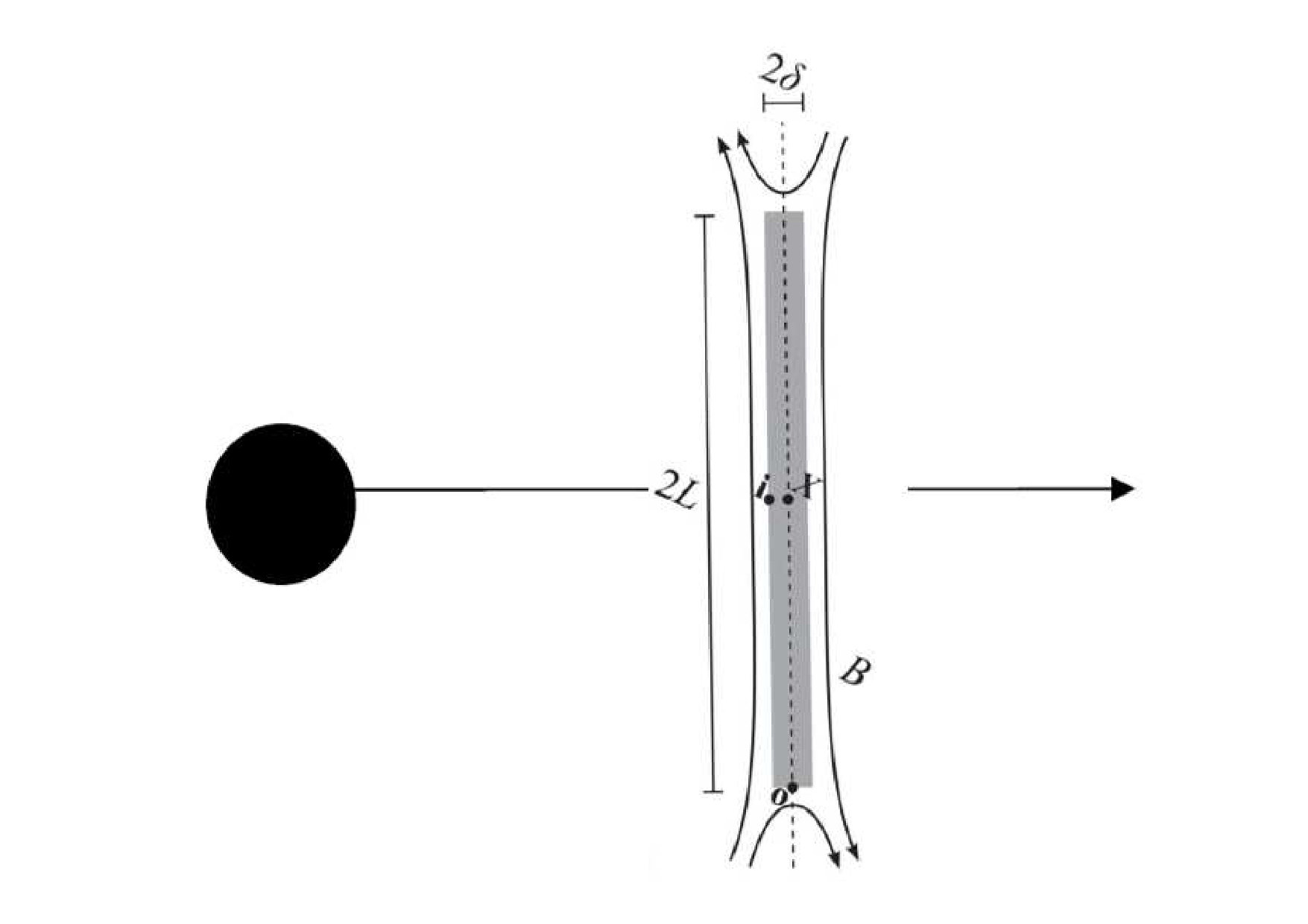 Figure 1
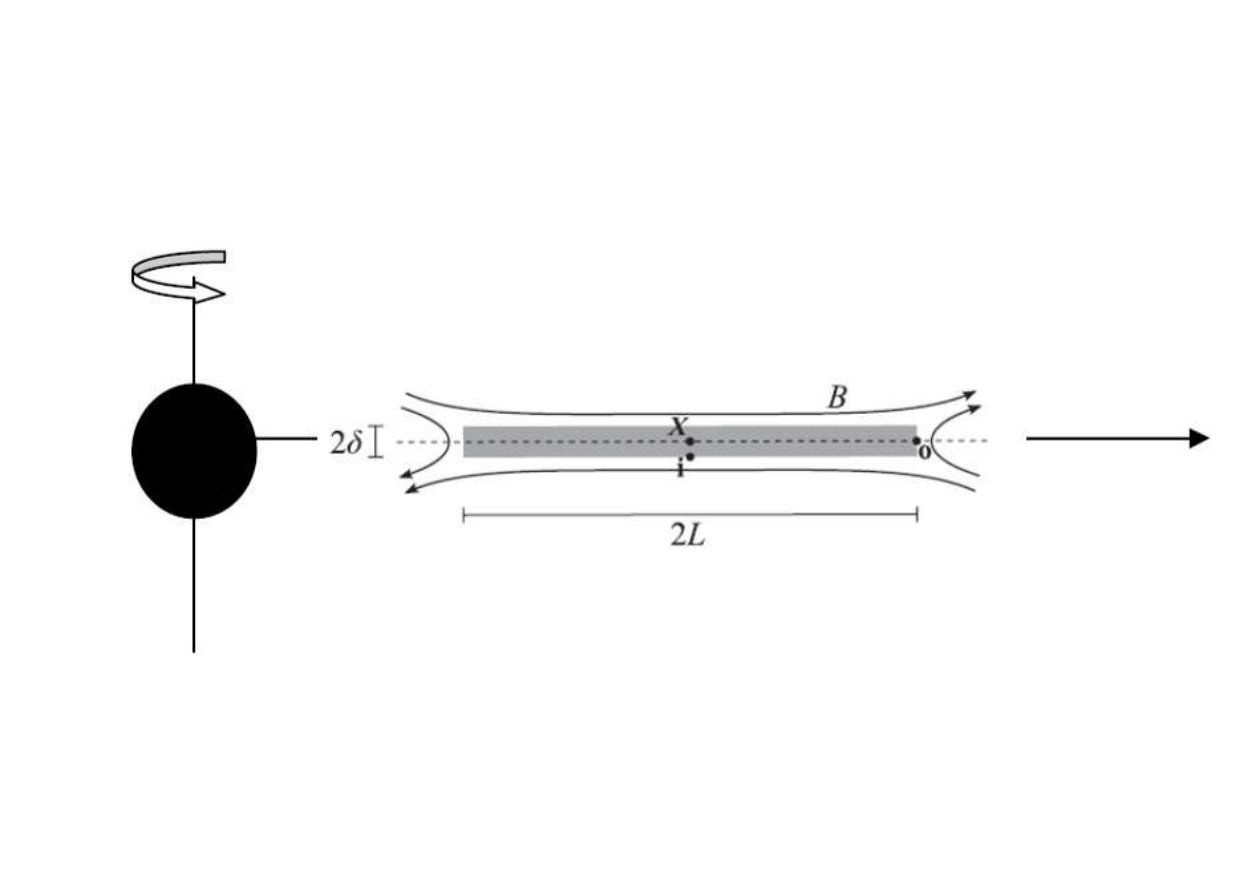 Figure 2
Peer Reviews
No public reviews on file for this paper yet. If you reviewed it on a platform where reviews are public (OpenReview, ICLR, NeurIPS, ICML), you can paste yours below so the community can read it here.
Videos
No videos yet. Explain this paper in a talk, walkthrough, or lecture? Add one.
Taxonomy
TopicsCosmology and Gravitation Theories · Solar and Space Plasma Dynamics · Black Holes and Theoretical Physics
One-fluid equations of general relativistic two-fluid plasma with the Landau-Lifshitz radiation reaction force in curved space
Wenshuai Liu11affiliation: School of Physics and Technology, Nanjing Normal University, Nanjing 210023, China ,a, Weihao Bian11affiliation: School of Physics and Technology, Nanjing Normal University, Nanjing 210023, China ,b, Bixuan Zhao11affiliation: School of Physics and Technology, Nanjing Normal University, Nanjing 210023, China , Liming Yu11affiliation: School of Physics and Technology, Nanjing Normal University, Nanjing 210023, China , Chan Wang11affiliation: School of Physics and Technology, Nanjing Normal University, Nanjing 210023, China
Abstract
Incorporating the radiation reaction force into two-fluid plasma in curved space, we get a set of one-fluid general relativistic magnetohydrodynamics (GRMHD) equations with the Landau-Lifshitz radiation reaction force. We analyze the importance of the radiation reaction acting on plasma around an astrophysical compact object.
Subject headings:
accretion, accretion disks — acceleration of particles — magnetohydrodynamics (MHD)
aaaffiliationtext: [email protected]: [email protected]
1. Introduction
A charged particle moving in the electromagnetic field can feel Landau-Lifshitz radiation reaction force due to synchrotron radiation, thus modifying the motion of the charged particle significantly when taking into account the radiation reaction force. Recent observations have demonstrated that there is strong evidence that a magnetic field of several hundred gauss exists in the vicinity of the supermassive black hole at the center of the Milky Way (Eatough et al., 2013). A dynamo mechanism from an accretion disk around a black hole accounts for the appearance of such a magnetic field (Punsly, 2001; Hawley et al., 1996; Brandenburg et al., 1995). There is also clear evidence that the magnetic field on the surface of the neutron star can be up to G (Duncan & Thompson, 1992; Usov, 1992; Paczyński, 1992; Thompson & Duncan, 1995, 1996; Vasisht & Gotthelf, 1997). The Landau-Lifshitz radiation reaction has been investigated in detail in Landau & Lifshitz (1975) in flat space, while, in curved space, the radiation reaction is described in Sokolov et al. (1978), Sokolov et al. (1983), DeWitt & Brehme (1960) and Tursunov et al. (2018). Thus, the radiation reaction force can affect the charged particles from the accretion disk around the black hole and the neutron star significantly. Radiation reactions have been an important element of pair creation scenarios in positron-electron plasma just above the pole of the event horizon (Hirotani & Pu, 2016). Curvature radiation in black hole magnetopshere pair creation schemes is radiation resistance limited (Broderick & Tchekhovskoy, 2015). Recently, a radiation reaction has also been applied to protonic acceleration in the vortex above the pole of the black hole (Ruffini et al., 2018). Radiation reactions are of fundamental importance in the evacuated vortex of black hole magnetospheres (Punsly, 2001). In particular, if the field line angular velocity is set much less than the horizon angular velocity by distant plasma and a very tenuous plasma exists in the event horizon magnetosphere then radiation resistance will determine the flow dynamics of accretion as well as the rotational energy extraction by a putative jet (Punsly, 2001, 1991). The dynamics mentioned above cannot be revealed by MHD simulations with mass floors. The ad hoc injection of mass will damp any large waves that can break ideal MHD and prevent the associated large local electromagnetic forces from being achieved. Therefore, all existing numerical simulations of the black hole magnetosphere bypass the radiation reaction dominated dynamics as a consequence of numerical dissipation of waves and numerical diffusion in the MHD system in the evacuated vortex above the event horizon. Thus, a proper treatment of radiation reaction is critical for assessing the time evolution of these types of astrophysical systems. Numerical simulations using general relativistic magnetohydrodynamics (GRMHDs) are applied to investigate the physical process in accretion disks around neutron stars, as well as in microquasars (QSOs), gamma-ray bursts and active galactic nuclei. In curved spacetime, the dynamical evolution of the high energy disks made of ion-electron plasma in simulated GRMHD is usually performed without the contribution from Landau-Lifshitz radiation reaction force which may play a crucial role. The method of particle-in-cell (Philippov & Spitkovsky, 2014; Chen & Beloborodov, 2014; Philippov et al., 2015b; Cerutti et al., 2015; Belyaev, 2015; Cerutti et al., 2016) containing the radiation reaction forces has been investigated in flat space, while, in curved space, the same method with a radiation reaction has been achieved in Philippov et al. (2015a). Incorporating the radiation reaction into the relativistic magnetohydrodynamic equations governing the dynamics of plasma has been studied by Tam & Kiang (1979), Berezhiani et al. (2004) and Berezhiani et al. (2008). In a recent study, Liu et al. (2018) achieved the one-fluid relativistic magnetohydrodynamics description of two-fluid plasma in which the Landau-Lifshitz radiation reaction is incorporated. However, numerical simulation with the radiation reaction from Liu et al. (2018) is not practical due to its highly nonlinear form at present, we expect that analytical investigations are essential and provide more motivation for future work. Thus, in this work, similar to Liu et al. (2018), we get the GRMHD equation for the one-fluid description of two-fluid plasma containing a Landau-Lifshitz radiation reaction in curved space, and these results could be applied to both positron-electron and proton-electron plasma.
2. Equations derived
In this section, we derive the one-fluid GRMHD including the Landau-Lifshitz radiation reaction force based on general relativistic two-fluid plasma in curved space. The two-fluid plasma is composed of positively charged particles with mass , electric charge and negatively charged particles with mass , electric charge . The spacetime is where a line element is characterized by metric . We set , , and which represent the speed of light, the dielectric constant, and the magnetic permeability in vacuum set to be unity.
Before deriving the one-fluid GRMHD equations based two-fluid plasma with the radiation reaction, we first define the average and difference variables which are the same as those of Koide (2010). We list the variables as follows
[TABLE]
where the variables with subscripts, plus and minus, are those of the fluid of particles with positive charge and of the fluid of particles with negative charge, respectively, is the proper particle number density, is the proper pressure, is the Lorentz factor of the positively charged and negatively charged fluid observed by the plasma’s local center-of mass frame, , is the four-velocity, and , , , and are density, proper particle number density, proper pressure, four-velocity, four-current density in one-fluid frame, respectively.
The generalized GRMHD equations based on the two-fluid plasma with the Maxwell equations are given as follows (Koide, 2010)
[TABLE]
where , , , , is the electromagnetic field tensor, is the dual tensor density of , and is the thermal energy exchange rate from the negatively charged fluid to the positive fluid (see Appendix A of Koide (2009) for details).
In Minkowski spacetime, the dynamical equation of a charged particle with mass and electric charge when accounting for Landau-Lifshitz radiation reaction is
[TABLE]
where is the four-velocity and
The radiation reaction force in the Lorentz-Abraham-Dirac form is
[TABLE]
When assuming that is small compared with Lorentz force in the instantaneous rest frame of the charged particle (Landau & Lifshitz, 1975), we could express equation (13) as follows
[TABLE]
where the first term, called Frenkel force (Walser & Keitel, 2001), is negligible compared to other terms (Cerutti et al., 2016; Tamburini et al., 2010). Then equation (12) becomes
[TABLE]
The above derived radiation reaction force acting on a charged particle is in Minkowski spacetime. When changing to curved spacetime, we next derive the detailed form of the radiation reaction felt by a charged particle. Without the radiation reaction, the dynamical equation of a charged particle with mass and electric charge is
[TABLE]
The dynamical motion of a charged particle undergoing radiation reaction force in curved space is (DeWitt & Brehme, 1960; Hobbs, 1968; Tursunov et al., 2018)
[TABLE]
where
[TABLE]
is the tail integral.
The term with Ricci tensor vanishes in the metric, being not included in the derivation (Tursunov et al., 2018). The tail term is the integral of the past world line of the particle, which can be neglected as we show in the following. For a charged particle with mass and electric charge , the tail term while the Newton gravitational force , then we get the ratio of the tail term to the Newton gravitational force near a black hole’s horizon () as (Tursunov et al., 2018)
[TABLE]
where and are the mass and the charge of an electron
The ratio is eight orders lower when taking supermassive black hole with mass (Tursunov et al., 2018). The second term from the right-hand side of equation (17) when velocity is comparable to the speed of light, then the ratio of this term to Newton gravitational force is (Tursunov et al., 2018)
[TABLE]
Considering the supermassive black hole with mass and magnetic field , the ratio leads to the same order of magnitude (Tursunov et al., 2018), meaning that the second term can be comparable to the gravitational force.
With the negligence of the third and the last terms on the right-hand side of equation (17), the equation reduces to
[TABLE]
Similar to the method in the special relativistic case, we take the covariant derivative with respect to the proper time from both sides of equation (16) and get
[TABLE]
Then we get the radiation reaction force by substituting equation (22) into (21)
[TABLE]
where
[TABLE]
As in Liu et al. (2018), is negligible compared to other terms. Then equation (23) changes to
[TABLE]
When inserting the radiation reaction into generalized GRMHD, we need to get the total radiation reaction force on the two species of the two-fluid plasma in curved space. Using a similar method to that in Liu et al. (2018), we should get and . Before doing this, we first show the metric (Koide, 2010)
[TABLE]
where we assume that off-diagonal spatial elements vanish.
Then we get
[TABLE]
When defining
[TABLE]
as a lapse function and shift vector, respectively, we get the line element as
[TABLE]
The determinant of the matrix is and the the contravariant metric is given as
[TABLE]
where is the Kronecker symbol.
When introducing a locally nonrotating frame, the zero-angular-momentum-observer (ZAMO) frame, it is convenient to write (27) as
[TABLE]
where
[TABLE]
Thus the spacetime is similar to Minkowski spacetime locally in the ZAMO frame. For contravariant vector in the Boyer CLindquist coordinates, the contravariant vector , which is in the ZAMO frame, is
[TABLE]
Then the covariant vector is
[TABLE]
Based on the above, we get
[TABLE]
and we note that
[TABLE]
With respect to the two-fluid plasma, the Lorentz factor for the positively charged and negatively charged component are
[TABLE]
From equation (5) and (6), we get
[TABLE]
Then we could get and as follows with equation (40) and (39)
[TABLE]
Then the radiation reaction force of the two species in the fluid element is
[TABLE]
Inserting the fluid element’s radiation reaction equation (43) into momentum density equation (8), we get the momentum density equation with the radiation reaction as
[TABLE]
Then equation (7)-(11) can be changed to
[TABLE]
For a convenient form, equations (45)-(49) can be written as
[TABLE]
where
[TABLE]
In the ZAMO frame, we could get the the following set of equations based on equation (50)-(54) combined with radiation reaction force (Koide, 2010)
[TABLE]
[TABLE]
[TABLE]
[TABLE]
[TABLE]
[TABLE]
[TABLE]
[TABLE]
[TABLE]
where
[TABLE]
[TABLE]
[TABLE]
[TABLE]
[TABLE]
[TABLE]
[TABLE]
[TABLE]
Equation (74) to (75) could be changed to the following with , ,
[TABLE]
where
[TABLE]
We find that formulas (67)-(77) measured in the ZAMO frame are similar to that of special relativistic case.
3. A Simple Application to Reconnection around the Rotating Black Hole
Next we analyze magnetic reconnection near black hole with Landau-Lifshitz radiation reaction force shown in Figure. 1. We consider the spacetime to be a Kerr metric represented by and
[TABLE]
where
[TABLE]
Then we get , , and
When we assume the plasma is proton-electron fluid, then equation (44) reduces to
[TABLE]
where we neglect the radiation reaction force acting on the proton due to its large mass
Equation (82) could be changed to the following form in the ZAMO frame in the azimuthal direction along the neutral line (Asenjo & Comisso, 2017)
[TABLE]
In the radial direction along the neutral line, equation (82) could be reduced to (Asenjo & Comisso, 2017)
[TABLE]
According to the result in Asenjo & Comisso (2017), we get and at the outflow point represented by ”o” in Figure. 1. Then the ratio of radiation reaction force to Lorentz force is (the detailed derivation for the reconnection layer in the azimuthal direction can be found in Section 3.1 and the reconnection layer in the radial direction could be achieved in the same way). When we set , the value of is . If we set the density of the plasma to be , the number density is . Then we note that the radiation reaction force is comparable to Lorentz force and this is the maximum Lorentz force allowed in the physical system in this situation. With the same approximation and calculation used in Asenjo & Comisso (2017), we find that the reconnection rate in the azimuthal direction with the radiation reaction can be larger than that without the radiation reaction according to equation (83) from above and equation (9) in Asenjo & Comisso (2017). The outflow during the process of magnetic reconnection is mainly along the neutral line. The results from the radial direction can be achieved using the same method and is similar to the above.
3.1. Derivation for the reconnection layer in the azimuthal direction
The Landau-Lifshitz radiation reaction force from the right side of equation (75) acting on the proton-electron fluid element is (the radiation reaction force acting on the proton is neglected due to . Here, we conduct the derivation without setting )
[TABLE]
When we assume the plasma is neutral, , then the above equation changes to
[TABLE]
In resistive relativistic magnetohydrodynamics, we assume for simplicity. According to the assumption in Asenjo & Comisso (2017), vanishes, , and at the neutral line and , and everywhere. The result shows that the outflow velocity is mildly relativistic meaning . For convenience of the following derivation, we set . Substituting these into the above equation, we get the following in the direction
[TABLE]
Then the ratio of radiation reaction force to the Lorentz force is
[TABLE]
where we assume that the small value of is small enough, and that the relative velocity of proton and electron in the direction, , is far less than the speed of light.
Then the radiation reaction force in the azimuthal direction could be written as
[TABLE]
4. Discussion
We have derived the GRMHD equations of one-fluid by using the two-fluid approximation of plasma made of positively and negatively charged particles into which the Landau-Lifshitz radiation reaction force is incorporated in curved space, providing a detailed self-consistent expression of the Landau-Lifshitz radiation reaction force felt by the charged particles in the plasma. These derived results could apply to two-fluid of the arbitrary mass ratio of a positively charged particle to a negatively charged particle, like positron-electron or proton-electron plasma. The GRMHDs containing the Landau-Lifshitz radiation reaction force is a natural generalization of modern GRMHDs and thus could be applied to many physical processes in astrophysics for simulation, like the accretion onto a newly born stellar mass black hole in a gamma-ray burst and the inner accretion region around neutron star where the motion of plasma is relativistic, the background magnetic field is sufficiently large and the curved space is obvious. Because of the small value of radiation reaction force compared to the Lorentz force in most of previous studies, the radiation reaction is not considered to be a major contribution to the dynamics of plasma and thus is usually neglected. When accounting for the radiation reaction force in curved space by adopting the general relativistic particle-in-cell method, Philippov et al. (2015a) showed that the current layers become thinner in contrast to that without a radiation reaction in the pulsar magnetosphere. Thus, in the extreme astrophysical process, we expect that there may exist some distinctive phenomenon. Let us take the accretion around a newly born magnetized black hole in a gamma-ray burst for instance. First we investigate the motion of a test electron moving around the magnetized black hole in a stable orbit perpendicular to the large magnetic field. We find that the kinetic energy of the test electron decreases along with motion due to the radiation reaction force. According to the results in Tursunov et al. (2018), the radiation reaction will make the electron fall into the black hole when the direction of the Lorentz force is toward the black hole, while when Lorentz force is outward of the black hole, the orbit of the electron could remain bounded and oscillations are decaying. When considering an accretion disk around such a black hole, we may expect that the accretion rate of material flowing into the black hole with a radiation reaction is different from that without a radiation reaction; thus, the radiation reaction force can affect the accretion of charged particles in an accretion disk around the black hole significantly. Numerical simulation applied to high energy astrophysics with equations derived in this work will be performed in the future.
Acknowledgements
We are very grateful to the anonymous referee for the instructive comments, which improved the content of the manuscript. This work is supported by the National Key Research and Development Program of China (No. 2017YFA0402703). This work has been supported by the National Science Foundations of China (Nos. 11373024, 11233003 and 11873032).
The reference list from the paper itself. Each links out to its DOI / PubMed record.
- 1Asenjo & Comisso (2017) Asenjo, F. A., & Comisso, L. 2017 Phys. Rev. Lett. 118, 055101
- 2Belyaev (2015) Belyaev, M. A. 2015, MNRAS, 449, 2759
- 3Berezhiani et al. (2004) Berezhiani, V. I., Hazeltine, R. D., & Mahajan, S. M. 2004 Phys. Rev. E, 69, 056406
- 4Berezhiani et al. (2008) Berezhiani, V. I., Mahajan, S. M. & Yoshida, Z. 2008, Phys. Rev. E, 78, 066403
- 5Bhattacharya & van den Heuvel (1991) Bhattacharya, D., & van den Heuvel, E. P. J. 1991, Ph R, 203, 1
- 6Brandenburg et al. (1995) Brandenburg, A., Nordlund, A., Stein, R., & Torkelsson, U. 1995, Ap J, 446, 741
- 7Broderick & Tchekhovskoy (2015) Broderick, A. E., & Tchekhovskoy, A. 2015, Ap J, 809, 97
- 8Chen & Beloborodov (2014) Chen, A. Y. & Beloborodov, A. M. 2014 Ap J, 795, L 22