Channel capacity enhancement with indefinite causal order
Nicolas Loizeau, Alexei Grinbaum

TL;DR
This paper investigates whether quantum superposition and quantum switch are the same resource for enhancing classical communication capacity, finding superposition always helps while the switch can be beneficial or detrimental.
Contribution
It demonstrates through simulations that quantum superposition consistently enhances capacity, whereas the quantum switch's effect varies, revealing different underlying quantum resources.
Findings
Quantum superposition always increases communication capacity.
Quantum switch can both increase or decrease capacity.
The difference is due to superposition and non-commutativity effects.
Abstract
Classical communication capacity of a channel can be enhanced either through a device called a 'quantum switch' or by putting the channel in a quantum superposition. The gains in the two cases, although different, have their origin in the use of a quantum resource, but is it the same resource? Here this question is explored through simulating large sets of random channels. We find that quantum superposition always provides an advantage, while the quantum switch does not: it can either increase or decrease communication capacity. The origin of this discrepancy can be attributed to a subtle combination of superposition and non-commutativity.
Click any figure to enlarge with its caption.
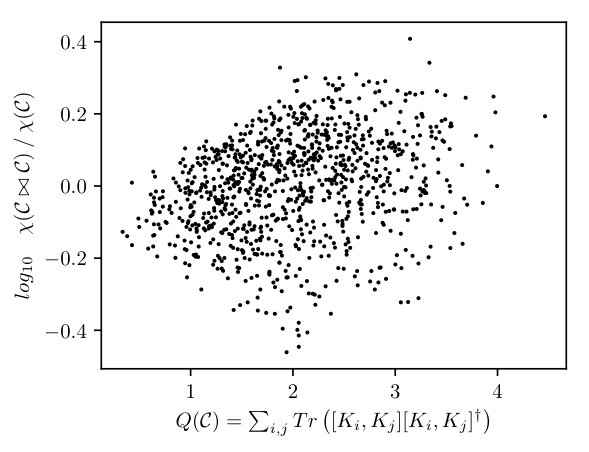 Figure 1
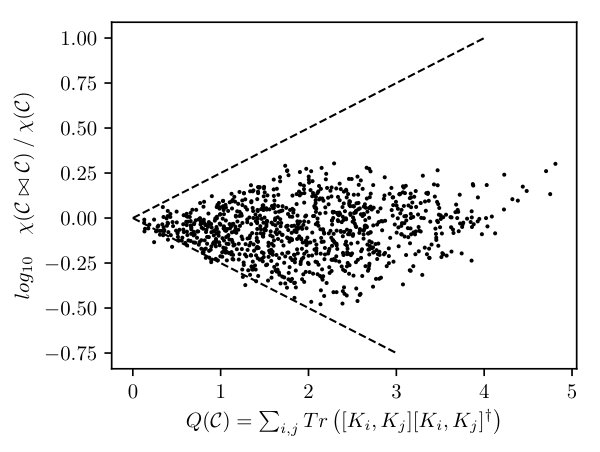 Figure 2
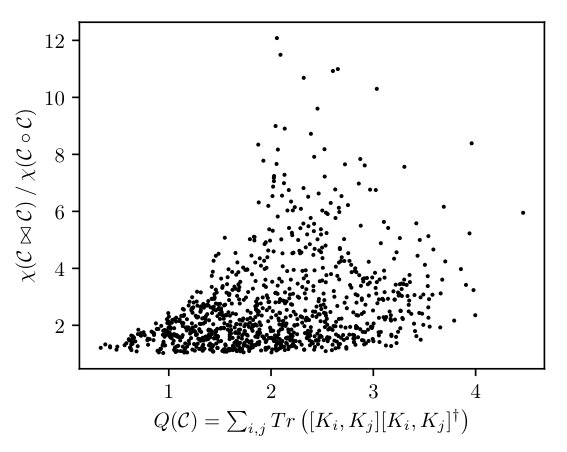 Figure 3
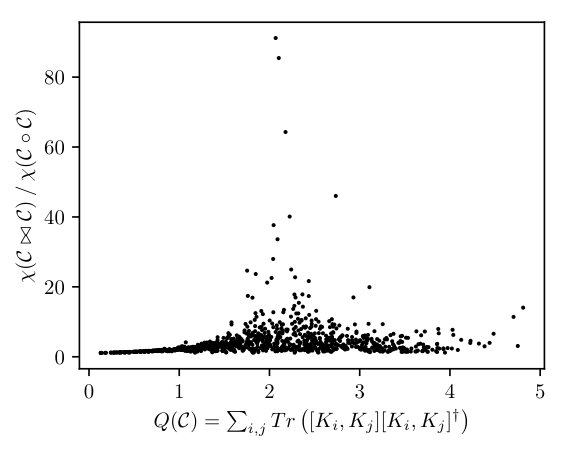 Figure 4
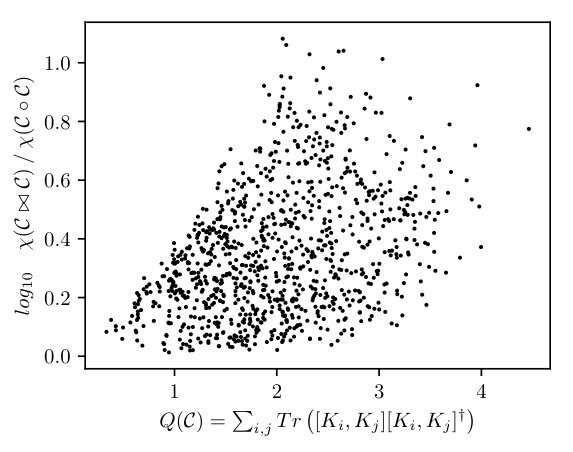 Figure 5
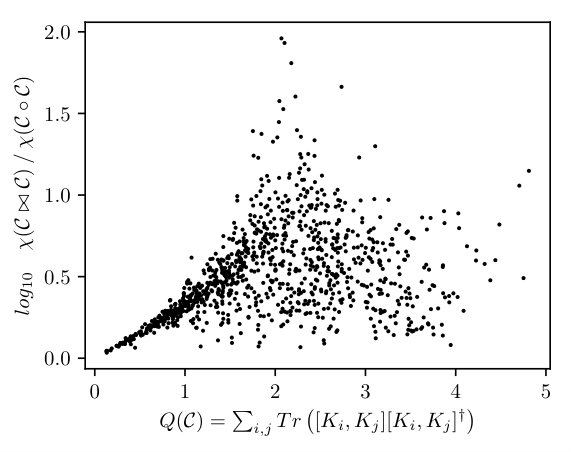 Figure 6
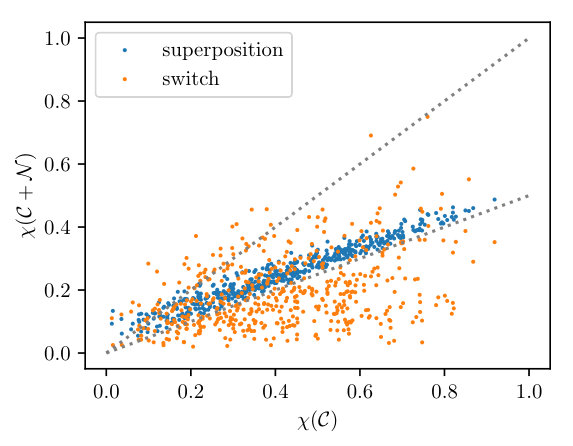 Figure 7
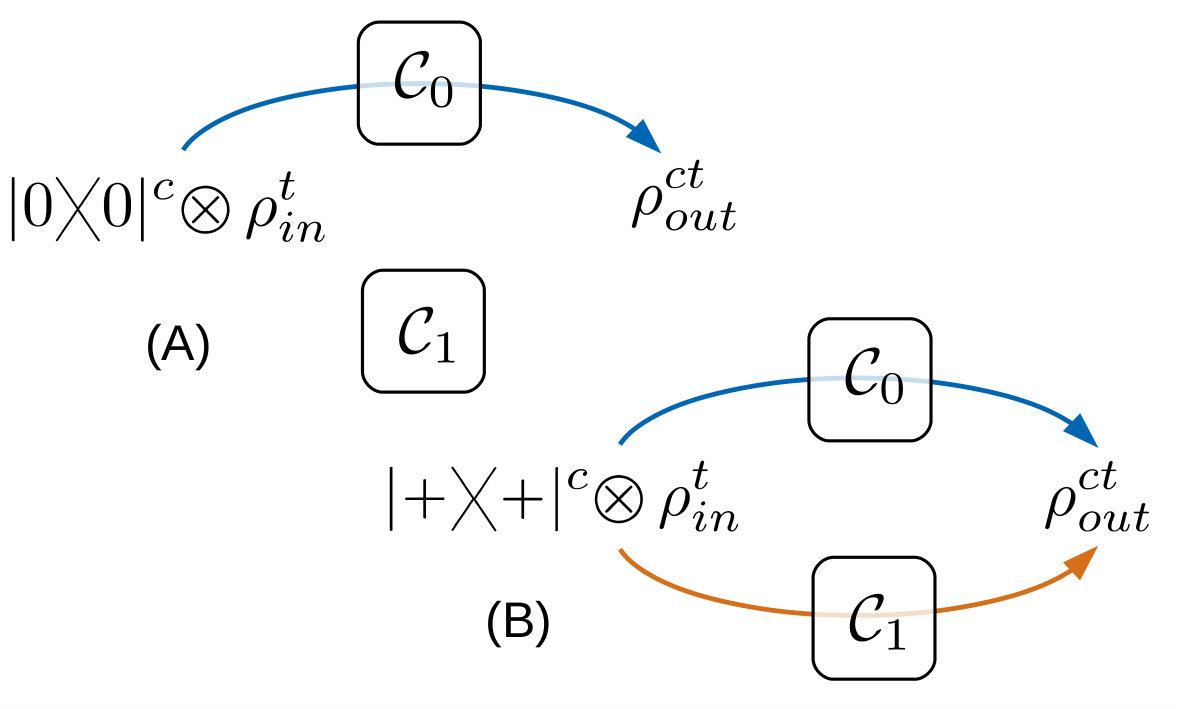 Figure 8
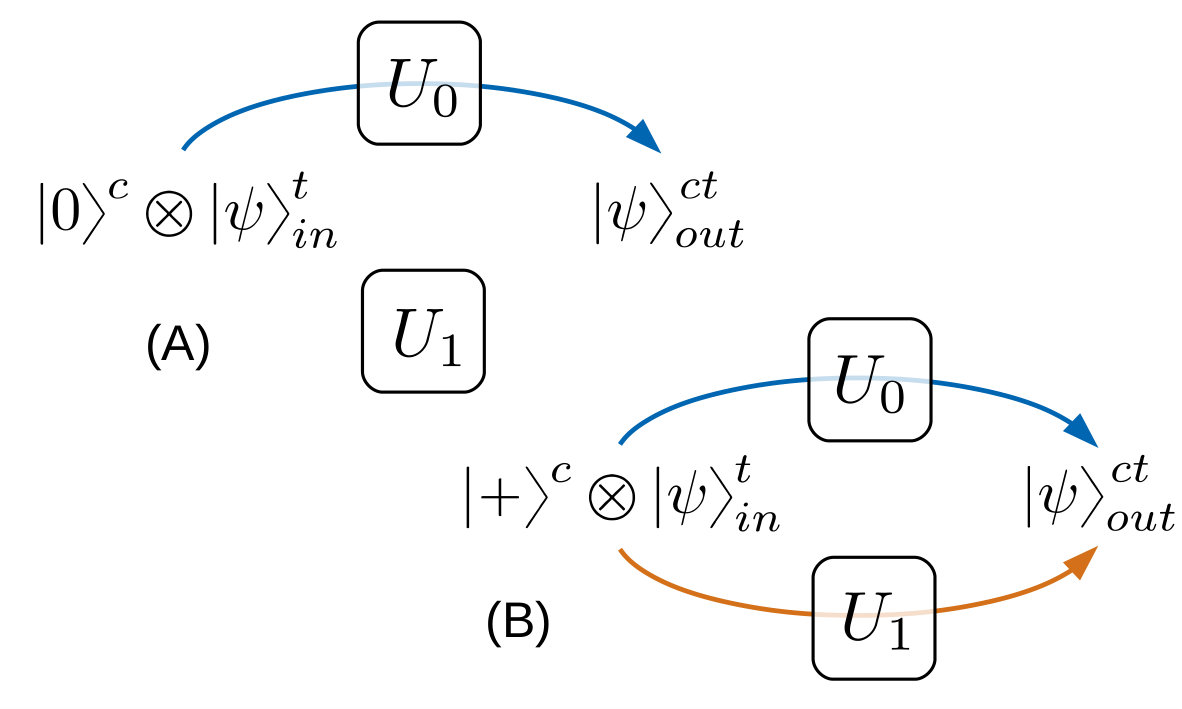 Figure 9
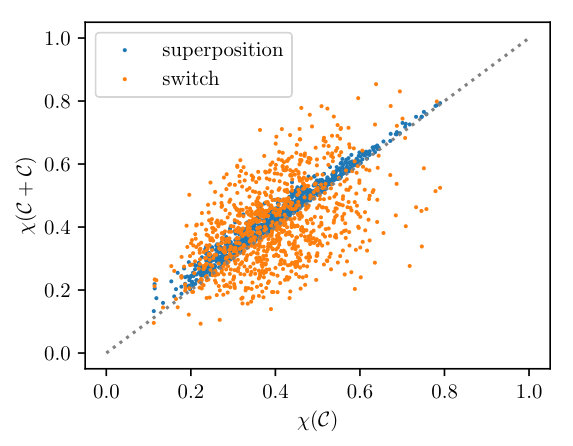 Figure 10
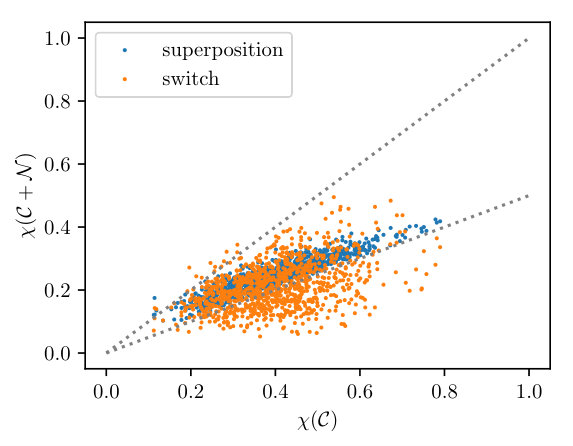 Figure 11
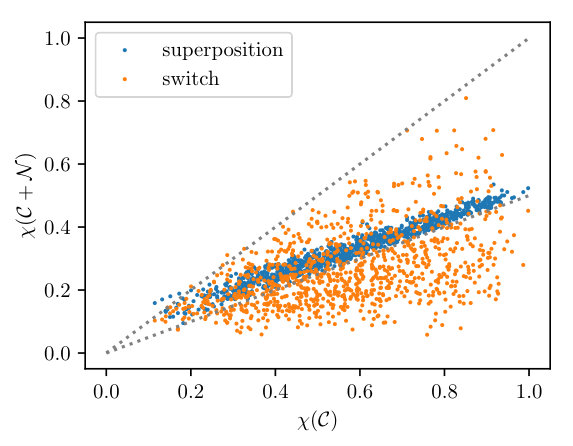 Figure 12
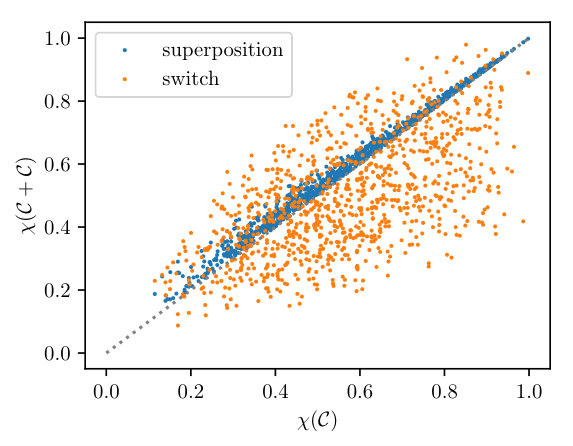 Figure 13
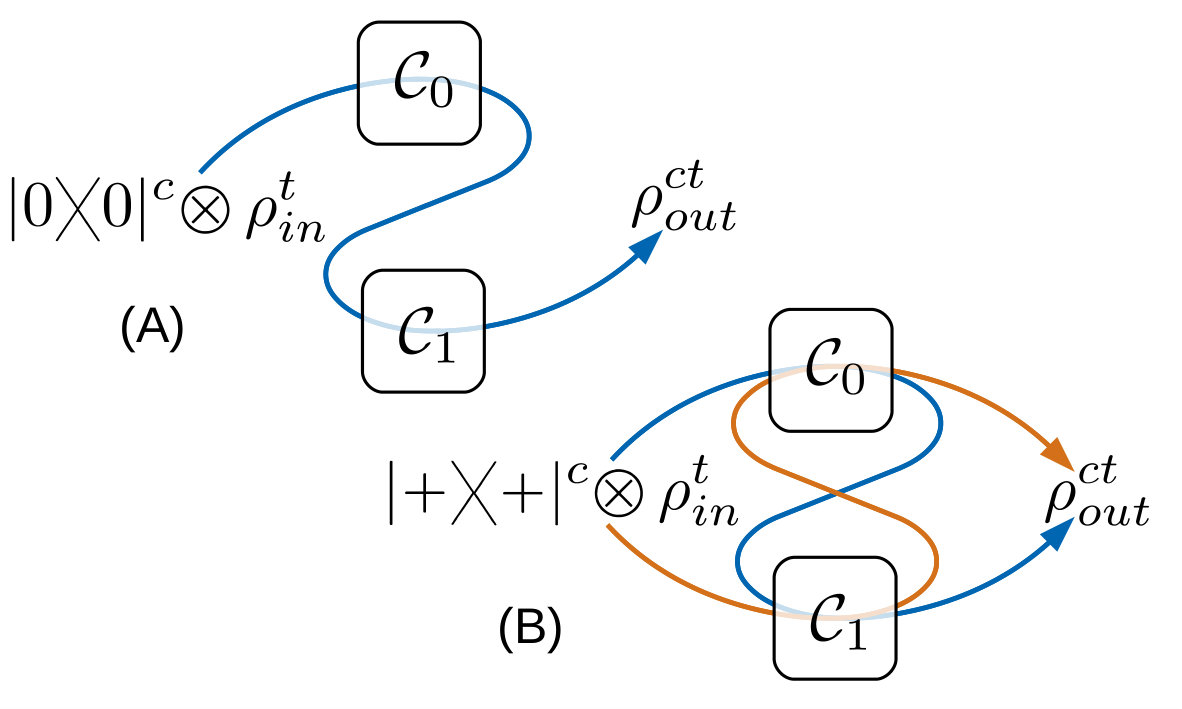 Figure 14
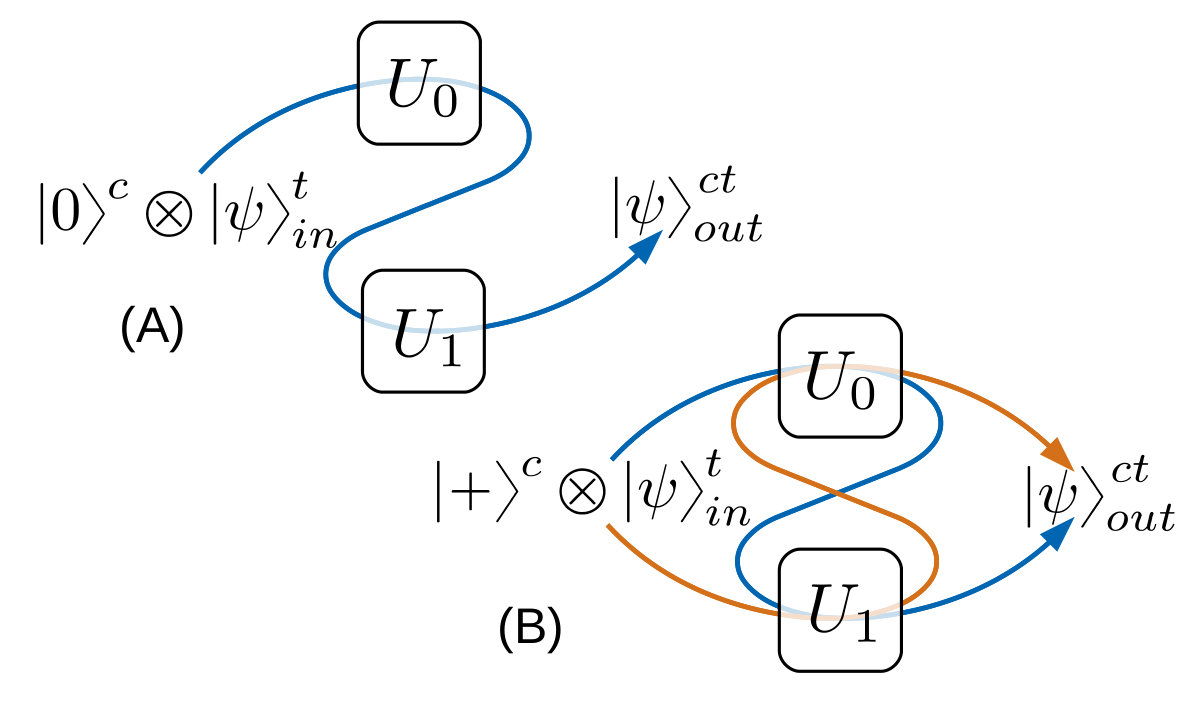 Figure 15
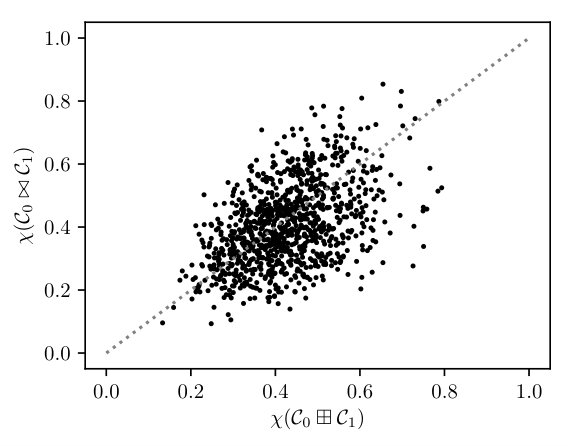 Figure 16
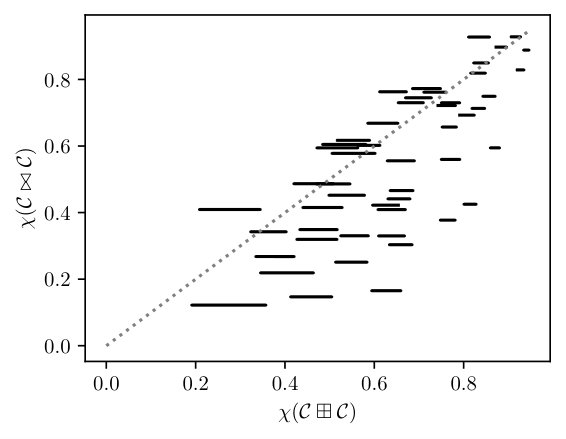 Figure 17
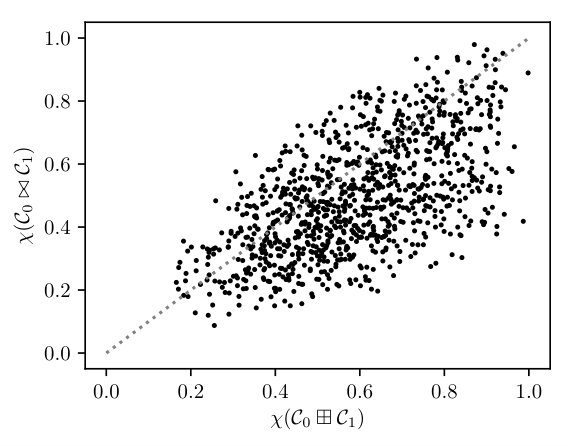 Figure 18
Peer Reviews
No public reviews on file for this paper yet. If you reviewed it on a platform where reviews are public (OpenReview, ICLR, NeurIPS, ICML), you can paste yours below so the community can read it here.
Videos
No videos yet. Explain this paper in a talk, walkthrough, or lecture? Add one.
Channel capacity enhancement with indefinite causal order
Nicolas Loizeau
Department of Physics, New York University, 726 Broadway, New York, NY 10003, USA
Alexei Grinbaum
CEA-Saclay, IRFU/Larsim, 91191 Gif-sur-Yvette Cedex, France
Abstract
Classical communication capacity of a channel can be enhanced either through a device called a ‘quantum switch’ or by putting the channel in a quantum superposition. The gains in the two cases, although different, have their origin in the use of a quantum resource, but is it the same resource? Here this question is explored through simulating large sets of random channels. We find that quantum superposition always provides an advantage, while the quantum switch does not: it can either increase or decrease communication capacity. The origin of this discrepancy can be attributed to a subtle combination of superposition and non-commutativity.
††preprint: APS/123-QED
I Introduction
In spacetime, events and can be in three causal relations: either is before , is before , or and are causally separated, i.e. they lie on a spacelike interval. Quantum mechanics admits causal structures that do not correspond to any of these cases. Heuristically, this can be pictured as putting the order between and in a quantum superposition. More precisely, several approaches to indefinite causal orders have been proposed using ‘process matrix’ or ‘quantum switch’ [1, 2, 3, 4, 5, 6]. While these approaches are not strictly equivalent mathematically, all of them support one underlying idea: an indefinite causal order is an inherently quantum phenomenon that sheds new light on a notion hitherto explored mainly in spacetime theories. This phenomenon has recently been observed experimentally in several implementations of the quantum switch [7, 8, 9, 10, 11, 12].
To gauge precisely the new element brought by quantum theory into the study of causality, quantum control on causal order can be treated as a resource that provides non-classical communication advantage, i.e., two noisy channels in a quantum switch can transmit more information than any of these channels individually [13]. This approach has the benefit of immediately clarifying the physical interest of the quantum switch, however it relies on a currently unresolved question whether any local party can operationally exercise such quantum control [14]. In this work we assume that a positive heuristic has been given by the empirical work: quantum control of the causal order via the quantum switch has been obtained experimentally. In what follows we strive to achieve a better theoretical understanding of the advantage demonstrated in such setups. In particular, a standing problem concerns the origin of this advantage: to deny that the quantum switch is an independent resource, it has been argued that the one-pass quantum superposition of two channels, without the indefinite causal order, already leads to a similar result [15, 16].
After introducing basic mathematical concepts in Section II, we explore the controversial origin of this non-classical advantage in Section III. To this end, we simulate large sets of random channels and use them to compare communication gains from the quantum switch and the one-pass superposition. In Section V, we argue that the advantage for the quantum switch has its origin in two separate factors. One is quantum superposition; the other is non-commutativity of the Kraus decompositions of the channels. A combination of these factors can be significantly more beneficial than the advantage gained from the superposition alone, but in other cases it can also be much less advantageous. When the indefinite causal order is realized through a quantum switch, the gain provided by this resource is essentially due to this combination.
II Mathematical framework
A quantum system going through a quantum channel is modelled by a completely positive trace preserving linear map on its state Hilbert space . Any such map can be represented by a set of Kraus operators such as [17, 18, 19]:
[TABLE]
This decomposition is not unique: if and have Kraus operators and respectively, then implements the same channel as if and only if there exists a unitary operator such as:
[TABLE]
A quantum switch between channels and is a new channel that puts in a superposition two differently ordered compositions and (Figure 1). It acts on , where stands for control and for target. Unless stated otherwise, both of these Hilbert spaces are taken to be two-dimensional. The switch is a higher-order operation defined through its Kraus decomposition
[TABLE]
where and are the Kraus operators of and respectively. To get a heuristic picture, one may think about the target as a subsystem that passes through the channels, while the control subsystem in a generic state determines the order of passage. This is easy to comprehend in the case of unitary with the subsystems in pure states:
[TABLE]
One can see that, depending on the state of the control qubit, the order in which the target undergoes different operations is switched. If, for example, the state of the control qubit is , then the quantum switch yields a balanced superposition of two orders.
Somewhat paradoxically, classical information can be transmitted though the quantum switch between two totally depolarizing channels. The Holevo capacity of a channel is defined as , where are the possible inputs of the channel with probabilities and is the quantum mutual information calculated on the state [20]. In terms of the von Neumann entropy , if , then
[TABLE]
This maximum can be reached on no more than pure states [21], where is the dimension of the target subsystem.
The Holevo capacity of the quantum switch between two totally depolarizing channels acting on a qubit equals [13]. However, a similar advantage occurs if the channels are put in a superposition (Figure 2). The one-pass superposition of and is defined through its Kraus operators
[TABLE]
As before, in the case of unitary and the definition can be simplified:
[TABLE]
Starting from a well-known result in quantum communication [22], it has recently been shown that has a greater Holevo capacity than if and are totally depolarizing. A lower bound is [15].
III Results
The indefinite causal order provides an indisputable advantage in terms of Holevo capacity but this advantage is not systematic. To explore this situation, we randomly generate pairs of quantum channels and and numerically compute Holevo capacities of and for a control qubit in the reduced state . Figure 3, generated on two sets of 1000 channels each, shows the absence of any obvious correlation between and . After three such runs, the average ratio is stable around , meaning that on average the one-pass superposition gives a slightly better advantage than the quantum switch. However, individual channels can exhibit vastly different behaviour.
To study the combination of a channel with itself, we set . Figure 4 shows that varies significantly as one applies (2) to change the Kraus decomposition of a channel, while remains fixed. Figure 5 provides a comparison between the Holevo capacities of self-switch and self-superposition. The latter always increases channel capacity: as we prove below, while this is not true for the former. If the number of subsystems is increased, e.g. in the case of the 3-switch [12], the picture remains very similar to the one shown here. To make sure that this effect is not only due to self-switching, we explore the Holevo capacity of a composition between a random channel and a totally depolarizing channel with Kraus operators (Fig. 6). All generated channels verify , whereas this inequality does not hold for the quantum switch.
IV Methods
A random channel is obtained by generating a random set of Kraus operators. To get the latter, we generate a random Choi matrix. Let be a Ginibre complex random matrix and . Then the following matrix is random Choi [23]:
[TABLE]
Holevo capacity is computed by solving the optimization problem (5) using the basin-hopping method [24]. States are parameterized as , , . Each step of the basin-hopping method consists of: a) random perturbation of the parameters, b) local minimization using the BFGS method, c) acceptance or rejection of the new parameters based on the minimized function value and the metropolis test [25, 26].
The basin-hopping method converges fast and is relatively easy to implement using common programming libraries. Since this method is heuristic by nature, we have compared its results with the tight bounds on Holevo capacity computed via a different procedure [27]. Both methods are in good agreement on all examples given in [27]. To estimate the divergence, we have run the basin-hopping computation 20 times for each channel with different initial parameters and selected the highest estimated capacity. Standard deviation after 20 runs on a set of 1000 random channels is and .
To check our results in the case of unitary channels only, we have also generated random unitary channels directly by a random set of unitary matrices and a random set of real coefficients constrained by . Then, Kraus operators . Any such set of operators that verify defines a quantum channel. Using the Nelder-Mead method [28] with three free parameters, we have computed Holevo capacities and found that they are in full agreement with the results of the basin-hopping calculation.
V Discussion
To study the discrepancy between the capacities of the superposition and the quantum switch, note that the one-pass superposition acts as:
[TABLE]
where are the Kraus operators of and the fixed control subsystem is omitted for brevity. To prove , define a channel acting on with Kraus operators . Since , is trace-preserving. It acts as:
[TABLE]
If the spectrum of is , then the spectrum of is , each eigenvalue having multiplicity two. Hence:
[TABLE]
It now follows from (5) that:
[TABLE]
i.e. . By the data processing inequality, a channel can only lose information between the input and the output: .∎
The quantum switch acts as:
[TABLE]
Unlike with quantum superposition, no simple relationship between Holevo capacities is available in this case. When the quantum switch lowers communication capacity of , this phenomenon has a likely origin in the loss of information in diagonal terms . On the contrary, the advantage of the quantum switch over the superposition, when it occurs, comes from non-diagonal terms. Heuristically, the non-diagonal terms in (17) are more versatile than the non-diagonal terms in (11), explaining the behaviour of the switch in Figure 5.
Note that the self-switch is not the same channel as the superposition . If has Kraus operators , then the Kraus operators of are . Inserting this in (11), one obtains:
[TABLE]
This expression is different from (17) if do not commute. The latter factor happens to have an even deeper significance: our study of the non-diagonal terms provides evidence for the hypothesis, inspired by [13], that a greater advantage occurs when the Kraus operators do not commute. To observe this effect, define:
[TABLE]
is independent of the Kraus decomposition of . Indeed, note that two Kraus decompositions and describing the same channel are related by (2):
[TABLE]
Hence .∎
Figures 7 and 8, generated on a set of random channels, show that the spread of increases with . If almost commute and is small, then the effect of the indefinite causal order is also small: the Holevo capacity of the quantum switch is close to the Holevo capacity of the superposition. On the contrary, when is high, the effect of the indefinite causal order is strong: the Holevo capacity of the quantum switch is dominated by this non-commutativity and the non-diagonal terms of (17) are larger than the diagonal ones. Our simulation shows that the same conclusion is also valid for the 3-switch [12].
VI Conclusion
Both the coherent control of quantum channels and the indefinite causal order between them were shown to be resources for communicating through noisy channels. While the notion of controlling quantum channels via a quantum subsystem is a useful heuristic, its rigorous mathematical formulation shows that the action of observers involved in such control and measurement operations is hardly ever local in time and space [14, 16]. Nonetheless, as mentioned above, experimental setups have been realized for two or three subsystems combined via the quantum switch. These empirically available setups call for a better theoretical characterization of their workings.
On the one hand, it has been argued that the communication advantage found with the quantum switch “is also present” in the scenario involving one-pass superposition [15]. On the other, this advantage was hailed as a “striking …new paradigm of Shannon theory” [13]. Our analysis via numeric simulations shows that the two resources provide the same communication gain only in very rare cases. In a more general setting, simulated by choosing either generic or unitary channels at random, the conceptual origin and the quantitative measure of the advantage differ. This is because the quantum switch exhibits an intricate interplay between two non-classical factors, both of which are capable of providing a communication advantage: quantum superposition and non-commutativity. What is more, the quantum switch, but not the one-pass superposition, can also induce a loss in communication capacity because it involves a composition of channels. When the switch is treated as a resource, it remains a genuine combination of different contributing properties and should not be reduced to any one of them. These results motivate further theoretical research on an important problem of quantum communication: achieving precise understanding of the interrelations between non-classical resources that provide an advantage in communication via noisy channels.
The reference list from the paper itself. Each links out to its DOI / PubMed record.
- 1Oreshkov et al. [2012] O. Oreshkov, F. Costa, and Č. Brukner, Quantum correlations with no causal order, Nature Communications 3 , 1092 (2012).
- 2Chiribella et al. [2013] G. Chiribella, G. M. D Ariano, P. Perinotti, and B. Valiron, Quantum computations without definite causal structure, Physical Review A 88 , 022318 (2013).
- 3Hardy [2007] L. Hardy, Towards quantum gravity: a framework for probabilistic theories with non-fixed causal structure, Journal of Physics A: Mathematical and Theoretical 40 , 3081 (2007).
- 4Araújo et al. [2015] M. Araújo, C. Branciard, F. Costa, A. Feix, C. Giarmatzi, and Č. Brukner, Witnessing causal nonseparability, New Journal of Physics 17 , 102001 (2015).
- 5Chiribella and Kristjánsson [2019] G. Chiribella and H. Kristjánsson, Quantum Shannon theory with superpositions of trajectories, Proceedings of the Royal Society A: Mathematical, Physical and Engineering Sciences 475 , 20180903 (2019).
- 6Ibnouhsein and Grinbaum [2015] I. Ibnouhsein and A. Grinbaum, Information-theoretic constraints on correlations with indefinite causal order, Phys. Rev. A 92 , 042124 (2015).
- 7Procopio et al. [2015] L. M. Procopio, A. Moqanaki, M. Araújo, F. M. Costa, I. A. Calafell, E. G. Dowd, D. R. Hamel, L. A. Rozema, C. Brukner, and P. Walther, Experimental superposition of orders of quantum gates, Nature Communications 6 , 7913 (2015).
- 8Rubino et al. [2017] G. Rubino, L. A. Rozema, A. Feix, M. Araújo, J. M. Zeuner, L. M. Procopio, Č. Brukner, and P. Walther, Experimental verification of an indefinite causal order, 3 , e 1602589 (2017), ar Xiv:1608.01683 .