Phenomenological predictions for pentaquark masses from fits to baryon masses
Pontus Holma, Tommy Ohlsson

TL;DR
This paper extends a phenomenological mass formula to predict pentaquark masses, fitting known baryon data and successfully estimating masses close to experimental values for observed pentaquarks.
Contribution
The work introduces an extended mass model incorporating charm and bottom quarks to predict pentaquark masses, validated by fitting baryon data.
Findings
Model fits well to baryon masses
Predicted pentaquark masses align with experimental data
Future predictions may guide experimental searches
Abstract
We investigate the mass spectra of exotic hadrons known as pentaquarks. We extend a simple phenomenological model based on the G\"ursey-Radicati mass formula for hadrons to include both charmed and bottom baryons as well as to be able to predict masses of pentaquark states including both charm and bottom quark-antiquark pairs. In particular, we perform numerical fits of this model, which includes seven free parameters, to masses of 21 baryons. We find that the model can be well fitted to the experimental values of the baryon masses and observe that the predicted value of about 4400 MeV for the mass of the pentaquark lies within the experimental range reported by the LHCb experiment. In addition, the predicted value of about 4500 MeV for the mass of the pentaquark is close to the experimental value. Finally, in the future, other predicted values for masses of…
Click any figure to enlarge with its caption.
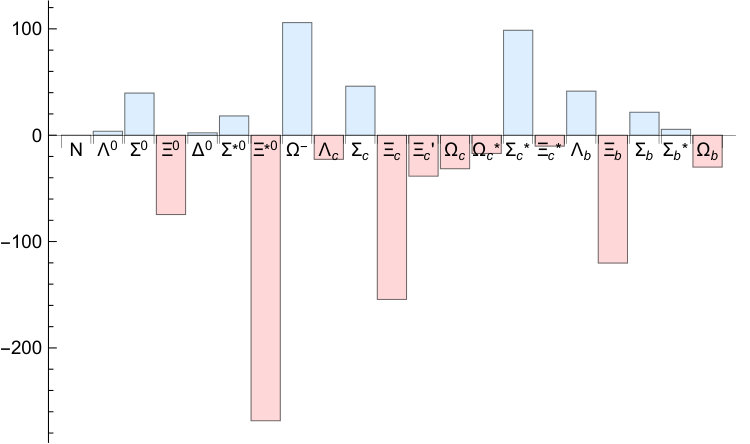 Figure 1
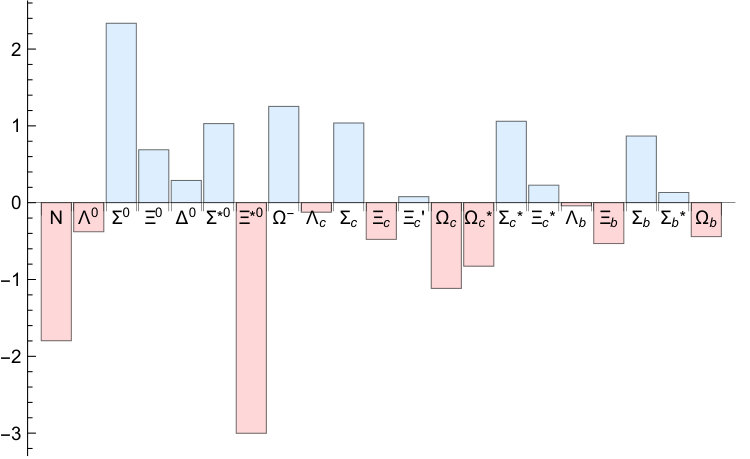 Figure 2
| Baryon | Exp. mass [MeV] | Exp. error [MeV] | multiplet | ||||||
|---|---|---|---|---|---|---|---|---|---|
| 939.5654133 | 3 | 1 | 0 | 0 | |||||
| 1115.683 | 3 | 0 | 0 | 0 | 0 | ||||
| 1192.642 | 3 | 0 | 1 | 0 | 0 | ||||
| 1314.86 | 3 | 0 | 0 | ||||||
| 1232 | 6 | 1 | 0 | 0 | |||||
| 1383.7 | 6 | 0 | 1 | 0 | 0 | ||||
| 1531.80 | 6 | 0 | 0 | ||||||
| 1672.45 | 6 | 0 | 0 | 0 | |||||
| 2286.46 | 0 | 1 | 0 | ||||||
| 2453.75 | 1 | 1 | 0 | ||||||
| 2470.87 | 1 | 0 | |||||||
| 2578.8 | 1 | 0 | |||||||
| 2695.2 | 0 | 1 | 0 | ||||||
| 2765.9 | 0 | 1 | 0 | ||||||
| 2518.48 | 1 | 1 | 0 | ||||||
| 2646.32 | 1 | 0 | |||||||
| 5619.60 | 0 | 0 | 1 | ||||||
| 5791.9 | 0 | 1 | |||||||
| 5811.3 | 0 | 1 | |||||||
| 5832.1 | 1 | 0 | 1 | ||||||
| 6046.1 | 0 | 0 | 1 |
| Parameter | Fit I | Fit II | Fit III | Fit IV | Fit V | Fit VI | Fit VII |
| [MeV] | 980.3 | 971.2 | 965.3 | 1003 | 953.7 | 980.3 | 962.9 |
| [MeV] | 17.08 | 19.50 | 21.78 | 18.29 | 15.82 | 17.15 | 21.17 |
| [MeV] | |||||||
| [MeV] | 38.07 | 38.04 | 37.99 | 21.35 | 38.02 | 22.44 | |
| [MeV] | 40.85 | 43.32 | 46.14 | 33.11 | 52.07 | 40.82 | 47.06 |
| [MeV] | 1376 | 1368 | 1366 | 1376 | 1367 | ||
| [MeV] | 4829 | 4830 | 4842 | 4823 | |||
| 129800 | 111100 | 25.44 | 99250 | 21.53 | 147400 | 26.71 | |
| 12980 | 12350 | 2.544 | 14180 | 3.076 | 10530 | 1.908 |
| Pentaquark states | Fit I | Fit II | Fit III | Fit IV | Fit V | Fit VI | Fit VII |
|---|---|---|---|---|---|---|---|
| , () | 4397 | 4397 | 4396 | 4397 | 4395 | ||
| , () | 4482 | 4495 | 4505 | 4483 | 4501 | ||
| 4573 | 4558 | 4560 | 4573 | 4559 | |||
| , , | 4649 | 4634 | 4605 | 4649 | 4604 | ||
| , | 4787 | 4756 | 4747 | 4787 | 4745 | ||
| , () | 11320 | 11300 | 11330 | 11310 | |||
| , () | 11410 | 11380 | 11410 | 11410 | |||
| 11500 | 11470 | 11500 | 11470 | ||||
| , , | 11570 | 11510 | 11580 | 11520 | |||
| , | 11710 | 11650 | 11720 | 11660 |
Peer Reviews
No public reviews on file for this paper yet. If you reviewed it on a platform where reviews are public (OpenReview, ICLR, NeurIPS, ICML), you can paste yours below so the community can read it here.
Videos
No videos yet. Explain this paper in a talk, walkthrough, or lecture? Add one.
Phenomenological predictions for pentaquark masses from fits to baryon masses
Pontus Holma
Department of Physics, School of Engineering Sciences, KTH Royal Institute of Technology, AlbaNova University Center, Roslagstullsbacken 21, SE–106 91 Stockholm, Sweden
The Oskar Klein Centre for Cosmoparticle Physics, AlbaNova University Center, Roslagstullsbacken 21, SE–106 91 Stockholm, Sweden
Tommy Ohlsson
Department of Physics, School of Engineering Sciences, KTH Royal Institute of Technology, AlbaNova University Center, Roslagstullsbacken 21, SE–106 91 Stockholm, Sweden
The Oskar Klein Centre for Cosmoparticle Physics, AlbaNova University Center, Roslagstullsbacken 21, SE–106 91 Stockholm, Sweden
University of Iceland, Science Institute, Dunhaga 3, IS–107 Reykjavik, Iceland
Abstract
We investigate the mass spectra of exotic hadrons known as pentaquarks. We extend a simple phenomenological model based on the Gürsey–Radicati mass formula for hadrons to include both charmed and bottom baryons as well as to be able to predict masses of pentaquark states including both charm and bottom quark-antiquark pairs. In particular, we perform numerical fits of this model, which includes seven free parameters, to masses of 21 baryons. We find that the model can be well fitted to the experimental values of the baryon masses and observe that the predicted value of about 4400 MeV for the mass of the pentaquark lies within the experimental range reported by the LHCb experiment. In addition, the predicted value of about 4500 MeV for the mass of the pentaquark is close to the experimental value. Finally, in the future, other predicted values for masses of additional pentaquarks could be shown to agree with upcoming experimental results.
I Introduction
The idea of hadrons, which contain more than the minimal quark content ( or ), was proposed by Gell-Mann Gell-Mann (1964) in 1964. This includes the possibility of hadrons containing five quarks, which were given the name pentaquark by Gignoux et al. Gignoux et al. (1987) and Lipkin Lipkin (1987) in 1987. It was not until 2015 when the two first pentaquark states were conclusively observed by the LHCb collaboration in studying decays. These two states are denoted and . Both of the discovered states have quark content Aaij et al. (2015). Furthermore, in 2019, additional pentaquark states were discovered Aaij et al. (2019). The , formerly reported by LHCb, received further confirmation and is observed to consist of two narrow overlapping peaks, named and .
Several quantitative models for masses of pentaquarks have been studied in the literature: a selection of these are briefly summarized below. In 2017, a group theoretical classification and prediction for masses of pentaquarks based on the results from LHCb can be found in Ref. Santopinto and Giachino (2017), where the masses are predicted from a modified mass formula fitted to masses of baryons. In Refs. Bijker et al. (2004a, b), masses and magnetic moments of pentaquarks were obtained in a constituent quark model with a complete classification of pentaquark states. In Ref. Karliner and Lipkin (2003), Karliner and Lipkin proposed a model for pentaquark states to predict their masses, which is based on a model known to reliably deal with both and interactions. In Ref. Hosaka (2006), the mass spectrum of pentaquarks based on the quark model and with emphasis on chiral symmetry was presented. In Ref. Monemzadeh et al. (2016), the authors reduced the complications of studying five-quark systems by considering the pentaquark as being a bound state composed of a baryon and a meson, thereafter solving the Lippmann–Schwinger equation for this system to obtain approximate masses for some pentaquark states. In Ref. Ali et al. (2017), the mass spectrum of pentaquarks having for multiplets was explored, whose analysis is based on the two pentaquark states observed in 2015 by LHCb. In Ref. Li et al. (2019), the authors primarily examined pentaquarks of quark content, which are not presently known to exist, and estimated the masses of the said pentaquarks using the chromomagnetic model. Recently, in Ref. Ortiz-Pacheco et al. (2019), the masses of ground-state hidden-charm pentaquarks with based on an SU(4) quark model were calculated, which are considerably smaller than the masses of pentaquarks measured by LHCb Aaij et al. (2015, 2019).
In the present work, we will primarily consider the simple mass formula for hadrons presented in Ref. Santopinto and Giachino (2017), which predicts the masses of pentaquarks using numerical fits to masses of baryons. We will also make modifications to this formula in order to predict masses of pentaquarks not examined in Ref. Santopinto and Giachino (2017). More specifically, we will consider pentaquarks containing or .
We will study spin-flavor pentaquark configurations, which can be decomposed as . The multiplets are relevant when determining the masses of the pentaquark states. These multiplets will also be part of the baryon data used to perform the numerical fits. We will make use of the Young tableaux technique and let each representation be denoted by , where stands for the number of boxes in the th row of the Young tableau and is the dimension of the representation. This will follow the classification outlined in Ref. Santopinto and Giachino (2017), where the main study of the spin-flavor pentaquark configurations was originally performed.
It should be noted that we will focus on the possibility of pentaquarks having . We do not attempt to describe the binding mechanism for pentaquarks, but in Ref. Aaij et al. (2019), it is clear that seems to be the most reasonable option if a pentaquark is indeed a bound system consisting of a baryon and a meson, i.e. a molecular description. However, as reported in Ref. Cho (2019), the molecular description of pentaquarks is currently the most favored one.
This work is organized as follows. In Sec. II, we present the simple mass model for hadrons that can predict masses of pentaquarks and describe the numerical fitting procedure used. Then, in Sec. III, we perform seven numerical fits of this model and state the results of these fits, including predicted masses of pentaquarks. Finally, in Sec. IV, we summarize our main results and conclude based on our presented results.
II Model and fitting procedure
In this work, we investigate a simple model for hadron mass spectra based on a generalization of the Gürsey–Radicati mass formula Gürsey and Radicati (1964) performed in Ref. Santopinto and Giachino (2017) for the charm sector, which reads
[TABLE]
where , , , , , and are the spin, hypercharge, isospin, eigenvalue of the Casimir operator, number of charm quarks and antiquarks, and number of bottom quarks and antiquarks of the hadron , respectively. In addition, , , , , , , and are free parameters of the model and the parameter is a scale factor related to the number of particles making up the hadron . It should be noted that Eq. (1) holds for baryons, but not mesons which follow another but similar mass formula Gürsey and Radicati (1964). However, we assume Eq. (1) to hold also for pentaquarks (including charm and bottom quarks) and change accordingly. Thus, the model has either six (including charmed baryons and pentaquarks) or seven free parameters (including both charmed and bottom baryons and pentaquarks). For baryons, , whereas for pentaquarks, , since the number of quarks in a pentaquark is five instead of three as in a baryon. The original Gürsey–Radicati mass formula Gürsey and Radicati (1964) stems from a group theoretical approach and is based on a broken symmetry. The generalization in Eq. (1) is a natural extension of the original formula. The strongly broken symmetry of is modeled and handled by the different free parameters in Eq. (1), especially by and . In addition, it should be noted that another generalization of the Gürsey–Radicati mass formula for the strange sector can be found in Ref. Giannini et al. (2005).
Now, we present our fitting procedure. In order to find the best-fit values of the free parameters, we use a test, which gives rise to the goodness of fit, by minimizing the corresponding function with respect to the free parameters in Eq. (1). More precisely, for the model with seven free parameters, we minimize the following function
[TABLE]
where is the number of hadrons used, denotes the predicted mass of the hadron by the generalized Gürsey–Radicati mass formula (1), and and are the experimental value for the mass of the hadron and its corresponding experimental error, respectively. For the model with six free parameters, we have to remove the dependence on one of the free parameters and , which can be done by enforcing either or in the minimization of Eq. (2). Note that Eq. (1) is linear in all free parameters, and therefore, the minimum of Eq. (2) can be found exactly.
To date, there are only three (or four) experimentally known pentaquarks containing Cho (2019), and therefore, there is not enough information to determine the free parameters , , , , , , and , using the experimental data of these pentaquarks. Thus, due to the lack of experimental results on pentaquarks, we fit the free parameters to the values of the known baryon mass spectra and assume that the values of the free parameters will be the same for pentaquarks, i.e. the parameters are universal. This is an extended (and more rigorous) procedure to the similar approach presented in Ref. Santopinto and Giachino (2017), which did however not include bottom hadrons. In Tab. 1, the values of the masses and errors (i.e. the baryon spectra) that we use in our fits are listed. Since the function in Eq. (2) weighs the different terms based on their experimental errors, we expect the best-fit values of the free parameters to give an accurate value for the mass of (i.e. the neutron), which is the baryon that has the lowest experimental error by far (cf. Tab. 1).
III Numerical fits and results
First, we calculate the free parameters using the same data for the baryon masses as in Ref. Santopinto and Giachino (2017) and compare our results to those presented in that work. Since it is not mentioned in this work the exact method used to obtain the values of these parameters, it is challenging to determine how those values were obtained. Using the values of the free parameters as well as the baryon masses and the corresponding errors presented in Ref. Santopinto and Giachino (2017), we obtain , which is a very large value for a function. However, if we minimize Eq. (2) with respect to , , , , , and under the condition and use the data in Ref. Santopinto and Giachino (2017), we find that , , , , , and with , which is about ten orders of magnitude smaller than the value presented in Ref. Santopinto and Giachino (2017). Therefore, we believe that the values of the six free parameters in Ref. Santopinto and Giachino (2017) cannot constitute the true minimum of the function. In addition, our fit leads to the mass of to be 939.6 MeV, whereas the fit in Ref. Santopinto and Giachino (2017) gives 972.45 MeV, which explains why the function is so large for that fit.
Next, we define seven different fits that we perform in this work, which are the following
- Fit I:
Data for the 16 baryons in Tab. 1 with or and 6 free parameters (),
- Fit II:
Data for 15 baryons in Tab. 1 with or [excluding ] and 6 free parameters (),
- Fit III:
Data for the 16 baryons in Tab. 1 with or , but with errors equal to 1 % of the experimental mass values, and 6 free parameters (),
- Fit IV:
Data for the 13 baryons in Tab. 1 with or and 6 free parameters (),
- Fit V:
Data for the 13 baryons in Tab. I with or , but with errors equal to 1 % of the experimental mass values, and 6 free parameters ().
- Fit VI:
Data for all 21 baryons in Tab. 1 and 7 free parameters ().
- Fit VII:
Data for all 21 baryons in Tab. I, but with errors equal to 1 % of the experimental mass values, and 7 free parameters ().
In Tab. 2, we display the results of the minimization of the function in Eq. (2) for the seven different fits. Basically, the results of Fit I consist of corrected and updated results compared to the earlier results presented in Ref. Santopinto and Giachino (2017). We note that Fit I leads to very similar values of the free parameters as in the case of using the data for the baryon spectra given in Ref. Santopinto and Giachino (2017), and still is a very large number. Despite the fact that the term for dominates the function in Eq. (2), the removal of from the fit does not change the goodness of fit for Fit II by much compared to Fit I, since the value of the function per degrees of freedom only shrinks to . In addition, the predicted value for the mass of becomes 955.6 MeV, which is not very close to the well-measured experimental value. Then, the results of Fit III show that by increasing the errors from the experimental ones to values being 1 % of the corresponding experimental masses the value of the function per degrees of freedom decreases significantly to , which actually constitutes a very good fit. However, the fitted value for the mass of is 956.1 MeV, which is again far away from the experimental value. Next, instead of using mass spectra for charmed baryons, we use mass spectra for bottom baryons. The results of Fit IV (compared to Fit I) show that the fitted values of the free parameters are only somewhat different, and the value of the function per degrees of freedom increases slightly to . Again, we use mass spectra for bottom baryons, but now as for Fit III with errors of 1 % of the experimental baryon masses. The results of Fit V lead to , which is much smaller than for Fit IV (cf. the situation for Fits I and III). Thus, we conclude that using errors of 1 % of the experimental baryon masses in fits to both types of mass spectra (i.e. mass spectra for charmed or bottom baryons) lead to values of the function per degrees of freedom that are considerably smaller than using the experimental errors of the baryon masses. Our conclusion confirms the predicted uncertainty of the generalized Gürsey–Radicati mass formula already found in Ref. Santopinto and Giachino (2017) for charmed baryons. Following the procedure of Fits I and IV, we also perform a fit using mass spectra for both charmed and bottom baryons. The results of Fit VI give , which is at least smaller than for Fits I, II, and IV. Finally, the results of Fit VII based on a fit of seven free parameters to masses of 21 baryons (including both charmed and bottom baryons) render the best fit with a value of the function per degrees of freedom given by . For Fit VII, using three significant digits, the best-fit values of the seven free parameters are , , , , , , and . In fact, the best-fit values of the six parameters , , , , , and are rather similar to the ones of Fit III, so the effect of including bottom baryons in the fit seems to be mostly encoded in the free parameter . For Fits III, V, and VII (all using errors of 1 % of the experimental baryon masses), we find low values of , obviously the lowest being about for Fit VII.
In Figs. 1 and 2, we display the pulls for the 21 fitted baryon masses using the values of the free parameters from Fits VI and VII, respectively. First, in Fig. 1, we observe that the pull for is negligible. Furthermore, the two baryons and have also small pulls, whereas the largest pull comes from . In general, it is interesting to note that all and baryons have negative pulls, while all baryons and have positive pulls. Second, in Fig. 2, we observe that the three largest pulls originate from , , and . Due to the choice of the errors being 1 % of the experimental baryon masses for this fit, the pull for is naturally non-negligible. Comparing the pulls from the two fits, it is striking to note that the largest pull in both fits comes from . It should be noted that the pulls are generally about 100 times smaller for Fit VII (see Fig. 2) than for Fit VI (see Fig. 1). Finally, despite the approach based on a simple mass formula, it is encouraging that our and previous similar results estimate to such a good accuracy the baryon mass spectra (the pulls of Fit VII are at most a couple of per mille of the experimental values for the baryon masses). However, we are aware that this approach is not as sophisticated as more advanced models based on QCD sum rules, various quark models, and effective field theory (see e.g. Refs. Chen et al. (2015); Wang (2016); Yang and Ping (2017); Chen et al. (2016); Ali et al. (2016); Park et al. (2017); Ali et al. (2017); Azizi et al. (2017); Yamaguchi et al. (2017); Ferretti et al. (2019); Yang et al. (2019); Li et al. (2019); Weng et al. (2019)).
Now, we study five different sets of quantum numbers that could be identified as pentaquark states, which are the following
- •
, : , , ,
- •
, : , , ,
- •
: , , ,
- •
, , : , , ,
- •
, : , , ,
where , i.e. is either a charm-anticharm pair or a bottom-antibottom pair. In fact, all above states with belong to the octet, which has (that is also assumed for the states with . It should, of course, be noted that other sets of quantum numbers for potential pentaquark states could also be studied using Eq. (1).
In Tab. 3, we present the predicted mass spectrum of pentaquark states containing charm and bottom quark-antiquark pairs for the seven different fits that we have performed, using Eq. (1) with and the best-fit values of the free parameters for each of the fits given in Tab. 2. Especially, for Fit VII with three significant digits, the predicted mass spectrum is given by , , , , and for pentaquarks with and , , , , and for pentaquarks with . In fact, it should be noted that the predicted mass spectra for pentaquarks with for Fits III (I) and VII (VI) exactly coincide using three significant digits (see Tab. 3). Thus, we conclude that the fits using errors equal to 1 % of the experimental baryon mass values do not give much different results than the other fits for the predicted masses of the pentaquarks, which is one of the central topics in this work. Furthermore, our predicted masses of pentaquarks with (for all seven fits) are all larger than the four ones reported in Tab. VI of Ref. Santopinto and Giachino (2017).
It is encouraging to observe that the predicated value of 4400 MeV for the mass of the pentaquark [ ()] lies within the experimental value of reported by the LHCb experiment Aaij et al. (2015) and listed in the 2018 review of the Particle Data Group Tanabashi et al. (2018). In addition, the predicated value of 4500 MeV for the mass of the pentaquark [ ()] is in the close vicinity of the experimental value of .
It should be mentioned that the latest results of the LHCb experiment now confirm that the previously reported pentaquark is resolved into two narrow pentaquark states, i.e. and Aaij et al. (2019). In addition, another narrow pentaquark is discovered, which might or might not be the pentaquark , since the analysis is not sensitive to such wide pentaquark states as .
Several previous studies have made predictions for pentaquarks containing and . A selection of such studies can be found in Refs. Chen et al. (2015); Azizi et al. (2017); Yamaguchi et al. (2017); Ferretti et al. (2019); Yang et al. (2019). In general, our predicted masses of pentaquarks containing seem to be larger than the previously reported results.
IV Summary and Conclusions
We have investigated a simple phenomenological model based on an extension of the Gürsey–Radicati mass formula to predict masses of pentaquarks containing charm-anticharm or bottom-antibottom pairs from numerical fits to masses of charmed and/or bottom baryons, which are reproduced to a good accuracy. We have found that the predicted values for the masses of the pentaquarks and are about 4400 MeV and 4500 MeV, respectively. It should be noted that the latest LHCb experimental results suggest that is resolved into two pentaquarks and . Furthermore, our predicted value of 4500 MeV for (or and ) assumed that the eigenvalue of the Casimir operator is equal to 3 (as for , which belongs to the octet). However, this assumption might be uncertain.
Our model could also be used to predict masses for other potential pentaquark states, given their quantum numbers, for which no experimental data exist today. In addition, using in our model, we could predict masses for hadrons consisting of four quarks, i.e. so-called tetraquarks.
Acknowledgements.
T.O. acknowledges support by the Swedish Research Council (Vetenskapsrådet) through Contract No. 2017-03934 and the KTH Royal Institute of Technology for a sabbatical period at the University of Iceland.
The reference list from the paper itself. Each links out to its DOI / PubMed record.
- 1Gell-Mann (1964) M. Gell-Mann, Phys. Lett. 8 , 214 (1964) . · doi ↗
- 2Gignoux et al. (1987) C. Gignoux, B. Silvestre-Brac, and J. M. Richard, Phys. Lett. B 193 , 323 (1987) . · doi ↗
- 3Lipkin (1987) H. J. Lipkin, Phys. Lett. B 195 , 484 (1987) . · doi ↗
- 4Aaij et al. (2015) R. Aaij et al. (LH Cb Collaboration), Phys. Rev. Lett. 115 , 072001 (2015) , ar Xiv:1507.03414 [hep-ex] . · doi ↗
- 5Aaij et al. (2019) R. Aaij et al. (LH Cb Collaboration), Phys. Rev. Lett. 122 , 222001 (2019) , ar Xiv:1904.03947 [hep-ex] . · doi ↗
- 6Santopinto and Giachino (2017) E. Santopinto and A. Giachino, Phys. Rev. D 96 , 014014 (2017) , ar Xiv:1604.03769 [hep-ph] . · doi ↗
- 7Bijker et al. (2004 a) R. Bijker, M. M. Giannini, and E. Santopinto, Eur. Phys. J. A 22 , 319 (2004 a) , ar Xiv:hep-ph/0310281 . · doi ↗
- 8Bijker et al. (2004 b) R. Bijker, M. M. Giannini, and E. Santopinto, 27th Symposium on Nuclear Physics Taxco, Guerrero, Mexico, January 5-8, 2003 , Rev. Mex. Fis. 50S 2 , 88 (2004 b), ar Xiv:hep-ph/0312380 .