TL;DR
This paper proposes a new detection method using cyclostationarity properties in a two-channel passive detection system, improving detection performance by exploiting signal cyclostationarity.
Contribution
It introduces an asymptotic GLRT for detecting cyclostationary signals in a two-channel setup, considering various covariance structures, which is a novel approach.
Findings
Proposed detector outperforms existing methods in simulations.
Exploiting cyclostationarity enhances detection accuracy.
The method is effective across different covariance models.
Abstract
This paper addresses a two-channel passive detection problem exploiting cyclostationarity. Given a reference channel (RC) and a surveillance channel (SC), the goal is to detect a target echo present at the surveillance array transmitted by an illuminator of opportunity equipped with multiple antennas. Since common transmission signals are cyclostationary, we exploit this information at the detector. Specifically, we derive an asymptotic generalized likelihood ratio test (GLRT) to detect the presence of a cyclostationary signal at the SC given observations from RC and SC. This detector tests for different covariance structures. Simulation results show good performance of the proposed detector compared to competing techniques that do not exploit cyclostationarity.
Click any figure to enlarge with its caption.
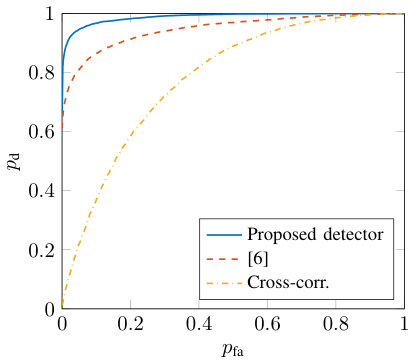 Figure 0
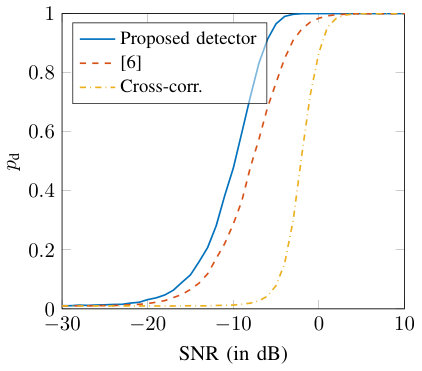 Figure 1
Peer Reviews
No public reviews on file for this paper yet. If you reviewed it on a platform where reviews are public (OpenReview, ICLR, NeurIPS, ICML), you can paste yours below so the community can read it here.
Code & Models
Videos
No videos yet. Explain this paper in a talk, walkthrough, or lecture? Add one.
Two-Channel Passive Detection Exploiting Cyclostationarity
Stefanie Horstmann The work of S. Horstmann and P. J. Schreier was supported by the German Research Foundation (DFG) under grant SCHR 1384/6-1. The work of D. Ramírez was supported by the Ministerio de Ciencia, Innovación y Universidades under grant TEC2017-92552-EXP (aMBITION), by the Ministerio de Ciencia, Innovación y Universidades, jointly with the European Commission (ERDF), under grants TEC2015-69868-C2-1-R (ADVENTURE) and TEC2017-86921-C2-2-R (CAIMAN), by The Comunidad de Madrid under grant Y2018/TCS-4705 (PRACTICO-CM), and by the German Research Foundation (DFG) under grant RA 2662/2-1. Signal and System Theory Group
*University of Paderborn
*Paderborn, Germany
David Ramírez
Department of Signal Theory and Communications
*Universidad Carlos III de Madrid
Gregorio Marañón Health Research Institute
*Leganés, Spain
Peter J. Schreier
Signal and System Theory Group
*University of Paderborn
*Paderborn, Germany
Abstract
This paper addresses a two-channel passive detection problem exploiting cyclostationarity. Given a reference channel (RC) and a surveillance channel (SC), the goal is to detect a target echo present at the surveillance array transmitted by an illuminator of opportunity equipped with multiple antennas. Since common transmission signals are cyclostationary, we exploit this information at the detector. Specifically, we derive an asymptotic generalized likelihood ratio test (GLRT) to detect the presence of a cyclostationary signal at the SC given observations from RC and SC. This detector tests for different covariance structures. Simulation results show good performance of the proposed detector compared to competing techniques that do not exploit cyclostationarity.
Index Terms:
Cyclostationarity, generalized likelihood ratio test (GLRT), multiple-input multiple-output (MIMO) passive detection
I Introduction
We consider a two-channel multiple-input multiple-output (MIMO) passive detection problem motivated by a passive radar application. Specifically, we consider a passive bistatic radar consisting of one receiver and one transmitter each equipped with multiple antennas. However, the transmitter is non-cooperative and also referred to as illuminator of opportunity (IO). That is, the illuminator operates independently of the passive radar system and would typically be a commercial broadcast system such as DVB-T or, for instance, navigation satellites [1]. In order to detect a moving object a two-channel passive radar system consists of a reference channel (RC) and a surveillance channel (SC). The reference array observes a noisy version of the transmitted signal from the IO, whereas the surveillance array there is the reflected signal from the target. If there is no target present, only noise is measured at the SC. Direct-path signals from the IO to the SC are assumed to be canceled by, for instance, directional antennas.
Our goal is to detect whether there is a target echo at the SC, i.e., whether there is correlation between the signals observed at the RC and the SC. A common approach to solve this detection problem is based on the cross-correlation of the signals at SC and RC. However, this approach is only suboptimal due to noise at the RC [2]. Generalized likelihood ratio tests (GLRT) were derived in [3, 4, 5, 6] for various assumptions on the signal and noise models and considering unknown stochastic waveforms. The authors in [7] and [8] derived the GLRT for unknown deterministic waveforms in temporally and spatially white noise. Furthermore, [8] and [9] also presents Bayesian tests for the same problem.
These detectors typically assume that the transmitted signals are temporally white. However, digital communication signals as transmitted by potential IOs are cyclostationary (CS) processes [10]. This property was exploited, for instance, in [11] and [12], which derived locally optimum tests for detection with a single array for known signal statistics and different assumptions on the noise (temporally and spatially white Gaussian in [11] and non-Gaussian in [12]). The authors in [13] derived the GLRT and locally most powerful invariant test for the single array case for unknown waveforms in temporally colored and spatially correlated noise, which was specialized to various noise structures in [14, 15].
In this paper, we derive the GLRT for the two-channel passive detection problem that aims at detecting the presence of cyclostationarity in the SC given the additional (reference) channel. Since the derivation requires the estimation of covariance matrices with block-Toeplitz structure, we make use of an asymptotic result from [13], which allows us to find approximate closed-form estimates under both hypotheses.
The paper is organized as follows: The detection problem is formulated in Section 2 followed by the derivation of the GLRT in Section 3. In Section 4 we evaluate the performance of the detector with numerical simulations.
II Problem formulation
We consider a passive radar system consisting of an RC and an SC. Without loss of generality, we assume that both RC and SC are equipped with antennas each, but the derivations in this paper can be easily extendend to different numbers of antennas at both arrays. At the RC a noisy version of the transmitted signal by the IO is received, whereas at the SC the target echo is observed, which we assume to be synchronized in time delay and Doppler shift [6, 16]. Furthermore, it is assumed that there is no direct-path interference present at the SC, which is a reasonable assumption considering that directional antennas are used or spatial filtering is applied. This two-channel detection problem has the two hypotheses
[TABLE]
where and represent the frequency-selective channels from the IO to the reference and surveillance arrays, respectively. The additive noise terms and are assumed to be wide-sense stationary (WSS) with arbitrary temporal and spatial correlation, but the noise terms are assumed to be uncorrelated between reference and surveillance arrays. The signal transmitted by an IO equipped with antennas is assumed to be a discrete-time zero-mean second-order CS signal with cycle period , i.e., its matrix-valued covariance sequence is periodic in with period . This implies that the signal is a multivariate CS process with cycle period under both hypotheses, whereas is WSS under and CS with cycle period under . We assume that the cycle period is known a priori. This is a reasonable assumption since the cycle period is related to signal features such as symbol rate, carrier frequency, or cyclic prefix length, which are known if the standard used by the IO is known. If this is not the case, the cycle period may be estimated with techniques presented in, e.g. [17, 18]. Furthermore, we assume that to ensure that the covariance functions of and are full rank as the additional structure imposed by low-rank covariance matrices would not be exploited in this work.
It is shown in [19] that the vector
[TABLE]
is WSS if is CS with cycle period . Hence, the covariance matrix only depends on the time-shift. Moreover, the covariance matrix of a stack of realizations of , i.e., , is given by
[TABLE]
which is a block-Toeplitz matrix with block size .
Following the latter considerations, we stack samples of and into the vectors
[TABLE]
respectively. Under both hypotheses, the covariance matrix is a block-Toeplitz matrix with block size as the signal is CS with cycle period under and . The covariance matrix is a block-Toeplitz matrix with block size under since is CS with cycle period , whereas is block-Toeplitz with block size when is WSS.
Under the null hypothesis the signals and are uncorrelated. For this reason the covariance matrix of
[TABLE]
is given by
[TABLE]
with block-Toeplitz matrices and with block sizes and , respectively.
Under the signals at SC and RC are correlated and the structure of is more involved since its off-diagonal blocks are non-zero. For this reason, we permute the elements in as
[TABLE]
where is the commutation matrix.111For the commutation matrix the following holds: for an matrix . Note that . This structure makes it easier to find a maximum-likelihood (ML) estimate. Now the vector contains the samples and in alternating order. Since the vector is CS with cycle period , the covariance matrix is a block-Toeplitz matrix with block size . Hence, from (8) the covariance matrix of under the alternative hypothesis is given by
[TABLE]
Finally, we assume and to be zero-mean proper complex Gaussian random processes, thus, the hypothesis test can be formulated as
[TABLE]
III Derivation of the GLRT
Since the covariance matrices and are unknown, we deal with a composite hypothesis test, which can commonly be approached with a GLRT. To this end we have to find the ML estimates of the covariance matrices under both hypotheses. However, the covariance matrices are block-Toeplitz for which no closed-form solution exists [20]. For this reason we make use of Theorem 1 in [13], where the authors showed that we can asymptotically (as ) approximate the block-Toeplitz covariance matrix as a block-circulant covariance matrix. As block-circulant matrices can be diagonalized by the DFT, we can exploit this property in order to obtain covariance matrices that are easier to estimate. Specifically, we consider the following linear transformation of
[TABLE]
where is the DFT matrix of dimension . Hence, this transformation reorders the frequency components of the DFTs of and in a specific way. In the subsequent sections we will show that this transformation allows us to easily obtain the (asymptotic) ML estimates of the covariance matrix of under both hypotheses. The hypothesis test may be reformulated as
[TABLE]
where and are the covariance matrices under each hypothesis. These covariance matrices have different structures as we will show in Sections III-A and III-B. Therefore, assuming there are independent and identically distributed (i.i.d.) realizations222Since in practice there are no i.i.d. observations available, we divide a long observation into windows and treat them as if they were i.i.d. of , the generalized likelihood ratio (GLR) is given by
[TABLE]
where and denote the ML estimates under and , respectively, which are derived in the following paragraphs. Under the Gaussian assumption the likelihoods are given by
[TABLE]
where is the sample covariance matrix of and indicates whether it is the likelihood under or . In order to obtain the GLR, we must now derive the ML estimates of the covariance matrices.
III-A ML estimate under the null hypothesis
Let us first consider the covariance matrix of under the null hypothesis, which is given by
[TABLE]
where is a block-diagonal matrix with block size and is a block-diagonal matrix with block size . This can be observed by recalling that the transformation in (11) block-diagonalizes a block-circulant matrix. This can be easily verified considering the results from [13].
The ML estimate of can be obtained using results from complex-valued matrix differentiation [21] and is given by
[TABLE]
where and denote the north-west and south-east blocks of dimension of the sample covariance matrix , respectively. Moreover, denotes an operator that builds a block-diagonal matrix with block size from the diagonal blocks of .
III-B ML estimate under the alternative
Second, to find the ML estimate of let us consider again the permutation from (8), which has a block-Toeplitz structured covariance matrix with block size . This enables us to find a closed-form (asymptotic) ML estimate.
Similar to the previous section let us consider the linear transformation of given by
[TABLE]
Again we can asymptotically block-diagonalize by the latter transformation, i.e., is the block-diagonal matrix with block size . Considering that with permutation matrix
[TABLE]
which follows from (8), (11), and (17), the ML estimate of is given by
[TABLE]
where . As we are interested in an estimate of rather than , we exploit the invariance property of the ML estimate to find
[TABLE]
III-C GLRT
Putting the pieces together, the GLR is given by
[TABLE]
where denotes the th diagonal block of size of matrix , and we exploited properties of the determinant of block-diagonal matrices and that is an orthogonal matrix, i.e., . Finally, the GLRT is
[TABLE]
We now need to find a threshold that assures a given probability of false alarm. To this end it should be noted that the test statistic is invariant to a multiplication with any matrix of the structure of in (15). In the time-domain this is equivalent to an invariance to filtering, i.e., circular convolution of and circular convolution of . Hence, we can use numerical simulations with a white process under the null hypothesis to obtain the threshold, which can be applied for any arbitrary covariance matrix (asymptotically).
IV Numerical results
In this section we evaluate the performance of the proposed detector using Monte Carlo simulations. According to our model we generate a CS signal as a QPSK-signal with raised-cosine pulse shaping and roll-off factor . The symbol rate is Kbauds. Together with a sampling frequency MHz this yields a cycle period of . The frequency-selective channels and are both Rayleigh-fading channels with a delay spread of 10 times the symbol duration. Moreover, we draw a new channel realization in every Monte Carlo simulation. The independent noises at SC and RC are both colored Gaussian generated with a moving average filter of order and correlated among antennas.
The benchmark techniques are the correlated subspace detector proposed in [6] and the popular cross-correlation detector [1, 2]. It should be noted that the cross-correlation detector does not require any prior knowledge, whereas the correlated subspace detector needs to know the number of antennas at the IO and the proposed technique also needs to know the cycle period .
To evaluate the performance of the proposed GLRT we choose a scenario with transmit antennas at the IO and receive antennas at both the SC and RC. Furthermore, we choose and , i.e., we generate a sequence of length , which we cut into pieces of length . The particular choice of and is a bias-variance trade-off. As it was shown in [22] for a similar problem, if is small, it is beneficial to sacrifice some spectral resolution (smaller ) in order to decrease the variance of the estimate (larger ). If there are more samples available, they can be used to achieve a better spectral resolution (larger ).
Figure 1 shows the receiver operating characteristic (ROC) curve for fixed dB and dB at the SC and RC, respectively. As can be seen the proposed GLRT outperforms both the technique from [6] and the cross-correlation detector. Moreover, in Figure 2 we show the probability of detection versus the SNR, where we assume that and probability of false alarm . Again the GLRT performs better than the detector from [6] and the cross-correlation detector.
V Conclusion
We have derived the GLRT for a two-channel passive detection problem for cyclostationary processes. The proposed technique tests for different covariance structures under the null hypothesis and alternative. Its main advantage is that it exploits the fact that digital communication signals are cyclostationary. The simulation results show that the proposed technique outperforms the benchmark detectors, which do not use this fact.
The reference list from the paper itself. Each links out to its DOI / PubMed record.
- 1[1] H. D. Griffiths and C. J. Baker, “Passive coherent location radar systems. Part 1: Performance prediction,” IEE Proc. Radar Sonar Navig. , vol. 152, no. 3, pp. 153–159, June 2005.
- 2[2] J. Liu, H. Li, and B. Himed, “On the performance of the cross-correlation detector for passive radar applications,” Signal Process. , vol. 113, pp. 32–37, 2015.
- 3[3] I. Santamaría, L. L. Scharf, D. Cochran, and J. Vía, “Passive detection of rank-one signals with a multiantenna reference channel,” in Proc. 24th European Signal Proc. Conf. (EUSIPCO) , Budapest, Hungary, 2016, pp. 140–144.
- 4[4] H. Wang, Y. Wang, L. L. Scharf, and I. Santamaría, “Canonical correlations for target detection in a passive radar network,” in Proc. 50th Asilomar Conf. Signals, Syst., Comput. , Pacific Grove, CA, USA, 2016, pp. 1159 – 1163.
- 5[5] I. Santamaría, J. Vía, L. L. Scharf, and Y. Wang, “A GLRT approach for detecting correlated signals in white noise in two MIMO channels,” in Proc. 25th European Signal Proc. Conf. (EUSIPCO) , Kos, Greece, 2017, pp. 1395–1399.
- 6[6] I. Santamaría, L. L. Scharf, J. Vía, H. Wang, and Y. Wang, “Passive detection of correlated subspace signals in two MIMO channels,” IEEE Trans. on Signal Process. , vol. 65, no. 20, pp. 5266–5280, Oct. 2017.
- 7[7] D. E. Hack, L. K. Patton, and B. Himed, “Detection in passive MIMO radar networks,” IEEE Trans. on Signal Process. , vol. 62, no. 11, pp. 780–785, June 2014.
- 8[8] S. D. Howard and S. Sirianunpiboon, “Passive radar detection using multiple transmitters,” in Proc. 47th Asilomar Conf. Signals, Syst., Comput. , Pacific Grove, CA, USA, 2013, pp. 945–948, IEEE.
