Suppression of coherence collapse in semiconductor Fano lasers
Thorsten S. Rasmussen, Yi Yu, and Jesper Mork

TL;DR
This paper demonstrates that semiconductor Fano lasers significantly reduce or eliminate coherence collapse caused by external optical feedback, outperforming conventional lasers and enhancing stability for integrated photonics applications.
Contribution
The study introduces a novel approach showing that semiconductor Fano lasers suppress feedback-induced instabilities, with analytical insights into the critical feedback levels involved.
Findings
Fano lasers exhibit orders of magnitude better feedback stability than Fabry-Perot lasers.
In many cases, coherence collapse is completely suppressed in Fano lasers.
An analytical expression for the critical feedback level is derived.
Abstract
We show that semiconductor Fano lasers strongly suppress dynamic instabilities induced by external optical feedback. A comparison with conventional Fabry-Perot lasers shows orders of magnitude improvement in feedback stability, and in many cases even total suppression of coherence collapse, which is of major importance for applications in integrated photonics. The laser dynamics are analysed using a generalisation of the Lang-Kobayashi model for semiconductor lasers with external feedback, and an analytical expression for the critical feedback level is derived.
Click any figure to enlarge with its caption.
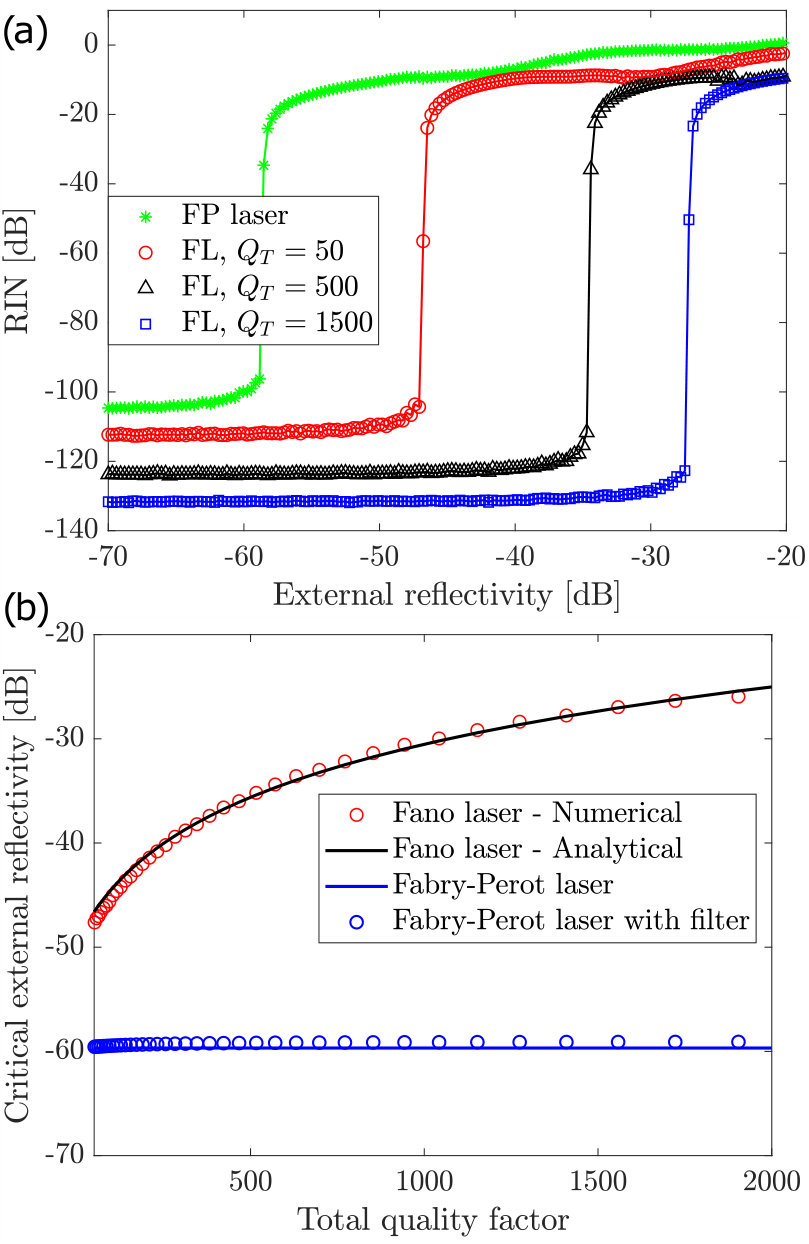 Figure 1
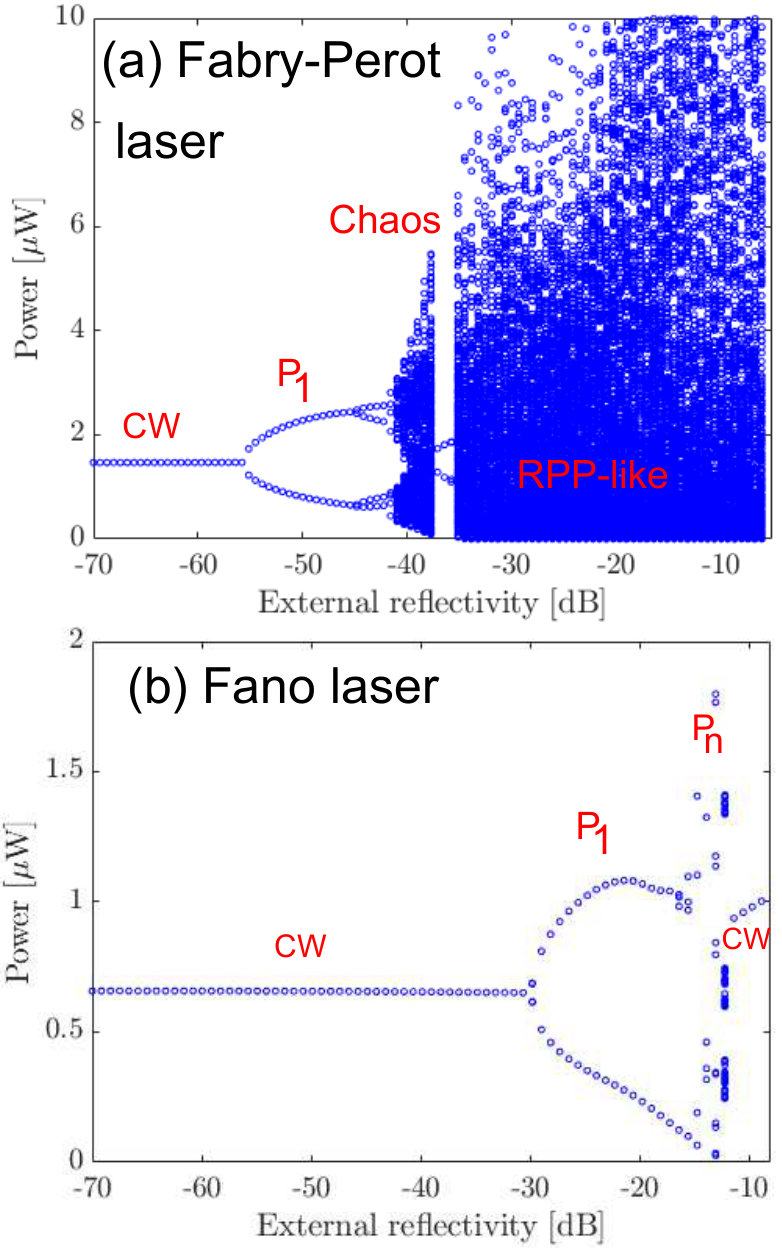 Figure 2
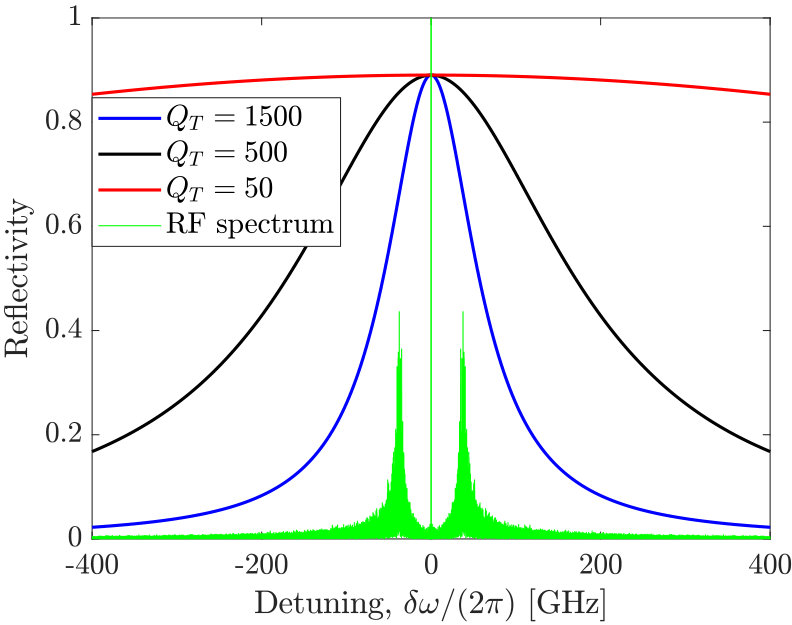 Figure 3
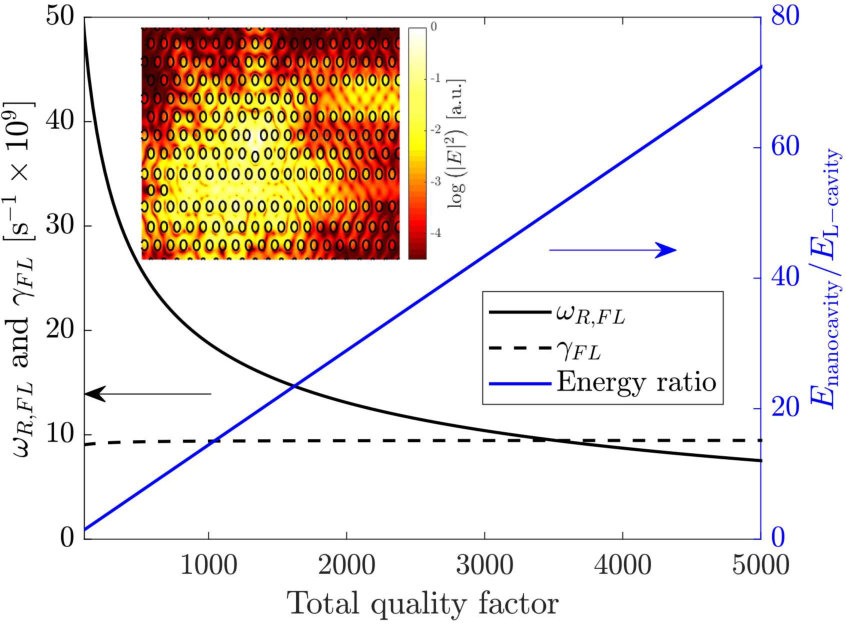 Figure 4
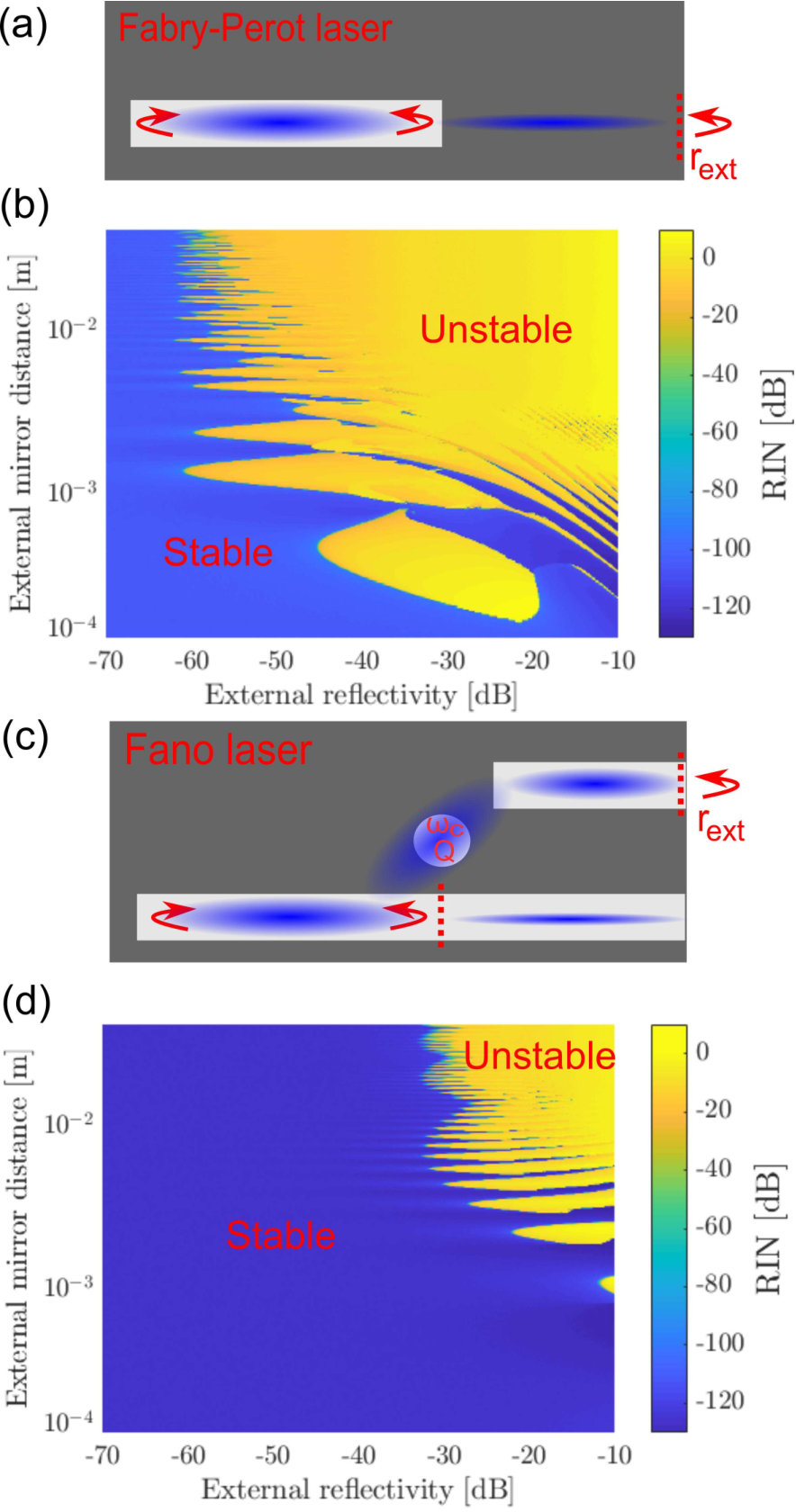 Figure 5
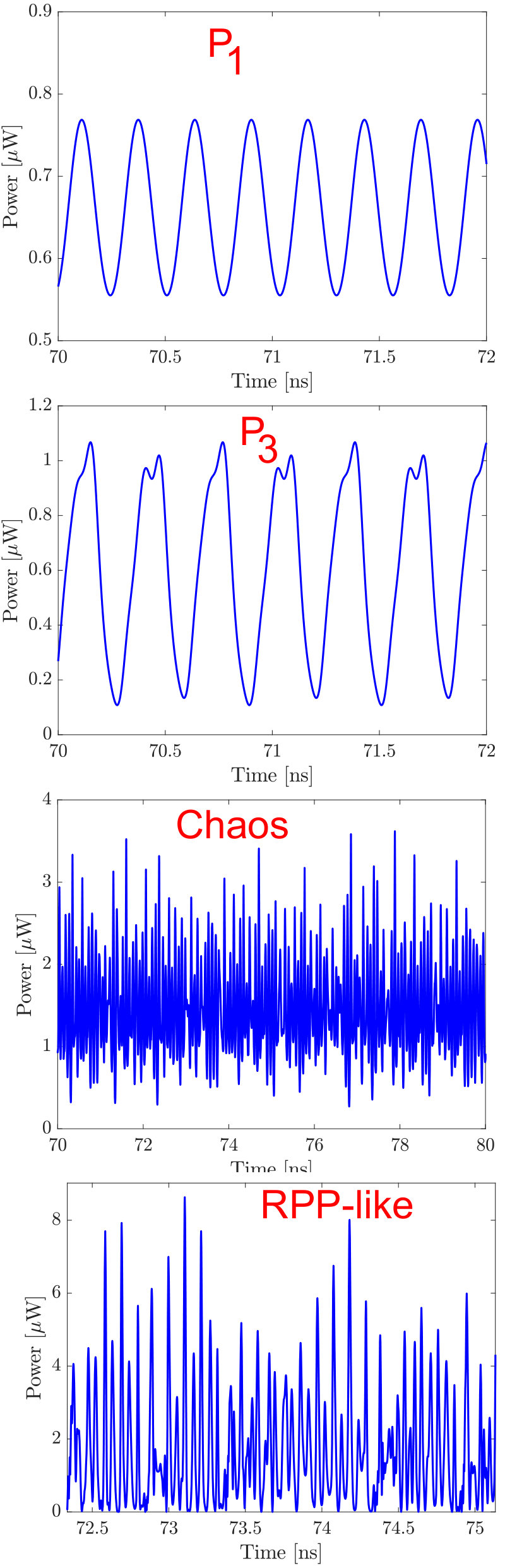 Figure 6
Peer Reviews
No public reviews on file for this paper yet. If you reviewed it on a platform where reviews are public (OpenReview, ICLR, NeurIPS, ICML), you can paste yours below so the community can read it here.
Videos
No videos yet. Explain this paper in a talk, walkthrough, or lecture? Add one.
Suppression of coherence collapse in semiconductor Fano lasers
Thorsten S. Rasmussen
Yi Yu
Jesper Mork
DTU Fotonik, Technical University of Denmark, DK-2800 Kongens Lyngby, Denmark
Abstract
We show that semiconductor Fano lasers strongly suppress dynamic instabilities induced by external optical feedback. A comparison with conventional Fabry-Perot lasers shows orders of magnitude improvement in feedback stability, and in many cases even total suppression of coherence collapse, which is of major importance for applications in integrated photonics. The laser dynamics are analysed using a generalisation of the Lang-Kobayashi model for semiconductor lasers with external feedback, and an analytical expression for the critical feedback level is derived.
Nonlinear dynamical systems with time-delayed feedback show rich and varied physics due to their infinite-dimensional nature Farmer (1982) with important examples in a large variety of disciplines, such as mechanics Hu and Wang (2013), physiology Mackey and Glass (1977), and neural networks Liao and Wang (2000). Semiconductor lasers with external optical feedback are one of the most studied examples of such delay systems, due to their wide range of applications and the serious issue of instabilities, chaos and coherence collapse arising from even extremely weak feedback Lang and Kobayashi (1980); Lenstra et al. (1985); Mørk et al. (1990); Mork et al. (1992); Petermann (1995). The inherent sensitivity of these lasers towards external feedback, as well as the nature of the non-linear dynamics, remain open problems under study Sciamanna and Shore (2015); Wishon et al. (2018); Huang et al. (2018); Munnelly et al. (2017); van Schaijk et al. (2018), and the instabilities are a particularly relevant issue in on-chip applications, due to the absence of integrated optical isolators. This has led to a number of novel solution proposals, e.g. isolators based on topological photonics Takata and Notomi (2018); Lu et al. (2014), reduction of the alpha-factor Duan et al. (2018); Huang et al. (2018), increased damping Huang et al. (2018), and complicated laser geometries van Schaijk et al. (2018). Most studies have, as of yet, dealt with macroscopic lasers, while the feedback dynamics of emerging microlasers and nanolasers remain largely unexplored, with few exceptions Munnelly et al. (2017); Wang et al. (2019). Here, we explore part of this new regime, by showing that a simple microscopic laser geometry in which one mirror is realised by a Fano resonance, providing a so-called Fano laser (FL)Mork et al. (2014); Yu et al. (2017), is intrinsically exceedingly stable towards external optical feedback, in some cases entirely suppressing coherence collapse. The origin of the strongly enhanced stability is identified as a unique reduction of the relaxation oscillation (RO) frequency which suppresses a period-doubling route to chaos, and it is shown how the Fano laser outperforms lasers with conventional, non-dispersive mirrors by orders of magnitude in terms of feedback stability. The Fano laser is analysed using a generalisation of the traditional Lang-Kobayashi model Lang and Kobayashi (1980) for semiconductor lasers with external optical feedback.
Figure 1 shows schematic representations of the Fano laser and the conventional Fabry-Perot (FP) laser, and their corresponding phase diagrams. The FL consists of a waveguide terminated at one end, which is side-coupled to a nearby cavity, from whence the Fano interference between the continuum of waveguide modes and the discrete nanocavity mode leads to a narrowband reflection peak Fan et al. (2003); Miroshnichenko et al. (2010) with bandwidth inversely proportional to the quality factor of the nanocavity. This realises a bound-mode-in-continuum Hsu et al. (2016), which functions as a cavity mode. This configuration was experimentally realised in a photonic crystal platform Yu et al. (2017), showing remarkable properties including pinned single-mode lasing and the first case of self-pulsing in a microscopic laser Yu et al. (2017); Rasmussen et al. (2017), and theory suggests that its frequency modulation bandwidth is orders of magnitude larger than conventional lasers Rasmussen et al. (2018). A comprehensive review of Fano lasers is given in Mork et al. (2019). The photonic crystal platform itself has provided numerous promising microscopic lasers for the photonic integrated circuits of the future Matsuo et al. (2013); Crosnier et al. (2017); Ota et al. (2017).
Figures 1(b) and (d) show the calculated relative intensity noise (RIN) as a function of the external reflectivity, , and the distance to the external mirror, , for a Fabry-Perot laser (top) and a Fano laser (bottom). The Fabry-Perot laser is described using the conventional Lang-Kobayashi model Lang and Kobayashi (1980), while the Fano laser is modelled using a generalised version of the Lang-Kobayashi model, to be presented later. The RIN is defined as , where is the variance and the mean of the time-domain output power. This provides a convenient quantitative measure of the stability, with low RIN (blue) indicating stable continuous-wave (CW) states, and high RIN (yellow) corresponding to self-sustained oscillations, chaotic dynamics and coherence collapse. Despite the intricacies of these phase diagrams, the main point is clear: The Fano laser provides an extraordinary improvement in feedback stability, as shown simply by comparing the sizes of the blue and yellow regions in figure 1. The critical feedback level, at which the laser is stable irrespective of the distance to the external reflector, is seen to be three orders of magnitude larger for the Fano laser compared to conventional lasers. Additionally, the Fano laser is essentially immune to feedback when the length scale reaches on-chip dimensions ( mm), whereas this does not happen until m for the Fabry-Perot laser. Furthermore, instabilities, chaos, and coherence collapse are completely suppressed for any feedback level for the Fano laser for certain ranges of delay lengths, a characteristic not observed for Fabry-Perot lasers. The supplemental material presents a bifurcation analysis using Refs. 30; 31; 32, showing a period-doubling route to chaos for the Fano laser.
The phase diagram for the Fabry-Perot laser is generated using the conventional Lang-Kobayashi model for semiconductor lasers with external feedback Lang and Kobayashi (1980). This model has proven to work well for both Fabry-Perot and distributed feedback lasers, as well as VCSELs Petermann (1995), but in order to describe the Fano laser a generalisation is necessary. The generalisation consists of coupling the Lang-Kobayashi model to a dynamical equation for the field stored in the nanocavityMork et al. (2014); Rasmussen et al. (2017), in order to temporally resolve the Fano interference. This approach is also of interest for studying other coupled systems with complicated external feedback arrangements due to the generic nature of the formulation. As the output power is mainly coupled out through the cross-port Mork et al. (2014), the feedback is assumed to originate in this port, as illustrated in figure 1(c). This leads to the following model equations:
[TABLE]
Here is the envelope of the complex electric field in the laser cavity, is the carrier density in the active region, is the linewidth enhancement factor, is the field confinement factor, is the group velocity, is the gain, with being the differential gain and the transparency carrier density, is the photon lifetime, is the laser cavity roundtrip time, with being the group velocity and the cavity length, is a complex Langevin noise source, is the pump rate, is a characteristic carrier lifetime, and is the photon density, where is the photon volume and is given in Ref. 33. Finally, is related to the reflected external field, and differs for the FP laser and the FL:
[TABLE]
Here is the conventional definition of the external feedback coefficient Mork et al. (1992), with and being the laser cavity and external mirror amplitude reflectivities respectively, while is the delay time of the external feedback and is the laser oscillation frequency. is the field stored in the nanocavity, is the field coupling rate from the waveguide to the nanocavity, is the detuning of the resonance frequency of the nanocavity () from the laser frequency, is the total decay rate of the nanocavity field, and is the field coupling rate from the nanocavity into the cross-port. For the FP laser, the external feedback enters directly into equation (1) Tromborg et al. (1987), while for the FL it couples to equation (1) through the nanocavity field, . This field is the solution to the conventional coupled-mode theory equation Fan et al. (2003), but extended to self-consistently include the external feedback in equation (5). In the calculations, parameters appropriate for microscopic lasers are used, which by itself leads to a notably lower critical feedback level than is usually observed for macroscopic Fabry-Perot lasers. Due to the cavity length being in the few-m range, the critical feedback level is dB, which is orders of magnitude lower than the dB observed for macroscopic lasers Petermann (1995); Mork et al. (1992). The parameters are given in the supplementary, together with an efficient iterative formulation of the model equations.
We next turn to the physics responsible for the improved feedback stability of the Fano laser. The effect of the Fano mirror bandwidth is investigated in figure 2(a), showing the variation of the RIN with external reflectivity, , for a Fabry-Perot laser (circles) and Fano lasers with increasing values of the nanocavity Q-factor for ns.
The four curves show the same qualitative shape, reflecting the phase diagrams of figure 1. The crucial difference between the curves, however, is the critical external reflectivity at which the onset of instability occurs, which varies by orders of magnitude. For low Q, the Fano laser RIN curve is close to the Fabry-Perot laser curve, and the critical feedback level then increases dramatically with the increase in quality factor, as shown in figure 2(b). From a stability analysis one finds that in the short-cavity limit () the Fano laser critical external reflectivity is given by
[TABLE]
where is the Fano laser RO damping rate. This expression is plotted as the black line in figure 2(b), showing excellent agreement with the numerical results (red circles). Equation (6) is identical to that of Fabry-Perot lasers Tromborg and Mork (1990), except that half the laser roundtrip time () is replaced by , i.e. the storage time of the energy in the nanocavity (). Thus, the improvement in feedback stability is simply
[TABLE]
where is the difference in dB between the critical external power reflectivity of a Fano laser and a Fabry-Perot laser with the same parameters. This shows how the improvement in stability is an intrinsic property of the Fano mirror, independent of all parameters other than the Q-factor and the roundtrip time.
The appearance of the Q-factor as the governing parameter for the stability means the improvement is inversely proportional to the mirror linewidth, and as such, one might intuitively think that the Fano laser simply acts a filter for the external feedback. Such filtered feedback systems are well-studied, showing altered mode selection properties Yousefi and Lenstra (1999), changes to the laser dynamics Fischer et al. (2004), a sensitive dependence on the filter width Erzgräber and Krauskopf (2007), and phase-dependent stability improvements Tronciu et al. (2006). The blue circles in figure 2(b) are a numerical calculation of the critical feedback level for a Fabry-Perot laser with filtered feedback, as function of the filter width, showing how in the range of relevant Q-factors, the filtering is essentially broadband and negligible, so that the stability improvement of the Fano laser cannot be explained simply as a filtering effect. This is the case for the entire range of delay lengths covered in figure 1.
The improved stability can instead be understood by considering the paths to instability for lasers with feedback: Competition between allowed external cavity modes and relaxation oscillations becoming un-damped through a Hopf-bifurcation. The external cavity mode selection properties of Fano lasers in the presence of feedback differ fundamentally from conventional semiconductor lasers, and instead function as an amplified version of the improved mode selection of lasers with filtered feedback Yousefi and Lenstra (1999). For Fano lasers, the number of external cavity modes is strongly reduced due to the narrow bandwidth of the Fano mirror, which significantly increases the threshold gain of modes that are separated in frequency by more than . In this case an effective C-parameter Petermann (1995) for the Fano laser may be estimated as
[TABLE]
where acts as an effective feedback parameter for the Fano laser. In comparison to lasers with filtered feedback, the filtering of external cavity modes is much stronger, because a detuning in frequency changes the internal reflectivity of the laser, rather than simply the feedback strength, leading to a much larger threshold gain separation between neighbouring external cavity modes. This extreme sensitivity to frequency changes ensures that a single, dominant external cavity mode is selected, so that the critical feedback level is uniquely determined by the location of the first Hopf bifurcation, and the location of this Hopf bifurcation is what is determined by Eq. (6).
The origin of the scaling with the Q-factor in the expression for the critical feedback level is a unique reduction in the relaxation oscillation frequency for the Fano laser compared to Fabry-Perot lasers without notable change of the RO damping rate. The benefit of this reduction in terms of feedback stability is that the instability is born from ROs becoming un-damped. Thus, if the frequency to damping rate ratio is reduced, fewer oscillations take place before a perturbation decays back to the steady-state. Because of this, a larger level of feedback is necessary to drive the instability, leading to the feedback stability scaling with the Q-factor. This type of reduction of the RO frequency is particularly efficient for suppressing coherence collapse, because the route to chaos is of the period-doubling form. As the temporal period is controlled by the RO frequency, a lower frequency means a longer period, requiring stronger feedback to sustain the oscillations through the longer and longer periods in order to drive the laser towards chaos. We believe that due to the generic nature of the FL equations and the stability mechanism, this type of behaviour could also be exploited to suppress chaotic dynamics in other delay systems if the natural frequency of the system can be engineered, in particular for systems governed by period-doubling routes to chaos as is the case here.
The reduction of the RO frequency with Q-factor arises because of a longer effective photon lifetime of the system, as the high-Q nanocavity stores a significant amount of the intensity during lasing (see inset in figure 3). As the Q-factor increases, this amount increases, as shown in figure 3 (right axis, blue curve), which in turn means that the interaction between photons and free carriers in the laser cavity is weaker, leading to a smaller relaxation oscillation frequency (full black, left axis), similar to reducing the photon number or increasing the photon lifetime of a conventional laser Coldren and Corzine (1995).
A small-signal analysis of the feedback-free FL equations yields the FL RO frequency as
[TABLE]
Here is the corresponding RO frequency for a Fabry-Perot laser with the same parameters Coldren and Corzine (1995). The connection to equation (6) and (7) is clear, since in the short-cavity limit we have
[TABLE]
showing how the reduction of the RO frequency explains the improved feedback stability.
Here, one should appreciate the fundamental difference between Fano and FP lasers. As additional energy is stored in the nanocavity due to increasing Q-factor, the RO frequency decreases until eventually the FL approaches an over-damped regime ().
The absence of relaxation oscillations can be interpreted as a transition of the FL from a class B laser towards a class A laser Tredicce et al. (1985), i.e. a system of lower dimensionality, which leads to an intrinsic suppression of chaos as the quality factor increases. For FP lasers, in contrast, the critical feedback level is determined exclusively by the damping rate Petermann (1995), as exemplified by stability improvements due to a short carrier lifetime due to growth defects in Ref. 12. Figure 3 shows that despite the strong variation of the RO frequency, the Fano laser damping rate only changes marginally with Q. In contrast, the damping rate in conventional lasers increases approximately with the square of the RO frequency, showing how the mechanism of improved feedback stability in Fano lasers is fundamentally different.
In conclusion, it has been shown how semiconductor Fano lasers intrinsically suppress dynamic instabilities induced by exposure to external optical feedback. A generalisation of the Lang-Kobayashi model was employed to study the laser dynamics. Using this, the feedback stability was analytically and numerically shown to scale with the quality factor of the nanocavity, due to a unique reduction of the relaxation oscillation frequency, as well as large gain separation of external cavity modes due to the highly dispersive Fano mirror. For realistic designs, the Fano laser outperforms conventional Fabry-Perot lasers by orders of magnitude in terms of the critical external feedback level. In many cases, coherence collapse is even entirely suppressed, in contrast to the conventional classification of semiconductor lasers with feedback, demonstrating fundamentally new and different underlying dynamics arising from the Fano mirror. Due to the general nature of the problem, this stability mechanism may be exploitable for chaos suppression in similar delay systems.
Acknowledgements.
Authors gratefully acknowledge funding by Villum Fonden via the NATEC Center of Excellence (Grant 8692). This project has received funding from the European Research Council (ERC) under the European Union’s Horizon 2020 research and innovation programme (grant agreement number 834410 — FANO).
The reference list from the paper itself. Each links out to its DOI / PubMed record.
- 1Farmer (1982) J. D. Farmer, Chaotic attractors of an infinite-dimensional dynamical system, Physica D: Nonlinear Phenomena 4 , 366 (1982) . · doi ↗
- 2Hu and Wang (2013) H. Y. Hu and Z. H. Wang, Dynamics of controlled mechanical systems with delayed feedback (Springer Science & Business Media, 2013).
- 3Mackey and Glass (1977) M. C. Mackey and L. Glass, Oscillation and chaos in physiological control systems, Science 197 , 287 (1977).
- 4Liao and Wang (2000) T.-L. Liao and F.-C. Wang, Global stability for cellular neural networks with time delay, IEEE Transactions on neural networks 11 , 1481 (2000).
- 5Lang and Kobayashi (1980) R. Lang and K. Kobayashi, External optical feedback effects on semiconductor injection laser properties, IEEE Journal of Quantum Electronics 16 , 347 (1980) . · doi ↗
- 6Lenstra et al. (1985) D. Lenstra, B. Verbeek, and A. Den Boef, Coherence collapse in single-mode semiconductor lasers due to optical feedback, IEEE Journal of Quantum Electronics 21 , 674 (1985) . · doi ↗
- 7Mørk et al. (1990) J. Mørk, J. Mark, and B. Tromborg, Route to chaos and competition between relaxation oscillations for a semiconductor laser with optical feedback, Phys. Rev. Lett. 65 , 1999 (1990) . · doi ↗
- 8Mork et al. (1992) J. Mork, B. Tromborg, and J. Mark, Chaos in semiconductor lasers with optical feedback: theory and experiment, IEEE Journal of Quantum Electronics 28 , 93 (1992) . · doi ↗