Gauge-field description of Sagnac frequency shift and mode hybridization in a rotating cavity
Hongkang Shi, Zhongfei Xiong, Weijin Chen, Jing Xu, Shubo Wang, and, Yuntian Chen

TL;DR
This paper models a rotating optical cavity using gauge fields, revealing how rotation induces Sagnac frequency shifts and mode hybridization, with potential applications in measuring rotation through far-field analysis.
Contribution
It introduces a gauge-field framework to describe Sagnac shifts and mode hybridization in rotating cavities, supported by analytical derivations and finite element simulations.
Findings
Rotation induces a synthetic gauge field in the cavity.
Hybridization of CW and CCW modes depends on rotation.
Far-field variations can be used to measure rotation.
Abstract
Active optical systems can give rise to intriguing phenomena and applications that are not available in conventional passive systems. Structural rotation has been widely employed to achieve non-reciprocity or time-reversal symmetry breaking. Here, we examine the quasi-normal modes and scattering properties of a two-dimensional cylindrical cavity under rotation. In addition to the familiar phenomenon of Sagnac frequency shift, we observe the the hybridization of the clockwise(CW) and counter-clockwise(CCW) chiral modes of the cavity controlled by the rotation. The rotation tends to suppress one chiral mode while amplify the other, and it leads to the variation of the far field. The phenomenon can be understood as the result of a synthetic gauge field induced by the rotation of the cylinder. We explicitly derived this gauge field and the resulting Sagnac frequency shift. The analytical…
Click any figure to enlarge with its caption.
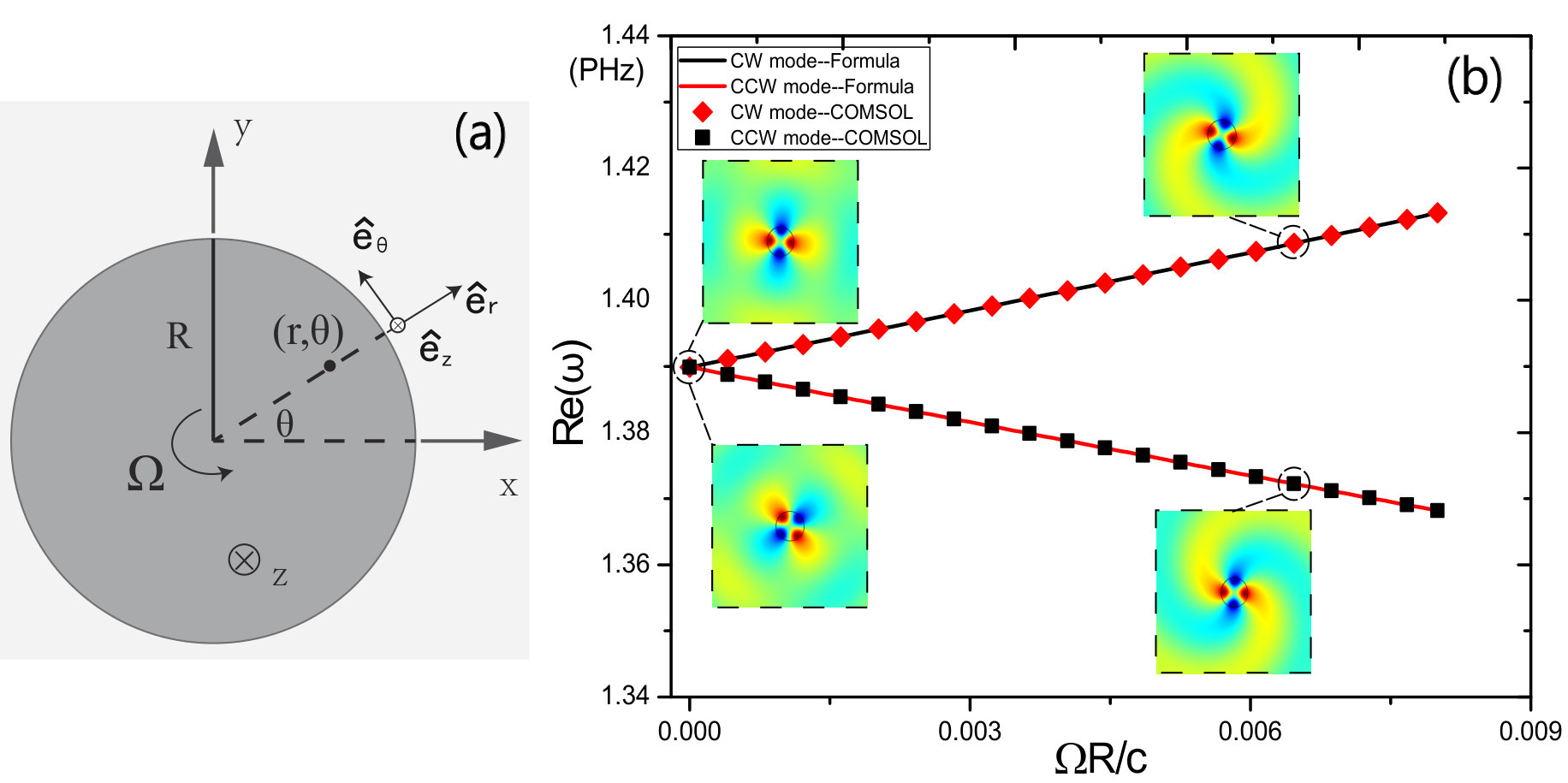 Figure 1
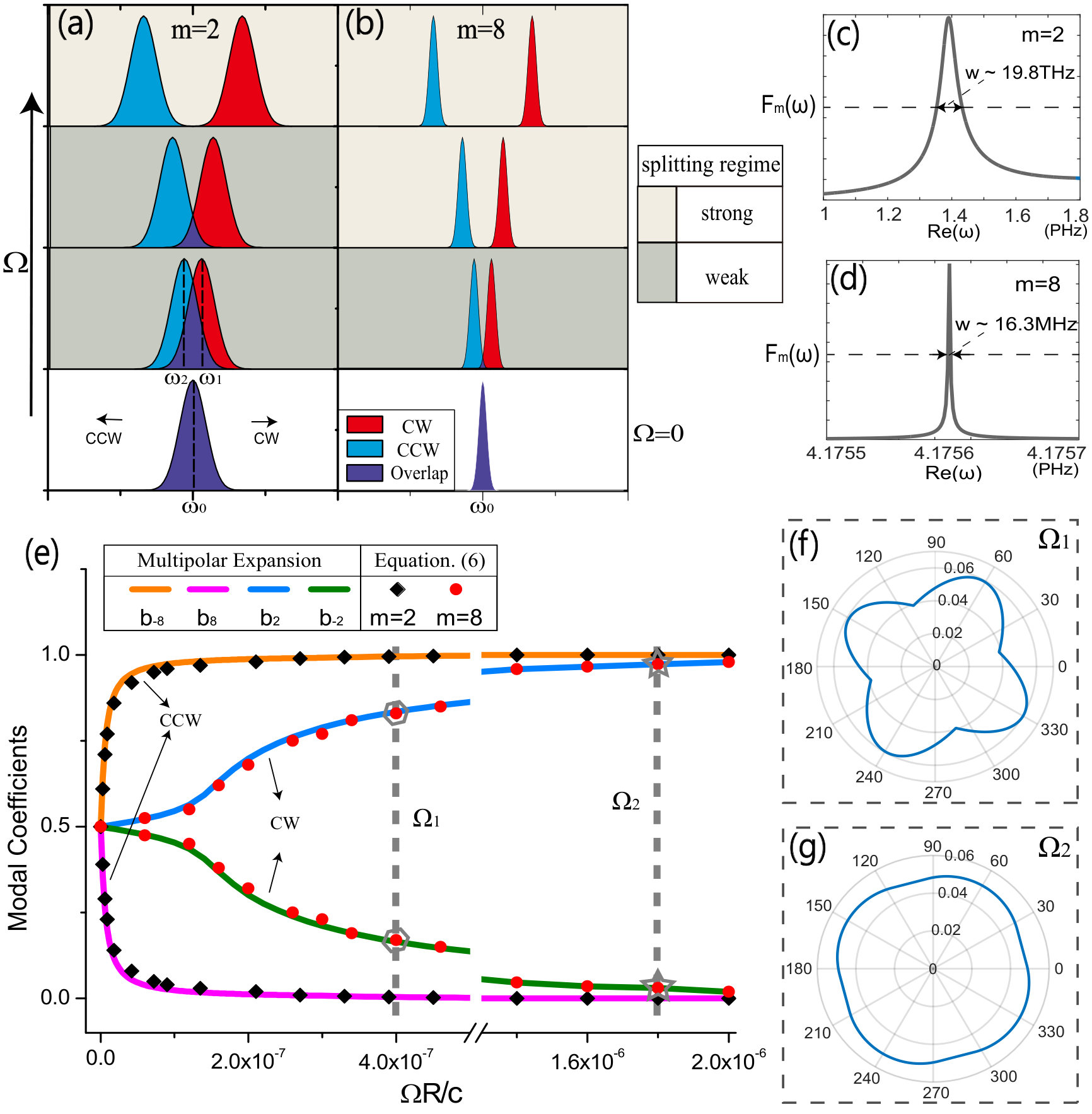 Figure 2
Peer Reviews
No public reviews on file for this paper yet. If you reviewed it on a platform where reviews are public (OpenReview, ICLR, NeurIPS, ICML), you can paste yours below so the community can read it here.
Videos
No videos yet. Explain this paper in a talk, walkthrough, or lecture? Add one.
Gauge-field description of Sagnac frequency shift and mode hybridization in a rotating cavity
Hongkang Shi
\authormark1 Zhongfei Xiong
\authormark1 Weijin Chen
\authormark1 Jing Xu
\authormark1,3 Shubo Wang
\authormark2,4 and Yuntian Chen
\authormark1,3,5
\authormark1School of Optical and Electronic Information, Huazhong University of Science and Technology, Wuhan, China
\authormark2Department of Physics, City University of Hong Kong, Hong Kong, China
\authormark3Wuhan National Laboratory for Optoelectronics, Huazhong University of Science and Technology, Wuhan, China
Abstract
Active optical systems can give rise to intriguing phenomena and applications that are not available in conventional passive systems. Structural rotation has been widely employed to achieve non-reciprocity or time-reversal symmetry breaking. Here, we examine the quasi-normal modes and scattering properties of a two-dimensional cylindrical cavity under rotation. In addition to the familiar phenomenon of Sagnac frequency shift, we observe the the hybridization of the clockwise(CW) and counter-clockwise(CCW) chiral modes of the cavity controlled by the rotation. The rotation tends to suppress one chiral mode while amplify the other, and it leads to the variation of the far field. The phenomenon can be understood as the result of a synthetic gauge field induced by the rotation of the cylinder. We explicitly derived this gauge field and the resulting Sagnac frequency shift. The analytical results are corroborated by finite element simulations. Our results can be applied in the measurement of rotating devices by probing the far field.
††journal: oe††articletype: Research Article
1 Introduction
The rotating cavity is a rich subject with far-reaching implications and has many applications such as optical gyroscopes[1, 2, 3], as evidenced by the long record of literature in the past four decades. The rotation induced effects, such as Sagnac frequency splitting and the modified far-field pattern, can be interpreted in various ways by the stationary observer (inertial frame) and the moving observer (reference frame rotating with the cavity). Coincidentally, it is found that the first order approximation[4] in either inertial frame or rotating frame yields consistent results on the Sagnac frequency shift by using the proper non-relativistic constitutive relation for the moving medium. Interestingly, Cook and co-workers compare the time-independent Schröndinger equation with the wave-equation for the electric field in moving medium up to the first order[5], and concluded that the velocity of the moving medium and the vorticity play the roles of the vector potential and the effective magnetic field that bend light, analogous to electrons travelling in magnetic field. The similar concept as well as the first-order treatment are also used to examine the Aharonov-Bohm effect of light associated with a rotating rod immersed in a viscous fluid[6]. Considering the recent development of topological photonics, it is theoretically appealing to have a gauge field description[7, 8, 9, 10, 11]of the optical properties of rotating cavities beyond the first order approximation.
In this paper, with Minkowski’s postulation of the modified constitutive relation of moving medium[12], we revisit the rotating rod hosted in vacuum and develop a physically transparent yet rigorous description for the Sagnac frequency splitting and modal hybridization of the cavity by constructing the effective gauge field induced by rotation. In particular, we consider finite quality(Q)-factor cavity modes supported by high refractive index dielectric rod. The rotating cavity can be equivalently treated as stationary cavity with bianisotropic response, which can be further solved by analytical or numerical approaches. From the first principle of Maxwell’s equation, we analytically derive the rotation-induced gauge field, the effective magnetic field, and the Sagnac frequency splitting , which are further benchmarked against full-wave finite-element simulations. At low rotation speed, as is small, the spectra of the CW and CCW resonances overlap, leading to rotation-induced evolution of far-field emission patterns as explained qualitatively by Ge et al[13]. The spectra overlapping is essentially due to the modal hybridization between the CW and CCW modes, which is semi-analytically described by the coherent superposition of the two quasi-normal modes in this paper.
The paper is organized as follows. In Section 2, we give the detailed derivations of rotation-induced gauge field and effective magnetic field as well as frequency splitting . The simulation results and discussions are provided in Section 3. Finally, the paper is concluded in Section 4.
2 Fundamentals of rotation-induced gauge field
2.1 Synthetic gauge field and effective magnetic field in a rotating cavity
Figure 1(a) shows a two-dimensional (2D) view of a cylinder rotating around the axis with angular velocity , where are, respectively, the radial and azimuthal coordinates, and and are the corresponding unit vectors. The linear velocity of the rotating cylinder is at a radius . The modified constitutive relation [12] of the moving medium in the stationary frame is given by,
[TABLE]
where , , , and are electromagnetic fields, is the speed of light in vacuum. Equation (1) amounts to introducing bianisotropic response to the rotating cylinder, and the general form of the effective constitutive relation is given by \left({\begin{array}[]{*{18}{c}}\bm{D}\\ \bm{B}\end{array}}\right)=\left({\begin{array}[]{*{18}{c}}{\bar{\bm{\varepsilon}}}&{{{\bar{\bm{\chi}}}_{eh}}}\\ {{{\bar{\bm{\chi}}}_{he}}}&{\bar{\bm{\mu}}}\end{array}}\right)\left({\begin{array}[]{*{18}{c}}\bm{E}\\ \bm{H}\end{array}}\right), where ,, and . Notably, all the elements of the material tensor explicitly depend on rotation speed . In contrast to reciprocal medium which have , and , the rotating cylinder does not obey reciprocity, and the bianisotropic tensor elements satisfy . The rotation introduces non-reciprocity to the equivalent electromagnetic medium, therefore, it can be employed to realize the optical isolation[14, 15].
The source-free Maxwell’s equations with time harmonic dependence are given by and , where , is the angular frequency, are the normalized electromagnetic field, and is the vacuum impedance. Considering TE modes where the electric field only has component in a 2D cylindrical rotating cavity, see Fig. 1(a), one arrives at the Helmholtz equation by eliminating the magnetic field as follows,
[TABLE]
where , , , and . Importantly, Eq. (2) gives the explicit expression of the gauge field (i.e. vector potential) in the azimuthal direction: , which accounts for the rotation-induced effects. The effective magnetic field along axis can be obtained from the vector potential as
[TABLE]
where is the unit vector in direction.
2.2 Sagnac frequency splitting
A cylindrical cavity of radius has a pair of CW and CCW modes with the mode electric field , where , is an integer. Substituting it into Eq. (2), one obtains the frequency splitting between CW and CCW modes as
[TABLE]
In the limit of , all high-order terms about in Eq. (4) can be omitted, so , the vector potential is , and effective magnetic field is . We then get
[TABLE]
which describes the Sagnac effect induced by the effective magnetic field in a closed cavity. From Eq. (5), it’s clear that the frequency splitting of a pair of CW and CCW modes is proportional to the azimuthal quantum number and angular velocity . For comparison, a set of representative researches on Sagnac frequency splitting are listed in Table.1 in Appendix A, including inertial frame and co-rotating frame. Surprisingly, Eq. (5) shows good consistency with the formula in second row of Table.1 if the dispersion term is omitted. The explicit expression of rotation-induced effective magnetic field in Eq. (3) and the rigorous relation between the Sagnac frequency splitting and the rotation-induced effective gauge field in Eq. (4) are the first main result of our paper.
3 Results and discussions
3.1 Frequency splitting simulation
We examine the Sagnac frequency splitting of CW and CCW modes using the analytical results of Eq. (4) and the full-wave simulation results obtained from finite-element calculation. Though the rotating cylindrical rod can be calculated analytically[16, 17, 13, 2], the finite-element model we adopted here can handle generically bianisotropic medium with complex geometric shape[18]. COMSOL Multiphysics with the modified weak form of finite-element formulation[19, 20, 21, 22] is used to simulate the rotating cylinder in this paper. Figure 1(b) shows the real parts of eigenfrequencies of CW and CCW modes with azimuthal number as a function of dimensionless angular speed , where the solid lines denote the analytical results from Eq. (4) and the symbols denote the simulation results. The analytical results match perfectly well with the simulation results, indicating a linear dependence as . The insets in Fig. 1(b) show the modal profiles of the CW and CCW modes. We note that the mode pair (i.e. CW and CCW modes) are originally degenerated at . As increases, this degeneracy is lifted, and the profiles of CW and CCW mode carry a ’spinning’ chiral feature, as shown by the right insets in Fig. 1(b). It is worthy to point out that the cavity modes examined in this paper is essentially quasi-normal modes with complex eigenfrequencies and finite Q-factors. The finite value of the Q-factor approximately determines the line-shape of cavity resonance, and it turns out to be rather important in determining the modal hybridization and thus the far-field pattern at lower rotation speed, which will be discussed shortly in the next section.
3.2 Hybridization of CW and CCW components in a rotating cylinder
Sagnac frequency shift reflects the modification of the eigenfrequency induced by the rotation. Now we proceed to discuss the impact of rotation upon the eigenfields. It is well understood that the eigenfields for the two split bands due to rotation, as shown in Fig. 1(b), are CW and CCW modes respectively, i.e., and . However, a precise one-to-one correspondence between the upper/lower band to the CW/CCW mode only exists at high rotation speed. As discussed in details by Ge[13], a low rotation speed gives rise to a rotation-dependent far-field distribution, indicating a certain mixture of CW and CCW mode.
To reveal the underlying principle behind rotation-dependent far-field distribution, we first identity the modal splitting of and as the rotation speed varies. At , as illustrated in Figs. 2(a)-2(b), each resonance of the stationary rod has a finite broadening, and the y dimensions represent the normalized resonant amplitude. The full width at half maximum (FWHM), denoted as in this paper, decreases as the azimuthal quantum number increases. In the presence of non-zero rotation speed, i.e., , the coupling between the original eigenmodes and does not vanish, and there is modal splitting at this situation, as shown in Figs. 2(a)-2(b). Depending on the relative values between and , the modal splitting can be categorized into two regimes, i.e., weak splitting regime and strong splitting regime, as shown in Figs. 2(a) and 2(b). In strong splitting regime, i.e., , the two resonant modes are completely split with negligible spectra overlapping. In contrast, in the weak splitting regime, there is spectral overlapping due to the fact that , which gives rise to the rotation-dependent far-field distribution as discussed by Ge[13]. The above analysis gives a qualitative understanding of how and contribute to the eigenfields of the rotating cavity. In the following, we give a quantitatively assessment of how and contribute to the eigenfields of a 2D rotating cylinder by including the line-shape function explicitly in the weak splitting regime.
Due to the cylindrical symmetry, the eigenfield of the stationary rod at =0 can be expressed as , where () is the line-shape function of CW (CCW) mode with resonant frequency and FWHM (see the definition and detailed calculation of in Appendix B). At , it can be proved that is identical to , i.e., , so is line-shape function of the stationary cavity mode with azimuthal number . The precisely calculated line-shape functions of the modes with and for the stationary rod are shown in Fig. 2(c) and 2(d), respectively, where the FWHM is on the order of THz/MHz range. At low rotation speed (), to a good approximation, the weighting factors of and the line-shape function remain unchanged, except that the resonant frequencies are shifted by half of the Sagnac frequency splitting. In this regard, the eigenfield of the low-speed rotating cylinder can be well approximated as follows,
[TABLE]
where is the Sagnac frequency shift defined in Eq. (4). Evidently, the modal coefficients of the CW/CCW resonance at a certain eigenfrequency can be semi-analytically determined by Eq. (6) in the weak splitting regime. This is the second main result of this paper.
In the following, we apply Eq. (6) to quantitatively study the modal hybridization of the rotating cylinder, accompanied with the numerical verification from multipolar expansion analysis, as shown in Fig. 2(e). Based on the revised finite-element calculation as well as Mie scattering theory[23, 24, 25], the multipolar components of the eigenfields can be extracted numerically by projecting the eigenfields of the rotating cylinder to vector spherical harmonic waves. Surprisingly, the modal coefficients obtained by the full-wave simulation and multipolar expansion agree with the results of our simple analytical model given by Eq. (6), for both the CW mode (orange and magenta for =8) and the CCW mode (blue and olive for =2), as shown in Fig. 2(e). At =0, it is easy to find that , which is consistent with Eq. (6) at =0. As the cylinder rotates, the coefficients of the original equal pair of multipolar components for CW (CCW) mode start to differ, with coefficients increased for >0 (<0) and decreased for <0 (>0). In comparison, the variation trends of the multipolar components of the CW mode and that of the CCW mode are exactly the opposite. This can be understood by our hybridization model that the Sagnac frequency splitting gives rise to a dominant role of () in CW (CCW) modes, such that the weighting factor of () increases (decreases) with angular velocity in CW modes while decreases (increases) in CCW modes. Evidently, coefficients of the CW mode with and coefficients of the CCW mode with drop to 0 at high rotation speed due to the fact that the Sagnac frequency shift is so large that there is negligible spectra overlapping. We also note that the multipolar components of the cavity mode with large value are more sensitive to the rotation speed than that of the cavity mode with small value. This is due to a simple fact that the line-shape function of a higher-order mode has a smaller , and with same can easily lead to complete splitting of the higher-order CW and CCW modes.
According to our analysis, the rotation-dependent far-field distribution can be obtained by superposing the eigenfields and with proper weighting factors in accordance with the angular velocity . Taking the CW mode with in Fig. 2(e) as an example, the far-field distribution at and are shown in Fig. 2(f) and 2(g) respectively. From Fig. 2(f) to Fig. 2(g), the original four-lobed shape gradually becomes a circle, which is consistent with our previous analysis. As long as the angular speed is large enough, the far field has a circular pattern, indicating that only component exists.
4 Conclusion
In conclusion, we have investigated the optical properties of a rotating cavity beyond the first order approximation. Starting from the first principle of electromagnetism, we have derived the effective magnetic field and Sagnac frequency splitting in a 2D rotating rod from the perspective of synthetic gauge field. With the modified weak form of finite-element model, full-wave simulations are implemented to examine the rotating cavity by treating it as a stationary bianisotropic medium. Moreover, a simple hybridization model is semi-analytically constructed for the cylinder at a low rotation speed, which provides a simple yet accurate description of the rotation-dependent far-field pattern. Our model is benchmarked against numerical analysis of multipolar expansions and enables a quantitative study of the far-field distribution of the cylinder at different angular velocity . The results might be applied in the angular speed measurement of rotating devices by monitoring the modification of the far-field distribution.
Appendix A: Summary of different formulae of Sagnac frequency shift
Appendix B: Line-shape function of stationary cylindrical cavity modes
Starting from the Mie scattering theory, when the incident light is normal to the cylinder axis, the coefficient of the scattered field vanishes, and has the following form
[TABLE]
where and are Bessel function of first kind and Hankel function, respectively, of integral order (i.e. angular quantum number). is the relative refractive index of the cylinder. , is the wave number in vacuo, being the frequency in the time harmonic oscillating field , and is the speed of light in vacuum. represents the radius of the cylinder. We define the line-shape function as , using the identities and , by varying angular frequency , the absolute value of the function of different angular quantum number are obtained.
As a test, we make a comparison with the results of COMSOL. For example, for the mode with angular quantum number at , its (angular) eigenfrequency is , for the other mode with angular quantum number at rest, its eigenfrequency is . However, for the CCW mode with azimuthal number at , its eigenfrequency becomes . By approximation, we assume that the imaginary parts of the modes remain unchanged, since the value of is particularly small() in our considered cases and the real parts of the modes are at least 70 times that of imaginary parts.
Funding
Natural National Science Foundation (NSFC) (11874026, 61735006, 61775063); National Key Research and Development Program of China (2017YFA0305200); Research Grants Council of Hong Kong SAR (CityU 21302018).
Acknowledgment
We thank Prof. Wei Liu for fruitful discussions.
The reference list from the paper itself. Each links out to its DOI / PubMed record.
- 1[1] R. Sarma, H. Noh, and H. Cao, “Wavelength-scale microdisks as optical gyroscopes: a finite-difference time-domain simulation study,” \Journal Title JOSA B 29 , 1648–1654 (2012).
- 2[2] S. Sunada and T. Harayama, “Design of resonant microcavities: application to optical gyroscopes,” \Journal Title Optics Express 15 , 16245–16254 (2007).
- 3[3] A. Mignot, G. Feugnet, S. Schwartz, I. Sagnes, A. Garnache, C. Fabre, and J.-P. Pocholle, “Single-frequency external-cavity semiconductor ring-laser gyroscope,” \Journal Title Optics Letters 34 , 97–99 (2009).
- 4[4] E. J. POST, “Sagnac Effect,” \Journal Title Rev. Mod. Phys. 39 , 475–493 (1967).
- 5[5] R. Cook, H. Fearn, and P. Milonni, “Fizeau’s experiment and the aharonov–Bohm effect,” \Journal Title American Journal of Physics 26 , 705–710 (1995).
- 6[6] M. Vieira, A. M. d. M. Carvalho, and C. Furtado, “Aharonov-Bohm effect for light in a moving medium,” \Journal Title Phys. Rev. A 90 , 012105 (2014).
- 7[7] K. Y. Bliokh and Y. P. Bliokh, “Modified geometrical optics of a smoothly inhomogeneous isotropic medium: the anisotropy, Berry phase, and the optical Magnus effect,” \Journal Title Physical Review E 70 , 026605 (2004).
- 8[8] K. J. Fang, Z. F. Yu, and S. H. Fan, “Photonic Aharonov-Bohm effect based on dynamic modulation,” \Journal Title Physical Review Letters 108 , 153901 (2012).