Presupernova neutrino signals as potential probes of neutrino mass hierarchy
Gang Guo, Yong-Zhong Qian, Alexander Heger

TL;DR
This paper explores how presupernova neutrino signals detected at JUNO could determine the neutrino mass hierarchy, emphasizing the importance of precise predictions, proximity of the star, and background reduction.
Contribution
It proposes a method to determine the neutrino mass hierarchy using presupernova neutrino signals, including a model-independent approach with both neutrino types.
Findings
Detection within 440-880 pc can determine hierarchy at >95% confidence
Betelgeuse signals could reveal hierarchy if uncertainties are reduced
Background reduction is crucial for the feasibility of the method
Abstract
We assess the potential of using presupernova neutrino signals at the Jiangmen Underground Neutrino Observatory (JUNO) to probe the yet-unknown neutrino mass hierarchy. Using models for stars of 12, 15, 20, and 25 solar masses, we find that if the electron antineutrino signals from such a star can be predicted precisely and the star is within ~440-880 pc, the number of events of electron antineutrino captures on protons detected within one day of its explosion allows to determine the hierarchy at the > ~95% confidence level. For determination at this level using such signals from Betelgeuse, which is at a distance of ~222 pc, the uncertainty in the predicted number of signals needs to be < ~14-30%. In view of more realistic uncertainties, we discuss and advocate a model-independent determination using both electron neutrino and antineutrino signals from Betelgeuse. This method is…
Click any figure to enlarge with its caption.
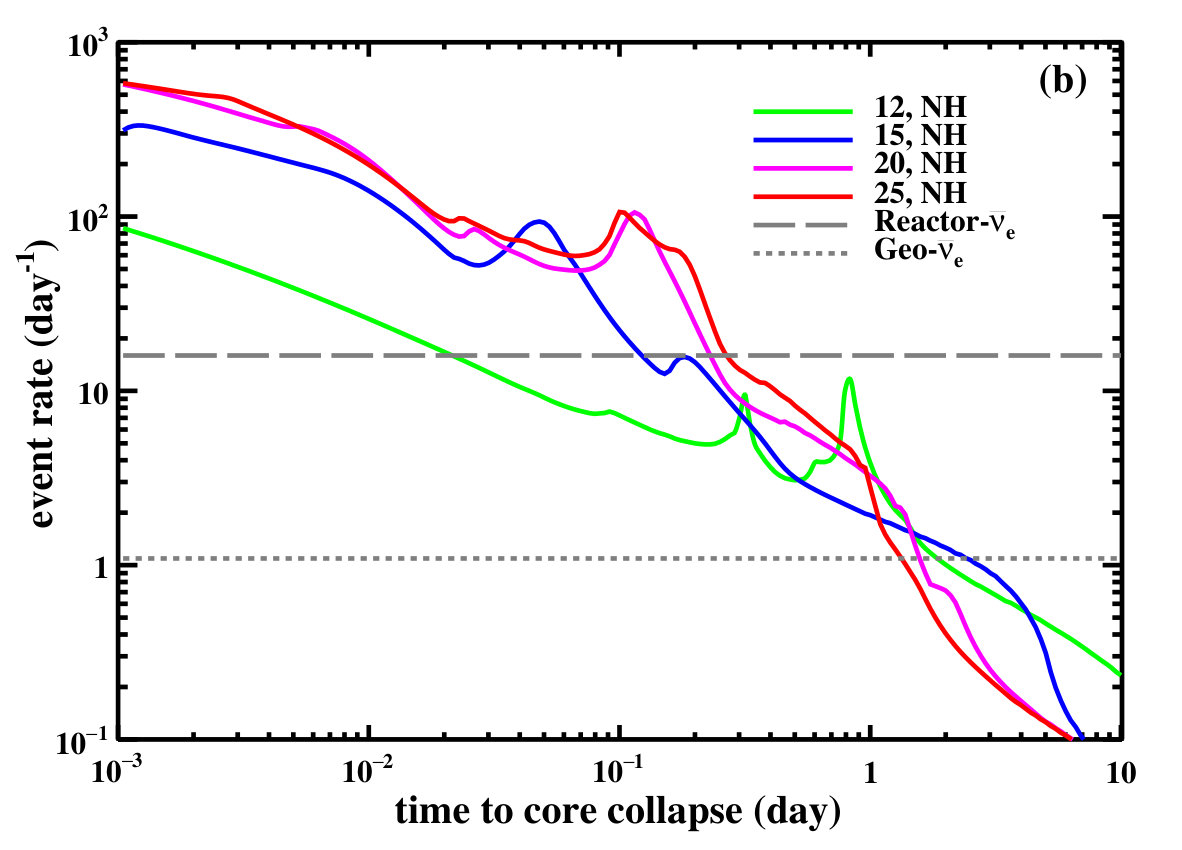 Figure 1
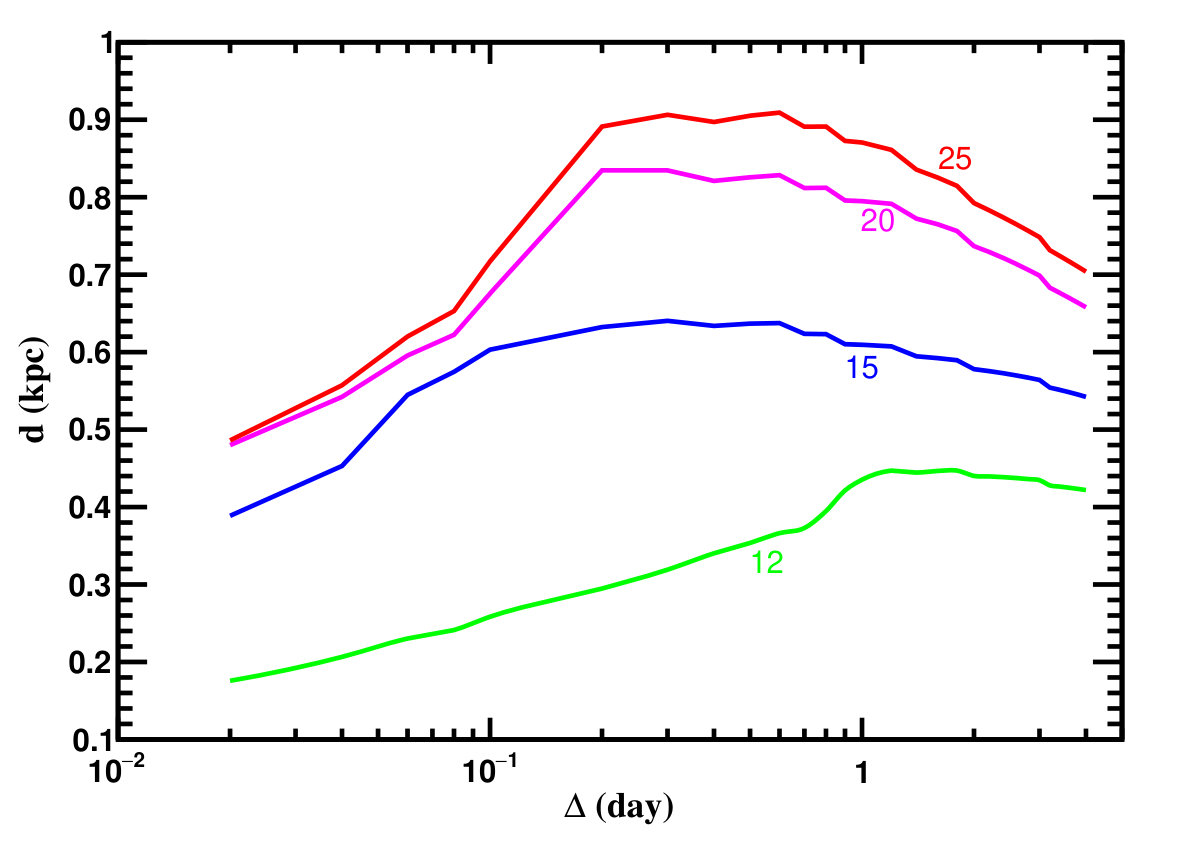 Figure 2
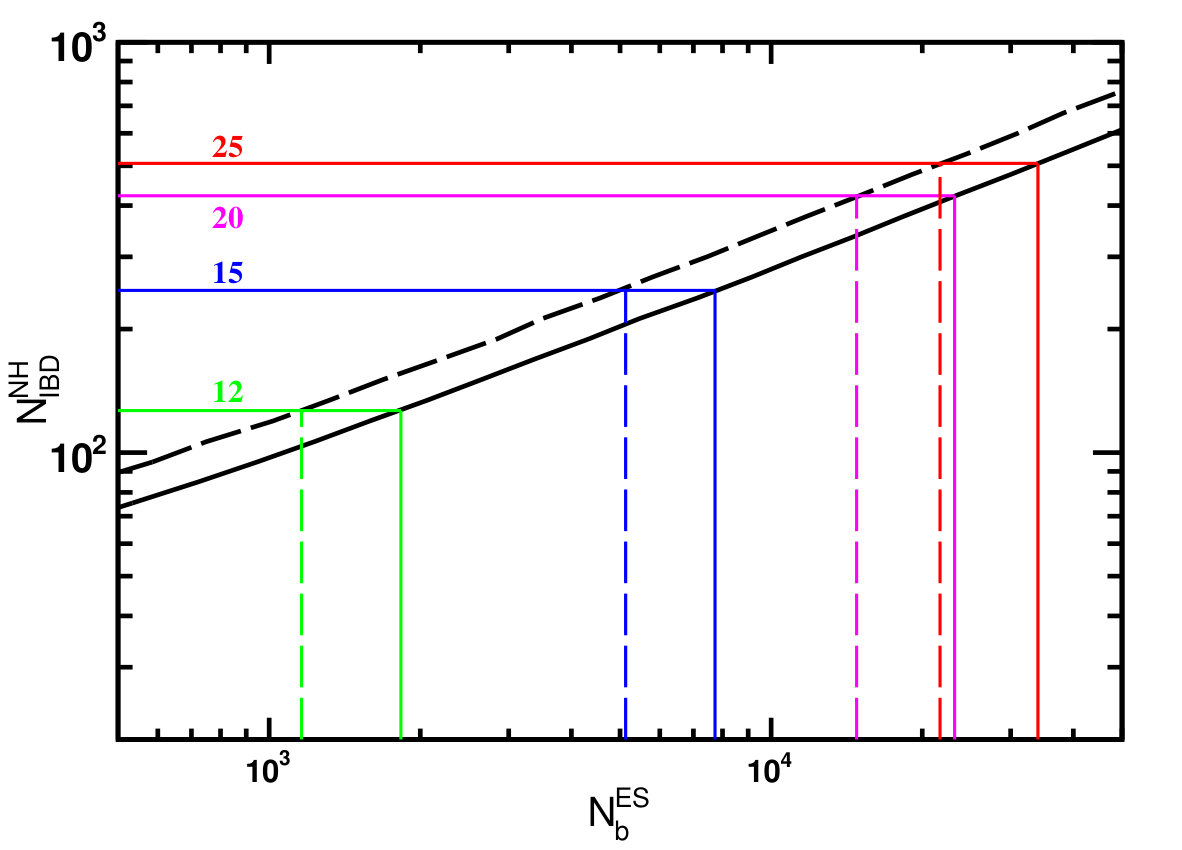 Figure 3
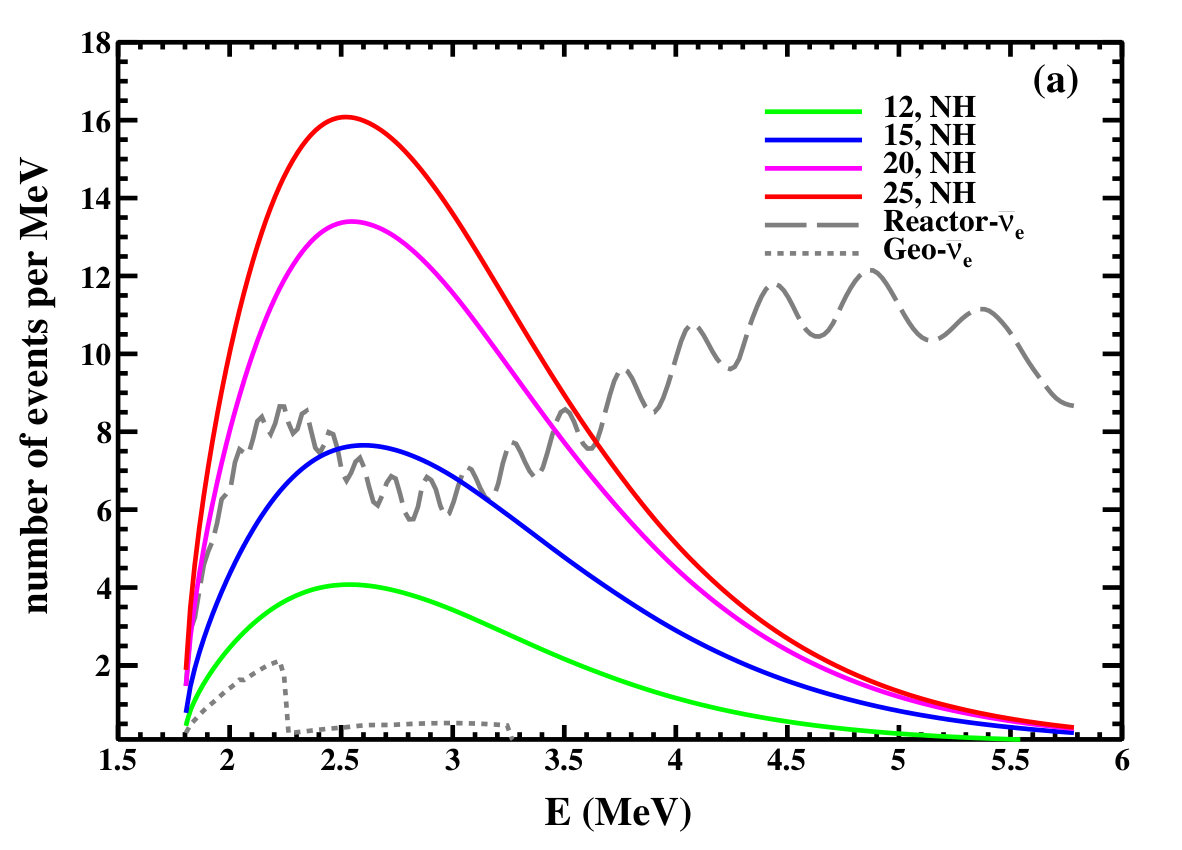 Figure 4
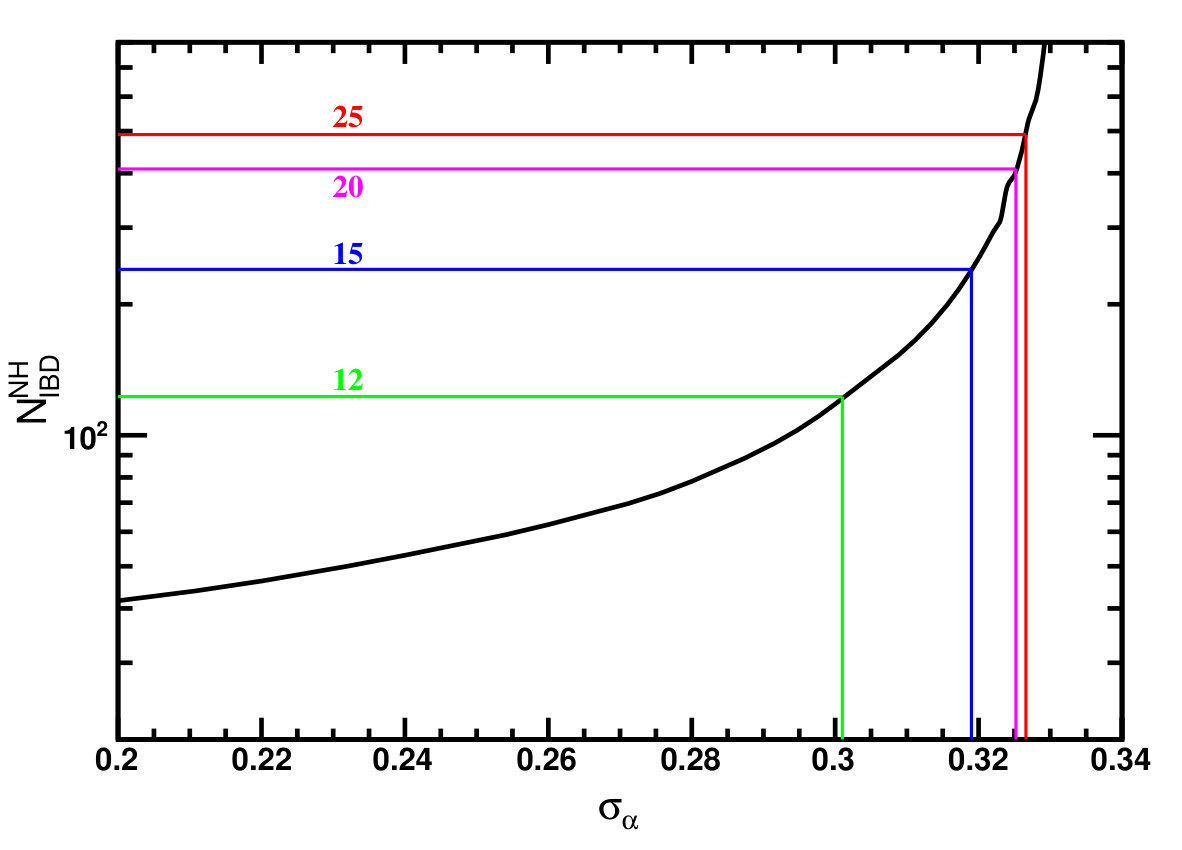 Figure 5
Peer Reviews
No public reviews on file for this paper yet. If you reviewed it on a platform where reviews are public (OpenReview, ICLR, NeurIPS, ICML), you can paste yours below so the community can read it here.
Videos
No videos yet. Explain this paper in a talk, walkthrough, or lecture? Add one.
Presupernova neutrino signals as potential probes of neutrino mass hierarchy
Gang Guo
Yong-Zhong Qian
Alexander Heger
GSI Helmholtzzentrum für Schwerionenforschung, Planckstrae 1, 64291 Darmstadt, Germany
School of Physics and Astronomy, University of Minnesota, Minneapolis, MN 55455, USA
Monash Centre for Astrophysics, School of Physics and Astronomy, Monash University, VIC 3800, Australia
Tsung-Dao Lee Institute, Shanghai 200240, China
Abstract
We assess the potential of using presupernova neutrino signals at the Jiangmen Underground Neutrino Observatory (JUNO) to probe the yet-unknown neutrino mass hierarchy. Using models for stars of 12, 15, 20, and , we find that if the signals from such a star can be predicted precisely and the star is within –880 pc, the number of events detected within one day of its explosion allows to determine the hierarchy at the confidence level. For determination at this level using such signals from Betelgeuse, which is at a distance of pc, the uncertainty in the predicted number of signals needs to be –30%. In view of more realistic uncertainties, we discuss and advocate a model-independent determination using both and signals from Betelgeuse. This method is feasible if the cosmogenic background for - scattering events can be reduced by a factor of –10 from the current estimate. Such reduction might be achieved by using coincidence of the background events, the exploration of which for JUNO is highly desirable.
1 Introduction
Stars are profuse sources of neutrinos. For massive stars of , as their central temperature and density increase dramatically during later evolution stages, () pair production by photo-neutrino emission, plasmon decay, and pair annihilation becomes the dominant mechanism of energy loss (e.g., [1, 2]). Likewise, and production by weak nuclear processes, including capture and decay, becomes more and more significant as such stars evolve. These neutrinos not only play essential roles in cooling the interiors of massive stars, but also serve as potential signatures of their evolution, which leads to the eventual core collapse and supernova (SN) explosion. With the next generation of detectors such as the Jiangmen Underground Neutrino Observatory (JUNO) [3] and the Deep Underground Neutrino Experiment (DUNE) [4] under construction, there is growing interest in detecting pre-SN neutrinos. Previous studies [5, 6, 7, 8, 9, 10, 11, 12] showed that it is plausible to detect the pre-SN from a star within a few kpc a few days before its explosion, thereby providing an advance warning. A promising candidate is Betelgeuse with an estimated mass of [13] and at a distance of pc [14].
In this paper we focus on the possibility of using pre-SN neutrinos to determine the yet-unknown neutrino mass hierarchy (MH). As these neutrinos propagate through the stellar interior, they undergo flavor transformation due to the Mikheyev-Smirnov-Wolfenstein (MSW) effect [15]. This effect depends on the electron number density profile of the star and the vacuum neutrino mixing parameters, especially on whether the MH is normal (NH) or inverted (IH) [16]. Because the survival probability of for the NH is much higher than that for the IH, the rate of (inverse -decay, IBD) events in a detector is correspondingly higher for the NH [7, 8, 10]. Unaware of any detailed analysis, here we quantitatively assess the potential of using pre-SN neutrino signals as probes of the MH.
Based on the typical energies and fluxes of pre-SN neutrinos, we focus on JUNO as the detector, whose best capability is to detect above MeV through IBD. The key input to determine the MH from pre-SN signals is the theoretical model for the stellar source. We adopt representative models [17] for stars of 12, 15, 20, and . For each model, we determine the limiting distance within which the NH or IH can be distinguished assuming that the predicted number of IBD signals is precise. We further estimate the maximum uncertainty permitted in the prediction so that such signals from Betelgeuse can be used to determine the MH. In view of realistic uncertainties, we finally discuss a model-independent determination using both IBD and - scattering (ES) events at JUNO.
2 Analyses with IBD events only
Pre-SN signals mostly occur a few days prior to core collapse and are predominantly produced by pair annihilation in a star. Weak nuclear processes contribute significantly to these signals within hour of the core collapse [6], but account for of the total pre-SN signals [10, 11, 12]. Below we only consider the signals from pair annihilation.
Without neutrino oscillations, the energy-differential pre-SN flux from a star is
[TABLE]
where is the energy, is time, is the distance to the star, is the energy-differential rate of production by pair annihilation per unit stellar volume, and is the differential volume element. The calculation of requires the temperature, , and the net electron number density, , both of which vary with the radius inside the star and with time.
Pre-SN undergo flavor transformation due to the MSW effect [15]. Inspection of the stellar profiles shows that flavor evolution of pre-SN with MeV is highly adiabatic. Therefore, the at JUNO is
[TABLE]
where is equivalent to or , for the NH, and for the IH [16, 18, 19]. For the time window and energy relevant for detection, we find that . Consequently, for the NH is times higher than that for the IH. We use detailed stellar models [17] to calculate .
The energy spectrum of pre-SN IBD events integrated over a time window [] is
[TABLE]
where is the total number of protons in JUNO (20 kton liquid scintillator with a proton mass fraction of %), is the IBD cross section, and is the detection efficiency [3]. In Fig. 1a, we show the over the last day prior to the core collapse at kpc for four stellar models [17] and the NH. For comparison, we also show the expected background, which is predominantly from the two closest reactors with negligible contributions from geo- [20]. As shown in Fig. 1a, pre-SN IBD spectra peak at MeV and decrease rapidly above MeV, where the reactor background dominates. For all the results on the IBD signals presented below, we adopt the energy window of MeV, where the lower value corresponds to the IBD threshold. We find that this choice is close to optimal for analyzing these signals. Within this energy window and over the last day prior to the core collapse at kpc, we expect 6.1 (1.9), 12.0 (3.6), 20.5 (5.9) and 24.5 (7.0) IBD signals in JUNO for the NH (IH) using stellar models [17] of 12, 15, 20 and , respectively. For comparison, 15.7 and 1.1 events are expected from reactor and geo-, respectively. The corresponding rates are shown as functions of time in Fig. 1b.
We now estimate the limiting distance within which pre-SN IBD signals might allow a determination of the MH. For each of our adopted stellar models, we calculate the predicted number, , of IBD events with MeV and over the time window as a function of and , where always corresponds to the onset of core collapse. We then determine how likely the cases of the NH and IH can be distinguished considering the background, statistical fluctuations, and uncertainty in .
We assume that the relative uncertainty of follows a Gaussian distribution normalized over , and that the expected number, , of background events is well measured. Under these assumptions, the observed number of events, , follows the distribution
[TABLE]
For a fixed set of , , , and , the distributions and cross at , where and are the predicted numbers of signals for the NH and IH, respectively. If the NH is true, then the probability of observing more than events is
[TABLE]
Given that , the above outcome can be distinguished from the case of the IH at a confidence level (CL) of
[TABLE]
Consequently, we have a probability of to exclude the IH at a CL of if the NH is true. Likewise, if the IH is true, we have a probability of to exclude the NH at a CL of . We take and refer to fulfillment of this criterion as determining the MH at the 95% CL.
To precisely predict , we must know with high accuracy the distance to the source and its stellar model for pre-SN neutrino emission. Assuming that is known exactly, we consider an ideal case of precisely predicted by taking for the uncertainty in the stellar model. For this case, we show in Fig. 2 combinations of and for which the MH can be determined at the 95% CL for each of the adopted stellar models. It can be seen that the largest values correspond to –4, 0.1–1, 0.2–1, and 0.2–1 day for stars of 12, 15, 20, and 25 , respectively. Taking day, we obtain , 0.6, 0.8, and 0.88 kpc, respectively, as the limiting distance within which the MH can be determined at the CL for the ideal case. We find that day is not only optimal for all of our stellar models in this case, but also for . We take day for all the analyses below.
For a specific source, and are related by a fixed factor and have the same relative uncertainty . Using Eqs. (4), (5), and (6), we show in Fig. 3 the combinations of and that are required to determine the MH at the 95% CL. As an example of using this figure, we assume that one of our stellar models provides a good description of Betelgeuse as a potential source. We take pc and show the predicted by our models in Fig. 3. It can be seen that if one of these models fits Betelgeuse, the uncertainty in the predicted is required to be so that its pre-SN IBD signals can be used to determine the MH at the CL. With the current measurement of pc for Betelgeuse [14], the error in already contributes to , which leaves little room for error in stellar models. An uncertainty of in the model prediction is permitted, however, if a precise distance measurement, e.g., at the level becomes available.
It is unclear which of our stellar models fits Betelgeuse. This uncertainty greatly increases the error in predicting its pre-SN IBD signals. Consistent with the mass estimate of Ref. [13], we assume that our 15 and models represent the limiting cases for Betelgeuse. Under this assumption, we estimate the restriction on so that the case of a star and the NH can be distinguished from that of a star and the IH. Using for a star in Eq. (5) and for a star in Eq. (6) and assuming the same for both these numbers, we find that is required to distinguish the two cases at the CL. This requirement is unlikely to be fulfilled by stellar models even if the distance to Betelgeuse can be measured precisely. Clearly, a model-independent determination of the MH is highly desirable. Below we discuss such a determination using both the pre-SN IBD and ES events at JUNO.
3 Model-independent analyses
All neutrino species contribute to the ES events. Subsequent to flavor evolution in the stellar interior, the pre-SN neutrino fluxes at JUNO for species other than are
[TABLE]
where for the NH, and for the IH [16, 18, 19]. Considering recoil electrons with kinetic energy and assuming 100% detection efficiency, we estimate the expected number, , of ES events as
[TABLE]
where is the total number of electrons in JUNO, , , is the electron rest mass, corresponds to , and is the differential cross section for - scattering [21]. In Eq. (10), the sum runs over , , , and , with the last two fluxes multiplied by and , respectively.
The pre-SN ES signals mostly occur at MeV, but solar neutrinos present a high background at MeV. Taking MeV and MeV, we obtain for all the stellar models considered. This ratio is insensitive to the energy and time windows. For our adopted windows, we find for all of our stellar models. In contrast, the above ratios along with give , which greatly exceeds . This large difference in between the NH and IH, along with the associated insensitivity to stellar models, provides the basis for a model-independent determination of the MH by combining the IBD and ES signals.
Unlike the IBD events, which can be identified by coincidence, ES causes single hits in the detector and suffers from high background. For our adopted energy window of MeV, the dominant background at JUNO is decay of the cosmogenic 11C, with an estimated level of events per day [3]. For comparison, the predicted number, , of pre-SN ES signals from Betelgeuse over the last day is 117.2 (143.5), 212.9 (259.0), 380.9 (467.1), or 479.8 (592.1) for the NH (IH) and a mass of 12, 15, 20, or , respectively. Therefore, the above model-independent method to determine the MH is practical only when the high ES background can be suppressed. Because is mainly produced by spallation following the shower initiated by cosmic muons, a three-fold coincidence of the muon, neutron, and 11C decay products can be used to suppress the background [22, 3]. With this possible experimental improvement in mind, we calculate the maximum allowed number, , of ES background events so that the model-independent method can be used to determine the MH at the 95% CL with the pre-SN signals from Betelgeuse.
We define
[TABLE]
where and , respectively, are the observed numbers of ES and IBD events including the associated background. The expected number, , of IBD background events is the same as in Section 2 and assumed to be well measured. The expected number, , of ES background events is to be constrained but is also assumed to be well measured. Similarly to the analyses in Section 2, and follow the corresponding Poisson distributions. To allow for large uncertainties in the predicted numbers of signals in view of the poorly-known stellar model of Betelgeuse, we calculate the expected numbers, and , of ES and IBD signals, respectively, for the NH (IH) as follows. We treat the predicted number, , of IBD signals as a parameter. For each predicted , we consider that the expected is uniformly distributed over as a conservative estimate. For each , we generate , , and by sampling Gaussian distributions for the ratios , , and . Based on our stellar models, we adopt central values of 3.42, 0.91, and 1.23, respectively, for these distributions, with a common relative uncertainty of 5% (including the –2% variations of the above ratios due to uncertainties in the vacuum neutrino mixing parameters [19]).
For each , we generate sets of and to calculate the distribution of , which peaks at (3.8). The distributions and cross at . Similarly to the analyses with IBD events only, we consider that the MH can be determined at the 95% CL when
[TABLE]
The combinations of and corresponding to the above criterion are shown as the solid curve in Fig. 4, where the predicted values of for our stellar models are also indicated. It is reasonable to assume that our 15 and models provide the limiting cases for Betelgeuse, especially when the results shown in Fig. 4 allow for a factor of 2 uncertainty in the model prediction. Accordingly, we conclude that the pre-SN IBD and ES signals from Betelgeuse over the last day can be used to determine the MH at the 95% CL in a model-independent manner if the ES background in JUNO can be reduced from by a factor of . If our model fits Betelgeuse better, the reduction needs to be by a factor of .
So far we have ignored the pre-SN produced by weak nuclear processes in stars. In view of the theoretical uncertainties associated with these , we estimate their maximum effect by treating their contribution to the ES signals as additional uncertainties in the ratios and . For a generous estimate, we consider that these are up to of those produced by pair annihilation in the relevant energy window [12]. As increasing by increases and by and , respectively, we adopt larger relative uncertainties of 20% and 10% for the Gaussian distributions of and , respectively, and repeat the calculations described above. The results are shown as the dashed curve in Fig. 4. It can be seen that the maximum effect of the pre-SN produced by weak nuclear processes is to require a further reduction of the ES background by a factor of for a model-independent determination of the MH with pre-SN neutrinos from Betelgeuse.
4 Discussion and conclusions
We have presented quantitative analyses of pre-SN neutrino signals at JUNO as potential probes of the MH. Using the IBD events alone, we have considered three cases, for all of which determination of the MH requires accurate stellar models of pre-SN neutrino emission. In the ideal case where the distance to the source is known exactly and the uncertainty in the predicted number, , of IBD events is 10%, the MH can be determined at 95% CL with pre-SN IBD signals over the last day from stars of 12, 15, 20, and within , 0.6, 0.8, and 0.88 kpc, respectively. In the case where the stellar model for the nearby Betelgeuse is known, determination at this level requires an uncertainty of in the predicted . In the more realistic case where our 15 and models provide the limiting cases for Betelgeuse, this uncertainty is restricted to . With the current measurement of pc for the distance to Betelgeuse [14], the error in already gives a uncertainty in the predicted . Even if this distance can be measured precisely, the required uncertainty of –30% in the prediction is difficult to achieve for stellar models.
We advocate a model-independent determination of the MH using both the pre-SN IBD and ES events at JUNO. This determination relies on the large difference in between the NH and IH, as well as the insensitivity of this ratio to stellar models. The key issue here is the ES background in the adopted energy window of MeV, which is dominated by decay of the cosmogenic 11C. Our analyses show that if our 15 and models provide the limiting cases for Betelgeuse, using its pre-SN IBD and ES signals to determine the MH at the CL requires this background to be events per day. With the background currently estimated to be events per day, the required reduction by a factor of is possible by using coincidence of the background events [22, 3]. Even if our model fits Betelgeuse better, the required reduction by a factor of might still be feasible. In any case, however, a further reduction by a factor of might be required when uncertainties associated with the pre-SN produced by weak nuclear processes are taken into account. On the other hand, measuring solar neutrinos at JUNO precisely may allow us to use the ES signals with MeV, which would increase the pre-SN signals significantly, thereby relaxing the requirement of the cosmogenic background reduction.
The pre-SN of –10 MeV from weak nuclear processes produce signals in both charged-current and neutral-current channels at DUNE. These signals can, in principle, provide a model-independent determination of the MH, which merits a quantitative assessment. We note, however, that the relevant event rates are low and have significant theoretical uncertainties.
A large number of neutrino events can be detected from a Galactic SN (e.g., [23, 24, 3, 25]). Flavor evolution of SN neutrinos, however, is complicated by details of their emission, SN dynamics, and collective oscillations (e.g., [26, 27]), which may make it difficult to determine the MH with these neutrinos. Therefore, pre-SN neutrinos are not only precursors to their SN counterpart, but also complementary probes of neutrino physics. We consider it an exciting possibility to determine the MH with pre-SN neutrinos from Betelgeuse and urge that background reduction at JUNO be explored for the model-independent determination presented here.
Acknowledgments
This work was supported in part by the Deutsche Forschungsgemeinschaft (279384907-SFB 1245, GG), the US Department of Energy (DE-FG02-87ER40328, YZQ), the Australian Research Council (FT120100363, AH), the National Natural Science Foundation of China (11655002, TDLI), and the Science and Technology Commission of Shanghai Municipality (16DZ2260200, TDLI).
The reference list from the paper itself. Each links out to its DOI / PubMed record.
- 1[1] N. Itoh, H. Hayashi, A. Nishikawa, and Y. Kohyama, Astrophys. J. Suppl. Ser. 102, 411 (1996).
- 2[2] G. Guo and Y.-Z. Qian, Phys. Rev. D 94, 043005 (2016).
- 3[3] F. An et al. (JUNO), J. Phys. G 43, 030401 (2016).
- 4[4] J. Strait et al., ar Xiv:1601.05823.
- 5[5] A. Odrzywolek, M. Misiaszek, and M. Kutschera, Astropart.Phys. 21, 303 (2004).
- 6[6] A. Odrzywolek and A. Heger, Proceedings, 16th Cracow Epiphany Conference on Physics in Underground Laboratories and its Connection with LHC, Acta Phys. Polon. B 41, 1611 (2010).
- 7[7] C. Kato, M. D. Azari, S. Yamada, K. Takahashi, H. Umeda, T. Yoshida, and K. Ishidoshiro, Astrophys. J. 808, 168 (2015).
- 8[8] K. Asakura et al. (Kam LAND), Astrophys. J. 818, 91 (2016).