Accelerating field enhancement due to ion motion in plasma wakefield accelerators
V.A. Minakov, A.P. Sosedkin, K.V. Lotov

TL;DR
This paper investigates how ion motion in plasma wakefield accelerators leads to a temporary increase in the electric field, affecting experimental interpretation and beam acceleration quality.
Contribution
It reveals the role of ion motion in enhancing the electric field in plasma wakefield accelerators, a factor previously underexplored.
Findings
Ion motion causes a temporal increase in the longitudinal electric field.
Energy redistribution in transverse direction influences wave dynamics.
Implications for experimental interpretation and beam quality enhancement.
Abstract
Ion motion in plasma wakefield accelerators can cause temporal increase of the longitudinal electric field shortly before the wave breaks. The increase is caused by re-distribution of the wave energy in transverse direction and may be important for correct interpretation of experimental results and acceleration of high-quality beams.
Click any figure to enlarge with its caption.
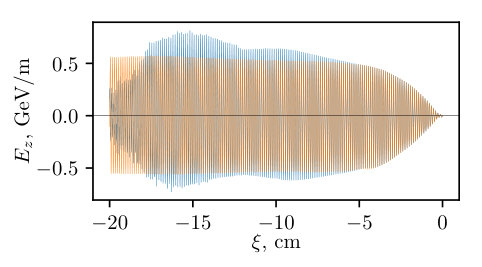 Figure 1
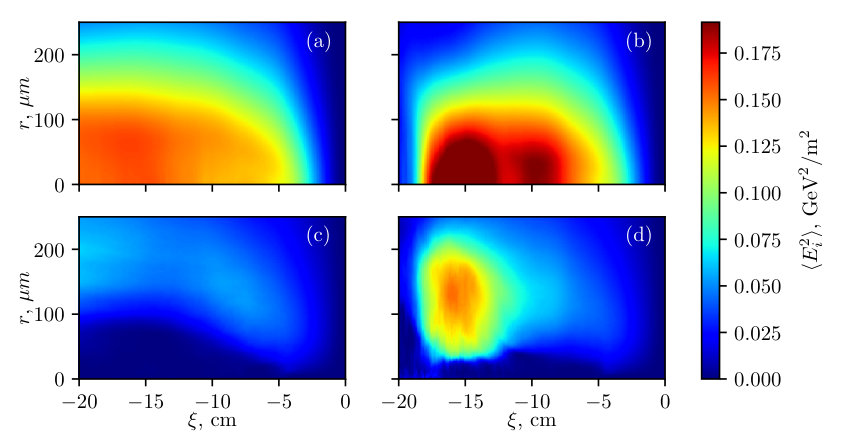 Figure 2
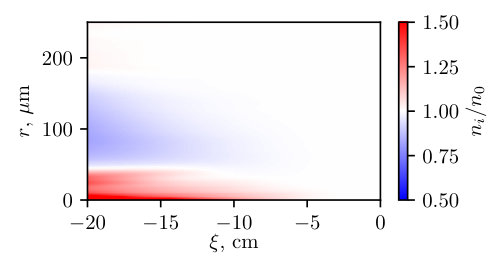 Figure 3
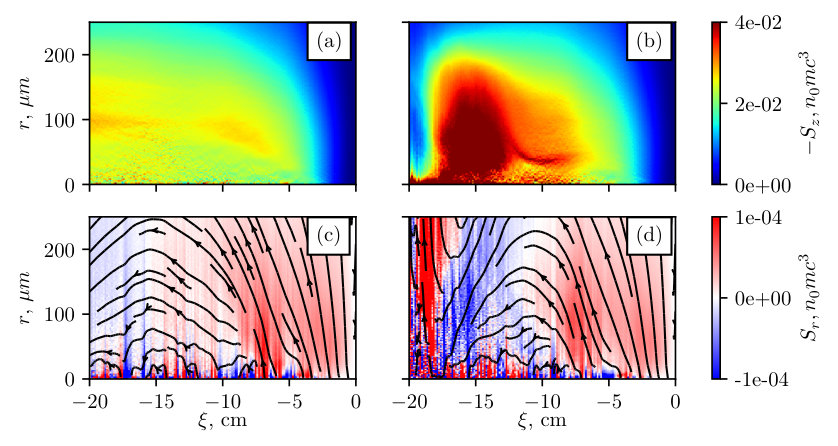 Figure 4
| Parameter & notation | Value |
|---|---|
| Plasma density, | |
| Distance to observation point, | 5 m |
| Plasma ion-to-electron mass ratio | 157 000 |
| Maximum beam density, | |
| Beam half-length, | 7 cm |
| Beam radius, | 0.2 mm |
| Beam energy, | 400 GeV |
| Beam energy spread, | 0.35% |
| Beam normalized emittance, , | mm mrad |
Peer Reviews
No public reviews on file for this paper yet. If you reviewed it on a platform where reviews are public (OpenReview, ICLR, NeurIPS, ICML), you can paste yours below so the community can read it here.
Videos
No videos yet. Explain this paper in a talk, walkthrough, or lecture? Add one.
Accelerating field enhancement due to ion motion in plasma wakefield accelerators
V.A. Minakov
Budker Institute of Nuclear Physics, Novosibirsk, 630090, Russia
Novosibirsk State University, Novosibirsk, 630090, Russia
A.P. Sosedkin
Budker Institute of Nuclear Physics, Novosibirsk, 630090, Russia
Novosibirsk State University, Novosibirsk, 630090, Russia
K.V. Lotov
Budker Institute of Nuclear Physics, Novosibirsk, 630090, Russia
Novosibirsk State University, Novosibirsk, 630090, Russia
Abstract
Ion motion in plasma wakefield accelerators can cause temporal increase of the longitudinal electric field shortly before the wave breaks. The increase is caused by re-distribution of the wave energy in transverse direction and may be important for correct interpretation of experimental results and acceleration of high-quality beams.
Keywords: plasma wakefield acceleration, ion motion, numerical simulations \ioptwocol
1 Introduction
Controllable electric fields in plasmas can exceed those in radio-frequency accelerating structures by orders of magnitude, and this ability promises size reduction of future particle accelerators. Of particular interest in this context is wakefield acceleration [1, 2, 3, 4, 5], in which the field is excited in the plasma for a short time between passage of the drive beam (laser pulse or particle bunch) and the accelerated witness beam.
The time interval between driver and witness is usually one or two periods of Langmuir wave. It is too short for heavy plasma ions to respond, so only plasma electrons participate in wave formation, while ions remain immobile. However, there are cases in which ion motion becomes important. These are very intense drivers or witnesses that perturb the ion background during a single wave period [6, 7, 8, 9, 10] and long drivers that resonantly excite the plasma wave during many wave periods [11, 13, 14, 12]. Our study refers to the second case.
The effect of ion motion on the plasma wave is usually destructive. Ion density perturbations cause phase mismatch of electron oscillations and wavebreaking [15, 16, 13, 14, 17]. However, at certain conditions, the ion motion results in increase of the longitudinal electric field near the axis. The increase is not drastic, about 20%, but this value may be important for correct interpretation of experimental results and acceleration of high-quality witnesses. We describe the discovered effect in Sec. 2 and suggest its explanation in Sec. 3.
2 Wakefield enhancement
The effect of wakefield enhancement was first noticed in numerical simulations of the AWAKE experiment. In AWAKE [18, 19, 20], a long proton bunch undergoes seeded self-modulation in the plasma [21, 22, 23] and transforms into a train of short micro-binches that resonantly drive the plasma wave [24, 25]. The number of micro-bunches depends on the plasma density and is typically about one hundred, so the plasma wave exists sufficiently long to move the ions. For this reason, AWAKE simulations usually include ion motion.
In simulations of various AWAKE regimes, the longitudinal electric field on the axis reaches higher values if ions are allowed to move (Fig. 12 in [26]). Figure 1 illustrates the effect for plasma and beam parameters listed in Table 1. The proton beam density before entering the plasma at is
[TABLE]
and zero otherwise. Here is the co-moving coordinate, and is the speed of light. The half-cut cosine profile (1) mimics plasma creation with rapid ionization of a neutral gas by a short laser pulse that co-propagates with the beam centroid. Simulations are made with quasi-static two-dimensional (axisymmetric) code LCODE [27, 28].
As we see in Fig. 1, the field enhancement is strongest shortly before wavebreaking, after which the longitudinal field quickly degrades in case of mobile ions. The effect cannot come from narrow field spikes, as the wakefield potential (in which all local spikes are averaged out) reveals the same trend.
3 Cause of wakefield enhancement
The onset of wakefield enhancement obviously correlates with visible perturbations of the ion density (Fig. 2). The density increases near the axis and decreases off-axis, which is typical for wakefields of narrow drivers [15, 16, 13, 17]. This density profile is known to distort wave fronts, which causes energy transfer from longitudinal to transverse oscillations [16]. Therefore, the increase of wave front curvature cannot account for the growth of the longitudinal field.
The effect comes from spatial redistribution of the wave energy. To make it visible, we look at the energy flux density in the co-moving frame [29]
[TABLE]
where , , and are mass, velocity, and relativistic factor of plasma particles, the summation is carried out over plasma particles in the unit volume, and are electric and magnetic fields, and is the unit vector in -direction. The energy in the co-moving window predominantly flows against -direction, so the component shows where the wakefield energy is (Fig. 3). Unlike the usual energy density, the energy flux density does not oscillate with the plasma frequency [17], which eases visualisation.
In the case of immobile ions, the energy remains at almost the same radial positions where it was delivered to the plasma by the beam [Fig. 3(a,c)], which is typical for weakly nonlinear waves [29]. If ions are allowed to move, there appears energy redistribution along the radius [Fig. 3(b,d)]. This is indeed the energy redistribution, as there is almost no beam in this region (), and the total energy flux
[TABLE]
is conserved. The energy concentrates near the axis and amplifies the wakefield amplitude there (Fig. 4). The effect dominates over energy transfer to the transverse field component [which certainly takes place, Fig. 4(d)], and we observe the overall enhancement of the longitudinal field [Fig. 4(c)]. Similar redistribution of energy may be responsible for temporal increase of the on-axis electric field immediately after wave-breaking in the case of laser-driven wakefield (Fig.1(b) of [17]).
Figure 3 contains another interesting feature not related to amplitude enhancement. After the wave breaks at cm, the longitudinal energy flux disappears [Fig. 3(b)], because the wake energy goes away in radial direction with high-energy electrons that appear after wave-breaking [Fig. 3(d)].
The question, however, remains why the wave energy drifts radially on this ion background. We have no answer yet. Apparently, this is not simply related to the ion density gradient, as gradients of both signs are present in the system, and we do not observe energy drift in different directions.
References
- [1]
S.M. Hooker, Developments in laser-driven plasma accelerators. Nature Photon. 7, 775 (2013).
- [2]
K.Nakajima, Laser-Driven Plasma Electron Acceleration and Radiation. Reviews of Accelerator Science and Technology 9, 19 (2016).
- [3]
M.J.Hogan, Electron and Positron Beam-Driven Plasma Acceleration. Reviews of Accelerator Science and Technology 9, 63 (2016).
- [4]
E. Adli and P. Muggli, Proton-Beam-Driven Plasma Acceleration. Reviews of Accelerator Science and Technology 9, 85 (2016).
- [5]
M.C. Downer, R. Zgadzaj, A. Debus, U. Schramm, and M.C. Kaluza, Diagnostics for plasma-based electron accelerators. Rev. Mod. Phys. 90, 035002 (2018).
- [6]
J.B.Rosenzweig, A. M.Cook, A.Scott, M.C.Thompson, and R.B.Yoder, Effects of Ion Motion in Intense Beam-Driven Plasma Wakefield Accelerators. Phys. Rev. Lett. 95, 195002 (2005).
- [7]
R. Gholizadeh, T. Katsouleas, P. Muggli, C. Huang, and W. Mori, Preservation of Beam Emittance in the Presence of Ion Motion in Future High-Energy Plasma-Wakefield-Based Colliders. Phys. Rev. Lett. 104, 155001 (2010).
- [8]
W. An, W.Lu, C. Huang, X. Xu, M.J. Hogan, C. Joshi, and W.B. Mori, Ion Motion Induced Emittance Growth of Matched Electron Beams in Plasma Wakefields. Phys. Rev. Lett. 118, 244801 (2017).
- [9]
C. Benedetti, C.B. Schroeder, E. Esarey, and W.P. Leemans, Emittance preservation in plasma-based accelerators with ion motion. Phys. Rev. Accel. Beams 20, 111301 (2017).
- [10]
T.J. Mehrling, C. Benedetti, C.B. Schroeder, E. Esarey, and W.P. Leemans, Suppression of Beam Hosing in Plasma Accelerators with Ion Motion. Phys. Rev. Lett. 121, 264802 (2018).
- [11]
V. A. Balakirev, V. I. Karas’, and I. V. Karas’, Charged Particle Acceleration by an Intense Ultrashort Electromagnetic Pulse Excited in a Plasma by Laser Radiation or by Relativistic Electron Bunches. Plasma Physics Reports 28, 125 (2002).
- [12]
S.M. Hooker, R. Bartolini, S.P.D. Mangles, A. Tünnermann, L. Corner, J. Limpert, A. Seryi, and R. Walczak, Multi-pulse laser wakefield acceleration: a new route to efficient, high-repetition-rate plasma accelerators and high flux radiation sources. J. Phys. B: At. Mol. Opt. Phys. 47, 234003 (2014).
- [13]
J.Vieira, R.A.Fonseca, W.B.Mori, and L.O.Silva, Ion Motion in Self-Modulated Plasma Wakefield Accelerators. Phys. Rev. Lett. 109, 145005 (2012).
- [14]
J. Vieira, R. A. Fonseca, W. B. Mori, and L. O. Silva, Ion motion in the wake driven by long particle bunches in plasmas. Phys. Plasmas 21, 056705 (2014).
- [15]
L.M.Gorbunov, P.Mora, and A.A.Solodov, Plasma ion dynamics in the wake of a short laser pulse. Phys. Rev. Lett. 86, 3332 (2001).
- [16]
L.M.Gorbunov, P.Mora, and A.A.Solodov, Dynamics of a plasma channel created by the wakefield of a short laser pulse. Phys. Plasmas 10, 1124 (2003).
- [17]
R.I. Spitsyn, I.V. Timofeev, A.P. Sosedkin, and K.V. Lotov, Characterization of wavebreaking time and dissipation of weakly nonlinear wakefields due to ion motion. Phys. Plasmas 25, 103103 (2018).
- [18]
E. Gschwendtner, E. Adli, L. Amorim, R. Apsimon, R. Assmann, A.-M. Bachmann, F. Batsch, J. Bauche, V.K. Berglyd Olsen, M. Bernardini, et al., AWAKE, The Advanced Proton Driven Plasma Wakefield Acceleration Experiment at CERN. Nuclear Instr. Methods A 829, 76 (2016).
- [19]
P.Muggli, E.Adli, R.Apsimon, F.Asmus, R.Baartman, A-M.Bachmann, M.Barros Marin, F.Batsch, J.Bauche, V.K.Berglyd Olsen, et al., AWAKE readiness for the study of the seeded self-modulation of a 400 GeV proton bunch. Plasma Phys. Control. Fusion 60, 014046 (2018).
- [20]
E. Adli, A. Ahuja, O. Apsimon, R. Apsimon, A.-M. Bachmann, D. Barrientos, F. Batsch, J. Bauche, V.K. Berglyd Olsen, M. Bernardini et al., Acceleration of electrons in the plasma wakefield of a proton bunch. Nature 561, 363 (2018).
- [21]
N.Kumar, A.Pukhov, and K.Lotov, Self-modulation instability of a long proton bunch in plasmas. Phys. Rev. Lett. 104, 255003 (2010).
- [22]
A. Caldwell, K. V. Lotov, Plasma wakefield acceleration with a modulated proton bunch. Phys. Plasmas 18, 103101 (2011).
- [23]
K. V. Lotov, Physics of beam self-modulation in plasma wakefield accelerators. Phys. Plasmas 22, 103110 (2015).
- [24]
M. Turner, E. Adli, A. Ahuja, O. Apsimon, R. Apsimon, A.-M. Bachmann, M. Barros Marin, D. Barrientos, F. Batsch, J. Batkiewicz, et al., Experimental Observation of Plasma Wakefield Growth Driven by the Seeded Self-Modulation of a Proton Bunch. Phys. Rev. Lett. 122, 054801 (2019).
- [25]
E. Adli, A. Ahuja, O. Apsimon, R. Apsimon, A.-M. Bachmann, D. Barrientos, M. M. Barros, J. Batkiewicz, F. Batsch, J. Bauche, et al., Experimental Observation of Proton Bunch Modulation in a Plasma at Varying Plasma Densities. Phys. Rev. Lett. 122, 054802 (2019).
- [26]
A. Caldwell, E. Adli, L. Amorim, R. Apsimon, T. Argyropoulos, R. Assmann, A.-M. Bachmann, F. Batsch, J. Bauche, V.K. Berglyd Olsen, et al., Path to AWAKE: Evolution of the concept. Nuclear Instr. Methods A 829, 3 (2016).
- [27]
K.V.Lotov, Fine wakefield structure in the blowout regime of plasma wakefield accelerators. Phys. Rev. ST - Accel. Beams 6, 061301 (2003).
- [28]
A.P.Sosedkin, K.V.Lotov, LCODE: A parallel quasistatic code for computationally heavy problems of plasma wakefield acceleration. Nuclear Instr. Methods A 829, 350 (2016).
- [29]
K.V.Lotov, Blowout regimes of plasma wakefield acceleration. Phys. Rev. E 69, 046405 (2004).
The reference list from the paper itself. Each links out to its DOI / PubMed record.
- 1[1] S.M. Hooker, Developments in laser-driven plasma accelerators. Nature Photon. 7 , 775 (2013).
- 2[2] K.Nakajima, Laser-Driven Plasma Electron Acceleration and Radiation. Reviews of Accelerator Science and Technology 9, 19 (2016).
- 3[3] M.J.Hogan, Electron and Positron Beam-Driven Plasma Acceleration. Reviews of Accelerator Science and Technology 9, 63 (2016).
- 4[4] E. Adli and P. Muggli, Proton-Beam-Driven Plasma Acceleration. Reviews of Accelerator Science and Technology 9, 85 (2016).
- 5[5] M.C. Downer, R. Zgadzaj, A. Debus, U. Schramm, and M.C. Kaluza, Diagnostics for plasma-based electron accelerators. Rev. Mod. Phys. 90, 035002 (2018).
- 6[6] J.B.Rosenzweig, A. M.Cook, A.Scott, M.C.Thompson, and R.B.Yoder, Effects of Ion Motion in Intense Beam-Driven Plasma Wakefield Accelerators. Phys. Rev. Lett. 95, 195002 (2005).
- 7[7] R. Gholizadeh, T. Katsouleas, P. Muggli, C. Huang, and W. Mori, Preservation of Beam Emittance in the Presence of Ion Motion in Future High-Energy Plasma-Wakefield-Based Colliders. Phys. Rev. Lett. 104, 155001 (2010).
- 8[8] W. An, W.Lu, C. Huang, X. Xu, M.J. Hogan, C. Joshi, and W.B. Mori, Ion Motion Induced Emittance Growth of Matched Electron Beams in Plasma Wakefields. Phys. Rev. Lett. 118, 244801 (2017).