Dynamically Generated Inflation from Non-Riemannian Volume Forms
David Benisty, Eduardo Guendelman, Emil Nissimov, Svetlana Pacheva

TL;DR
This paper introduces a modified gravity model using non-Riemannian volume forms that naturally generates an inflationary potential, leading to cosmological predictions consistent with current observations.
Contribution
It presents a novel gravity model with non-Riemannian volume elements that produce inflationary dynamics without initial matter fields.
Findings
Predicts spectral index n_s ≈ 0.96
Predicts tensor-to-scalar ratio r ≈ 0.002
Compatible with observational data for 60 e-folds
Abstract
We propose a simple modified gravity model without any initial matter fields in terms of several alternative non-Riemannian spacetime volume elements within the metric (second order) formalism. We show how the non-Riemannian volume-elements, when passing to the physical Einstein frame, create a canonical scalar field and produce dynamically a non-trivial inflationary-type potential for the latter with a large flat region and a stable low-lying minimum. We study the evolution of the cosmological solutions from the point of view of theory of dynamical systems. The theory predicts the spectral index and the tensor-to-scalar ratio for 60 e-folds, which is in accordance with the observational data. In the future Euclid and SPHEREx missions or the BICEP3 experiment are expected to provide experimental evidence to test those predictions.
Click any figure to enlarge with its caption.
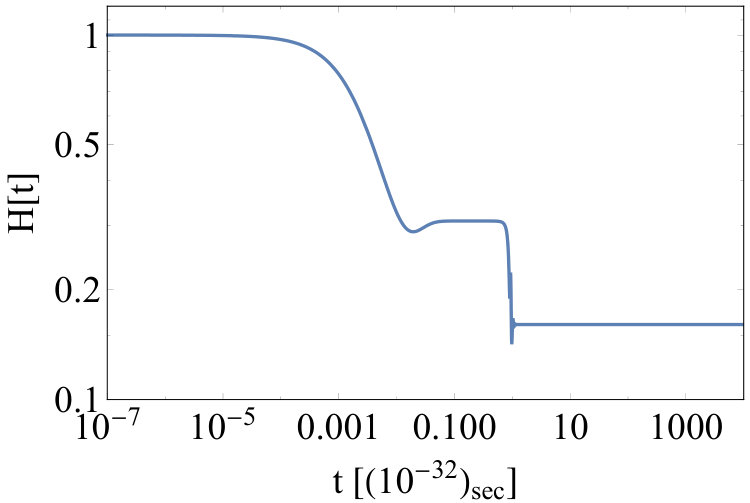 Figure 1
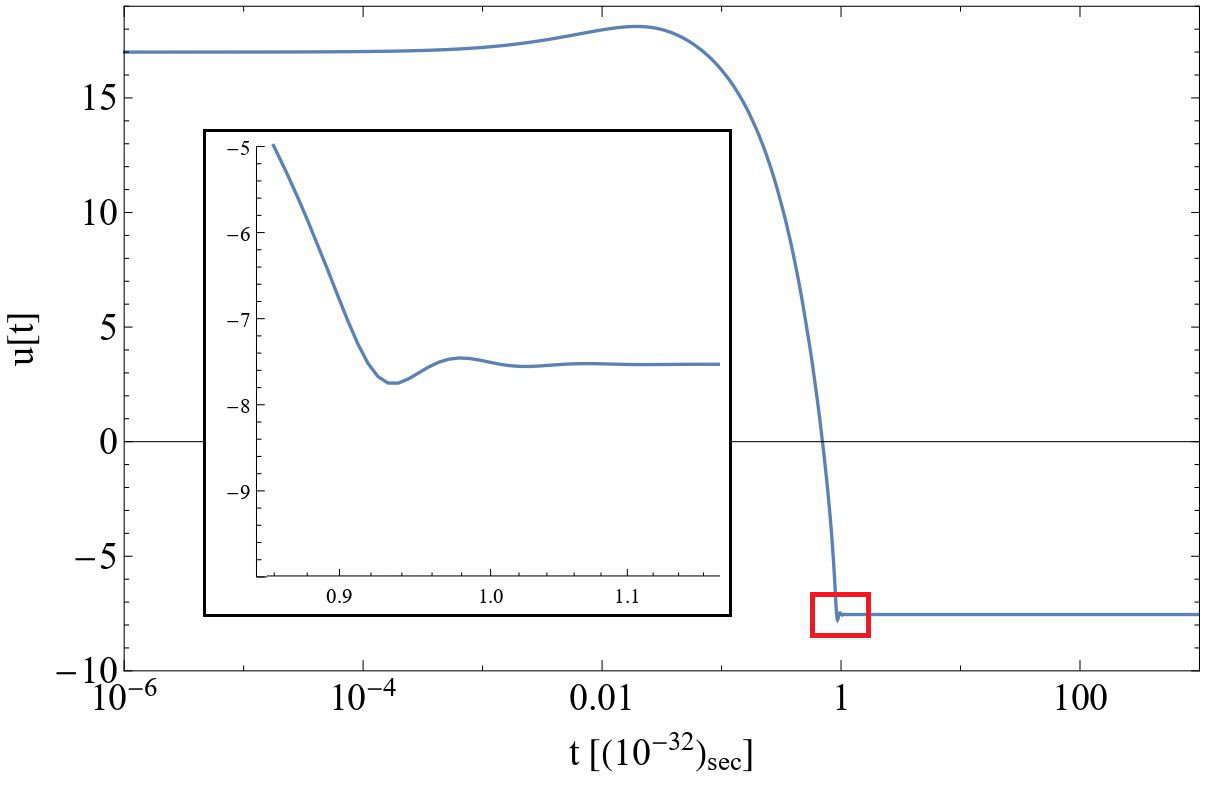 Figure 2
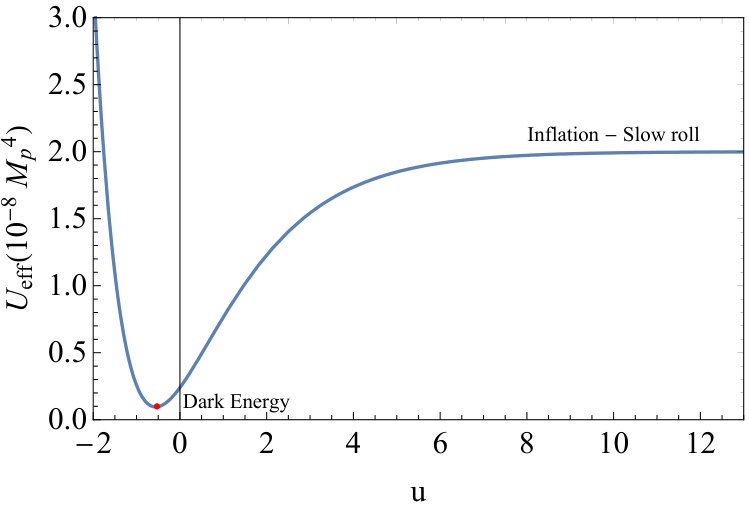 Figure 3
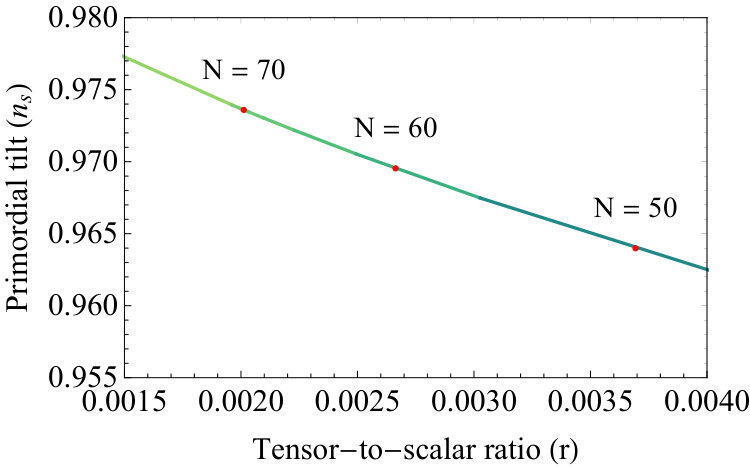 Figure 4
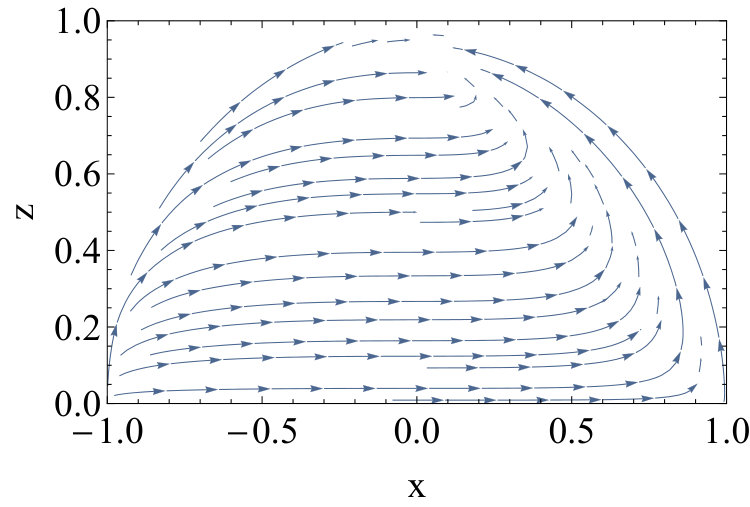 Figure 5
Peer Reviews
No public reviews on file for this paper yet. If you reviewed it on a platform where reviews are public (OpenReview, ICLR, NeurIPS, ICML), you can paste yours below so the community can read it here.
Videos
No videos yet. Explain this paper in a talk, walkthrough, or lecture? Add one.
∎
\thankstext
e1e-mail: [email protected] \thankstexte2e-mail: [email protected] \thankstexte3e-mail: [email protected] \thankstexte4e-mail: [email protected]
11institutetext: Physics Department, Ben-Gurion University of the Negev, Beer-Sheva 84105, Israel 22institutetext: Frankfurt Institute for Advanced Studies (FIAS), Ruth-Moufang-Strasse 1, 60438 Frankfurt am Main, Germany 33institutetext: Bahamas Advanced Study Institute and Conferences, 4A Ocean Heights, Hill View Circle, Stella Maris, Long Island, The Bahamas 44institutetext: Institute for Nuclear Research and Nuclear Energy, Bulgarian Academy of Sciences, Sofia, Bulgaria
Dynamically Generated Inflation from Non-Riemannian Volume Forms
D. Benisty\thanksrefe1,addr1,addr2
E. I. Guendelman\thanksrefe2,addr1,addr2,addr3
E. Nissimov \thanksrefe3,addr4
S. Pacheva \thanksrefe4,addr4
Abstract
We propose a simple modified gravity model without any initial matter fields in terms of several alternative non-Riemannian spacetime volume elements within the metric (second order) formalism. We show how the non-Riemannian volume-elements, when passing to the physical Einstein frame, create a canonical scalar field and produce dynamically a non-trivial inflationary-type potential for the latter with a large flat region and a stable low-lying minimum. We study the evolution of the cosmological solutions from the point of view of theory of dynamical systems. The theory predicts the spectral index and the tensor-to-scalar ratio for 60 -folds, which is in accordance with the observational data. In the future Euclid and SPHEREx missions or the BICEP3 experiment are expected to provide experimental evidence to test those predictions.
1 Introduction
Developments in cosmology have been influenced to a great extent by the idea of inflation Starobinsky:1979ty ; Starobinsky:1980te ; Linde:1981mu ; Guth:1980zm ; Albrecht:1982wi , which provides an attractive solution of the fundamental puzzles for the standard Big Bang model, as the horizon and the flatness problems. In addition, providing a framework for sensible calculations of primordial density perturbations were discussed in Mukhanov:1981xt ; Guth:1982ec . However, it has been recognized that a successful implementation requires some very special restrictions on the dynamics that drives inflation. In particular, in New Inflation Linde:1981mu , a potential with a large flat region, which then drops to zero (or almost zero) in order to reproduce the vacuum with almost zero (in Planck units) cosmological constant of the present universe, is required.
In a parallel development, extended (modified) gravity theories as alternatives/generalizations of the standard Einstein General Relativity are being extensively studied in the last decade or so. The main motivation for this development comes from:
- •
(a) Cosmology – modified gravity may solve the problems of dark energy and dark matter and explain the large scale structure and the accelerated expansion of the universe Perlmutter:1998np ; Copeland:2006wr );
- •
(b) Quantum field theory in curved spacetime – because of non-renormalizability of standard general relativity in higher loops it fails to describe the universe at quantum scales weinberg-79 ;
- •
(c) Modern String theory – because of the natural appearance of scalar-tensor couplings and higher-order curvature invariants in low-energy effective field theories aimed at phenomenologically realistic description of particle physics GSW-1 .
The principal approaches to construct modified gravity theories include -gravity, scalar-tensor theories, Gauss-Bonnet gravity models. For detailed accounts, see the book extended-grav-book and the extensive reviews extended-grav ; odintsov-1 ; berti-etal ; odintsov-2 , as well as for further details Refs.Dvali:1998pa -Benisty:2019jqz .
One broad class of actively developed modified/extended gravitational theories is based on employing alternative non-Riemannian spacetime volume-forms, i.e., metric- independent generally covariant volume elements in the pertinent Lagrangian actions on spacetime manifolds with an ordinary Riemannian geometry, instead of the canonical Riemannian volume element whose density is given by the square-root of the determinant of the Riemannian metric:
[TABLE]
originally proposed in TMT-orig-0 ; Hehl ; TMT-orig-1 ; TMT-orig-2 ; 5thforce . For a concise geometric formulation, see susyssb-1 ; grav-bags .
This formalism was used as a basis for constructing a series of extended gravity-matter models describing unified dark energy and dark matter scenario dusty ; dusty-2 , quintessential cosmological models with gravity-assisted and inflaton-assisted dynamical suppression (in the “early” universe) or generation (in the post-inflationary universe) of electroweak spontaneous symmetry breaking and charge confinement grf-essay ; varna-17 ; bpu-10 , and a novel mechanism for the supersymmetric Brout-Englert-Higgs effect in supergravity susyssb-1 .
In the present paper we propose a very simple gravity model without any initial matter fields involving several non-Riemannian volume-forms instead of the standard Riemannian volume element . We show how the non-Riemannian volume-elements, when passing to the physical Einstein frame, generate a canonical scalar field and manage to create dynamically a non-trivial inflationary-type potential for with a large flat region for large positive and a stable low-lying minimum, i.e., will play the role of a dynamically created “inflaton”. This dynamically generated inflationary potential turns out to be a generalization of the well-known Starobinsky potential Starobinsky:1979ty .
We study the evolution of the cosmological solutions from the point of view of the theory of dynamical systems and calculate the spectral index and the tensor-to-scalar ratio in our model whose values are in accordance with the observational data.
In Section 2 below we briefly review the general notion of volume forms on arbitrary differential manifolds. Section 3 briefly presents the general construction of Lagrangian actions on Riemannian manifolds employing metric-independent (non-Riemannian) volume forms (volume elements). Our main results are contained in Sections 4, 5 and 6. In Section 4 we propose our simple modified gravity model in terms of several non-Riemannian volume elements without any matter fields and derive the corresponding Einstein-frame description with the associated dynamical creation of a canonical scalar field with a non-trivial effective inflationary potential. In Section 5 we study the cosmological evolutionary solutions within the Friedmann-Lemaitre-Robertson-Walker framework. In Section 6 we derive the explicit expressions for the Hubble slow-roll parameters and use them to obtain analytic results for the scalar power spectral index and the tensor-to-scalar ratio which we compare with the available observational data.The last Section 7 contains our conclusions.
2 Non-Riemannian Volume-Forms Formalism
Let us first recall the general notion of volume-forms (volume elements) in integrals over arbitrary differentiable manifolds – not necessarily Riemannian one, so no metric is needed. Volume forms are given by nonsingular maximal rank differential forms (see e.g. Ref.spivak ):
[TABLE]
(our conventions for the alternating symbols and are: and ).
The volume element density , as it is evident from its definition in (2), transforms as scalar density under general coordinate reparametrizations on the manifold.
In Riemannian -dimensional spacetime manifolds a standard generally-covariant volume-form is defined through the “D-bein” (frame-bundle) canonical one-forms ():
[TABLE]
To construct modified gravitational theories as alternatives to ordinary standard theories in Einstein’s general relativity, instead of we can employ one or more alternative non-Riemannian volume element densities as in (2) given by non-singular exact -forms where:
[TABLE]
Thus, the non-Riemannian volume element density is defined in terms of the (scalar density of the) dual field-strength of an auxiliary rank tensor gauge field and it transforms as scalar density under general coordinate transformations, which is evident from its definition (4). Accordingly, the integration element is manifestly invariant under general coordinate transformations.
Let us stress that the term “non-Riemannian” relates only to the nature of the volume element density (4), whose definition does not involve the metric. Otherwise the geometry of the spacetime is a regular Riemannian one – scalar products of vector fields are given as usual by the Riemannian metric , the connection is the usual Levi-Civita one in terms of , there is no torsion, etc..
3 The Action
In general, modified gravity Lagrangian actions based on the non-Riemannian volume-form formalism have the following generic form (here and below we are using units with ):
[TABLE]
Here are several different non-Riemannian volume element densities of the form (4), i.e., defined by auxiliary rank 3 tensor gauge fields ; denotes the scalar curvature in either first-order (Palatini) or second order (metric) formalism; and are some matter field Lagrangians; the dots indicate possible additional terms containing higher powers of the non-Riemannian volume element densities e.g., \bigl{(}\Phi_{1}(A)\bigr{)}^{2}/\sqrt{-g}. The specific forms of and can be uniquely fixed via the requirement for invariance of (5) under global Weyl-scale invariance (see (10) below).
Let us stress that the modified gravity action (5), in complete analogy with
[TABLE]
which is the standard Einstein-Hilbert action, is explicitly invariant under general coordinate reparametrizations since, as mentioned above, non-Riemannian volume element densities transform as scalar densities similarly to .
A characteristic feature of the modified gravitational theories (5) is that when starting in the first-order (Palatini) formalism all non-Riemannian volume-forms are almost pure-gauge degrees of freedom, i.e. they do not introduce any additional physical (field-propagating) gravitational degrees of freedom except for few discrete degrees of freedom with conserved canonical momenta appearing as arbitrary integration constants. The reason is that the modified gravity action in Palatini formalism is linear w.r.t. the velocities of some of the auxiliary gauge field components defining the non-Riemannian volume element densities, and does not depend on the velocities of the rest of auxiliary gauge field components. The (almost) pure-gauge nature of the latter is explicitly shown in Refs.grav-bags ; grf-essay (appendices A) employing the standard canonical Hamiltonian treatment of systems with gauge symmetries, i.e., systems with first-class Hamiltonian constraints a’la Dirac (e.g., henneaux-teitelboim ; rothe ).
Unlike Palatini formalism, the above situation changes significantly when we treat (5) in the second order (metric) formalism. In the latter case the “Einstein-Hilbert” part of the modified gravity action (5) contains second order time derivative terms of the metric in , which is in sharp contrast with the case of ordinary Riemannian volume element where the corresponding second-order time derivatives amount to a total derivative. According to the general canonical Hamiltonian treatment of systems with higher-order time derivatives on the canonical variables (see e.g., gitman-tyutin – modern version of the classical Ostrogradsky formalism ostrogradski ) the presence of the latter implies the appearance of some of the corresponding velocities as additional physical degrees of freedom. In the present case this is reflected in the fact that (as we will see below, Eqs.(19)-(21)) upon passing to the physical Einstein frame via conformal transformation:
[TABLE]
the first non-Riemannian volume element density in (5) is not any more a “pure gauge”, but creates a new dynamical canonical scalar field via . In the following Section we will see how a non-trivial inflationary potential for is dynamically generated.
4 Einstein Frame - the Effective Scalar Potential
Let us now consider the simplest member in the class of modified gravitational models (5) with no original matter fields. i.e., and , and where we only add a quadratic term w.r.t. non-Riemannian volume element density :
[TABLE]
Here is the scalar curvature in the second order (metric) formalism and:
[TABLE]
The specific form of the action (8) is dictated by the requirement about global Weyl-scale invariance under:
[TABLE]
where .
Scale invariance has always played an important role since the original papers on the non-canonical volume-form formalism TMT-orig-1 .
In a more general context let us recall, that scale invariance is a symmetry which relates small scales to large scales. As such (together with conformal symmetry) it plays fundamental role in quantum field theory and modern string theory in particle physics at (ultra)high energies as it dynamically generates (via spontaneous breakdown) mass scales hierarchies. On the other hand it plays an important role in cosmology as well, where it leads naturally to flat inflationary potentials (in the present context this is because it introduces a shift symmetry of the scalar field(s)) and produces candidates for dark matter (see the lectures at CERN’s Workshop on “Scale invariance in particle physics and cosmology”, Ref.CERN-workshop ). Also let us note another specific application of spontaneously broken dilatation symmetry in combination with application of the non-canonical volume form formalism: elimination of the Fifth Force Problem in a quintessential inflationary scenario 5thforce .
The equations of motion resulting from (8) upon variation w.r.t. the auxiliary gauge fields yield, respectively:
[TABLE]
Here and are (dimensionful and dimensionless, respectively) integration constants. The appearance of indicate spontaneous breaking of global Weyl symmetry (10).
The equations of motion w.r.t. from (8) read:
[TABLE]
with as in (7). On the other hand, taking the trace of (13) and using Eq.(11) we obtain the equation of motion for :
[TABLE]
We now transform Eqs.(13) and (14) via the conformal transformation (7) and show that the transformed equations acquire the standard form of Einstein equations w.r.t. the new “Einstein-frame” metric . To this end we are using the known formulas for the conformal transformations of and , the latter being an arbitrary scalar field, in particular (see e.g. Ref.dabrowski ; bars indicate magnitudes in the -frame):
[TABLE]
[TABLE]
and
[TABLE]
Following the analogous derivation in Ref.benisty-1 , upon using (15)-(16) we rewite Eqs.(13) as:
[TABLE]
where we have redefined:
[TABLE]
in order to obtain a canonically normalized kinetic term for the scalar field , and where:
[TABLE]
On the other hand, using (16) we rewrite Eq.(14) in terms of the canonical scalar field :
[TABLE]
with as in (19).
Accordingly, the corresponding Einstein-frame action reads:
[TABLE]
We now observe an important result – in (21) we have a dynamically created scalar field with a non-trivial effective scalar potential (19) entirely dynamically generated by the initial non-Riemannian volume elements in (8) because of the appearance of the free integration constants in their respective equations of motion (11)-(12).
The qualitative shape of (19) is depicted on Fig.1. The effective potential has two main features relevant for cosmological applications. First, (19) possesses a flat region for large positive and, second, it has a stable minimum for a small finite value :
(i) for large ;
(ii) for where:
[TABLE]
The flat region of for large positive correspond to “early” universe’ inflationary evolution with energy scale . On the other hand, the region around the stable minimum at (22) correspond to “late” universe’ evolution where the minimum value of the potential:
[TABLE]
is the dark energy density value Angus:2018tko ; Zhang:2018gbq .
Let us note that the effective potential (19) generalizes the well-known Starobinsky inflationary potential Starobinsky:1979ty ((19) reduces to Starobinsky potential upon taking the following special values for the parameters: ).
5 Evolution of the homogeneous solution
We now consider reduction of the Einstein-frame action (21) to the Friedmann-Lemaitre-Robertson-Walker (FLRW) setting with metric , and with . In order to study the evolution of the scalar field and the Friedmann scale factor , it is useful to use the method of autonomous dynamical systems.
The FLRW action describes a minimally coupled canonical scalar field with specific potential (19) (using again units with ):
[TABLE]
Variations w.r.t. (and subsequently using the gauge for the lapse function) yield the pertinent Friedmann and field equations ( being the Hubble parameter):
[TABLE]
In the treatment of Eqs.(25)-(27) it is instructive to rewite them in terms of a set of dimensionless parameters (following the approach in Ref.Bahamonde:2017ize ):
[TABLE]
with as in (23). In these coordinates the system defines a closed orbit:
[TABLE]
which is equivalent to the first Friedmann equation (25).
Employing the variables in Eqs.(25)-(27) and taking into account the constraint (29) we obtain the autonomous dynamical system w.r.t. :
[TABLE]
where the primes denote derivative w.r.t. the parameter , and the function is defined as:
[TABLE]
The phase portrait of the system (30) is depicted on Fig.2. There are two critical points in the system. The stable point corresponds to the “late” universe de Sitter solution with the asymptotic cosmological constant (23).
The second point is unstable corresponding to the beginning of the universe’ evolution in the “early” universe at large . If the evolution starts at any point close to , initially the evolution is of de Sitter type with effective cosmological constant . Then the dynamics drives the system away from all the way towards the stable point at late times.
Numerical solutions are demonstrated in Fig. 3. One can see that the Hubble parameter begins and ends with two different values. The first one is related to the inflationary epoch and the other related to the dark energy in the late universe. The scalar field oscillates around the minimum point (22) of (19), which corresponds to particle creation in the reheating epoch.
6 Perturbations
In order to check the viability of the model we investigate the perturbations of the above background evolution, in particular focusing on the inflationary observables such as the scalar spectral index and the tensor-to-scalar ratio . As usual, we introduce the Hubble slow-roll parameters Martin:2013tda ; Bamba:2016wjm , which in our case using the potential (19) read:
[TABLE]
where:
[TABLE]
with – the dark energy density (23), and therefore very small.
Inflation ends when for some where ():
[TABLE]
For the number of -foldings we obtain:
[TABLE]
where and is very large corresponding to the start of the inflation. Ignoring and using the last equality (35) we have approximately:
[TABLE]
Using the slow-roll parameters, one can calculate the values of the scalar spectral index and the tensor-to-scalar ratio respectively as Nojiri:2019kkp ; Dalianis:2018frf :
[TABLE]
Taking into account Eqs.(32),(33) (ignoring ) and (37) we find:
[TABLE]
and
[TABLE]
where is the solution of the transcedental Eq.(37) for as a function of .
One viable example in our model is to take -folds. Eq.(37) yields provided we choose , which yields . In such a way the observables are predicted to be:
[TABLE]
which are well inside the PLANCK observed constraints Akrami:2018odb :
[TABLE]
Fig. 4 demonstrates the relation between the number of -folds and the dimensionless parameters. One can see that all those values fit the latest PLANCK collaboration constraints.
7 Conclusions
We propose a very simple gravity model without any initial matter fields in terms of several alternative non-Riemannian spacetime volume elements within the second order (metric) formalism. We show how the non-Riemannian volume-elements, when passing to the physical Einstein frame, create a canonical scalar field and produce dynamically a non-trivial inflationary-type potential for the latter with a large flat region and a stable low-lying minimum. We study the evolution of the cosmological solutions from the point of view of the theory of dynamical systems. Our model predicts scalar spectral index and tensor-to-scalar ratio for 60 -folds, which is in accordance with the observational data.
A natural next step is to consider two-field inflation (Refs. Bahamonde:2017ize ; 2-field-inflation-1 ; 2-field-inflation-1a ; 2-field-inflation-2 ; Ben-Dayan:2018mhe ; Artymowski:2019vfy ; Ben-Dayan:2014isa ; Benisty:2019bmi ; Aragam:2019khr ; Kubo:2018kho , for a geometric treatment see Refs. lili ; MadrizAguilar:2019wgd ; Barvinsky:2019qzx ; Ahmad:2019jbm ; Granda:2019jqy , and references therein) by adding a new scalar field with non-trivial potentials in the starting modified gravity action (8) built in terms of several non-Riemannian volume elements and subject to preserving the requirement of global Weyl-scale invariance (10).In this case the non-Riemannian volume elements will again generate a second scalar field and create dynamically a non-trivial two-field scalar potential with a very specific geometry of the field space of . This is studied in more detail in our subsequent work Benisty:2019bmi , where it is shown that the latter dynamically generated two-field inflationary model similarly conforms to the observational data.
Acknowledgements.
We gratefully acknowledge support of our collaboration through the Exchange Agreement between Ben-Gurion University, Beer-Sheva, Israel and Bulgarian Academy of Sciences, Sofia, Bulgaria. E.N. and S.P. are thankful for support by Contract DN 18/1 from Bulgarian National Science Fund. D.B., E.G. and E.N. are also partially supported by COST Actions CA15117, CA16104 and the action CA18108. D.B., E.N. and S.P. acknowledge illuminating discussions with Lilia Anguelova. Finally we would like to thank the referees whose comments contributed to significant improvement of the presentation.
The reference list from the paper itself. Each links out to its DOI / PubMed record.
- 1(1) A. A. Starobinsky, JETP Lett. 30 (1979) 682 [Pisma Zh. Eksp. Teor. Fiz. 30 (1979) 719].
- 2(2) A. A. Starobinsky, Phys. Lett. B 91 , 99 (1980)
- 3(3) A. H. Guth, Phys. Rev. D 23 (1981) 347
- 4(4) A. D. Linde, Phys. Lett. 108B , 389 (1982).
- 5(5) A. Albrecht and P. J. Steinhardt, Phys. Rev. Lett. 48 , 1220 (1982)
- 6(6) V. F. Mukhanov and G. V. Chibisov, JETP Lett. 33 , 532 (1981) [Pisma Zh. Eksp. Teor. Fiz. 33 , 549 (1981)].
- 7(7) A. H. Guth and S. Y. Pi, Phys. Rev. Lett. 49 (1982) 1110.
- 8(8) S. Perlmutter et al. [Supernova Cosmology Project Collaboration], Astrophys. J. 517 , 565 (1999) [astro-ph/9812133].