Polytetrahedral short-range order and crystallization stability in supercooled ${\rm Cu_{64.5}Zr_{35.5}}$ metallic liquid
R.E. Ryltsev, N.M. Chtchelkatchev

TL;DR
This study compares interatomic potentials for Cu-Zr alloys, revealing that local structural differences in supercooled liquids influence crystallization stability, with icosahedral order enhancing stability.
Contribution
It demonstrates how different potential models affect predicted local structures and crystallization stability in supercooled Cu-Zr alloys, highlighting the importance of structural details.
Findings
Similar liquid structures at low supercooling across models
Different local structures in deeply supercooled liquids
Icosahedral order correlates with increased crystallization stability
Abstract
Development of reliable interatomic potentials is crucial for theoretical studies of relationship between chemical composition, structure and observable properties in glass-forming metallic alloys. Due to ambiguity of potential parametrization procedure, some crucial properties of the system, such as crystallization stability or symmetry of the ground state crystal phase, may not be correctly reproduced in computer simulations. Here we address this issue for alloy described by two modifications of embedded atom model potential as well as by \textit{ab initio} molecular dynamics. We observe that, at low supercooling, both models provide very similar liquid structure, which agrees with that obtained by \textit{ab initio} simulations. Hoverer, deeply supercooled liquids demonstrate essentially different local structure and so different crystallization stability.…
Click any figure to enlarge with its caption.
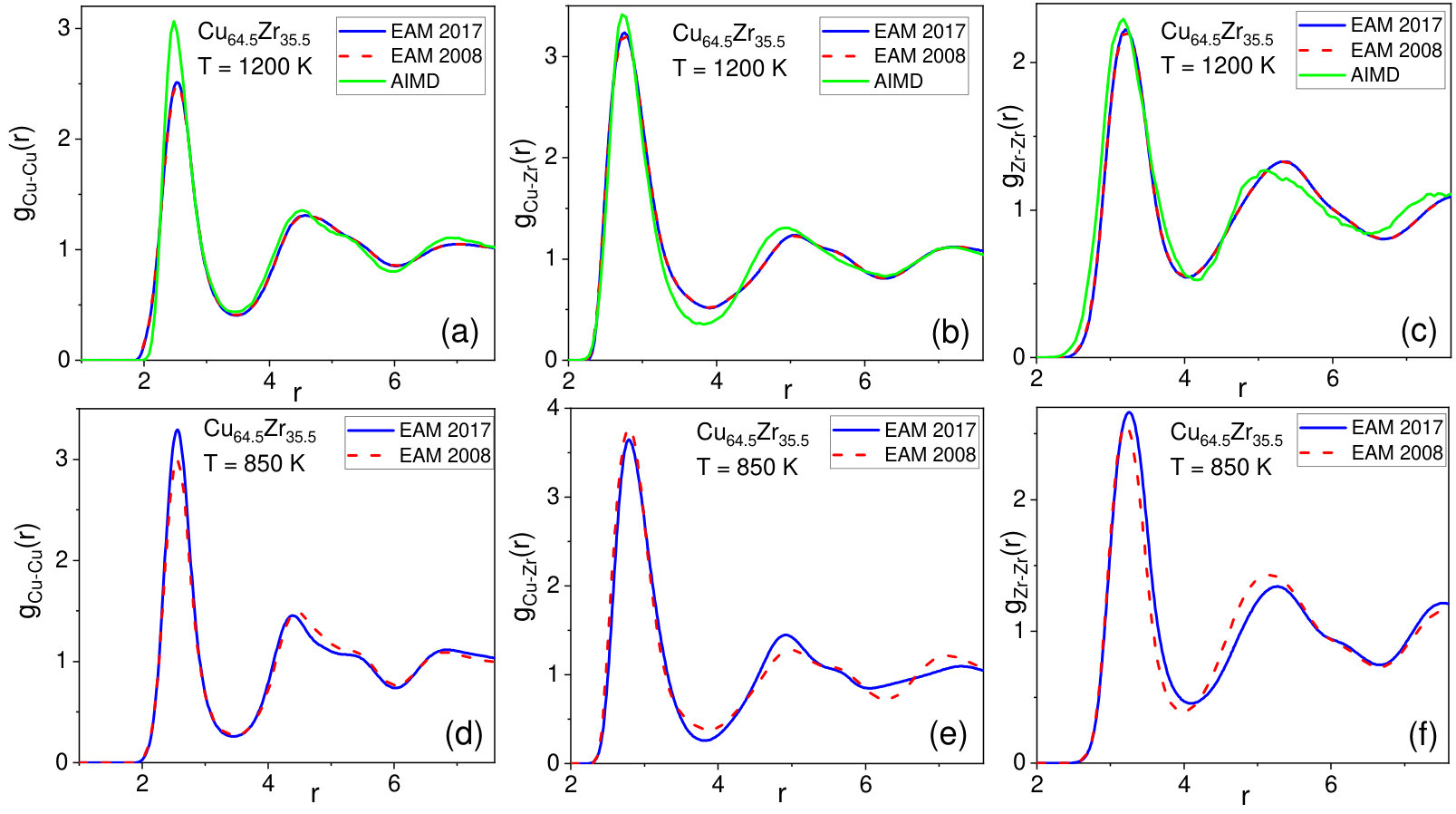 Figure 1
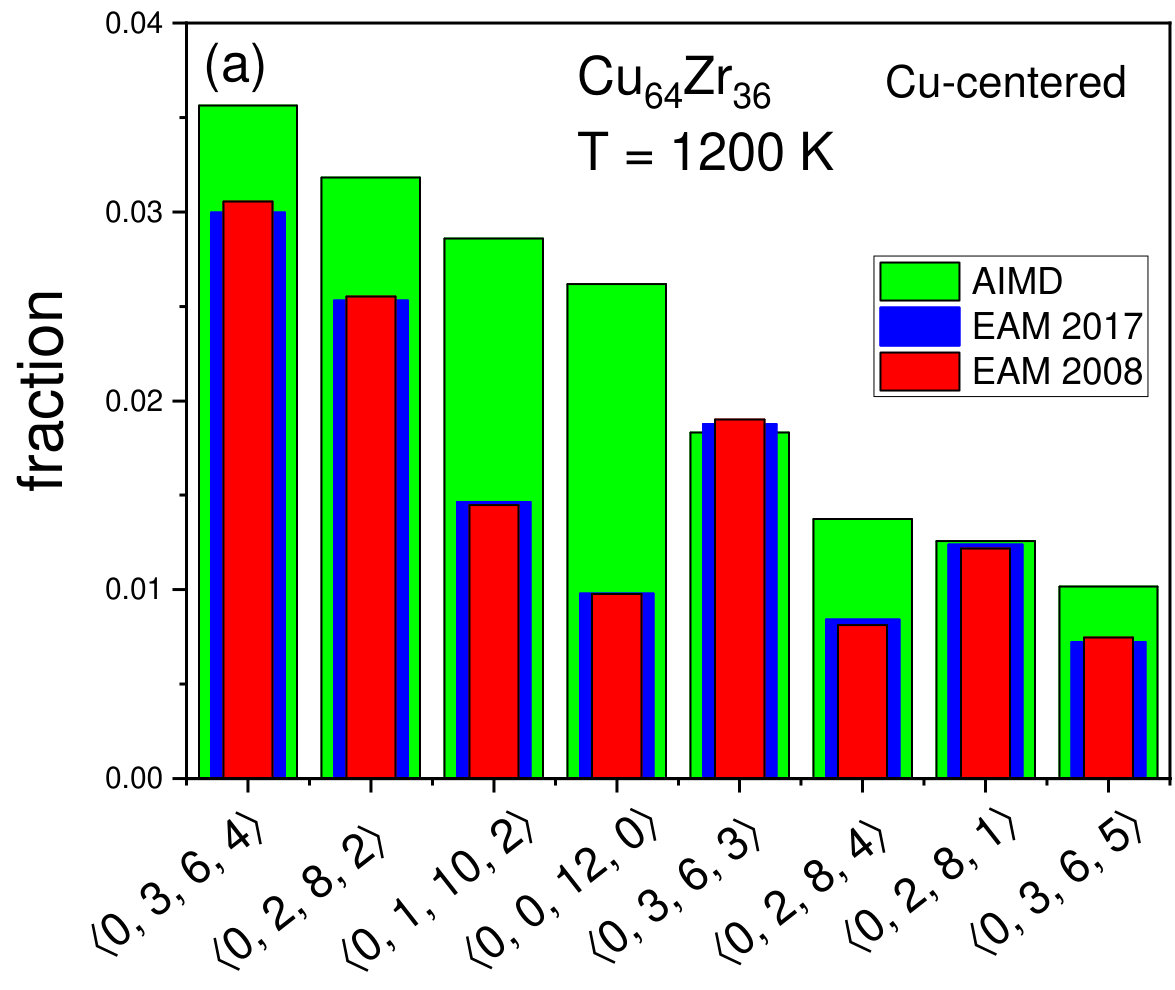 Figure 2
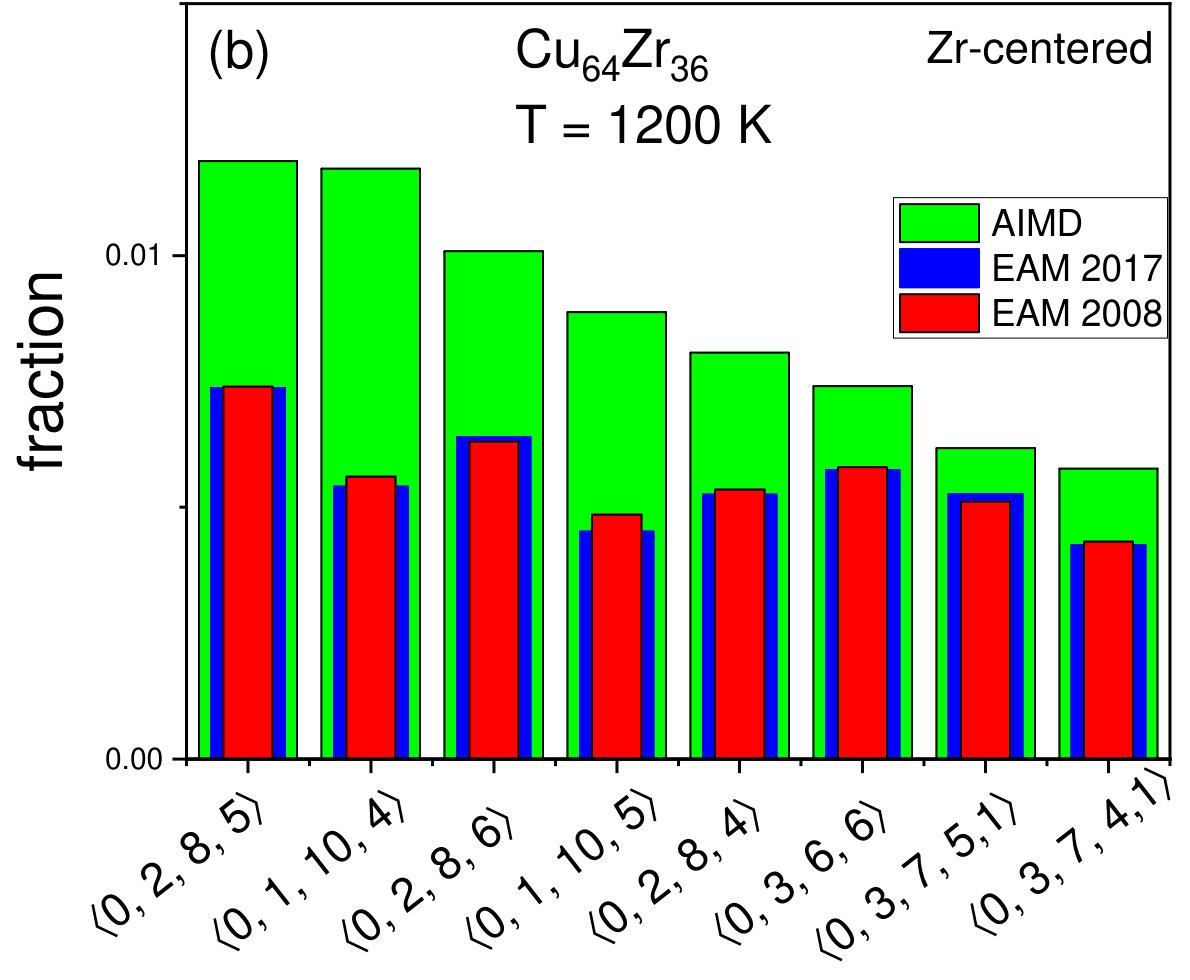 Figure 2
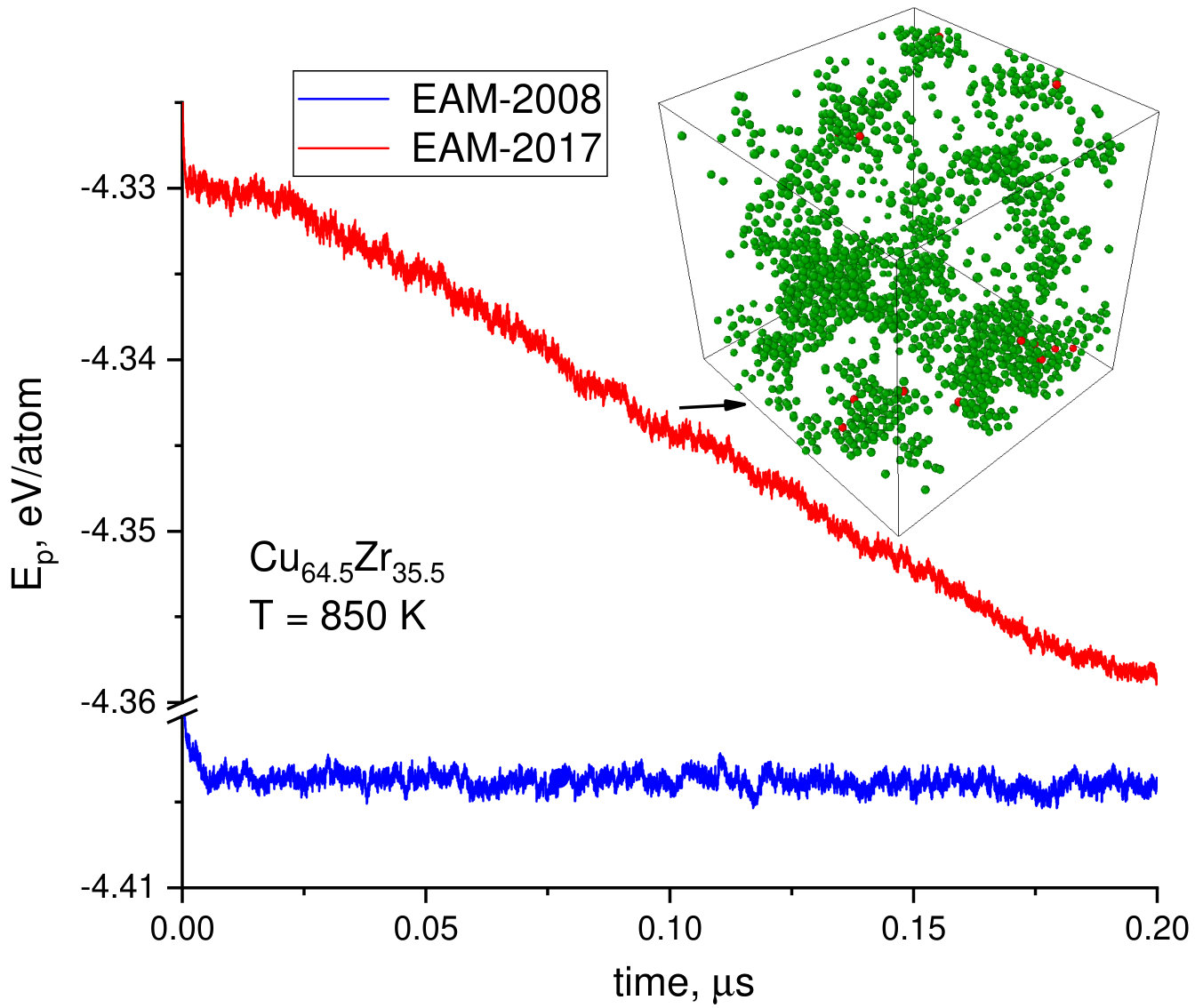 Figure 3
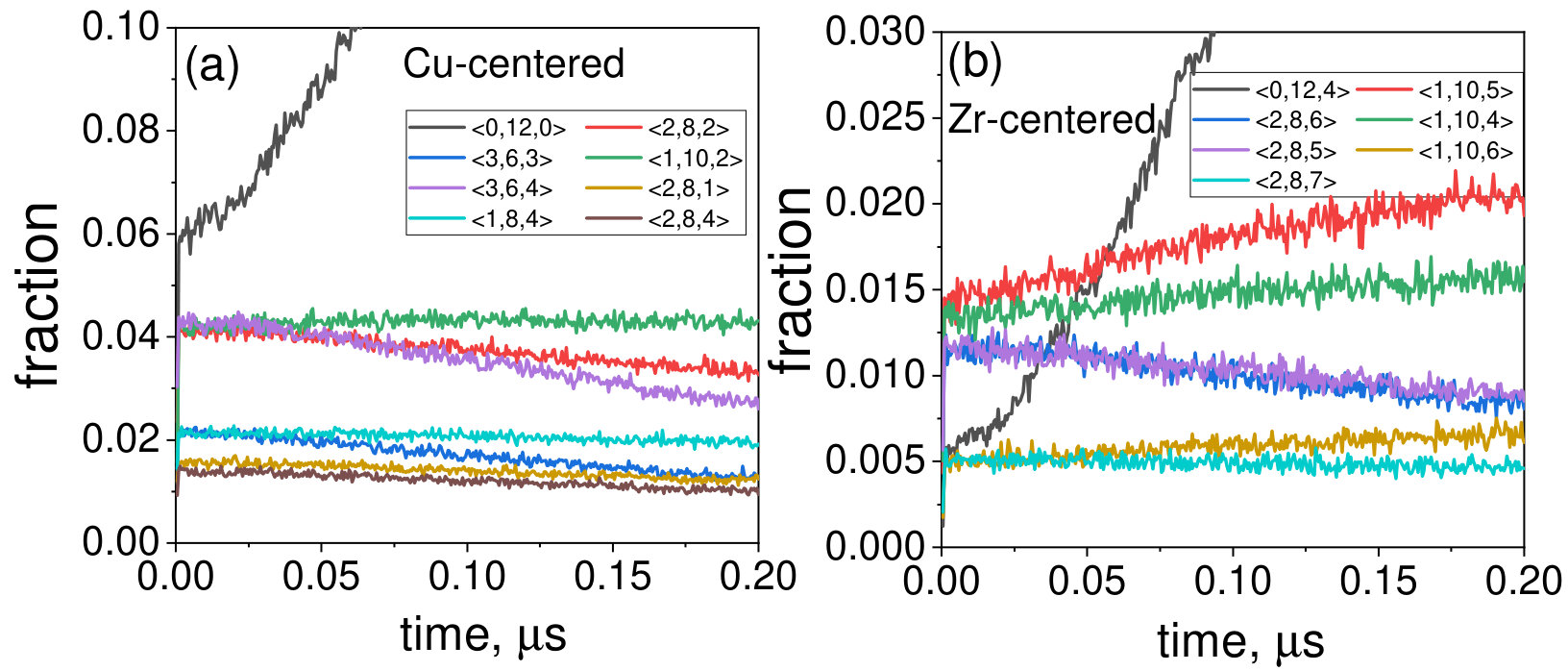 Figure 4
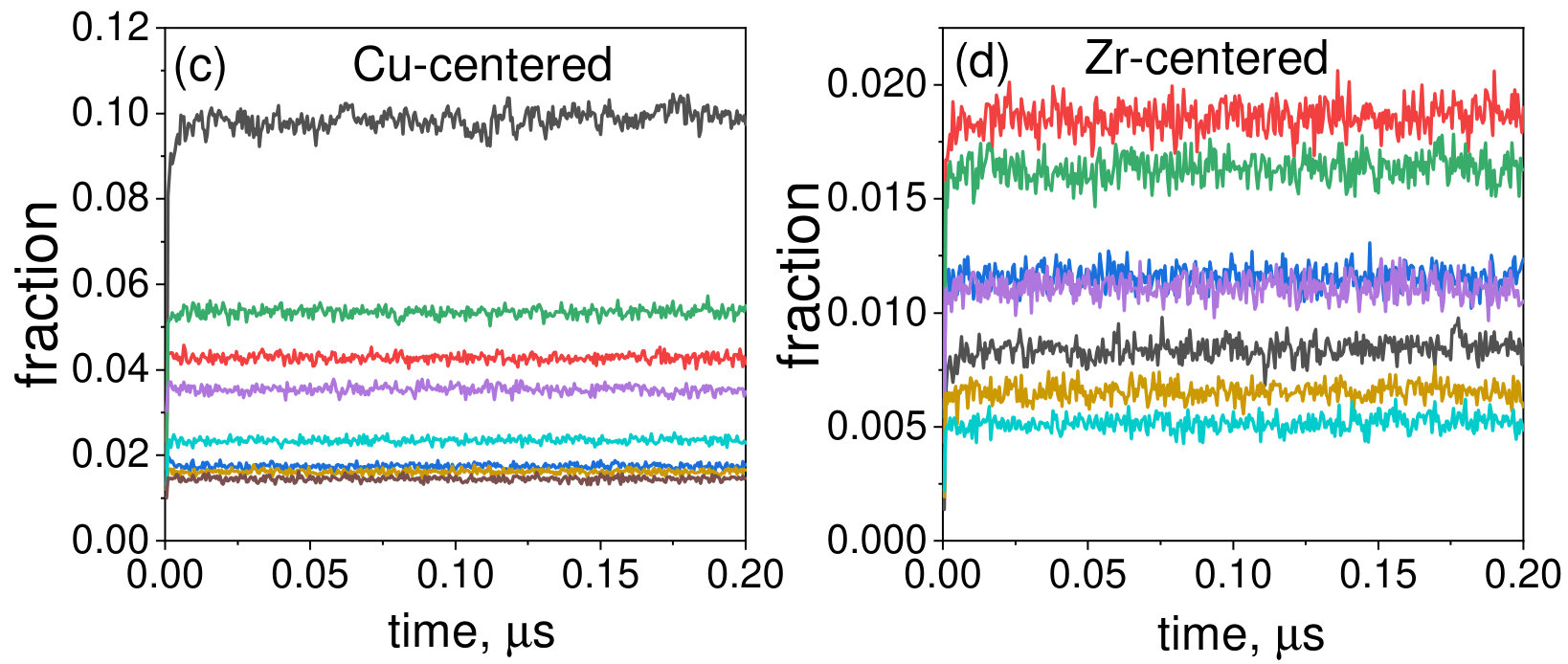 Figure 4
Peer Reviews
No public reviews on file for this paper yet. If you reviewed it on a platform where reviews are public (OpenReview, ICLR, NeurIPS, ICML), you can paste yours below so the community can read it here.
Videos
No videos yet. Explain this paper in a talk, walkthrough, or lecture? Add one.
Polytetrahedral short-range order and crystallization stability in supercooled metallic liquid
R.E. Ryltsev
N.M. Chtchelkatchev
Institute of Metallurgy, Ural Division of Russian Academy of Sciences, Amudsena str. 101, 620016 Ekaterinburg, Russia
Ural Federal University, Mira str. 19, 620002 Ekaterinburg, Russia
Institute for High Pressure Physics, Russian Academy of Sciences, 142190 Troitsk, Russia
Moscow Institute of Physics and Technology, 141700, 9 Institutskiy per., Dolgoprudny, Moscow Region, Russia
Abstract
Development of reliable interatomic potentials is crucial for theoretical studies of relationship between chemical composition, structure and observable properties in glass-forming metallic alloys. Due to ambiguity of potential parametrization procedure, some crucial properties of the system, such as crystallization stability or symmetry of the ground state crystal phase, may not be correctly reproduced in computer simulations. Here we address this issue for alloy described by two modifications of embedded atom model potential as well as by ab initio molecular dynamics. We observe that, at low supercooling, both models provide very similar liquid structure, which agrees with that obtained by ab initio simulations. Hoverer, deeply supercooled liquids demonstrate essentially different local structure and so different crystallization stability. The system, which demonstrate more pronounced icosahedral sort-range order, is more stable to crystallization that is in agreement with Frank hypothesis.
keywords:
Cu-Zr alloys , glass-forming ability , nucleation , molecular dynamics , embedded-atom model , icosahedral short-range order
††journal: Journal of Crystal Growth
1 Introduction
Understanding relationship between chemical composition, short-range order (SRO) and nucleation stability in supercooled metallic liquids is crucial to fabricate bulk metallic glasses. One of the generally accepted paradigm suggests that icosahedral SRO (ISRO) is responsible for stability of supercooled metallic liquids. Such SRO provides local minima of potential energy but it is incompatible with translational order that causes so-called geometric frustration [1, 2, 3]. Following the pioneering work by Frank [4], years of research have established that this idea can explain dynamical arrest in supercooled liquids [5, 6] as well as glass-forming ability of metallic alloys [7, 8, 9, 10, 11].
Among other glass-forming metallic alloys the Cu-Zr-based ones are of special interest due to their high glass-forming ability [12, 13]. Moreover, simulated Cu-Zr alloys have become model systems demonstrating pronounced ISRO [7, 8, 9, 10, 11, 14].
Molecular dynamics (MD) is the main theoretical tool for investigating SRO in supercooled liquids and glasses because it provides direct information regarding atomic-level structure. The key point of any MD simulation is the choice of interaction potential determining all the system properties at microscopic level. The most relevant type of potentials for describing metallic alloys is Embedded Atom Model (EAM), which usually provides good description of structural properties of both liquid and glassy metallic alloys [15, 16, 17]. However, development of EAM potentials is a rather complex task due to the fact that many independent parameters need to be determined. Such parameters are usually obtained via fitting procedure, during which some properties calculated by EAM match to those either experimentally measured or calculated by ab initio methods. This procedure is often ambiguous one: some properties (especially those involved in fitting procedure) may be described rather well while others may not [18, 19]. In regard to glassforming systems that means that, despite of good description of structure, some crucial properties of the system, such as crystallization stability or symmetry of the ground state crystal phase, may not be correctly reproduced in simulations [20, 17]. For example, recently we showed that, despite of pronounced ISRO, alloy described by widely accepted EAM potential [15] nucleates in sufficiently lengthy simulations with the formation of intermetallic compound with structure of C15 Laves phase. Moreover the alloy is actually unstable to crystallization for large system sizes ().
Such problems can be in principle overcome within the framework of ab initio molecular dynamics (AIMD). This method does not require any fitting and, in principle, can provide comprehensive information regarding structural properties of a system under consideration. However, strong limitations on time and spatial scales available in AIMD simulations raise concerns about applicability of the method for describing supercooled liquids and glasses.
Here we address these issues for alloy described by two modifications of EAM potential as well as by AIMD. We show that, at low supercooling, both models provide very similar liquid structure, which is in good agrement with that obtained by AIMD. Hoverer, deeply supercooled liquids demonstrate essentially different SRO and so different crystallization stability. The system, which demonstrate more pronounced ISRO, is more stable to crystallization that is in agreement with Frank hypothesis.
2 Methods
For MD simulations, we use Molecular Dynamics Simulator [21]. Periodic boundary conditions in Nose-Hoover NPT ensemble at were imposed. The number of particles was . The MD time step was 2 fs that provides good energy conservation at given thermodynamic conditions.
Even though many properties of metals can be satisfactory described with using pair potentials [22, 23, 24, 25], many-body effects are usually important for describing crystallization (see, for example, Ref. [26]). Thus, EAM potentials are applied in classical MD simulations of Cu-Zr alloys. We use two versions of EAM potential developed in the group of M. Mendelev from Ames Laboratory. The first one (hereinafter referred to as EAM-2008) is a widely accepted model [15, 27], which has been specially designed to describe liquid and glassy states of the Cu-Zr alloys. The second one (hereinafter referred to as EAM-2017) is modified version of EAM-2008 developed by the same group [28]. The main difference between two models is due to pair interaction between Cu and Zr; the embedded function for Zr and electron density functions for Zr-Zr and Cu-Zr are also slightly different; other functions are the same for both models.
Initial configurations were prepared as hcp-lattices with random seeding of the species in the lattice sites. These configurations were melted, completely equilibrated at K for 1 ns, then immediately cooled down to K and isothermally annealed at this temperature for s. Note that annealing of particles for 0.2 s ( MD steps) requires about a month of calculations in 128 supercomputer cores.
To study the structure of liquid, glassy and crystalline phases, we use radial distribution functions , Voronoi tessellation (VT) [29] and visual analysis of the snapshots. Detailed description of these methods is presented in Refs. [30, 11, 17].
The classical MD results for the high-temperature liquid state (at K) were compared with those obtained by AIMD. To perform AIMD, we use open source quantum chemistry and solid state physics software package, CP2K. Projector augmented-wave (PAW) pseudopotentials and Perdew-Burke-Ernzerhof gradient approximation to the exchange-correlation functional were used. The simulations were performed at the point only, with a time step of 2 fs. Cubic supercell of 512 atoms with target composition was built. Initial configuration was a random distribution of the atoms, which were subsequently equilibrated at 3000 K and 1200 K for 10 ps at each stage. Additional simulations for 10 ps were performed to collect data for calculating structural properties.
3 Results
Our first purpose is to compare two versions of EAM potential for Cu-Zr and to check how closely both models describe structure of the Cu-Zr liquids in comparison with AIMD. In Fig. 1 we show partial radial distribution functions of alloy calculated by using both versions of EAM as well as by AIMD. We see that both EAM models demonstrate practically the same structure at K, which corresponds to slightly supercooled liquid (Fig. 1(a)-(c)). Comparison with AIMD reveals good agrement. However, for deeply supercooled liquid at K, for the EAM models under consideration are noticeably different (Fig. 1(d)-(f)). Such difference is probably caused by difference in which becomes important and low temperatures.
In Fig. 2 we show histograms of the most popular Voronoi polyhedra for alloy at K. We see again that both EAM potentials demonstrate practically the same results. Comparison with AIMD reveals qualitative agreement; the list of the most popular Voronoi polyhedra is the same for EAMs and AIMD but they fractions are essentially different. For example, fraction of icosahedra for AIMD is greater by a factor of two.
Our main purpose it to study crystallization stability of simulated Cu-Zr alloys. Recently we reported that alloy described by EAM-2008 is actually unstable to crystallization for large system sizes (); it nucleates with the formation of Laves phases [20]. Here we perform the same annealing for with EAM-2017. In Fig. 3, we show time dependencies of the potential energy for both systems mentioned. We see that average is constant for EAM-2017 but decreases essentially for EAM-2008. That means the former is stable to crystallization on the simulation timescales.
To compare structural evolution of the systems under consideration, we perform Voronoi analysis. In Fig. 4 we demonstrate time dependencies of the fractions of the most popular Voronoi polyhedra. All the polyhedra presented are ZCN Kasper polyhedra (including icosahedron Z12) and their distorted modifications (CN is coordination number) [31]. Note that the increase of the fraction of both icosahedra and Z16 in with EAM-2017 is due to the growth of C15 Laves phase, which is build of these polyhedra [20]. Comparison of the pictures reveals that with EAM-2017 has more pronounced ISRO order than that with EAM-2008. Indeed the latter has only 6% of icosahedral clusters in the supercooled liquid state (before the crystal growth starts) whereas the former has 10% of icosahedra. We suggest that causes crystallization stability of EAM-2017 alloy that is in agreement with Frank hypothesis.
Analysis of Fig. 4(a,b) allows making important conclusions regarding growth of crystal nuclei in with EAM-2008. First, we see that fraction of Z16 polyhedra in supercooled liquid is order of magnitude less than fraction of icosahedra. That suggests the Z16 polyhedron is an useful indicator of the growth of Laves phases. In the insert for Fig. 3 we show spatial distributions of the centers of Z16 polyhedra in alloy described by EAM-2008 at K and s. This distribution clearly demonstrates the existence of several independent nuclei. This observation is in agreement with recent studies [32, 33] where the authors observe that crystallization at low supercooling levels occurs through a mononuclear scenario but high concentration of crystal nuclei form at high supercooling levels.
4 Conclusions
Doing molecular dynamics simulations we compare structure and crystallization stability of two Embedded Atom Models for alloy developed by M. Mendelev and co-authors (EAM-2008 [15] and EAM-2017 [28]). Exploring their structural evolution at isothermal annealing near the glass transition temperature for 0.2 s, we observe that crystallization stability of supercooled Cu-Zr liquids is closely related to ISRO that is in agreement with Frank hypothesis. Indeed, the alloy with EAM-2017 demonstrating more pronounced ISRO (about 10% of ico-like clusters) is stable to crystallization at simulation timescales. Whereas, the one with EAM-2008 having about 6% of ico-like clusters nucleates with the formation of C15 Laves phase. In general, SRO of Cu-Zr alloys is polytetrahedral that means it is mainly presented by Kasper polyhedra. Thus, besides icosahedra, other Kasper polyhedra, such as Z13 and Z11, can play important role in crystallization stability.
We observe that systems demonstrating similar structure in both equilibrium and slightly supercooled liquid states can have noticeably different structure and crystallization stability being deeply supercooled. That conclusion may be important for developing interatomic potentials procedure. Indeed, our findings rise a question if an EAM potential developed with using fitting of high-temperature structure properties is suitable for simulating deeply supercooled liquids and glasses.
We also observe that crystallization of the system at high supercooling level (i.e., at temperatures comparable to and below the glass transition temperature) occurs through polynuclear scenario that is in agreement with recent studies [32, 33].
5 Acknowledgments
The authors gratefully acknowledge M. Mendelev for helpful discussion and providing EAM potentials. This work was supported by Russian Science Foundation (grant RNF №18-12-00438). Molecular dynamic simulations have been carried out using ”Uran” supercomputer of IMM UB RAS and computing resources of the Federal collective usage center ”Complex for Simulation and Data Processing for Mega-science Facilities” at NRC “Kurchatov Institute”.
The reference list from the paper itself. Each links out to its DOI / PubMed record.
- 1Tarjus et al. [2005] G. Tarjus, S. A. Kivelson, Z. Nussinov, P. Viot, The frustration-based approach of supercooled liquids and the glass transition: a review and critical assessment, J. Phys.: Condensed Matt. 17 (2005) R 1143.
- 2Berthier and Biroli [2011] L. Berthier, G. Biroli, Theoretical perspective on the glass transition and amorphous materials, Rev. Mod. Phys. 83 (2011) 587–645. doi: 10.1103/Rev Mod Phys.83.587 . · doi ↗
- 3Shintani and Tanaka [2006] H. Shintani, H. Tanaka, Frustration on the way to crystallization in glass, Nature Phys. 2 (2006) 200. doi: 10.1038/nphys 235 . · doi ↗
- 4Frank and Mott [1952] F. Frank, N. Mott, Supercooling of liquids, Proceedings of the Royal Society of London. Series A. Mathematical and Physical Sciences 215 (1952) 43–46. doi: 10.1098/rspa.1952.0194 . · doi ↗
- 5Royall and Williams [2015] C. P. Royall, S. R. Williams, The role of local structure in dynamical arrest, Phys. Reports 560 (2015) 1 – 75. doi: 10.1016/j.physrep.2014.11.004 . · doi ↗
- 6Hallett et al. [2018] J. E. Hallett, F. Turci, C. P. Royall, Local structure in deeply supercooled liquids exhibits growing lengthscales and dynamical correlations, Nature Communications 9 (2018) 3272.
- 7Cheng et al. [2009] Y. Q. Cheng, E. Ma, H. W. Sheng, Atomic level structure in multicomponent bulk metallic glass, Phys. Rev. Lett. 102 (2009) 245501. doi: 10.1103/Phys Rev Lett.102.245501 . · doi ↗
- 8Soklaski et al. [2013] R. Soklaski, Z. Nussinov, Z. Markow, K. F. Kelton, L. Yang, Connectivity of icosahedral network and a dramatically growing static length scale in cu-zr binary metallic glasses, Phys. Rev. B 87 (2013) 184203. doi: 10.1103/Phys Rev B.87.184203 . · doi ↗