A counterexample to prism-hamiltonicity of 3-connected planar graphs
Simon Spacapan

TL;DR
This paper constructs a specific counterexample disproving the conjecture that all 3-connected planar graphs are prism-hamiltonian, challenging a long-standing assumption in graph theory.
Contribution
The paper provides the first known counterexample to the conjecture that every 3-connected planar graph is prism-hamiltonian.
Findings
Counterexample to the conjecture is constructed
Disproves the universal property of prism-hamiltonicity in 3-connected planar graphs
Challenges previous assumptions in graph theory
Abstract
The prism over a graph is the Cartesian product of with the complete graph . A graph is hamiltonian if there exists a spanning cycle in , and is prism-hamiltonian if the prism over is hamiltonian. In [M.~Rosenfeld, D.~Barnette, Hamiltonian circuits in certain prisms, Discrete Math. 5 (1973), 389--394] the authors conjectured that every 3-connected planar graph is prism-hamiltonian. We construct a counterexample to the conjecture.
Click any figure to enlarge with its caption.
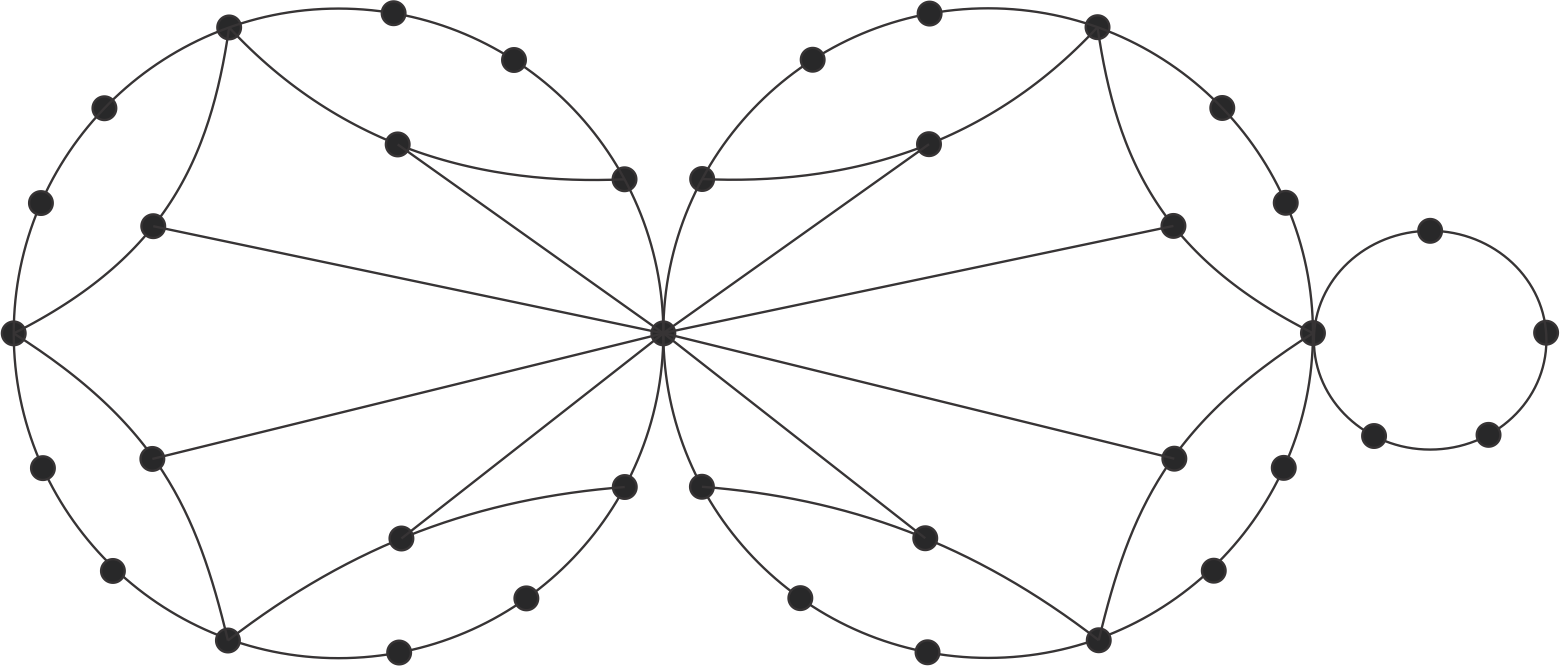 Figure 1
Peer Reviews
No public reviews on file for this paper yet. If you reviewed it on a platform where reviews are public (OpenReview, ICLR, NeurIPS, ICML), you can paste yours below so the community can read it here.
Videos
No videos yet. Explain this paper in a talk, walkthrough, or lecture? Add one.
A counterexample to prism-hamiltonicity of 3-connected planar graphs
Simon Špacapan111 University of Maribor, FME, Smetanova 17, 2000 Maribor, Slovenia. e-mail: simon.spacapan @um.si.
Abstract
The prism over a graph is the Cartesian product of with the complete graph . A graph is hamiltonian if there exists a spanning cycle in , and is prism-hamiltonian if the prism over is hamiltonian.
In [M. Rosenfeld, D. Barnette, Hamiltonian circuits in certain prisms, Discrete Math. 5 (1973), 389–394] the authors conjectured that every 3-connected planar graph is prism-hamiltonian. We construct a counterexample to the conjecture.
Key words: Hamiltonian cycle, planar graph
AMS subject classification (2010): 05C10, 05C45
1 Introduction
In 1956 Tutte proved in [16] that every 4-connected planar graph has a Hamilton cycle. On the other hand there exist 3-connected planar graphs that are not hamiltonian. An example of such cubic graph was first found by Tutte in [15], thereby disproving the Tait’s conjecture.
A -tree is a tree with maximum degree , and a -walk in is a closed walk that visits every vertex of at most times. It is well known (see for example [9] and [2]), that the following implications hold.
is hamiltonian is traceable is prism-hamiltonian has a spanning 2-walk has a spanning 3-tree
In this hierarchy the property of being hamiltonian is the strongest and existence of a spanning 3-tree is the weakest. It was proved recently that in -free graphs prism-hamiltonicity is equivalent to existence of a spanning 2-walk, see [5]. However for general graphs these properties are not equivalent, moreover they are also not equivalent in the class of 3-connected planar graphs.
In [1] it was proved that every 3-connected planar graph has a spanning 3-tree. This was strengthened in [6], where the authors prove that every 3-connected planar graph has a spanning 2-walk.
In this paper we address the following conjecture of Rosenfeld and Barnette, see [13], [7] and [9]222The conjecture is mentioned in the abstract of [13], and in [7] page 1145. Rosenfeld mentioned the conjecture during many of his talks [14], before it was formulated in [9] as Conjecture 1.1..
Conjecture 1.1
Any 3-connected planar graph is prism-hamiltonian.
In [13] and [7] the conjecture is given as a special case of a broader conjecture, claiming that every graph of a simple 4-polytope is hamiltonian. We construct a counterexample to Conjecture 1.1.
Many classes of graphs are prism-hamiltonian: chordal 3-connected planar graphs (also known as kleetopes) [9], planar near-triangulations [2], Halin graphs [9], line graphs of bridgeless graphs [9], 3-connected cubic graphs [12] and [4], and graphs that fulfil special degree conditions [11]. A characterization of prism-hamiltonian graphs is also given in [10]. Hamiltonicity of -fold prisms is studied in [13], where the authors prove that for every the -fold prism over a 3-connected planar graph is hamiltonian (here denotes the -cube).
We also mention that some special subclasses of 3-connected planar graphs are hamiltonian. Every triangulation of the plane with at most 3 separating triangles is hamiltonian, see [8]. This result was extended recently, in [3], where it is proved that all 3-connected planar graphs with at most three 3-cuts are hamiltonian.
2 The counterexample
Let and be graphs. The graph is the graph with vertex set and edge set , and is the graph with vertex set and edge set . If , then is the graph obtained from by removing all vertices in , and all edges incident to a vertex in . If is a single vertex, we write instead of . If is a path in with endvertices and , then we say that starts in and ends in , or vice versa. A block of a graph is a maximal connected subgraph without a cutvertex. Let be the complete graph on two vertices, and let us denote . For , we use to denote the set of positive integers not larger than . This notation is used throughout the article.
The Cartesian product of graphs and is the graph with vertex set , where vertices and are adjacent in if and , or and . The prism over is the Cartesian product .
A Hamilton path (cycle) in a graph is a spanning path (cycle) in . A graph is a hamiltonian graph if it has a Hamilton cycle, and it is traceable if it has a Hamilton path.
Let be the graph shown in Fig. 1. Observe that vertices and are cutvertices of , and that has exactly three blocks. Let be the block of containing vertex , the block containing vertices and and the block of containing vertex .
Let be the subgraph of induced by vertices (see Fig. 1). Note that is the union of two 5-cycles with a common vertex. Since is a vertex separator in , and the cycle containing is odd, we have the following lemma.
Lemma 2.1
The prism has no Hamilton path with endvertices and .
**Proof. **Let be the 5-cycle of containing vertex , and the other 5-cycle. If is a path in with endvertices and that contains all vertices of , then one neighbor of in is contained in and the other is contained in (the same is true for vertex ). The lemma follows form the fact that is odd.
Lemma 2.2
Let be a path in with the following properties:
- (i)
One endvertex of is or , and the other is or
- (ii)
* contains all vertices of .*
Then and .
**Proof. **Let be a path as declared in the lemma. Suppose that . Then starts in . Let and . Now there are only two possibilities, either the second vertex of is contained in or it is contained in . Since is symmetric we may assume, without loss of generality, that the latter is true (hence the second vertex of is or ). Since , will eventually go through or and enter to cover vertices of . Since ends with or we conclude that and .
If the proof is analogous. Assume therefore that . Now, if , then the argument is basically the same as above. Either the third vertex of is contained in or it is contained in , with the same reasoning as before. So assume that , and assume also that starts in . Now the only difference of this case is the fact that might enter , cover all vertices of , and then go through to enter . Since the graph induced by is , this is not possible by Lemma 2.1.
Note that Lemma 2.2 can be applied to blocks and , since they are isomorphic (the isomorphism takes to , so these two vertices have the same role when applying Lemma 2.2.)
Lemma 2.3
There is no path in with the following properties:
- (i)
One endvertex of is or , and the other is or
- (ii)
* contains all vertices of .*
**Proof. **Suppose on the contrary, that there is such a path . Let and . Then and fulfil the properties (i) and (ii) of Lemma 2.2. We apply Lemma 2.2 to and to find that . It follows that . We may assume, without loss of generality that and for some and . By symmetry of we may assume (without loss of generality) that (where and are defined as in Lemma 2.2). Since contains all vertices of , we find that will eventually go through vertex or and enter . Then is a Hamiltonian path in , with endvertices and . This contradicts Lemma 2.1.
It’s straightforward to check the following lemma (which is due to the fact that is an odd cycle).
Lemma 2.4
If and are disjoint paths in such that both paths have one endvertex in and the other in , then .
Now we define counterexamples to the conjecture. Let and be paths on the boundary walk of from vertex to , and note that there are exactly two such paths, the “upper” and the “lower”.
Let be the graph obtained from graphs , where , and two additional vertices and . To construct the graph we first identify vertex with for . We may embed the obtained graph in the plane so that is always the “upper” path and the “lower” path. Then we draw edges from to every vertex in and from to every vertex in , for . Clearly, this can be done so that the obtained graph is a plane graph.
Lemma 2.5
For every , the graph is 3-connected.
**Proof. **Suppose that the claim is false and that is a vertex separator of size 2. Note that is not a vertex separator in , therefore we may assume (by symmetry) that .
If , then , where . Observe that every block of contains at most one vertex of (the vertex ). Therefore, if is a block of , then is connected. Since is adjacent to more than one vertex of (in fact is adjacent to at least three vertices of ) we find that induces a connected graph. Since this is true for every block , the graph is connected.
If also , then , where . If is a connected graph, for every block of , the argument is the same as above. Assume therefore that there is a block of such that is disconnected. This is possible only if . It follows that there is at most one block such that is not connected. Note that every connected component of containes an external vertex of (a vertex incident to the unbounded face of ). It follows that every connected component of is adjacent to or in . The argument is completed by noting that and are adjacent to all other blocks of (by more than one edge), and all these blocks remain connected in .
Theorem 2.6
If , then is not prism-hamiltonian.
**Proof. **Suppose that , and that is a Hamilton cycle in . There are at most 8 edges of incident to a vertex in . Since there exist consecutive graphs and , such that has no edge with one endvertex in and the other in .
Let be connected components of , and let
[TABLE]
Each is a path or an isolated vertex. If it is a path, it has both endvertices in . If is an isolated vertex, then it is a vertex of (these properties follow from the assumption that no vertex in is adjacent to a vertex in by an edge of ). It follows that . Moreover there is either one component which is a path, or there are two such components .
Assume the latter, and suppose that and are paths. Since is a Hamilton cycle and contain all vertices of .
Case 1. Suppose that both, and , have one endvertex in and the other in . For every the set is a vertex separator in . It follows that for every either and , or and . Therefore and are disjoint paths that partition the vertex set of the prism . Moreover and have one endvertex in and the other in . This contradicts Lemma 2.4.
Case 2. Suppose that . Then are endvertices of , and are endvertices of . If contains a vertex of , then contains vertices and . Therefore is a disjoint union of two paths and that partition the vertex set of the prism . This contradicts Lemma 2.4. Otherwise contains a vertex of , and therefore is a disjoint union of two paths that partition the vertex set of the prism , a contradiction.
Assume now that there is one component which is a path. Let be the only path, and note that contains all vertices of . If and are endvertices of , we have Case 2 above. Otherwise one endvertex of is contained in and the other in . It follows that is a path that contains all vertices of . Moreover, one endvertex of is or , and the other is or . This contradicts Lemma 2.3.
We note that a slight modification of the above proof is needed to prove that for sufficiently large , has no Hamilton path.
3 Concluding remarks
A cactus is a connected graph such that every block of is either a or a cycle. An even cactus is a cactus with no odd cycles. A good cactus is a cactus such that every vertex is contained in at most two blocks. A good even cactus is a cactus that is good and even simultaneously. A good vertex of a cactus is a vertex contained in exactly one block of .
The authors of [4] considered good even cactuses with the additional property that no vertex is contained in two distinct cycles. They prove the following theorem (which is formulated in terms of our terminology).
Theorem 3.1
Every 3-connected cubic graph has a spanning subgraph , such that is a good even cactus, and every vertex of is contained in at most one cycle of .
It follows from the above theorem, and Proposition 3.2, that 3-connected cubic graphs are prism-hamiltonian. The restriction that no vertex of a cactus is contained in two cycles of is redundant, when questions of prism-hamiltonicity are addressed. This is justified by Proposition 3.2, and its corollary.
The partitioning result given in [6] implies that every 3-connected planar graph has a spanning good cactus. The existence of a spanning good catctus in implies the existence of a 2-walk in , while the existence of a spanning good even cactus implies prism-hamiltonicity of - as mentioned in the introduction this is a stronger property. The method applied to prove the following proposition is inspired by [2].
Proposition 3.2
Every good even cactus is prism-hamiltonian.
**Proof. **We use induction to prove the following stronger statement. Every prism over a good even cactus has a Hamilton cycle such that for every good vertex of , we have . This is clearly true for all even cycles and . Let be a good even cactus and assume that the statement is true for all good even cactuses with fewer vertices than . If all vertices of are good, then is an even cycle or . Otherwise, there is a vertex , which is not a good vertex of . Hence, is contained in exactly two blocks of .
Let and be connected components of , and let and . Both, and , are good even cactuses. Moreover, is a good vertex in , for . By induction hypothesis there is a Hamilton cycle n such that uses the edge in . The desired Hamilton cycle in is . Observe that every good vertex of is a good vertex of or . It follows that for every good vertex of , we have .
Corollary 3.3
Every graph , that has a good even cactus as a spanning subgraph, is prism-hamiltonian.
The counterexample to prism-hamiltonicity of 3-connected planar graphs, given in Theorem 2.6, was constructed via a construction of a graph with no spanning good even cactus. We conclude this article with open problems.
Problem 3.4
Prove or disprove the following statement. If a 3-connected planar graph is prism-hamiltonian, then has a good even cactus as a spanning subgraph.
The following problem is due to Rosenfeld, in fact it’s conjectured that question (1) has a positive answer [14].
Problem 3.5
(1) Is every 4-connected 4-regular graph prism-hamiltonian ? (2) Is also every 3-connected 4-regular graph prism-hamiltonian ?
Acknowledgement: The author thanks M. Rosenfeld for helpful comments on the origin of Conjecture 1.1. This work was supported by the Ministry of Education of Slovenia [grant numbers P1-0297, J1-9109].
The reference list from the paper itself. Each links out to its DOI / PubMed record.
- 1[1] D.W. Barnette, Trees in polyhedral graphs, Canad. J. Math. 18 (1966), 731–736.
- 2[2] D. P. Biebighauser, M. N. Ellingham, Prism-Hamiltonicity of triangulations, J. Graph Theory, 57 (2008), 181–197.
- 3[3] G. Brinkmann, C. T. Zamfirescu. Polyhedra with few 3-cuts are hamiltonian, ar Xiv:1606.01693
- 4[4] R. Čada, T. Kaiser, M. Rosenfeld, Z. Ryj a ´ ´ a {\rm\acute{a}} ček, Hamiltonian decompositions of prisms over cubic graphs, Discrete Math. 286 (2004), 45–56.
- 5[5] M. N. Ellingham, Pouria Salehi Nowbandegani, Songling Shan, Toughness and prism-hamiltonicity of P 4-free graphs, ar Xiv:1901.01959.
- 6[6] Z. Gao, R. B. Richter, 2-walks in circuit graphs, J. Comb. Theory Ser. B, 62 (1994), 259–267.
- 7[7] B. Grünbaum, Polytopes, graphs, and complexes, Bull. AMS 76 (1970), 1131–1201.
- 8[8] B. Jackson, X. Yu, Hamilton cycles in plane triangulations, Journal of Graph Theory, 41 (2002), 138–150.