Cross-band versus intra-band pairing in superconductors: signatures and consequences of the interplay
A. A. Vargas-Paredes, A. A. Shanenko, A. Vagov, M. V. Milo\v{s}evi\'c, and A. Perali

TL;DR
This paper investigates the competition between intra-band and cross-band pairing in two-band superconductors, revealing experimental signatures and consequences of their interplay, with implications for materials like MgB2 and iron-based superconductors.
Contribution
It introduces a phase-sensitive framework for analyzing intra- and cross-band pairing competition and describes the crossover regimes, including a gapless state, in two-band superconductors.
Findings
Identification of gap-splitting as a signature of crosspairing
Observation of non-BCS temperature dependence of gaps
Changes in pairing symmetry with temperature
Abstract
We analyze the paradigmatic competition between intra-band and cross-band Cooper-pair formation in two-band superconductors, neglected in most works to date. We derive the phase-sensitive gap equations and describe the crossover between the intraband-dominated and the crossband-dominated regimes, delimited by a ``gapless'' state. Experimental signatures of crosspairing comprise notable gap-splitting in the excitation spectrum, non-BCS behavior of gaps versus temperature, as well as changes in the pairing symmetry as a function of temperature. The consequences of these findings are illustrated on the examples of MgB and BaKFeAs.
Click any figure to enlarge with its caption.
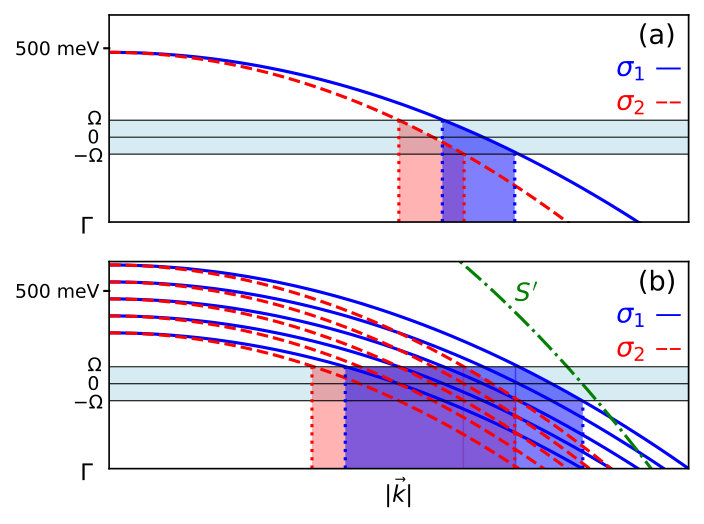 Figure 1
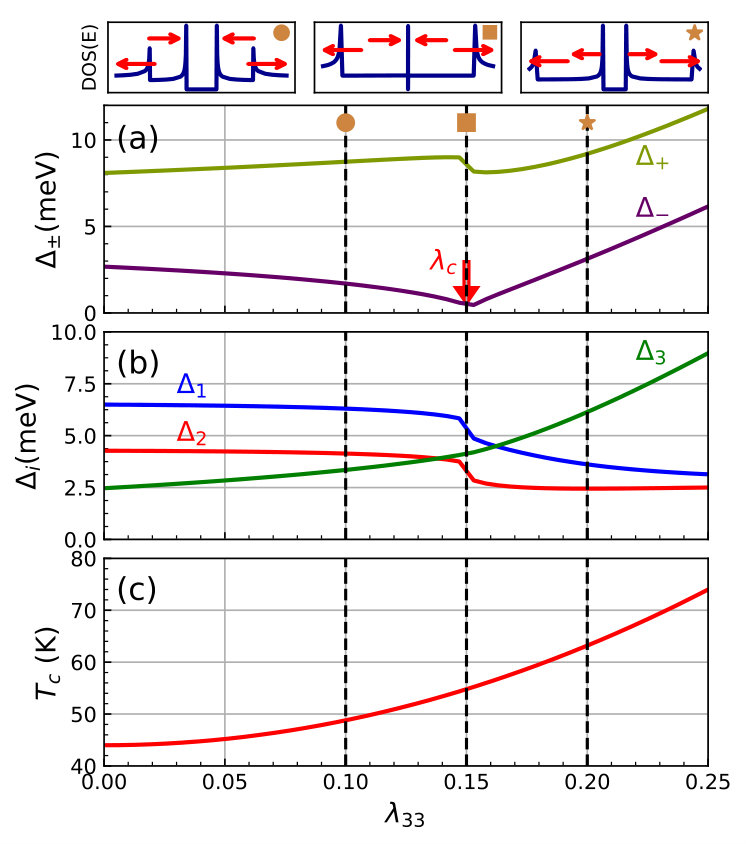 Figure 2
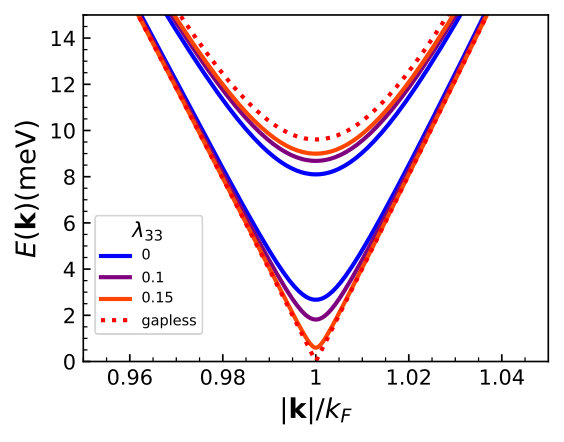 Figure 3
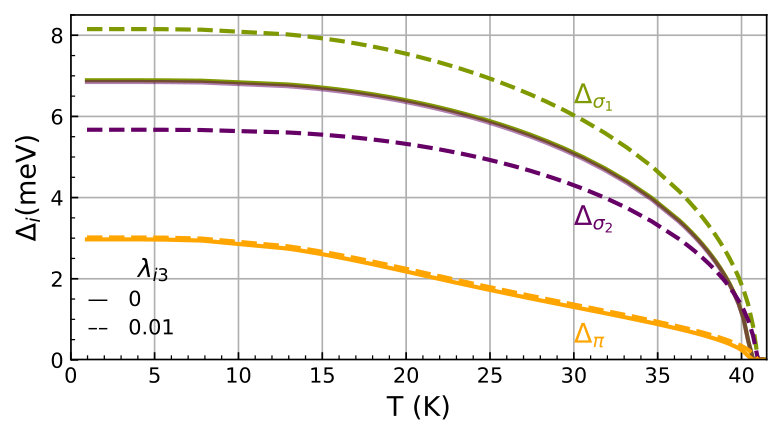 Figure 4
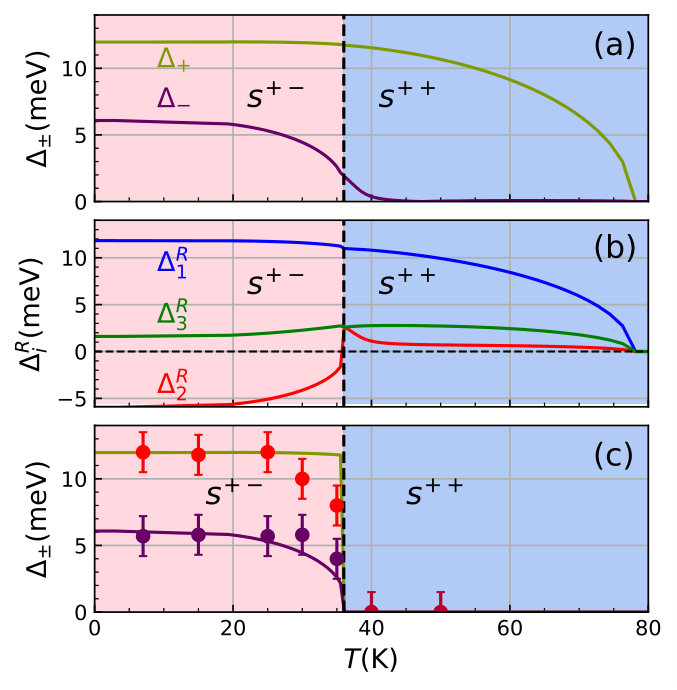 Figure 5
Peer Reviews
No public reviews on file for this paper yet. If you reviewed it on a platform where reviews are public (OpenReview, ICLR, NeurIPS, ICML), you can paste yours below so the community can read it here.
Videos
No videos yet. Explain this paper in a talk, walkthrough, or lecture? Add one.
Cross-band versus intra-band pairing in superconductors:
signatures and consequences of the interplay
A. A. Vargas-Paredes
School of Pharmacy, Physics Unit, Università di Camerino, 62032 Camerino, Italy
Department of Physics, University of Antwerp, Groenenborgerlaan 171, B-2020 Antwerp, Belgium
A. A. Shanenko
Universidade Federal de Pernambuco, Av. Prof. Luiz Freire, s/n, 50670-901 Recife-PE, Brazil
A. Vagov
Institut für Theoretische Physik III, Bayreuth Universität, Bayreuth, D-95440, Germany
M. V. Milošević
Department of Physics, University of Antwerp, Groenenborgerlaan 171, B-2020 Antwerp, Belgium
School of Pharmacy, Physics Unit, Università di Camerino, 62032 Camerino, Italy
A. Perali
School of Pharmacy, Physics Unit, Università di Camerino, 62032 Camerino, Italy
Abstract
We analyze the paradigmatic competition between intra-band and cross-band Cooper-pair formation in two-band superconductors, neglected in most works to date. We derive the phase-sensitive gap equations and describe the crossover between the intraband-dominated and the crossband-dominated regimes, delimited by a “gapless” state. Experimental signatures of crosspairing comprise notable gap-splitting in the excitation spectrum, non-BCS behavior of gaps versus temperature, as well as changes in the pairing symmetry as a function of temperature. The consequences of these findings are illustrated on the examples of MgB2 and Ba0.6K0.4Fe2As2.
††preprint: APS/123-QED
Multiband superconductivity is known to promote novel quantum phenomena of great fundamental importance and versatility Milošević and Perali (2015). Among recent examples are optically excited collective modes in multiband MgB2 Giorgianni et al. (2019), the emergent phenomena at the BCS-BEC crossover in FeSe Hanaguri et al. (2019), and at oxide intefaces Singh et al. (2019). Strong scientific appeal of multiband superconductivity stems from its pronounced tunability. External pressure, lattice strain effects, gating, chemical doping, photo-induction, quantum confinement and surface effects are all able to move and change the band dispersions and the position of the chemical potential with respect to Lifshitz transitions Singh et al. (2019); Li et al. (2018, 2010); Costanzo et al. (2016); Continenza and Profeta (2018); Porta et al. , where superconducting properties can radically change.
To date, multiband electronic structure is proven to be of crucial importance in rather versatile superconducting systems, such as MgB2 Nagamatsu et al. (2001), iron-based compounds de’ Medici et al. (2014); Benfatto et al. (2018); Yu et al. (2018); Herbrych et al. (2018); Black-Schaffer and Balatsky (2013); Ding et al. (2008), superconducting nanostructures Bianconi et al. (1997); Valletta et al. (1997); Shanenko et al. (2015); Flammia et al. (2018); Zhang et al. (2017a), 2D electron gases at interfaces Valentinis et al. (2017); Mohanta and Taraphder (2015); Trevisan et al. (2018), metal-organic superconductors Wang et al. (2017); Zhang et al. (2017b); Mazziotti et al. (2017), etc. In such multiband superconductors, the pairing interaction and the proximity/hybridization of two or more bands can result in the formation of Cooper pairs with electrons originating from different bands, a phenomenon termed “cross-band pairing” or simply “crosspairing”. This pairing is to be distinguished from the Josephson-like pair transfer between the intraband condensates, which is usually taken as their sole coupling in multiband superconductors. Crosspairing and intraband pairing are intuitively competitive, therefore it is necessary to understand their interplay qualitatively and quantitatively, together with associated changes in physical properties and observables. Such understanding is far from established, as crosspairing and its competition with intraband pairing were predominantly neglected in the studies to date. In superfluid systems with at least two fermionic species, the partially overlapping bands at the Fermi level are prone to crosspairing, as discussed in Refs. Liu and Wilczek, 2003; Gubankova et al., 2003. In superconductors, the hybridization of multiple bands close to the Fermi level is favorable for cross-band pair formation. This occurs in the iron-based superconductors (FeSCs) which present hybridized orbitals Moreo et al. (2009a, b), cuprates with the hybridization of and orbitals Matt et al. (2018); Tahir-Kheli (1998), and also in the heavy-fermion compounds, where crosspairing between electrons with and orbital character has been considered Dolgov et al. (1987). However, even without hybridization, the plain proximity of multiple bands can facilitate crosspairing, as illustrated in Fig. 1 for bulk and atomically-thin MgB2.
In this Letter, we examine the interplay between intra- and cross-band pairing in two-band superconductors and its experimental signatures. We reformulate the mean-field equations for the superconducting order parameter, going beyond the Suhl, Matthias and Walker (SMW) extension of the BCS theory Suhl et al. (1959). This results in an extended self-consistent and phase-dependent set of equations for the several components of the order parameter, with strongly hybridized excitation spectra. The mean-field Hamiltonian including both intraband and cross-band pairing reads:
[TABLE]
where represent the band index, and the spin. Here are the pairing amplitudes, and is the band-dependent kinetic energy of the electrons. We note that Eq. (1) resembles the Hamiltonian of a two-band system with hybridization upon the change from orbital to the band basis Moreo et al. (2009b). The full k-dependent form of the interaction matrix is given by , where is the average energy scale of the effective interaction, and with chemical potential . In , the upper left inner matrix corresponds to the well established SMW case Suhl et al. (1959), and the third row and column include the crosspairing (where (12) indicates symmetrization under given indices, so that e.g., ). In the interaction matrix the effective attraction between electrons is given by its diagonal elements, and the off-diagonal ones describe the Josephson-like coupling between intraband and cross-band condensates.
In what follows, we simplify our indices as , and . Next, we use the Gor’kov Green’s functions formalism to obtain the pair amplitude equations Korchorbé and Palistrant (1993); Shanenko et al. (2015). In momentum space the two excitation spectra without crosspairing () are and the pair amplitudes are given by , where is the phase of the pair amplitude.
The crosspairing pair amplitude hybridizes the energy spectra of the two BCS-like excitation branches:
[TABLE]
where and . We emphasize here that the angle will introduce new degrees of freedom in our system depending on the combination of the couplings, as will be shown later. The excitation gaps coincide with the minimum energy of the excitation branches . These are the two gaps present in the density of states (DOS), however these gaps no longer correspond to the energy needed to break intraband Cooper pairs (as is conventionally the case). Instead, they describe the energy needed to disallow either intra- or cross-band pairing.
The self-consistent equations for the pair amplitudes are given by:
[TABLE]
where , , , , and \beta=1\big{/}k_{B}T. Note that these pairing amplitudes (i.e. the order parameters in the problem) do not correspond to the measurable gaps .
Before solving the above formalism to reveal new physics brought by crosspairing, we introduce parabolic bands and dimensionless effective couplings, , where is the band-dependent density of states and . We start by solving Eq. (5) when all couplings are positive and with the same phase, i.e. . To visualize the effect of crosspairing we fix all parameters but : meV, meV, , , . In Figs. 2(a) and 2(b), we show the excitation gaps and all three pairing amplitudes at K. As crosspairing coupling is increased, the two excitation gaps and are split further apart: increasing strengthens and suppresses , up to a characteristic value (roughly half the average of and ). This characteristic value marks the maximal competition between the intraband and the crossband pairing channels and separates the two regimes: the intraband-dominated regime (IDR) for , and a crosspairing-dominated regime (CDR) for . In the CDR, both gaps increase at the same rate, similarly to the one-band scenario. Therefore the CDR describes a two-gap system which is characterized by a sole order parameter , while the intraband pair amplitudes participate only passively, by proximity Giubileo et al. (2007, 2001). Fig. 2(c) shows that superconducting critical temperature increases with faster than expected considering the range of values of alone.
In the miniplots above Fig. 2(a), we show the density of states (as a measurable quantity in STM/STS) for the IDR, CDR as well as for the crossover point . Note that in the latter situation the inner coherence peak approaches zero energy, and may disappear at exactly zero for a favorable combination of parameters. That case would mark a gapless regime, where the weaker gap is no longer directly detectable, but must play a role in all observables in e.g., applied magnetic field or transport measurements. In such a state, superconducting gaps extracted from the tunneling spectra of STM would no longer coincide with the ones extracted from low-temperature ARPES Damascelli et al. (2003) using normal-state band structure as a reference. Moreover, the lowest energy excitation branch exhibits linear V-shaped dispersion in the gapless state (see Fig. 3). Such a multiband system has a peculiar multicomponent composition, with the coexistence of a large-gap condensate and the in-gap states having a free-particle character. This leads to a finite DOS at low energies, and radically changed temperature dependence of all superconducting properties with respect to the gapped state. One concludes that such a gapless state, induced by crosspairing, is a unique feature of multiband superconductors worthy of further investigation.
To quantify the effects of crosspairing, it is instructive to take the example of the best known two-gap superconductor MgB2 Souma et al. (2003). This superconductor has four contributing bands, two -bands for the stronger gap and two -bands for the weaker one. The distance of two -bands in the vicinity of the Fermi level is approximately meV [see Fig. 1(a)]. Taking the parameters meV and meV from Refs. Poncé et al. (2016); Kuzmichev et al. (2014), we consider the crosspairing between the -bands, with the coupling matrix
[TABLE]
The above matrix is asymmetric because of different DOS associated with each band. is the coupling to the bands, and third column and row correspond to the coupling to the crosspairing channel, with as a free (small) parameter. Other coupling constants are taken from literature, and yield the experimentally verified gaps of MgB2 ( and 3 meV) in absence of crosspairing (, see Fig. 4). Even a small yields a 2 meV split of the two gaps and a K increase in . This gives confidence that crosspairing effects, even if seemingly small, can lead to significant modifications of the gap spectrum without significantly changing . That in turn calls for revisiting of theoretical approaches, e.g., to include crosspairing in anisotropic Eliashberg calculations even for materials that seemed previously well described Choi et al. (2002); Aperis et al. (2015), as well as revisiting the available experimental data (bearing in mind the non-equivalence between and the pairing amplitudes in presence of crosspairing). Conducting more refined ARPES measurements (e.g., in case of crystalline MgB2, on two -bands separately) can provide evidence for the gap splitting caused by crosspairing.
Last but not least, we discuss the phase-frustrated solutions of Eq. (5), with non-zero angle . For example, in the family of FeSCs one can have two cases where a non trivial phase difference is present. The first is the conventional case, which contemplates a -phase difference between electron-like and hole-like pair amplitudes Mazin et al. (2008). The second is the orbital antiphase case, with a -phase difference between bands of the same type (electron-like or hole-like), as reported in the optimally doped (BaK)Fe2As2 ( K) Lu et al. (2012); Zhang et al. (2014); Yin et al. (2014). This compound presents two hole-like bands (, ) stemming from two nested Fermi sheets at -point, and two electron-like bands (, ) stemming from two nested Fermi sheets at the M-point. The proximity of both pairs of bands to the Fermi level and the smallness of their interband distance justifies the assumption of crosspairing between bands and or and . To identify the emergent effects, we will consider the effect of crosspairing only between and (assuming similar consequences for crosspairing between and ). We take the interband distance between and as meV and the Fermi level at meV, following Ref. Ding et al. (2011). To obtain the gaps () as measured in low-temperature experiments of Ref. Ding et al., 2008 ( and 6.2 meV extrapolated to ), we take for the coupling matrix:
[TABLE]
Here is taken negative, which is the standard way to obtain the sign change in the band-dependent order parameters (as reported in Ba0.6K0.4Fe2As2 Salovich et al. (2013)). We introduce a small repulsion , which induces a phase shift between the two intraband pair amplitudes, . In such a case, the coupling of the crosspairing pair amplitude with the intraband pair amplitudes (for ) will introduce frustration on the phase of the crosspairing order parameter . Phase frustration of similar sort is known in three-band systems Stanev and Koshelev (2012); Orlova et al. (2013); Brendan and Mukunda (2013) and can lead to skyrmionic vortex states Garaud et al. (2011, 2013); Orlova et al. (2016), but is not possible in a two-band system unless crosspairing is present. In the present case, we reveal additional new physics, as crosspairing induces transition as a function of temperature, as shown in Fig. 5(a,b) for exemplified parameters of (BaK)Fe2As2.
In the example shown in Fig. 5(a,b), after the transition, the pair amplitudes recover the same phase () until the expected BCS critical temperature of K. In experiment however Ding et al. (2008), the measured gaps abruptly cease at K, for reasons that are not understood to date. Without claiming to rigorously describe the non BCS behavior of the gaps versus temperature, we notice that our calculation of the gaps vs. temperature can closely reproduce the experimentally measured data [as shown in Fig. 5(c)], in cases that the orbital antiphase is protected by symmetry or the transition to state is disallowed in any way.
In summary, although mostly neglected to date, the cross-band pairing in multiband superconductors is certainly of importance in materials with hybridized or energetically close bands in the vicinity of the Fermi level. In this regime, the interplay between intra- and cross-band pairing leads to several unique effects. For one, crossband pairing increases the splitting between intraband gaps, with a tendency to decrease the weaker gap towards an entirely novel “gapless” state, signatures of which will still be observable since vanishing gap does not imply vanishing order parameter(s) in this regime. The crosspairing also introduces the possibility of a phase frustration between the pairing channels, leading to novel transitions as a function of temperature (such as ), and likely nontrivial response of the superconductor to e.g., magnetic field Garaud et al. (2017). Our results call for revisiting the existing theories and experimental data for multiband superconductors with close bands, bearing also in mind that the band dispersions and chemical potential can be tuned towards a parameter regime where the above mentioned signatures of crosspairing can be detected. In that context, we point out the most recent measurements of Ref. Singh et al., 2019, where tunability of multiple gaps has been achieved at the oxides’ interface by gate doping around a Lifshitz transition, as the closest experimental system to our present model.
Besides the needed generalization to the case of multiple (3+) bands, the outlook of the present study is very broad. It includes understanding the effects of impurities, particularly magnetic ones where DOS signatures of crosspairing near a gapless state can overlap with the Majorana zero-energy bound state Wang et al. (2018); Yin et al. (2015). It is also of interest to further examine the intra- to cross-pairing competition in the presence of spin-flip scattering Gonnelli et al. (2006), oddness in parity Black-Schaffer and Balatsky (2013), and photo-induced phenomena Kumar and Sinha (1968); Porta et al. . Even beyond superconductivity, crosspairing and its competition with intraband pairing remains insufficiently explored in molecular optics Abo-Shaeer et al. (2005), multicomponent superfluidity Liu and Wilczek (2003), and quantum chromodynamics Gubankova et al. (2003).
The authors thank Andrea Guidini for his help during the initial stage of this work and Laura Fanfarillo for useful discussions. This work was partially supported by the Italian MIUR through the PRIN 2015 program (contract No. 2015C5SEJJ001) and the Research Foundation - Flanders (FWO). A. A. Vargas-Paredes acknowledges support by the joint doctoral program “MultiSuper” (http://www.multisuper.org) and by the Erasmus+ exchange and M.V. Milošević acknowledges the University of Camerino for support during his visit.
The reference list from the paper itself. Each links out to its DOI / PubMed record.
- 1Milošević and Perali (2015) M. V. Milošević and A. Perali, “Emergent phenomena in multicomponent superconductivity: an introduction to the focus issue,” Supercond. Sci. Technol. 28 , 060201 (2015) . · doi ↗
- 2Giorgianni et al. (2019) F. Giorgianni, T. Cea, C. Vicario, C. P. Hauri, W. K. Withanage, X. Xi, and L. Benfatto, “Leggett mode controlled by light pulses,” Nature Physics 15 , 341–346 (2019) . · doi ↗
- 3Hanaguri et al. (2019) T. Hanaguri, S. Kasahara, J. Böker, I. Eremin, T. Shibauchi, and Y. Matsuda, “Quantum Vortex Core and Missing Pseudogap in the Multiband BCS-BEC Crossover Superconductor Fe Se,” Phys. Rev. Lett. 122 , 077001 (2019) . · doi ↗
- 4Singh et al. (2019) G. Singh, A. Jouan, G. Herranz, M. Scigaj, F. Sánchez, L. Benfatto, S. Caprara, M. Grilli, G. Saiz, F. Couëdo, C. Feuillet-Palma, J. Lesueur, and N. Bergeal, “Gap suppression at a lifshitz transition in a multi-condensate superconductor,” Nature Materials (2019), 10.1038/s 41563-019-0354-z . · doi ↗
- 5Li et al. (2018) Y. Li, C. An, C. Hua, X. Chen, Y. Zhou, Y. Zhou, R. Zhang, C. Park, Z. Wang, Y. Lu, Y. Zheng, Z. Yang, and Z. Xu, “Pressure-induced superconductivity in topological semimetal Nb As 2,” npj Quantum Materials 3 , 58 (2018) . · doi ↗
- 6Li et al. (2010) W.X. Li, R. Zeng, L. Lu, and S.X. Dou, “Dependence of superconducting properties on lattice strain in Mg B 2 ,” Physica C: Superconductivity and its Applications 470 , S 629 – S 630 (2010) , proceedings of the 9th International Conference on Materials and Mechanisms of Superconductivity. · doi ↗
- 7Costanzo et al. (2016) D. Costanzo, S. Jo, H. Berger, and A. F. Morpurgo, “Gate-induced superconductivity in atomically thin Mo S 2 crystals,” Nature Nanotechnology 11 , 339 (2016) . · doi ↗
- 8Continenza and Profeta (2018) A. Continenza and G. Profeta, “Chemical doping in pnictides superconductors: The case of Ca(Fe 1-x X x ) 2 As 2 , X = = Co, Ni, Pt,” Journal of Magnetism and Magnetic Materials 452 , 179 – 183 (2018) . · doi ↗