Theory of giant skew scattering by spin cluster
Hiroaki Ishizuka, Naoto Nagaosa

TL;DR
This paper presents a non-perturbative theoretical analysis of skew scattering caused by spin clusters, revealing that three-spin clusters induce significantly larger skew angles than impurity-based mechanisms, with implications for Hall effects in complex magnets.
Contribution
It introduces a non-perturbative T matrix approach to analyze skew scattering by spin clusters, highlighting the necessity of three spins for significant skew effects and their relation to Hall phenomena.
Findings
Three-spin clusters produce large skew angles (~0.1π rad).
Skew scattering requires at least three spins.
Spin Hall effect is linked to three spins, while vector spin chirality involves two.
Abstract
Skew scattering of electrons induced by a spin cluster is studied theoretically focusing on metals with localized magnetic moments. The scattering probability is calculated by a non-perturbative matrix method; this method is valid for arbitrary strength of electron-spin coupling. We show the scattering of electrons by a three-spin cluster produces a skew angle of order rad when the electron-spin coupling is comparable to the bandwidth. This is one or two orders of magnitude larger than the usual skew angle by an impurity with spin-orbit interaction. Systematic analysis of the scattering probability of one-, two-, and three-spin clusters show that three spins are necessary for skew scattering. We also discuss the relation between anomalous/spin Hall effects and the spin chiralities; we find that the spin Hall effect requires three spins while it is related to the vector spin…
Click any figure to enlarge with its caption.
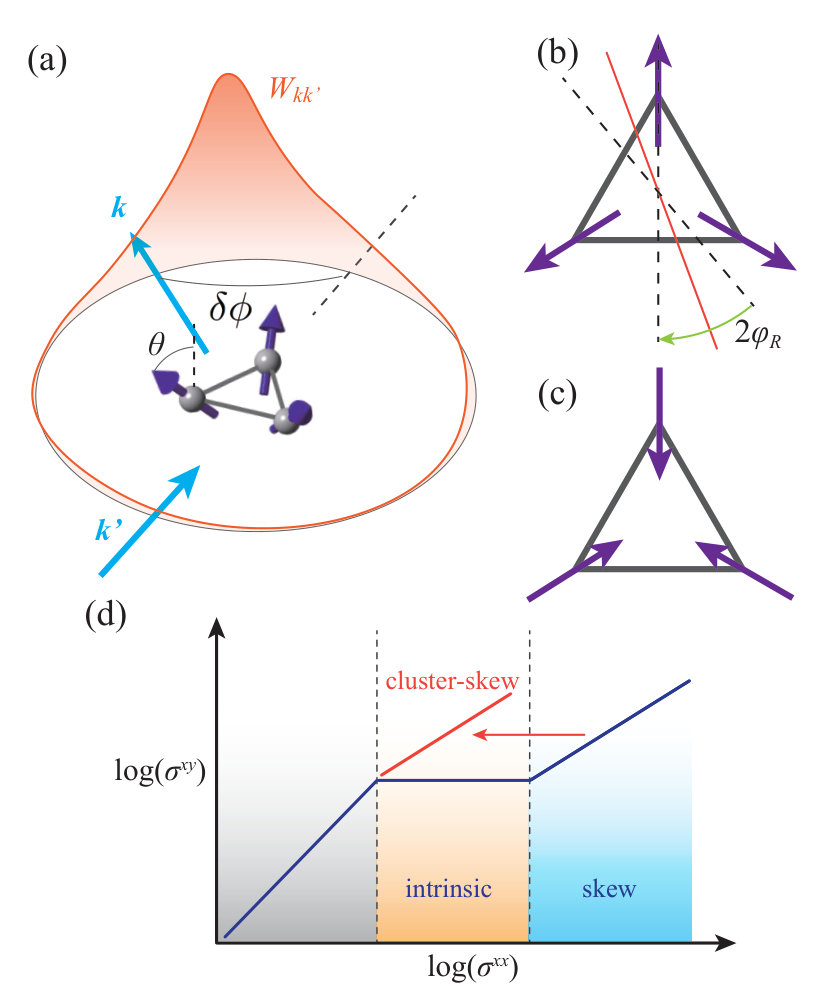 Figure 1
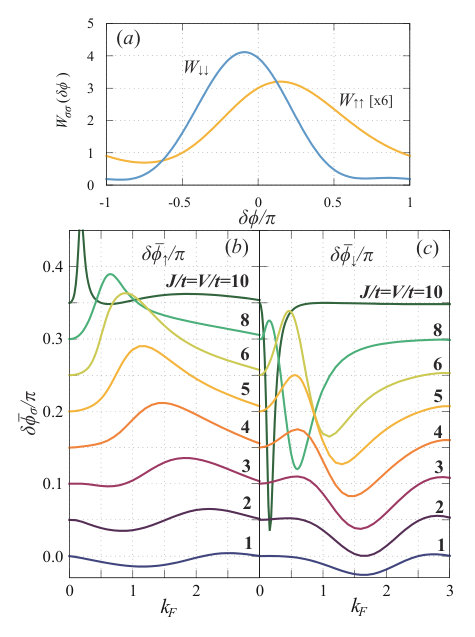 Figure 2
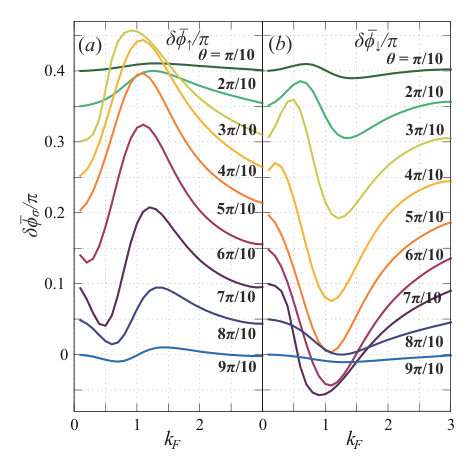 Figure 3
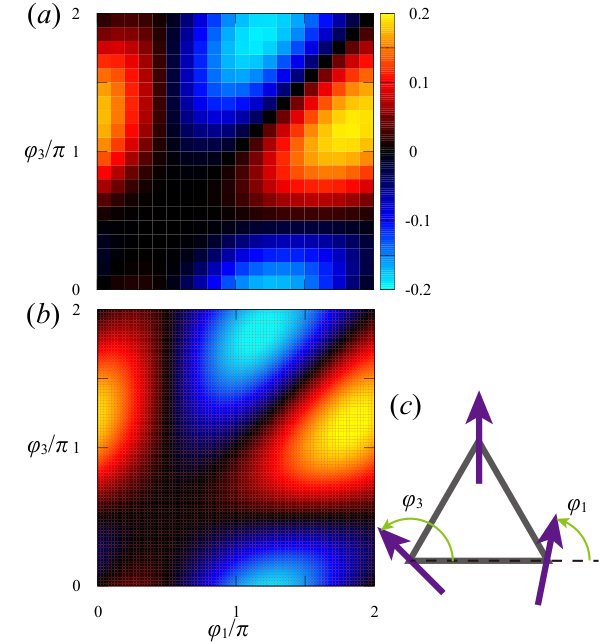 Figure 4
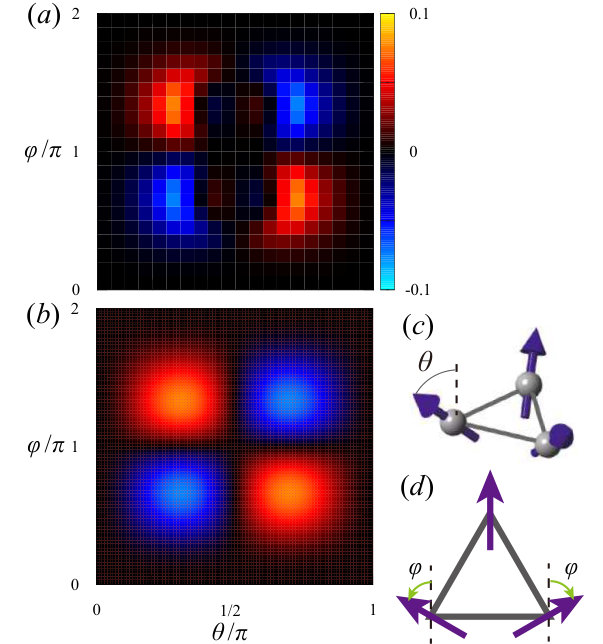 Figure 5
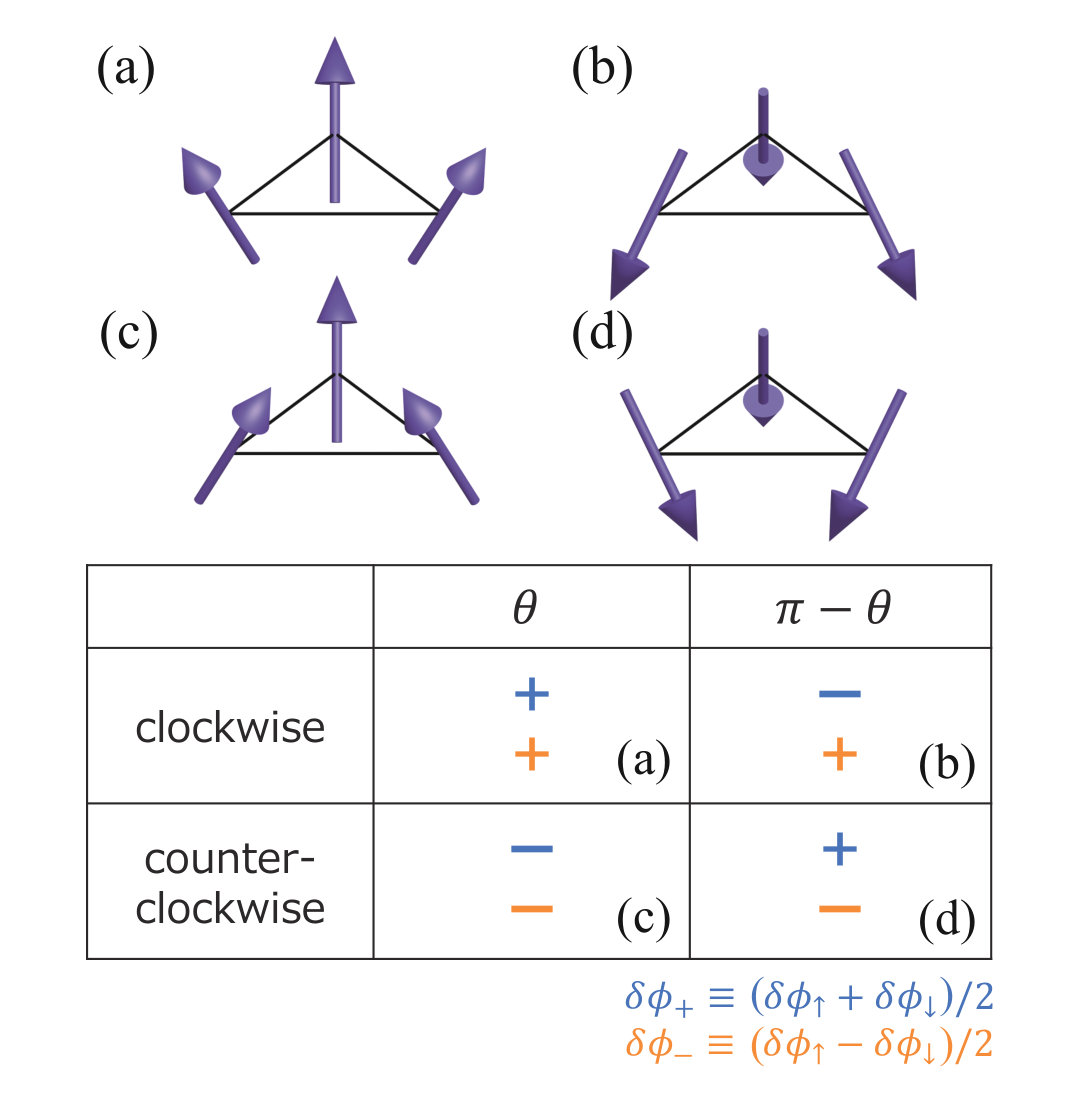 Figure 6
Peer Reviews
No public reviews on file for this paper yet. If you reviewed it on a platform where reviews are public (OpenReview, ICLR, NeurIPS, ICML), you can paste yours below so the community can read it here.
Videos
No videos yet. Explain this paper in a talk, walkthrough, or lecture? Add one.
Theory of giant skew scattering by spin cluster
Hiroaki Ishizuka
Department of Applied Physics, The University of Tokyo, Bunkyo, Tokyo, 113-8656, JAPAN
Naoto Nagaosa
Department of Applied Physics, The University of Tokyo, Bunkyo, Tokyo, 113-8656, JAPAN
RIKEN Center for Emergent Matter Sciences (CEMS), Wako, Saitama, 351-0198, JAPAN
Abstract
Skew scattering of electrons induced by a spin cluster is studied theoretically focusing on metals with localized magnetic moments. The scattering probability is calculated by a non-perturbative matrix method; this method is valid for arbitrary strength of electron-spin coupling. We show the scattering of electrons by a three-spin cluster produces a skew angle of order rad when the electron-spin coupling is comparable to the bandwidth. This is one or two orders of magnitude larger than the usual skew angle by an impurity with spin-orbit interaction. Systematic analysis of the scattering probability of one-, two-, and three-spin clusters show that three spins are necessary for skew scattering. We also discuss the relation between anomalous/spin Hall effects and the spin chiralities; we find that the spin Hall effect requires three spins while it is related to the vector spin chirality defined by a pair of spins. The relevance of these results to the large extrinsic anomalous and spin Hall effects in noncentrosymmetric and/or frustrated magnets is also discussed.
pacs:
Anomalous and spin Hall effect reflects rich physics related to the quantum nature of electrons such as Berry phase and electron scattering by impurities Nagaosa2010 ; Sinova2015 ; Maekawa2017 . Traditionally, the microscopic mechanisms of these transport phenomena are classified into two groups: intrinsic and extrinsic mechanisms. The intrinsic mechanism of anomalous Hall effect (AHE) Karplus1954 is related to the Berry curvature of electronic bands Xiao2010 . Later it was realized that the same mechanism also produces intrinsic spin Hall effect (SHE) Murakami2003 ; Sinova2004 . More recently, it was pointed out that the scalar spin chirality of ordered magnetic moments also contributes to the AHE Ye1999 ; Ohgushi2000 ; Shindou2001 . This mechanism is thought to be responsible for the intrinsic AHE in ordered phases of magnets with non-coplanar magnetic order, such as in pyrochlore Taguchi2001 and kagome Nakatsuji2015 magnets, and in chiral magnets Neubauer2009 ; Kanazawa2011 . On the other hand, the extrinsic mechanisms of AHE are related to impurity scattering. Several mechanisms are known for single non-magnetic Smit1958 ; Berger1970 or magnetic Kondo1962 ; Levy1987 ; Yamada1993 impurities; they also contribute to the SHE Dyakonov1971 ; Hirsch1999 . While a variety of mechanisms are known, in three-dimensional materials, the Hall angle of anomalous Hall conductivity is usually small compared to the longitudinal conductivity . Typically regardless of the mechanism Onoda2008 .
In the case of the extrinsic mechanisms, the small Hall angle is related to the necessity of the spin-orbit interaction. All extrinsic mechanisms by single impurity require spin-orbit interaction. For example, the major contribution is believed to be the skew scattering, where the electrons are scattered asymmetrically by the spin-orbit interaction of the impurity. In a typical ferromagnet, this spin-orbit interaction is thought to be a weak perturbation compared with the energy scale of the hybridization between the resonance state and the conduction electrons. Therefore, the skew angle of the scattering is typically very small, which only produces a small AHE. In contrast, such limitation does not apply to the skew scattering by multiple scatterers. The scattering by multiple magnetic scatterers also contributes to AHE; the AHE is directly related to the scalar spin chirality of impurity spins Tatara2002 . Later, it was shown that this AHE is an extrinsic AHE by the skew scattering related to the three-spin scattering Denisov2016 ; Ishizuka2017 . In addition, a mechanism related to the vector spin chirality also contributes to the AHE in certain cases Taguchi2009 ; Yi2009 ; Zhang2018 ; Ishizuka2018 . These studies so far focus on the weak-coupling limit, in which the impurities are treated as perturbations; studies on related phenomena in the strong-coupling cases are limited to several numerical works Yi2009 ; Ishizuka2013 ; Chern2014 ; Ishizuka2013b . On the other hand, experimentally, the strong-coupling cases are often realized in transition-metal materials, e.g., in Mn compounds Zener1951 ; Anderson1955 . However, much less is known about the multiple-spin scattering when the electron-spin coupling is strong.
In this work, we systematically study the skew scattering by multiple spins using a -matrix approach. The matrix is calculated by a Green’s function method for the Anderson impurity model. From the matrix, we study the skew scattering by a three-spin cluster scattering. We find that the three-spin cluster causes a skew scattering with a large skew angle in the order of rad when the electron-spin coupling is strong. This skew angle is 10-100 times larger than the typical scattering angle of the skew scattering by single impurity. The skew scattering may produce a large Hall angle in the magnetic metals if the scalar spin chirality of fluctuating spins remains finite. In addition, we find the spin clusters also produce a large spin-dependent skew scattering. We further discuss that the skew scattering is related to the net vector spin chirality of the three pairs of spins. This spin-dependent skew scattering is expected to produce a large extrinsic spin Hall effect, which is potentially relevant to the spin Hall effect in spin glasses Jiao2018 .
I Results
**Model
** We here study the matrix of a triangular lattice model with three impurity sites subject to Zeeman field. The Hamiltonian is
[TABLE]
where and ( and ) are respectively the annihilation (creation) operator of itinerant and localized electrons, is the vector of Pauli matrices (), [] is the spinor for itinerant (localized) electrons,
[TABLE]
is the eigenenergy of itinerant electrons on the triangular lattice with momentum , , , is the Zeeman splitting of the localized electron, is the position of th spin, and is a unit vector parallel to the magnetic moment of site . Here, we assumed the site distance . The eigenenergy of electrons are approximated by a quadratic dispersion. This model corresponds to a mean-field theory for the Anderson impurity model where the onsite interaction between the localized electrons are treated by Hartree-Fock approximation. Note that there is no spin-orbit interaction in Eq. (1a).
We calculate the scattering rate of electrons using matrix. The details of the derivation is elaborated in Materials and Methods section. We here summarize the main results we use in the rest of this paper. The matrix for the scattering by the spin cluster reads
[TABLE]
where is a matrix with its elements
[TABLE]
is the self-energy of localized electrons. The scattering rate is proportional to the square of matrix ,
[TABLE]
This gives the scattering rate of electrons from the state with momentum and spin to that with and .
We study the skew scattering by spin clusters using the average of over the incident electron directions. We define the averaged by
[TABLE]
where , is the angle of incident electron, is the difference of angles between the momentum of incoming and outgoing electrons, is a vector of matrix ( and is the matrix unit), and is the first Bessel function,
[TABLE]
We define the averaged scattering rate calculated using Eq. (6) by
[TABLE]
Equations (6) and (8) gives the basis of our discussion in the rest of this work.
Equation (6) implies the absence of skew scattering in one- and two-impurity cases. In the case of one impurity, . Therefore, has no dependence. We can also show that the two-impurity cluster do not produce skew scattering. Suppose there are two impurities placed with a distance ; if and otherwise. According to Eq. (6), the angular dependence appears from the terms and . In the two-impurity case, the product of two vectors are and . By substituting into Eq. (6), we obtain
[TABLE]
Therefore, is always symmetric with respect to . Namely, no skew scattering for the one- and two-impurity cases.
**Giant skew scattering by a three-spin cluster
** The smallest spin cluster contributing to the skew scattering is the cluster with three spins. Previous studies finds the scattering by three-spin cluster causes skew scattering Denisov2016 ; Ishizuka2017 and AHE Tatara2002 ; Denisov2016 ; Ishizuka2017 . These theories are based on the perturbation expansion with respect to the Kondo coupling; the results are valid when the Kondo coupling is small compared to the Fermi energy. In contrast, we here study the behavior of electron scattering using a formalism which applies to arbitrary strength of electron-spin coupling.
In this section, we consider a three-spin cluster consisting of three nearest-neighbor sites on the triangular lattice. We particularly focus on the umbrella configuration of spins where three spins are tilted by from the ferromagnetic configuration [Fig. 1(a)]. Figure 2(a) shows the dependence of and for and . The result is asymmetric with respect to with the maximum of away from . This is a typical result of skew scattering, in which the scatterer scatters electrons asymmetrically.
The skewness of scattering is captured by the skew scattering angle
[TABLE]
where
[TABLE]
is positive when the electrons are scattered rightward such as in Fig. 2(a), and negative when scattered leftward as in in the same figure. Figures 2(b) and 2(c) shows the Fermi wavenumber dependence of for cases. We here set the cutoff .
The results in Figs. 2(b) and 2(c) shows distinct behaviors depending on . The and case corresponds to the case studied in Ref. Ishizuka2017 . and behaves similarly when ; the sign of is negative for both spins with the minimum at around . This is approximately consistent with the perturbation theory in Ref. Ishizuka2017 , in which . On the other hand, and generally behaves differently when is large. For instance, is always positive for while shows oscillation in the sign. Overall, the sign of is positive and is negative when . This is consistent with the double-exchange limit in which the coupling of localized moment and itinerant electrons produce fictitious magnetic field Ye1999 ; Ohgushi2000 ; the effective magnetic field for down spins has the opposite sign to the up spin. These results indicate the skew scattering shows a distinct behavior from the weak-coupling regime when is large.
Another important feature is the large skew angle. Figures 2(b) and 2(c) shows a skew angle of order when . This is 10-100 times larger than the typical skew angle rad Nagaosa2010 . This result implies that the skew scattering by the spin clusters produce a large AHE, which produces a large Hall angle in experiment.
The large skew angle generally appears in the three-spin cluster. We investigate this focusing on the dependence of . Figure 3 shows the dependence of the skew angle for different with ; Figure 3(a) is for and Fig. 3(b) is for . The result shows of order rad when . Therefore, the thermally-fluctuating spins with local chiral correlation results in a large extrinsic anomalous Hall conductivity.
Despite the rich structure of in Figs. 2 and 3, we find the average skew angle is approximately proportional to the scalar spin chirality. Figure 4(a) shows the contour plot of for and ; the plot is for canting angle and with the rotation in the plane [See Fig. 4(c) and 4(d)]. The scalar spin chirality for the spin configuration is shown in Fig. 4(b) for comparison. Figures 4(a) and 4(b) shares common features; they are both antisymmetric about and lines, and the maximum in each quadrant is approximately at the same point. As is related to AHE, this result implies the close relation between AHE and the scalar spin chirality of spin cluster even when the coupling between electrons and spins is strong. We further discuss this aspect later based on the general property of .
The maximum of is located at in the current results. Namely, when the wavelength of the electrons is comparable to the distance between the spins. This feature resembles the scattering of magnons by skyrmions Iwasaki2014 , where the maximum of skew angle is at a wavenumber comparable to the inverse of the diameter of the skyrmion. Reference Iwasaki2014 also points out that their numerical simulation for the magnon scattering is well reproduced by the theory for Aharonov-Bohm scattering Aharonov1959 ; Brown1985 ; Brown1987 . The current problem has a similar aspect to the magnon scattering when the coupling between the electrons and scatterers is strong; in this limit, the coupling of electrons and spins produces a fictitious magnetic field in a canted spin configuration Ye1999 ; Ohgushi2000 . Hence, the enhancement at is most likely related to the inverse of the size of the spin cluster, which is in the current case.
The anomalous Hall effect due to cluster-spin scattering potentially results in an unconventional behavior in the scaling plot of the conductivities [Fig. 1(d)]. Within the relaxation-time approximation, it is known that the extrinsic anomalous Hall effect by skew scattering is proportional to the relaxation time while that by the intrinsic mechanism is insensitive. As a consequence, the skew scattering is dominant in a clean material with high conductivity (larger relaxation time) while the intrinsic mechanism is dominant when the conductivity is low; the crossover typically occurs at a longitudinal conductivity S/cm Onoda2008 . This crossover applies to the typical case in which the skew scattering angle is rad. On the other hand, the skew scattering by the spin clusters has the skew scattering angle of rad, about 10-100 times larger than the conventional cases. As a consequence, the extrinsic Hall conductivity increases by 10-100 times for a given . Therefore, the crossover shifts to a lower conductivity by 1-2 order of magnitude [Fig. 1(b)]. Therefore, the scaling plot of conductivities shows an unconventional plot if the spin-cluster scattering is dominant.
**Extrinsic spin-Hall effect by the spin-cluster scattering
**
The skew scattering also causes spin Hall effect. In contrast to the anomalous Hall effect, the results for in Fig. 3 implies a coplanar spin texture produces a finite spin Hall current; the skew angle for up and down spins has the opposite sign for arbitrary . Therefore, the transverse charge current cancels while that of the spin current remains finite. In this section, we study the spin dependent skew scattering focusing on the coplanar spin texture where all spins lie in the plane.
Figure 5(a) shows the contour plot of when the three spins lies in the plane; the result is for . The two axis, and are the angle of two spins shown in Fig. 5(c). The result resembles that of the net vector chirality of three spins,
[TABLE]
where is the direction of in Fig. 5(c). Figure 5(b) shows the contour plot of with .
On the other hand, single impurity spin and two-spin cluster do not produce a skew scattering in general. This fact is discussed in the above section. Therefore, a scattering process that involves three spins is necessary for a nonzero . Intuitively, this is because we need at least three spins to define the plane in which the Hall effect takes place. Therefore, the three-spin cluster is necessary for a finite .
To see the relation between the skew scattering and the spin chirality, we expand
[TABLE]
When , the leading order term of appears from the third order in expansion; it reads
[TABLE]
Here, we used , which eliminates two spin variables from the above formula. In case of the three spin cluster, and . Therefore, the above formula becomes
[TABLE]
The sum over is independent of and . Therefore, the leading order in is proportional to the sum of the vector chirality while it requires (at least) three spins.
**Spin-cluster scattering and spin chirality
** The above results show that the spin-cluster scattering produces rich behaviors in the scattering phenomena. We here organize the relation between the spin configurations studied above and the anomalous/spin Hall coefficients. The discussion here is based on the three general properties of scattering rate . The results are summarized in Fig. 6. We find that the sign of skew angle changes depending on the orientation of spins (clockwise or anti-clockwise) and the canting angle or ; four spin configurations with different orientation and canting angle are shown in Figs. 6(a)-6(d).
The table in Fig. 6 is obtained from the properties of , which are explained below. In the table, we considered instead of because they are directly related to extrinsic anomalous () and spin () Hall effects.
1. . — Here, is the scattering rate for the three spin cluster with canting angle ; the spins cant outward [Fig. 1(b)] when and inward [Fig. 1(c)] when . The relation is explicitly shown by rewriting Eq. (6). We expand the Green function in Eq. (6),
[TABLE]
where and . The first term of this equation is diagonal in the spin index while the diagonal elements in the second terms are zero. Substituting this formula into Eq. (6), we find
[TABLE]
for . Therefore /because transforms and ; the scattering rate does not change. This is consistent with the conventional notion because the transformation neither changes scalar or vector spin chiralities.
2. . — Here, and are respectively the scattering rate for clockwise and counter-clockwise configurations. The relation implies the Hall conductivity switches the sign by changing the sign of chirality. Formally, the clockwise to counter-clockwise transformation is equivalent to switching the positions of two sites, e.g., . We define the switched positions by :
[TABLE]
For the particular choice of ,
[TABLE]
the transposition is equivalent to the mirror operation about axis: and . Therefore,
[TABLE]
Therefore, the scattering rate after the transformation reads
[TABLE]
This transformation changes both the scalar and the vector spin chiralities. In the view of , the above result shows both and for counter-clockwise configuration has the opposite sign to that of the clockwise configuration [see the table in Fig. 6].
3. . — Here, for . The relation is implied from the rotation about an axis parallel to the incident momentum [Fig. 1(b)]. Suppose the incident momentum is parallel to the solid line in Fig. 1(b). Then, the rotation about this axis and rotation about the axis perpendicular to the triangle transforms the spin cluster with to the cluster with . This transformation indicates that there is a relation between and . Here, the wavenumbers of incoming and outgoing electrons for configuration is not necessarily the same as and , which is represented by tilde. However, the rotation gives relations and ; there is a relation between the rate of electrons scattered to one side in the configuration and the rate to the opposite side in configuration. This relation implies because we take sum over all directions for the incident . This transformation changes the scalar spin chirality but not the vector spin chirality. Regarding , the above transformation changes the sign of while it leaves invariant [see the table in Fig. 6].
The results obtained from the above arguments are summarized in Fig. 6. In this table, each of the four blocks corresponds to different pair of signs for the scalar chirality and the component of vector spin chirality; the counter-clockwise configurations have the opposite sign of both scalar and vector chiralities compared to the clockwise ones, and configurations have the same vector spin chirality and opposite scalar spin chirality. Suppose we define the sign of both scalar and vector chiralities positive for the clockwise configuration. Then the scalar spin chirality is positive for clockwise and counter-clockwise configurations. On the other hand, the component of the vector chirality is positive for the two clockwise configurations. As shown in the table of Fig. 6, the sign of obeys that of the scalar spin chirality while follows that of the vector spin chirality. The result indicates the close relation between the spin chiralities and AHE/SHE despite the rich features seen in Figs. 2 and 3, e.g., sign change of by changing , , and .
This argument is consistent with the results in Figs. 4 and 5. In the two figures, we find that the contour plot of () resembles that of the scalar (vector) spin chirality. The above argument shows that the symmetry of corresponds to that of corresponding spin chiralities. Therefore, the spin configuration dependence of should look similar to that of the corresponding chiralities.
II Discussions
To summarize, in this work, we systematically studied the skew scattering of electrons by three-spin clusters. Using an Anderson impurity model and the Green-function method, we calculated the scattering rate of the spin clusters for an arbitrary strength of the impurity-spin electron coupling. We find spin cluster causes a skew scattering with a large skew scattering angle in the order of rad; this is 10-100 times larger than the typical skew scattering by non-magnetic impurities. This cluster skew scattering potentially produces a large anomalous and spin Hall effects related to the local spin correlation. When the cluster skew scattering is dominant, the scaling relation Onoda2008 of the longitudinal and transverse conductivities deviates from the scaling plot, as shown in Fig. 1(d). These results show that the cluster skew scattering with strong coupling shows rich behaviors different from that in the weak-coupling limit.
Regarding the experiments, a recent experiment on the Hall effect of MgZnO/ZnO thin films finds a large Hall angle of order rad Maryenko2017 ; the anomalous Hall conductivity scales linearly with the longitudinal conductivity. The origin of the Hall effect is not clear. However, it was discussed that the magnetic moments in ZnO plays a role. As the physics takes place in the interface between MgZnO and ZnO, the symmetry breaking by the interface possibly produces the interfacial Dzyaloshinskii-Moriya interaction. The Dzyaloshinskii-Moriya interaction then induces chiral spin correlation under the external magnetic field. Hence, the cluster skew scattering discussed here should take place in this material.
In a different experiment, a large spin Hall effect was recently reported in Pd- and Au-based metallic spin glasses above the spin-glass transition temperature Jiao2018 . In these materials, the effective exchange interactions between the spins are believed to be mediated by itinerant electrons, i.e., Ruderman-Kittel-Kasuya-Yosida (RKKY) interaction Ruderman1954 ; Kasuya1956 ; Yosida1957 . As the typical length scale of RKKY interaction is given by , the spin correlation typically has a structure of . On the other hand, our results above show that the skew scattering is enhanced when the magnetic structure has a size of . Therefore, the RKKY interaction tunes the magnetic configuration to that produce a large skew scattering and the extrinsic spin Hall effect. This result implies the metallic spin glass is an ideal material for realizing the large extrinsic spin Hall effect.
III Materials and Methods
** matrix of the magnetic-impurity model
** We here review a Green’s function formula for calculating matrix, which is convenient for our study. A similar technique was used to study Anderson impurity models Hewson1993 . The formula applies to a general system with two subspaces and ; the size of the Hilbert spaces are and for and , respectively. For the sake of convenience, we note the matrix Green function for subspace as and that for as ; the matrix corresponding to the inter-subspace Green function elements of and is and the other inter-subspace elements is .
We calculate the matrix from the Green function. The Dyson equation for Green function reads
[TABLE]
Here, and are the Hamiltonian matrix within each subspace and and are the Hamiltonian elements that connects and subspaces. The last equation implies
[TABLE]
where
[TABLE]
is the Green function for the decoupled subspace (when ). Substituting this result to Eq. (22), reads
[TABLE]
and hence
[TABLE]
Similarly, we find
[TABLE]
and hence
[TABLE]
Using the general property of adjoint matrices, , reads
[TABLE]
and
[TABLE]
Here, we defined the decoupled Green function for () in a similar manner to . The comparison of Eq. (34) to the matrix representation, , implies
[TABLE]
This is the general formula for the matrix of subspace treating as the scatterer.
**Averaged scattering rate
** The skew scattering by spin cluster is studied focusing on the scattering rate
[TABLE]
where , and are the wavenumbers of incomming and outgoing waves, and is the eigenenergy of the electrons with momentum and spin . In the main text, we focused on the paramagnetic case in which . This quantity shows the rate of electron scattering from the states with momentum and to that with and . The delta function in Eq. (36) reflects the scattering is an elastic one; this is because we treat the magnetic moment within the mean-field approximation. The skew scattering of electrons is manifested in the asymmetry of , that is, .
The skew scattering is studied by considering the averaged over the incident wave direction. for the magnetic impurity clusters reads,
[TABLE]
The average of is calculated by a substitution and and calculating the average over . With this procedure, we find
[TABLE]
where , and is the first Bessel function,
[TABLE]
This formula is used to discuss the skew scattering by the impurity clusters.
The reference list from the paper itself. Each links out to its DOI / PubMed record.
- 1(1) N. Nagaosa, J. Sinova, S. Onoda, A. H. Mac Donald, and N. P. Ong, Anomalous Hall effect, Rev. Mod. Phys. 82 , 1539 (2010).
- 2(2) J. Sinova, S. O. Valenzuela, J. Wunderlich, C. H. Back, and T. Jungwirth, Spin Hall effects. Rev. Mod. Phys. 87 , 1213 (2015).
- 3(3) S. Maekawa, S. O. Valenzuela, E. Saitoh, and T. Kimura, Spin current (Oxford Univ. Press, 2017).
- 4(4) R. Karplus and J. M. Luttinger, Hall effect in Ferromagnetics. Phys. Rev. 95 , 1154-1160 (1954).
- 5(5) D. Xiao, M.-C. Chang, Q. Niu, Berry phase effects on electronic properties, Rev. Mod. Phys. 82 , 1959 (2010).
- 6(6) S. Murakami, N. Nagaosa, and S.-C. Zhang, Dissipationless quantum spin current at room temperature. Science 301 , 1348-1351 (2003).
- 7(7) J. Sinova, D. Culcer, Q. Niu, N. A. Sinitsyn, T. Jungwirth, and A. H. Mac Donald, Universal intrinsic spin Hall effect. Phys. Rev. Lett. 92 , 126603 (2004).
- 8(8) J. Ye, Y.-B. Kim, A. J. Millis, B. I. Shraiman, P. Majumdar, and Z. Tesanovic, Berry phase theory of the anomalous Hall effect: Application to colossal magnetoresistance manganites, Phys. Rev. Lett. 83 , 3737 (1999).