Quantum phase transition and criticality in quasi one-dimensional spinless Dirac fermions
Yasuhiro Tada

TL;DR
This paper investigates quantum phase transitions in quasi-one-dimensional spinless Dirac fermions on a pi-flux square lattice, revealing continuous Ising and Gaussian criticalities and their relation via bosonization.
Contribution
It uncovers the nature of quantum critical points in this system, showing their classification and connection through a unified bosonization framework.
Findings
Quantum phase transitions are continuous and belong to the (1+1)-D Ising universality class for certain circumferences.
Other circumferences exhibit Gaussian transitions from gapless Dirac fermions to charge density wave states.
A critical line with central charge c=1/2 emerges from a Gaussian transition, indicating an Ising transition involving Majorana fermions.
Abstract
We study quantum criticality of spinless fermions on the quasi one dimensional -flux square lattice in cylinder geometry, by using the infinite density matrix renormalization group and abelian bosonization. For a series of the cylinder circumferences with the periodic boundary condition, there are quantum phase transitions from gapped Dirac fermion states to charge density wave (CDW) states. We find that the quantum phase transitions for such circumferences are continuous and belong to the (1+1)-dimensional Ising universality class. On the other hand, when , there are gapless Dirac fermions at the non-interacting point and the phase transition to the CDW state is Gaussian. Both of these two criticalities are described in a unified way by the bosonization. We clarify their intimate relationship and demonstrate that a central charge…
Click any figure to enlarge with its caption.
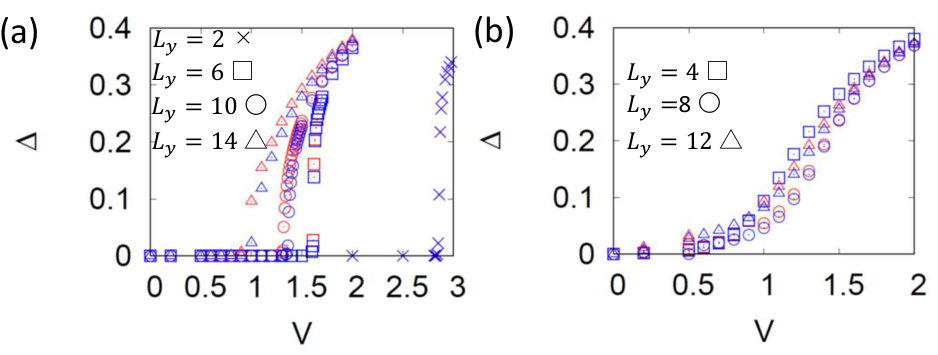 Figure 1
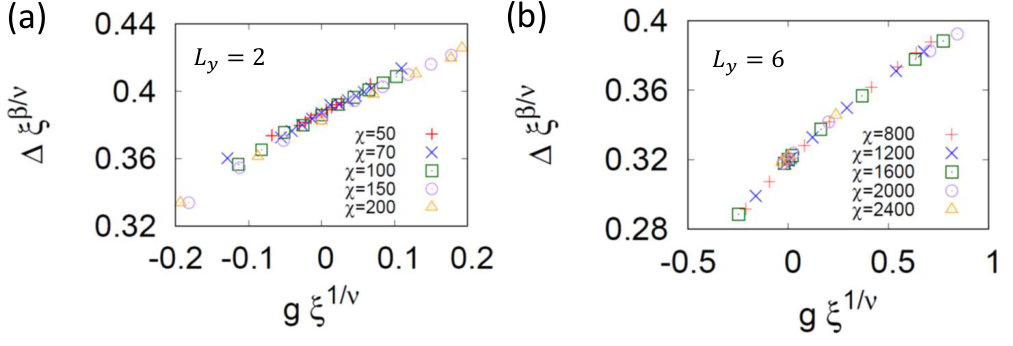 Figure 2
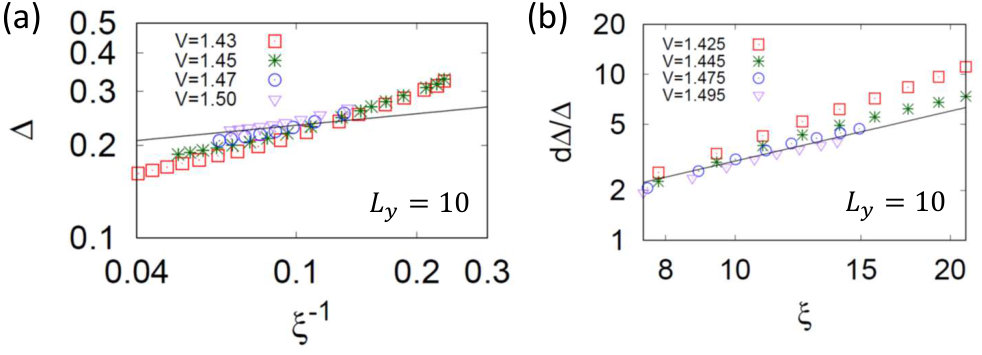 Figure 3
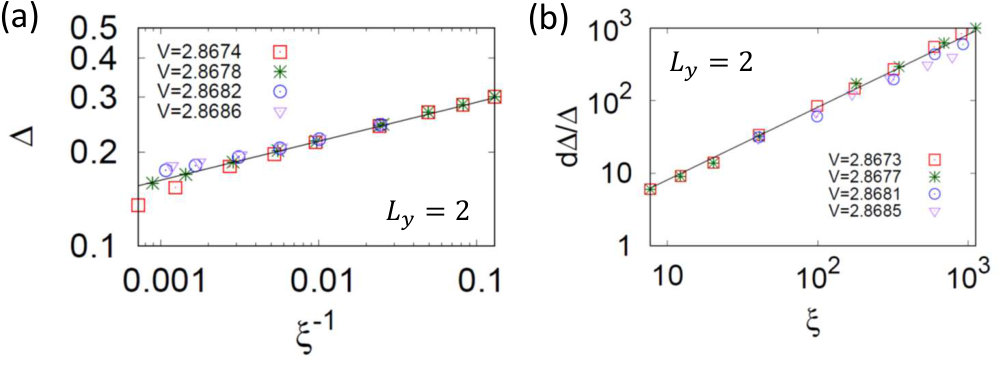 Figure 4
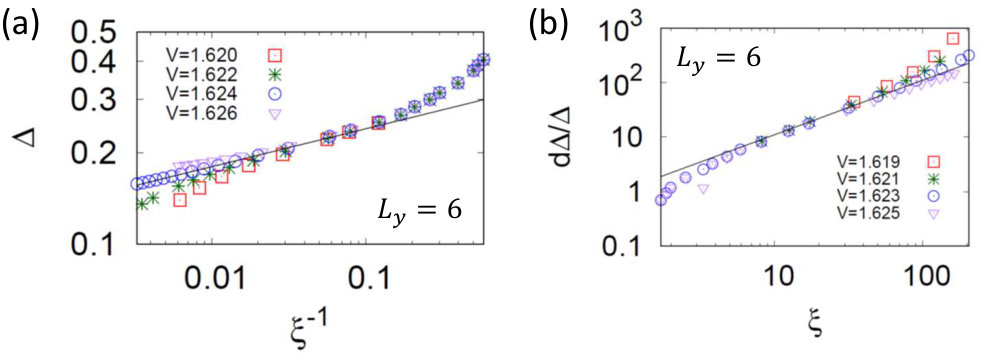 Figure 5
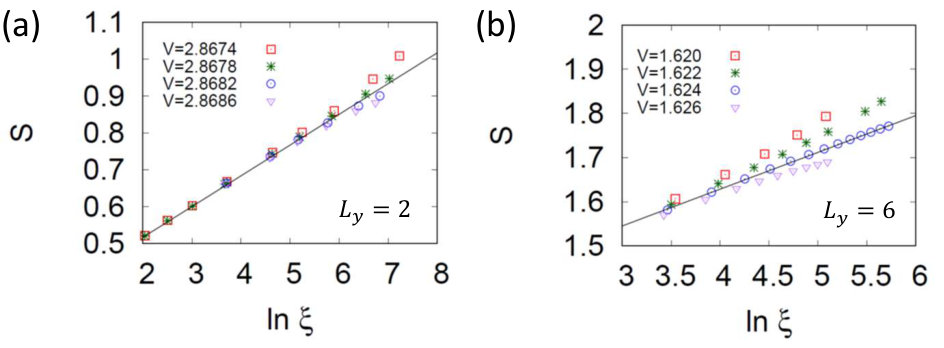 Figure 6
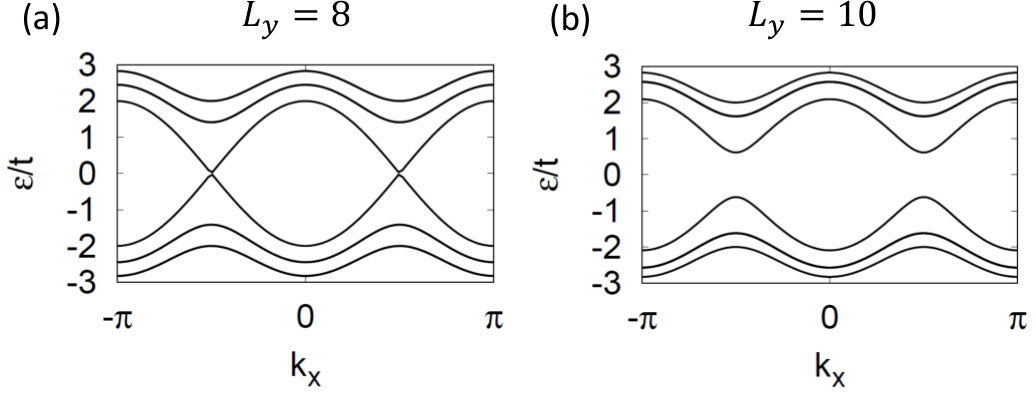 Figure 7
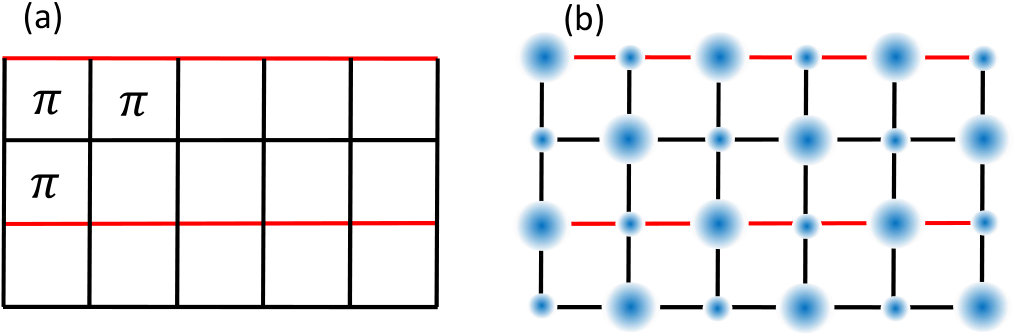 Figure 8
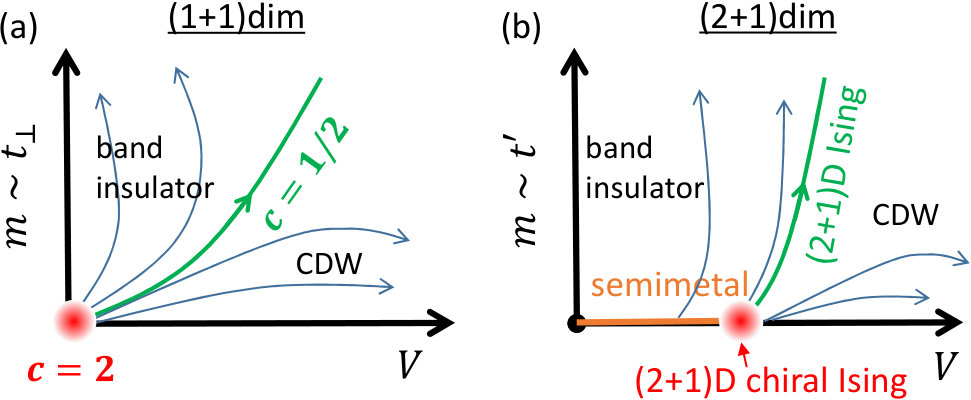 Figure 9
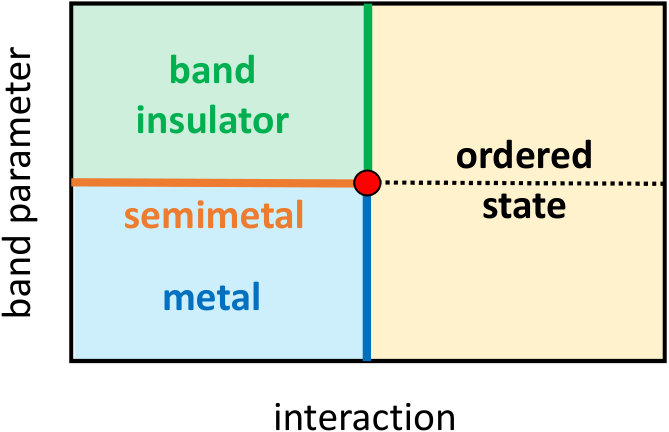 Figure 10
Peer Reviews
No public reviews on file for this paper yet. If you reviewed it on a platform where reviews are public (OpenReview, ICLR, NeurIPS, ICML), you can paste yours below so the community can read it here.
Videos
No videos yet. Explain this paper in a talk, walkthrough, or lecture? Add one.
Quantum phase transition and criticality
in quasi one-dimensional spinless Dirac fermions
Yasuhiro Tada
Institute for Solid State Physics, University of Tokyo, Kashiwa 277-8581, Japan
Abstract
We study quantum criticality of spinless fermions on the quasi one dimensional -flux square lattice in cylinder geometry, by using the infinite density matrix renormalization group and abelian bosonization. For a series of the cylinder circumferences with the periodic boundary condition, there are quantum phase transitions from gapped Dirac fermion states to charge density wave (CDW) states. We find that the quantum phase transitions for such circumferences are continuous and belong to the (1+1)-dimensional Ising universality class. On the other hand, when , there are gapless Dirac fermions at the non-interacting point and the phase transition to the CDW state is Gaussian. Both of these two criticalities are described in a unified way by the bosonization. We clarify their intimate relationship and demonstrate that a central charge Ising transition line arises as a critical state of an emergent Majorana fermion from the Gaussian transition point.
I introduction
Criticality associated with a phase transition is one of the central issues in condensed matter physics. Various phase transitions have been established mainly for insulators which are well described by bosonic models such as Ising, XY, and Heisenberg models. However, phase transitions in metals where gapless fermions are coupled with bosons are rather poorly understood compared to insulators only with bosons. In such a system, fermions strongly affect low energy behaviors of the bosonic order parameters and consequently could change criticality of the phase transition. The critical bosonic fluctuations in turn influence the fermions, and resulting non-Fermi liquid like behaviors are often observed in various systems Moriya and Ueda (2000); Löhneysen et al. (2007); Brando et al. (2016); Berg et al. (2019).
The criticality depends on structures of fermionic excitations such as dimensionality of the Fermi surface and the number of fermion flavors (orbitals and spins). One of the simplest examples is the spinless fermions on a one-dimensional (1D) chain at half-filling with the nearest neighbor repulsive interaction , where the classical ground states for are the charge density wave (CDW) states Giamarchi (2003); Gogolin et al. (2004). When one introduces fermionic hopping , there will be a Kosterlitz-Thouless phase transition to a Tomonaga-Luttinger liquid, which is disctinct from the Ising transition in bosonic models such as the transverse Ising model. Quantum criticality in higher dimensional systems are also of great interest, and in this context, a semi-metallic system is an ideal platform to study interplay between fermions and bosons where the Fermi surface is a point. Indeed, critical behaviors of phase transitions in Dirac systems have been extensively studied, and the gapless Dirac excitations can lead to new criticalities such as chiral Ising, chiral XY, chiral Heisenberg universality classes Sorella and Tosatti (1992); Assaad and Herbut (2013); Wang et al. (2014, 2016); Li et al. (2015a, b); Parisen Toldin et al. (2015); Otsuka et al. (2016); Zhou et al. (2018); Corboz et al. (2018); Rosenstein et al. (1993); Rosa et al. (2001); Herbut (2006); Herbut et al. (2009); Janssen and Herbut (2014); Ihrig et al. (2018). The critical exponents of these phase transitions have been evaluated accurately by several methods, e.g. analytical calculations and unbiased quantum Monte Calro simulations. In these (semi)metallic systems, the gapless fermions play essential roles and the resulting quantum criticality is different from that in the corresponding purely bosonic system with gapped fermions.
These two criticalities are usually studied separately as distinct properties of metals and insulators. For example, the quantum phase transition from a gapless Dirac state to an antiferromagnetic state in a honeycomb lattice is described by (2+1)D chiral Heisenberg universality class, while the one from a spin-orbit coupled gapped Dirac state to the antiferromagnetic state belongs to 3D XY universality class Parisen Toldin et al. (2015); Lee (2011); Hohenadler et al. (2012). Similarly, one can separately discuss two criticalities of phase transitions from a metal or a band insulator to an ordered state in general. However, such separate discussions would be somewhat subtle when the band gap is very small, and there will be crossover between fermionic criticality and bosonic criticality in a narrow gap system. Then, a natural question is that how these two criticalities are connected along the critical line of the phase transition in an extended phase diagram including both metals and insulators (Fig. 1).
In this study, we consider quasi 1D half-filled spinless fermions on a -flux square lattice in cylinder geometry with the circumference , as a simple example for the quantum phase transition of symmetry breaking. When the nearest neighbor repulsive interaction is weak, there are Dirac fermions with a mass due to the finite system size for under the periodic boundary condition along the -direction, while there are gapless Dirac fermions at for . The system exhibits a staggered CDW ordered state for large . The quantum phase transition is studied with use of the infinite density matrix renormalization group (iDMRG) White (1992); Schollwöck (2005, 2011); DMR ; Kjäll et al. (2013); Hauschild and Pollmann (2018) together with the recently developed scaling analysis Corboz et al. (2018). Then, we demonstrate that the quantum phase transition at a critical between the gapped Dirac fermions and the CDW state is continuous, and the corresponding criticality is simply (1+1)D Ising universality class. On the other hand, the iDMRG results suggest that the phase transition from the gapless Dirac state is smooth around , which turns out to be Gaussian. These two behaviors are well described within the bosonization approach in a unified manner, and a global phase diagram in the - plane is discussed. We clarify their intimate relationship and demonstrate that the central charge Ising transition line arises as a critical state of an emergent Majorana fermion from the Gaussian transition point.
II model and phase transition
II.1 Model
We consider spinless fermions on a -flux square lattice at half-filling,
[TABLE]
where along the -direction at even (odd) and along the -direction. represents a pair of nearest neibghbor sites (Fig. 2). We use the energy unit . The system size is with the periodic boundary condition for the -direction otherwise specified. In 2D () at , this model has two Dirac points and there is a continuous quantum phase transition to a staggered CDW state at Wang et al. (2014, 2016); Li et al. (2015a, b). The criticality of the CDW phase transition belongs to the (2+1)D chiral Ising universality class, whose critical exponents are evaluated as and by the quantum Monte Carlo calculations Wang et al. (2014, 2016); Li et al. (2015a, b).
For a finite , the single particle dispersion under the periodic boundary condition for the -direction is given by
[TABLE]
where takes continuum values and . Similarly, for . Due to the discreteness of , the dispersion is qualitatively different when and ; the gapless Dirac points exist for , while the Dirac fermions are massive with the gap size for . is shown in Fig. 3 for and as an example.
To discuss effects of the interaction , we use iDMRG for a system of cylinder geometry and abelian bosonization. The iDMRG allows a highly accurate calculation, and has been used extensively not only for one dimensional sytems but also for two dimensional systems. One can directly describe a quantum phase transition of discrete symmetry in such an infinite length cylinder by using iDMRG. Later, we also perform bosonization analysis around but with a twisted boundary condition for the -direction, which enables us to discuss the gapped and gapless fermions on an equal footing.
II.2 iDMRG calculations
II.2.1 Order parameter
In this section, the CDW quantum phase transition is investigated by iDMRG White (1992); Schollwöck (2005, 2011); DMR with use of the open source code TenPy Kjäll et al. (2013); Hauschild and Pollmann (2018). We discuss the CDW order parameter associated with the symmetry breaking,
[TABLE]
where is the unit period assumed in the iDMRG calculation. The summation is over and . We have performed calculations for various and confirmed that the results are essentially independent of . Firstly, we show for the massive case () and massless case () respectively in Fig. 4. For the massive case , we find a clear quantum phase transition from the gapped Dirac state to the CDW state at -dependent critical values . The critical value decreases as increases for a fixed bond dimension , because the Dirac band mass is reduced for larger . We expect that is monotonically decreasing and approaches the 2D value , although for used is smaller than due to the strong finite effect. On the other hand, for the massless case with , the order parameter behaves smoothly as a function of since the gapless Dirac states can be correctly described only when the bond dimension in the iDMRG calculation is infinitely large . In this limit, we expect a Gaussian transition takes place at , which is indeed described by the bosonization in the later section. In the next part, we focus on the massive case and discuss its criticality within iDMRG.
II.2.2 Finite correlation length scaling for
The criticality of the phase transition for is expected to be (1+1)D Ising universality class if it is continuous, because the CDW state breaks translation symmetry and there is no gapless Dirac fermions at for these . In order to examine the criticality numerically, we use the scaling ansatz recently developed for tensor network states in iPEPS Corboz et al. (2018). Since the one-dimensional system size is infinite in iDMRG, criticality is controlled not by but by the correlation length in our calculations. The correlation length is computed from the second largest eigenvalue of the transfer matrix for a given bond dimension , and characterizes finite bond dimension effects. One would naively expect that the system may exhibit the (2+1)D -Ising criticality if , while it shows (1+1)D bosonic Ising criticality if . In the following, we focus only on the latter case with .
The scaling ansatz for the ground state energy density is written as
[TABLE]
where and is the conjugate field to . We have assumed the dynamical critical exponent is . The -dependent critical points are determined so that a scaling behavior of the order parameter Eqs. (5), (6) hold for larger . We obtain , and as will be discussed in the following. At the critical point , the CDW order parameter exhibits the scaling behaviors
[TABLE]
which are derived from the scaling ansatz Eq.(4). From these two equations, we can determine the critical exponents and .
In Fig. 5, we show -dependence of and for . First of all, the quantum phase transition is continuous since the scaling behaviors hold up to large , although a discontinuous transition was potentially possible. The critical interaction strength is obtained as from the figure. The critical behaviors of are in good agreement with those of (1+1)D Ising universality class with , as we have expected. Similarly, we show -dependence of and for in Fig. 6. The critical interaction is evaluated as . Although there is some signature for dimensional crossover from (2+1)D chiral Ising universality class for small , the true criticality close to the critical point belongs to the (1+1)D Ising universality class. For , however, it is difficult to explicitly demonstrate the critical behavior of the (1+1)D Ising universality class as shown in Fig. 7, because of the heavy finite effects. Here, we used up to 2400, and the critical interaction is estimated to be . We think that the critical behavior of the (1+1)D Ising universality class will be reproduced for sufficiently large similarly to the cases for .
To further confirm the critical behaviors of the (1+1)D Ising universality class, in Fig. 8, we show the scaling plot
[TABLE]
where is a scaling function. Here, we have used only the data for to avoid effects of the dimensional crossover. All the data collapse into a single curve in each system size , which gives a cross check for the Ising universality class of the CDW phase transition. Finally, Fig 9 shows the entanglement entropy for bipartitioning the infinite one dimensional chain in the iDMRG calculation into two half-infinite chains. In such bipartitioning, the entanglement entropy at the critical point is characterized by the central charge of the underlying conformal field theory and is given by
[TABLE]
where is a constant Kjäll et al. (2013); Calabrese and Cardy (2004). In the present system, the calculated at the critical point is well fitted by this formula with , which means that the corresponding conformal field theory is the Ising theory in agreement with the critical behaviros of the order parameter .
II.3 Bosonization and global phase diagram
In this section, we discuss the relationship between the CDW phase transitions from gapless and gapped Dirac states within the bosonization approach Giamarchi (2003); Gogolin et al. (2004); Balents and Fisher (1997); Carr et al. (2006). Our primary purpose is to find an effective theory description for the iDMRG calculation results. To discuss the gapless and gapped states on an equal footing, we introduce the twisted boundary condition with the twist angle for the -direction, or equivalently insert a flux along the cylinder He et al. (2017). When the boundary condition is realized and the non-interacting Dirac fermions are gapless for . The band gap in Eq. (2) is tuned by the twisting angle since the allowed discrete points for given finite changes as is varied. For example in case, the band gap becomes maximum at , for which there is a CDW phase transition from a gapped Dirac state whose criticality is (1+1)D Ising universality class. In this way, one can smoothly connect the two extreme cases, the gapless Dirac semimetal and maximally gapped Dirac band insulator, for fixed system size .
We firstly consider the non-interacting excitation spectra in the -flux cylinder for example with a fixed under the periodic boundary condition as shown in Fig. 3 (a), and focus only on the gapless Dirac fermion branches and neglect other gapped bands. There are two pairs of linear dispersions with positive and negative velocities around . If we introduce a twist angle , a band gap will be induced in the pre-existing gapless Dirac bands. The two branches can be reproduced by an effective two leg ladder model
[TABLE]
where . A similar effective model was studied before in the context of carbon nanotubes Balents and Fisher (1997). By using the transformation , the Hamiltonian is rewritten into the familiar form with an additional staggered hybridization term ,
[TABLE]
where hopping along the chain is for both .
The fermion operators are approximated around the Fermi point as with , where is the lattice constant and is the Klein factor Giamarchi (2003); Gogolin et al. (2004). The bosonic phase operators satisfy the commutation relation
[TABLE]
Furthermore, we introduce new fields for convenience. Then the Hamiltonian is bosonized into
[TABLE]
where . For small , the parameters are given by , and
[TABLE]
where is the Fermi velocity of the non-interacting model. The scaling dimensions of the operators are easily read off as
[TABLE]
We first consider the case with , or equivalently . Then, the most relevant term is the -term, and -field gets pinned to because of the strong coupling . The remaining -terms will have the same functional form, , and be renormalized to . Therefore, both of the two fields become gapped as long as , and the phase transition is a Gaussian transition from the two-flavor gapless Dirac state to the fully gapped CDW state. This is consistent with the iDMRG calculation where the CDW order parameter is non-zero for very small when under the periodic boundary condition.
Next, we consider a very small , for which the renormalized parameters still satisfy down to some energy scale under the renormalization group. In this energy scale, -field is nearly locked as and the low energy physics is described by the -field only,
[TABLE]
where and we have used the approximation . Note that the parameters in Eq. (15) should be regarded as renormalized ones under the renormalization group flow down to the above mentioned energy scale. In this Hamiltonian, the -term favors the CDW state while the -term leads to the band insulator, and this competition can lead to a gapless state when these two perturbations cancel each other. The resulting gapless state is described by the Majorana fermions, which corresponds to the criticality of the CDW phase transition from the band gapped Dirac state discussed in the previous section. To see this, we focus on a fine-tuned state where the two perturbation terms are maximally competing having the same scaling dimensions, , namely
[TABLE]
By redefining the boson fields as with , the Hamiltonian is rewritten as
[TABLE]
This Hamiltonian is called the self-dual sine-Gordon model and has been studied extensively Gogolin et al. (2004); Shelton et al. (1996); Shelton and Tsvelik (1996); Lecheminant et al. (2002); Robinson et al. (2019). Since the scaling dimensions of both -terms are 1, one can refermionize them by using a spinless fermion operator as
[TABLE]
Therefore the self-dual sine-Gordon model is mapped to a free spinless fermion model with mass terms,
[TABLE]
where Then we introduce Majorana fermions to write the Hamiltonian in the Majorana basis,
[TABLE]
where . Clearly, only one Majorana fermion is gappless and the other one is gapped along the special line given by in the - plane. (Note that we have assumed and thus in this study.) This emergent gapless Majorana fermions describe the conformal field theory which is the critical theory for the CDW phase transition from the band gapped Dirac state studied in the previous section. Physically, the Majorana fermions correspond to domain walls of the CDW oder.
We have shown within the bosonization how the fermionic criticality at the Gaussian transition is connected to the bosonic criticality at the Ising transition. These discussions are summarized in the global phase diagram shown in Fig. 10. We expect that competition between the band gap and interaction would be important also for higher dimensions. For example in spinless fermions on the two dimensional -flux square lattice, there is a CDW quantum phase transition with (2+1)D chiral Ising criticality at from the gapless Dirac semimetal Wang et al. (2014, 2016); Li et al. (2015a, b), while a transition from the gapped Dirac insulator is expected to show 3D Ising criticality if it is continuous. The two phase transitions would be connected in a non-trivial way, and the familiar 3D Ising criticality might be understood as a critical state of an emergent object from the (2+1)D chiral Ising critical point. Further studies are necessary to develop theoretical understanding of these issues.
III summary and discussion
We have studied the CDW quantum phase transition and its criticality in spinless fermions on the quasi one dimensional -flux square lattice, by using iDMRG and bosonization. We find that the phase transition from a Dirac band insulator is continuous and its universality class is (1+1)D Ising with the central charge when under the periodic boundary condition, while that from a Dirac semimetal is Gaussian with when . By introducing the twisted boundary condition, we discussed how the fermionic criticality of the Gaussian transition in the gapless Dirac semimetal is connected to the bosonic criticality of the Ising transition in the gapped Dirac band insulator. The global phase diagram was discussed, where the critical point is connected to the critical line. The resulting critical line arises from the competition between the band mass and the density interaction leading to the CDW gap, and is described by the emergent Majorana fermions which is regarded as a fractionalized object. This could give a new insight for a comprehensive understanding of phase transitions in both metals and insulators. Our results could provide a basis to understand higher dimensional systems, and also may be directly relevant for the artificially created -flux systems in cold atoms with the synthetic magnetic field Dalibard et al. (2011); Ozawa and Price (2019).
Acknowledgement
We are grateful to Y. Fuji for valuable discussions and constructive comments on our manuscript. We also thank J. -H. Chen, R. Kaneko, M. Nakamura, M. Oshikawa, S. Takayoshi and Y. Yao for fruitful discussions. The numerical calculations have been done at Max Planck Institute for the Physics of Complex Systems. This work was supproted by Grants-in-Aid for Scientific Research No. JP17K14333 and KAKENHI on Innovative Areas “J-Physics” [No. JP18H04318].
The reference list from the paper itself. Each links out to its DOI / PubMed record.
- 1Moriya and Ueda (2000) T. Moriya and K. Ueda, Advances in Physics 49 , 555 (2000) . · doi ↗
- 2Löhneysen et al. (2007) H. v. Löhneysen, A. Rosch, M. Vojta, and P. Wölfle, Rev. Mod. Phys. 79 , 1015 (2007) . · doi ↗
- 3Brando et al. (2016) M. Brando, D. Belitz, F. M. Grosche, and T. R. Kirkpatrick, Rev. Mod. Phys. 88 , 025006 (2016) . · doi ↗
- 4Berg et al. (2019) E. Berg, S. Lederer, Y. Schattner, and S. Trebst, Annual Review of Condensed Matter Physics 10 , 63 (2019) . · doi ↗
- 5Giamarchi (2003) T. Giamarchi, Quantum Physics in One Dimension (Oxford University Press, 2003).
- 6Gogolin et al. (2004) A. O. Gogolin, A. A. Nersesyan, and A. M. Tsvelik, Bosonization and Strongly Correlated Systems (Cambridge University Press, 2004).
- 7Sorella and Tosatti (1992) S. Sorella and E. Tosatti, Europhysics Letters (EPL) 19 , 699 (1992) . · doi ↗
- 8Assaad and Herbut (2013) F. F. Assaad and I. F. Herbut, Phys. Rev. X 3 , 031010 (2013) . · doi ↗