Behavior of Shannon entropy around an exceptional point in an open microcavity
Kyu-Won Park, Jinuk Kim, Songky Moon, and Kyungwon An

TL;DR
This study explores how Shannon entropy behaves near an exceptional point in an open microcavity, revealing extremal values, discontinuities, and a complex topological structure in the entropy landscape.
Contribution
It provides the first analysis of Shannon entropy behavior around an exceptional point in a non-Hermitian microcavity system.
Findings
Shannon entropy reaches an extremum at the exceptional point.
Discontinuities in Shannon entropy occur across specific parameter lines.
The entropy surfaces exhibit a nontrivial topological structure.
Abstract
We have investigated the Shannon entropy around an exceptional point (EP) in an open elliptical microcavity as a non-Hermitian system. The Shannon entropy had an extreme value at the EP in the parameter space. The Shannon entropies showed discontinuity across a specific line in the parameter space, directly related to the occurrence of exchange of the Shannon entropy as well as the mode patterns with that line as a boundary. This feature results in a nontrivial topological structure of the Shannon entropy surfaces.
Click any figure to enlarge with its caption.
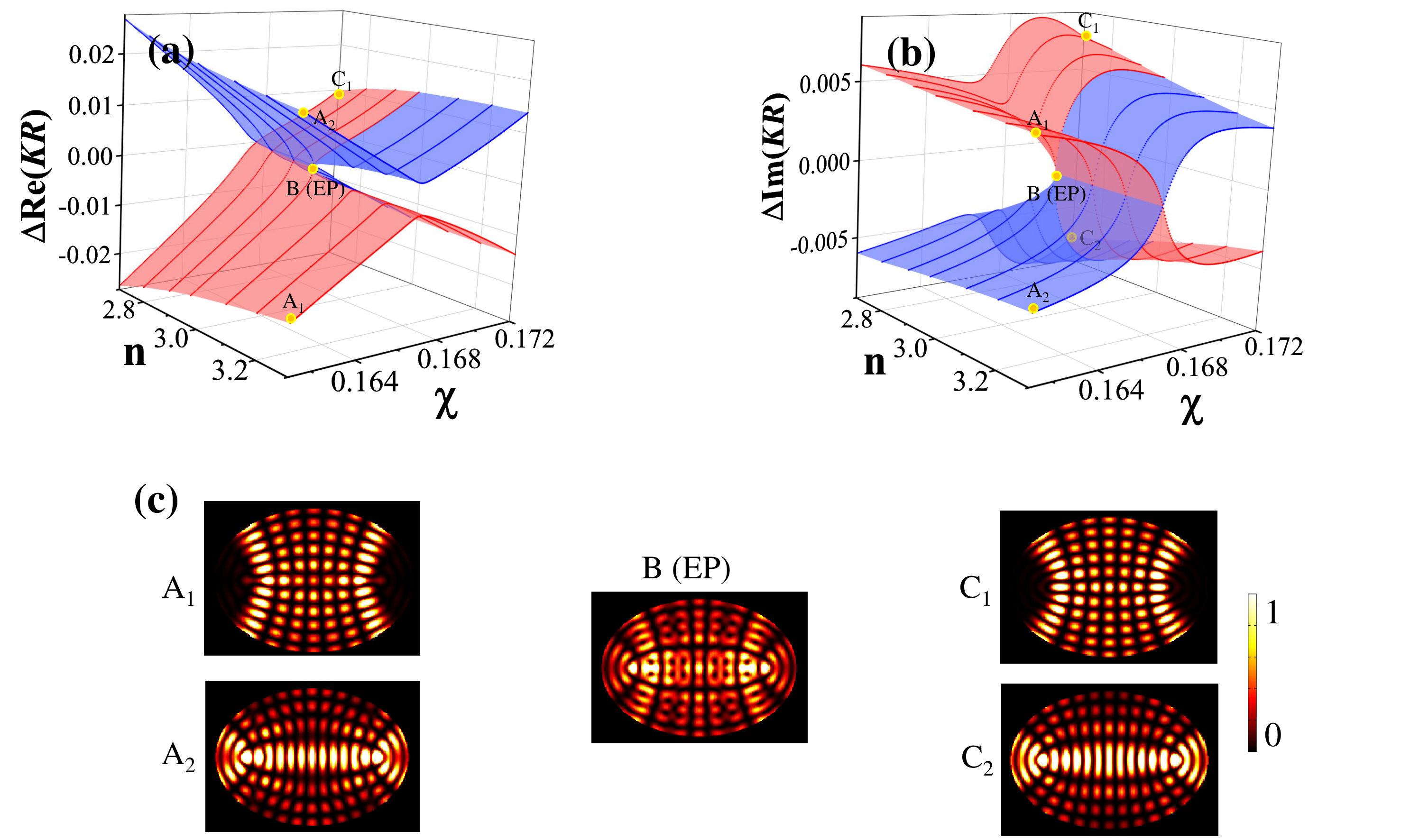 Figure 1
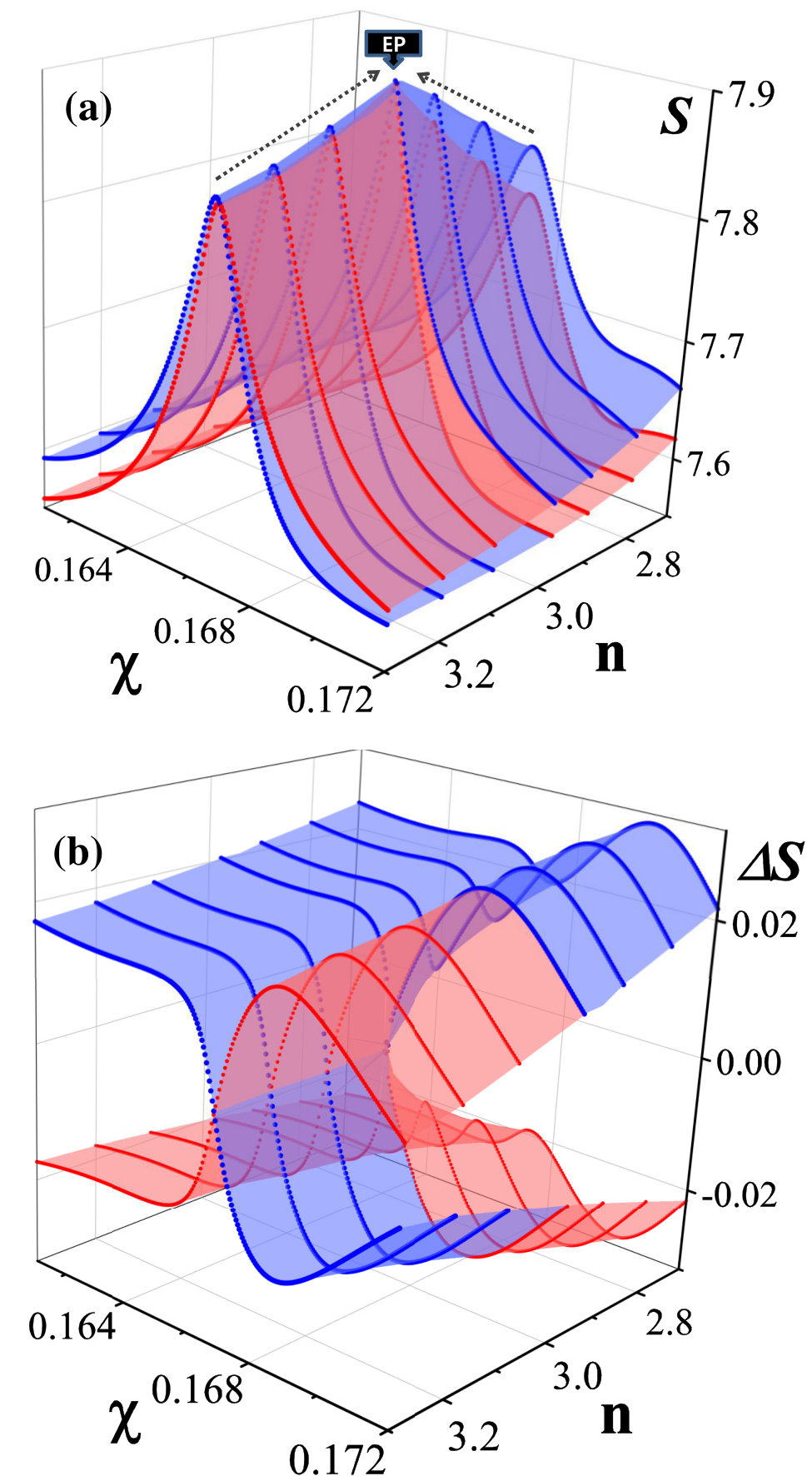 Figure 2
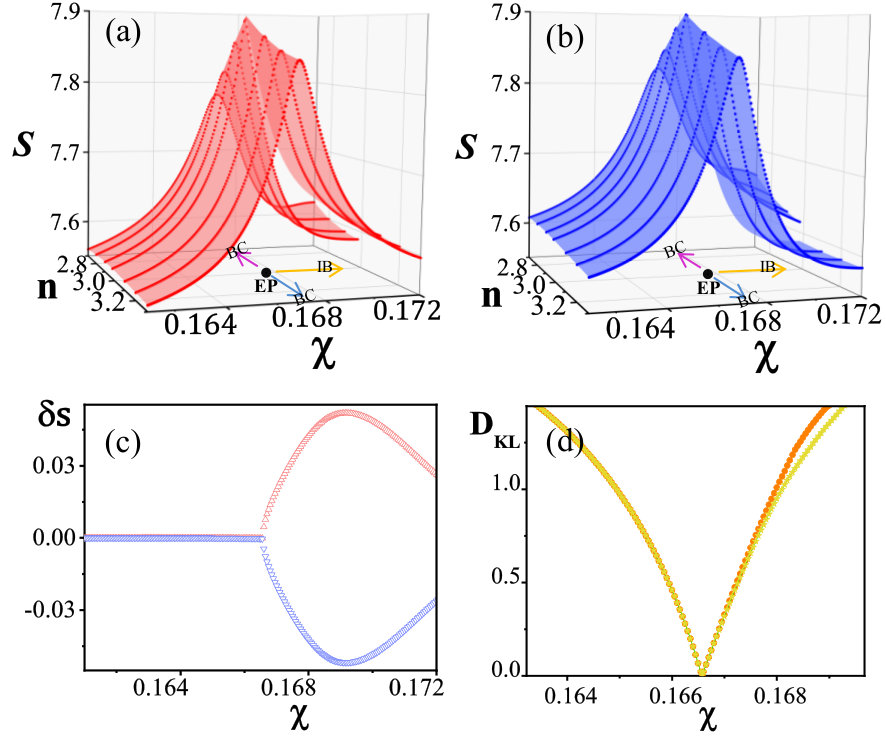 Figure 3
Peer Reviews
No public reviews on file for this paper yet. If you reviewed it on a platform where reviews are public (OpenReview, ICLR, NeurIPS, ICML), you can paste yours below so the community can read it here.
Videos
No videos yet. Explain this paper in a talk, walkthrough, or lecture? Add one.
Taxonomy
TopicsQuantum chaos and dynamical systems · Quantum Mechanics and Non-Hermitian Physics · Mechanical and Optical Resonators
Behavior of Shannon entropy around an exceptional point in an open microcavity
Kyu-Won Park
School of Physics and Astronomy, Seoul National University, Seoul 08826, Korea
Jinuk Kim
School of Physics and Astronomy, Seoul National University, Seoul 08826, Korea
Songky Moon
School of Physics and Astronomy, Seoul National University, Seoul 08826, Korea
Kyungwon An
School of Physics and Astronomy, Seoul National University, Seoul 08826, Korea
Abstract
We have investigated the Shannon entropy around an exceptional point (EP) in an open elliptical microcavity as a non-Hermitian system. The Shannon entropy had an extreme value at the EP in the parameter space. The Shannon entropies showed discontinuity across a specific line in the parameter space, directly related to the occurrence of exchange of the Shannon entropy as well as the mode patterns with that line as a boundary. This feature results in a nontrivial topological structure of the Shannon entropy surfaces.
pacs:
42.60.Da, 42.50.-p, 42.50.Nn, 12.20.-m, 13.40.Hq
Understanding the characteristics of open physical systems has been a very essential and fundamental issue since there are always system-bath interactions in real physical systems. The convenient and effective ways to investigate this openness effect is to consider a non-Hermitian system R09 ; M11 . The openness effects in a non-Hermitian system are significantly exhibited in the vicinity of a singular point called an exceptional point (EP), where not only the complex eigenvalues but also their eigenmodes coalesce K66 ; W04 .
The investigations of physical effects near the EP have been extensively conducted in various areas such as atomic physics HJ07 ; HM16 , microwave cavities CB03 ; SB14 , photonic crystals AA16 ; SM17 , optical microcavities SJ09 ; WS17 ; SJ12 , ultrasonic acoustic cavities SK16 and so on, both theoretically and experimentally. They have not only provided useful applications such as microcavity sensors J14 ; HA17 ; S17 and enhancement of spontaneous emission ZA16 ; Y06 ; AB17 , but also revealed many intriguing concepts and phenomena related to parity-time symmetry LR17 ; SC15 ; RK18 ; aa14 , chirality AG17 ; TG18 ; BS16 ; WG17 , phase transition YW14 ; AH15 ; PJ00 and topological transfer of energy HD16 . To the best of our knowledge, however, there have been no attempts to address the behavior of eigenmodes near the EP in the perspective of information theory. In this Letter, we challenge this task by introducing the Shannon entropy for the probability density of eigenmodes around an EP in a dielectric microcavity.
The Shannon entropy is defined as a measure of the average information content associated with a random outcome C48 . Originally introduced in data communication C48 and information theory J91 ; RM92 , it is now utilized in diverse research fields. The Shannon entropy has been studied in association with the black holes J73 , confined hydrogenic-like systems WF18 and the entanglement JS09 in physics. It was also applied to the bio-system JW05 ; JC97 , the ecological modeling SJ06 and information flow in finance RH02 . Moreover, the Shannon entropy recently has also been used as an indicator for avoided crossing in dielectric microcavities KS18 as well as atomic systems GD033 ; HC15 .
To deal with the interactions in an open system, it is convenient to introduce a non-Hermitian Hamiltonian formulated by
[TABLE]
where is a Hermitian Hamiltonian for a closed system (without interaction with a bath) associated with the open system, is an outgoing Green function in a bath, and () is the interaction from the bath (the closed system) to the closed system (the bath) R09 ; M11 . It should be noted that the domain of is restricted to the part of the system excluding the bath, so are its eigenvectors R09 ; K18 . The matrix elements for are typically given by
[TABLE]
where , , and its eigenvalues are
[TABLE]
with . Here we assume to be a real value to simplify the relation between strong and weak interactions: there is a repulsion in the real part of the energy eigenvalue with a crossing in the imaginary part for while there is a repulsion in the imaginary part with a crossing in the real part for . The former (latter) case corresponds to the strong (weak) interaction. Especially, the eigenvalue is degenerate when , corresponding to an EP. It is well-known that the EP is a singular point where the transition between the strong and the weak interactions takes place W90 ; W00 ; SJ08 .
When an integrable billiard becomes open, the off-diagonal elements of the non-Hermitian Hamiltonian accounting for mode-mode interactions come only from the openness effect or from the external interaction () R09 ; K18 . Therefore, we consider an elliptical dielectric microcavity as our open system in the present work.
Figure 1 depicts the eigenvalue surfaces () of the two interacting modes (shown in red and blue, respectively) around an EP in the parameter space for an elliptical dielectric microcavity. We consider the eigenvalue differences, with , from their average values instead of the eigenvalue themselves in order to display the EP structure clearly. Here, is the refractive index of the cavity medium and is a deformation parameter associated with the major axis and the minor axis , respectively. The eigenvalues are obtained with the boundary element method (BEM) W03 for a transverse-magnetic (TM) mode and their values are presented in the size parameter with the complex wave number. In Fig. 1, the two modes (red, blue) are divided by a reference line (n=2.9777), which separates the two regimes of interactions, i.e., the strong and and weak interactions. The EP is located at \big{(}n_{\textnormal{EP}}\simeq 2.9777,\chi_{\textnormal{EP}}\simeq 0.16657\big{)}.
The mode patterns of two interacting modes at are labeled by , the mode pattern at by B (EP) and those at by . These mode patterns are plotted in Fig. 1(c), respectively. Note that the mode pattern at B(EP) has more uniform probability than the others .
We now suggest that the Shannon entropy can be defined near an EP and can reveal the peculiar topology associated with the EP. The Shannon entropy for a specific discrete probability distribution at number of different states is defined as
[TABLE]
with a normalized condition . Here, we choose the mode intensity pattern inside the cavity as the probability distribution and the -mesh points for the mode intensity pattern as the spatial-coordinate states of a fictitious particle in the corresponding billiard as our different states. In Fig. 2, the Shannon entropies of probability density for the two interacting modes around the EP in our elliptical microcavity are plotted in the parameter space. The plots in Fig. 2 reveal two important features of Shannon entropy for EP, i.e., an extreme value at EP and a nontrivial topological structure around it.
For the extreme value, we note that the Shannon entropy is maximized at the center of interaction at the fixed refractive index in both weak and strong interaction regimes. It is because the coherent superposition of eigenfunctions in either weak or strong interaction regime leads to an increase in Shannon entropy. More interestingly, the dotted black arrows in Fig. 2(a) indicate that the trace of these maximum points has the extreme value at the EP with a value of .
For the nontrivial topological structure, we observe that the two cyclic variations are required for the Shannon entropy values to return to the original values on the Shannon entropy surface, just like the complex eigenvalues on the complex energy surfaces. To see a clear connection between these two, we define with , similarly to in Fig. 1. It is easily seen that the Shannon entropy surface resembles the imaginary part of the complex energy surfaces.
In order to investigate the origin of the nontrivial topological structure of the Shannon entropy surfaces, let us consider the Shannon entropy for each mode as shown in Fig. 3(a) and (b), respectively. The surface discontinuity is exhibited along the line in both cases. The discontinuity can be quantified by , where , with , for example. The result is shown in Fig. 3(c), where remains almost zero for whereas it increases significantly for along the line . This line is where the two interacting modes (red, blue) on different branches merge together, so let us call this line the interaction branch. A schematic diagram for the EP (branch point), the branch cut (BC) and the interaction branch(IB) is shown on the base planes in Fig. 3(a) and (b), respectively.
The discontinuity across the interaction branch is directly related to the exchange of the Shannon entropy as well as the mode exchange. This observation is consistent with our previous work KS18 , where the Shannon entropy is exchanged with the repulsion in the real part of eigenvalues in the strong interaction regime. This exchange property can be quantified by introducing the relative entropy. The relative entropy or the Kullback-Leibler (KL) divergence between the two probability distributions on a random variable is a measure of the distance between them KL51 . The KL divergence from to , usually denoted by D_{\textnormal{KL}}\big{(}P\parallel Q\big{)}, is defined by
[TABLE]
The KL divergence for the two interacting modes along the lines, respectively, is plotted in Fig. 3(d). The yellow (orange) symbols represent the KL divergence in the weak (strong) interaction regime at as the is varied. It is seen that the KL divergences are almost degenerate when and they become zero at the EP: when and at the EP. However, the difference becomes larger across the interaction branch when . These results are consistent with the fact that the mode patterns as well as the Shannon entropies in the weak interaction regime are not exchange whereas those in the strong interaction regime are exchanged. The transition from mode-pattern non-exchange to mode-pattern exchange gives rise to the intersection of the Shannon entropy surfaces as seen in Fig. 2 and leads to the nontrivial topological structure of the Shannon entropy in the parameter space.
In summary, we proposed the Shannon entropy for investigating the behavior of eigenmode patterns near an EP in a dielectric elliptical microcavity in the perspective of the information theory. Our study yielded two interesting results. First, the Shannon entropy has the extremal value at the EP. Second, the Shannon entropy surfaces show a nontrivial topological structure with two cyclic variations and this feature analyzed with the relative entropy is associated with a discontinuity across the interaction branch in the parameter space.
We thanks Sera Yu for useful comments. This work was supported by Samsung Science and Technology Foundation under Project No. SSTF-BA1502-05, the Korea Research Foundation (Grant No. 2016R1D1A109918326) and the Ministry of Science and ICT of Korea under ITRC program (Grand No. IITP-2019-0-01402).
The reference list from the paper itself. Each links out to its DOI / PubMed record.
- 1(1) I. Rotter, J. Phys. A: Math. Theor. 42 , 153001 (2009).
- 2(2) N. Moiseyev, Non-Hermitian Quantum Mechanics (Cambridge Univ. Press, 2011).
- 3(3) T. Kato, Perturbation Theory for Linear Operators (Springer-Verlag, Berlin, 1966).
- 4(4) W. D. Heiss J. Phys. A:Math. Gen. 37 (2004).
- 5(5) H. Cartarius, J. Main, and G. Wunner, Phys. Rev. Lett. 99 , 173003 (2007).
- 6(6) H. Menke, M. Klett, H. Cartarius, J. Main, and G. Wunner, Phys. Rev. A 93 , 013401 (2016).
- 7(7) C. Dembowski, B. Dietz, H. -D. Gräf, H. L. Harney, A. Heine, W. D. Heiss, and A. Richter, Phys. Rev. Lett. 90 , 034101 (2003).
- 8(8) S. Bittner, B. Dietz, H. L. Harney, M. Miski-Oglu, A. Richter, and F. Schäfer Phys. Rev. E 89 , 032909 (2014).