Double spin asymmetry in dihadron production in SIDIS off the longitudinally polarized nucleon target
Xuan Luo, Hao Sun, Jing Li, Yi-Ling Xie, Tichouk

TL;DR
This paper investigates the double spin asymmetry in dihadron production in SIDIS off polarized nucleons, calculating a twist-3 fragmentation function and comparing predictions with experimental data and future collider expectations.
Contribution
It introduces a new twist-3 dihadron fragmentation function within a spectator model and applies it to analyze azimuthal asymmetries in SIDIS.
Findings
Calculated the unknown twist-3 fragmentation function $ ilde{D}^ ext{sphericalangle}$.
Estimated azimuthal asymmetries at COMPASS kinematics and compared with data.
Provided predictions for future EIC measurements.
Abstract
In this paper we study the double longitudinal spin asymmetry of dihadron production in semi-inclusive deep inelastic scattering (SIDIS). We calculate a unknown twist-3 dihadron fragmentation function within a spectator model which has been used successfully in describing the dihadron production in both the unpolarized and the single polarized processes. The collinear picture, in which the transverse momentum of the final state hadron pair is integrated out, has been considered. The azimuthal asymmetry arises from the coupling and the coupling is studied. We estimate the asymmetry at the kinematics of COMPASS and compare with the data. The prediction at the future Electron Ion Collider (EIC) has also been presented.
Click any figure to enlarge with its caption.
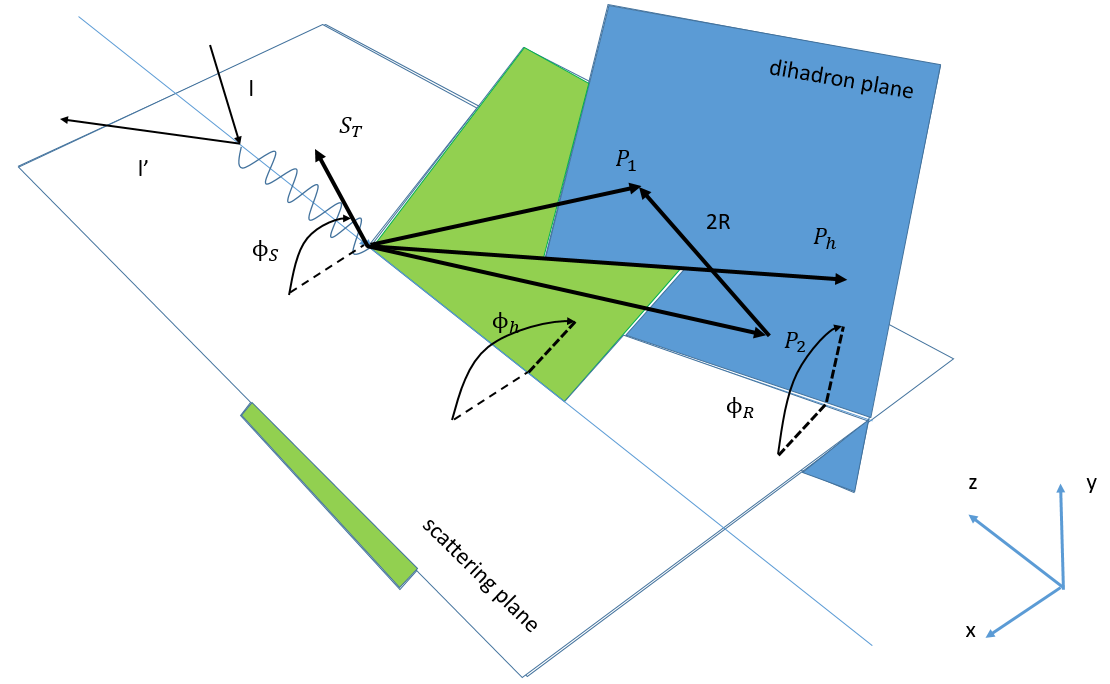 Figure 1
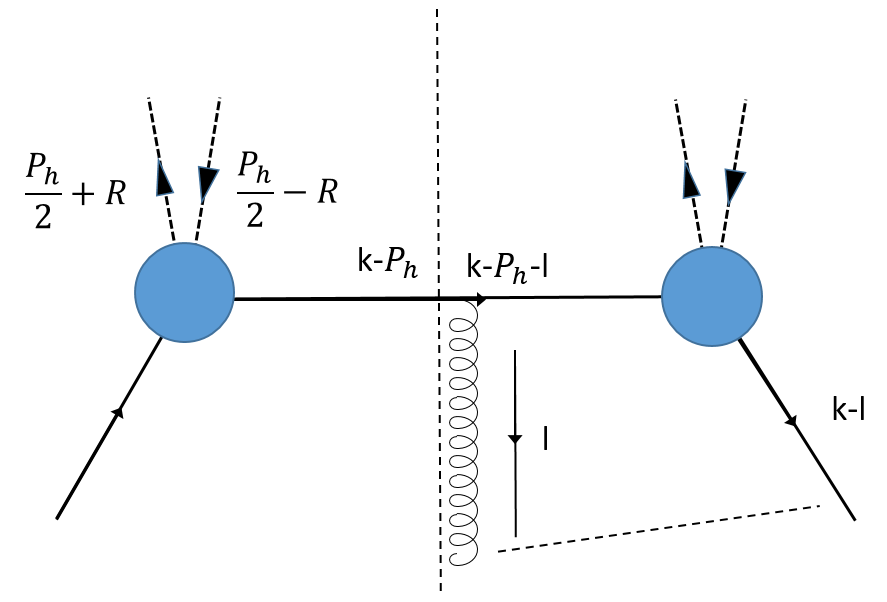 Figure 2
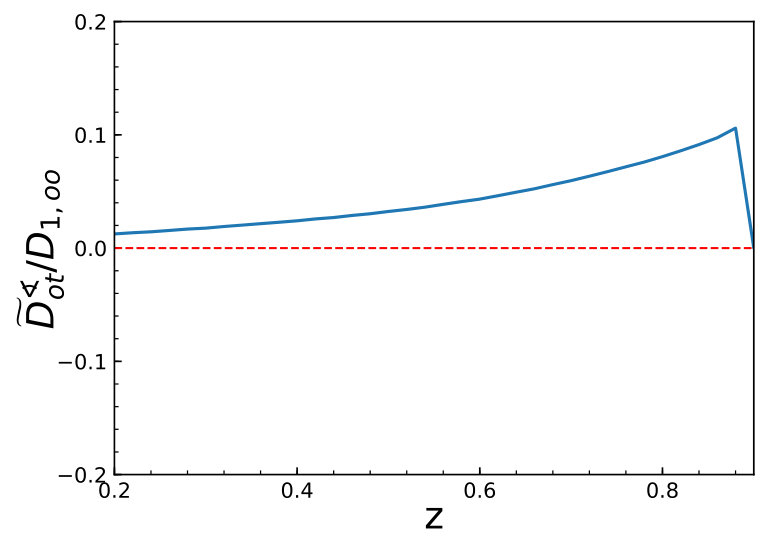 Figure 3
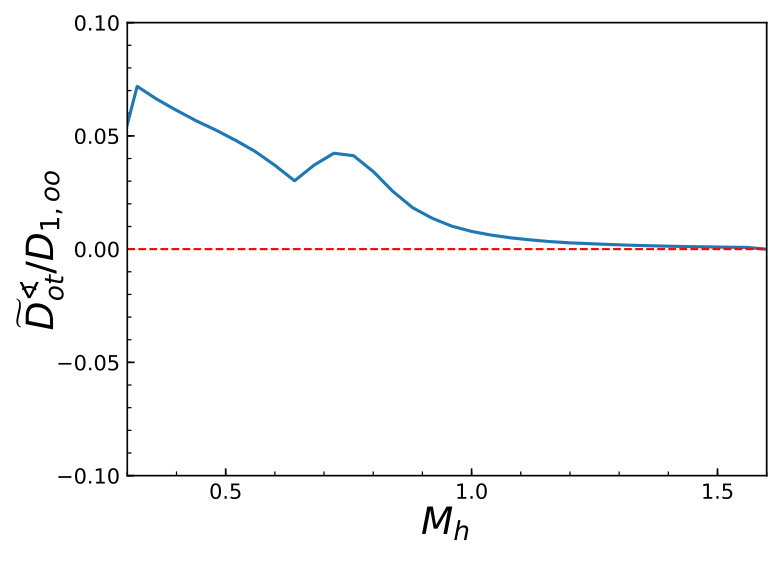 Figure 3
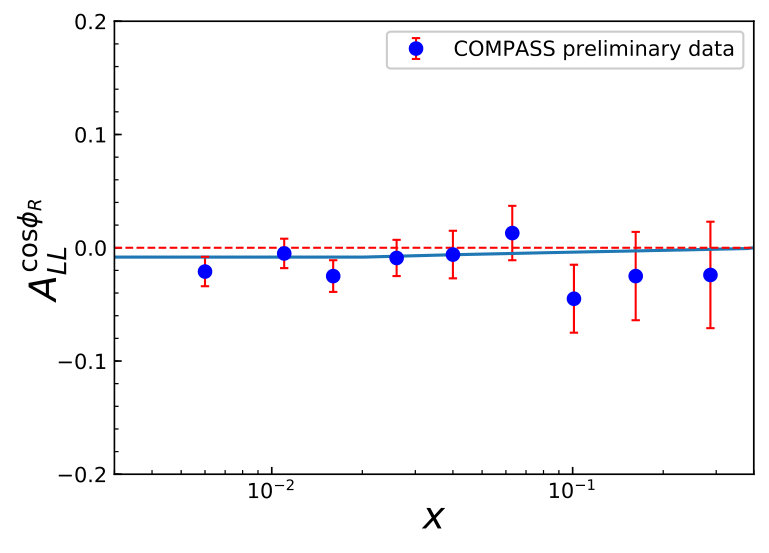 Figure 4
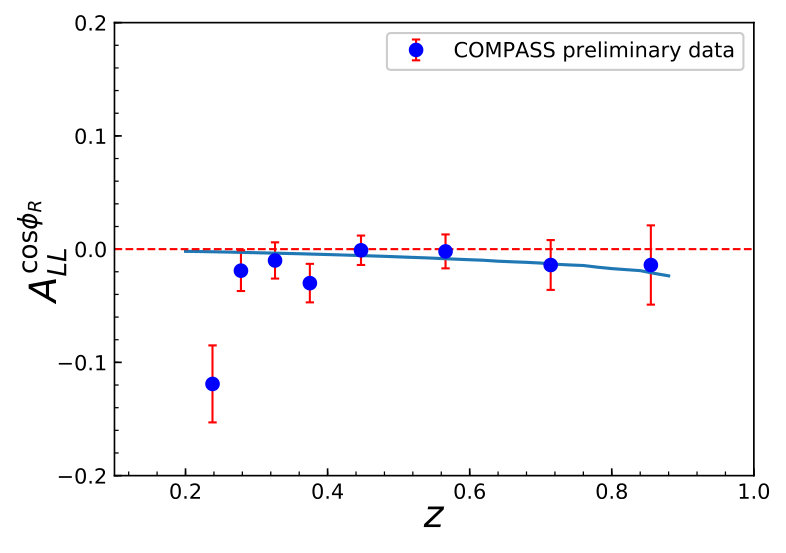 Figure 4
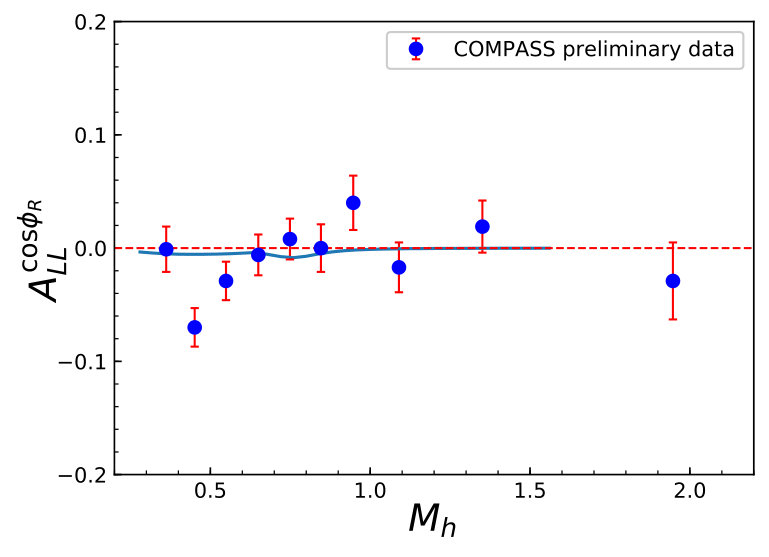 Figure 4
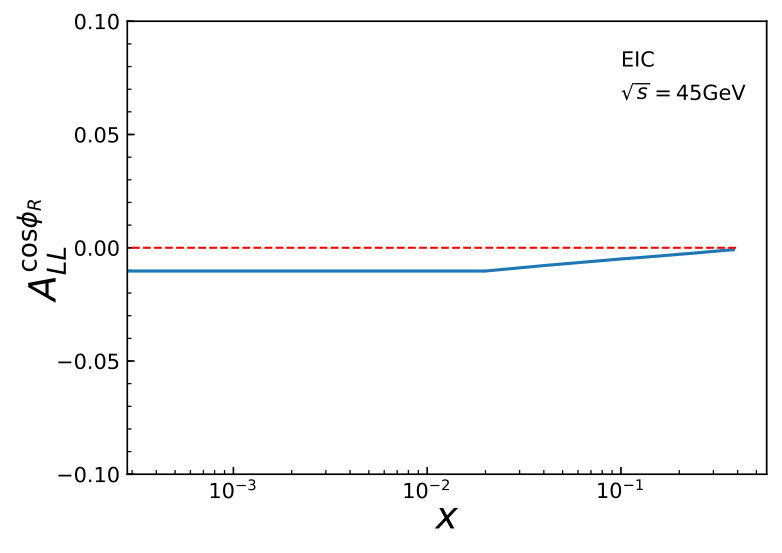 Figure 5
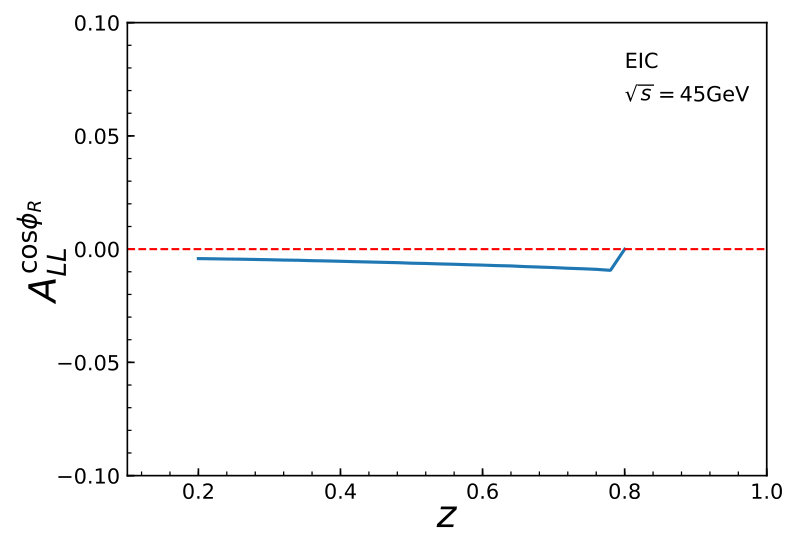 Figure 5
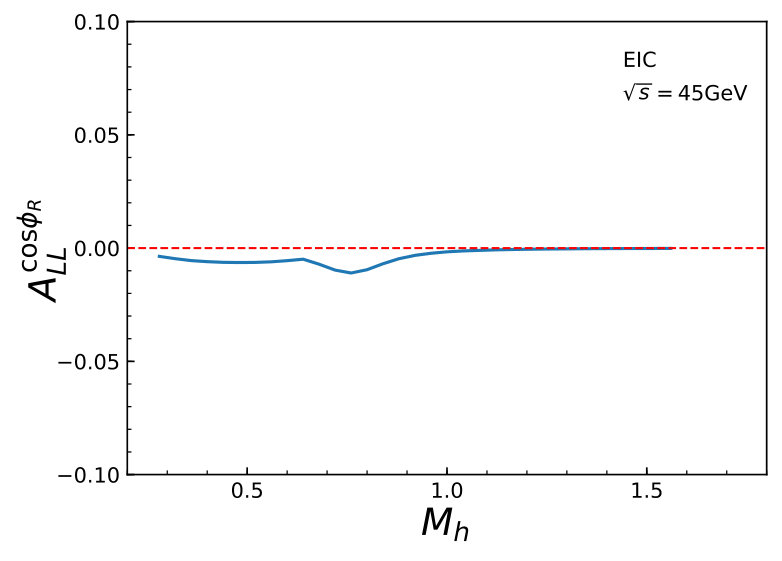 Figure 5
Peer Reviews
No public reviews on file for this paper yet. If you reviewed it on a platform where reviews are public (OpenReview, ICLR, NeurIPS, ICML), you can paste yours below so the community can read it here.
Videos
No videos yet. Explain this paper in a talk, walkthrough, or lecture? Add one.
Double spin asymmetry in dihadron production in SIDIS off a longitudinally polarized nucleon target
Xuan Luo
Hao Sun111Corresponding author: [email protected] [email protected]
Jing Li
Yi-Ling Xie
Tichouk
Institute of Theoretical Physics, School of Physics, Dalian University of Technology,
No.2 Linggong Road, Dalian, Liaoning, 116024, P.R.China
Abstract
In this paper we study the double longitudinal spin asymmetry of dihadron production in semi-inclusive deep inelastic scattering. We calculate an unknown twist- dihadron fragmentation function within a spectator model which has been used successfully in describing the dihadron production in both the unpolarized and the single polarized processes. The collinear picture in which the transverse momentum of the final state hadron pair is integrated out has been considered. The azimuthal asymmetry arising from the coupling and the coupling is studied. In general, and its respective contribution vanish model-independently and dominates in this asymmetry. Moreover, we have adopted the same choice as before for the quark mass m fixed to zero GeV, which eliminates the contribution to the . Using the model results obtained at the low hadronic scale and neglecting the QCD evolution effects we estimate the asymmetry and compare with the COMPASS preliminary data. An estimate for the future electron ion collider is also presented.
I INTRODUCTION
Azimuthal asymmetries in SIDIS are key observables to investigate the spin dependent substructure of the nucleon. Azimuthal asymmetries can be theorically connected to combinations of parton distribution functions (PDFs) and fragmentation functions. In recent years, it is of great interest to study the hadron pair production in semi- inclusive deep inelastic scattering (SIDIS). This process is encoded by the so-called dihadron fragmentation functions (DIFFs) describing the probability that a quark is fragmented into two hadrons.
The DiFFs were proposed for the first time in Ref.Konishi et al. (1978) and their evolution equations have been studied in Refs.Vendramin (1981a, b). The DiFF evolution equations were also studied in Ref.Ceccopieri et al. (2007), the first place where they were discussed as functions of the hadron pair invariant mass . Reference Collins and Ladinsky (1994) introduced the transversely polarized DiFF as spin analyzer of the transversely polarized fragmenting quark, which later lead to the definition of . The basis of all possible DiFFs for two unpolarized detected hadrons has been given in Ref.Bianconi et al. (2000a). The method of partial-wave analysis was introduced in Ref.Radici et al. (2002), which is important to make the connection between the two produced hadrons clear. Reference Bacchetta and Radici (2004) extended the analysis to subleading twist with transverse momentum being integrated out.Such analysis can be directly promoted into the transverse momentum-dependent case. DiFFs have been used for investigating the transverse spin phenomena of the nucleon, and they can act as analyzers of the spin of the fragmenting quark Collins et al. (1994); Jaffe et al. (1998). Physicists started to focus on these functions by searching for a mechanism to extract the chiral-odd transversity distribution in an alternative and technically simpler way than the Collins effect Collins (1993). In this mechanism, the chiral-odd DiFF Radici et al. (2002); Bacchetta and Radici (2003) plays an important role in accessing transversity distribution , as it couples with at the leading-twist level in the collinear factorization. In Refs.Bacchetta et al. (2011, 2013); Radici et al. (2015, 2016); Radici and Bacchetta (2018), the authors extracted from SIDIS and proton-proton collision data. The first extraction of interference fragmentation functions was given by Ref.Courtoy et al. (2012) in annihilation. Meanwhile, the model predictions of the DiFFs by using the spectator model Bianconi et al. (2000b); Bacchetta and Radici (2006); Bacchetta et al. (2009) and by using the Nambu-Jona-Lasino quark model Matevosyan et al. (2013, 2014, 2017, 2018) were performed.
Experimentally, azimuthal asymmetries of hadron pair productions with both the unpolarized target and the transversely polarized target have been measured by the HERMES Collaboration Airapetian et al. (2008) and COMPASS Collaboration Adolph et al. (2012, 2014). Very recently, preliminary results on the azimuthal asymmetries in dihadron production were obtained by the COMPASS Collaboration Sirtl (2017). Considering the dihadron cross section in a collinear factorization approach with the incident lepton beam being unpolarized or longitudinally polarized, only two modulation, the and angle dependence, remain. Here is the angle between the lepton plane and two-hadron plane. The asymmetry was studied in a very recent paper Yang et al. (2019a) using a spectator model. Notice the asymmetry was also studied in Ref.Yang et al. (2019b). This COMPASS measurement showed a clearly negative asymmetry within experiment precision which was different from an obtained clearly positive asymmetry. In the parton model, in principle two source contribute to the asymmetry, one is the coupling of the twist-three distribution and the twist-two DiFF , the other is the twist-three DiFF combined with the helicity distribution . The former contribution vanishes model independently: Bacchetta et al. (2007) since the T-odd PDF is forbidden by time-reversal invariance. This is because after integration the Wilson line in the nonlocal quark bilinear expression, which defines the PDF, connects the quark fields along a straight line on the light cone. For a T-odd PDF this immediately implies that it vanishes.
In this paper, we use the spectator model results of the distribution functions and DiFFs to investigate the asymmetry. The only possible contribution of this asymmetry comes from . Thus we focus on the role of twist-three DiFF encoding the quark-gluon-quark correlation. It is reported in Refs.Kanazawa and Koike (2013); Metz and Pitonyak (2013) that the contribution of the twist-three fragmentation function to the single spin asymmetry also plays an important role in SIDIS and proton-proton collision within the framework of the collinear factorization. A phenomenological study Kanazawa et al. (2014) presents that it is possible to simultaneously describe azimuthal asymmetries data in SIDIS and proton proton collisions Adams et al. (2004); Abelev et al. (2008); Adamczyk et al. (2012); Lee and Videbaek (2007) by using collinear twist-three factorization. We adopt the spectator model Bacchetta and Radici (2006) to calculate . In the calculation we consider the effect of the gluon rescattering at one loop level needed for nonzero twist-three quark-gluon-quark correlator for fragmentation as the authors have done in Refs.Lu and Schmidt (2015); Yang et al. (2016). Applying the spectator model results for the distributions and DiFFs, we compute the asymmetry and compare with the COMPASS preliminary data.
The paper is organized as follows. In Sec.II we review the theoretical framework of the azimuthal asymmetry of dihadron production in longitudinally polarized lepton beam scattered off a longitudinally polarized proton target. We apply the spectator model to calculate the twist-three DiFF in Sec.III. In Sec.IV, we give the numerical results of the azimuthal asymmetry at the kinematics of COMPASS as well as EIC. We make the summary for our work in Sec.V.
II The asymmetry of dihadron production in SIDIS
As shown in Fig.1, we consider the dihadron SIDIS production
[TABLE]
where a longitudinally polarized muon with momentum scatters off a longitudinally polarized target nucleon with mass , polarization and momentum , via the exchange of a virtual photon with momentum . Inside the target, the photon hits the active quark with momentum and the final state quark with momentum and then fragments into two leading unpolarized hadrons with mass , and momenta . To present the differential cross section with respect to dihadron-dependent structure function, we define the following kinematic invariants:
[TABLE]
Here, we describe the 4-vector in the light-cone coordinates as , where and is the transverse component of the vector. Thus represents the light-cone fraction of target momentum carried by the initial quark, denotes the light-cone fraction of the fragmented quark carried by the hadron . The light-cone fraction of fragmenting quark momentum carried by the final hadron pair is defined by . Moreover, the invariant mass, the total momentum and the relative momentum of the hadron pair are denoted by , and , respectively.
It is convenient to choose the axis according to the condition . In this case, the momenta , and can be written as Bacchetta and Radici (2006)
[TABLE]
where
[TABLE]
Here is the angle between the lepton plane and the two-hadron plane and is the mass of pion. It is desired to notice that in order to perform partial-wave expansion, we have reformulated the kinematics in the CM frame of the dihadron system. is the cm polar angle of the pair with respect to the direction of in the target rest frameBacchetta and Radici (2003). Here we can find some useful relations as
[TABLE]
We will consider the SIDIS process of longitudinally polarized muons off longitudinally polarized nucleon target. After integrating out the transverse momentum of the dihadron, the differential cross section for this process reads
[TABLE]
and
[TABLE]
where is the longitudinal spin component. For convenience, we have indicated the unpolarized or longitudinally polarized states of the beam or the target with the labels U and L, respectively. In Eq.(8), and are the unpolarized PDF and unpolarized DiFF with flavor . We have removed the vanishing contribution coming from in Eq.(9), where is the helicity distribution combined with the twist-three DiFF .
The collinear DiFFs is extracted from the integrated quark-quark correlator
[TABLE]
where is the quark field operator and is the Wilson line running from to along to ensure the gauge invariance of the operator. denotes the negative light-like vector . The twist-three DiFF represented by the quark-gluon-quark correlator origins from the triparton correlation during the quark fragmentation Yang et al. (2019a)
[TABLE]
where is the gluon field strength tensor. After integrating out , one obtains Yang et al. (2019a)
[TABLE]
By projecting out the usual Dirac structures, we obtain the following decomposition results
[TABLE]
where the index is restricted to be transverse. Thus can be extracted from the correlator by the following trace:
[TABLE]
where is the negative light-cone Dirac matrix.
The DiFFs and with flavor can be expanded in the relative partial waves of the dihadron system up to the -wave level Bacchetta and Radici (2003):
[TABLE]
where comes from the interference of - and -waves, and originates from the interference of two waves with different polarization.
In this paper we will not consider the -dependent terms in the expansion of DiFFs. This is because that -dependent terms correspond to the higher order contribution in the partial wave expansion and can only be significant when the two hadrons produce via a spin-one resonance. Whereas the function can also contribute to a double spin asymmetry by integrating upon in a different range, and we will study this -dependent contribution in a future paper. Therefore, we focus on the functions , and . Under these selections, the asymmetry of the considered process can be expressed asSirtl (2017)
[TABLE]
where we have applied the approximations of the diquark spectator model.
III The model calculation of
Before working out the DiFF in the spectator model, we briefly review the calculation of twist-two DiFFs given by Ref.Bacchetta and Radici (2006). The model can make predictions for these collinear DiFFs and also for transverse momentum-dependent DiFFs, which we will consider in a next work. As stated in Eq.(15), was expanded in terms of the relative partial waves of the dihadron and the expansion was truncated up to the -wave. The can receive contributions from both and waves, but not from the interference between the two. The - and -wave quark dihadron vertex structures denoted by and are defined below and introduced in Ref.Bacchetta and Radici (2006). The vertex is complex. Finally, the parameters of the model are fixed by fitting the output of the PYTHIA Monte Carlo generatorSjostrand et al. (2001), and the numerical results of the twist-2 DiFFs is therefore given.
We will work out the DiFF in the spectator model in the following. It is desired to notice that we mainly following the calculation framework of Ref.Yang et al. (2019a). At the twist-three level, the DiFF originates from the quark-gluon-quark correlator. The diagram adopted to calculate the twist-three DiFF in the spectator model is shown in Fig.2. The left and right hand sides of Fig.2 correspond to the quark-dihadron vertex and the vertex containing gluon rescattering , respectively.
Here we adopt the Feynman gauge, in which the transverse gauge links and can be neglected Ji and Yuan (2002); Belitsky et al. (2003).
With these considerations at hand, we can write down the s- and p-wave contributions to the quark-gluon-quark correlator as
[TABLE]
where and represent the masses of the fragmented quark and the spectator quark, respectively. represents the color factor and the strong coupling constant is denoted by . The factor originates from the Feynman rule corresponding to the gluon field strength tensor, as described by the open circle in Fig.2. In Eq.(18), in principle the Gaussian form factors should depend on the loop momentum . Here following choice in Ref.Bacchetta et al. (2008a) we abandon this dependence and merely use instead of in those form factors to simplify the integration. This choice is introduced to cutting off the high- region. The s- and p-wave vertex structure and have the following forms Bacchetta and Radici (2006):
[TABLE]
where and denotes the unit step function. The couplings , , and are the model parameters. The first two terms of can be identified as the contributions of the and the resonances decaying into two pions. The masses and the widths of the two resonances can be obtained from the PDG Eidelman et al. (2004): GeV, GeV, GeV and GeV. In addition, according to isospin symmetry we have the conclusion that the fragmentation correlators for processes , , and are the same. Thus, by transforming the sign of , equivalently changing and . Therefore, the DiFF which depends linearly on R coming from and processes has an additional minus sign comparing to the process.
By using Eq.(12) and expanding Eq.(18), we obtain
[TABLE]
Here the -dependent -cutoffs and have the relation
[TABLE]
where have the following ansatz :
[TABLE]
and , and are the parameters showing below. The term is fixed by the on-shell condition of the spectator
[TABLE]
In Eq.(21), the lines with and describe the pure - and -wave contributions, thus they will not make a difference in the interference of - and -waves functions . While the last two lines describe the - and - wave interference, and they do contribute to the . Therefore, in principle there are two sources for nonvanish at one loop level. One is the real part of the loop integral over , coupling with the real part of . The other is the imaginary part of the loop integral over , combined with the imaginary part of . The real part of the integral is just the usual loop integral adopting the Feynman parameterization. While for the imaginary part of the integral, we impose the Cutkosky cutting rules:
[TABLE]
Then we can obtain the final result for ,
[TABLE]
where and are the usual one loop scalar or tensor integrals. The general defination of 2-point one-loop scalar integration is given by Ellis and Zanderighi (2008)
[TABLE]
and three-point one-loop scalar integration is denoted as
[TABLE]
where and . The coefficients and denote the following functions
[TABLE]
which originate from the decomposition of the following integral Lu and Schmidt (2015)
[TABLE]
The functions represent the results of the following integrals
[TABLE]
IV Numerical results
In order to fix the parameters of the spectator model, the authors of Ref.Bacchetta and Radici (2006) compare it with the output of the PYTHIA event generator adopted for HERMES. The values of the parameters obtained by the fit are:
[TABLE]
where we have adopted the same choice as in Ref.Bacchetta and Radici (2006) for the quark mass fixed to be zero GeV. Since the term is proportional to the quark mass , in our calculation only the term in Eq.(26) contributes to numerically. Furthermore, we make a preliminary estimate for choosing the strong coupling .
In the left panel of Fig.3, we plot the radio between and as a function of , integrated over the region . In the right panel of Fig.3 we plot the radio between and as a function of with integrated over the range . Comparing with the unpolarized DiFF , the is an order of magnitude smaller. The result in Fig.3 shows one example where a tilde-function is significantly smaller than a non-tilde function, which provides a certain support for the Wandzura-Wilczek approximation and analog approximations as used for instance in Ref.Bastami et al. (2019).
Then we present the numerical results of the azimuthal asymmetry in the SIDIS process of longitudinally polarized muons off longitudinally polarized nucleon target. When expanding the flavor sum in the numerator of Eq.(17), we apply the isospin symmetry mentioned in Sec.II to the DiFF . Furthermore, in principle sea quark distributions can be generated via perturbative QCD evolution and they are zero at the model scale. In this paper, we make a rough consideration by ignoring QCD evolution, which leads to zero antiquark PDFs and . Therefore, the expressions of the -dependent, -dependent and -dependent asymmetry can be adopted from Eq.(17) as follows
[TABLE]
We adopt the previous spectator model result for unpolarized DiFF Bacchetta and Radici (2006). As for the twist-two PDFs and , we apply the same spectator model results Bacchetta et al. (2008b) for consistency. To perform numerical calculation for the asymmetry in dihadron SIDIS at COMPASS, we adopt the following kinematical cuts Sirtl (2016)
[TABLE]
where W is the invariant mass of photon-nucleon system with . Since the evolution equations of the twist-3 DiFF is presently unknown, we disregard QCD evolution effects for all involved DIFFs and (for consistency) also for all PDFs, and use the model results at the low hadronic scale of the model. We present a first rough estimation for the asymmetry.
Our main results in this work is our prediction for the azimuthal asymmetry in the SIDIS process of longitudinally polarized muons off longitudinally polarized nucleon target, as shown in Fig.4. The -, - and -dependent asymmetries are depicted in the left, central and right panels of the figure, respectively. The solid lines represent our model predictions. The full circles with error bars show the preliminary COMPASS data for comparison. Since we have not considered the QCD evolution effects, it can be found that the model results only give a rough prediction of the COMPASS preliminary data. In some probable future works, the obtained model results including the QCD evolution will give a reliable prediction.
In addition, to make a further comparison, we also make a prediction on the asymmetry in the double longitudinally polarized SIDIS at the future EIC. Such a facility could be ideal to study this observable. We adopt the following EIC kinematical cuts Matevosyan et al. (2015):
[TABLE]
The -, - and -dependent asymmetries are plotted in the left, central, and right panels in Fig.5. We find that the overall tendency of the asymmetry at the EIC is similar to that at COMPASS. The size of the asymmetry is slightly smaller than that at COMPASS.
V Conclusion
In this work, we have considered the double longitudinal spin asymmetry with a modulation of dihadron production in SIDIS. With the spectator model result for at hand, we worked out the twist-3 DiFF by considering the gluon rescattering effect. Using the partial wave expansion, we found that origins from the interference contribution of the - and -waves. By using the numerical results of the DiFFs and PDFs, we present the prediction for the asymmetry and compare it with the COMPASS measurement. Since we have not considered the QCD evolution of PDFs and DiFFs, our result from coupling yields a preliminary and rough description of the COMPASS data. Moreover, we also estimate the asymmetry in dihadron SIDIS at the typical kinematics of the future EIC. We conclude that in a spectator model calculation the twist-3 DiFF would be the dominate contribution so as to produce a preliminary understanding of the asymmetry in dihadron production in SIDIS.
Acknowledgements.
X. L. thanks professor Alessandro Bacchetta for his patient guidance. The authors also thank professor Zhun Lu and doctor Yongliang Yang for useful discussions. H. S./ is supported by the National Natural Science Foundation of China (Grant No.11675033) and by the Fundamental Research Funds for the Central Universities (Grant No. DUT18LK27).
The reference list from the paper itself. Each links out to its DOI / PubMed record.
- 1Konishi et al. (1978) K. Konishi, A. Ukawa, and G. Veneziano, Phys. Lett. 78B , 243 (1978).
- 2Vendramin (1981 a) I. Vendramin, Nuovo Cim. A 62 , 21 (1981 a).
- 3Vendramin (1981 b) I. Vendramin, Nuovo Cim. A 66 , 339 (1981 b).
- 4Ceccopieri et al. (2007) F. A. Ceccopieri, M. Radici, and A. Bacchetta, Phys. Lett. B 650 , 81 (2007), eprint hep-ph/0703265.
- 5Collins and Ladinsky (1994) J. C. Collins and G. A. Ladinsky (1994), eprint hep-ph/9411444.
- 6Bianconi et al. (2000 a) A. Bianconi, S. Boffi, R. Jakob, and M. Radici, Phys. Rev. D 62 , 034008 (2000 a), eprint hep-ph/9907475.
- 7Radici et al. (2002) M. Radici, R. Jakob, and A. Bianconi, Phys. Rev. D 65 , 074031 (2002), eprint hep-ph/0110252.
- 8Bacchetta and Radici (2004) A. Bacchetta and M. Radici, Phys. Rev. D 69 , 074026 (2004), eprint hep-ph/0311173.