On the 4-color theorem for signed graphs
Franti\v{s}ek Kardo\v{s}, Jonathan Narboni

TL;DR
This paper investigates a generalization of the Four Color Theorem to signed planar graphs, ultimately disproving a conjecture that four colors suffice in this setting.
Contribution
The paper provides a counterexample to the conjecture that four colors are always enough for signed planar graphs, challenging previous assumptions.
Findings
Disproved the conjecture for signed planar graphs
Established that four colors are not always sufficient in this context
Contributed to the understanding of coloring properties in signed graphs
Abstract
There are several ways to generalize graph coloring to signed graphs. M\'a\v{c}ajov\'a, Raspaud and \v{S}koviera introduced one of them and conjectured that in this setting, for signed planar graphs four colors are always enough, generalising thereby The Four Color Theorem. We disprove the conjecture.
Click any figure to enlarge with its caption.
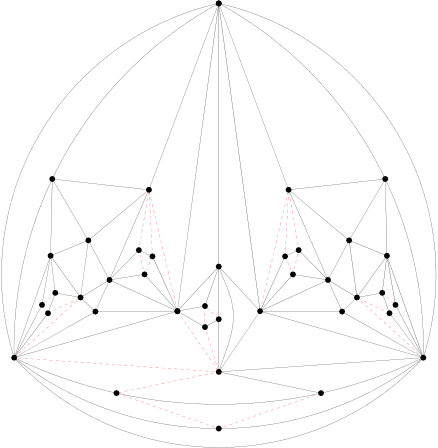 Figure 1
Peer Reviews
No public reviews on file for this paper yet. If you reviewed it on a platform where reviews are public (OpenReview, ICLR, NeurIPS, ICML), you can paste yours below so the community can read it here.
Videos
No videos yet. Explain this paper in a talk, walkthrough, or lecture? Add one.
On the 4-color theorem for signed graphs
František Kardoš 111This research was supported by the French National Research Agency (ANR) project HOSIGRA (HOmomorphisms of SIgned GRAphs) no. ANR-17-CE40-0022.
Univ. Bordeaux, CNRS, Bordeaux INP, LaBRI, UMR 5800, F-33400, Talence, France
Jonathan Narboni
Univ. Bordeaux, CNRS, Bordeaux INP, LaBRI, UMR 5800, F-33400, Talence, France
Abstract
There are several ways to generalize graph coloring to signed graphs. Máčajová, Raspaud and Škoviera introduced one of them and conjectured that in this setting, for signed planar graphs four colours are always enough, generalising thereby The Four Color Theorem. We disprove the conjecture.
1 Introduction
All graphs in this paper are finite, simple undirected graphs. Let be a graph and be a mapping. The pair is called a signed graph, is called the signature of the graph, and the underlying graph. For convenience, when there is no ambiguities, we only write to denote the signed graph.
Signed graph is a notion introduced by Zaslavsky [Zas82b]. He also defined a -signed coloring of a signed graph (see [Zas82a]) as a mapping
[TABLE]
such that for every edge , .
This definition is relevant and natural because it is compatible with the switch operation on a signed graph. Switching a vertex in a signed graph consists in switching the sign of every edge incident to . This operation induces equivalence classes on signed graphs that have the same underlying graph.
Because switching a vertex preserves the sign of every cycle in the graph (i.e., the product of the signs of the edges composing the cycle), the equivalence switching classes can be characterized by the sign of the cycles in the graphs: Two signed graphs and are equivalent if and only if every cycle of have the same sign as the corresponding cycle of .
A signed coloring corresponding to the Zaslavsky’s definition is also preserved by the switch operation. When switching a vertex in a colored signed graph , switching the sign of the color of preserves the coloring of , but with this definition, a -signed coloring of uses colors.
Máčajová, Raspaud and Škoviera [MRŠ16] introduced a new definition of -signed coloring in which only colors are used. According to this definition, a -signed coloring of a signed graph is, if (resp. ) a mapping (resp. ), such that for every edge , .
Given a signed graph , we denote by (or ) the chromatic number of : \chi(G)=min\{k:\$$G has a -signed coloring.
Máčajová, Raspaud and Škoviera also conjectured that the Four Color Theorem holds for the signed planar graphs as well :
Conjecture 1
[MRŠ16]** Let be a simple signed planar graph. Then
Signed coloring is also closely related to list-coloring, and Conjecture 1 would in fact imply another conjecture about a special type of list-coloring of (non-signed) graphs called weak list-coloring.
A list assignement of a graph is symmetric if, for every vertex of , is such that, if an integer is in , then is also in . A graph is -weakly choosable if, for every symmetric list-assignement , such that for every vertex , , then is -colorable. The weak choice number of a graph is the minimum such that is -weakly choosable, this number is denoted .
Zhu [Zhu18] proposed the following generalization of the Four Color Theorem:
Conjecture 2
[Zhu18]** Let be a planar graph. Then .
Zhu [Zhu18] showed that Conjecture 1 implies Conjecture 2; in this paper, we prove that Conjecture 1 does not hold.
2 Results
Before introducing a counterexample to Conjecture 1, we translate the question of vertex-coloring of a signed planar graph to a question of edge-labeling of its dual. We extend this way the reduction from -coloring of a triangulation to -edge-coloring of the dual used in the proof of the four-color theorem (see [RSST97]).
Let be a 3-connected signed planar graph, and let be a face of . We call the face positive (negative) if the facial cycle of contains an even (odd, respectively) number of negative edges.
Let be the dual graph of . We call the vertices of corresponding to the positive faces of positive, and the vertices corresponding to the negative face of negative.
Observe that there is always an even number of negative faces, and that the set of negative faces is invariant with respect to switching, so signature of the vertices of the dual graph is the same for every graph belonging to a same switch equivalence class.
In the figures, the positive vertices will be represented by simple dots, and the negative ones will be represented by circles with a minus sign inside.
Let be a 3-connected planar graph and let be a -edge-labeling of . We denote the number of edges incident to labelled for and .
Definition 1
Let be a 3-connected planar graph with an even number of negative vertices and let be a -edge-labeling of . The labeling is a weak signed edge-labeling of if
- (i)
, and 2. (ii.a)
* if is a positive vertex, or* 3. (ii.b)
* if is a negative vertex.*
In particular, if is a cubic graph with an even number of negative vertices, then a weak signed edge-labeling of is a -edge-labeling of such that
- •
if is positive, then it is incident to one edge of each label from ,
- •
if is negative, then it is incident to one edge labelled [math], and the two other edges have the same label .
Conjecture 3
Let be a 3-connected planar graph with an even number of negative vertices. Then there exists a weak signed edge-labeling of .
Theorem 1
Conjectures 1 and 3 are equivalent.
Proof. We prove first that Conjecture 1 implies Conjecture 3. Suppose the former true.
Let be a 3-connected planar graph with an even number of negative vertices. Let be the set of negative vertices of . Then there exists a -join (a subgraph of such that is odd if and only if ) in – it suffices to consider a binary sum of (not necessarily disjoint) paths joining disjoint pairs of vertices in .
We will call an edge of negative if , otherwise it is positive. We denote () the number of positive (negative) edges labeled incident to , respectively.
Let be a signature of defined by
[TABLE]
By definition, a face of is negative if and only if the corresponding vertex of is negative.
Let be a signed 4-coloring of with colors from . Let be an edge of and be the edge of corresponding to . The label of is defined depending on the sign of and the colors of and in the following way:
[TABLE]
Observe that if , then and so is well-defined. It suffices to prove that is a weak signed edge-labeling.
Let be an edge of . When passing from to , the color may (or may not) change the sign and/or change the absolute value.
Let be a face of . Consider the edges of the cycle defining the boundary of . The following observations are direct consequences of the definition of :
Each change of the absolute value of vertex color corresponds to an - or -edge; the number of such changes around is even. Therefore, there is an even number of - or -labeled edges incident to , which is equivalent to
[TABLE]
so satisfies the condition . In other words,
[TABLE]
In particular, if is a triangle then there is an odd number of [math]-labeled edges incident to . 2. 2.
Each change of the sign of vertex color corresponds either to a positive [math]- or -labeled edge, or to a negative -labeled edge; the number of such changes around is even again. Therefore,
[TABLE]
which is equivalent to
[TABLE]
meaning
[TABLE]
and so the total number of positive edges incident to in has the same parity as the total number of -labeled edges incident to in . Hence, the labeling satisfies also the condition .
In particular, if is a positive triangle, then there is an odd number of -labeled edges (and of -labeled edges) incident to ; if is a negative triangle, then there is an even number of -labeled edges (and of -labeled edges) incident to .
Conversely, let be a 3-connected signed planar graph. Let be a weak signed -edge-labeling of . We define a coloring of in the following way: Let be a spanning tree of rooted at a vertex . We set and for every other vertex of , the color of is defined depending on the color of its father in the spanning tree, the label of the edge corresponding to to the edge and the sign of in the following way:
[TABLE]
We claim that the coloring of defined this way and the coloring of satisfy the equation (1) for every edge of , and so is a proper signed 4-coloring of .
It is straightforward to verify that the formulae (1) and (2) are equivalent for every edge .
The edges of corresponding to the edges from form a spanning tree of . We will prove that (1) is verified for these edges by induction.
Let be a vertex of corresponding to a face of such that (1) has already been verified for all the incident edges but one; let that edge be .
Since, for each , the parity of the -labeled edges incident to is determined by the degree and the sign of , the label of is uniquely determined by the labels of the other edges incident to and the sign of .
Observe that if and only if there is a change of absolute value of colors of vertices ; at there is always an even number of such edges by .
Similarly, an edge represents a change of the sign of colors of vertices if and only if it is a positive [math]- or -labeled edge or a negative -labeled edge; it follows from the definition of a weak signed edge-labeling that there is always an even number of such edges at .
Let be the set of edges incident to distinct from , let be the corresponding path from to along in .
By definition of a weak signed edge-labeling, if and only if among the edges on there is an even number of edges labeled or , which means that along , there is an even number of changes of absolute value, and so and have the same absolute value.
Moreover, has a label that corresponds to a change of sign (a positive [math]- or -labeled edge or a negative -labeled edge) if and only if among the edges of there is an odd number of such edges, which means that along , there is an odd number of changes of the sign, and so and have different signs.
The last two paragraphs combined together imply that (1) is true for the edge .
Definition 2
Let be a 3-connected planar graph with an even number of negative vertices. A -edge-labeling of is a strong signed edge-labeling if
- (i)
* is a weak signed edge-labeling of , and* 2. (ii)
* for every odd-degree vertex of .*
Observe that is possible only if is a negative vertex of odd degree.
Conjecture 4
Let be a 3-connected planar graph with an even number of negative vertices. Then there exists a strong signed edge-labeling of .
Theorem 2
Conjectures 3 and 4 are equivalent.
Proof. Trivially, Conjecture 4 implies Conjecture 3.
Let be an odd integer. We define as the graph obtained from a cycle of length with every other vertex negative by adding a pending edge to each positive vertex of the cycle, and by adding a positive vertex adjacent to each negative vertex of the cycle. See Figure 1 for illustration.
We will call the edges of the -cycle in ring edges, and the edges joining negative vertices of the cycle to the central positive vertex spikes.
Suppose Conjecture 3 is true. Let be a 3-connected planar graph with an even number of negative vertices. Let be the graph obtained from by replacing every odd negative vertex by a copy of . Since the graph is planar, 3-connected and has an even number of negative vertices, it has a weak signed edge-labeling.
We claim that we can reduce this weak signed edge-labeling of to a strong signed edge-labeling of simply by a contraction of each gadget to a single (negative) vertex, keeping the labels of the edges.
Let be a copy of in for some odd .
Observe first that not all the edges leaving are labeled [math]. If this was the case, all the ring edges would be labeled or . However, along the ring, a positive 3-vertex corresponds to a change from to (or vice versa), whereas a negative 3-vertex cannot be incident to an - and -labeled edge at the same time. There has to be an even number of changes, but there is an odd number of positive ring vertices, a contradiction.
We need yet to prove that the number of edges leaving labeled (resp. ) is even; the fact that the number of edges leaving labeled [math] is odd will follow automatically.
Let us count the number of incidences with -labeled edges. Since the central vertex is a positive odd vertex, it is incident to an odd number of -labeled edges. There is an odd number of negative vertices on the ring, each of them is incident to an even number of -labeled edges. There is an odd number of positive vertices on the ring, each of them is incident to an odd number of -labeled edges.
Therefore, in total, there is an even number of -labeled edge incidences in , and so there is an even number of edges leaving labeled .
As a direct consequence of the definition of the strong signed edge-labeling we get the following:
Corollary 1
Let be a cubic 3-connected planar graph with an even number of negative vertices. has a strong signed edge-labeling if and only if has a 2-factor such that every cycle of has an even number of positive vertices.
If admits such a 2-factor , we call a consistent 2-factor.
Proof. If has a strong signed edge-labeling, then for each , . Hence, the edges labeled or form a 2-factor of . Moreover, as for , is a positive vertex if and only if , each cycle of must have an even number of positive vertex.
Conversely, assume that has a consistent 2-factor . For each cycle , choose an edge , and label with . Then, label the other edges of with and , in such a way that the labels change only at positive vertices. The edges that are not part of are labeled [math]. It is easy to see that such a labeling is a strong signed edge-labeling of .
Observe that if is a hamiltonian cubic planar graph with an even number of negative vertices, then any Hamilton cycle of is a consistent 2-factor.
Lemma 1
Let be a cubic 3-connected planar graph with an even number of negative vertices, containing a Tutte’s fragment attached by the edges , , , as depicted in Figure 2. Then every consistent 2-factor of contains the edge .
Proof. Assume that is not in of . Then , are in . Moreover, as there is an odd number of positive vertices in the fragment, the edges and have to be in .
We introduce a sequence of claims, each one being easy to check.
- •
. If not, then , and so there would be an odd number of positive vertices left in the fragment to be covered by .
- •
. If not, then there would be a 4-cycle in with three positive vertices.
- •
. If not, then , , , , and so , so is not a 2-factor.
- •
. If not, then , , , , and so , meaning , so does not cover all the vertices of the fragment.
- •
. If not, then , , , , and so , meaning , so contains a 4-cycle with three positive vertices.
From the previous claims, we have that if has a consistent 2-factor s.t. , then , , , , , , , and are in , as depicted in Figure 3, left. The remaining edges form a cycle, so we only have two choices to complete . Each of these leads to a cycle with an odd number of positive vertices (see Figure 3).
Theorem 3
There exists a set of twelve vertices of the Tutte’s graph to be chosen negative such that does not have a consistent 2-factor.
Proof. Let the negative vertices of be chosen as in Figure 4. Assume that has a consistent 2-factor .
The graph can be viewed as a where three of the four vertices were replaced by the Tutte’s fragment. By Lemma 1, all the three edges incident to the central vertex belong to , a contradiction.
Corollary 2
Conjecture 1 is false.
To find a counterexample, it suffices to consider the Tutte’s graph with a choice of negative vertices as depicted in Figure 4 and replace every negative vertex by the graph depicted in Figure 1, and then take the dual. This gives a graph on 61 vertices.
3 Concluding remarks
The question that naturally arises is the size of a minimum non--colorable signed planar graph, and this question remains open. Clearly, it suffices to search for a triangulation whose dual is a non-hamiltonian 3-connected cubic planar graph, and then search for a position of an even number of negative vertices such that there is no weak edge-labeling of the dual graph.
It is known [HM88] that 3-connected cubic planar graphs on at most 36 vertices are all hamiltonian. There are six smallest non-hamiltonian 3-connected cubic planar graphs on 38 vertices, and for each of them it is possible to choose a position of eight negative vertices such that the graph does not admit a consistent 2-factor, and therefore it that does not admit a strong edge-labeling. (We omit the details).
To guarantee the non-existence of a weak edge-labeling, it suffices to replace four negative vertices by a gadget that has 7 vertices, the corresponding graph that does not admit a weak edge-labeling then has 74 vertices, which corresponds to a non-4-colorable signed triangulation on 39 vertices, see Figure 5. (Again, we omit the details).
Another interesting question is the complexity of deciding whether or not a planar signed graph is -signed colorable. By the way, Conjecture 2 remains a challenging and interesting open question.
The reference list from the paper itself. Each links out to its DOI / PubMed record.
- 1[HM 88] Derek A Holton and Brendan D Mc Kay. The smallest non-hamiltonian 3-connected cubic planar graphs have 38 vertices. Journal of Combinatorial Theory, Series B , 45(3):305–319, 1988.
- 2[MRŠ16] Edita Máčajová, André Raspaud, and Martin Škoviera. The chromatic number of a signed graph. The Electronic Journal of Combinatorics , 23(1):P 1–14, 2016.
- 3[RSST 97] Neil Robertson, Daniel Sanders, Paul Seymour, and Robin Thomas. The four-colour theorem. Journal of combinatorial theory, Series B , 70(1):2–44, 1997.
- 4[Zas 82a] Thomas Zaslavsky. Signed graph coloring. Discrete Mathematics , 39(2):215–228, 1982.
- 5[Zas 82b] Thomas Zaslavsky. Signed graphs. Discrete Applied Mathematics , 4(1):47–74, 1982.
- 6[Zhu 18] Xuding Zhu. A refinement of choosability of graphs. ar Xiv preprint ar Xiv:1811.08587 , 2018.