Particle dynamics and geometric optics in Chern-Simons black holes
Rehana Rahim, Khalid Saifullah

TL;DR
This paper investigates how the Chern-Simons coupling constant influences various physical properties of black holes, including mass, particle collision energy, energy extraction efficiency, and polarization rotation, revealing some properties are independent of the coupling.
Contribution
It provides a detailed analysis of the effects of Chern-Simons coupling on black hole physics, highlighting which properties depend on or are independent of this coupling.
Findings
Hawking mass for slowly rotating black holes is independent of the coupling constant.
Energy gain and efficiency in the Penrose process are unaffected by the coupling.
Polarization vector rotation depends on the Chern-Simons coupling constant.
Abstract
In this paper we study the effects of the coupling constant of the Chern-Simons modified gravity on some physical properties of black holes. The Hawking mass is one of the proposed definitions of quasilocal mass. We find that, for slowly rotating Chern-Simons black holes, the Hawking mass is independent of the coupling constant. Next, we show the dependence on the centre of mass energy, for two neutral colliding particles, of coupling constant and the rotation parameter. We also investigate energy extraction through Penrose process and find that the energy gain and efficiency of the Penrose process are independent of this coupling constant. Rotation of the polarization vector is also studied for dependence on the Chern-Simons coupling constant.
Click any figure to enlarge with its caption.
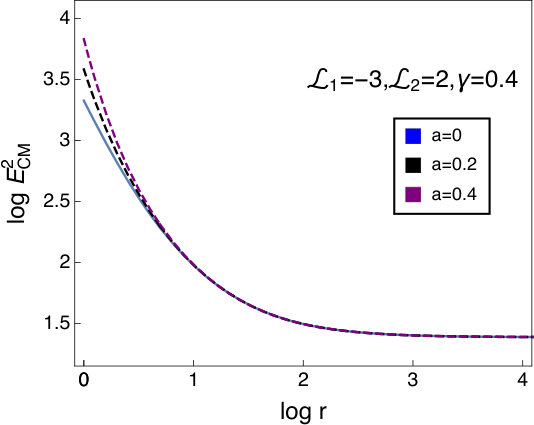 Figure 1
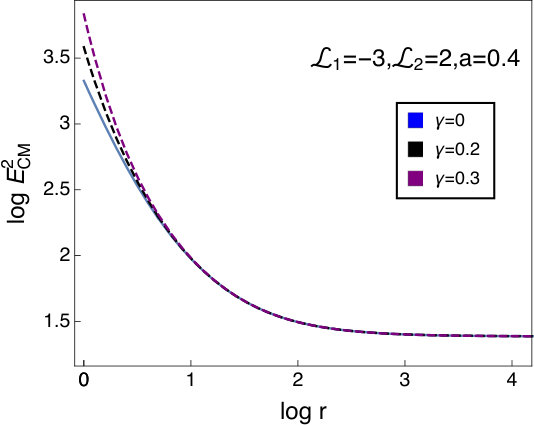 Figure 2
Peer Reviews
No public reviews on file for this paper yet. If you reviewed it on a platform where reviews are public (OpenReview, ICLR, NeurIPS, ICML), you can paste yours below so the community can read it here.
Videos
No videos yet. Explain this paper in a talk, walkthrough, or lecture? Add one.
Taxonomy
TopicsRelativity and Gravitational Theory · Black Holes and Theoretical Physics · Cosmology and Gravitation Theories
aainstitutetext: Department of Mathematics, Quaid-i-Azam University, Islamabad, Pakistanbbinstitutetext: Department of Mathematics and Statistics, Riphah International University, Islamabad, Pakistan
Particle dynamics and geometric optics in Chern-Simons black holes
Rehana Rahim a
and Khalid Saifullah
Abstract
In this paper we study the effects of the coupling constant of the Chern-Simons modified gravity on some physical properties of black holes. The Hawking mass is one of the proposed definitions of quasilocal mass. We find that, for slowly rotating Chern-Simons black holes, the Hawking mass is independent of the coupling constant. Next, we show the dependence on the centre of mass energy, for two neutral colliding particles, of coupling constant and the rotation parameter. We also investigate energy extraction through Penrose process and find that the energy gain and efficiency of the Penrose process are independent of this coupling constant. Rotation of the polarization vector is also studied for dependence on the Chern-Simons coupling constant.
1 Introduction
Extremely massive, rotating black holes are believed to be present at the centre of most of galaxies. The gravitational field outside such black holes is important not only for the evolution of the captured compact objects but is also a source of gravitational waves. These gravitational waves have been recently discovered 1 . A qualitative description of such a gravitational field is provided by the Kerr metric in the theory of general relativity (GR). According to the no-hair theorem 2a , a black hole in general relativity, is described only by its mass, spin and electric charge.
The theory of GR has been tested extensively. One of the test is to see that the black holes are represented by the Kerr solution 2b ; 2c ; 2d . Tests in the weak gravitational field regime can depend on the parametrized post-Newtonian (PPN) approach 3 . On the other hand, testing in the strong gravitational regime requires the construction of the black hole metric in terms of parametric deviations from the Kerr spacetime 4b ; 4c ; 12 ; rs . Such modifications in the theory of gravity have received a lot of attention. This is mainly attributed to quantum gravity which is requisite for the description of extreme situations in the universe like the vicinity of a black hole.
One of the many interesting theories that modify gravity is the Chern-Simons (CS) theory 5 ; 6 . The four-dimensional CS theory has some remarkable features, e.g. (i) it can be obtained from the superstring theory where the CS term is important for the cancellation of the anomaly in Lagrangian density 6 ; 7 , (ii) the Schwarzschild solution remains valid in the CS theory, hence all classical tests of GR hold in this theory 5 , and (iii) the CS gravity theory modifies the axial part of the gravitational field as compared to GR.
CS theory has two types of independent theoretical formulations, namely, dynamical and non-dynamical. In the non-dynamical theory, the CS scalar is a priori prescribed function with the evolution equation becoming a differential constraint on the space of allowed solutions. On the other hand, the dynamical theory has CS scalar as a dynamical field having its own evolution equation and stress-energy-momentum tensor. In recent years there has been an increasing interest in the dynamical CS theory.
The black hole solutions have been developed in the non-dynamical theory 8 ; 9 ; 10 ; 11 . A solution has been determined 8 ; 9 by employing far-field approximation where (the CS scalar field) is linearly proportional to the asymptotic time coordinate . This solution is stationary but not axisymmetric and gives correction to the frame dragging effect. The slow rotation approximation was employed to obtain a rotating black hole solution 10 . An exact rotating solution in non-dynamical theory was found 11 which is stationary and axisymmetric for arbitrary . In dynamical theory, a solution in slow rotation approximation and small coupling constant was also obtained 12 ; 13 . This solution was extended to include the terms for second order in spin parameter 14 . The solution in slow rotation approximation up to the order in spin parameter has also been found 14a . The assumption of slow rotation was relaxed in Ref. 15 where CS scalar field induced by a (rapidly) rotating black hole (Kerr metric) in the dynamical theory was considered.
In this work, we investigate black holes under slow rotation approximation in dynamical CS theory and study their different properties. Our focus is to see how the coupling constant of CS theory effects different physical phenomena e.g. quasi local mass, particle motion, energy extraction process and the geometrical optics. We will show that the Hawking mass and efficiency of the Penrose process do not depend on the coupling constant, whereas, it is interesting to note that the centre of mass energy and the polarization angle show a behaviour that is dependent on the coupling constant. All the computations are done to the second order in the spin parameter and to the order in the coupling constant where is the spin parameter and is CS coupling constant.
The paper is organized as follows. In Section 2 we will give a brief review of mathematical formalism of the CS theory. After this introduction, the subsequent sections will focus on different physical phenomena. In Section 3 we will discuss Hawking mass in CS theory and study its relation to the coupling constant. Section 4 provides an analytical expression for the centre of mass energy for two colliding neutral particles as a function of CS coupling constant. Energy extraction through Penrose process is discussed in Section 5. Rotation of the polarization vector is the subject of Section 6. We conclude the work with a brief summary in the last section. In this work, we take and the coordinates are taken in the order with indices running from [math] to .
2 The Chern-Simons theory
The action for a CS gravity is written as null
[TABLE]
where is the CS coupling constant, , is a scalar field, denotes the metric tensor ’s determinant , represents the Ricci scalar with being the Ricci tensor, is the Pontryagin density defined as
[TABLE]
where is the dual Riemann tensor. Here represents the 4 dimensional Levi-Civita tensor. The first term is the standard Einstein-Hilbert action, the second term is the CS correction term and the third term is the scalar field term. This action is parity even. Varying the action with respect to and the scalar field gives two equations, respectively
[TABLE]
[TABLE]
In Eq. (3) is the traceless C-tensor 11 given as
[TABLE]
The exterior derivative of a CS form gives the Pontryagin density as
[TABLE]
giving the conservation of the topological current. Using the above equation, the CS correction term in the action can be simplified by partial integration as
[TABLE]
The spinning solution of Eqs. (3) and (4), valid for slow rotation and small coupling constant, is given in Refs. 12 ; 13 . The full Kerr spacetime is
[TABLE]
where
[TABLE]
Here and denote mass and spin of the black hole respectively. If we keep the terms up to in the slow rotation approximation the Kerr metric takes the form
[TABLE]
where . The solution corresponding to the CS term is given as 12
[TABLE]
The equation for the scalar field is
[TABLE]
We note that the off-diagonal term which results in a weakened dragging effect has the coupling constant contribution to . One can follow an outgoing quasispherical light cone backwards in time from for the purpose of determining the event horizon. This null cone is given by the axisymmetric null hypersurface , which satisfies the equation
[TABLE]
On expanding this gives
[TABLE]
The inverse metric components appearing in the above equation are independent of CS correction, and thus lead to the same horizon as in the Kerr black hole 12 .
3 Hawking mass
In GR gravitational field is a non-local object and pointwise energy (or mass) cannot be defined for it. Although gravitational field mass cannot be defined locally, it is still possible to define it on quasi local level i.e. on a bounded region of spacetime. There are several definitions for mass at quasi local level such as the Brown-York energy by , the Misner-Sharp mass sha , the Komar mass ko , the Bartnik mass bar , the Hawking mass haw , the Geroch mass ger and the Penrose mass pen . In this work, we will study Hawking mass because it is more convenient and appropriate for our purpose.
Let be a spacelike 2-surface defined by constant and constant . The area of the surface is denoted by . Consider a null tetrad on . Here and , respectively, represent outgoing and ingoing future directed null vectors orthogonal to , and are the tangent vectors to . On the Hawking mass is given by haw
[TABLE]
where and denote the spin coefficients of the Newman-Penrose formalism, representing the expansions of the outgoing and ingoing null cones, respectively 20 .
Hawking mass on the event horizons of Reissner-Nordström and Kerr black holes is discussed in Ref. bq . We discuss Hawking mass for spacetime (8) for the regions outside the event horizon.
The outgoing and ingoing null 4-vectors are given by 12a
[TABLE]
[TABLE]
where we have multiplied the ingoing null 4-vector by for the orthogonality condition to hold and called it . To determine complex null 4-vector, we will employ certain properties that a null tetrad and a metric tensor satisfy in Newman-Penrose formalism. Let us denote the complex null vector by . In the component form it is represented as
[TABLE]
and its complex conjugate as . The null vectors and satisfy the condition . In terms of , the inverse metric tensor is 20
[TABLE]
By employing this and the orthogonality conditions , one can determine the components of the null vector and its complex conjugate . The expression of is given as
[TABLE]
By replacing by , we can obtain .
There are spin coefficients in the Newman-Penrose formalism. For the sake of Hawking mass we require only two, namely, and . In terms of the null vectors (, their expressions are dem
[TABLE]
where the symbol represents the covariant derivative, and are the covariant counterparts of the null vectors and . Thus, after substituting the values, we get the spin coefficients as
[TABLE]
These spin coefficients are in the form of complex quantities. For and to be hyper surface orthogonal, we require these spin coefficients to be real cha ; grif . For this purpose the coordinate system needs to be rotated such that
[TABLE]
Then and become real. Two rotations are performed for this purpose. First we do a type II and then a type I rotation cha leading to the new transformed tetrad as
[TABLE]
where and are complex functions to be determined such that Eq. (20) is satisfied. The spin coefficients and as determined from the tetrad given in Eqs. (21)-(23) are
[TABLE]
As mentioned earlier, we are considering the surface defined by constant and constant, and the induced metric for the surface in this case has the components given by and of the metric (8). The surface area element is
[TABLE]
The surface area is From Eqs. (24)-(26) it is clear that and the area element are independent of the CS coupling constant . As a result, the Hawking mass is independent of and is given by
[TABLE]
This shows the dependence of Hawking mass on and up to order . This result matches with the Hawking mass for the Kerr metric Msc . It also shows that Hawking mass is independent of the CS coupling constant . Here it is important to mention that up to the order , the scalar field does not contribute to the total energy of the spacetime 12 (it does contribute to total energy of the spacetime, but the contribution is of order which is beyond the order considered here). This is also evident from Eq. (27) which shows the independent behaviour.
4 The centre of mass energy
This section deals with the centre of mass energy for the collision of two neutral particles with equal masses i.e. in the vicinity of a slowly rotating Chern-Simons black hole. The particles are moving from infinity with equal energies towards the black hole with different angular momenta and The motion as well as collision of the particles takes place in the equatorial plane (. The expression for the given by Bañados, Silk and West (BSW) 20a is
[TABLE]
where =( and ( represent the 4-velocity of the first and second particles. Here the overdot represents the derivative w. r. t the proper time . This formula is valid both for curved and flat spacetimes. For motion in the equatorial plane By Giving variation 0-3 to indices and in Eq. (28), one obtains
[TABLE]
The time-like geodesics for a particle of mass are 12a ; 19a
[TABLE]
where , is the energy and is the angular momentum of the particle. These equations are velocity components of a particle of mass . After substituting values of the components of the 4-velocities of particles from Eqs. (30)-(32), we obtain the expression for the as
[TABLE]
where and are the angular momenta of the particles, and ,
Setting , one gets the for two particles of equal masses at the equatorial plane up to second order in the spin parameter 20a . The limit recovers the Schwarzschild metric, so does the case . The centre of mass energy in such a situation is 20a
[TABLE]
Eq. (33) shows the dependence of on and The limit of Eq. (33) gives which is the same as if the particles are colliding in a flat spacetime. The event horizon of the slowly rotating CS black hole is at where is the event horizon of the Kerr metric 12 . To the required order in the spin parameter, the event horizon can be written as From Eq. (33), we see that is finite at for finite and in this slow rotation limit. As the expression shows that it might diverge at , we take limit and get the expression
[TABLE]
which is also finite for finite values of and
The profiles of have been plotted in Figure 1. From the graphs it is clear that the increases with increase in the coupling constant and rotation parameter Variation between different curves is obvious for small values of radius but as increases, all curves merge together.
5 Extraction of energy from slowly rotating Chern-Simons black hole
through Penrose process
Penrose penrose proposed a mechanism for extraction of energy from a rotating black hole. It is based on the existence of negative energy orbits in the ergosphere. Consider a positive energy particle moving along a time-like geodesic into the ergosphere. The particle decays into two photons, one crossing the event horizon and the other escaping to infinity. The photon crossing the event horizon carries negative energy while the other one carries more positive energy than the initial particle. It is assumed that such a decay occurs at the turning point of the equatorial radial geodesics where , then we have from Eq. (32)
[TABLE]
The above equation is quadratic both in and , so we solve for both. The solution in terms of leads to
[TABLE]
and that for the angular momentum is given by
[TABLE]
where
[TABLE]
and the following identity was used for simplification
[TABLE]
Only positive sign is selected in Eq. (37) because we want the 4-momentum of the particle to be future directed. The orbit of the particle with negative energy in the ergosphere region is important for energy extraction in the Penrose process. From Eq. (37), for negative energy, we have the following conditions
[TABLE]
[TABLE]
These imply that conditions for negative energy are
[TABLE]
[TABLE]
Same conditions on energy have been observed for the Kerr black hole also. The terms containing the CS coupling parameter do not appear here as they get cancelled out in the process of simplification.
As mentioned earlier we consider the situation where a particle of mass decays into two photons, one of which goes inside the event horizon and the other one escapes to infinity. The photon which crosses the event horizon has negative energy and the other photon carries more energy than the initial particle. Let and denote the energies of the initial particle and photons respectively and and are their angular momenta. Let us take and for the initial particle and photons respectively. The angular momentum of these particles can be obtained from Eq. (38)
[TABLE]
[TABLE]
[TABLE]
According to the law of conservation of energy and angular momentum
[TABLE]
and
[TABLE]
Solving the above system of equations for and gives
[TABLE]
[TABLE]
The approximation in these energy values is done so that we can have their expressions up to our order of interest (up to in spin parameter and in the coupling parameter). Keeping the terms up to these orders, and are the same as in Kerr metric. The gain in energy The efficiency of the energy extraction by the Penrose process is given by
[TABLE]
For maximum efficiency one must consider the situation where the radial distance is minimum. Therefore we consider the situation where For Kerr metric the maximum efficiency is found to be (which corresponds to ) cha . For slow rotation approximation, we cannot have , therefore for metric (8) the maximum efficiency is less than and is independent of the CS coupling constant as shown in Figure. 2.
6 Rotation of polarization vector for slowly rotating Chern-Simons black hole
In this section our focus is the geometrical optics. The shadow and gravitational lensing of metric (8) has been studied in Refs. null and lens respectively. In this paper we study the effect of polarization vector on the slowly rotating black hole in the dynamical CS modified gravity. The study for the polarization vector has been done initially for the Kerr metric in the small rotation approximation 21 . This has been extended for rotating black holes in a Randall-Sundrum brane and non-Kerr black holes 23 ; 24 . The formulation which is being used here has been developed in Ref. 21 , where Newman-Penrose formalism is employed to determine optical quantities in the weak-field and slow rotation approximation. The relationship between the tangent vector (the wave vector) to the null congruence and the polarization vector is given by the equations
[TABLE]
and
[TABLE]
Here the operator is the covariant derivative in the direction of the vector .
The Newman-Penrose formalism assumes a null tetrad given by where
[TABLE]
The vector is important for the determination of polarization vector. Consider the null rotations
[TABLE]
where is complex and is real.
If is tangent to the null congruence then the spin coefficient becomes zero 20 . For the parallel propagation of the null tetrad along the null congruence, this condition leads to the vanishing of the spin coefficients and Then one can identify the plane generated by and with the polarization plane which propagates along the direction. In other words, the polarization vector can be identified with the vector leading to the construction of an orthonormal frame
[TABLE]
such that this tetrad corresponds to the one forms of the locally non-rotating frame (LNFR) 25 . The LNRF indices are written in parentheses. Consider the situation where the source and the observer are at rest in LNFR, then they are rotating with the black hole. The vector (i.e. – the projection of the vector on LNRF is 21
[TABLE]
where and represents the projection of on LNRF. A null rotation of the form
[TABLE]
is done to make the spin coefficient zero. The expression for and the rotation mentioned above lead to the expression
[TABLE]
This equation gives the variation of angle in the direction of For the metric (8) is
[TABLE]
After substituting the values of and provided in the Appendix, up to the linear order in the spin parameter takes the form
[TABLE]
Up to the order , reduces to null
[TABLE]
Thus modifies to
[TABLE]
Equation is associated with the variation between and according to the null rotation given in Eq. (55). Figure. 3 shows for some values of . From the graph it is evident that the polarization angle decreases as increases.
Eq. (58) can be written as
[TABLE]
The total change in the polarization vector is
[TABLE]
Here, the second term comes from the spacetime dragging. The integration of Eq. (58) with the help of the coordinate gives The coordinate is taken as the azimuthal angle in the orbital plane of the null coordinate 21 . The angle between the equatorial and orbital planes is represented by . We have the expression of the form
[TABLE]
Using Eq. (61) in Eq. (59), we have
[TABLE]
where
[TABLE]
Consider the physical scenario where the source is on the equatorial plane ( and the observer is on the plane with The distance of the observer and the source from the symmetry axis is denoted by . This situation is drawn in the Figure. 4. The source and the observer are represented by the timelike curves and respectively. Also, in the photon equations of motion.
Following the assumptions, one has the expression
[TABLE]
which has the derivative of the form
[TABLE]
Substituting Eq. (64) in Eq. (63), one has
[TABLE]
Integration leads to
[TABLE]
where and which leads to .
[TABLE]
Setting and gives which is same as for the Kerr spacetime 21 .
7 Summary and conclusion
The Kerr metric is that unique solution of the Einstein field equations which obeys the no-hair theorem i.e. it depends on the mass and spin for its complete description. In recent years several alternative theories of gravity have been constructed in which the spacetimes are different from Kerr, having parameters other than mass and spin. Putting all deviations to zero, all the modified spacetimes become Kerr. One of these modified gravity theories is the Chern-Simons gravity theory having two independent formulations namely, the non-dynamical theory and dynamical theory. Black hole solutions have been developed in both formulations but our focus in this paper is the solution of the CS gravity given in Ref. 12 . The solution has been developed under the assumptions of small rotation parameter and small coupling constant. Setting the coupling constant equal to zero, the solution reduces to Kerr in small rotation approximation. Therefore, our focus in this paper is to study the effects of the coupling constant in different physical situations. First we studied the Hawking mass outside the event horizon of the black hole and obtained an exact value. We find that the Hawking mass is independent of the CS coupling constant It just depends on the mass and spin parameter like in Kerr’s case. Next, based on the BSW mechanism 20a , we studied the dependence of the coupling constant on the for two neutral colliding particles of equal masses. The graphs are drawn for different values of the coupling constant and rotation parameter. The graphical results show that both and cause an increase in the centre of mass energy. We also studied the energy extraction through Penrose process and found that the efficiency of the process is independent of the CS coupling constant but is not exactly equal to the efficiency of the Kerr case due to the assumption of the small rotation approximation. In the geometrical optics regime, rotation of the polarization vector is studied. The polarization vector shows decreasing behaviour with increasing CS coupling constant.
Acknowledgements.
RR acknowledges the support of the Indigenous Fellowship of the Higher Education Commission (HEC) of Pakistan. The work was also supported by the HEC, NRPU research grants 20-2087 and 6151.
8 Appendix
The components of and its projections are related by
[TABLE]
The functions and are
[TABLE]
The Christoffel symbols in LNFR are given as 25
[TABLE]
The reference list from the paper itself. Each links out to its DOI / PubMed record.
- 1(1) B. P. Abbott et al. (LIGO Scientific Collaboration and Virgo Collaboration), Phys. Rev. Lett. 116 (2016) 061102.
- 2(2) W. Israel, Phys. Rev. 164 (1967) 1776; W. Israel, Commun. Math. Phys. 8 (1968) 245; B. Carter, Phys. Rev. Lett. 26 (1971) 331; S. W. Hawking, Commun. Math. Phys. 25 (1972) 152; D. C. Robinson, Phys. Rev. Lett. 34 (1975) 905.
- 3(3) S. A. Hughes, Probing strong-field gravity and black holes with gravitational waves , ar Xiv:1002.2591 (2010).
- 4(4) T. Johannsen and D. Psaltis, Ap J. 716 (2010) 187.
- 5(5) N. Wex and S. M. Kopeikin, Ap J. 514 (1999) 388.
- 6(6) C. M. Will, Theory and experiment in gravitational physics , Cambridge University Press, Cambridge (1993).
- 7(7) S. J. Vigeland, N. Yunes and L. C. Stein, Phys. Rev. D 83 (2011) 104027 .
- 8(8) T. Johannsen and D. Psaltis, Phys. Rev. D 83 (2011) 124015.