Topological classification of shot noise on fractional quantum Hall edges
Christian Sp\r{a}nsl\"att, Jinhong Park, Yuval Gefen, Alexander D., Mirlin

TL;DR
This paper demonstrates that shot noise measurements can electrically classify the topological nature of fractional quantum Hall edges, revealing three universality classes based on thermal transport behavior.
Contribution
It introduces a method to classify edge topologies via shot noise, linking electrical measurements to thermal transport regimes in fractional quantum Hall systems.
Findings
Shot noise falls into three topological classes: vanishing, algebraically decaying, or constant.
Electrical transport remains ballistic across all classes.
Thermal transport varies: ballistic, diffusive, or antiballistic.
Abstract
Electrical and thermal transport on a fractional quantum Hall edge are determined by topological quantities inherited from the corresponding bulk state. While electrical transport is the standard method for studying edges, thermal transport appears more challenging. Here, we show that the shot noise generated on the edge provides a fully electrical method to probe the edge structure. In the incoherent regime, the noise falls into three topologically distinct universality classes: charge transport is always ballistic while thermal transport is either ballistic, diffusive, or "antiballistic". Correspondingly, the noise either vanishes, decays algebraically or is constant up to exponentially small corrections in the edge length.
Click any figure to enlarge with its caption.
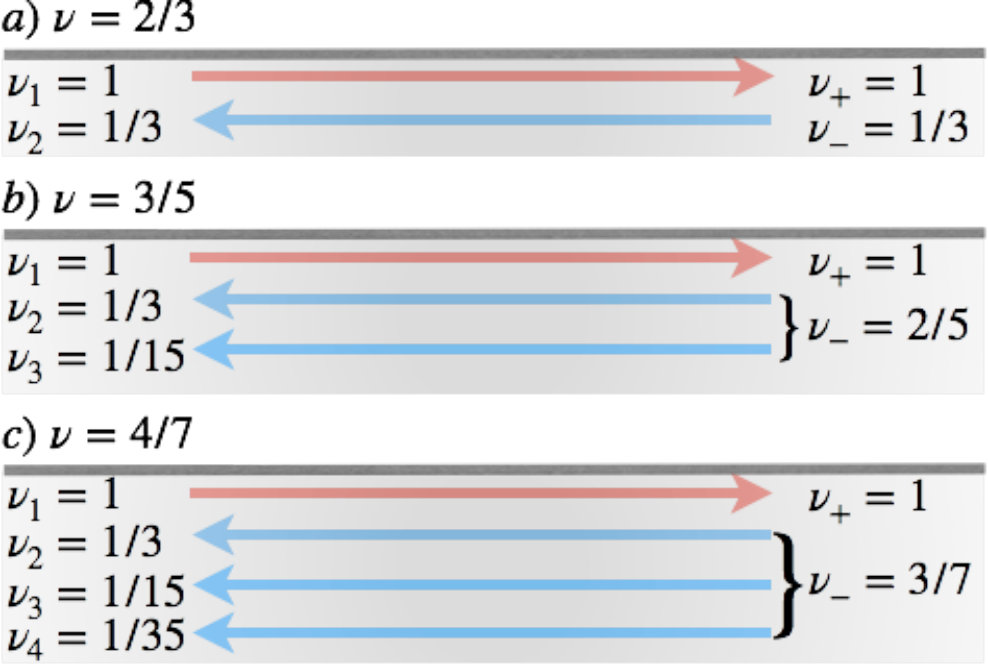 Figure 1
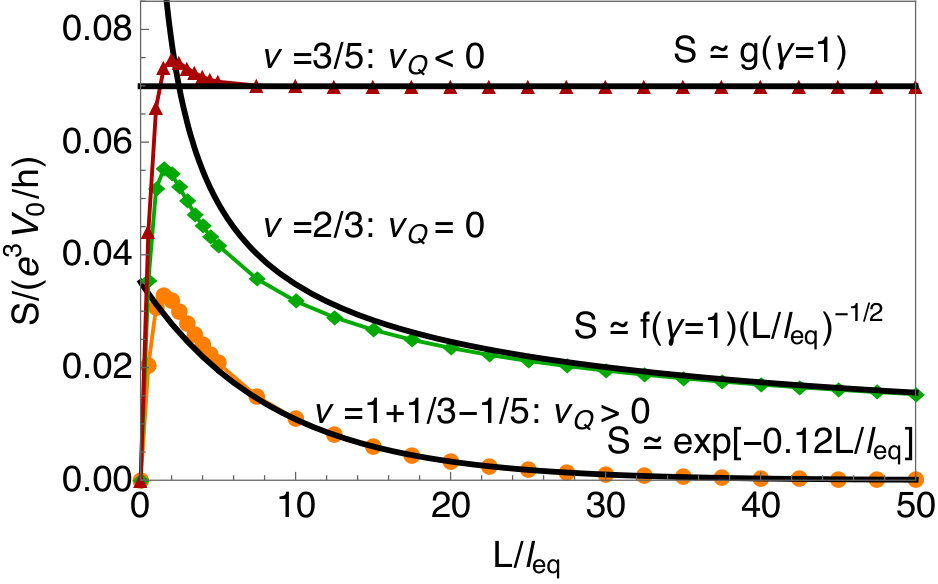 Figure 2
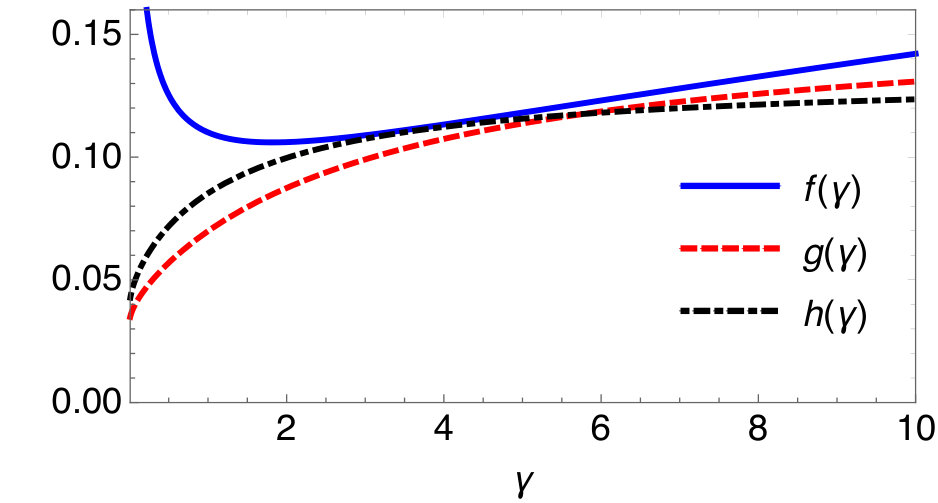 Figure 3
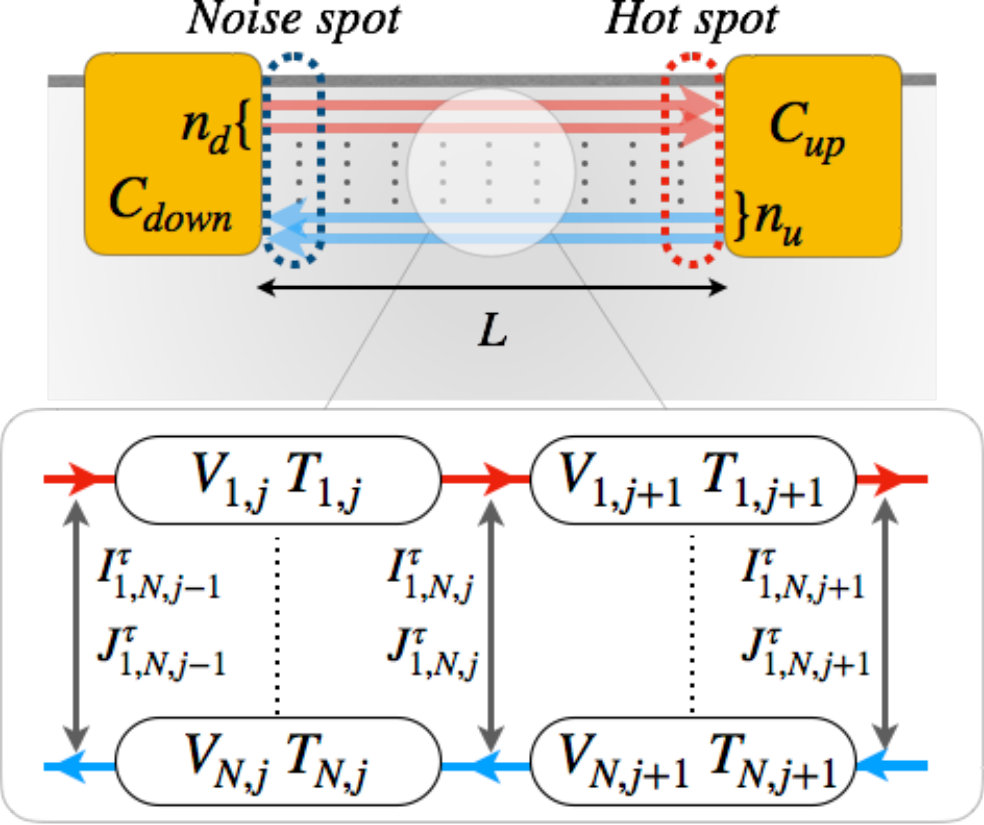 Figure 4
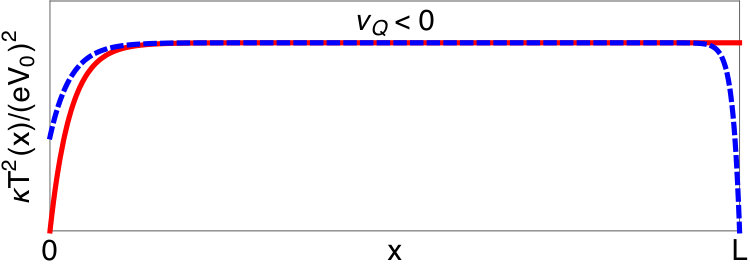 Figure 5
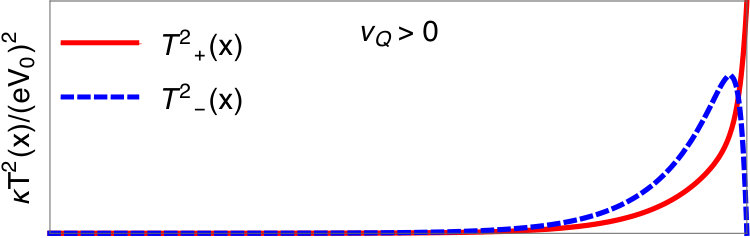 Figure 6
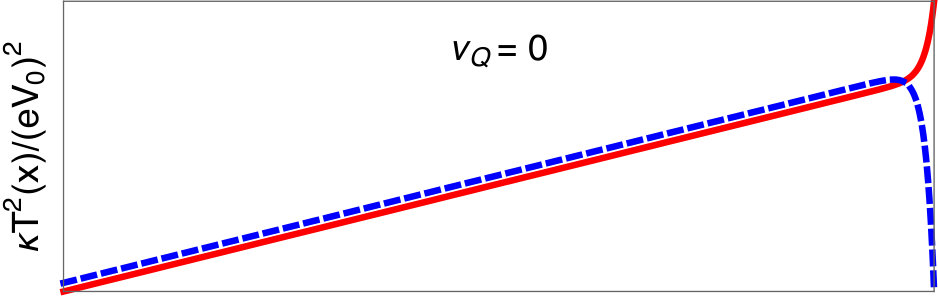 Figure 7
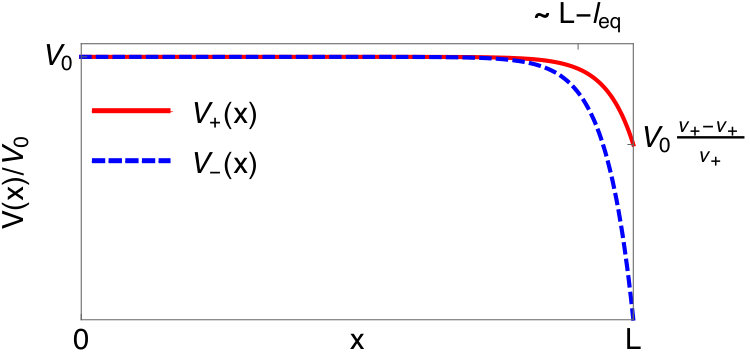 Figure 8
Peer Reviews
No public reviews on file for this paper yet. If you reviewed it on a platform where reviews are public (OpenReview, ICLR, NeurIPS, ICML), you can paste yours below so the community can read it here.
Videos
No videos yet. Explain this paper in a talk, walkthrough, or lecture? Add one.
Topological Classification of Shot Noise on Fractional Quantum Hall edges
Christian Spånslätt
Institut für Nanotechnologie, Karlsruhe Institute of Technology, 76021 Karlsruhe, Germany
Institut für Theorie der Kondensierte Materie, Karlsruhe Institute of Technology, 76128 Karlsruhe, Germany
Jinhong Park
Department of Condensed Matter Physics, Weizmann Institute of Science, Rehovot 76100, Israel
Yuval Gefen
Institut für Nanotechnologie, Karlsruhe Institute of Technology, 76021 Karlsruhe, Germany
Department of Condensed Matter Physics, Weizmann Institute of Science, Rehovot 76100, Israel
Alexander D. Mirlin
Institut für Nanotechnologie, Karlsruhe Institute of Technology, 76021 Karlsruhe, Germany
Institut für Theorie der Kondensierte Materie, Karlsruhe Institute of Technology, 76128 Karlsruhe, Germany
Petersburg Nuclear Physics Institute, 188300 St. Petersburg, Russia
L. D. Landau Institute for Theoretical Physics RAS, 119334 Moscow, Russia
Abstract
Electrical and thermal transport on a fractional quantum Hall edge are determined by topological quantities inherited from the corresponding bulk state. While electrical transport is the standard method for studying edges, thermal transport appears more challenging. Here, we show that the shot noise generated on the edge provides a fully electrical method to probe the edge structure. In the incoherent regime, the noise falls into three topologically distinct universality classes: charge transport is always ballistic while thermal transport is either ballistic, diffusive, or “antiballistic”. Correspondingly, the noise either vanishes, decays algebraically or is constant up to exponentially small corrections in the edge length.
Electrical and thermal transport on fractional quantum Hall (FQH) edges are quantized, reflecting the bulk topological order Wen (1990a, b); Chang (2003). In particular, the electrical Hall and two-terminal conductances, and ,
[TABLE]
are determined by the bulk filling factor . Furthermore, the thermal Hall and two-terminal conductances, and ,
[TABLE]
manifest the difference between the number of “downstream” and “upstream” (with respect to the chirality direction set by the magnetic field) edge channels Kane and Fisher (1997); Cappelli et al. (2002); for Abelian states . Here is the temperature, , and is Boltzmann’s constant. It should be emphasized that, for edges with counterpropagating channels, the quantizations (1) and (2) hold under the condition (and is a hallmark) of the incoherent regime Protopopov et al. (2017); Nosiglia et al. (2018). This regime is generic for nearly all FQHE experiments on such edges; reaching the coherent regime requires very low temperatures and/or very small distances between electrodes and/or special control over intermode tunneling Cohen et al. (2019).
Since the discovery of the FQH effect Tsui et al. (1982); Laughlin (1983), electrical transport has been the standard method for probing the edge structure. On the other hand, experiments on thermal transport have only recently determined the number of active channels for a variety of edges Jezouin et al. (2013); Banerjee et al. (2017, 2018). These experiments are technically very challenging, and so far only capable of determining . The heat conductance was measured recently also for a quantum spin liquid Kasahara et al. (2018), which belongs to a class of topologically ordered states distinct from the FQH states.
In this Letter, we classify FQH edges into topological classes according to the scaling of the shot noise with the edge length . We thus show that a measurement of the noise is an efficient diagnostic tool for determining important features of the edge structure. We emphasize that this method of probing the edge structure is purely electrical and thus complementary to the (very difficult) measurements of the heat conductance.
Noise measurements are already a ubiquitous tool in mesoscopic physics de Jong and Beenakker (1996); Blanter and Büttiker (2000), in particular for FQH experiments, where they are used to probe fractionally charged quasiparticles in quantum point contact (QPC) geometries Saminadayar et al. (1997); de Picciotto et al. (1997); Dolev et al. (2008). Shot noise has also been suggested as a probe of quasiparticle statistics Feldman et al. (2007).
We focus on the incoherent transport regime (which is generic as emphasized above) , where is a characteristic equilibration length. Beyond , individual channels cannot be distinguished as they fully equilibrate and form hydrodynamic modes. By the same token, any effects from edge reconstruction Meir (1994); Wang et al. (2013) are negligible. What remains are the transport coefficients and , which can be observed either through conductance measurements or also, as we emphasize in this Letter, in the shot noise. The incoherent regime has been discussed in early works Kane and Fisher (1995a, 1997) and more recently studied in the context of line junctions Sen and Agarwal (2008); Rosenow and Halperin (2010) and of the edge Protopopov et al. (2017); Nosiglia et al. (2018); Aharon-Steinberg et al. (2019); Park et al. (2019a).
We consider a general Abelian FQH edge (see Fig. 1) and show that an edge with generates vanishing noise (up to exponential corrections in ), generates , and edges with generate . These three types of noise asymptotics reflect respectively the three possible combinations of electrical and thermal transport: (i) Both charge and heat flows ballistically downstream. This is for instance the case for the integer quantum Hall states von Klitzing et al. (1980) as well as for particlelike states such as , , etc. (ii) Charge flows downstream, but the heat transport is diffusive. This holds whenever , with as the most studied example MacDonald (1990); Johnson and MacDonald (1991); Kane et al. (1994); Protopopov et al. (2017); Nosiglia et al. (2018); Park et al. (2019a). (iii) Charge flows downstream, but heat flows ballistically upstream; we term such heat transport “antiballistic”. This is the case for hole-conjugate states such as, e.g., , , etc, which are characterized by Kane and Fisher (1995b).
The mechanism for such strikingly different noise characteristics follows from a spatial separation of where heat and noise is generated Park et al. (2019a). This separation is a consequence of the chiral nature of the edge which, in turn, is a manifestation of the gauge anomaly in Abelian Chern-Simons theory Callan and Harvey (1985); Stone (1991); Wen (1995).
More concretely, full equilibration on the edge yields a two-terminal charge conductance , where and describe the current on the considered portion of the edge in response to the voltages on the electrodes and , respectively Sup . Regardless of which of the two electrodes is a source (respectively, a drain), the local voltage along the edge drops only within a distance in the vicinity of (see Fig. 1) and is therefore fixed by the net chirality (i.e, by the downstream direction). The region of the voltage drop is associated with Joule heating, and is therefore referred to as the hot spot Ise et al. (2005); Park et al. (2019a). The nature and direction of heat transport away from the hot spot depend crucially on which is fixed by the topological order of the bulk Kane and Fisher (1997); Cappelli et al. (2002).
Because of the heating along the edge, thermally activated tunneling between the edge channels can excite particle-hole pairs. Such pairs exist only within from where they are generated; beyond that distance they recombine due to equilibration processes. If the respective constituents of a pair would reach different contacts, fluctuations in the charge current—shot noise—will be observed in the contacts. Crucially, only pairs created within a distance of have a non-negligible probability to contribute to this type of partition noise. Particles or holes further away from this point will experience equilibration due to repeated tunneling and, as a result, will both flow in the downstream direction, finally reaching . Hence, the region close to is referred to as the noise spot. Interestingly, this noise generating mechanism carries some resemblance to the photon pair splitting picture of Hawking radiation Misner et al. (2017).
Model.– We consider a segment of a general Abelian FQH edge with edge channels between two contacts separated by a distance (see Fig. 1). For each channel , corresponding to a filling factor discontinuity , we introduce virtual reservoirs (which absorb neither charge nor energy) modeling local equilibration Nosiglia et al. (2018); Park et al. (2019a); Engquist and Anderson (1981). For simplicity, we neglect any temporary charge or heat accumulation in the reservoirs (in any case, such an accumulation would not affect the zero frequency noise). Hence, at any time , charge and energy currents are locally conserved
[TABLE]
Here, is the outgoing (incoming) charge current of channel into its reservoir at location , and are corresponding energy currents. Since we are only interested in steady state conditions and zero frequency noise, all quantities are hereafter assumed to be time averaged and we therefore drop any explicit dependence. The local voltages , where is the channel chirality, and temperatures drive charge and energy tunneling currents and from channel to at position ,
[TABLE]
To lowest order in the tunneling couplings gDe , these currents read
[TABLE]
where parametrize the deviation (of order unity) from Wiedemann-Franz law for the interchannel tunneling current. In general, depends on , , and the intermode interactions. As an example, in the case of noninteracting channels with and with integer one finds = Nosiglia et al. (2018).
By combining Eqs. (4) and (5), we derive continuum equations for the voltage, current, and temperature profiles along the edge. We denote by the distance between successive reservoirs and define . Taking the continuum limit , , , with the coordinate and the equilibration length kept finite, we obtain the following equation for the local voltages:
[TABLE]
where (superscript denotes transposition) and
[TABLE]
The local electric currents obey a similar equation,
[TABLE]
with .
For the local temperatures, we obtain
[TABLE]
with and
[TABLE]
Here, we have defined the thermal equilibration lengths , and
[TABLE]
reflects the Joule heating contribution.
To compute the noise, we consider fluctuations in the charge currents and let denote the deviation of any quantity from its time average: . We decompose the charge tunneling current fluctuations into
[TABLE]
Here the intrinsic contributions (superscript “int”) arise from local Johnson-Nyquist noise; we take them to be independent random variables with zero mean and with variance
[TABLE]
We have here assumed that the local voltage difference between any two channels is much smaller than their average temperature: . This approximation is excellent (holds up to exponentially small corrections in ) around the noise spot, where the channels equilibrate to the same voltage Sup .
The transmitted contributions (superscript “tr”) in Eq. (12) reflect fluctuations in the voltage difference between the channels
[TABLE]
that are induced by according to the transport equation (6). In the continuum limit, we find the following equation for the local electric current fluctuations
[TABLE]
where
[TABLE]
and . With Eqs. (6), (9), and (15), we can compute the noise for any edge structure. However, due to the hierarchy of the length scales the noise expressions are algebraically involved. To render the physics more transparent, we therefore employ the following simplification scheme Sup : (i) We let all length scales associated with equilibration between channels of the same chirality be . This approximation does not influence the dc noise, since tunneling between copropagating channels does not give rise to any partitioning of the current. (ii) The edge is then transformed into two hydrodynamic modes (consisting of and channels respectively) with effective filling factor discontinuities . There remains only a single length scale , where is the effective tunneling coupling between the modes. Hence, the treatment of the edge is reduced to that of two channels. Evaluating the noise, we find Sup
[TABLE]
where are the temperatures of the hydrodynamic modes. It is clear from Eq. (17) that, while the noise in principle originates from the heating along the full edge, the dominant contribution is given by the region of extension near (). Other contributions are exponentially suppressed in .
It follows that the characteristics of the noise depend crucially on the temperature profiles . Within our approximation, channels of a given chirality are assumed to have the same temperature. We therefore solve Eqs. (6) and (9) for two effective hydrodynamic modes, taking the composition of and channels into account Sup . The temperature profiles are then determined by the two eigenvalues of the matrix . Their dependence is crucially determined by . We then find, up to boundary effects, that whenever , decays exponentially with (for the special case , the temperature profiles equal the contact temperature defined to be zero); for , ; and for , . We depict these three types of temperature profiles in Fig. 2.
Substituting the results for in Eq. (17), we obtain three topologically distinct types of the scaling of noise in the incoherent regime, , that were announced in the Introduction. These results are illustrated in Fig. 3 where we choose a representative edge for each class. For the edge we have (antiballistic heat transport), so that the noise is constant for . For , the heat transport is diffusive in view of , and the noise decays as . Finally, the boundary between the 4/3 and 1/5 fractions is characterized by and thus ballistic heat transport, so that the noise decays exponentially in . In the short edge limit, , the tunneling events are rare, and the noise scales as in all cases.
Discussion.– We expect our noise classification to be applicable not only for conventional edge structures, but also for experimentally engineered edge structures with equal but different Grivnin et al. (2014); Ronen et al. (2018); Cohen et al. (2019); Lin et al. (2019). For instance, an interface between and FQH states is expected to host two copropagating channels. In the incoherent regime, this edge yields and in contrast to the conventional edge where but Protopopov et al. (2017); Nosiglia et al. (2018). Our model predicts that only the latter edge generates nonvanishing noise, which can be tested experimentally. Recent measurements of noise on conductance plateaux in QPC geometries Bhattacharyya et al. (2019) could also be analyzed with our model.
We further anticipate that our classification can be extended to the exotic non-Abelian state. Current research points towards three prominent and competing theories of the edge structure Moore and Read (1991); Levin et al. (2007); Lee et al. (2007); Fidkowski et al. (2013); Son (2015); Simon (2018); Ma and Feldman (2019); Feldman (2018) and our preliminary results Park et al. (2019b) indicate that these proposals fall into distinct noise classes (ballistic heat flow and exponentially suppressed noise for the Pfaffian and particle-hole-Pfaffian edges, and antiballistic heat flow and constant noise for the anti-Pfaffian edge; assuming no equilibration between the Landau levels). Our results thereby provide an experimental signature that may distinguish between these theories.
Our analysis of the incoherent regime does not depend on microscopic parameters but only requires . At the same time, the equilibration length depends on temperature, tunneling, and interaction between the channels (see Ref. Protopopov et al. (2017) for the corresponding analysis for ). For Abelian edges, experimental data imply a charge equilibration length m and a thermal length m at an ambient temperature mK Banerjee et al. (2017, 2018); Aharon-Steinberg et al. (2019); Ma and Feldman (2019); Cohen et al. (2019). This is consistent with our model where . The data indicate further that edges with m are sufficiently short to suppress heat leakage into the bulk. Thus, measurements on edges with electrical and thermal equilibration and without thermal leakage should be feasible.
We end by noting that by measuring the constant noise (i.e. for ) in the incoherent regime, the functions and Sup (and their generalization to other edges in the same class) can be used to extract and probe violations of the Wiedemann-Franz law.
Summary.– We studied shot noise on incoherent fractional quantum Hall edges and found that the asymptotic characteristics of the shot noise can be classified into three topological universality classes. These classes represent the three different possibilities in the interplay between electrical and thermal transport: ballistic charge and heat transport generate either vanishing or exponentially suppressed noise, ballistic charge and diffusive heat transport generate algebraically decaying noise, and ballistic charge but antiballistic heat transport generate constant noise. We expect this classification to be applicable to conventional filling factors, edge states at the interface between different FQH bulk states, more complex QPC geometries, and non-Abelian states. Our findings suggest that noise measurements in the incoherent regime provide important insights into current edge state theories.
Acknowledgements.
Acknowledgments.– We thank Moty Heiblum, Rajarshi Bhattacharyya, Amir Rosenblatt, and Roland Willa for useful discussions. C.S., Y.G., and A.D.M. acknowledge support by DFG Grant No. MI 658/10-1. Y.G. further acknowledges support by DFG RO 2247/11-1 and CRC 183 (project C01). J.P. acknowledges support by the Koshland Foundation.
I SA. Reduction to the effective theory
To simplify the treatment of the general edge, we merge the edge channels into sets of the same chirality. The channels within these sets are assumed to equilibrate on the length scale (which defines the shortest length scale of the problem) into hydrodynamic modes. We start with the general matrix in Eq. (7) in the main paper and require for (with chirality ) and for (chirality ). We obtain
[TABLE]
together with the constraints
[TABLE]
Inserting these constraints back into Eq. (S1) results in an effective -channel problem with
[TABLE]
where are the chiralities of the two hydrodynamical modes and is a length related to equilibration between them. The exact dependence of on and the channel conductances is generally complicated. However, its exact expression is unimportant in the continuum limit and instead we use (see Sec. SB) as a phenomenological parameter. Physically, depends generally on the temperature and the microscopic structure of the edge Protopopov2018SM . Our results for the incoherent regime are however only dependent on the condition .
We treat the temperature profiles in the same manner. The amount of heat carried by each Abelian channel is the same Capelli2002SM and the resulting effective matrix therefore reads
[TABLE]
where parametrizes the effective thermal equilibration length. Here is the Wiedemann-Franz parameter of the effective heat tunneling current Nosiglia2018SM . We also obtain (see Eq. (9) in the main paper).
The merging of the channels is equivalent to assuming the following hierarchy of length scales
[TABLE]
where , , and are lengths corresponding to tunneling between modes within the set, within the set, and between the sets respectively. The only remaining length scale is therefore which we use to define the incoherent regime (see the last inequality in Eq. (S5)).
II SB. Voltage profiles and charge conductances for the effective counter-propagating modes
We consider the voltage profiles for two counterpropagating hydrodynamic modes (the same results hold also for two simple edge channels) with filling factor discontinuities and and chiralities . Using the matrix in Eq. (S3) and boundary conditions and , the solution of Eq. (6) in the main paper reads
[TABLE]
where . These profiles are plotted in Fig. S1. It follows that
[TABLE]
In the limit , we obtain and the conductance determining the response of the current on this edge to the potential of the left contact () reads . Reversing the role of source and drain by choosing and yields for the conductance determining the response of the current on this edge to the potential of the right contact () in the same limit . The two-terminal conductance that includes also the current flowing on the second edge connecting and is generically . We thus have a quantized conductance in the incoherent regime
[TABLE]
up to exponentially small corrections. In contrast, for the perfectly clean edge, one finds and , yielding . This result follows straight-forwardly from a Landau-Büttiker treatment in the absence of the inter-mode interaction but holds also for a clean interacting edge Protopopov2018SM .
III SC. Derivation of DC noise for the effective counter-propagating modes
Within the approximation scheme that reduces the general edge structure to two hydrodynamical modes, Eq. (15) of the main paper reduces to
[TABLE]
This system of two coupled inhomogeneous linear differential equations has the general solution
[TABLE]
To proceed, we first consider an edge where all channels have the same chirality (right-moving): . This is a maximally chiral edge in which we have split all modes in two sets. The appropriate boundary conditions read assuming noiseless bias voltages in the contacts. The measured noise , then vanishes identically, , since due to current conservation. Physically, this holds since the maximally chiral edge lacks any mechanism for current partitioning. We conclude that the maximally chiral edge generates identically zero noise.
Next, we return to an edge with counterpropagating modes. The appropriate boundary conditions are now . The noise (which can be calculated in , in , or at any other point along the edge), , becomes
[TABLE]
which is Eq. (17) in the main paper. In this derivation, we have used the definition as well as the continuum limit of Eq. (13) in the main paper,
[TABLE]
From Eq. (S11) we see that the noise depends crucially on the temperature profiles along the edge. The noise classification (see the main paper and the next section in this Supplemental Material) follows directly from the fact that there are three distinct types of temperature profiles corresponding to being positive, zero, or negative. This property is fixed by the topological order of the FQH state.
We further find that is symmetric with respect to interchange of source and drain contacts: the result does not depend on whether is biased and is grounded or vice versa. In fact, the noise is only dependent on the absolute value of the difference of potentials of the two contacts. This is related to the fact that the positions of hot spot and of the noise spot are fixed by the net chirality of the edge and are thus independent on the values and signs of the applied potentials.
IV SD. Temperature profiles for the effective counter-propagating modes
We first consider . Using Eq. (S4) and (S7) in Eq. (9) of the main paper, both temperature profile solutions take the form
[TABLE]
up to boundary corrections. We have here used the boundary conditions , corresponding to the assumption that the contact temperatures are zero. From (S13), we see that the heating of the edge is proportional to the bias voltage and decays exponentially away from the hot spot towards on two competing length scales: and where the latter is typically dominating. The heat reaching the noise-generating spot is therefore exponentially suppressed in . Using these temperature profiles in Eq. (S11), we obtain zero noise, up to exponentially small corrections in :
[TABLE]
The special case with generates , i.e. the temperature along the edge equals that of the bias contact.
Next, we consider and find diffusive temperature profiles
[TABLE]
The heat reaching the noise-generating spot at decays slowly as increases. Such temperature profiles generate through Eq. (S11) an asymptotic noise behaviour
[TABLE]
This result is consistent with the previous result Park2019SM for the edge.
When , we find
[TABLE]
up to boundary effects. The noise becomes asymptotically constant as a function of ,
[TABLE]
The three types of temperature profiles can be anticipated from the matrix entering Eq. (S4). If , the matrix elements are linear in , otherwise exponential. This property together with appropriate boundary conditions determine the type of heat transport.
Finally, it is instructive to verify that our formalism correctly reproduces the equilibrium noise. For this purpose, we consider a constant ambient temperature along the edge and in the contacts, for , and no bias. Using the local fluctuation-dissipation relations , , and , we obtain in the limit
[TABLE]
where is the charge conductance of the equilibrated edge. Equation (S19) is nothing but the thermal Johnson-Nyquist noise on the edge. Adding the contribution from the other edge (the FQH geometry requires every contact to connect two edges), the total thermal noise becomes , which is the proper value of the equilibrium noise as dictated by the fluctuation-dissipation theorem applied to the whole system.
V SE. Explicit noise expressions
In this section, we give explicit expressions for the the temperature profiles and the noise for a few representative examples of FQH edges with counterpropagating modes.
V.1 The edge
For the edge, the mode structure of the edge corresponds to , , , and (see Fig. S2). This edge is thus characterized by and therefore by diffusive heat transport. Solving Eq. (9) of the main paper using Eq. (S4), we find
[TABLE]
The profiles are linear in (up to boundary effects and exponentially small corrections), which indicates diffusive heat transport, in consistency with . Using these profiles in Eq. (S11), we obtain
[TABLE]
where with being the incomplete gamma function. This is (up to a factor due to different definitions of ) the result obtained in Ref. Park2019SM, . The function is plotted in Fig. S3, and is used in Fig. 3 in the main paper. It should be mentioned that was derived for the non-interacting edge Nosiglia2018SM .
V.2 The edge
The edge is predicted to consist of three modes: one downstream mode and two upstream modes, and . We therefore have , , , and (see Fig. S2). This edge is thus characterized by , implying antiballistic heat transport. We find
[TABLE]
These profiles describe constant temperatures along the edge that drop sharply close to the contacts. The noise becomes
[TABLE]
where . Here is the gamma function and is the regularized hypergeometric function . We plot in Fig. S3, and is used in Fig. 3 in the main paper.
V.3 The edge
The edge is predicted to consist of four modes: one downstream mode and upstream modes , , and (see Fig. S2). We have therefore , , , and . This edge is thus characterized by and therefore by antiballistic heat transport. We obtain
[TABLE]
Similarly to the edge, the temperature profiles are constant up to boundary corrections. The noise reads
[TABLE]
with . We plot in Fig. S3.
References
- (1) I. V. Protopopov, Y. Gefen, and A. D. Mirlin, Transport in a disordered fractional quantum Hall junction, Annals of Physics 385, 287 (2017).
- (2) A. Capelli, M. Huerta, and G.R. Zemba, Thermal transport in chiral conformal theories and hierarchical quantum Hall states, Nuclear Physics B 636, 568 (2002).
- (3) C. Nosiglia, J. Park, B. Rosenow, and Y. Gefen, Incoherent transport on the quantum Hall edge, Phys. Rev. B 98, 115408 (2018).
- (4) J. Park, A. D. Mirlin, B. Rosenow, and Y. Gefen, Noise on complex quantum Hall edges: Chiral anomaly and heat diffusion, Phys. Rev. B 99, 115408 (2019).
The reference list from the paper itself. Each links out to its DOI / PubMed record.
- 1Wen (1990 a) X. G. Wen, Topological orders in rigid states , Int. J. Mod. Phys. B 04 , 239 (1990 a) . · doi ↗
- 2Wen (1990 b) X. G. Wen, Chiral luttinger liquid and the edge excitations in the fractional quantum hall states , Phys. Rev. B 41 , 12838 (1990 b) . · doi ↗
- 3Chang (2003) A. M. Chang, Chiral luttinger liquids at the fractional quantum hall edge , Rev. Mod. Phys. 75 , 1449 (2003) . · doi ↗
- 4Kane and Fisher (1997) C. L. Kane and M. P. A. Fisher, Quantized thermal transport in the fractional quantum hall effect , Phys. Rev. B 55 , 15832 (1997) . · doi ↗
- 5Cappelli et al. (2002) A. Cappelli, M. Huerta, and G. R. Zemba, Thermal transport in chiral conformal theories and hierarchical quantum hall states , Nuclear Physics B 636 , 568 (2002) . · doi ↗
- 6Protopopov et al. (2017) I. Protopopov, Y. Gefen, and A. Mirlin, Transport in a disordered ν = 2 / 3 𝜈 2 3 \nu=2/3 fractional quantum hall junction , Annals of Physics 385 , 287 (2017) . · doi ↗
- 7Nosiglia et al. (2018) C. Nosiglia, J. Park, B. Rosenow, and Y. Gefen, Incoherent transport on the ν = 2 / 3 𝜈 2 3 \nu=2/3 quantum hall edge , Phys. Rev. B 98 , 115408 (2018) . · doi ↗
- 8Cohen et al. (2019) Y. Cohen, Y. Ronen, W. Yang, D. Banitt, J. Park, M. Heiblum, A. D. Mirlin, Y. Gefen, and V. Umansky, Synthesizing a ν 𝜈 \nu =2/3 fractional quantum hall effect edge state from counter-propagating ν 𝜈 \nu =1 and ν 𝜈 \nu =1/3 states , Nature Communications 10 , 1920 (2019) . · doi ↗