Fine Tuning Problem of the Cosmological Constant in a Generalized Randall-Sundrum Model
Guang-Zhen Kang, De-Sheng Zhang, Hong-Shi Zong, Jun Li

TL;DR
This paper proposes a generalized Randall-Sundrum model with two branes that naturally produces a tiny effective cosmological constant and explains the universe's transition from deceleration to acceleration as an extra-dimensional effect.
Contribution
It introduces a new brane world scenario with positive tensions that solves the cosmological constant fine-tuning problem and aligns with cosmic data.
Findings
Achieves an effective cosmological constant of order 10^{-124}.
Predicts a universe evolution from deceleration to acceleration.
Matches cosmic chronometers dataset for Hubble parameter evolution.
Abstract
To solve the cosmological constant fine tuning problem, we investigate a -dimensional generalized Randall-Sundrum brane world scenario with two -branes instead of two 3-branes. Adopting an anisotropic metric ansatz, we obtain the positive effective cosmological constant of order and only require a solution . Meanwhile, both the visible and hidden branes are stable because their tensions are positive. Therefore, the fine tuning problem can be solved quite well. Furthermore, the Hubble parameter as a function of redshift is in good agreement with cosmic chronometers dataset. The evolution of the universe naturally shifts from deceleration to acceleration. This demonstrates that the evolution of the universe is intrinsically an extra-dimensional phenomenon. It can be seen as a dynamic model of dark energy which is driven…
Click any figure to enlarge with its caption.
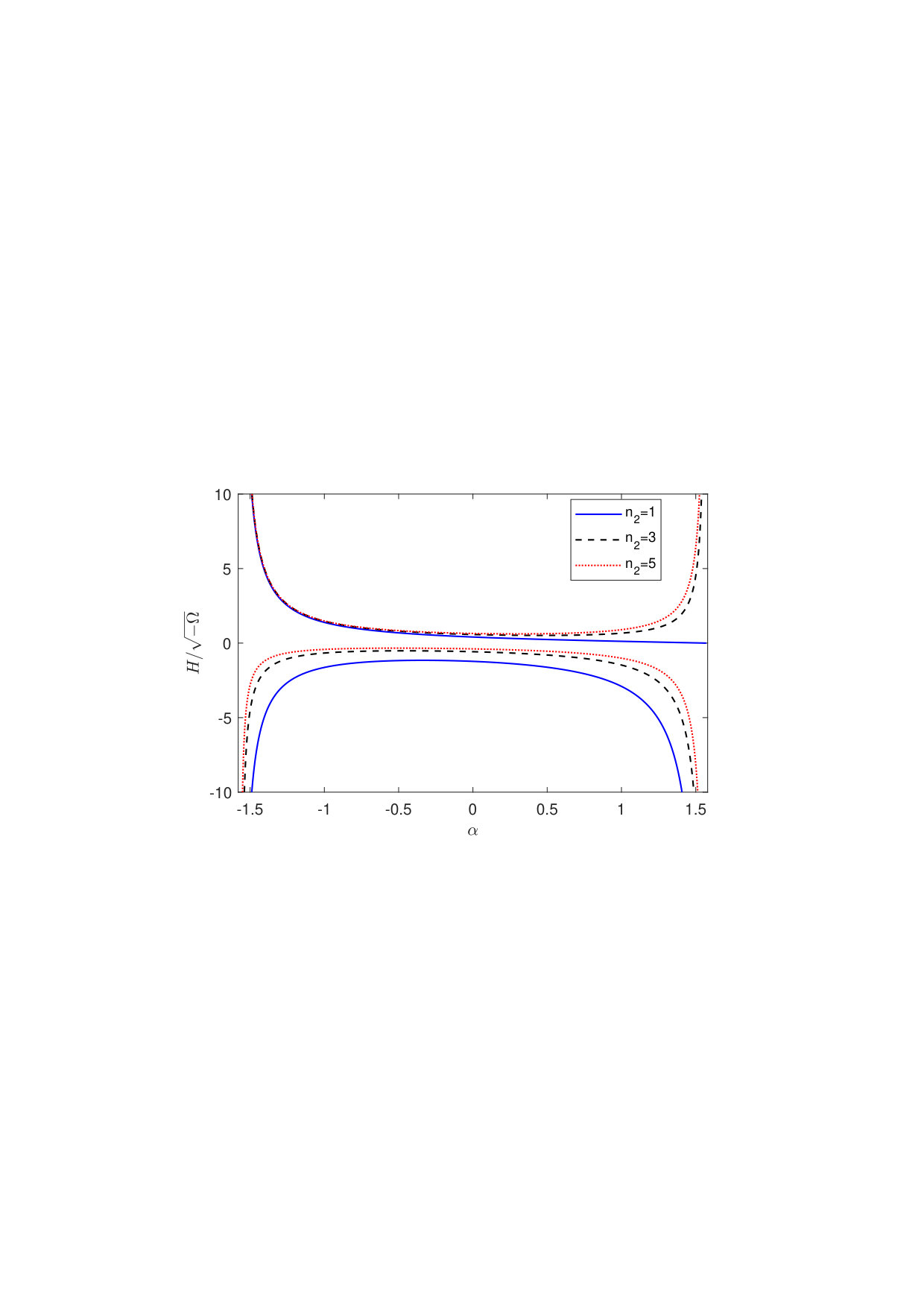 Figure 1
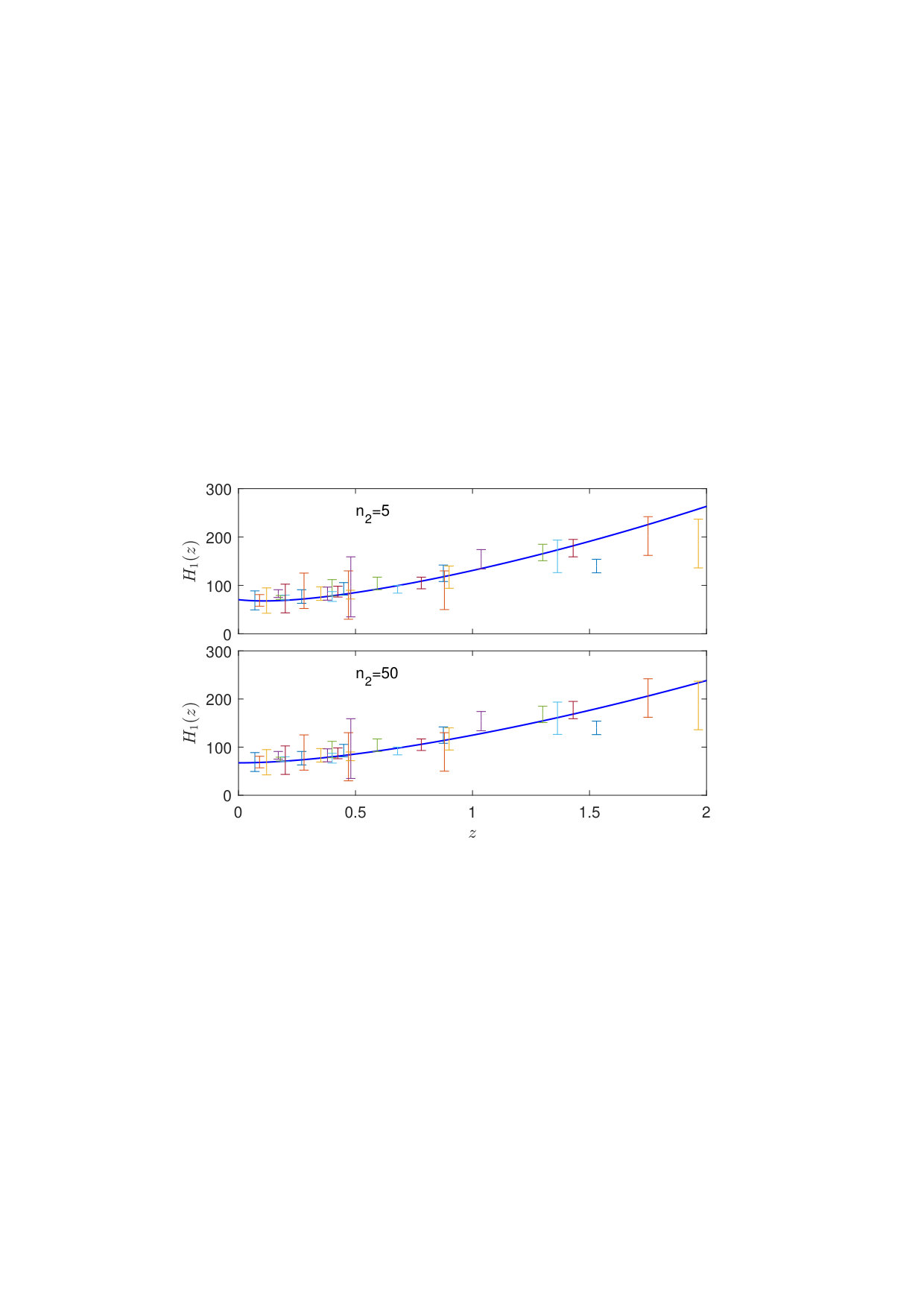 Figure 2
Peer Reviews
No public reviews on file for this paper yet. If you reviewed it on a platform where reviews are public (OpenReview, ICLR, NeurIPS, ICML), you can paste yours below so the community can read it here.
Videos
No videos yet. Explain this paper in a talk, walkthrough, or lecture? Add one.
aainstitutetext: School of Science, Yangzhou Polytechnic Institute,
199 Huayang West Road, Yangzhou, Chinabbinstitutetext: Department of Physics, Nanjing University,
22 Hankou Road, Nanjing, China,ccinstitutetext: School of Science, Changzhou Institute of Technology,
1 Wushan Road, Changzhou, China,
Fine Tuning Problem of the Cosmological Constant in a Generalized Randall-Sundrum Model
Guang-Zhen Kang c
De-Sheng Zhang b
Hong-Shi Zong b
and Jun Li
Abstract
To solve the cosmological constant fine tuning problem, we investigate a -dimensional generalized Randall-Sundrum brane world scenario with two -branes instead of two 3-branes. Adopting an anisotropic metric ansatz, we obtain the positive effective cosmological constant of order and only require a solution . Meanwhile, both the visible and hidden branes are stable because their tensions are positive. Therefore, the fine tuning problem can be solved quite well. Furthermore, the Hubble parameter as a function of redshift is in good agreement with cosmic chronometers dataset. The evolution of the universe naturally shifts from deceleration to acceleration. This demonstrates that the evolution of the universe is intrinsically an extra-dimensional phenomenon. It can be seen as a dynamic model of dark energy which is driven by the evolution of the extra dimensions on the brane.
Keywords:
cosmological constant, fine tuning, generalized RS model
1 Introduction
The accelerated expansion of the universe has been discovered by analyzing distant and nearby supernovae in 1998 Riess ; Perlmutter . This discovery indicated the return of cosmological constant which was proposed by Einstein, or termed as dark energy. Data of last two decades indicate that the cosmological constant is a very tiny positive value of order in Planck unit Perlmutter ; Riess ; Bennett ; Halverson ; Netterfield ; Valent ; Zhang ; Verde ; Moresco1 ; Moresco2 ; Moresco3 ; Ratsimbazafy ; Stern ; Simon . In Einstein’s theory of general relativity, the cosmological constant coincides with the vacuum energy Peebles . Vacuum energy contains the contribution of vacuum fluctuations caused by quantum mechanics. However, the theoretical expectations for the vacuum energy exceed the observed value by orders of magnitude Copeland . This gives rise to the cosmological constant fine tuning problem Amendola . Theorists have proposed numerous theoretical models Zlatev ; Wetterich ; Caldwell ; Feng ; Sotiriou ; Dvali ; Bousso in order to solve this problem. But these theories can only partially solve this problem or avoid the vacuum energy caused by quantum fluctuations. It is still one of the central problems in theoretical physics and cosmology.
We have investigated some high-dimensional theory KK ; NAH1 ; NAH2 ; Antoniadis ; RS ; Das ; Das1 ; Antoniadis1 ; Sundrum ; Lykken ; Visinelli ; Vagnozzi ; Paul ; Polchinski in order to solve this problem better. Among these theories, the Randall-Sundrum (RS) two-brane model RS has attracted our attention. In this model the hierarchy problem why there is such a large discrepancy between the electroweak scale/Higgs mass TeV and the Planck mass TeV is solved very well. The warp factor originating from the background metric generates a large hierarchy but requires only . This large hierarchy problem is somewhat similar to the cosmological constant fine tuning problem. However, RS model has a negative brane tension which results in the instability of the visible brane. Furthermore, zero cosmological constant on the visible 3-brane is not consistent with presently observed data Das ; Koley . Therefore one solution of the fine tuning problem is to find a new mechanism in RS model that renders the effective cosmological constant a very small positive value compatible with the present cosmological observation.
In this paper, we show that this problem can be solved using the -dimensional (-d) generalized RS braneworld model Das with two -branes (the visible and the hidden branes) instead of two 3-branes. In this model, the induced cosmological constant on the visible brane appears naturally. For the negative induced cosmological constant, there is a solution with positive visible and hidden brane tension Mitra ; SC1 ; SC2 ; SC3 ; Banerjee . For of order , we obtain the solutions corresponding to the magnitude of the warp factor.
In order to be consistent with observations, the negative induced cosmological constant must be transformed into the positive effective cosmological constant. We investigate the case that the scale factors on the visible brane evolve with different rates by adopting an anisotropic metric ansatz Middleton . The Hubble parameters are obtained by solving the Einstein field equation. We obtain a positive effective cosmological constant consistent with observations of order . It indicates that cosmic acceleration is intrinsically an extra-dimensional phenomenon. The Hubble parameter as a function of redshift is consistent with most of cosmic chronometers dataset. More precise cosmic chronometers dataset may verify the existence of extra dimensions on the visible brane.
2 -d Generalized Randall-Sundrum model
We start with a -d generalized RS braneworld model. The total action is composed of the bulk action and two -brane actions:
[TABLE]
[TABLE]
[TABLE]
where is a bulk cosmological constant of order in Planck unit (the vacuum energy caused by quantum mechanics), denotes -d fundamental mass scale, is the -d metric tensor, is the -d Ricci scalar, and are the matter field Lagrangian and the tension of the brane, or . The total action is stationary with respect to arbitrary variations in if and only if:
[TABLE]
where Capital Latin indices run over all spacetime coordinate labels , Lowercase Latin , and are the -d Ricci and the energy-momentum tensors respectively, represents the position of the -th brane in the -th coordinate. The -d energy-momentum tensor of an anisotropic perfect fluid is . In this generalized RS model, the metric ansatz satisfying the Einstein filed equations Eq. (4) is of the form:
[TABLE]
where is the -d metric tensor, is known as the warp factor, is the extra dimensional coordinate of length . Combining the Eq. (4) with Eq. (5), each energy-momentum tensor is given by . This is similar to the RS model in which each 3-brane Lagrangian separated out a constant vacuum energy RS . Then, the equations of and are given by:
[TABLE]
where we redefine the brane tension , the constant Planck mass, the arbitrary constant corresponds to the induced cosmological constant on the visible brane. Meanwhile, the -d Einstein field equations with this induced cosmological constant are given by:
[TABLE]
where and are the -d Ricci tensor and Ricci scalar, respectively. The arbitrary constant corresponds to the induced cosmological constant on the visible brane. In this paper, we only consider the situation . Since always brings about the negative tension on the visible brane that results in instability.
For , the warp factor satisfying Eqs. (4) and (5) is obtained:
[TABLE]
where , for considering the normalization at the extra dimensional fixed coordinate . Setting , , Das ; Kang , we get from Eq. (9):
[TABLE]
where the induce cosmological constant have an upper bound () to ensure that the value in the square root is greater than zero. Eq. (10) have two solutions which give rise to the required warping. For , the first solution corresponds to the visible brane tension
[TABLE]
Here the visible brane is unstable because the visible brane tension is negative. We do not consider this solution in the following. The second solution , which is consistent with the Eq. (21) in Ref. Das . Both the visible and the hidden brane are stable because both brane tensions are:
[TABLE]
3 Fine tuning problem of the cosmological constant
The -d effective theory can be obtained by substituting Eq. (5) into the bulk action Eq. (1). We can obtain the scale of gravitational interactions from the curvature term:
[TABLE]
Substituting Eq. (9) into Eq. (13) and performing the integral of , we can obtain a -d effective action. We find that depends only weakly on in the large limit when . Thus, is given by:
[TABLE]
The hierarchy problem cannot be solved in this -d generalized RS braneworld model because that we can not determine the physical mass by means of renormalization.
If , namely the magnitude of induced cosmological constant is of order in Planck unit, we get the second solution corresponds to when satisfies the condition . Different warp factors correspond to different solutions to ensure . The cosmological constant fine tuning problem can be partially solved in this mechanism only requiring .
The remaining unsolved problem is how to transform negative cosmological constant into positive. We choose an anisotropic metric ansatz of the form Middleton :
[TABLE]
where is the scale factor. First, we investigate the case that the scale factors on the visible brane evolve with two different rates. With the negative induced cosmological constant , we obtain the solutions of Eq. (8):
[TABLE]
where the Hubble parameter , , is the initial phase angle which is determined by the scale of the formation of the brane. In other words, the value of must ensure that the presently observed three dimensional (3D) scale can be found. The terms , and are respectively:
[TABLE]
where and are the number of dimensions which evolve with two different rates, respectively. We choose which is most in line with the presently observed 3D space universe. From the time of the formation of the brane to the present time ( in planck unit), it is easy to satisfy the condition that 3D scale factor is expanding all the time because is a very tiny value which is of order in Planck unit.
In Fig. 1, and as functions of are shown. The three curves in the upper half of Fig. 1 correspond to at respectively. It is shown that has a lower bound as long as :
[TABLE]
where . Here we can see that the number of extra dimensions on the brane can not be one, otherwise the time-independent positive effective cosmological constant cannot be obtained Kang . In the limit, the lower bound of the Hubble parameter is . In the region near , is close to a constant of order . Comparing with 3D Friedmann equation with , we obtain the effective cosmological constant is of order because in the region near we have:
[TABLE]
This is an important result. It tells us that the negative induced cosmological constant can be transformed into the positive effective cosmological constant because of the evolution of the extra dimensions. Cosmic acceleration is intrinsically an extra-dimensional phenomenon, and the cosmological constant fine tuning problem can be solved by this extra-dimensional evolution.
From Eqs. (16) and (17) we can get the scale factors and . Further, we obtain the volume of the visible brane:
[TABLE]
where and are the scale factors when the brane forms. We choose because there is no reason to make them different when the brane has not evolved yet. If the scale of the brane just formed is of order in planck unit (), in order to form the presently observed 3D scale of order , we obtain the scale of extra dimensions is of order with . Therefore, the scale of extra dimensions can be much larger than Planck length, which leads to the fact that physics are still valid in this model. The three curves in the lower half of Fig. 1 presents with respectively. With the increase of , the scale of the brane just formed can be smaller, meanwhile it ensures that the extra dimensions will not be reduce to Planck length in present time. is close to as long as is tiny. So in the region of we obtain:
[TABLE]
At , is about which is as similar as the radiation dominating eras. In the limit , .
The figure on the top in Fig. 2, as a function of redshift with is shown. In order to best fit cosmic chronometers dataset, we take the present time which is the time when . Therefore, has a minimum at . Between and , is slowly decreasing which is not against most of cosmic chronometers dataset. When , is monotonically increasing which is in agreement with cosmic chronometers dataset except at . The Hubble parameter is slightly larger than cosmic chronometers dataset at this redshift. The redshift from deceleration to accelerated expansion (namely, deceleration parameter ) is about . It is somewhat inconsistent with the observed value . If more precise cosmic chronometers dataset show that the Hubble parameter is in line with the above curve, the existence of extra dimension can be verified. The figure on the bottom in Fig. 2, is a monotonic curve when . We take the present time which is the time when . This curve is in good agreement with cosmic chronometers dataset very well. With the increase of , the slope of becomes smaller so that it is more consistent with cosmic chronometers dataset at . The evolution of the 3D space shifts from deceleration to acceleration when the redshift which is in line with the observed value. We would obtain more restrictions on the number of extra dimensions if cosmic chronometers dataset are more precise.
4 Summary and conclusion
In conclusion, we investigate a -d generalized Randall-Sundrum model with a bulk cosmological constant of order in Planck unit (the vacuum energy caused by quantum fluctuations). The induced cosmological constant on the visible brane appears naturally in this model. Both the visible and hidden branes are stable because their tensions are positive when . Adopting an anisotropic metric ansatz, we obtain the positive effective cosmological constant of order and only require a solution . Therefore, the cosmological constant fine tuning problem can be solved quite well.
Meanwhile, the Hubble parameters as a function of redshift is consistent with most of cosmic chronometers dataset. The evolution of the 3D space naturally shifts from deceleration to acceleration when the redshift . Furthermore, more precise cosmic chronometers dataset may verify the existence of extra dimensions on the visible brane and restrict the number of the extra dimensions. It is worth noting that we did not introduce the matter and radiation energy-momentum tensor having a perfect fluid form when we obtain the above results. This demonstrates that the evolution of 3D scale factor (cosmic acceleration period or the like-matter-dominated period) is intrinsically an extra-dimensional phenomenon. This can be seen as a dynamic model of dark energy which is driven by the evolution of the extra dimensions on the brane.
Acknowledgements.
We wish to acknowledge the support of the State Key Program of National Natural Science Foundation of China (under Grant No. 11535005), the National Natural Science Foundation of China (under Grant No. 11647087), the Natural Science Foundation of Yangzhou Polytechnic Institute (under Grant No. 201917), and the Natural Science Foundation of Changzhou Institute of Technology (under Grant No. YN1509).
The reference list from the paper itself. Each links out to its DOI / PubMed record.
- 1(1) A. G. Riess et al., Observational Evidence from Supernovae for an Accelerating Universe and a Cosmological Constant , Astron. J. 116 (1998) 1009 [astro-ph/9805201].
- 2(2) S. Perlmutter et al., Measurements of Omega and Lambda from 42 High-Redshift Supernovae , Astrophys. J. 517 (1999) 565 [astro-ph/9812133].
- 3(3) C. L. Bennett et al., First Year Wilkinson Microwave Anisotropy Probe (WMAP) Observations: Preliminary Maps and Basic Results , Astrophys. J. Suppl. Ser. 148 (2003) 1 [astro-ph/0302207].
- 4(4) C. B. Netterfield et al., A measurement by BOOMERANG of multiple peaks in the angular power spectrum of the cosmic microwave background , Astrophys. J. 571 (2002) 604 [astro-ph/0104460].
- 5(5) N.W. Halverson et al., DASI First Results: A Measurement of the Cosmic Microwave Background Angular Power Spectrum , Astrophys. J. 568 (2002) 38 [astro-ph/0104489].
- 6(6) A. Gómez-Valent and L. Amendolab, H 0 subscript 𝐻 0 H_{0} from cosmic chronometers and Type Ia supernovae, with Gaussian Processes and the novel Weighted Polynomial Regression method , JCAP 04 (2018) 051 [ar Xiv:1802.01505].
- 7(7) C. Zhang, H. Zhang, S. Yuan, T.-J. Zhang and Y.-C. Sun, Four new observational H(z) data from luminous red galaxies in the Sloan Digital Sky Survey data release seven , Res. Astron. Astrophys. 14 (2014) 1221 [ar Xiv:1207.4541].
- 8(8) R. Jiménez, L. Verde, T. Treu and D. Stern, Constraints on the equation of state of dark energy and the Hubble constant from stellar ages and the CMB , Astrophys. J. 593 (2003) 622 [astro-ph/0302560].