Topological Electronic States in HfRuP Family Superconductors
Yuting Qian, Simin Nie, Changjiang Yi, Lingyuan Kong, Chen Fang, Tian, Qian, Hong Ding, Youguo Shi, Zhijun Wang, Hongming Weng, and Zhong Fang

TL;DR
This study combines first-principles calculations and experiments to reveal topological electronic states in HfRuP family superconductors, showing Weyl semimetal and topological crystalline insulator phases that may lead to unconventional superconductivity.
Contribution
It is the first to identify nontrivial topological phases in HfRuP family superconductors and experimentally verify their superconductivity and topological properties.
Findings
HfRuP hosts a Weyl semimetal phase with 12 pairs of type-II Weyl points.
ZrRuAs, ZrRuP, and HfRuAs are topological crystalline insulators with nontrivial mirror Chern numbers.
Superconductivity coexists with nontrivial topological states, suggesting potential for topological superconductivity.
Abstract
Based on the first-principles calculations and experimental measurements, we report that the hexagonal phase of ternary transition metal pnictides TT'X (T=Zr, Hf; T'=Ru; X=P, As), which are well-known noncentrosymmetric superconductors with relatively high transition temperatures, host nontrivial bulk topology. Before the superconducting phase transition, we find that HfRuP belongs to a Weyl semimetal phase with 12 pairs of type-II Weyl points, while ZrRuAs, ZrRuP and HfRuAs belong to a topological crystalline insulating phase with trivial Fu-Kane indices but mirror Chern numbers. High-quality single crystal samples of the noncentrosymmetric superconductors with these two different topological states have been obtained and the superconductivity is verified experimentally. The wide-range band structures of ZrRuAs have been identified by ARPES and reproduced by…
Click any figure to enlarge with its caption.
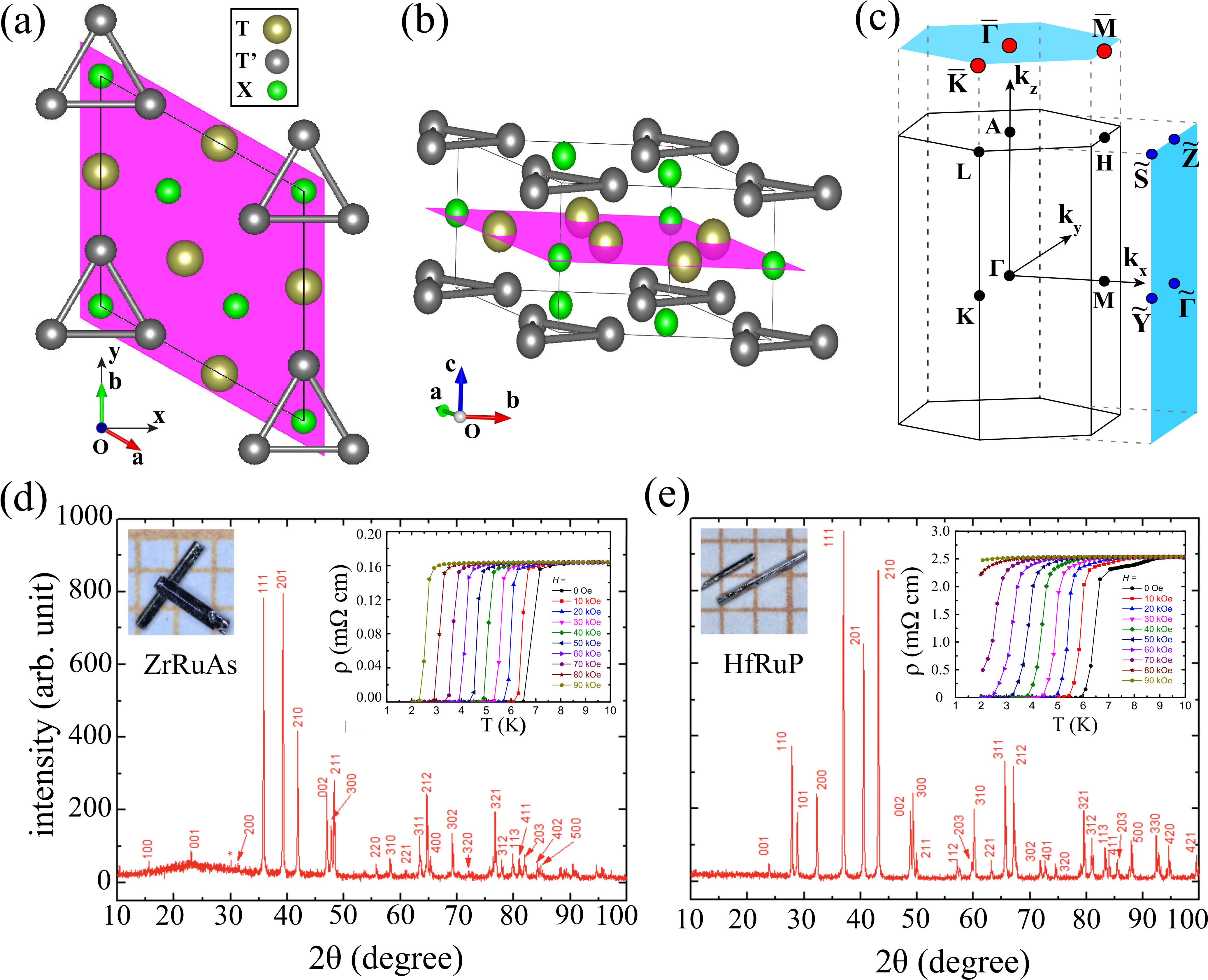 Figure 1
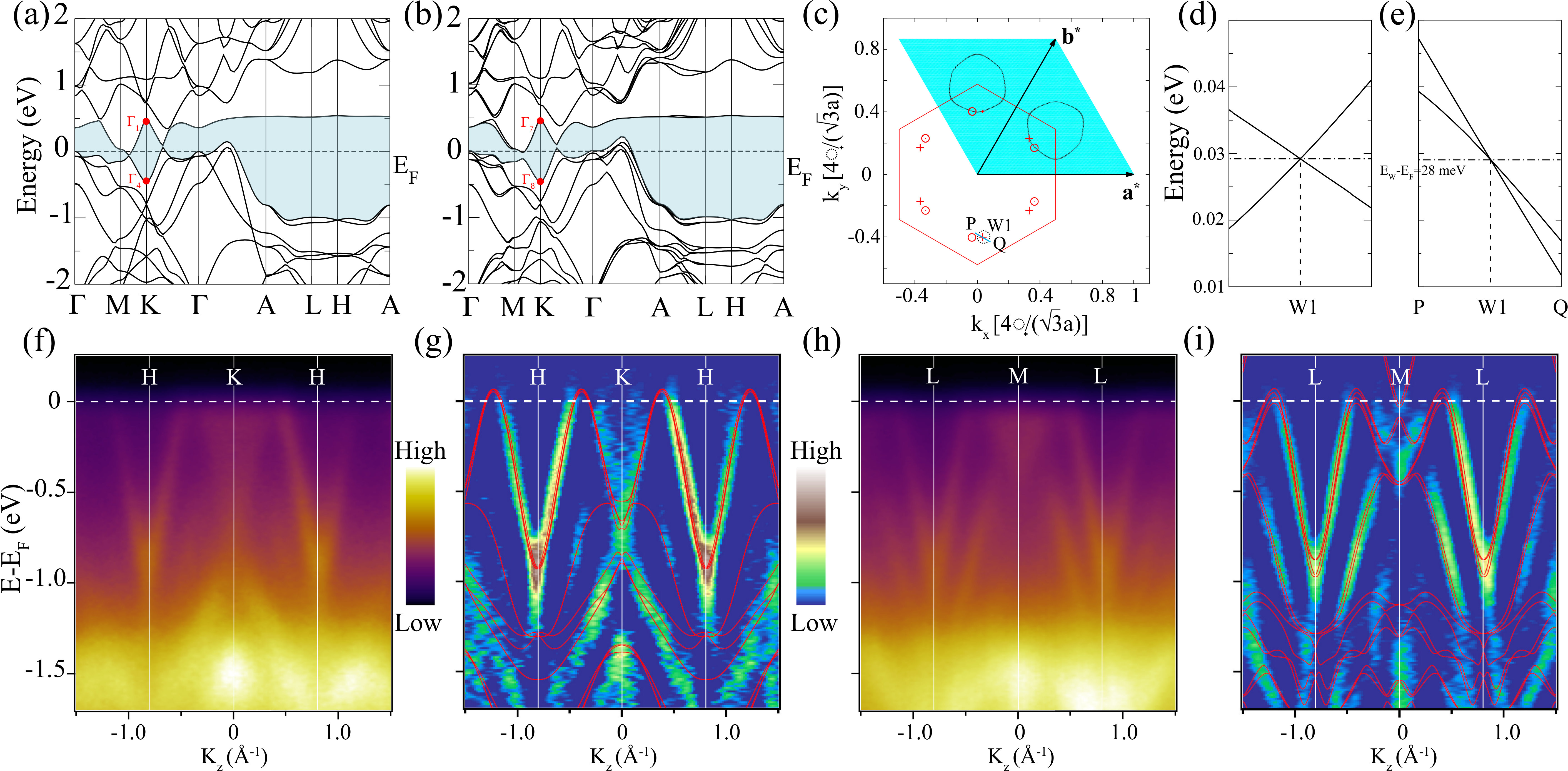 Figure 2
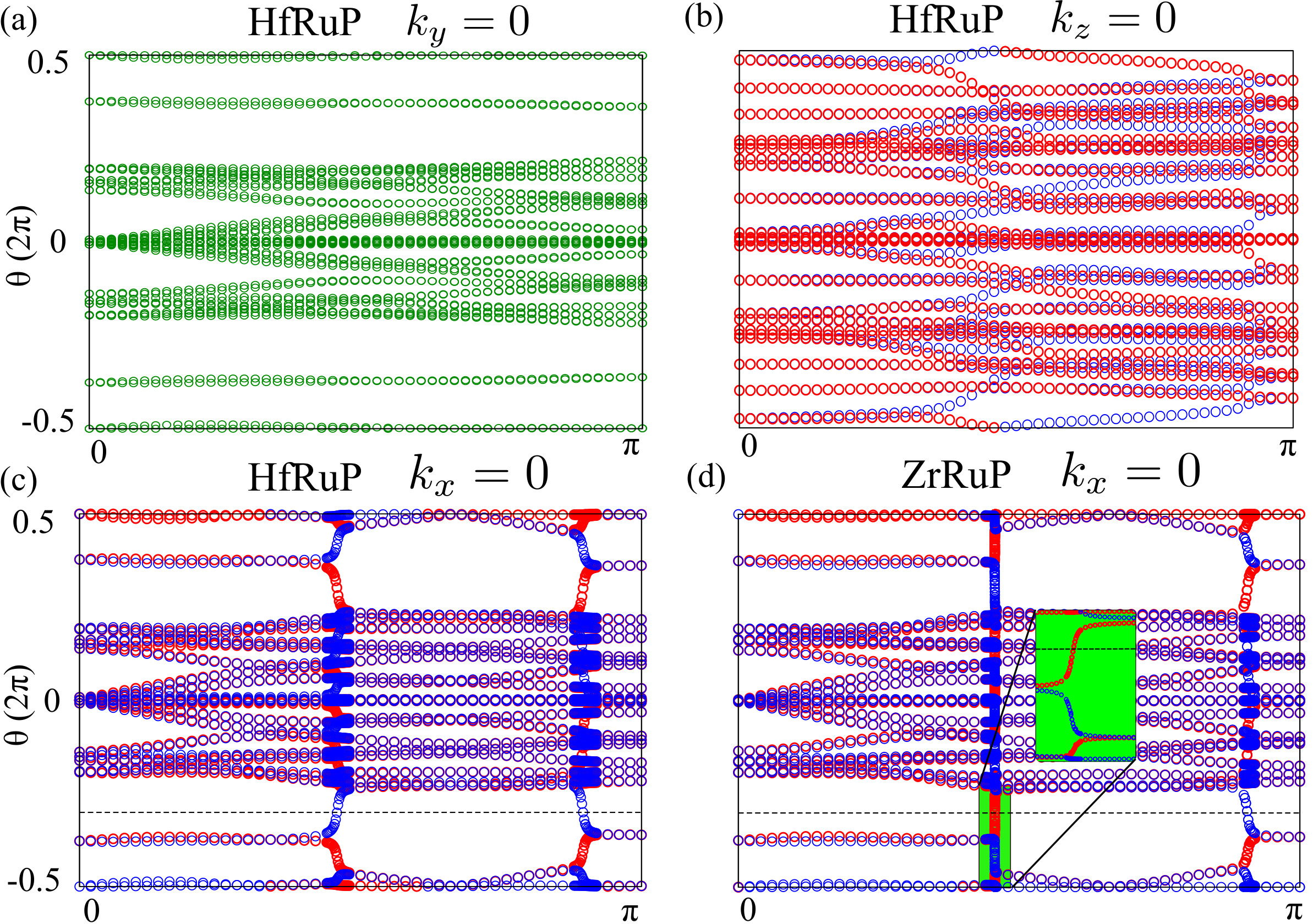 Figure 3
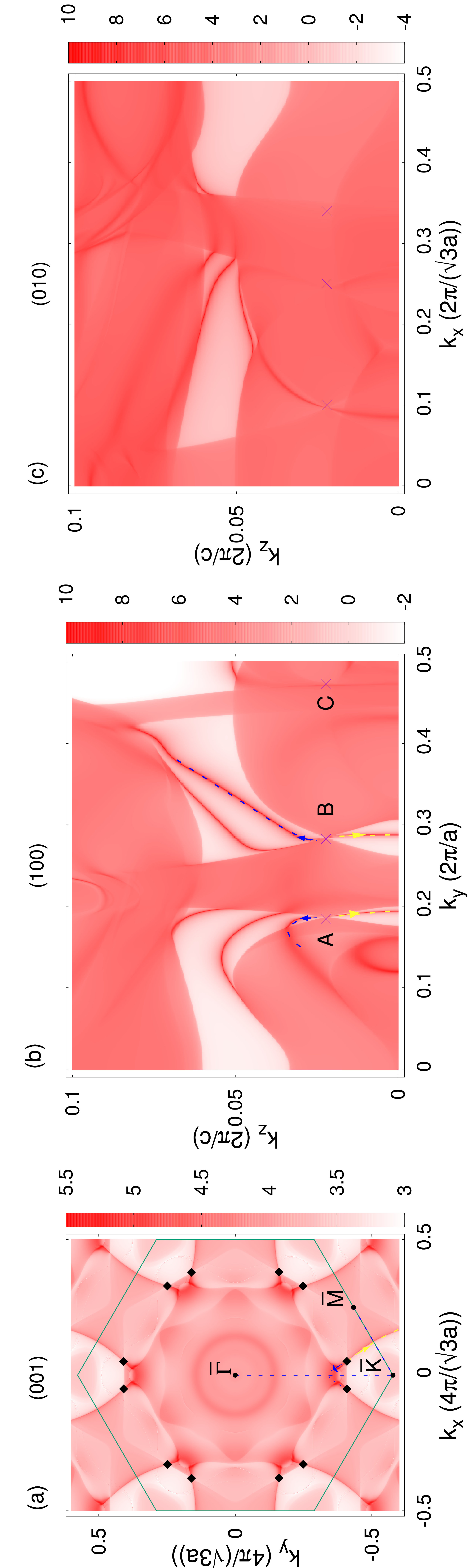 Figure 4
Peer Reviews
No public reviews on file for this paper yet. If you reviewed it on a platform where reviews are public (OpenReview, ICLR, NeurIPS, ICML), you can paste yours below so the community can read it here.
Videos
No videos yet. Explain this paper in a talk, walkthrough, or lecture? Add one.
††thanks: These authors contributed equally to this work.††thanks: These authors contributed equally to this work.††thanks: These authors contributed equally to this work.
Topological Electronic States in HfRuP Family Superconductors
Yuting Qian
Beijing National Laboratory for Condensed Matter Physics, and Institute of Physics, Chinese Academy of Sciences, Beijing 100190, China
University of Chinese Academy of Sciences, Beijing 100049, China
Simin Nie
Beijing National Laboratory for Condensed Matter Physics, and Institute of Physics, Chinese Academy of Sciences, Beijing 100190, China
Department of Materials Science and Engineering, Stanford University, Stanford, California 94305, USA
Changjiang Yi
Beijing National Laboratory for Condensed Matter Physics, and Institute of Physics, Chinese Academy of Sciences, Beijing 100190, China
Lingyuan Kong
Beijing National Laboratory for Condensed Matter Physics, and Institute of Physics, Chinese Academy of Sciences, Beijing 100190, China
University of Chinese Academy of Sciences, Beijing 100049, China
Chen Fang
Beijing National Laboratory for Condensed Matter Physics, and Institute of Physics, Chinese Academy of Sciences, Beijing 100190, China
University of Chinese Academy of Sciences, Beijing 100049, China
CAS Center for Excellence in Topological Quantum Computation, University of Chinese Academy of Sciences, Beijing 100190, China
Songshan Lake Materials Laboratory, Dongguan, Guangdong 523808, China
Tian Qian
Beijing National Laboratory for Condensed Matter Physics, and Institute of Physics, Chinese Academy of Sciences, Beijing 100190, China
Songshan Lake Materials Laboratory, Dongguan, Guangdong 523808, China
Hong Ding
Beijing National Laboratory for Condensed Matter Physics, and Institute of Physics, Chinese Academy of Sciences, Beijing 100190, China
CAS Center for Excellence in Topological Quantum Computation, University of Chinese Academy of Sciences, Beijing 100190, China
Songshan Lake Materials Laboratory, Dongguan, Guangdong 523808, China
Youguo Shi
Beijing National Laboratory for Condensed Matter Physics, and Institute of Physics, Chinese Academy of Sciences, Beijing 100190, China
University of Chinese Academy of Sciences, Beijing 100049, China
Songshan Lake Materials Laboratory, Dongguan, Guangdong 523808, China
Zhijun Wang
Beijing National Laboratory for Condensed Matter Physics, and Institute of Physics, Chinese Academy of Sciences, Beijing 100190, China
University of Chinese Academy of Sciences, Beijing 100049, China
Hongming Weng
Beijing National Laboratory for Condensed Matter Physics, and Institute of Physics, Chinese Academy of Sciences, Beijing 100190, China
University of Chinese Academy of Sciences, Beijing 100049, China
CAS Center for Excellence in Topological Quantum Computation, University of Chinese Academy of Sciences, Beijing 100190, China
Songshan Lake Materials Laboratory, Dongguan, Guangdong 523808, China
Zhong Fang
Beijing National Laboratory for Condensed Matter Physics, and Institute of Physics, Chinese Academy of Sciences, Beijing 100190, China
University of Chinese Academy of Sciences, Beijing 100049, China
Abstract
Based on the first-principles calculations and experimental measurements, we report that the hexagonal phase of ternary transition metal pnictides TT’X (T=Zr, Hf; T’=Ru; X=P, As), which are well-known noncentrosymmetric superconductors with relatively high transition temperatures, host nontrivial bulk topology. Before the superconducting phase transition, we find that HfRuP belongs to a Weyl semimetal phase with 12 pairs of type-II Weyl points, while ZrRuAs, ZrRuP and HfRuAs belong to a topological crystalline insulating phase with trivial Fu-Kane indices but nontrivial mirror Chern numbers. High-quality single crystal samples of the noncentrosymmetric superconductors with these two different topological states have been obtained and the superconductivity is verified experimentally. The wide-range band structures of ZrRuAs have been identified by ARPES and reproduced by theoretical calculations. Combined with intrinsic superconductivity, the nontrivial topology of the normal state may generate unconventional superconductivity in both bulk and surfaces. Our findings could largely inspire the experimental searching for possible topological superconductivity in these compounds.
INTRODUCTION
Topological insulators (TIs) kane2010 ; qi2011 and semimetals wan2011topological ; xu2011chern ; wang2012dirac ; wang2013three ; weng2015weyl have received a tremendous amount of attention in the last decade due to the appearance of exotic properties, such as spin-momentum locked gapless surface state in TIs PhysRevLett.106.257004 ; zhang2013spin , Fermi-arc states xu2016observation ; xu2015discovery ; wang2016observation2 and negative magnetoresistance in Weyl semimetals (WSMs) weng2015weyl ; huang2015observation ; zhang2016signatures . These insulators can be characterized by topological invariants/indices, like Fu-Kane indices PhysRevLett.98.106803 and mirror Chern numbers hsieh2012topological ; nie2016band for TIs and topological crystalline insulators (TCIs), respectively. However, WSMs are topological metallic states with discrete accidental twofold degenerate points, described by the three-dimensional (3D) Weyl equation. Due to the lack of strict Lorentz invariance, the type-II Weyl points can be strongly tilted soluyanov2015type , which have no analogy in high-energy physics. In contrast to the point-like bulk Fermi surfaces of the type-I WSMs weng2015weyl ; huang2015weyl ; lv2015experimental ; lv2015observation ; lv2015observation2 ; nie2017topological ; nie2019magnetic ; PhysRevLett.117.236401 , these type-II WSMs deng2016experimental ; jiang2017signature ; tamai2016fermi ; liang2016electronic ; wang2016mote have both electron pockets and hole pockets touching at the Weyl points, resulting in various novel physical properties kumar2017extremely ; shekhar2015extremely .
Topological materials that host superconductivity are ideal systems to detect topological superconductivity (TSC) and Majorana fermions yan2013large ; wu2015 ; Schoop2015 ; chang2016 ; wang2016spontaneous ; xie2017 ; nie2018 . The topological surface Dirac-cone states can be used to generate two-dimensional (2D) TSC induced by the intrinsic bulk superconductivity Fu2008superconducting ; Fu2010odd ; alicea2012new ; sato2017topological . Very recently, the superconducting gap of the predicted topological surface Dirac-cone states in FeTe1-xSex wang2015 ; xu2016 has been detected in recent angle-resolved photoemission spectroscopy (ARPES) Zhang182 and scanning tunneling microscope experiments Wang333 . In noncentrosymmetric WSMs, 3D time-reversal symmetric TSC can arise from sign-changing superconductivity in Fermi surfaces with different Chern numbers qi2010 ; Hosur204 . However, to the best of our knowledge, almost all noncentrosymmetric WSMs need external pressure or doping to induce or enhance superconductivity pan2015pressure ; kang2015superconductivity ; qi2016superconductivity ; chen2016superconductivity ; li2017concurrence ; xu2019topological . Due to the lack of suitable candidates, 3D TSC is studied very little experimentally. Therefore, the material proposal of a WSM with high-quality single crystals and relatively higher superconducting transition temperature (TC) is of great interest.
Ternary transition metal pnictides TT’X (T=Zr, Hf; T’=Ru; X=P, As) are a series of well-known superconductors barz1980ternary ; meisner1983superconductivity . As we know, there are three different types of crystal structures for these compounds MULLER1983177 ; meisner1983superconductivity , i.e. the Fe2P-type hexagonal structure (h-phase), the TiNiSi-type orthorhombic structure (o-phase), and the TiFeSi-type orthorhombic structure (o*′-phase). Superconductivity is found in both h- and o-phases, and the superconducting transition temperature is generally higher for h-phase than that for o-phase. In this work, we only focus on the h-phase of TT’X, exhibiting relatively high (such as 12.7 K for HfRuP barz1980ternary , 13.3 K for ZrRuP and 12 K for ZrRuAs meisner1983superconductivity ). Based on the first-principles calculations, the nontrivial topological properties of these materials in the normal state (above TC*) are revealed. When spin-orbit coupling (SOC) is ignored, they possess two nodal rings slightly above the Fermi energy (EF) in the plane, with each surrounding a K point in the hexagonal Brillouin zone (BZ). After the consideration of SOC, they enter either a WSM phase (e.g. HfRuP) with 12 pairs of type-II Weyl points (WPs) due to the lack of inversion symmetry, or a topological crystalline insulating (TCI) phase (e.g. ZrRuAs) with trivial Fu-Kane indices Fu2007topo but nontrival mirror Chern numbers. The nontrivial electronic topology in these materials could intrigue tremendous experimental study of the interplay between topological electronic states and superconductivity.
RESULTS AND DISCUSSION
.1 Crystal structure and electronic band structures
The h-phase of TT’X is of space group (#189) with a layered structure. Each layer in the hexagonal lattice is occupied by either T and X atoms or T’ and X atoms. All atoms have positions in the layers parallel to the crystallographic -plane and separated by a half of the lattice constant . The triangular clusters of three T’ atoms (T’3) are formed in the -plane. In the crystal structure of the TT’X shown in Figs. 1(a) and (b), the T’3 clusters and the planer structure are clearly shown. The high-symmetry -points and surface projections are shown in Fig. 1(c). The structure has two kinds of mirror symmetries, and , which are vital to define the mirror Chern numbers as will be shown below. Meantime, we have successfully grown the single crystals of ZrRuAs and HfRuP, as shown in Figs. 1(d) and (e), respectively. The hexagonal structure and superconductivity are confirmed by the x-ray diffraction (XRD) and resistivity measurements, respectively. More details and data (i.e. magnetic susceptibility) can be found in the Supplementary Material.
We first checked the electronic band structure without SOC. Among these compounds, we mainly investigated HfRuP and ZrRuAs for details in the following, as typical examples of the type-II WSM phase and TCI phase, respectively. More results on other compounds are presented in the Supplementary Material. From the band dispersion of HfRuP in Fig. 2(a), one can notice there is a direct energy gap shadowed in light blue near EF, except the band crossings along both and lines. These two lines are actually in the plane, where the symmetry is present. The eigenvalues of the two crossing bands are computed to be , respectively. Thus, the two crossing points are parts of the -protected nodal rings, each of which surrounds a K point in the plane, as depicted in Fig. 2(c). This situation is different from that in CaAgAs yamakage2015line , where there is only one nodal ring surrounding the point. The two nodal rings circled around two K points are also found for all other compounds (see electronic band structures of ZrRuAs, HfRuAs and ZrRuP in Supplementary Section A). We conclude that the band inversion happens at the K point, which is supported by the theory of topological quantum chemistry tqc2017 ; wang2019 . By exchanging the highest valence band () and the lowest conduction band () at the K point (with little group ) only, the occupied bands become trivial, being a linear combination of elemental band representations tqc2017 .
After including SOC, the band structure doesn’t change too much, but the bands do split due to the lack of inversion symmetry. To confirm the reliability of the density functional theory (DFT) band structures, we have performed ARPES measurement for ZrRuAs, shown in Figs. 2(f)-(i). The observed spectra along H-K-H and L-M-L lines match very well with the DFT calculations (red lines in Figs. 2(g) and (i)), especially for the low-energy bands. We clearly see that the energy bands at K point are much lower than that at M point. In addition, the degeneracy of the two nodal rings is lifted by SOC. The 2D time-reversal invariant (TRI) planes (e.g. and etc.) become fully gapped, making the invariants well-defined. In CaAgAs, the single nodal line enclosing point guarantees that the (or ) plane is nontrivial with an infinitesimal SOC gap. But, it’s not the case with two nodal rings around two K points. The invariants for both and planes remain trivial in the series of these compounds. Note that the plane is gapped even without SOC, and no gapless point is found in all TRI planes. To confirm triviality of invariants, we have calculated the Wannier charge centers (WCCs) of the -directed (-directed) Wilson loops as a function of (called Wilson-loop bands) for the () plane. The results of ZrRuAs are shown in Figs. 3(a) and (b), suggesting a trivial invariant in the plane and plane. Accordingly, the Fu-Kane indices Fu2007topo for the 3D bulk are computed to be (0;000) for all the compounds. The detailed calculations for the invariants in all six TRI planes (only four of them are distinct due to the symmetry) are presented in Supplementary Section B. Furthermore, the symmetry indicators ashvin2017 ; song2017 ; Jorrit2017 ; zhang2019 ; wanxg2019 for these compounds are computed to be and , revealing the topological nature of the SOC gap (shadowed in light blue) in Fig. 2(b).
.2 Mirror Chern numbers and WPs
Due to the presence of mirror symmetry, the mirror Chern number is well defined as long as the mirror plane is fully gapped. Because time-reversal symmetry commutes with the mirror symmetries, the Chern numbers satisfy , with the subscript representing the mirror eigenvalues in the presence of SOC. With time reversal symmetry, the mirror Chern number is defined as . As we know, it can be further reduced to in half of the mirror plane, where is easily obtained in the plot of Wilson-loop bands, by counting the number of the positively-sloped bands crossing a horizontal reference line [the dashed line in Figs. 3(c) or (d)] and subtracting from it the number of the negatively-sloped crossing ones in the mirror eigenvalue subspace. The results of ZrRuAs for the plane are shown in Fig. 3(b). The mirror Chern number in ZrRuAs is computed to be for the = 0 plane, while it’s zero for the plane. That’s the case for all the compounds [see more in Supplementary Section C].
The lack of inversion symmetry allows the appearance of WPs in the systems. The nonzero mirror Chern number suggests there are some strings of gauge singularities (i.e. the Dirac string) going through the plane bernevig2015s , which have to either terminate at WPs in the 3D BZ, or thread some other nontrivial planes. Our systematic calculations show that these compounds can be classified into two classes: i) one has zero Chern number with 12 pairs of type-II WPs, termed a WSM phase; ii) the other one has nonzero mirror Chern number with no WPs, termed a TCI phase. In the WCCs of HfRuP for the plane in Fig. 3(c), is obtained to be 0. WPs are found in this compound, which is consistent with the topological WSM phase. However, for ZrRuAs, HfRuAs and ZrRuP, turns out to be , as shown in Fig. 3(d) and in Supplementary Section C. Accordingly, no WP is found in these three materials. The detailed calculations of mirror Chern numbers are presented in Supplementary Section C.
By checking the energy gap and the associated topological monopole charge, we find that 6 pairs of WPs emerge from each nodal ring. Thus, there are 12 pairs of WPs in total (as shown in the first BZ in Fig. 2(c)). They reside at the same energy, because they are all related by either time-reversal symmetry or the crystalline symmetry (including 12 symmetry operators). The coordinate of the WP W1 enclosed by a dashed circle in Fig. 2(c) is [0.2761, 0.4654, 0.02439]. From the band dispersion of the WP W1 along the -direction [Fig. 2(d)] and the P-Q direction [Fig. 2(e)], we conclude that it belongs to a type-II WP xu2015 , and its energy level (EW*) is about 28 meV above EF (i.e. EW-E meV), very close to the Fermi energy. The topological monopole charge is computed with the Wilson-loop method applied on an enclosed manifold surrounding a single WP. The monopole charge of the WP W1 is +1. The distribution of all the WPs above the plane is illustrated in Fig. 2(c), with the “+(o)” symbol representing the topological monopole charge of , while these below the plane possess the opposite monopole charge shown in Fig. 2(c) because of the symmetry.
.3 Fermi arcs on surfaces
Surface Fermi arcs connecting the projections of two WPs with opposite chirality are expected in a WSM. For this purpose, the surface spectrum is computed based on the surface Green’s function method Sancho_1985 in the maximally localized Wannier function (MLWF) Hamiltonian of a half-infinite structure. First, the (001)-surface energy contour of HfRuP is obtained in Fig. 4(a) with meV. Since the two WPs with opposite chirality project onto the same point on the (001)-surface, no topological arc states are guaranteed to come out from the projections. However, we find that there are two trivial arc states (following the two dashed guiding lines) coming out of each WP projection: one is crossing the line; the other one is crossing the BZ boundary, (i.e. the line. Second, the computed (100)-surface energy contour is presented in Fig. 4(b). Since they are type-II WPs, the WPs should be located at the touching points between the electron pocket and the hole pocket. We do see that the projected points A and B are the touching points of two pockets. The constant energy contour with energy slightly below (or above) EW is presented in Supplementary Section D. We find that two surface Fermi arc states (indicated by dashed lines) are connected to the projected points (i.e. A and B). For the projected point C, it’s hard to see any surface state from it, because it is not projected onto a proper surface. At last, the computed (010)-surface energy contour is obtained and shown in Fig. 4(c), where the WPs with the same chirality project onto each other. As long as the projected electron/hole pockets (enclosing the projections of the WPs) are separated from each other, two topological Fermi arc states can be expected. Unfortunately, the metallic bulk states are projected into a big continuum, which makes the Fermi arc states invisible. Our ARPES experiment to search for the arc states on the (100)-surface is still in process.
.4 Exotic TSC
With intrinsic superconductivity, topological materials are promising platforms to realize TSCs owing to the nontrivial topology of the wave function in normal states. For example, surface Dirac fermions can realize a 2D TSC even for an -wave pairing state Fu2008superconducting ; wang2015 . Also, the FS topology in the normal state directly affects the TSC. In 3D, the integer topological quantum number in a time-reversal invariant superconductor is determined by the sign of the pairing order parameter and the first Chern number of the Berry phase gauge field on the FSs qi2011 . A WSM phase of a superconductor hosts the nontrivial FSs originating from WPs. Providing the two key ingredients: the nontrivial FSs and superconductivity, the WSM phase of HfRuP can be served as a good platform to realize the TRI TSC in 3D. Besides, the previous works shingo2015 ; ueno2013 report that the nontrivial mirror Chern number can generate multiple Majorana fermions in Cd3As2 and SrRuO4. These compounds in the TCI phase are very promising candidates to search for the topological crystalline superconductors too.
Discussion
Based on the DFT calculations, we find that there are two nodal rings in the band structure without SOC for the h-phase of TT’X, which is different from the situation in CaAgAs. After including SOC, they enter either a WSM phase with 12 pairs of type-II WPs, or a TCI phase with non-zero mirror Chern numbers. The single crystals for the two distinct topological phases are grown successfully. Their superconductivity and electronic band structures are verified by our resistivity, magnetic susceptibility and ARPES measurements, respectively. The series of Ru-based compounds are the desired single-crystal materials, which host both superconductivity below TC and topological states above TC. The experimental study of the interplay between superconductivity and Weyl or nontrivial mirror Chern states would be stimulated after this work.
At the stage of finalizing the present paper, we are aware of the mention of Weyl nodes in similar materials in the Ref.ivanov2019 . Our result of WPs in HfRuP is consistent with it, while the result for ZrRuP is different. That is because the topology (the annihilation of Weyl points) in ZrRuP may be sensitive to the parameters of the structure.
METHODS
The first-principles calculations were performed based on the DFT with the projector augmented wave (PAW) method paw1 ; paw2 as implemented in VASP package KRESSE199615 ; vasp . The generalized gradient approximation (GGA) of Perdew-Burke-Ernzerhof (PBE) type was adopted for the exchange-correlation functional pbe . The kinetic energy cutoff of the plane wave basis was set to 400 eV. A 10 10 16 k-point mesh for BZ sampling was adopted. The experimental lattice parameters were employed Meisner1983 ; MEISNER1983983 . The internal atomic positions were fully relaxed until the forces on all atoms were smaller than 0.01 eV/Å [the relaxed atomic positions are shown in Supplementary Section A]. The electronic structures were carried out both with and without SOC. The topological invariants and chiral charge were computed through the Wilson-loop technique. The MLWF method was used to calculate the surface states mlwf .
DATA AVAILABILITY
The data that support the findings of this study are available from the corresponding author upon reasonable request.
ACKNOWLEDGMENTS
We thank Dr. Xianxin Wu and Prof. Xi Dai for helpful discussions. This work was supported by the National Natural Science Foundation of China (11504117, 11774399, 11622435, U1832202), Beijing Natural Science Foundation (Z180008), the Ministry of Science and Technology of China (2016YFA0300600, 2016YFA0401000 and 2018YFA0305700), the Chinese Academy of Sciences (XDB28000000, XDB07000000), the Beijing Municipal Science and Technology Commission (Z181100004218001, Z171100002017018). H.W. acknowledges support from the Science Challenge Project (No. TZ2016004), the K. C. Wong Education Foundation (GJTD-2018-01). Y.S. acknowledges the National Key Research and Development Program of China (No. 2017YFA0302901). Z.W. acknowledges support from the National Thousand-Young-Talents Program and the CAS Pioneer Hundred Talents Program.
AUTHOR CONTRIBUTIONS
Z. W. and H. W. conceived and designed the project. Y. Q., S. N. and Z. W. performed all the DFT calculations, Y. Q., S. N., C. F, Z. W., H. W. and Z. F. did the theoretical analysis. C. Y. and Y. S. contributed in sample growth. L. K., T. Q. and H. D. carried out the ARPES experiment. All authors contributed to the manuscript writing.
ADDITIONAL INFORMATION
Supplementary information is available for this paper at https://doi.org/10.1038/s41524-019-0260-6.
Competing Interests the Authors declare no Competing Financial or Non-Financial Interests.
The reference list from the paper itself. Each links out to its DOI / PubMed record.
- 1(1) Hasan, M. Z. & Kane, C. L. Colloquium: Topological insulators. Rev. Mod. Phys. 82 , 3045–3067 (2010).
- 2(2) Qi, X.-L. & Zhang, S.-C. Topological insulators and superconductors. Rev. Mod. Phys. 83 , 1057–1110 (2011).
- 3(3) Wan, X., Turner, A. M., Vishwanath, A. & Savrasov, S. Y. Topological semimetal and Fermi-arc surface states in the electronic structure of pyrochlore iridates. Phys. Rev. B 83 , 205101 (2011).
- 4(4) Xu, G., Weng, H., Wang, Z., Dai, X. & Fang, Z. Chern semimetal and the quantized anomalous Hall effect in Hg Cr 2 Se 4 . Phys. Rev. Lett. 107 , 186806 (2011).
- 5(5) Wang, Z. et al. Dirac semimetal and topological phase transitions in A 3 Bi (A= Na, K, Rb). Phys. Rev. B 85 , 195320 (2012).
- 6(6) Wang, Z., Weng, H., Wu, Q., Dai, X. & Fang, Z. Three-dimensional Dirac semimetal and quantum transport in Cd 3 As 2 . Phys. Rev. B 88 , 125427 (2013).
- 7(7) Weng, H., Fang, C., Fang, Z., Bernevig, B. A. & Dai, X. Weyl semimetal phase in noncentrosymmetric transition-metal monophosphides. Phys. Rev. X 5 , 011029 (2015).
- 8(8) Pan, Z.-H. et al. Electronic structure of the topological insulator Bi 2 Se 3 subscript Bi 2 subscript Se 3 {\mathrm{Bi}}_{2}{\mathrm{Se}}_{3} using angle-resolved photoemission spectroscopy: Evidence for a nearly full surface spin polarization. Phys. Rev. Lett. 106 , 257004 (2011).