Theory of phonon side jump contribution in Anomalous Hall transport
Cong Xiao, Ying Liu, Ming Xie, Shengyuan A. Yang, and Qian Niu

TL;DR
This paper develops a Boltzmann theory for phonon side-jump contributions to the anomalous Hall effect, revealing temperature-dependent behavior and enabling quantitative comparisons with experiments.
Contribution
It introduces a microscopic quantum mechanical derivation of phonon side-jump conductivity within a Boltzmann framework, applicable to ab initio calculations.
Findings
Phonon side-jump conductivity varies with temperature, approaching different limits at high and low temperatures.
The theory predicts strong temperature dependence in the intermediate regime.
It provides a foundation for quantitative comparison between theory and experimental measurements.
Abstract
The role of electron-phonon scattering in finite-temperature anomalous Hall effect is still poorly understood. In this work, we present a Boltzmann theory for the side-jump contribution from electron-phonon scattering, which is derived from the microscopic quantum mechanical theory. We show that the resulting phonon side-jump conductivity generally approaches different limiting values in the high and low temperature limits, and hence can exhibit strong temperature dependence in the intermediate temperature regime. Our theory is amenable to ab initio treatment, which makes quantitative comparison between theoretical and experimental results possible.
Click any figure to enlarge with its caption.
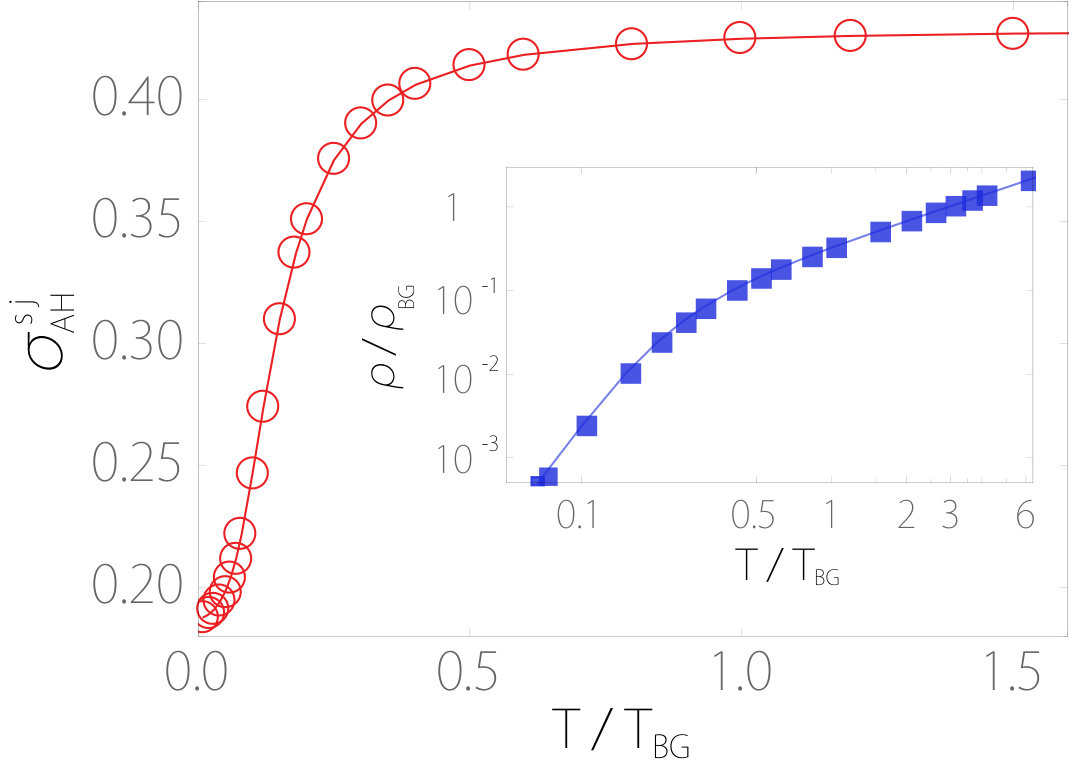 Figure 1
Peer Reviews
No public reviews on file for this paper yet. If you reviewed it on a platform where reviews are public (OpenReview, ICLR, NeurIPS, ICML), you can paste yours below so the community can read it here.
Videos
No videos yet. Explain this paper in a talk, walkthrough, or lecture? Add one.
Theory of phonon side jump contribution in Anomalous Hall transport
Cong Xiao
Department of Physics, The University of Texas at Austin, Austin, Texas 78712, USA
Ying Liu
Research Laboratory for Quantum Materials, Singapore University of Technology and Design, Singapore 487372, Singapore
Ming Xie
Department of Physics, The University of Texas at Austin, Austin, Texas 78712, USA
Shengyuan A. Yang
Research Laboratory for Quantum Materials, Singapore University of Technology and Design, Singapore 487372, Singapore
Qian Niu
Department of Physics, The University of Texas at Austin, Austin, Texas 78712, USA
Abstract
The role of electron-phonon scattering in finite-temperature anomalous Hall effect is still poorly understood. In this work, we present a Boltzmann theory for the side-jump contribution from electron-phonon scattering, which is derived from the microscopic quantum mechanical theory. We show that the resulting phonon side-jump conductivity generally approaches different limiting values in the high and low temperature limits, and hence can exhibit strong temperature dependence in the intermediate temperature regime. Our theory is amenable to treatment, which makes quantitative comparison between theoretical and experimental results possible.
I Introduction
Electron-phonon scattering plays a key role in electronic transport in crystalline solids Ziman1960 ; White1958 . For longitudinal transport, electron-phonon scattering limits the intrinsic mobility, and its effect can now be well evaluated via a combination of the first-principles band structure calculation and semiclassical Boltzmann approach AllenLOVA ; Li2015 ; Louie2016 ; GaAs ; MoS2 ; Kim2010 ; Mauri2014 ; Giustino2017 . However, its role in the anomalous Hall transport is much more subtle Tian2009 ; Nagaosa2010 ; Shitade2012 ; Ebert2013 ; Hou2015 ; Otani2019 ; Meng2016 ; Xia2017 , and a clear understanding has yet to be achieved.
Theoretical study of the anomalous Hall transport has been mostly performed with static impurities Nagaosa2010 . In the weak scattering regime, anomalous Hall conductivity is known to have three important contributions arising from different mechanisms in the semiclassical picture Sinitsyn2008 ; Sinitsyn2007 : intrinsic contribution from Berry curvatures in band structures Jungwirth2002 ; Yao2004 , side jump from electron coordinate shift during scattering Berger1970 ; Sinitsyn2006 , and skew scattering from the asymmetric part of the scattering rate Smit ; Borunda2007 . Particularly, side jump is a very peculiar contribution in that although it results from scattering, its value is found to be independent of the impurity concentration for static impurity scattering Berger1970 ; Nagaosa2010 ; Kovalev2010 ; Freimuth2011 .
Will phonon scattering be any different? Typically, the phonon energy scale () is much less than the Fermi energy , so the energy transfer in phonon scattering would be negligible. It seems that the phonon side jump contribution should be similar to that of static impurities, and hence it should be insensitive to temperature () Berger1970 ; Bruno2001 ; Dugaev2001 . This speculation has gained support from experiments performed at elevated temperatures where the longitudinal resistivity shows linear in dependence Dheer1967 ; Coleman1974 ; Miyasato2007 . Recently, researchers do realize that the side-jump from phonon and impurity scattering can be different, thereby the change of their relative importance with temperature can lead to -dependent behavior Yang2011 ; Hou2015 . However, the -independence of the phonon side-jump contribution alone has not been doubted.
In a very recent work Xiao2019 , it is realized that the phonon side jump contribution can indeed be -dependent. The key ingredient is the -dependent phonon occupation number, which makes the average momentum transfer, i.e., the effective range, of electron-phonon scattering -dependent. By analogy with the recently revealed sensitivity of the anomalous Hall conductivity to the scattering range of static random impurities Ado2017 , one can understand qualitatively the -dependence of phonon side jump.
However, we do not yet have a theory of phonon side jump with quantitative predictive power, accounting for the dynamical and inelastic nature of electron-phonon scattering. Here, we develop such a theory within the semiclassical Boltzmann framework. Surely, one may choose to construct a theory on a more fundamental level, with a fully quantum field theoretical treatment, and there were indeed a few attempts in the past Leribaux1966 ; Lyo1973 . Unfortunately, due to the complexity in modeling phonon scattering, such transport theories are extremely complicated, lacking physical transparency, and too difficult to be combined with calculations for real materials. In comparison, the semiclassical theory presented here enjoys the advantages of being physically intuitive and easily implementable with calculations. As an application of this theory, we show that the phonon side jump conductivity generally saturates to two different values in low and high temperature limits, and the strong -dependence naturally appears in the temperature regime in-between.
Our paper is organized as follows. In Sec. II we review the semiclassical theory for side jump from impurity scattering, and propose the new theory for phonon-induced side-jump in a heuristic way. In Sec. III, we present a general argument for the -dependence of phonon side jump conductivity. This -dependence is explicitly demonstrated in Sec. IV, by applying our theory to study the concrete massive Dirac model. Finally, in Sec. V, we discuss the possible experimental scheme to confirm our result and conclude this work. The detailed derivation of our theory is presented in the Appendix.
II Boltzmann theory for phonon side jump
We start by reviewing the theory for side jump induced by impurity scattering. The semiclassical nonequilibrium distribution function for electron wave-packets in phase space is governed by the Boltzmann equation:
[TABLE]
With a uniform dc electric field and in the steady state, the linearized equation takes the form of (set )
[TABLE]
Side jump refers to the coordinate shift of the electron wave-packet during scattering, for which Sinitsyn et al. have derived a general expression Sinitsyn2006 :
[TABLE]
where is the Berry connection, is the periodic part of the Bloch state, and is the scattering matrix element.
Due to this coordinate shift, the field does a nonzero work in scattering, which has to be accounted for in energy conservation Sinitsyn2008 . For static impurity scattering, one then has . Consequently, the equilibrium distribution no longer annihilate the collision term, because , and from the Boltzmann equation, this leads to an additional (anomalous) correction to the distribution function: , satisfying
[TABLE]
Thus, the out-of-equilibrium part of the distribution is
[TABLE]
where the terms with superscript refer to the “normal” contribution, satisfying Eq. (2b) without the side jump effect. Meanwhile, the side jump also corrects the electron velocity, which becomes
[TABLE]
Here, is the anomalous velocity induced by Berry curvature , and
[TABLE]
is called the side jump velocity. Applying the field in the direction, then the intrinsic anomalous Hall current is given by . The side jump induced Hall current, which is the focus of this paper, contains two terms to linear order in :
[TABLE]
Note that counting the order in relaxation time , , , , and , so both terms in are on the order of . For static impurities, the side jump contribution is independent of the impurity density as well as the scattering potential strength. The above semiclassical theory was shown to be consistent with fully quantum mechanical treatment for static impurities Sinitsyn2007 . Particularly, the side jump velocity in Eq. (7) was found to correspond to the scattering-induced band-off-diagonal elements of the out-of-equilibrium density matrix Sinitsyn2006 ; KL1957 ; Xiao2018KL .
Now let’s turn to phonon scattering. In the following, we present a heuristic argument for the theory. First of all, we note that Eqs. (2a) and (3) apply for dynamical disorder like phonons as well. Like before, the side jump leads to an additional work done by the field, modifying the relation between and , with
[TABLE]
where the last term indicates the absorption or emission of a phonon with mode label . Then the linearized Boltzmann equation becomes (details in Appendix A)
[TABLE]
where . Subtracting Eq. (2b) from Eq. (10) shows that the anomalous correction to the distribution due to side jump satisfies the equation
[TABLE]
Comparing Eq. (11) with Eq. (4) suggests that the proper definition for the phonon side jump velocity should be
[TABLE]
The above three equations are the main results of this paper. Here, the main difference between Eqs. (11,12) and Eqs. (4,7) is the appearance of the Pauli factor, which, as we have discussed before, reflects the dynamical character of phonon scattering. For static impurity scattering, the Pauli factor becomes unity, and the theory correctly recovers the familiar one. In metals the Pauli factor is important for acoustic phonons in the low- regime where is of the order of , thus the electronic occupancy and differ significantly. Whereas in semiconductor low-dimensional electron systems with small Fermi energy, the Pauli factor is also important for highly inelastic optical phonons Mauri2014 .
With the new definition of the side jump velocity in Eq. (12) and with solved from Eq. (11), the side jump current will still be calculated with Eq. (8). This completes our semiclassical theory for phonon side jump.
This theory, albeit seemingly simple and intuitive, is in fact nontrivial. Its justification requires tedious derivation from microscopic theories of coupled electron-phonon system. We have demonstrated that the theory can be derived from two different fundamental approaches: the density matrix equation of motion approach Argyres1961 and the Lyo-Holstein’s transport theory Lyo1973 ; Holstein1964 . The details are relegated to Appendices C and D.
III Temperature dependence of phonon side jump
As we have mentioned at the beginning, for , the common belief is that the phonon side jump Hall conductivity should be independent of the strength of disorder scattering (so its value remains the same even if the disorder density approaches zero), and hence it should have little dependence. As an application of our theory, we shall see that this naive conclusion is generally incorrect in the case where side jump arises from spin-orbit-coupled Bloch electrons scattered off phonons.
Consider the low- limit, which is specified by , where is the Debye temperature (Note that in this discussion, is always assumed to be the largest energy scale). For such case, the scattering is dominated by long wavelength acoustic phonons, which is short ranged in momentum space. Hence, the coordinate shift reduces to . From Eq. (11), we find that , whose contribution to the Hall conductivity (corresponding to ) is . Meanwhile, straightforward calculation of yields . Thus, the phonon side jump Hall conductivity in the low- limit can be put into a compact form of
[TABLE]
For two-dimensional systems, the Berry curvature has only -component , so the above result can be further simplified as
[TABLE]
In the high- limit with , we find that the major dependence comes from the scattering rate, which can be approximated as
[TABLE]
Here, we have written , with the plane-wave part of the electron-phonon scattering matrix element, and we have used the relation that in the high- limit, where is the Bose-Einstein distribution for the phonon mode . Hence in the high- limit, we have , , , and thus should saturate to a -independent constant value. Although we cannot write down a compact analytical expression for this limiting value (because of the complicated model-dependent interband scattering processes), it is clear that this value should generally be different from the low- limit value in Eq. (14). This analysis demonstrates that the phonon side jump conductivity approaches different values in the low- and high- limits, therefore pronounced dependence must exist in the intermediate range when the two limiting values differ by a significant amount.
IV Application to Massive Dirac model
In this section, we illustrate the above points by a concrete model calculation using our theory. We take the two-dimensional massive Dirac model
[TABLE]
which is considered as the minimal model for studying anomalous Hall effect. Here, and are model parameters, and the ’s are the Pauli matrices representing the two Dirac bands. Recalling that we work under the condition , hence, to proceed analytically, we neglect the phonon energy in the scattering, such that for the two electronic states before and after scattering Ziman1960 . We consider the metallic regime with low carrier density such that the Fermi surface is much smaller than the size of Brillouin zone. Thus the Umklapp process does not occur. We assume the scattering is dominated by acoustic phonons, and the electron-phonon coupling can be described by the deformation potentials (details in Appendix B). The coordinate shift for this model can be found as
[TABLE]
And straightforward calculation (see Appendix B for details) based on our theory leads to
[TABLE]
where the temperature dependence is dumped into the factor defined as , where is the transport relaxation time with
[TABLE]
is defined as
[TABLE]
and is the angle between and . In the low- and high- limits, we have respectively
[TABLE]
This demonstrates clearly that the phonon side jump contribution approaches different values in the low- and high- limits. This behavior is illustrated in Fig. 1, where the -dependence in the intermediate regime is obtained by assuming isotropic Debye spectrum ( is the sound velocity). The -dependence of the phonon side-jump contribution becomes apparent when . Note that in the same regime, one can show that the phonon-limited longitudinal resistivity also departs from the linear- scaling (see the inset of Fig. 1). Here is the Bloch-Gruneisen temperature, which marks the lower boundary of the high- equipartition regime () in two-dimensional metallic systems Kim2010 .
V Discussion and conclusion
We discuss the possible experimental scheme to confirm our result. The -band ferromagnetic transition metals such as Fe and Co offer suitable platforms, because their band splittings are much larger than room temperature, and the Curie temperatures are much higher than . It follows that the intrinsic Berry-curvature contribution to the anomalous Hall conductivity should be -insensitive up to room temperature. In order to observe the electron-phonon dominated behavior at lower temperatures (where deviates from the linear-in- scaling), one needs to work with high-purity samples (the resistance ratio should be at least 100), which are experimentally accessible White1958 . The skew scattering contribution due to non-Gaussian impurity correlations should be first subtracted from the data. This can be done by using the recently developed thin-film approach Hou2015 ; Yue2017 . In this approach one can limit the scattering of electrons to two main sources — the interface roughness and phonons, and achieve independent control of each one by tuning the film thickness and the temperature Yue2017 . The aforementioned skew scattering Hall conductivity in this case is given by , where is the residual resistivity, and is a system-specific parameter independent of film thickness that can be determined by tuning film thickness in the low- regime Hou2015 . After subtracting the skew scattering contribution, one can verify the -dependence of the side-jump conductivity predicted here. Quantitatively, one can further subtract the -insensitive intrinsic contribution obtained from method Yao2004 , and then compare the remaining to the phonon side-jump Hall conductivity yielded by the Boltzmann approach based on our result.
In conclusion, we have proposed a semiclassical Boltzmann theory for the phonon side jump contribution in the anomalous Hall effect. This intuitive theory has been derived from microscopic quantum mechanical transport theories of coupled electron-phonon systems. We demonstrate that the phonon side jump anomalous Hall conductivity can generally be temperature-dependent, which disproves the previous common belief that this contribution is -independent. The possible experimental scheme to confirm our result has been discussed. The proposed Boltzmann formalism can be easily implementable with calculations, making quantitative comparison between theoretical and experimental results possible.
Acknowledgements.
We thank Yi Liu and Liang Dong for helpful discussions. Q.N. is supported by DOE (DE-FG03-02ER45958, Division of Materials Science and Engineering) on the semiclassical formulation of this work. C.X. is supported by NSF (EFMA-1641101) and Welch Foundation (F-1255). M.X. is supported by the Welch Foundation under grant TBF1473. Y.L. and S.A.Y. are supported by Singapore Ministry of Education AcRF Tier 2 (MOE2017-T2-2-108).
C. X. and Y. L. contributed equally to this work.
Appendix A Heuristic argument for the side jump in the Bloch-Boltzmann
equation
In the presence of a dc weak uniform electric field and weak static disorder, the conventional Boltzmann equation for charge carriers (charge ) in nonequilibrium steady state reads Ziman1960
[TABLE]
In the case of static disorder there is no room KL1957 for the Pauli blocking factors and , which were introduced into the collision term of the Boltzmann equation phenomenologically by F. Bloch when studying phonon-limited mobility in metals in order to ensure the equilibrium Fermi distribution (rather than Bose or Boltzmann distributions) for Allen1978 . In the case of dynamical disorder such as phonons, the Bloch-Boltzmann equation takes the form of Eq. (2a), where and are calculated in the quantum mechanical perturbation theory. The collision term is considered only in the linear response regime. To the lowest order in Born expansion, the principle of microscopic detailed balance holds, as can be directly verified for electron-phonon scattering. Thus , and the Bloch-Boltzmann equation reads
[TABLE]
The argument about introducing the coordinate-shift into this equation is similar to that in the case of static disorder, but is a little more involved because appears in both the scattering-in and scattering-out terms. In the scattering-out term () of Eq. (23), the kinetic energy of an electron in state after scattering out of state via absorbing (emitting) a phonon is . In the scattering-in term (), the kinetic energy of an electron in state before scattering into state via emitting (absorbing) a phonon is . Thus in the linear response regime (), we have
[TABLE]
where is the out-of-equilibrium distribution. On the right hand side of the last equality the first term is zero, and other two terms can be simplified, leading to the following modified Bloch-Boltzmann equation
[TABLE]
By expressing , we arrive at Eq. (10) in the main text.
Appendix B Calculation details in the 2D massive Dirac model
In the two-dimensional massive Dirac model, is the Berry-curvature in the positive band. Thus the side-jump velocity and the anomalous distribution are given by
[TABLE]
By using the identity
[TABLE]
the slight inelasticity of acoustic phonon scattering renders
[TABLE]
where . Thus
[TABLE]
where
[TABLE]
and is the so-called electron-phonon coupling constant for the deformation-potential treatment of the electron-phonon coupling Abrikosov ; Kim2010 : .
In the high- regime is uniformly distributed on the Fermi circle, and drops out of both the numerator and denominator of , thus takes the same -independent value similar to that due to scalar zero-range impurities. While at low temperatures the temperature dependence of influences the integrals in , and becomes -dependent. In the low- limit is highly peaked around hence , and coincides with that due to long-range scalar-impurities Xiao2007 .
Appendix C Generalized Bloch-Boltzmann formalism from the density matrix
approach
To prove the validity of Eqs. (10) – (12) in the main text, in the following two sections, we provide the microscopic foundation for the Boltzmann formalism in weakly coupled electron-phonon systems. Firstly, the density-matrix equation-of-motion approach KL1957 ; Xiao2018KL is applied to the many-particle density matrix for the whole electron-phonon system Argyres1961 . The quantum Liouville equation is analyzed in the occupation number representation perturbatively with respect to the coupling parameter. Aside from the usual assumption that the phonon system remains approximately in thermal equilibrium Ziman1960 ; Holstein1964 ; Allen1978 , a basic statistical assumption is needed, which is analogous to the assumption of molecular chaos made in deriving the classical Boltzmann equation from the classical Liouville equation Kardar . We also show that the side jump contribution is connected to the scattering-induced interband-coherence responses in the microscopic transport theory, similar to the case of static disorder Sinitsyn2008 ; Sinitsyn2006 . This clearly goes beyond the relaxation time treatment where the effect of phonons is embodied only in an inelastic lifetime of electrons Shitade2012 .
For discussing problems in a quantum many-particle system, the second quantized formalism is a common starting point. We introduce the notation to denote the representation of an operator in the second-quantized formalism. For a single-particle operator, i.e., where depends only on the dynamical variables of the -th carrier, we write where is the corresponding matrix elements in the representation, and are the creation and annihilation operators for the single-electron state . The original version of Kohn-Luttinger density-matrix approach KL1957 rests on the existence of a single-electron Hamiltonian which contains all the information in the case of independent electrons interacting with static disorder. In the case of dynamical disorder such as phonons and magnons, as first pointed out by Argyres Argyres1961 , one can apply the Kohn-Luttinger treatment to the many-body density matrix in the occupation number representation for the whole system. Such a total Hamiltonian reads
[TABLE]
where is the electron Hamiltonian in the absence of external electric fields and scattering, and is the external-electric-field perturbation with () turned on adiabatically from the remote past. The electric field is turned on much more slowly than the scattering time () KL1957 ; Moore1967 . is the Hamiltonian of the scattering system, and is the interaction of electrons with the scattering system, where is a dimensionless parameter used for analyzing the order in the perturbative analysis and is set to 1 eventually. is still an operator in the Hilbert space of the scattering system. In the occupation number representation , and . Hereafter we set , and are the many-particle state indices for the electron system and scattering system, respectively. , and its eigenvalue denotes the electron number on the Bloch state marked by the index with single-electron eigenenergy . In the linear response regime the total many-particle density matrix reads
[TABLE]
where is the equilibrium many-particle density matrix for the whole system, and is linear in the electric field. The quantum Liouville equation
[TABLE]
becomes In the occupation number representation one has
[TABLE]
where . Hereafter we sometimes use the notation , to simplify expressions.
The linear response of an observable is where Tr denotes the trace operation in the occupation-number space, and the notation means that all the index equalities in the summation are avoided. Here we first outline the main results of the following detailed derivation. The linear response of the velocity of electrons is
[TABLE]
To obtain and in the weakly coupled system we make a perturbative analysis of Eq. (34) with respect to the coupling parameter. The off-diagonal elements can be expressed in terms of the diagonal ones , resulting in an equation for . Because by definition Tr and
[TABLE]
we derive the modified Bloch-Boltzmann equation (10) of the main text based on the equation for . According to Eq. (36) one has
[TABLE]
Whereas is proven to yield the transport contributions from the Berry-curvature anomalous velocity and the side-jump velocity:
[TABLE]
where is given by Eq. (3) of the main text. We also show that the side-jump velocity arises from scattering-induced interband-coherence, so does the anomalous distribution function (Eqs. (11) and (12)).
C.1 Perturbative analysis of the quantum Liouville equation
We split the quantum Liouville equation into diagonal and off-diagonal parts in the -representation:
[TABLE]
for , and
[TABLE]
According to the spirit of the Boltzmann theory, the first-order energy shift is incorporated into the renormalization of the band energy and henceforth neglected KL1957 ; Xiao2018KL . To solve these two equations in the weak coupling regime we make the standard order-by-order analysis with respect to the coupling parameter of the interaction with disorder:
[TABLE]
Hereafter the superscript denotes the order in .
For Eq. (39) one can obtain: in
[TABLE]
in
[TABLE]
in
[TABLE]
For Eq. (39) one can obtain: in
[TABLE]
in
[TABLE]
in
[TABLE]
For simplicity we assume the bosonic quasi-particles of the dynamical scattering systems, e.g., phonons and/or magnons, can be approximately thought to be in thermal equilibrium. Although this standard assumption after F. Bloch Ziman1960 can only be clearly justified at high temperatures, it was shown to work well in many cases beyond that regime Ziman1960 ; Sarma1992 ; Kim2010 . Here we adopt it to simplify the derivation (which is still quite tedious even after making this assumption).
The off-diagonal (with respect to ) elements can be expressed in terms of the diagonal ones , and are related to the diagonal (in the single-electron Bloch representation) elements of the single-electron density matrix (Eq. (36)). Thus the Bloch-Boltzmann theory formulated in the single-electron Bloch representation can be derived from the microscopic transport theory presented in the occupation number representation.
C.2 Perturbative calculation of
Applying the Karplus-Schwinger expansion Karplus1948
[TABLE]
up to the second order of one can calculate the equilibrium density matrix (, ) in weakly coupled systems. The partition function is given by , where and . We have ()
[TABLE]
then
[TABLE]
Next we look at
[TABLE]
There are so many terms that one should have some guiding principle to simplify the analysis. According to the insight we obtained in the discussion of static-disorder case Xiao2018KL , some trivial renormalization effects can be neglected and only the diagonal (in the Bloch representation for electrons) elements of electric-field perturbation survive in the final contribution to , which appears in the following Eq. (64) as an anomalous driving term KL1957 ; Xiao2018KL . Thus, we obtain
[TABLE]
where , and . Meanwhile the anomalous driving term that will appear in Eq. (64)
[TABLE]
only contains nontrivial correction to the driving term of the transport equation with given by Eq. (50). One can verify that . Henceforth . In the above derivation we used for and .
C.3 Conventional Bloch-Boltzmann equation
In the zeroth order of electron-disorder interaction one has
[TABLE]
with . Then
[TABLE]
where
[TABLE]
and
[TABLE]
In the derivation one uses
[TABLE]
Thus we obtain Argyres1961
[TABLE]
where . Since the bosonic quasi-particles of the dynamical scattering systems (e.g., phonons or magnons) are assumed to remain in equilibrium, we introduce the following assumption for factorizing the entire many-particle density matrix Argyres1961 :
[TABLE]
then
[TABLE]
where
[TABLE]
Now one has to introduce another basic statistical assumption, i.e.,
[TABLE]
which is analogous to the assumption of molecular chaos introduced in deriving the classical Boltzmann equation from the classical Liouville equation (BBGKY hierarchy) Kardar . Therefore, under the assumptions (57) and (59) one arrives at the Boltzmann equation for :
[TABLE]
which is just the linearized Bloch-Boltzmann equation. Utilizing the microscopic detailed balance that can be verified directly in the lowest order perturbation theory, one has
[TABLE]
and ()
[TABLE]
thus
[TABLE]
which is just the practical form of the Bloch-Boltzmann equation, i.e., Eq. (2b) in the main text (note that and ).
In the case of static disorder, the conventional skew scattering appears in the Boltzmann equation in the first order of disorder potential Sinitsyn2008 . The harmonic approximation is assumed for the scattering system, then one has , and . Thus and . This leads to vanishing conventional skew scattering due to phonons, as pointed out in Refs. Bruno2001 ; Hou2015 ; Lyo1973 and experimentally confirmed in Refs. Hou2015 ; Tian2009 .
C.4 Anomalous distribution function
In the second order of disorder potential the transport equation for can be decomposed into
[TABLE]
and , where and is given by Eq. (51). Here we only analyze the equation for , yielding the anomalous distribution that is related to the side jump effect. is related to the so-called intrinsic skew scattering, which is not likely to have an intuitive generic description in the case of dynamical disorder Lyo1973 .
Utilizing
[TABLE]
and Eq. (55) and similar techniques to those in deriving the conventional Bloch-Boltzmann equation, we get
[TABLE]
Notice because the the quanta of the scattering system is boson, and , we obtain
[TABLE]
By Eq. (61), we obtain
[TABLE]
Then we treat the collision term by employing the basic assumption
[TABLE]
and the “assumption of molecular chaos”
[TABLE]
yielding the Boltzmann equation for :
[TABLE]
Utilizing Eqs. (61) and (62), we get
[TABLE]
This is exactly the same Boltzmann equation for the anomalous distribution function as we obtained via phenomenological arguments in the main text.
C.5 Berry curvature anomalous velocity and side-jump velocity
For the observables of interest, is diagonal with respect to , hence does not contribute to the off-diagonal response, and the off-diagonal response is equal to
[TABLE]
where
[TABLE]
is the intrinsic part, whereas
[TABLE]
is the disorder-dependent part.
C.5.1 Intrinsic contribution: electric-field induced
interband-coherence
Due to Eqs. (49) and (55), we have ()
[TABLE]
where we used . Notice that for fermions
[TABLE]
we get
[TABLE]
where . This is just the intrinsic contribution to linear response with respect to the uniform and time-independent electric field. Here we use for , and is just the intrinsic correction to in the semiclassical Boltzmann formulation Xiao2017SOT-SBE . In the case of , is the Berry-curvature anomalous velocity.
C.5.2 Side-jump velocity: scattering-induced interband-coherence
Now we analyze . Here
[TABLE]
since and then and thus . Using
[TABLE]
we get
[TABLE]
where we have applied the assumption (57). In the case of , thus
[TABLE]
The reason for writing the last term in this form will be clear soon. Thus we get
[TABLE]
Besides, we have
[TABLE]
In the case of , thus
[TABLE]
Together with Eq. (75), we obtain (the term is neglected as trivial renormalization effect, as in Ref. Xiao2017SOT-SBE )
[TABLE]
which is equal to
[TABLE]
Here we used and .
Summarizing, in the case of we get
[TABLE]
where we have used Eqs. (58) and (61) as well as the two statistical assumptions (57) and (59), and applied the techniques used in Appendix A of Ref. Xiao2017SOT-SBE . This result confirms our heuristic argument on the “proper definition” of the semiclassical side-jump velocity in the case of dynamical disorder in the main text (note that and ).
Similar to the case of static disorder, the interband-coherence nature of and thus that of the anomalous distribution function are not quite obvious when is expressed in terms of Xiao2017SOT-SBE ; Xiao2018KL . Therefore, in the following we provide some more information about scattering-induced interband-coherence response when is not necessarily the current Xiao2017SOT-SBE ; Xiao2018KL . In the following derivation the interband-coherence nature of is apparent. In general cases of , we have
[TABLE]
and
[TABLE]
thus by some permutation of indices we get
[TABLE]
i.e., with
[TABLE]
From the interband matrix elements and (the momenta of the two states denoted by the subscripts are equal) one can see that the interband-coherence plays a role in both terms.
For static impurities, the state of the scattering system remains unchanged thus , and
[TABLE]
is just the average over the disorder configurations. Therefore, after some algebra we obtain
[TABLE]
which just reproduces the result obtained in the single-particle T-matrix formalism in the case of static disorder Xiao2017SOT-SBE ; Xiao2018KL .
Appendix D Generalized Bloch-Boltzmann formalism from the Lyo-Holstein transport theory
The Lyo-Holstein theory Lyo1973 ; Holstein1964 takes into account the many-body effects in weakly-coupled electron-phonon systems. Lyo Lyo1973 split the electron coordinate operator into intra-cell and inter-cell parts and considered separately the resulting four components of the velocity-velocity correlation function. The theory thus contains some non-gauge-invariant quantities which are difficult to interpret. Partly because of these complications, the theory has not found wide applications. The main theoretical results of Lyo are his Eqs. (3.39) and (3.43). The latter representing the crossed part of intrinsic skew scattering appears in the third Born order and is too complicated to be applicable in practice. We focus on Lyo’s Eq. (3.39), which contains the contents of Lyo’s Eqs. (3.25) – (3.27), (3.37) and (3.38). We show that, Lyo’s Eq. (3.39) includes the intrinsic and side jump anomalous Hall conductivities. The proof of the equivalence are outlined as the following four steps:
Lyo’s transport equation (3.27) is our Eq. (2b) in the main text for , i.e., the conventional Bloch-Boltzmann equation.
The opposite of the anomalous velocity defined by Lyo’s Eq. (3.26) is the last term of our side-jump velocity:
[TABLE]
Here is the electron-phonon scattering rate taking the same form as the lowest-Born-order expression in the density matrix approach, but with all the quantities renormalized by many-body effects (RPA-type renormalizations). For example, is proportional to with the renormalized electron-phonon coupling . But Lyo’s anomalous velocity is not gauge invariant (under the gauge transformation ).
Lyo’s transport equation (3.37) corresponds to our Eq. (11) in the main text for the anomalous distribution function , but has a different form
[TABLE]
because Lyo defined his transport function as
[TABLE]
with the Berry connection. The so-defined transport function is not gauge invariant and not a real distribution function.
Combining , we recognize that Lyo’s Eqs. (3.25) and (3.38), whose sum gives his (3.39), take the following form in our notations:
[TABLE]
[TABLE]
Both of them are gauge dependent. But we show that the sum of them is gauge invariant. In fact we show
[TABLE]
and
[TABLE]
thus
[TABLE]
As an example we provide the derivation of Eq. (86):
[TABLE]
where the interchange of and is used in the first step and the conventional Bloch-Boltzmann equation of the main text is used in the last step.
The reference list from the paper itself. Each links out to its DOI / PubMed record.
- 1(1) J. M. Ziman, Electrons and Phonons (Clarendon, Oxford, 1960).
- 2(2) G. K. White and S. B. Woods, Phil. Trans. Roy. Soc. (London) A 251 , 273 (1958).
- 3(3) F. Giustino, Rev. Mod. Phys. 89 , 015003 (2017); S. Ponce, E. R. Margine, and F. Giustino, Phys. Rev. B 97 , 121201(R) (2018).
- 4(4) P. B. Allen, Phys. Rev. B 17 , 3725 (1978); S. Y. Savrasov and D. Y. Savrasov, Phys. Rev. B 54 , 16487 (1996); R. Bauer, A. Schmid, P. Pavone, and D. Strauch, Phys. Rev. B 57 , 11276 (1998).
- 5(5) J. I. Mustafa, M. Bernardi, J. B. Neaton, and S. G. Louie, Phys. Rev. B 94 , 155105 (2016).
- 6(6) W. Li, Phys. Rev. B 92 , 075405 (2015).
- 7(7) J.-J. Zhou and M. Bernardi, Phys. Rev. B 94 , 201201(R) (2016); T.-H. Liu, J. Zhou, B. Liao, D. J. Singh, and G. Chen, Phys. Rev. B 95 , 075206 (2017); J. Ma, A. S. Nissimagoudar, and W. Li, Phys. Rev. B 97 , 045201 (2018).
- 8(8) K. Kaasbjerg, K. S. Thygesen, and K.W. Jacobsen, Phys. Rev. B 85, 115317 (2012); T. Gunst, T. Markussen, K. Stokbro, and M. Brandbyge, Phys. Rev. B 93 , 035414 (2016); B. Liao, J. Zhou, B. Qiu, M. S. Dresselhaus, and G. Chen, Phys. Rev. B 91 , 235419 (2015).