Structure and classification of Hom-associative algebras.
Ahmed Zahari
Université de Haute Alsace, IRIMAS-département de Mathématiques,
6, rue des Frères Lumière F-68093 Mulhouse, France
[email protected]
and
Abdenacer Makhlouf
Université de Haute Alsace, IRIMAS-département de Mathématiques,
6, rue des Frères Lumière F-68093 Mulhouse, France
[email protected]
Abstract.
The purpose of this paper is to study the structure and the algebraic varieties of Hom-associative algebras. We give characterize multiplicative simple Hom-associative algebras and show some examples deforming the 2×2-matrix algebra to simple Hom-associative algebras. We provide a classification of n-dimensional Hom-associative algebras for n≤3. Then study their derivations and compute small Hom-Type Hochschild cohomology groups. Furthermore, we discuss their irreducible components.
Key words and phrases:
Hom-associative algebra, simple Hom-associative algebra, classification, cohomology, irreducible component.
Mathematics Subject Classification:
Introduction
The first motivation to study nonassociative Hom-algebras came from quasi-deformations of Lie algebras of vector fields, in particular q-deformations of Witt and Virasoro algebras. The deformed algebras arising when replacing usual derivation by a σ-derivations are no longer Lie algebras. It was observed in the pioneering works, mainly by physicists, that in these examples a twisted Jacobi identity holds. Motivated by these examples and their generalization on the one hand, and the desire to be able to treat within the same framework such well-known generalizations of Lie algebras as the color and Lie superalgebras on the other hand, quasi-Lie algebras and subclasses of quasi-hom-Lie algebras and hom-Lie algebras were introduced by Hartwig, Larsson and Silvestrov in [6, 7].
The Hom-associative algebras play the role of associative algebras in the Hom-Lie setting. They were introduced by the second author and Silvestrov in [11]. Usual functors between the categories of Lie algebras and associative algebras were extended to Hom-setting, see [15] for the construction of the enveloping algebra of a Hom-Lie algebra.
A Hom-associative algebra (A,μ,α) is consisting of a vector space, a multiplication and a linear self map; It may be viewed as a deformation of an associative algebra, in which the associativity condition is twisted by a linear map α and such that when α=id, the Hom-associative algebra degenerates to exactly an associative algebra.
We aim in this paper to study the structure of Hom-associative algebras. We give a characterization of multiplicative simple Hom-associative algebras and show some examples deforming the 2×2-matrix algebra to simple Hom-associative algebras. Moreover we compute some invariants and discuss irreducible components of the corresponding algebraic varieties.
Let A be an n-dimensional K-linear space and {e1,e2,⋯,en} be a basis of A. A Hom-algebra structure on A with product μ is determined by n3 structure constants
Cijk, were μ(ei,ej)=∑k=1nCijkek and by α which is identified by n2 structure constants
aij, where α(ei)=∑j=1najiej. Requiring the algebra structure to be Hom-associative and unital gives rise to sub-variety HAssn (resp. UHAssn) of kn3+n2. Base changes in A result in the natural transport of structure action of GLn(K) on HAssn. Thus isomorphism classes of n-dimensional Hom-algebras are one-to-one correspondence with the orbits of the action of GLn(K) on HAssn. The decomposition of HAssn into irreducible components with respect to Zariski topology is called the geometric classification of n-dimensional algebras.
The paper is organized as follows. In the first section we give the basics about Hom-associative algebras and provide some new properties. Moreover, we discuss unital Hom-associative algebras. Section 2 deals with simple multiplicative Hom-associative algebras. We present one of the main results of this paper, that is a characterization of simple multiplicative Hom-associative algebras. Indeed, we show that they are all obtained by twistings of simple associative algebras. Moreover, we give all simple Hom-associative algebras, which are related to 2×2 matrix algebra. Section 3 is dedicated to describe algebraic varieties of Hom-associative algebras and provide classification, up to isomorphism, of 2-dimensional and 3-dimensional Hom-associative algebras. In Section 4, we study their derivations and twisted derivations, whereas in Section 5, we compute their Hom-type Hochschild cohomology. In the last section, we consider the geometric classification problem, using one-parameter formel deformations, and describe the irreducible components.
1. Structure of Hom-associative algebras
Let K be an algebraically closed field of characteristic [math], A be a linear space over K. We refer to a Hom-algebra by a triple (A,μ,α), where μ:A×A→A is a bilinear map (multiplication) and α is a homomorphism of A (twist map).
1.1. Definitions
Definition 1.1**.**
[11].
A Hom-associative algebra is a triple (A,μ,α) consisting of a linear space A, a bilinear map μ:A×A→A and
a linear space homomorphism α:A→A satisfying
[TABLE]
Usually such a Hom-associative algebras are called multiplicative. Since we are dealing only with multiplicative Hom-associative algebras, we shall call them Hom-associative algebras for simplicity.
We denote the set of all Hom-associative algebras by HAss.
In the language of Hopf algebras, the multiplication of a Hom-associative algebra over A consists of a linear map μ:A⊗A→A and Condition (1.1) writes
μ(α(x)⊗μ(y⊗z))=μ(μ(x⊗y)⊗α(z)).
Definition 1.2**.**
A unital Hom-associative algebra is given by a quadruple (A,μ,α,u), where u∈A, such that
- ∙
(A,μ,α) is a Hom-associative algebra,
2. ∙
μ(x,u)=μ(u,x)=α(x)∀x∈A,
3. ∙
α(u)=u.
Definition 1.3**.**
Let (A1,μ1,α1) and (A2,μ2,α2) be two Hom-associative algebras (resp. unital Hom-associative algebras with u1,u2 the units). A linear map φ:A1→A2 is called
a Hom-associative algebras morphism if
[TABLE]
and φ(u1)=u2 for unital algebras.
In particular, Hom-associative algebras (A1,μ1,α1) and (A2,μ2,α2) are isomorphic if φ is also bijective.
1.2. Structure of Hom-associative algebras
We state in this section some properties on the structure of Hom-associative algebras which are not necessarily multiplicative.
Proposition 1.4** ([14]).**
Let (A,μ,α) be a Hom-associative algebra and β:A→A be a Hom-associative algebra morphism. Then (A,βμ,βα) is a
Hom-associative algebra. In particular, if (A,μ) is an associative algebra and β is an algebra morphism, then
(A,βμ,β) is a Hom-associative algebra.
Definition 1.5**.**
Let (A,μ,α) be a Hom-associative algebra. If there is an associative algebra (A,μ′) such that μ(x,y)=αμ′(x,y),∀x,y∈A, we say that (A,μ,α) is of associative type and (A,μ′) is its compatible associative algebra or the untwist of (A,μ,α).
Corollary 1.6**.**
Let (A,μ,α) be a multiplicative Hom-associative algebra where α is invertible then (A,μ′=α−1∘μ)
is an associative algebra and α is an automorphism with respect to μ′. Hence, (A,μ,α) is of associative type and (A,μ′=α−1∘μ) is its compatible associative algebra.
Proof.
We prove that (A,α−1∘μ) is an associative algebra. Indeed,
[TABLE]
Moreover, α is an automorphism with respect to μ′. Indeed,
[TABLE]
∎
Remark 1.7*.*
Notice that if α is not invertible, assuming μ=αμ~ leads to
[TABLE]
which means that μ~ is associative up to α2.
Proposition 1.8**.**
Let (A1,μ1,α1) and (A2,μ2,α2) be two Hom-associative algebras and ϕ:A1→A2 be an invertible Hom-associative algebra morphism. If (A1,μ1,α1) is of associative type and (A1,μ1′) is its compatible associative algebra then (A2,μ2,α2) is of associative type with compatible associative algebra
(A2,μ2′=ϕ∘μ1∘(ϕ−1⊗ϕ−1)) such that ϕ:(A1,μ1′)→(A2,μ2′) is an algebra morphism.
Proof.
Because ϕ is a homomorphism from (A1,μ1,α1) to (A2,μ2,α2), then
α2ϕ=ϕα1,∀x,y∈A, ϕ defines μ2 by μ2(ϕ(x),ϕ(y))=ϕμ1(x,y). It is easy to
check that (A2,μ2) is an associative algebra. Furthermore
[TABLE]
We show that μ2 is an associative algebra such that μ2(u,v)=ϕ∘μ1(ϕ−1(u),ϕ−1(v)) with
x=ϕ−1(u),y=ϕ−1(v) and z=ϕ−1(w) for all x,y,z∈A.
[TABLE]
Hence, (A2,μ2) is an associative algebra.
∎
Proposition 1.9**.**
*Let (A,μ,α) be a n-dimensional Hom-associative algebra and ϕ:A→A be an invertible linear map. Then there is an
isomorphism with a n-dimensional Hom-associative algebra (A,μ′,ϕαϕ−1) where
μ′=ϕ∘μ∘(ϕ−1⊗ϕ−1). Furthermore, if {Cijk} are the structure constants of μ with
respect to the basis {e1,…,en}, then μ′ has the same structure constants with respect to the basis
{ϕ(e1),…,ϕ(en)} when ϕ(ep)=∑k=1nakpek.*
Proof.
We prove for any invertible linear map ϕ:A→A,(A,μ′,ϕαϕ−1) is a Hom-associative algebra.
[TABLE]
So (A,μ′,ϕαϕ−1) is a Hom-associative algebra.
It is also multiplicative. Indeed,
[TABLE]
Therefore ϕ:(A,μ,α)→(A,μ′,ϕαϕ−1) is a Hom-associative algebras morphism, since
ϕ∘μ=ϕ∘μ∘(ϕ−1⊗ϕ−1)∘(ϕ⊗ϕ)=μ′∘(ϕ⊗ϕ) and
(ϕαϕ−1)∘ϕ=ϕ∘α.
It is easy to see that
{ϕ(ei),⋯,ϕ(en)} is a basis of A. For i,j=1,⋯,n, we have
\begin{array}[]{ll}\mu_{2}(\phi(e_{i}),\phi(e_{j}))&=\phi\mu_{1}(\phi^{-1}(e_{i}),\phi^{-1}(e_{j}))=\phi\mu(e_{i},e_{j})=\sum_{k=1}^{n}\mathcal{C}^{k}_{ij}\phi(e_{k}).\end{array}
∎
Remark 1.10*.*
A Hom-associative algebra (A,μ,α) is isomorphic to an associative algebra if and only if α=id. Indeed,
ϕ∘αϕ−1=id is equivalent to α=id.
Remark 1.11*.*
Proposition 1.9 is useful to make a classification of Hom-associative algebras. Indeed, we have to consider the class of morphisms which are conjugate. Representations of these classes are given by Jordan forms of the matrices corresponding to the morphisms.
Any n×n matrix over K is equivalent, up to basis change, to a Jordan canonical form, then we choose ϕ such that the matrix of ϕαϕ−1=γ, where γ is a Jordan canonical form.
Hence, to obtain the classification, we consider only Jordan forms for the structure map of Hom-associative algebras.
Proposition 1.12**.**
Let (A,μ,α) be a Hom-associative algebra. Let (A,μ′,ϕαϕ−1) be its isomorphic Hom-associative algebra described
in Proposition 1.9. If ψ is an automorphism of (A,μ,α), then ϕψϕ−1 is an automorphism of
(A,μ,ϕαϕ−1).
Proof.
Note that γ=ϕαϕ−1. We have
ϕψϕ−1γ=ϕψϕ−1ϕαϕ−1=ϕψαϕ−1=ϕαψϕ−1=ϕαϕ−1ϕψϕ−1=γϕψϕ−1.
For any x,y∈A,
[TABLE]
By Definition, ϕψϕ−1 is an automorphism of (A,μ′,ϕαϕ−1).
∎
The following characterization was given for Hom-Lie algebras in [13].
Proposition 1.13**.**
Given two Hom-associative algebras (A,μA,α) and (B,μB,β), there is a Hom-associative algebra
(A⊕B,μA⊕B,α+β), where the bilinear map
μA⊕B(.,.):(A⊕B)×(A⊕B)→(A⊕B) is given by
[TABLE]
and the linear map
(α+β):A⊕B→A⊕B is given by
[TABLE]
Proof.
For any ai∈A,bi∈B, by direct computation, we get
[TABLE]
This ends the proof.
∎
A Hom-associative algebra morphism
ϕ:(A,μA,α)→(B,μB,β) is a linear map ϕ:A→B such that
ϕ∘μA(a,b)=μB∘(ϕ(a),ϕ(b)),∀a,b∈A,ϕ∘α=β∘ϕ.
Denote by ξϕ⊂A⊕B, the graph of linear map ϕ:A→B.
Proposition 1.14**.**
A linear map ϕ:(A,μA,α)→(B,μB,β) is a Hom-associative algebra morphism if and only if the graph
ξϕ⊂A⊕B is a Hom-associative subalgebra of (A⊕B,μA⊕B,α+β).
Proof.
Let ϕ:(A,μA,α)→(B,μB,β) be a Hom-associative algebra morphism. Then for any a,b∈A, we have
[TABLE]
Thus the graph ξϕ is closed under the product μA⊕B. Furthermore, since ϕ∘α=β∘ϕ we have
[TABLE]
which implies that
(α+β)⊂ξϕ. Thus ξϕ is a Hom-associative subalgebra of (A⊕B,μA⊕B,α+β).
Conversely, if the graph ξϕ⊂A⊕B is a Hom-associative subalgebra of (A⊕B,μA⊕B,α+β), then we have
[TABLE]
which implies that
μB(ϕ(a),ϕ(b))=ϕ∘μA(a,b). Furthermore, (α+β)(ξϕ)⊂ξϕ yields that
[TABLE]
which is equivalent to the condition
β∘ϕ(a)=ϕ∘α(a). Therefore, ϕ is a Hom-associative algebra morphism.
∎
1.3. Unital Hom-associative algebras
In this section we discuss unital Hom-associative algebras. We denote by UHAssn the set of n-dimensional unital Hom-associative algebras.
Proposition 1.15**.**
Let (A,μ,α) be a Hom-associative algebra. We set A~=span(A,u) the vector space generated by elements of
A and u. Assume μ(x,u)=μ(u,x)=α(x),∀x∈A and α(u)=u. Then (A~,μ,α,u) is a unital
Hom-associative algebra.
Proof.
It is straightforward to check the Hom-associativity. For example
\begin{array}[]{ll}\mu(\mu(x,y),\alpha(u))=\mu(\mu(x,y),u)=\alpha(\mu(x,y))=\mu(\alpha(x),\alpha(y))=\mu(\alpha(x),\mu(y,u)).\end{array}
∎
Remark 1.16*.*
Some unital Hom-associative algebras cannot be obtained as an extension of a non-unital Hom-associative algebra.
Remark 1.17*.*
Let (A,μ,α,u) be a n-dimensional unital Hom-associative algebra and ϕ:A→A be an invertible linear map
such that ϕ(u)=u. Then it is isomorphic to a n-dimensional Hom-associative algebra (A,μ′,ϕαϕ−1,u) where
μ′=ϕ∘μ∘(ϕ−1⊗ϕ−1). Moreover, if {Cijk} are the structure constants of μ with respect to the basis {e1,…,en} with e1=u being the unit, then μ′ has the same structure constants with respect to the basis
{ϕ(e1),…,ϕ(en)} with u the unit element.
Indeed, we use Proposition 1.9 and Definition 1.2. The unit is conserved since
μ′(x,e1)=ϕ∘μ(ϕ−1(x),ϕ−1(e1))=ϕ∘α∘ϕ−1(x).
Proposition 1.18**.**
Let (A1,μ1,α1,u1) and (A2,μ2,α2,u2) be two unital Hom-associative algebras. Suppose there exists a Hom-associative algebra morphism ϕ:A1→A2 with ϕ(u1)=u2. If (A1,μ1′,u1′) is an untwist of (A1,μ1,α1,u1) then there exists an untwist of (A2,μ2,α2,u2) such that ϕ:(A1,μ1′,u1′)→(A2,μ2′,u2′) is an algebra morphism.
Proof.
Since ϕ is a homomorphism from (A1,μ1,α1,u1) to (A2,μ2,α2,u2), then
α2ϕ=ϕα1, and for all x∈A we have μ2(ϕ(x),ϕ(u1))=μ2(ϕ(x),u2)=α2∘ϕ(x) and
ϕ∘μ1(x,u1)=ϕ∘α1(x). By Proposition 1.8, we can see that (A2,μ2,u2) is also an associative algebra.
Furthermore
\begin{array}[]{ll}\mu^{\prime}_{2}(\phi(x),\phi(u_{1}))=\mu^{\prime}_{2}(\phi(x),u_{2})&=\phi\circ\alpha^{\prime}_{1}\circ\phi(x)=\phi\circ\alpha_{1}\circ\mu_{1}(x,u_{1})\\
&=\alpha_{2}\circ\phi\circ\mu_{1}(x,u_{1})=\alpha_{2}\circ\mu_{2}(\phi(x),u_{2}).\end{array}
∎
2. Simple Hom-associative algebras
In this section, we study and characterize simple multiplicative Hom-associative algebras. Then we provide exemples by considering 2×2 matrix algebra. This study is inspired by the study of simple Hom-Lie
algebras in [16].
Definition 2.1**.**
Let (A,μ,α) be a Hom-associative algebra. A subspace H of A is called a Hom-associative subalgebra of (A,μ,α)
if α(H)⊆H and μ(H,H)⊆H. In particular, a Hom-associative subalgebra H is said to be a two-sided ideal of
(A,μ,α) if μ(H,A)⊆H and μ(A,H)⊆H.
Definition 2.2**.**
The set
[TABLE]
is called the center of (A,μ,α).
Clearly, C(A) is a two-sided ideal.
Lemma 2.3**.**
Let (A,μ,α) be a multiplicative Hom-associative algebra, then (Ker(α),μ,α) is a two-sided ideal.
Proof.
Obviously, α(x)=0∈Ker(α) for any x∈Ker(α). Since αμ(x,y)=μ(α(x),α(y)=μ(0,y)=0
for any x∈Ker(α) and y∈A, we get μ(x,y)∈Ker(α).
On the other hand, we have α(y)=0∈Ker(α) for any y∈Ker(α). Since
αμ(x,y)=μ(α(x),α(y))=μ(x,0)=0 for any x∈Ker(α) and y∈A, we get μ(x,y)∈Ker(α).
Therefore, (Ker(α),μ,α) is a two-sided ideal of (A,μ,α).
∎
Definition 2.4**.**
Let (A,μ,α)(α=0) be a non trivial Hom-associative algebra. It is said to be a simple Hom-associative algebra if
it has no proper two-sided ideal.
Theorem 2.5**.**
Let (A,μ,α) be a finite dimensional simple Hom-associative algebra. Then α is an automorphism, the Hom-associative algebra is of associative type with a simple compatible associative algebra.
Proof.
According to Lemma 2.3, Ker(α) is a two-sided ideal. Since the Hom-associative algebra is simple, either
Ker(α)={0} or Ker(α)=A. The Hom-associative algebra is nontrivial, therefore Ker(α)=A.
Thus, A is of associative type.
Let (A,μ′=α−1μ) be the induced associative algebra of the multiplicative simple Hom-associative algebra (A,μ,α).
Clearly, α is both an automorphism of (A,μ,α) and (A,μ′). Indeed αμ′(x,y)=αα−1μ(x,y)=α−1μ(α(x),α(y))=μ′(α(x),α(y)).
Suppose that A1=0, is the maximal two-sided ideal of (A,μ′). Because α(A1) is also a two-sided ideal of
(A,μ′), then α(A1)⊆A1. Moreover,
[TABLE]
and
[TABLE]
So A1 is a two-sided ideal of (A,μ,α). Then A1=A,
and we have
[TABLE]
and
[TABLE]
Furthermore, since (A,μ,α) is a
multiplicative simple Hom-associative algebra, we clearly have μ(A,A)=A. It is contradiction. Hence A1=0.
∎
By the above theorem, there exists an induced associative algebra for any multiplicative simple Hom-associative algebra (A,μ,α)
and α is an automorphism of the induced associative algebra, in addition to this their products are mutually determined.
Theorem 2.6**.**
Two simple Hom-associative algebras (A1,μ1,α) and (A2,μ2,β) are isomorphic if and only if there exists an associative algebra isomorphism φ : A1→A2 (between their induced associative algebras) satisfying
φ∘α=β∘φ. In other words, the two associative algebra automorphisms α and β are conjugate.
Proof.
Let (A1,μ~1) and (A2,μ~2) be the induced associative algebras of (A1,μ1,α) and (A2,μ2,β), respectively.
Suppose φ:(A1,μ1,α)→(A2,μ2,β) is an isomorphism of Hom-associative algebras, then
φ∘α=β∘φ, thus φ∘α−1=β−1∘φ. Moreover,
[TABLE]
So, φ is an isomorphism between the two induced associative algebras.
On the other hand, if there exists an isomorphism φ between the induced associative algebras
(A1,μ~1) and (A2,μ~2)
such that φ∘α=β∘φ, then
φμ1(x,y)=φ∘αμ~1(x,y)=β∘μ~2(φ(x),φ(y))=β(μ2(φ(x),φ(y))=μ2(φ(x),φ(y)).
∎
2.1. Examples of simple Hom-associative algebras
We consider the simple associative algebra defined by
2×2 matrices, which we denote by M2.
Let B={Eij}j=1,2i=1,2 be the canonical basis given by elementary matrices.
We seek first for algebra morphisms φ of M2, that is linear maps such that
[TABLE]
Then we apply the previous theorem to construct families of 4-dimensional simple Hom-associative algebras. We obtain by straightforward calculation the
following algebra morphisms where δij is the Kronecker symbol.
Morphism 1
[TABLE]
Morphism 2
[TABLE]
Morphism 3
[TABLE]
Morphism 4
[TABLE]
Morphism 5
[TABLE]
Morphism 6
[TABLE]
Morphism 7
[TABLE]
Morphism 8
[TABLE]
Morphism 9
[TABLE]
where β1,β2,β3,β4,λ1,λ2,λ3,λ4,γ1,γ2,γ3,γ4∈C are parameters.
They lead to simple Hom-associative algebras (M2,∗,φ) where Eij∗Epq=φ(EijEpq).
Therefore, the multiplication tables are given as follows :
Algebra 1
[TABLE]
Algebra 2
[TABLE]
Algebra 3
[TABLE]
Algebra 4
[TABLE]
Algebra 5
[TABLE]
Algebra 6
[TABLE]
Algebra 7
[TABLE]
Algebra 8
[TABLE]
Algebra 9
[TABLE]
3. Algebraic varieties of Hom-associative algebras and Classification
In this section, we deal with algebraic varieties of Hom-associative algebras with a fixed dimension. A Hom-associative algebra is identified with its structure constants with respect to a fixed basis. Their set corresponds to an algebraic variety where the ideal is generated by polynomials corresponding to the Hom-associativity condition.
3.1. Algebraic varieties HAssn
Let A be a n-dimensional K-linear space and {e1,⋯,en} be a basis of A. A Hom-algebra structure on A with product
μ determined by n3 structure constants Cijk where
μ(ei,ej)=∑k=1nCijkek and a structure map α determined by n2 structure constants aji, where
α(ei)=∑j=1najiej.
If we require this algebra structure to be Hom-associative, then this limits the set
of structure constants (Cijk,aij) to a cubic sub-variety of the affine algebraic variety Kn3+n2 defined by the following polynomial equations system :
[TABLE]
Moreover if μ is commutative,
we have Cijk=Cjiki,j,k=1,⋯,n.
The first set of equation correspond to the Hom-associative condition
μ(α(ei),μ(ej,ek))=μ(μ(ei,ej),α(ek)) and the second set to multiplicativity condition
α∘μ(ei,ej)=μ(α(ei),α(ej)).
We denote by HAssn the set of all n-dimensional multiplicative Hom-associative algebras.
Assume that e1=u, the unit, in the basis B. It turns out that in addition to the system (\refs1), we have the following condition with respect to unitality :
u1.ei=ei.u1=α(ei)⇒∑k=1nC1ikek=∑k=1nCi1kek=∑k=1nakiek,
that is
[TABLE]
We denote by UHAssn the algebraic varieties of n-dimensional unital Hom-associative algebras.
3.2. Action of linear group on the algebraic varieties HAssn
The group GLn(K) acts on the algebraic varieties of Hom-structures by the so-called transport of structure action defined as follows. Let A=(A,μ,α) be a n-dimensional Hom-associative algebra defined by multiplication μ and a linear map α. Given f∈GLn(K), the action f⋅A transports the structure,
[TABLE]
defined for x,y∈A, by
[TABLE]
The conjugate class is given by Θ(f,(A,μ,α))=(A,f−1∘μ∘(f⊗f),f∘α∘f−1)) for f∈GLn(K).
The orbit of a Hom-associative algebra A of HAssn is given by
[TABLE]
The orbits are in 1-1 correspondence with the isomorphism classes of n-dimensional Hom-associative algebras.
The stabilizer is
[TABLE]
We characterize in terms of structure constants the fact that two Hom-associative algebras are in the same orbit (or isomorphic).
Let (A,μ1,α1) and (A,μ2,α2) be two n-dimensional Hom-associative algebras. They are isomorphic if there exists
φ∈GLn(K) such that
[TABLE]
Remark 3.1*.*
Conditions (3.4) are equivalent to
μ1=φ−1∘μ2∘φ⊗φ and α1=φ−1∘α2∘φ.
We set with respect to a basis {ei}i=1,⋯,n:
φ(ei)=∑p=1napiep,α1(ei)=∑j=1nαjiej,α2(ei)=∑j=1nβjieji=1,⋯,n
μ1(ei,ej)=∑k=1nCijkek,μ2(ei,ej)=∑k=1nDijkeki,j=1,⋯,n.
Conditions (3.4) translate to the following
system :
∑k=1nCijkaqk−∑k=1n∑p=1nDpkqapiakj=0,and,∑k=1nαjiaqk−∑k=1nakiβqk=0,i,j,q=1,⋯,n.
3.3. Algebraic Variety HAss2
A Hom-associative algebra is identified to its structure constants (Ci,jk) and (aij) with respect to a given basis. They satisfy the first family of system (3.1), for which the solutions belong to the algebraic variety defined by the following Groebner basis.
[TABLE]
If the Hom-associative algebra is multiplicative, it should satisfy further the second family of (3.1), that is, it belongs to the intersection with the the algebraic variety defined by the following Groebner basis.
[TABLE]
Describing the algebraic varieties by solving such systems lead to the 2-dimensional and 3-dimensional Hom-associative algebras classifications.
3.4. Classification of 2-dimensional Hom-associative algebras
We have to consider two classes of morphisms which are given by Jordan forms, namely they are represented by the matrices
\left(\begin{array}[]{ccc}a&0\\
0&b\end{array}\right)
and
\left(\begin{array}[]{ccc}a&1\\
0&a\end{array}\right).
We check whether the previous are isomorphic. We provide all 2-dimensional Hom-associative algebras, corresponding to solutions of the system (3.1). To this end, we use a computer algebra system.
Lemma 3.2**.**
Let α be a diagonal morphism such that α(e1)=pe1,α(e2)=qe2,p=q with respect to basis
{e1,e2}. Then any φ:A→A such that φ∘α=α∘φ is of the form
φ(e1)=λe1 and φ(e2)=ρe2 with respect to the same basis.
Proof.
Let φ(e1)=λ1e1+λ2e2 and φ(e2)=ρ1e1+ρ2e2. On the one hand,
φ∘α(e1)=λ1pe1+λ2pe2 and α′∘φ(e1)=λ1p′e1+λ2q′e2. So we have
λ1p=λ1p′ and λ2p=λ2q′. On the other hand, φ∘α(e2)=qρ1e1+qρ2e2 and
α′∘φ(e2)=ρ1p′e1+ρ2q′e2. We have ρ1q=ρ1p′ and ρ2q=ρ2q′.
Then we have
λ1(p−p′)=0,λ2(p−q′)=0,ρ1(q−p′)=0,ρ2(q−q′)=0.
If p=p′ and q=q′, we have λ2(p−q′)=0 and ρ2(q−q′)=0.
If p=q, so λ2=ρ1=0. Hence the lemma with λ=λ1 and ρ=ρ2.
∎
Theorem 3.3**.**
Every 2-dimensional multiplicative Hom-associative algebra is isomorphic to one of the following pairwise non-isomorphic Hom-associative algebra (A,∗,α), where ∗ is the multiplication and α the structure map. We set {e1,e2} to be a basis of
K2.
: e1∗e1=−e1,e1∗e2=e2,e2∗e1=e2,e2∗e2=e1,α(e1)=e1,α(e2)=−e2;
: e1∗e1=e1,e1∗e2=0,e2∗e1=0,e2∗e2=e2,α(e1)=e1,α(e2)=0;
: e1∗e1=e1,e1∗e2=0,e2∗e1=0,e2∗e2=0,α(e1)=e1,α(e2)=0;
: e1∗e1=e1,e1∗e2=e2,e2∗e1=e2,e2∗e2=0,α(e1)=e1,α(e2)=e2;
: e1∗e1=e1,e1∗e2=0,e2∗e1=0,e2∗e2=0,α(e1)=0,α(e2)=ke2;
: e1∗e1=e2,e1∗e2=0,e2∗e1=0,e2∗e2=0,α(e1)=e1,α(e2)=e2;
: e1∗e1=0,e1∗e2=ae1,e2∗e1=be1,e2∗e2=ce1,α(e1)=0,α(e2)=e1, where a,b,c,k∈C;
: e1∗e1=0,e1∗e2=e1,e2∗e1=0,e2∗e2=e1+e2,α(e1)=e1,α(e2)=e1+e2;
: e1∗e1=0,e1∗e2=0,e2∗e1=e1,e2∗e2=e1+e2,α(e1)=e1,α(e2)=e1+e2.
Proof.
The proof follows from straightforward calculation using Definition 1.3 and Lemma 3.2.
∎
Proposition 3.4**.**
The Hom-associative algebras A1,A4,A6,A8,A9 are of associative type.
Proof.
Indeed, we set in the following corresponding associative algebras :
- A~12
: e1⋅e1=−e1,e1⋅e2=−e2,e2⋅e1=−e2,e2⋅e2=e1.
2. A~42
: e1⋅e1=e1,e1⋅e2=e2,e2⋅e1=e2,e2⋅e2=0.
3. A~62
: e1⋅e1=e2,e1⋅e2=0,e2⋅e1=0,e2⋅e2=0.
4. A~82
: e1⋅e1=0,e1⋅e2=e1,e2⋅e1=0,e2⋅e2=e2.
5. A~92
: e1⋅e1=0,e1⋅e2=e1,e2⋅e1=0,e2⋅e2=e2.
∎
Remark 3.5*.*
It turns out that A22,A32,A52,A72 cannot be obtained by twisting of an associative algebra.
3.5. Classification of 3-dimensional Hom-associative algebras
We seek for all 3-dimensional Hom-associative algebras.
We consider two classes of morphism which are given by Jordan form, namely they are represented by the matrices
[TABLE]
Using similar calculation as in previous section, we obtain the following classification.
Theorem 3.6**.**
Every 3-dimensional multiplicative Hom-associative algebra is isomorphic to one of the following pairwise non-isomorphic Hom-associative algebra (A,∗,α), where ∗ is the multiplication and α the structure map. We set {e1,e2,e3} to be a basis of K3 : (the non written products and images of α are equal to zero)
: e1∗e1=e1,e2∗e2=e2+e3e2∗e3=e2+e3,e3∗e2=e2+e3,e3∗e3=e2+e3,α(e1)=e1;
: e1∗e1=p1e1,e2∗e2=p2e2,e3∗e3=p3e3,α(e1)=e1,α(e2)=e2;
: e1∗e1=p1e1,e2∗e2=p2e2,e3∗e3=p3e3,α(e1)=e1,α(e2)=e2,α(e3)=e3;
: e1∗e2=p1e1,e1∗e3=p2e1,e2∗e2=p3e1,e2∗e3=p4e1,e3∗e1=p5e1,e3∗e2=p4e1,e3∗e3=p6e1,α(e2)=e1;
: e2∗e2=p1e1,e3∗e3=p2e3,α(e1)=e1,α(e2)=e1+e2;
: e1∗e2=e1,e2∗e2=e1,e2∗e3=e1,e3∗e2=e1,α(e2)=e1,α(e3)=e3;
: e2∗e2=e1,e2∗e3=e1,e3∗e2=e1,e3∗e3=e1,α(e1)=e1,α(e2)=e1+e2,α(e3)=e3;
: e1∗e2=−e3,e2∗e1=e3,e2∗e2=e3,α(e1)=e1,α(e2)=e1+e2,α(e3)=e3;
: e2∗e3=p1e1,e3∗e2=p2e1,α(e1)=ae1,α(e2)=e1+ae2,α(e3)=e3;
: e2∗e2=p1e1,e3∗e3=p2e1,α(e1)=e1,α(e2)=e1+e2,α(e3)=−e3;
: e1∗e3=p1e1,e2∗e3=p2e1,e3∗e3=p3e1,α(e2)=e1,α(e3)=e2;
: e2∗e3=−p1e1,e3∗e2=p1e1,e3∗e3=p2e1,α(e1)=e1,α(e2)=e1+e2,α(e3)=e2+e3.
Proposition 3.7**.**
The Hom-associative algebras A33,A73,A83,A93,A103,A123 are of associative type.
Proof.
Indeed, we set in the following the corresponding associative algebras :
- A~33
:e1⋅e1=p1e1,e2⋅e2=p2e2,e3⋅e3=p3e3;
2. A~73
:e2⋅e1=e1e2⋅e2=e1,e2⋅e3=e1,e3⋅e2=e1,e3⋅e3=e1;
3. A~83
:e1⋅e2=−e3,e2⋅e1=e3e2⋅e2=e3;
4. A~93
:e2⋅e3=ap1e1,e3⋅e2=ap2e1;
5. A~103
:e2⋅e2=p1e1,e3⋅e3=p2e1;
6. A~123
:e2⋅e1=e3e2⋅e3=−p1e1,e3⋅e2=p1e1,e3⋅e3=p2e1;
where pi are parameters.
∎
Remark 3.8*.*
It turns out that A13,A23,A43,A53,A63,A113 cannot be obtained by twisting of an associative algebra.
Theorem 3.9**.**
Every 2-dimensional unital multiplicative Hom-associative algebra is isomorphic to one of the following pairwise non-isomorphic Hom-associative algebra (A,∗,α), where ∗ is the multiplication and α the structure map. We set {e1,e2}
to be a basis of K2 where e1 is the unit :
- A1′2
: e1∗e1=e1,e1∗e2=e2,e2∗e1=e2,e2∗e2=e1+e2,α(e1)=e1,α(e2)=e2;
- A2′2
: e1∗e1=e1,e1∗e2=−e2,e2∗e1=−e2,e2∗e2=e1,α(e1)=e1,α(e2)=−e2;
- A3′2
: e1∗e1=e1,e1∗e2=0,e2∗e1=0,e2∗e2=e2,α(e1)=e1,α(e2)=0;
- A3′2
: e1∗e1=e1,e1∗e2=e2,e2∗e1=e2,e2∗e2=0,α(e1)=e1,α(e2)=e2.
Proposition 3.10**.**
The unital Hom-associative algebras A′~12,A′~22,A′~42 are of associative type.
Proof.
Indeed, we set in the following the corresponding associative algebras :
- A′~12
: e1⋅e1=e1,e1⋅e2=e2,e2⋅e1=e2,e2⋅e2=e1+e2.
2. A′~22
: e1⋅e1=e1,e1⋅e2=e2,e2⋅e1=e2,e2⋅e2=e1.
3. A′~42
: e1⋅e1=e1,e1⋅e2=e2,e2⋅e1=e2,e2⋅e2=0.
∎
Remark 3.11*.*
It turns out that A′~32 cannot be obtained by twisting of an associative algebra.
Theorem 3.12**.**
Every 3-dimensional unital multiplicative Hom-associative algebra is isomorphic to one of the following pairwise non-isomorphic Hom-associative algebras (A,∗,α), where ∗ is the multiplication and α the structure map. We set {e1,e2,e3} to be a basis of K3 where e1 is the unit (the no written products and images of α are equal to zero) :
- A1′3
: e1∗e1=e1,e2∗e2=e2+e3,e2∗e3=e2+e3,e3∗e2=e2+e3,e3∗e3=e2+e3,α(e1)=e1;
- A2′3
: e1∗e1=e1,e2∗e2=e2,e3∗e1=e3,e3∗e3=e1+e3,α(e1)=e1,α(e3)=e3;
- A3′3
: e1∗e1=e1,e2∗e2=e2,e1∗e3=−e3,e3∗e1=−e3,e3∗e3=e1,α(e1)=e1,α(e3)=−e3;
- A4′3
: e1∗e1=e1,e1∗e2=e2,e2∗e1=e2,e2∗e2=e1+e2,e3∗e3=e3,α(e1)=e1,α(e2)=e2;
- A5′3
: e1∗e1=e1,e1∗e2=−e2,e2∗e1=−e2,e2∗e2=e1,e3∗e3=e3,α(e1)=e1,α(e2)=−e2;
- A6′3
: e1∗e1=e1,e1∗e2=e2,e1∗e3=e3,e2∗e1=e2,e2∗e2=e2,e2∗e3=e3,e3∗e1=e3,e3∗e2=e3,e3∗e3=e2+e3,α(e1)=e1,α(e2)=e2,α(e3)=e3;
- A7′3
: e1∗e1=e1,e1∗e2=e2,e1∗e3=−e3,e2∗e1=e2,e2∗e2=−e2,e2∗e3=e3,e3∗e1=−e3,e3∗e2=e3,e3∗e3=e2,α(e1)=e1,α(e2)=e2,α(e3)=−e3;
- A8′3
: e1∗e1=e1,e1∗e2=−e2,e1∗e3=e3,e2∗e1=−e2,e2∗e2=e3,e2∗e3=e2,e3∗e1=e3,e3∗e2=e2,e3∗e3=−e3,α(e1)=e1,α(e2)=−e2,α(e3)=e3;
- A9′3
: e1∗e1=e1,e1∗e2=ae2,e1∗e3=e3,e2∗e1=ae2,e3∗e1=e3,e3∗e3=e3,α(e1)=e1,α(e2)=ae2,α(e3)=e3;
- A10′3
: e1∗e1=e1,e1∗e2=ae2,e1∗e3=−e3,e2∗e1=ae2,e3∗e1=−e3,α(e1)=e1,α(e2)=ae2,α(e3)=−e3;
- A11′3
: e1∗e1=e1,e1∗e2=ae2,e1∗e3=a2e3,e2∗e1=ae2,e2∗e2=e3,e3∗e1=a2e3,α(e1)=e1,α(e2)=ae2,α(e3)=a2e3;
- A12′3
: e1∗e1=e1,e1∗e2=e2,e1∗e3=be3,e2∗e1=e2,e2∗e2=b1e2,e2∗e3=e3,e3∗e1=be3,α(e1)=e1,α(e2)=e2,α(e3)=be3;
- A13′3
: e1∗e1=e1,e1∗e2=−e2,e1∗e3=be3,e2∗e1=−e2,e3∗e1=be3,α(e1)=e1,α(e2)=−e2,α(e3)=be3;
- A14′3
: e1∗e1=e1,e1∗e2=b2e2,e1∗e3=be3,e2∗e1=b2e2,e3∗e1=be3,e3∗e3=e2,α(e1)=e1,α(e2)=b2e2,α(e3)=be3;
- A15′3
: e1∗e1=e1,e1∗e2=ae2,e1∗e3=be3,e2∗e1=ae2,e3∗e1=be3,α(e1)=e1,α(e2)=ae2,α(e3)=be3.
Property 3.13**.**
The unital Hom-associative algebras
A′~63,A′~73,A′~83,A′~93,A′~103,A′~113,A′~123,
A′~133,A′~143,A′~153 are of associative type.
Proof.
Indeed, we set in the following, the corresponding associative algebras :
- A′~63
:e1⋅e1=e1,e1⋅e2=e2,e1⋅e3=e3,e2⋅e1=e2e2⋅e2=e2,e2⋅e3=e3,e3⋅e1=e3,e3⋅e2=e3,e3⋅e3=e2+e3;
2. A′~73
:e1⋅e1=e1,e1⋅e2=e2,e1⋅e3=e3,e2⋅e1=e2e2⋅e2=−e2,e2⋅e3=−e3,e3⋅e1=e3,e3⋅e2=−e3,e3⋅e3=e2;
3. A′~83
:e1⋅e1=e1,e1⋅e2=e2,e1⋅e3=e3,e2⋅e1=e2e2⋅e2=e3,e2⋅e3=e2,e3⋅e1=e3,e3⋅e2=−e2,e3⋅e3=−e3;
4. A′~93
:e1⋅e1=e1,e1⋅e2=e2,e1⋅e3=e3,e2⋅e1=e2,e3⋅e1=e3,e3⋅e3=e3;
5. A′~103
:e1⋅e1=e1,e1⋅e2=e2,e1⋅e3=e3,e2⋅e1=e2,e3⋅e1=e3;
6. A′~113
:e1⋅e1=e1,e1⋅e2=e2,e1⋅e3=e3,e2⋅e1=e2e2⋅e2=e3,e3⋅e1=e3;
7. A′~123
:e1⋅e1=e1,e1⋅e2=e2,e1⋅e3=e3,e2⋅e1=e2e2⋅e2=e2,e2⋅e3=e3,e3⋅e1=e3;
8. A′~143
:e1⋅e1=e1,e1⋅e2=e2,e1⋅e3=e3,e2⋅e1=e2,e3⋅e1=e3,e3⋅e3=e2.
∎
Remark 3.14*.*
It turns out that A′~13,A′~23,A′~33,A′~43,A′~53 cannot be obtained by twisting
an associative algebra.
4. Derivations of Hom-associative algebras
Let (A,μ,α) be a multiplicative Hom-associative algebra. For any nonnegative integer k, we denote by αk the k-times
composition of α, i.e αk=α∘⋯∘α (k-times). In particular, α0=id and α1=α.
Definition 4.1**.**
For any non-negative integer k, a linear map D:A⟶A is called an αk-derivation of a Hom-associative (A,μ,α), if
[TABLE]
and
[TABLE]
Denote by Derαk(A) the set of αk-derivations of a multiplicative Hom-associative algebra (A,μ,α).
For any f∈A satisfying α(f)=f, we define Dk(f):A→A by
[TABLE]
Then D(f) is an αk+1-derivation, which we will call an Inner αk+1-derivation. In fact, we have
Dk(f)(α(g))=μ(αk+1(g),f)=α(μ(αk(g),f)=α∘Dk(f)(g), which implies that identity (4.1) in Definition 4.1 is satisfied. On the other hand, we have
[TABLE]
Therefore, Dk(f) is an αk+1-derivation. The set of αk-derivations is denoted by Innerαk(A) , i.e.
[TABLE]
For any D∈Derαk(A) and D′∈Derαs(A), we define their commutator [D,D′] as usual :
[D,D′]=D∘D′−D′∘D.
Proposition 4.2**.**
For any D∈Derαk(A) and D′∈Derαs(A), we have
[D,D′]∈Derαk+s(A).
Proof.
For any f,g∈A, we have
[TABLE]
Since D and D′ satisfy D∘α=α∘D,D′∘α=α∘D′, we obtain
αk∘D′=D′∘αk,D∘αs=αs∘D. Therefore, we have
[TABLE]
Furthermore, it is straightforward to see that
[TABLE]
which yields that [D,D′]∈Derαk+s(A).
∎
5. Cohomology of Hom-associative algebras.
In this section, we deal with a cochain complex that defines a cohomology of multiplicative Hom-associative algebras and then compute the cohomology groups of Hom-associative algebras obtained in the 2-dimensional and 3-dimensional classifications.
Let (A,μ,α) be a Hom-associative algebra, for n≥1 we define a K-vector space CHomn(A,A) of n-cochains as
follows : φ~∈CHomn(A,A) is a n-linear map φ~:An→A satisfying
[TABLE]
Definition 5.1**.**
We call, for n≥1, n-coboundary operator of a Hom-associative algebra (A,μ,α) the linear map
δHomn:CHomn(A,A)→CHomn+1(A,A) defined by
[TABLE]
The space of n-cocycles is defined by
ZHomn(A,A)={φ∈CHomn(A,A):δHomnφ=0},
and the space of n-coboundaries is defined by
BHomn(A,A)={ϕ∈δHomn−1φ:φ∈Cn−1(A,A)}.
We call the nth cohomology group of the Hom-associative algebra A the quotient
HHomn(A,A)=BHomn(A,A)ZHomn(A,A).
In particular, a 2-coboundary operator of Hom-associative algebra A is given by the map
[TABLE]
defined by
[TABLE]
In order to compute the second cohomology group, we set for a 2-cochain φ, φ(ei,ej,ek)=fijkek. The
conditions δHom2φ(ei,ej,ek)=0 and α∘φ(ei,ej)=φ(α(ei),α(ej)) translate to the following
system
[TABLE]
Recall that δ1f(ei,ej)=f(ei).ej−f(ei.ej)+ei.f(ej).
Remark 5.2*.*
The following groups correspond in Deformation theory to the space of obstructions to extend a deformation of order p to a deformation of order p+1.
A 3-coboundary operator of Hom-associative algebra A is given by a map
[TABLE]
defined as
[TABLE]
For the computations, we set, for a 3-cochain ψ, ψ(ei,ej,ek,es)=φijkses.
Conditions δHom3ψ(ei,ej,ek,es)=0 and α∘ψ(ei,ej,ek)=ψ(α(ei),α(ej),α(ek)) translate
to the following system :
[TABLE]
The cohomology class is given by solving the equation ψ=δHom2φ, where φ is a 2-cochain.
5.1. Cohomology and Obstructions in HAss2
Cohomology in HAss2
In the following, we compute the 2-cocycles Z2 and the 2-cohomology group H2 and then Z3 and H3 for the 2-dimensional and 3-dimensional Hom-associative algebras provided in the classification. We do write only non-trivial images of basis elements.
- (1)
For A12, A42, A82 and A92, the Z2 is [math]-dimensional. Thus, we have H2=⟨0⟩.
2. (2)
For A22, the Z2 is 1-dimensional generated by the 2-cocycle defined as :
φ2(e2,e2)=e2. Thus, we have H2=⟨0⟩.
3. (3)
For A32, the Z2 is 3-dimensional generated by the 2-cocycle generators :
φ1(e1,e2)=e2, φ2(e2,e1)=e2, φ3(e2,e2)=e2. Thus, we have
H2=⟨φ2,φ3⟩.
4. (4)
For A52, the Z2 is 1-dimensional generated by the 2-cocycle generators :
φ1(e1,e1)=e1. Thus, we have H2=⟨0⟩.
5. (5)
For A62 the Z2 is 2-dimensional generated by the 2-cocycle generators :
φ1(e1,e1)=e2, φ2(e1,e2)=e2, φ2(e2,e1)=e2. Thus, we have
H2=⟨φ2⟩.
6. (6)
For A72, the Z2 is 2-dimensional generated by the 2-cocycle generators :
φ1(e1,e2)=e1,φ2(e2,e1)=e1. Thus, we have
H2=⟨φ1,φ2⟩.
Obstructions spaces of HAss2
- (1)
For A12, A42, A82, A92, the Z3 is [math]-dimensional. Thus, we have H3=⟨0⟩.
2. (2)
For A22, the Z3 is 4-dimensional generated by the 3-cocycle generators :
\begin{array}[]{ll}\psi_{1}(e_{1},e_{2},e_{1})=e_{2},\\
\psi_{1}(e_{1},e_{2},e_{2})=-e_{2},\quad\psi_{2}(e_{2},e_{1},e_{2})=e_{2},\end{array}
\begin{array}[]{ll}\psi_{3}(e_{2},e_{2},e_{1})=e_{2},\\
\psi_{4}(e_{2},e_{2},e_{2})=e_{2}.\end{array}
Thus, we have H3=⟨ψ1,ψ2,ψ3,ψ4⟩.
3. (3)
For A32, the Z3 is 6-dimensional generated by the 3-cocycle generators :
\begin{array}[]{ll}\psi_{1}(e_{1},e_{2},e_{1})=e_{2},\\
\psi_{2}(e_{1},e_{2},e_{2})=e_{2},\end{array} \begin{array}[]{ll}\psi_{3}(e_{2},e_{1},e_{1})=e_{2},\\
\psi_{4}(e_{2},e_{1},e_{2})=e_{2},\end{array}
\begin{array}[]{ll}\psi_{5}(e_{2},e_{2},e_{1})=e_{2},\\
\psi_{6}(e_{2},e_{2},e_{2})=e_{2}.\end{array}
Thus, we have H3=⟨ψ1,⋯,ψ6⟩.
4. (4)
For A52, the Z3 is 4-dimensional generated by the 3-cocycle generators :
\begin{array}[]{ll}\psi_{1}(e_{1},e_{1},e_{1})=e_{1},\\
\psi_{2}(e_{1},e_{1},e_{2})=e_{1},\quad\psi_{3}(e_{1},e_{2},e_{1})=e_{1},\end{array}
\begin{array}[]{ll}\psi_{4}(e_{2},e_{1},e_{1})=e_{1},\\
\psi_{4}(e_{2},e_{1},e_{2})=-e_{1}.\end{array}
Thus, we have H3=⟨ψ1,ψ3,ψ4⟩.
5. (5)
For A62, the Z3 is 3-dimensional generated by the 3-cocycle generators :
\begin{array}[]{ll}\psi_{1}(e_{1},e_{1},e_{1})=e_{1},\\
\psi_{1}(e_{2},e_{1},e_{1})=2e_{2},\quad\psi_{2}(e_{1},e_{1},e_{1})=e_{2},\end{array}
\begin{array}[]{ll}\psi_{3}(e_{1},e_{1},e_{2})=e_{2}.\\
\psi_{3}(e_{2},e_{1},e_{1})=-e_{2},\end{array}
Thus, we have H3=⟨ψ1,φ2,φ3⟩.
6. (6)
For A72, the Z3 is 2-dimensional generated by the 3-cocycle generators :
\begin{array}[]{ll}\psi_{1}(e_{1},e_{2},e_{2})=e_{1},\\
\psi_{1}(e_{2},e_{2},e_{2})=\frac{1}{2}e_{2},\end{array}
\begin{array}[]{ll}\psi_{2}(e_{2},e_{2},e_{1})=e_{1},\quad\psi_{2}(e_{2},e_{2},e_{2})=\frac{1}{2}e_{2}.\end{array} Thus, we have H3=⟨ψ1,ψ2⟩.
5.2. Cohomology and Obstructions in HAss3
Cohomology in HAss3
- (1)
For A13, the Z2 is 12-dimensional.Thus, we have H2=⟨φ1,…,φ12⟩.
2. (2)
For A23, the Z2 is 1-dimensional generated by the 2-cocycle generators φ1(e3,e3)=e3. Thus, we have
H2=⟨φ1⟩.
3. (3)
For A33,A93, the Z2 is [math]-dimensional. Thus, we have H2=⟨{0}⟩.
4. (4)
For A43, the Z2 is 7-dimensional. Thus, we have H2=⟨φ1,…,φ7⟩.
5. (5)
For A53, the Z2 is 1-dimensional generated by the 2-cocycle generators φ1(e3,e3)=e3.
Thus, we have H2=⟨0⟩.
6. (6)
For A63, the Z2 is 3-dimensional generated by the 2-cocycle generators
φ1(e1,e2)=e1, φ2(e2,e1)=e1, φ3(e3,e3)=e3. Thus, we have H2=⟨φ3⟩.
7. (7)
For A73 , the Z2 is 1-dimensional generated by the 2-cocycle generators φ1(e1,e2)=e1.
Thus, we have H2=⟨φ1⟩.
8. (8)
For A83, the Z2 is 2-dimensional generated by the 2-cocycle generators
φ1(e1,e1)=e3, φ2(e1,e2)=e3, φ2(e2,e1)=−e3.
Thus, we have H2=⟨φ1,φ2⟩.
9. (9)
For A103, the Z2 is 1-dimensional generated by the 2-cocycle generators
φ1(e3,e3)=e1. Thus, we have H2=⟨0⟩.
10. (10)
For A113, the Z2 is 2-dimensional generated by the 2-cocycle generators
φ1(e1,e3)=e1, φ2(e3,e1)=e1. Thus, we have H2=⟨φ2⟩.
11. (11)
For A123 , the Z2 is [math]-dimensional. Thus, we have H2=⟨0⟩.
Obstructions spaces of HAss3
- (1)
For A13, the Z3 is 42-dimensional and we have
H3=⟨ψ1,⋯,ψ42⟩\⟨ψ31,ψ32,ψ37,ψ38⟩.
2. (2)
For A23, the Z3 is 9-dimensional and we have H3=⟨ψ1,⋯,ψ9⟩.
3. (3)
For A33, the Z3 is [math]-dimensional generated by the 3-cocycle generators. Thus, we have
H3=⟨{0}⟩.
4. (4)
For A43, the Z3 is 2-dimensional and we have H3=⟨ψ1,…,2⟩
5. (5)
For A53, the Z3 is 11-dimensional and we have H3=⟨ψ1,⋯,ψ11⟩.
6. (6)
For A63, the Z3 is 18-dimensional and we have H3=⟨ψ1,ψ4,ψ5,ψ6,ψ7,ψ8,ψ9,ψ10,ψ14,ψ18⟩.
7. (7)
For A73, the Z3 is 14-dimensional and we have H3=⟨ψ1,⋯,ψ14⟩.
8. (8)
For A83, the Z3 is 7-dimensional and we have H3=⟨ψ1,⋯,ψ7⟩.
9. (9)
For A93, the Z3 is 5-dimensional generated by the following 3-cocycles generators :
\begin{array}[]{ll}\psi_{1}(e_{1},e_{3},e_{3})=e_{1},\\
\psi_{1}(e_{2},e_{3},e_{3})=e_{2},\\
\psi_{2}(e_{2},e_{3},e_{3})=e_{1},\end{array}
\begin{array}[]{ll}\psi_{3}(e_{3},e_{2},e_{3})=e_{1},\\
\psi_{4}(e_{3},e_{3},e_{1})=e_{1}\end{array}
\begin{array}[]{ll}\psi_{4}(e_{3},e_{3},e_{2})=e_{2},\\
\psi_{5}(e_{3},e_{3},e_{2})=e_{1}.\end{array}
Thus, we have H3=⟨ψ1,⋯,ψ5⟩.
10. (10)
For A103, the Z3 is 7-dimensional generated by the 3-cocycle generators :
\begin{array}[]{ll}\psi_{1}(e_{1},e_{2},e_{2})=e_{1},\\
\psi_{1}(e_{2},e_{2},e_{1})=-e_{1},\\
\psi_{1}(e_{2},e_{2},e_{3})=-e_{3},\\
\psi_{1}(e_{3},e_{2},e_{2})=e_{3},\end{array}
\begin{array}[]{ll}\psi_{2}(e_{1},e_{3},e_{3})=e_{1},\\
\psi_{2}(e_{2},e_{3},e_{3})=e_{2},\\
\psi_{2}(e_{3},e_{3},e_{1})=-e_{1},\\
\psi_{2}(e_{3},e_{3},e_{2})=-e_{2},\end{array}
\begin{array}[]{ll}\psi_{3}(e_{2},e_{2},e_{2})=e_{1},\\
\psi_{4}(e_{2},e_{3},e_{3})=e_{1},\\
\psi_{5}(e_{3},e_{2},e_{3})=e_{1},\\
\psi_{6}(e_{3},e_{3},e_{2})=e_{1}.\end{array}
Thus, we have H3=⟨ψ1,⋯,ψ4⟩.
11. (11)
For A113, the Z3 is 19-dimensional and we have H3=⟨ψ1,…,ψ19⟩\⟨ψ4,ψ10,ψ13⟩.
12. (12)
For A123, the Z3 is 7-dimensional and we have H3=⟨ψ1,⋯,ψ5⟩.
5.3. Cohomology of associative type algebras in HAssn
We compute the third cohomology of the associative algebras corresponding to Hom-associative algebras of associative type. The coboundary operator may be obtained from the coboundary operator of Hom-associative algebras by taking α equals to the identity map.
We have the following observation.
Theorem 5.3**.**
Let (A,μ,α) be a Hom-associative algebra of associative type where μ=αμ and (A,μ′) is an associative algebra.
Let φ′ be a n-cocycle with respect to Hochschild cohomology of (A,μ′). If φ′ satisfies
αφ′=φ′∘(α⊗α) then αφ′ is a n-cocycle of (A,μ,α) with respect to Hom-type Hochschild cohomology.
Proof.
Let
\begin{array}[]{ll}\delta^{n}_{Ass}\tilde{\varphi}(x_{0},\dots,x_{n})&=\tilde{\mu}(x_{0},\tilde{\varphi}(x_{1},x_{2},\dots,x_{n}))+\displaystyle\sum_{k=1}^{n}(-1)^{k}\tilde{\varphi}(x_{0},\dots,x_{k-2},\tilde{\mu}(x_{k-1},x_{k}),x_{k+1},\dots,x_{n})\\
&+(-1)^{n+1}\tilde{\mu}(\tilde{\varphi}(x_{0},\dots,x_{n-1}),x_{n}).\end{array}
If φ~ satisfies
[TABLE]
for x0,…,xn−1∈A, by equation (5.1), we have
[TABLE]
By multiplication α=(α1,…,αn), we obtain α∘φ~ is a n-cocycle for
(A,αμ~,α).
∎
5.4. Cohomology and Obstructions in Ass2
Computation of cohomology in Ass2
- (1)
For A~12,the Z2 is 4-dimensional generated by the 2-cocycle generators :
\begin{array}[]{ll}\tilde{\varphi}_{1}(e_{1},e_{1})=e_{1},\\
\tilde{\varphi}_{1}(e_{1},e_{2})=e_{2},\end{array}
\begin{array}[]{ll}\tilde{\varphi}_{1}(e_{2},e_{1})=e_{2},\\
\tilde{\varphi}_{2}(e_{1},e_{1})=e_{2},\end{array}
\begin{array}[]{ll}\tilde{\varphi}_{2}(e_{1},e_{2})=-e_{1},\\
\tilde{\varphi}_{2}(e_{2},e_{1})=-e_{2},\end{array}
\begin{array}[]{ll}\tilde{\varphi}_{3}(e_{2},e_{2})=e_{1},\\
\tilde{\varphi}_{4}(e_{2},e_{2})=e_{2}.\end{array} Thus, we have H2=⟨φ~1⟩.
2. (2)
A~42, the Z2 is 4-dimensional generated by the 2-cocycle generators :
\begin{array}[]{ll}\tilde{\varphi}_{1}(e_{1},e_{1})=e_{1},\\
\tilde{\varphi}_{1}(e_{1},e_{2})=e_{2},\end{array}
\begin{array}[]{ll}\tilde{\varphi}_{1}(e_{2},e_{1})=e_{2},\\
\tilde{\varphi}_{2}(e_{1},e_{1})=e_{2},\end{array}
\begin{array}[]{ll}\tilde{\varphi}_{3}(e_{2},e_{2})=e_{1},\quad\tilde{\varphi}_{4}(e_{2},e_{2})=e_{2}.\end{array}
Thus, we have H2=⟨φ~3⟩.
3. (3)
A~62, the Z2 is 4-dimensional generated by the 2-cocycle generators :
\begin{array}[]{ll}\tilde{\varphi}_{1}(e_{1},e_{1})=e_{1},\\
\tilde{\varphi}_{2}(e_{1},e_{1})=e_{2},\end{array}
\begin{array}[]{ll}\tilde{\varphi}_{3}(e_{1},e_{2})=e_{1},\\
\tilde{\varphi}_{3}(e_{2},e_{1})=e_{1},\quad\tilde{\varphi}_{3}(e_{2},e_{2})=e_{2},\end{array}
\begin{array}[]{ll}\tilde{\varphi}_{4}(e_{2},e_{2})=e_{2},\\
\tilde{\varphi}_{4}(e_{2},e_{1})=e_{2}\\
\end{array}
Thus, we have H2=⟨φ~1,φ~3,φ~4⟩.
4. (4)
A~82, the Z2 is 4-dimensional, the Z2 is 4-dimensional generated by the 2-cocycle generators :
\begin{array}[]{ll}\tilde{\varphi}_{1}(e_{1},e_{1})=e_{1},\\
\tilde{\varphi}_{1}(e_{2},e_{1})=e_{2},\end{array}
\begin{array}[]{ll}\tilde{\varphi}_{2}(e_{1},e_{2})=e_{1},\\
\tilde{\varphi}_{2}(e_{2},e_{2})=e_{2}.\end{array}
Thus, we have H2=⟨φ~1,φ~2⟩.
5. (5)
For A~92, the Z2 is 4-dimensional generated by the 2-cocycle generators :
\begin{array}[]{ll}\tilde{\varphi}_{1}(e_{1},e_{1})=e_{1},\\
\tilde{\varphi}_{1}(e_{2},e_{1})=e_{2},\end{array}
\begin{array}[]{ll}\tilde{\varphi}_{2}(e_{1},e_{2})=e_{1},\\
\tilde{\varphi}_{2}(e_{2},e_{2})=e_{2}.\end{array}
Thus, we have H2=⟨φ~1,φ~2⟩.
Obstructions spaces of Ass2
- (1)
For A~12 , the Z3 is 4-dimensional generated by the 3-cocycle generators :
\begin{array}[]{ll}\psi_{1}(e_{1},e_{1},e_{2})=e_{1},\\
\psi_{1}(e_{1},e_{2},e_{2})=-e_{2},\\
\psi_{1}(e_{2},e_{1},e_{2})=e_{2},\\
\psi_{1}(e_{2},e_{2},e_{2})=e_{1},\end{array}
\begin{array}[]{ll}\psi_{2}(e_{1},e_{1},e_{2})=e_{2},\\
\psi_{2}(e_{1},e_{2},e_{2})=e_{1},\\
\psi_{2}(e_{2},e_{1},e_{2})=-e_{1},\\
\psi_{2}(e_{2},e_{2},e_{2})=e_{2},\end{array}
\begin{array}[]{ll}\psi_{3}(e_{2},e_{1},e_{1})=e_{1},\\
\psi_{3}(e_{2},e_{1},e_{2})=e_{2},\\
\psi_{3}(e_{2},e_{2},e_{2})=-e_{2}\\
\psi_{3}(e_{2},e_{2},e_{2})=e_{1},\end{array}
\begin{array}[]{ll}\psi_{4}(e_{2},e_{1},e_{1})=e_{2},\\
\psi_{4}(e_{2},e_{1},e_{2})=-e_{1},\\
\psi_{4}(e_{2},e_{2},e_{1})=e_{1}\\
\psi_{4}(e_{2},e_{2},e_{2})=e_{2}.\end{array}
Thus, we have H3=⟨ψ~1,…,ψ~4⟩.
2. (2)
For A~42, the Z3 is 5-dimensional generated by the 3-cocycle generators :
\begin{array}[]{ll}\psi_{1}(e_{1},e_{1},e_{2})=e_{1},\\
\psi_{1}(e_{1},e_{2},e_{2})=-e_{2},\\
\psi_{1}(e_{2},e_{1},e_{2})=e_{2},\end{array}
\begin{array}[]{ll}\psi_{2}(e_{1},e_{1},e_{2})=e_{2},\\
\psi_{3}(e_{2},e_{1},e_{1})=e_{1},\\
\psi_{3}(e_{2},e_{1},e_{2})=e_{2},\end{array}
\begin{array}[]{ll}\psi_{3}(e_{2},e_{1},e_{2})=-e_{2},\\
\psi_{4}(e_{2},e_{1},e_{2})=e_{2},\\
\psi_{5}(e_{2},e_{2},e_{2})=e_{2}.\end{array}
Thus, we have H3=⟨ψ~1,⋯,ψ~5⟩.
3. (3)
For A~62, the Z3 is 5-dimensional generated by the 3-cocycle generators :
\begin{array}[]{ll}\psi_{1}(e_{1},e_{1},e_{2})=e_{2},\\
\psi_{2}(e_{1},e_{2},e_{1})=e_{1},\end{array}
\begin{array}[]{ll}\psi_{3}(e_{1},e_{2},e_{2})=e_{1},\\
\psi_{3}(e_{2},e_{2},e_{1})=-e_{1},\end{array}
\begin{array}[]{ll}\psi_{4}(e_{2},e_{1},e_{2})=e_{2},\\
\psi_{5}(e_{2},e_{2},e_{2})=e_{2}.\end{array}
Thus, we have H3=⟨ψ~1,⋯,ψ~5⟩.
4. (4)
For A~82, the Z3 is 5-dimensional generated by the 3-cocycle generators :
\begin{array}[]{ll}\psi_{1}(e_{1},e_{1},e_{1})=e_{1},\\
\psi_{1}(e_{1},e_{2},e_{1})=-e_{2},\\
\psi_{1}(e_{2},e_{1},e_{1})=e_{2},\end{array}
\begin{array}[]{ll}\psi_{2}(e_{1},e_{1},e_{2})=e_{1},\\
\psi_{2}(e_{1},e_{2},e_{1})=e_{1},\\
\psi_{2}(e_{1},e_{2},e_{2})=-e_{2},\\
\psi_{2}(e_{2},e_{1},e_{2})=e_{2},\end{array}
\begin{array}[]{ll}\psi_{3}(e_{1},e_{2},e_{2})=e_{1},\\
\psi_{4}(e_{2},e_{2},e_{1})=e_{1},\\
\psi_{5}(e_{2},e_{2},e_{2})=e_{1}.\end{array}
Thus, we have H3=⟨ψ~1,⋯,ψ~5⟩.
5. (5)
For A~92, the Z3 is 5-dimensional generated by the 3-cocycle generators :
\begin{array}[]{ll}\psi_{1}(e_{1},e_{1},e_{1})=e_{1},\\
\psi_{1}(e_{1},e_{2},e_{1})=-e_{2},\\
\psi_{1}(e_{2},e_{1},e_{1})=e_{2},\end{array}
\begin{array}[]{ll}\psi_{2}(e_{1},e_{1},e_{2})=e_{1},\\
\psi_{2}(e_{1},e_{2},e_{1})=e_{1},\\
\psi_{2}(e_{1},e_{2},e_{2})=-e_{2},\\
\psi_{2}(e_{2},e_{1},e_{2})=e_{2},\end{array}
\begin{array}[]{ll}\psi_{3}(e_{1},e_{2},e_{2})=e_{1},\\
\psi_{4}(e_{2},e_{2},e_{1})=e_{1},\\
\psi_{5}(e_{2},e_{2},e_{2})=e_{1}.\end{array}
Thus, we have H3=⟨ψ~1,⋯,ψ~5⟩.
5.5. Cohomology and Obstructions in Ass3
Computation of cohomology in Ass3
- (1)
For A~33 the Z2 is 9-dimensional and we have
H2=⟨φ~1,⋯,φ~9⟩.
2. (2)
For A~73 the Z2 is 4-dimensional and we have
H2=⟨φ~1,⋯,φ~4⟩.
3. (3)
For A~83, the Z2 is 8-dimensional and we have H2=⟨φ~1,⋯,φ~8⟩.
4. (4)
For A~93, the Z2 is 10-dimensional and we have H2=⟨φ~1,⋯,φ~10⟩\⟨φ~3,φ~6,φ~8,φ~9⟩.
5. (5)
For A~103, the Z2 is 10-dimensional and we have
H2=⟨φ~1,⋯,φ~10⟩\⟨φ~3,φ~6,φ~8,φ~9⟩.
6. (6)
For A~123, the Z2 is 2-dimensional generated by the 2-cocycle generators :
\begin{array}[]{ll}\tilde{\varphi}_{1}(e_{1},e_{2})=e_{1},\\
\tilde{\varphi}_{1}(e_{2},e_{1})=e_{1},\end{array}
\begin{array}[]{ll}\tilde{\varphi}_{1}(e_{2},e_{2})=2e_{2},\\
\tilde{\varphi}_{1}(e_{3},e_{2})=e_{3},\end{array}
\begin{array}[]{ll}\tilde{\varphi}_{2}(e_{2},e_{1})=e_{3},\\
\tilde{\varphi}_{2}(e_{2},e_{3})=e_{1}\end{array}
\begin{array}[]{ll}\tilde{\varphi}_{2}(e_{3},e_{2})=-e_{1},\\
\tilde{\varphi}_{2}(e_{3},e_{3})=-e_{1}.\end{array}
We have H2=⟨φ~1,φ~2⟩.
Obstructions spaces of Ass3
- (1)
For A~33, the Z3 is 18-dimensional generated by the 3-cocycle generators.
Thus, we have H3=⟨ψ~1,…,ψ~18⟩.
2. (2)
For A~73, the Z3 is 5-dimensional generated by the 3-cocycle generators.
Thus, we have H3=⟨ψ~1,⋯,ψ~5⟩.
3. (3)
For A~83, the Z3 is 24-dimensional generated by the 3-cocycle generators.
Thus, we have H^{3}=\left\langle\begin{array}[]{ll}\tilde{\psi_{1}},\cdots,\tilde{\psi_{24}}\end{array}\right\rangle.
4. (4)
For A~93, the Z3 is 27-dimensional generated by the 3-cocycle generators.
Thus, we have H^{3}=\left\langle\begin{array}[]{ll}\tilde{\psi_{1}},\cdots,\tilde{\psi_{27}}\end{array}\right\rangle.
5. (5)
For A~103, the Z3 is 23-dimensional generated by the 3-cocycle generators.
Thus, we have H^{3}=\left\langle\begin{array}[]{ll}\tilde{\psi_{1}},\cdots,\tilde{\psi_{23}}\end{array}\right\rangle.
6. (6)
For A~123, the Z3 is 2-dimensional generated by the 3-cocycle generators :
\begin{array}[]{ll}\psi_{1}(e_{1},e_{2},e_{2})=e_{1},\\
\psi_{1}(e_{2},e_{2},e_{1})=-e_{1},\\
\psi_{1}(e_{3},e_{2},e_{2})=e_{3},\end{array}
\begin{array}[]{ll}\psi_{2}(e_{2},e_{1},e_{2})=e_{1},\\
\psi_{2}(e_{2},e_{1},e_{3})=e_{1},\\
\psi_{2}(e_{2},e_{2},e_{1})=e_{1},\\
\psi_{2}(e_{2},e_{2},e_{3})=e_{2},\end{array}
\begin{array}[]{ll}\psi_{2}(e_{2},e_{3},e_{2})=-e_{3},\\
\psi_{2}(e_{2},e_{3},e_{3})=-e_{3},\\
\psi_{2}(e_{3},e_{2},e_{1})=e_{1}.\end{array}
Thus, we have H^{3}=\left\langle\begin{array}[]{ll}\tilde{\psi_{1}},\tilde{\psi_{2}}\end{array}\right\rangle.
5.6. Cohomology and Obstructions in UHAss2
Cohomology in UHAss2
- (1)
For A1′2, A2′2 and A4′2 the Z2 is [math]-dimensional and we have
H2=⟨0⟩.
2. (2)
For A3′2, the Z2 is 1-dimensional generated by the 2-cocycle generators φ(e2,e2)=e2.
We have H2=⟨0⟩.
Obstructions in UHAss2
- (1)
For A1′2, A2′2 and A4′2 the Z3 is [math]-dimensional and we have
H2=⟨0⟩.
2. (2)
For A32, the Z3 is 4-dimensional generated by the 3-cocycle generators :
\begin{array}[]{ll}\psi^{\prime}_{1}(e_{1},e_{2},e_{1})=e_{2},\\
\psi^{\prime}_{1}(e_{1},e_{2},e_{2})=-e_{2},\end{array}
\begin{array}[]{ll}\psi^{\prime}_{2}(e_{2},e_{1},e_{2})=e_{2},\\
\psi^{\prime}_{3}(e_{2},e_{2},e_{1})=e_{2},\quad\psi^{\prime}_{4}(e_{2},e_{2},e_{2})=e_{2}.\end{array}
Thus, we have H3=⟨ψ1~,ψ2~⟩.
5.7. Cohomology and Obstructions in UHAss3
Computation of cohomology in UHAss3
- (1)
For A1′3, the Z2 is 12-dimensional generated by the 2-cocycle generators :
\begin{array}[]{ll}\varphi^{\prime}_{1}(e_{1},e_{2})=e_{2},\\
\varphi^{\prime}_{1}(e_{1},e_{3})=-e_{2},\\
\varphi^{\prime}_{2}(e_{1},e_{2})=e_{3},\\
\varphi^{\prime}_{2}(e_{1},e_{3})=-e_{3},\end{array}
\begin{array}[]{ll}\varphi^{\prime}_{3}(e_{2},e_{1})=e_{2},\\
\varphi^{\prime}_{3}(e_{3},e_{1})=-e_{2},\\
\varphi^{\prime}_{4}(e_{2},e_{1})=e_{3},\\
\varphi^{\prime}_{4}(e_{3},e_{1})=e_{3},\end{array}
\begin{array}[]{ll}\varphi^{\prime}_{5}(e_{2},e_{2})=e_{2},\\
\varphi^{\prime}_{6}(e_{2},e_{2})=e_{3},\\
\varphi^{\prime}_{7}(e_{2},e_{3})=e_{2},\\
\varphi^{\prime}_{8}(e_{2},e_{3})=e_{3},\end{array}
\begin{array}[]{ll}\varphi^{\prime}_{9}(e_{3},e_{2})=e_{2},\\
\varphi^{\prime}_{10}(e_{3},e_{2})=e_{2},\\
\varphi^{\prime}_{11}(e_{3},e_{3})=e_{2},\\
\varphi^{\prime}_{12}(e_{3},e_{3})=-e_{3}.\end{array}
We have H2=⟨φ1′,…,φ12′⟩.
2. (2)
For A2′3, the Z2 is 1-dimensional generated by the 2-cocycle generators φ′(e2,e2)=e2.
Thus, we have H2=⟨φ1′⟩.
3. (3)
For A3′3, the Z2 is 1-dimensional generated by the 2-cocycle generators φ′(e2,e2)=e2.
Thus, we have H2=⟨0⟩.
4. (4)
For A4′3, the Z2 is 1-dimensional generated by the 2-cocycle generators φ′(e3,e3)=e3.
Thus, we have H2=⟨φ1′⟩.
5. (5)
For A5′3, the Z2 is 1-dimensional generated by the 2-cocycle generators φ′(e3,e3)=e2.
Thus, we have H2=⟨φ1′⟩.
6. (6)
For A6′3, A7′3, A8′3, A9′3, A10′3, A11′3, A12′3, A13′3, A14′3, A15′3 the Z2 is [math]-dimensional generated by the 2-cocycle generators φ′=0.
Obstructions Spaces in UHAss3
- (1)
For A1′3, the Z3 is 42-dimensional and we have
H3=⟨ψ1,⋯,ψ42⟩\⟨ψ31,ψ32,ψ37,ψ38⟩.
2. (2)
For A2′3, the Z3 is 11-dimensional.
Thus, we have H3=⟨ψ1′,…,ψ11′⟩\⟨ψ4′,ψ5′⟩.
3. (3)
For A3′3, the Z3 is 11-dimensional.
Thus, we have H3=⟨ψ1′,…,ψ11′⟩\⟨ψ2′,ψ7′,ψ8′,ψ10′⟩.
4. (4)
For A4′3, the Z3 is 11-dimensional.
Thus, we have H3=⟨ψ1′,…,ψ11′⟩\⟨ψ3′,ψ8′,ψ10′⟩.
5. (5)
For A5′3, the Z3 is 11-dimensional.
Thus, we have H3=⟨ψ1′,…,ψ11′⟩\⟨ψ9′,ψ10′⟩.
6. (6)
For A6′3,A7′3,A8′3, A9′3,A10′3,A11′3,A12′3,A13′3,A14′3, A15′3, the Z3 is [math]-dimensional. Thus, we have H3=⟨0⟩.
5.8. Cohomology and Obstructions in UAss2
Computation of cohomology in UAss2
- (1)
For A~1′2, the Z2 is 5-dimensional generated by the 2-cocycle generators :
\begin{array}[]{ll}\tilde{\varphi^{\prime}}_{1}(e_{1},e_{1})=e_{1},\\
\tilde{\varphi^{\prime}}_{1}(e_{1},e_{2})=e_{1},\\
\tilde{\varphi^{\prime}}_{1}(e_{2},e_{1})=e_{2},\end{array}
\begin{array}[]{ll}\tilde{\varphi^{\prime}}_{2}(e_{1},e_{1})=e_{1}+e_{2},\\
\tilde{\varphi^{\prime}}_{2}(e_{2},e_{1})=e_{1}+e_{2},\end{array}
\begin{array}[]{ll}\tilde{\varphi^{\prime}}_{3}(e_{2},e_{2})=e_{1},\\
\tilde{\varphi^{\prime}}_{4}(e_{2},e_{2})=e_{2}.\end{array} Thus, we have H2=⟨φ1′~,φ2′~,φ3′~⟩.
2. (2)
For A~2′2, the Z2 is 4-dimensional generated by the 2-cocycle generators :
\begin{array}[]{ll}\tilde{\varphi^{\prime}}_{1}(e_{1},e_{1})=e_{1},\\
\tilde{\varphi^{\prime}}_{1}(e_{1},e_{2})=e_{2},\\
\tilde{\varphi^{\prime}}_{1}(e_{2},e_{1})=e_{2},\end{array}
\begin{array}[]{ll}\tilde{\varphi^{\prime}}_{2}(e_{1},e_{1})=e_{2},\\
\tilde{\varphi^{\prime}}_{2}(e_{1},e_{2})=e_{1},\\
\tilde{\varphi^{\prime}}_{2}(e_{2},e_{1})=e_{2},\end{array}
\begin{array}[]{ll}\tilde{\varphi^{\prime}}_{3}(e_{2},e_{2})=e_{2},\\
\tilde{\varphi^{\prime}}_{4}(e_{2},e_{2})=e_{2}.\end{array}
Thus, we have H2=⟨φ1′~,φ2′~⟩.
3. (3)
For A~4′2, the Z2 is 4-dimensional generated by the 2-cocycle generators :
\begin{array}[]{ll}\tilde{\varphi^{\prime}}_{1}(e_{1},e_{1})=e_{1},\\
\tilde{\varphi^{\prime}}_{1}(e_{1},e_{2})=e_{2},\end{array}
\begin{array}[]{ll}\tilde{\varphi^{\prime}}_{1}(e_{2},e_{1})=e_{2},\\
\tilde{\varphi^{\prime}}_{2}(e_{1},e_{1})=e_{2},\end{array}
\begin{array}[]{ll}\tilde{\varphi^{\prime}}_{3}(e_{2},e_{2})=e_{1},\\
\tilde{\varphi^{\prime}}_{4}(e_{2},e_{2})=e_{2}.\end{array}
Thus, we have H2=⟨φ2′,φ3′⟩.
Obstructions spaces in UAss2
- (1)
For A~1′2, the Z3 is 1-dimensional generated by the 3-cocycle generators :
ψ′~1(e1,e2,e2)=e1,ψ′~1(e2,e1,e2)=−e1,ψ′~1(e2,e2,e2)=−e1+e2.
Thus, we have H3=⟨ψ′~1⟩.
2. (2)
For A~2′2, the Z3 is 2-dimensional generated by the 3-cocycle generators :
\begin{array}[]{ll}\tilde{\psi}^{\prime}_{1}(e_{1},e_{1},e_{2})=e_{1}-e_{2},\\
\tilde{\psi}^{\prime}_{1}(e_{1},e_{2},e_{2})=e_{1}-e_{2},\\
\tilde{\psi}^{\prime}_{1}(e_{2},e_{1},e_{1})=-e_{1}-e_{2},\\
\end{array}
\begin{array}[]{ll}\tilde{\psi}^{\prime}_{1}(e_{2},e_{2},e_{1})=-e_{1}+e_{2},\\
\tilde{\psi}^{\prime}_{2}(e_{2},e_{1},e_{2})=e_{1}+e_{2},\\
\tilde{\psi}^{\prime}_{2}(e_{2},e_{2},e_{2})=e_{1}-e_{2}.\end{array}
Thus, we have H3=⟨ψ′~1,ψ′~2⟩.
3. (3)
For A~4′2, the Z3 is 1-dimensional generated by the 3-cocycle generators :
ψ~1′(e1,e2,e2)=e1,ψ~1′(e2,e1,e2)=−e2.
Thus, we have H3=⟨ψ′~1⟩.
5.9. Cohomology and Obstructions in UAss3
Computation of cohomology in UAss3
- (1)
For A~6′3, the Z2 is 13-dimensional. Thus, we have H2=⟨φ1′~,…,φ13′~⟩.
2. (2)
For A~7′3, the Z2 is 12-dimensional. Thus, we have H2=⟨φ1′~,…,φ12′~⟩.
3. (3)
For A~8′3, the Z2 is 12-dimensional. Thus, we have H2=⟨φ1′~,…,φ12′~⟩.
4. (4)
For A~9′3, the Z2 is 11-dimensional. Thus, we have
H2=⟨φ1′~,φ3′~,φ4′~,φ5′~,φ6′~,φ7′~,φ8′~⟩.
5. (5)
For A~10′3, the Z2 is 12-dimensional. Thus, we have H2=⟨φ4~,…,φ12~⟩.
6. (6)
For A~11′3, the Z2 is 10-dimensional. Thus, we have H2=⟨φ4~,…,φ10~⟩.
7. (7)
For A~12′3, the Z2 is 10-dimensional generated.
Thus, we have
H2=⟨φ1~,…,φ10~⟩\⟨φ~3,φ~5⟩.
8. (8)
For A~14′3, the Z2 is 11-dimensional. Thus, we have
H2=⟨φ3~,φ4~,φ5~,φ7~,φ8~⟩.
Obstructions spaces in UAss3
- (1)
For A~6′3, the Z3 is 18-dimensional.
Thus, we have H3=⟨ψ~1′,…,ψ~18′⟩.
2. (2)
For A~7′3, the Z3 is 18-dimensional.
Thus, we have H3=⟨ψ~1′,⋯,ψ~18′⟩.
3. (3)
For A~8′3, the Z3 is 2-dimensional generated by the 3-cocycle generators :
\begin{array}[]{ll}\tilde{\psi}^{\prime}_{1}(e_{1},e_{1},e_{2})=e_{2},\\
\tilde{\psi}^{\prime}_{1}(e_{1},e_{1},e_{3})=e_{3},\end{array}
\begin{array}[]{ll}\tilde{\psi}^{\prime}_{1}(e_{2},e_{1},e_{1})=-e_{2},\\
\tilde{\psi}^{\prime}_{1}(e_{3},e_{1},e_{1})=-e_{3},\end{array}
\begin{array}[]{ll}\tilde{\psi}^{\prime}_{2}(e_{2},e_{2},e_{2})=e_{2},\\
\tilde{\psi}^{\prime}_{2}(e_{2},e_{2},e_{3})=e_{3}.\end{array}.
\begin{array}[]{ll}\tilde{\psi}^{\prime}_{2}(e_{2},e_{3},e_{2})=-e_{3},\\
\tilde{\psi}^{\prime}_{2}(e_{2},e_{3},e_{3})=-e_{2}.\end{array}.
Thus, we have H3=⟨ψ′~1,ψ~2′⟩.
4. (4)
For A~9′3, the Z3 is 16-dimensional.
Thus, we have
H3=⟨ψ~1′,…,ψ~16′⟩.
5. (5)
For A~10′3, the Z3 is 19-dimensional.
Thus, we have H3=⟨ψ~1′,…,ψ~19′⟩.
6. (6)
For A~11′3, the Z3 is 20-dimensional.
Thus, we have H3=⟨ψ~1′,…,ψ~20′⟩.
7. (7)
For A~12′3, the Z3 is 20-dimensional.
Thus, we have H3=⟨ψ′~1,…,ψ′~20⟩.
8. (8)
For A~14′3, the Z3 is 20-dimensional.
Thus, we have H3=⟨ψ′~1,…,ψ′~18⟩.
6. Deformations and irreducible components of Hom-associative algebras
In this section, we aim to discuss the geometric classification of HAssn and UHAssn for n=2,3. We use to this end one parameter formal deformation theory introduced first by Gerstenhaber for associative algebras and extended to Hom-associative algebras in [1, 10].
Definition 6.1**.**
Let (A,μ,α) be a Hom-associative algebra.
A formal deformation of the Hom-associative algebra A is given by a K[[t]]-bilinear map μt:A[[t]]×A[[t]]⟶A[[t]] of the form
μt=∑i≥0tiμi where each μi is a K-bilinear-map μi:A×A→A (extended to be K[[t]]-bilinear) and μ0=μ
such that hold for x,y,z∈A the following condition
[TABLE]
Suppose that (A[[t]],μ1,t,α1,t) and (A[[t]],μ1,t′,α1,t′) are
Hom-associative deformations of the Hom-associative algebras (A,μ,α). They are said equivalent if there exists
a formal isomorphism between them, i.e. a K[[t]]-linear map φt, compatible with both the deformed multiplications and the deformed twisting maps, of the form
φt=i≥0∑tiφi,
where the φi are linear maps φi:A→A and φ0=idA. Compatibility with the deformed multiplications means that
φt∘μt=μ′∘(φt⊗φt), compatibility to the twisting maps means
φt∘αt=α′∘φt.
Proposition 6.2**.**
Let μ1,t=ϕ−1∘μ2∘(ϕ⊗ϕ) and α1,t=ϕ−1∘α2∘ϕ. Then if (A,μ2,α2) is Hom-associative then (A[[t]],μ1,t,α1,t) is Hom-associative.
Proof.
By straightforward computation, we have
[TABLE]
∎
Definition 6.3**.**
A Hom-associative algebra A is called formally rigid, if every formal deformation of A is trivial. It is called
geometrically rigid, if its orbid ϑ(μ) is open in HAssn. Then ϑ(μ) is an irreducible
component of HAssn.
Remark 6.4*.*
Any irreducible component C of HAssn containing A also contains all degenerations of A. Indeed, we have
ϑ(μ)⊂C so that ϑ(μ) is contained in C, since C is closed.
Proposition 6.5**.**
The irreducible components of HAss2 are the Zariski closure of orbits of Hom-associative algebras
Ω={A32,A52}.
Irreducible Components HAss2
Proposition 6.6**.**
The irreducible components of HAss3 are the Zariski closure of orbits of Hom-associative algebras
Ω={A23,A53,A93}.
Irreducible components of Ass3
Proposition 6.7**.**
The irreducible components of UHAss2 are the Zariski closure of orbits of Hom-associative algebras
Ω={A3′2,A4′2}.
Irreducible components of UHAss2
Proposition 6.8**.**
The irreducible components of UHAss3 are the Zariski closure of orbits of Hom-associative algebras
Ω={A9′3,A10′3,A11′3,A12′3,A13′3,A14′3,A15′3}.
Irreducible components of UHAss3
Proposition 6.9**.**
The irreducible components of UAss3 are the Zariski closure of orbits of Hom-associative algebras
Ω={A~103,A~143}.
Irreducible components of Ass3

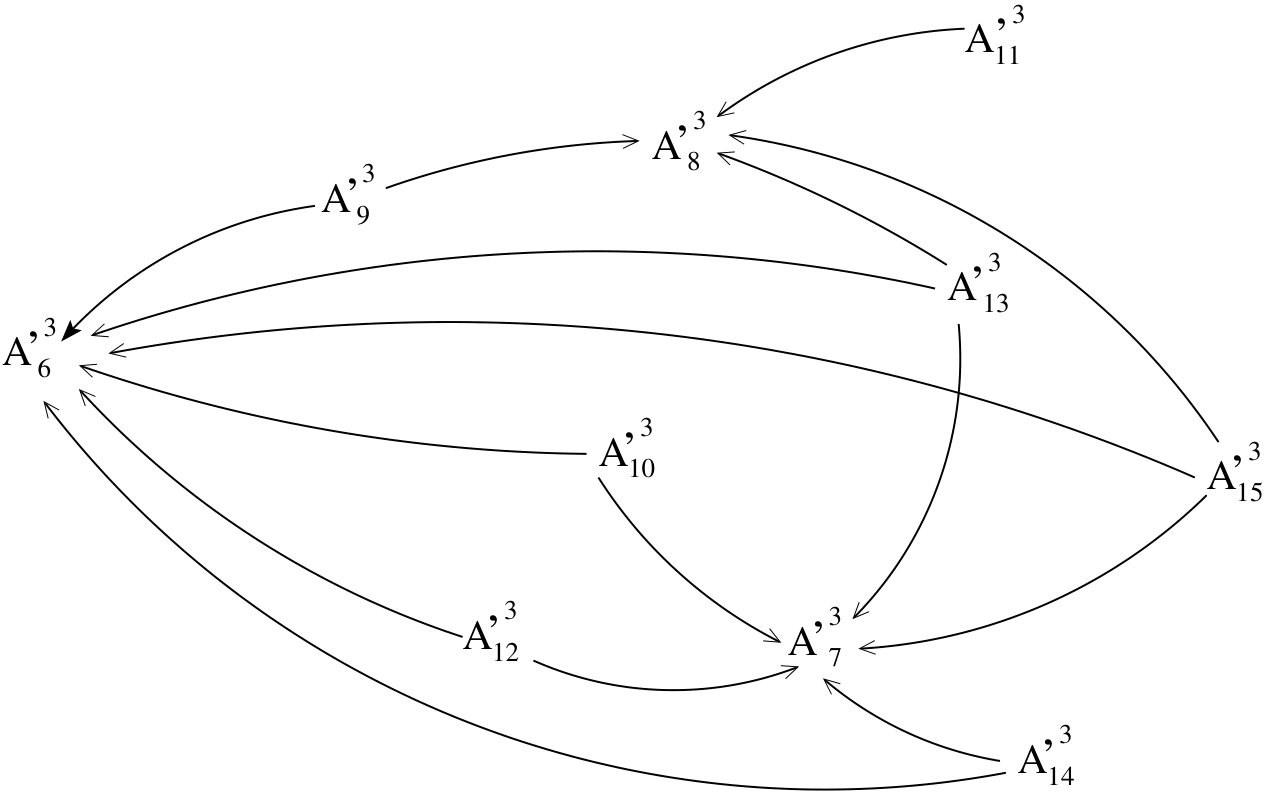 Figure 1
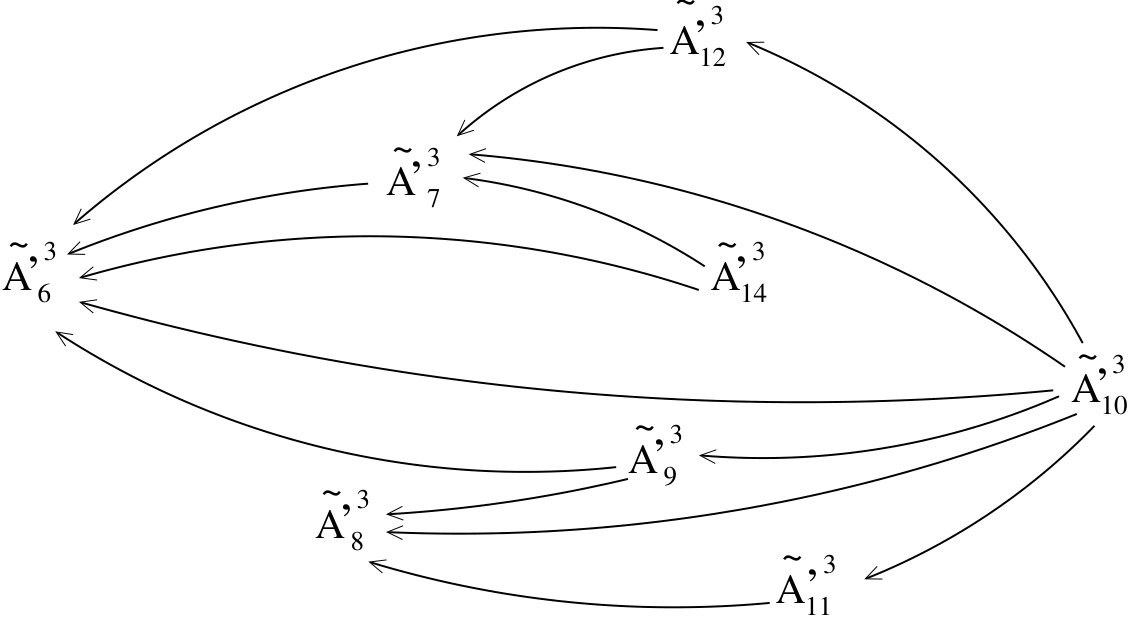 Figure 2
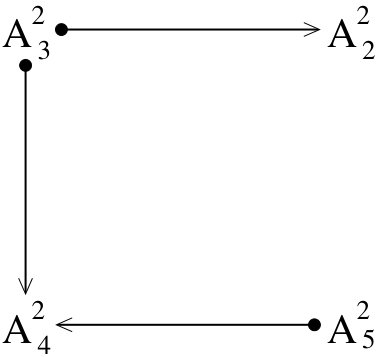 Figure 3
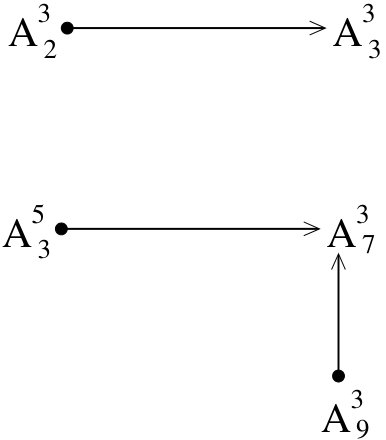 Figure 4
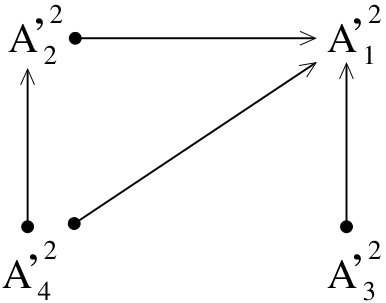 Figure 5
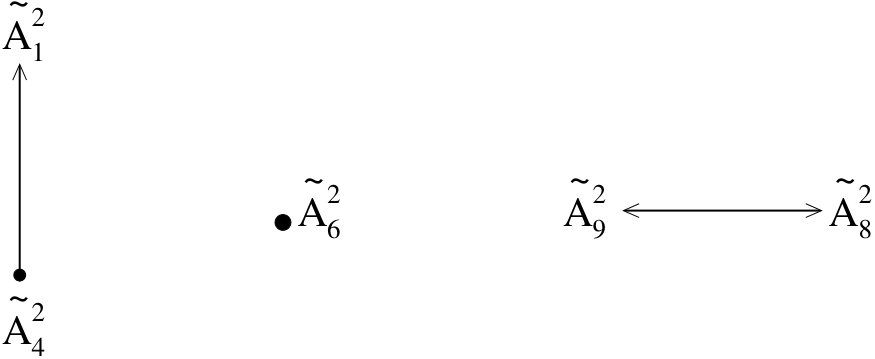 Figure 6
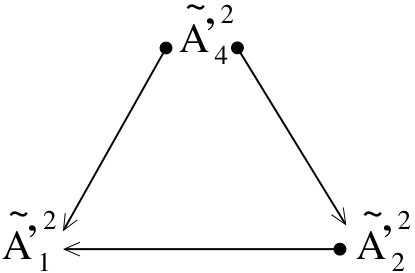 Figure 7