Chiral twodimensional p-wave superfluid from s-wave pairing in the BEC regime
K. Thompson, J. Brand, U. Z\"ulicke

TL;DR
This paper explores the BCS-to-BEC crossover in two-dimensional spin-orbit-coupled Fermi gases with s-wave pairing, revealing conditions under which robust topological chiral p-wave superfluidity persists even in the BEC regime, aiding experimental realization.
Contribution
It provides phase diagrams and analysis showing that topological chiral p-wave superfluidity remains stable in the BEC regime, unlike in the BCS limit, and identifies optimal parameters for experimental detection.
Findings
Topological phase retains Fermi surface features in the BEC regime.
Chiral p-wave order parameter is larger in the BEC regime, facilitating detection.
Moderate spin-orbit coupling suffices for topological superfluidity in the BEC regime.
Abstract
Twodimensional spin-orbit-coupled Fermi gases subject to s-wave pairing can be driven into a topological phase by increasing the Zeeman spin splitting beyond a critical value. In the topological phase, the system exhibits the hallmarks of chiral p-wave superfluidity, including exotic Majorana excitations. Previous theoretical studies of this realization of a twodimensional topological Fermi superfluid have focused on the BCS regime where the s-wave Cooper pairs are only weakly bound and, hence, the induced chiral p-wave order parameter has a small magnitude. Motivated by the goal to identify potential new ways for the experimental realization of robust topological superfluids in ultra-cold atom gases, we study the BCS-to-BEC crossover driven by increasing the Cooper-pair binding energy for this system. In particular, we obtain phase diagrams in the parameter space of two-particle…
Click any figure to enlarge with its caption.
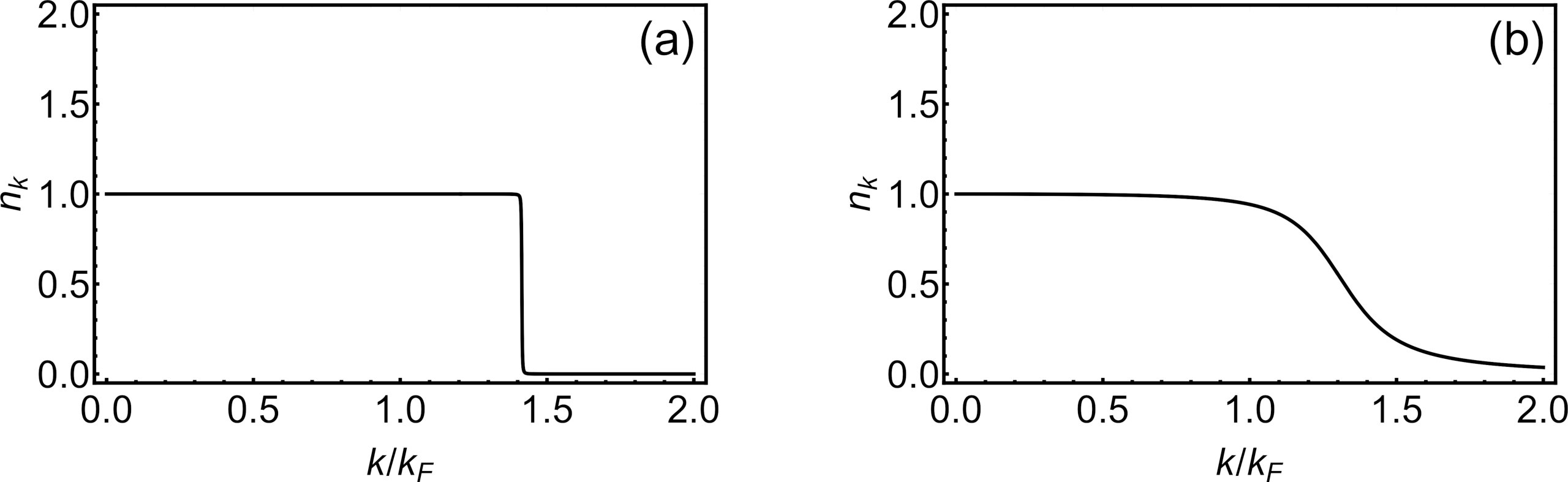 Figure 10
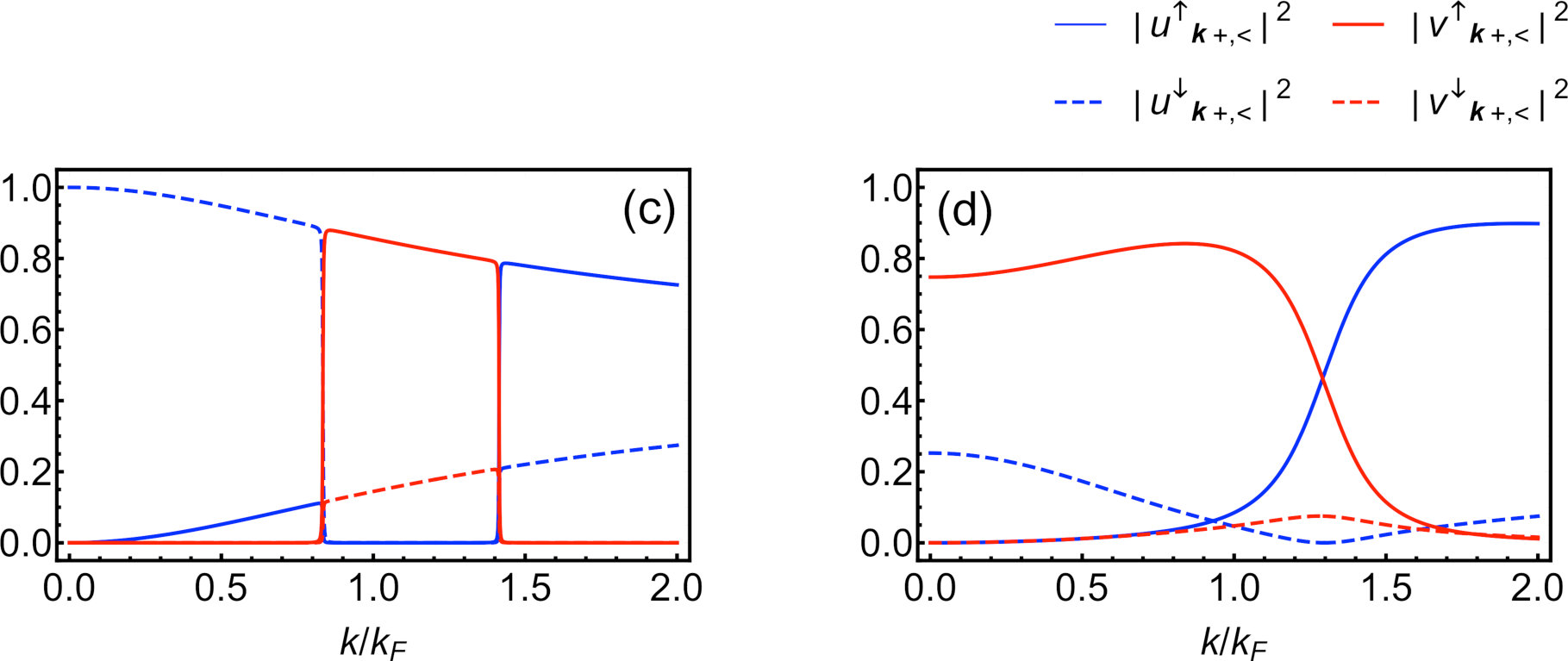 Figure 10
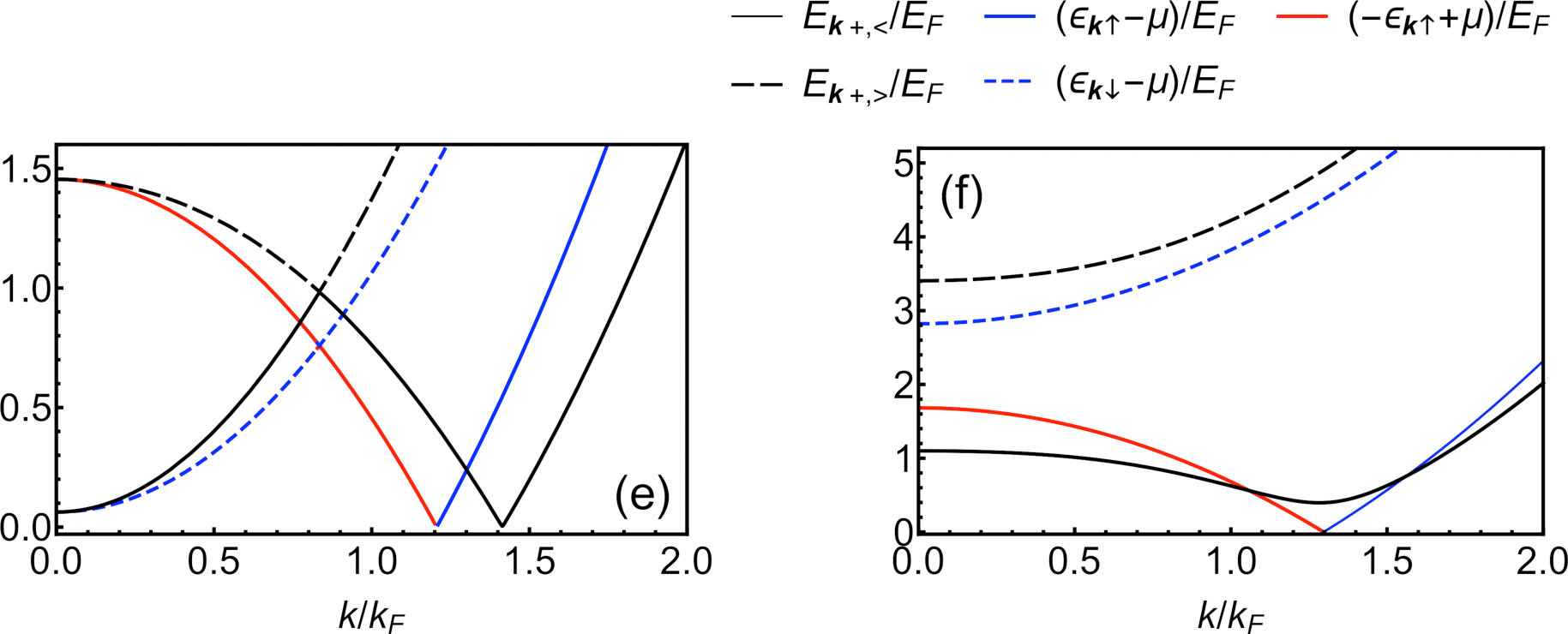 Figure 10
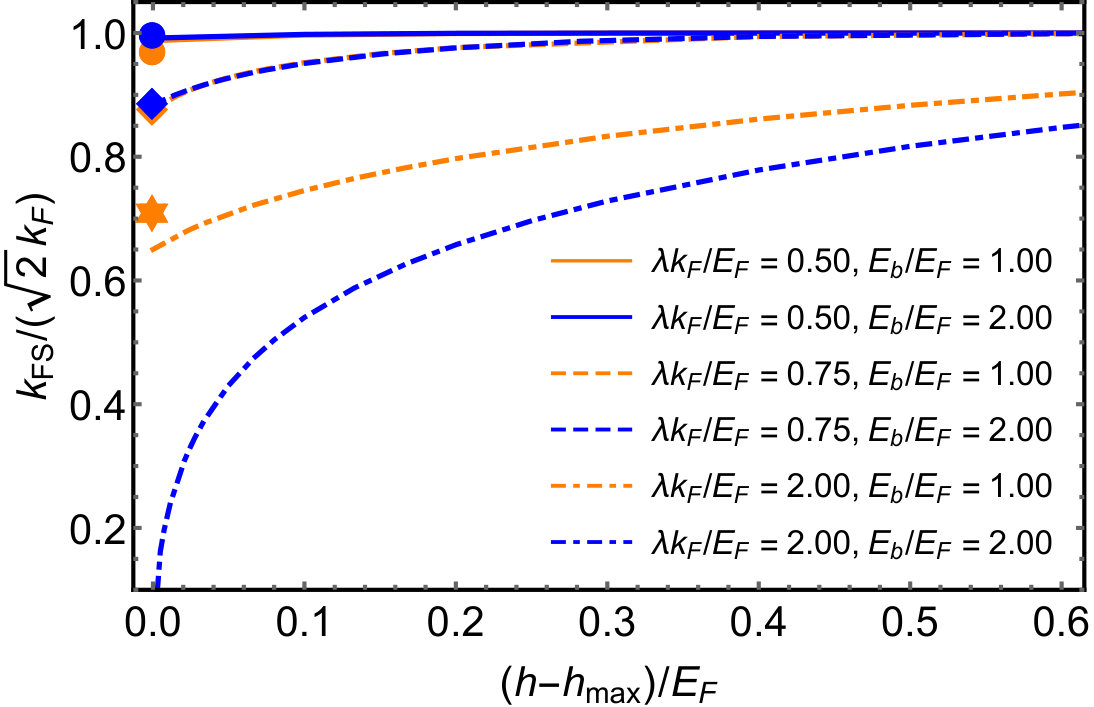 Figure 11
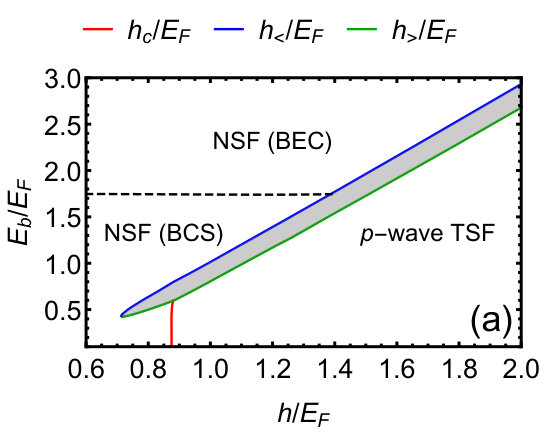 Figure 1
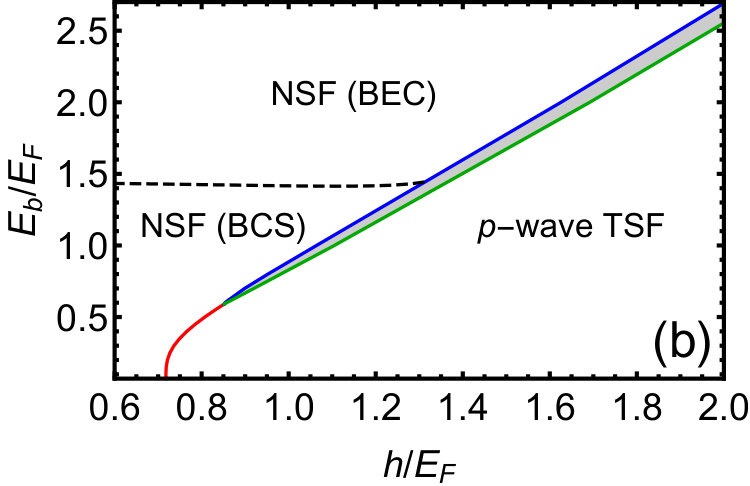 Figure 1
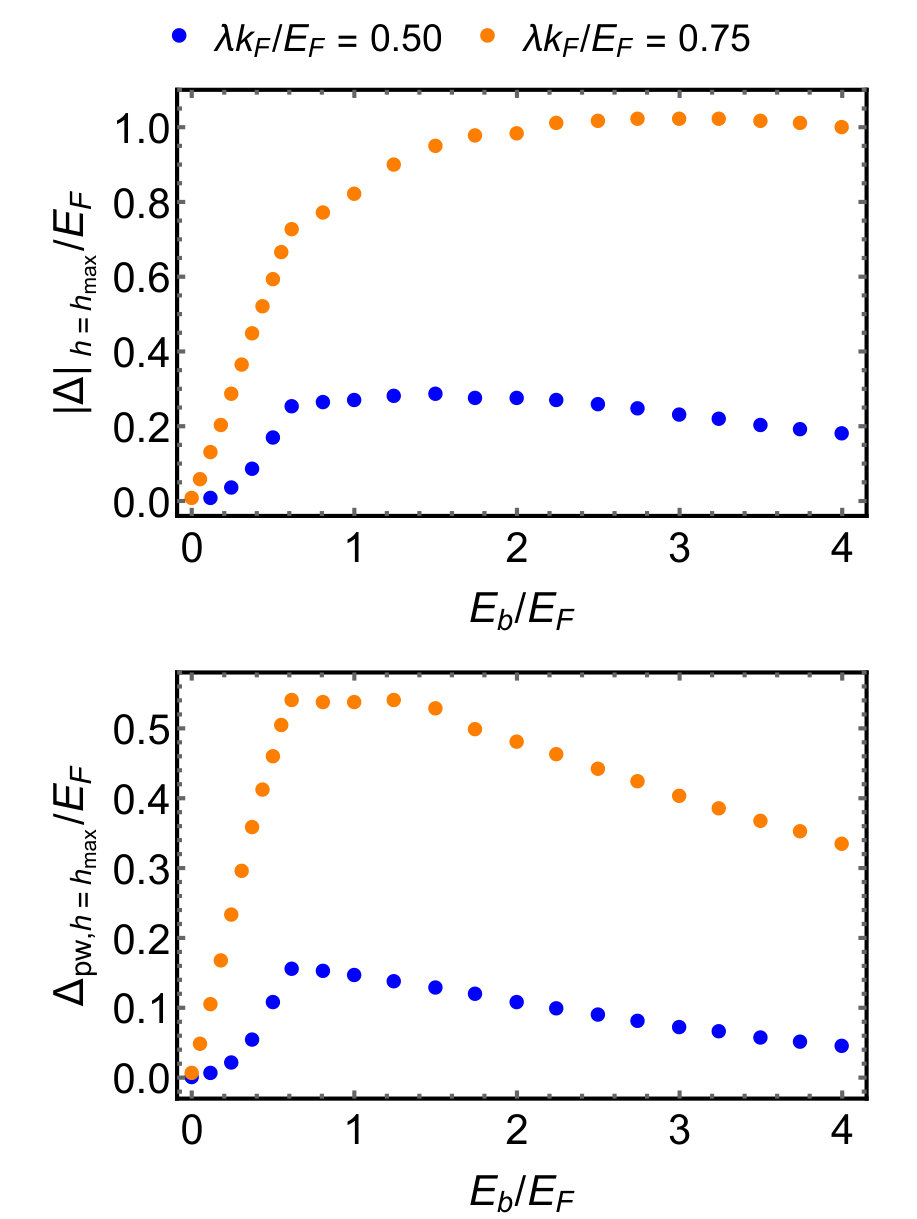 Figure 2
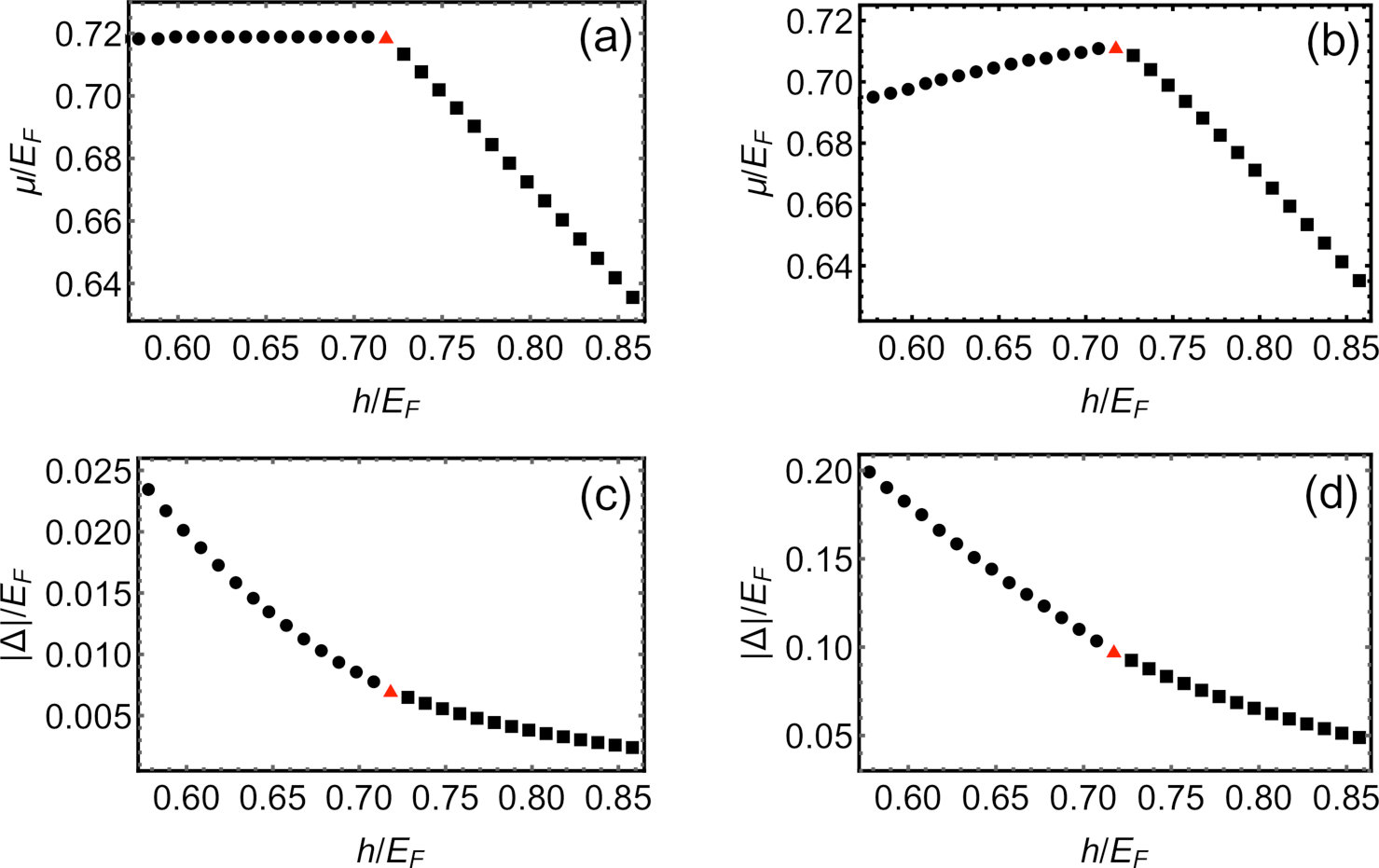 Figure 3
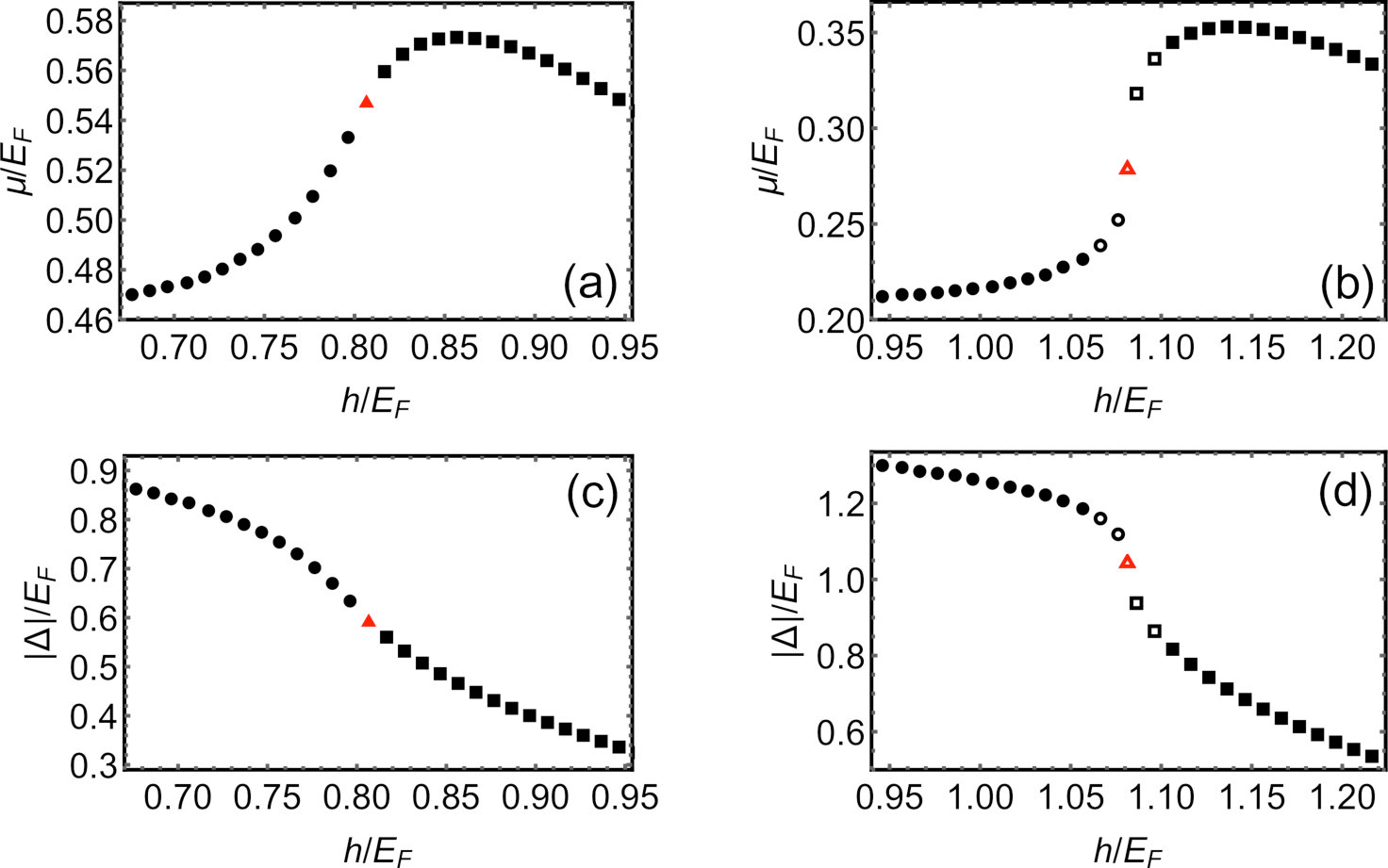 Figure 4
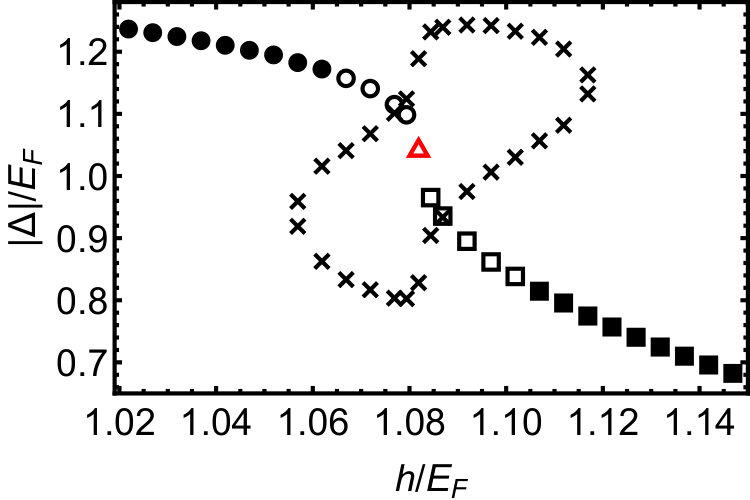 Figure 5
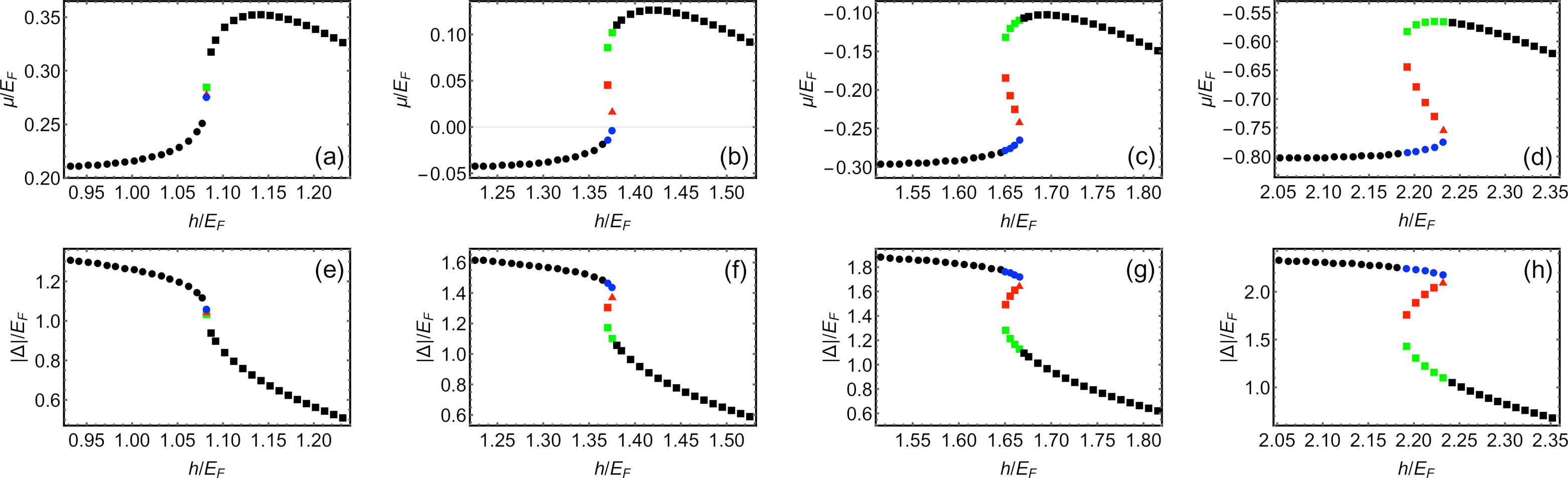 Figure 6
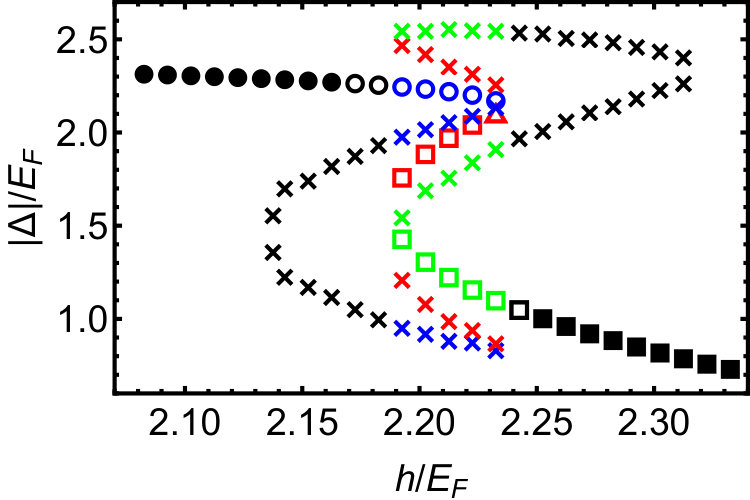 Figure 7
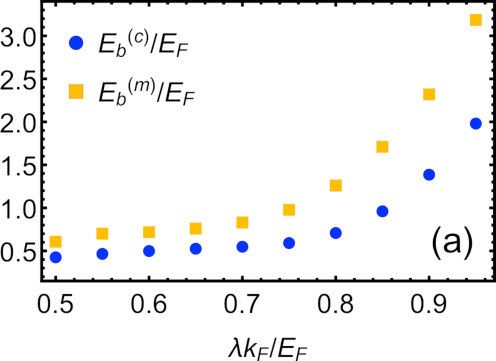 Figure 8
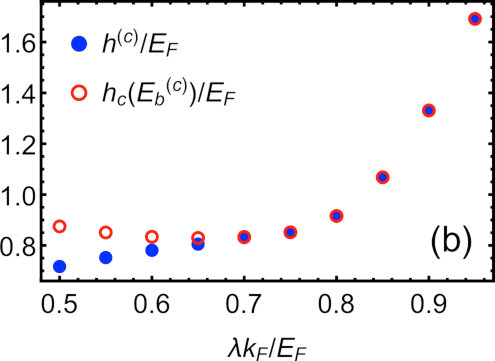 Figure 8
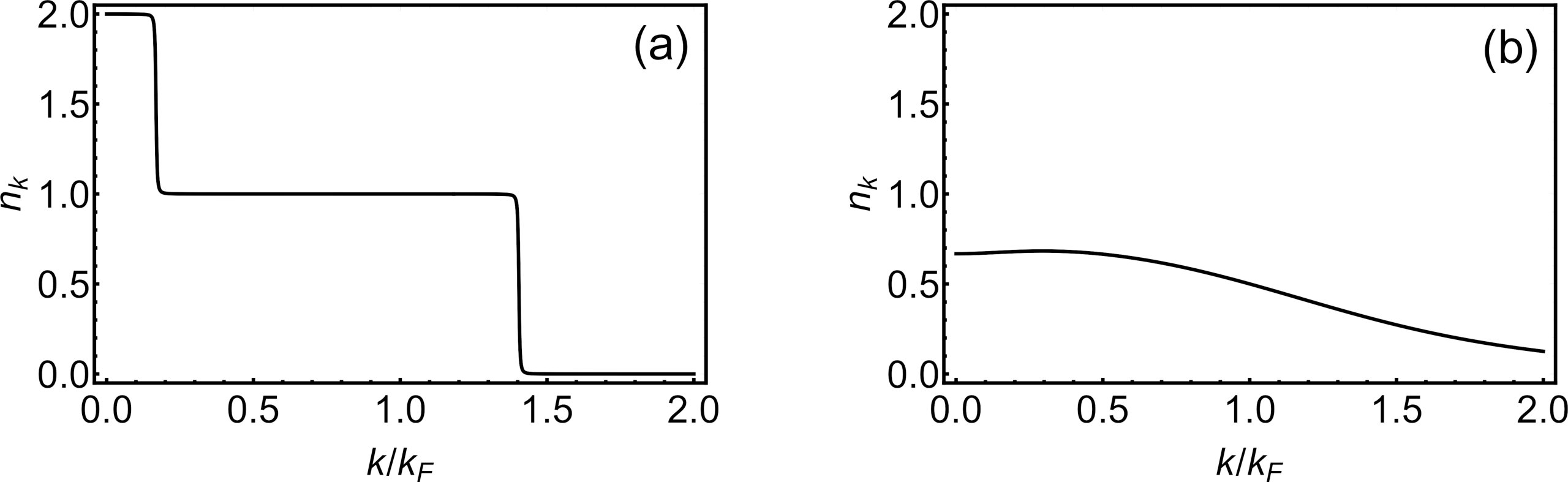 Figure 9
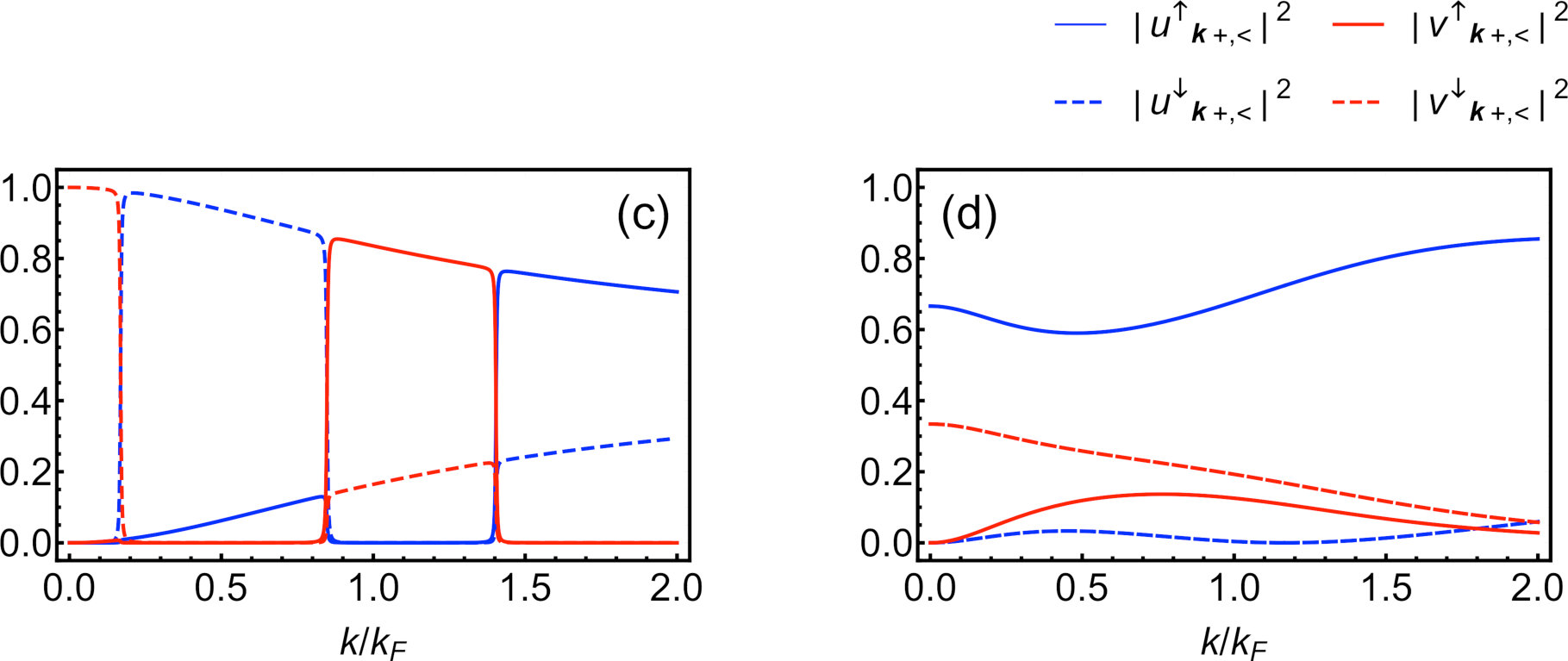 Figure 9
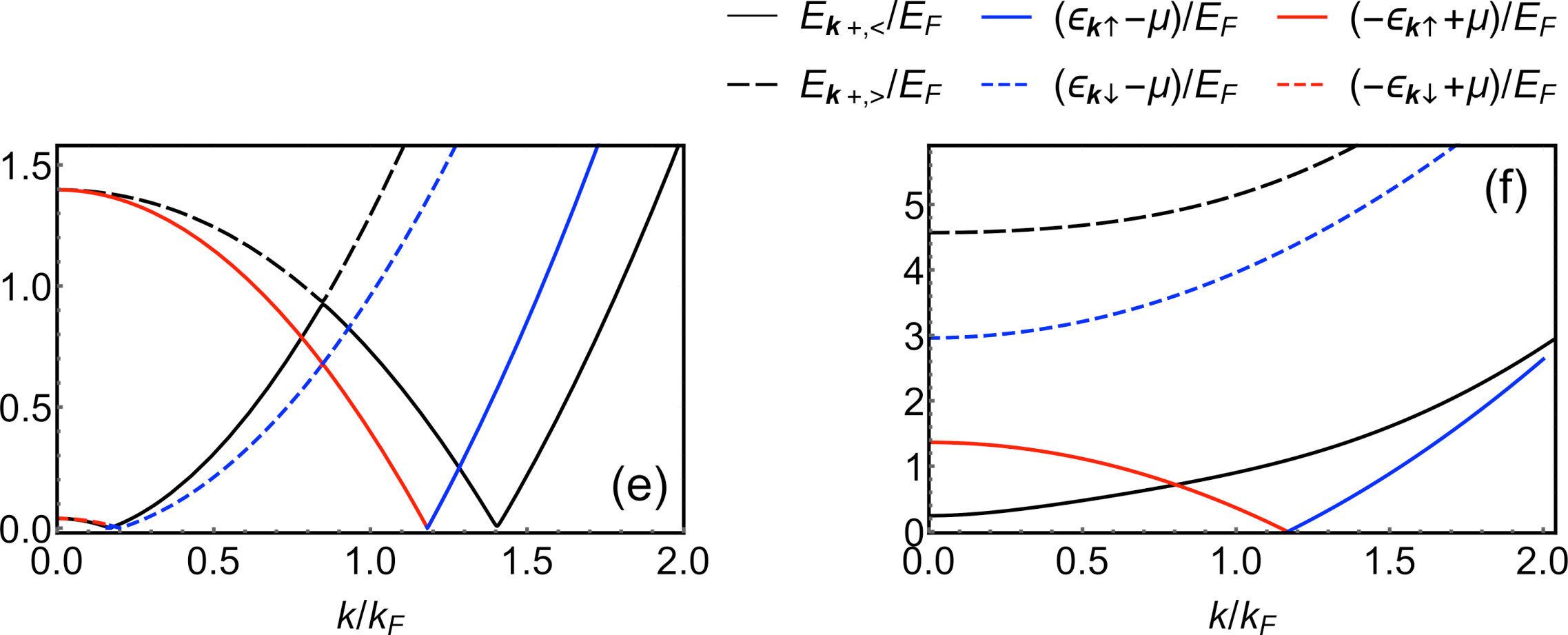 Figure 9
Peer Reviews
No public reviews on file for this paper yet. If you reviewed it on a platform where reviews are public (OpenReview, ICLR, NeurIPS, ICML), you can paste yours below so the community can read it here.
Videos
No videos yet. Explain this paper in a talk, walkthrough, or lecture? Add one.
Chiral twodimensional p-wave superfluid from
s-wave pairing in the BEC regime
K. Thompson
School of Chemical and Physical Sciences, Victoria University of Wellington, PO Box 600, Wellington 6140, New Zealand
Dodd-Walls Centre for Photonic and Quantum Technologies, PO Box 56, Dunedin 9056, New Zealand
J. Brand
Centre for Theoretical Chemistry and Physics, and New Zealand Institute for Advanced Study, Massey University, Private Bag 102904 NSMC, Auckland 0745, New Zealand
Dodd-Walls Centre for Photonic and Quantum Technologies, PO Box 56, Dunedin 9056, New Zealand
U. Zülicke
School of Chemical and Physical Sciences, Victoria University of Wellington, PO Box 600, Wellington 6140, New Zealand
Dodd-Walls Centre for Photonic and Quantum Technologies, PO Box 56, Dunedin 9056, New Zealand
Department of Physics, University of Basel, Klingelbergstrasse 82, CH-4056 Basel, Switzerland
Abstract
Twodimensional spin-orbit-coupled Fermi gases subject to s-wave pairing can be driven into a topological phase by increasing the Zeeman spin splitting beyond a critical value. In the topological phase, the system exhibits the hallmarks of chiral p-wave superfluidity, including exotic Majorana excitations. Previous theoretical studies of this realization of a twodimensional topological Fermi superfluid have focused on the BCS regime where the s-wave Cooper pairs are only weakly bound and, hence, the induced chiral p-wave order parameter has a small magnitude. Motivated by the goal to identify potential new ways for the experimental realization of robust topological superfluids in ultra-cold atom gases, we study the BCS-to-BEC crossover driven by increasing the Cooper-pair binding energy for this system. In particular, we obtain phase diagrams in the parameter space of two-particle bound-state energy and Zeeman spin-splitting energy. Ordinary characteristics of the BCS-to-BEC crossover, in particular the shrinking and eventual disappearance of the Fermi surface, are observed in the nontopological phase. In contrast, the topological phase retains all features of chiral p-wave superfluidity, including a well-defined underlying Fermi surface, even for large s-wave pair-binding energies. Compared to the BCS limit, the topological superfluid in the BEC regime turns out to be better realizable even for only moderate magnitude of spin-orbit coupling because the chiral p-wave order parameter is generally larger and remnants of s-wave pairing are suppressed. We identify optimal parameter ranges that can aid further experimental investigations and elucidate the underlying physical reason for the persistence of the chiral p-wave superfluid.
I Introduction and overview of main results
One of the earliest proposed pathways towards realization of a twodimensional (2D) topological superfluid (TSF) Sato and Ando (2017) is based on s-wave pairing of spin- fermions subject to spin-orbit coupling and Zeeman spin splitting Fu and Kane (2008); Zhang et al. (2008); Sau et al. (2010); Alicea (2010); Sato et al. (2010). In the absence of spin-orbit coupling, a population imbalance in the spin components (equivalent to nonzero Zeeman splitting) tends to destroy s-wave superfluidity due to the mismatch of the spin- and spin- Fermi surfaces for weak-coupling superfluids Chandrasekhar (1962); Clogston (1962). With strong s-wave attraction, phase separation between superfluid and normal phases ensues in this case He and Zhuang (2008). Adding 2D spin-orbit coupling (e.g., of Rashba form Bychkov and Rashba (1984); Winkler (2003); Galitski and Spielman (2013)) permits a pairing instability even for unmatched Fermi surfaces and re-establishes a homogeneous superfluid ground state with gapped fermionic quasiparticle excitations. The pairing field for each spin component separately Brand et al. (2018) now obtains the characteristics of a chiral 2D p-wave superfluid Kallin and Berlinsky (2016). Increasing the Zeeman coupling energy beyond the critical value
[TABLE]
quenches one of the Fermi surfaces, and the system enters a TSF phase. In Eq. (1), and denote the selfconsistent s-wave pair potential and chemical potential, respectively. Bearing all the characteristics of a 2D spinless p-wave superfluid, a nontrivial topological invariant can be defined Sato and Ando (2017), and Majorana quasiparticle excitations are present at boundaries Jackiw and Rebbi (1976); Fu and Kane (2008) and in vortex cores Kopnin and Salomaa (1991); Volovik (1999); Read and Green (2000); Ivanov (2001); Gurarie and Radzihovsky (2007) by virtue of an index theorem Tewari et al. (2007). Majorana zero modes are considered promising candidates for enabling fault-tolerant quantum-information processing Das Sarma et al. (2015).
Intense efforts towards experimental implementation of 2D TSFs using the above-described route have so far been thwarted by the deleterious effect of Zeeman-splitting-inducing magnetic fields on superconductivity in typical materials Loder et al. (2015), as well as basic physical constraints on the magnitude of spin-orbit coupling reachable in solids Winkler (2003) and ultra-cold atom gases Zhai (2015); Zhang et al. (2018). Our present study shows that a possible way around the latter limitation would be to access the strong-coupling regime of the s-wave pairing, which is commonly referred to as the BEC regime Leggett (1980a, b); Randeria et al. (1990); Parish (2015); Strinati et al. (2018).
The main insights reached in our work are underpinned by zero-temperature phase diagrams in the parameter space of two-particle s-wave bound-state energy not and Zeeman energy as illustrated in Fig. 1. These show a second-order transition line (red) between the nontopologial and topological superfluids at small being replaced by a first-order phase transition at larger . In the phase diagram at constant particle density , enforced by measuring energies in terms of the Fermi energy , the first-order phase transition manifests itself as a region without a uniform-density ground state (grey) where phase separation into spatially separated domains ensues. Critical Zeeman-energy values (blue) and (green) delimit the phase-separation region at fixed , defining two curves in the phase diagram. The properties of the phase-separation region itself have been the subject of previous work Yi and Guo (2011); Yang and Wan (2012), and we also provide a few more details later on. However, the main focus of our present study is the careful determination of the location of the boundaries and and the exploration of the adjacent homogeneous phases, especially in the regime where .
Comparison of our results with those obtained previously for spin-imbalanced 2D Fermi superfluids 111See, e.g., Fig. 2(a) in Ref. He and Zhuang (2008). helps to elucidate the physical consequences of finite spin-orbit coupling. The magnitude of the latter is most conveniently measured in terms of the dimensionless parameter that also involves the density-dependent Fermi wave number . One important effect of finite is to shift the low- boundary of the phase-separation region from zero to finite values of He and Zhuang (2008), and a second effect is to establish the TSF phase Yang and Wan (2012) for sufficiently high Zeeman energy in place of the fully polarized normal phase found for He and Zhuang (2008).
Our present study shows that the character of the TSF phase emerging in the BEC regime of the underpinning s-wave pairing () is fundamentally similar to the TSF occurring in the BCS limit (). In particular, for the entire TSF region in the phase diagram, the system exhibits canonical signatures of an underlying Fermi surface. As discussed by Sensarma et al. Sensarma et al. (2007), an underlying Fermi surface can be robustly defined even in strong-coupling fermionic superfluids by a number of alternative definitions, such as a zero crossing of the single-particle Greens function , a drop in the single-particle momentum distribution , or, if available, by a minimum of the quasiparticle dispersion relation. Our results for the TSF are in stark contrast to the nontopological superfluid (NSF) phase where the Fermi surface shrinks and eventually disappears as increases and the BEC regime is entered. This is expected from the known phenomenology of the BCS-to-BEC crossover for s-wave pairing Nozières and Schmitt-Rink (1985); Chen et al. (2005); Astrakharchik et al. (2005) and illustrated by recent Quantum-Monte-Carlo results Shi et al. (2015, 2016).
The defining element of the 2D TSF is an emergent chiral p-wave order parameter whose magnitude provides the energy scale of the quasiparticle-excitation gap. Its value is proportional to the spin-orbit-coupling strength and the modulus of the s-wave pair potential, but inversely related to the spin-splitting (Zeeman) energy scale Zhang et al. (2008); Alicea (2010); Sato et al. (2010); Seo et al. (2012); Brand et al. (2018). Given that increasing has adverse side effects such as heating of the atom gas Zhai (2015) in currently available experimental schemes, maximizing needs to be pursued by other means. As is a monotonously increasing function of but is suppressed with increasing (see, e.g., Refs. He and Huang (2013); Brand et al. (2018) and below), its practically largest magnitude occurs just after the transition to the homogeneous TSF phase at . Figure 2(a) illustrates the dependence of this value, , on both and . It reveals a maximum that gets broader and larger as the parameter increases. As the maximum value of reaches values up to typically, even for only moderately high values of the spin-orbit-coupling strength, the TSF realized in the BEC regime of s-wave pairing presents a much more favorable platform for useful study and application than would be available in the BCS regime at the same value of . This is established even more directly by measuring as the gap in the low-energy quasiparticle dispersion for the TSF. The values for found for the same parameter combinations that maximize are shown in Fig. 2(b). For both fixed values of , a maximum of occurs for , followed by a broad range for which is slowly decreasing.
All quantitative results in this work were obtained within mean-field theory, even though its validity for a 2D gas, in particular outside of the weakly interacting regime, may not be taken for granted. We nevertheless expect the qualitative physics, and in particular the presence of a Fermi surface in the TSF phase, to be robust because the topological property puts strong constraints on the many-body system. We comment further on the physical reasons below. Mean-field approximations have previously been found to provide useful insight into zero-temperature phases, even when interactions are strong Yi and Duan (2006a); Parish et al. (2007); He and Zhuang (2008); Fischer and Parish (2013). Quantitatively more accurate predictions, in particular for finite temperature, require more sophisticated approaches Kuchiev and Sushkov (1996); Yi and Duan (2006a); Parish et al. (2007); Bertaina and Giorgini (2011); Salasnich and Toigo (2015); He et al. (2015); Turlapov and Kagan (2017); Hu et al. (2018). The expected effects of beyond-mean-field corrections (quantum fluctuations) is to suppress pairing gaps compared to mean-field theory in the strongly interacting regime He et al. (2015); Hu et al. (2018). This fact reinforces the optimal value for realizing a robust TSF, as for , the true value for the s-wave pairing gap, and therefore also , are likely to be much smaller than mean-field theory predicts.
The physical reasons for the remarkable BCS-like behavior of the TSF even when interactions are strong enough to place s-wave pairs into the BEC regime may be seen from a careful analysis of the relevant low-energy part of the quasiparticle spectrum. A projection of the mean-field equations to the majority-spin component Brand et al. (2018) yields a useful approximate expression for the excitation gap and TSF order parameter
[TABLE]
where , and is the radius of the Fermi surface in the TSF phase (see end of Sec. III). The projective approximation is valid when is small compared to the Fermi energy , but this condition will be fulfilled when spin-orbit coupling is not too strong, , in the TSF regime where due to Eq. (1). Note that this means that is bounded while the binding energy may be much larger. Within the same projective approximation Brand et al. (2018) and for , one also obtains the estimate
[TABLE]
which shows that the Fermi surface radius is finite, , as long as the Zeeman energy is sufficiently large. Thus the large magnitude of the Zeeman energy required to reach the uniform TSF phase ultimately ensures the persistence of BCS-like character of chiral p-wave pairing, even as the s-wave interaction is deep in the BEC regime. While the situation becomes slightly more complex for very large spin-orbit-coupling strengths , we still find signatures of a Fermi surface persisting throughout the TSF phase, and canonical BCS-like behavior being exhibited for .
The remainder of this article is organized as follows. Section II introduces the theoretical approach used by us to describe the BCS-to-BEC crossover for the s-wave-paired 2D Fermi gas subject to both spin-orbit coupling and Zeeman spin splitting. Detailed results obtained within this formalism for the system with fixed uniform particle density are presented in the subsequent Sec. III, together with a discussion of physical implications and limitations inherent in the mean-field approach. Our conclusions are formulated in the final Sec. IV.
II Microscopic model of the 2D TSF
We utilize a standard Bogoliubov-de Gennes (BdG) mean-field formalism de Gennes (1989) to calculate the quasiparticle spectrum for our system of interest. All relevant thermodynamic quantities can be expressed in terms of the obtained eigenenergies and eigenstates. Throughout this work, we consider the zero-temperature limit.
The BdG Hamiltonian of the 2D spin-orbit coupled Fermi gas with -wave interactions and Zeeman spin splitting acting in the four-dimensional Nambu space of spin- fermions is 222Our notation adheres to that used in Ref. Brand et al. (2018).
[TABLE]
where denotes the 2D wave vector, with , and is the spin-orbit coupling 333While we adopt the 2D-Rashba form Bychkov and Rashba (1984) for , our results apply also to other types of spin-orbit coupling that depend linearly on the components of , such as the 2D-Dirac and 2D-Dresselhaus functional forms Winkler (2003); Galitski and Spielman (2013) corresponding to and , respectively.. The BdG equation reads
[TABLE]
Its spectrum consists of four eigenvalue branches Yi and Guo (2011); Zhou et al. (2011),
[TABLE]
with associated eigenspinors , where and label the four different energy-dispersion branches.
The chemical potential and magnitude of the pair potential need to be determined selfconsistently from solutions of the BdG equations in conjunction with the gap equation and the constraint that the uniform particle density is fixed at . Corresponding conditions can be formulated mathematically in terms of the energy spectrum and BdG-Hamiltonian eigenspinor amplitudes. See, e.g., Refs. de Gennes (1989); Brand et al. (2018). However, educated by the insights gained from previous work on spin-imbalanced Fermi superfluids Radzihovsky and Sheehy (2010), we base selfconsistency considerations on the properties of the system’s grand-canonical ground-state energy density Sheehy and Radzihovsky (2007a); Parish et al. (2007); Radzihovsky and Sheehy (2010); Yi and Guo (2011); Zhou et al. (2011), for which a standard calculation yields
[TABLE]
Here denotes the system’s volume (area), and is the magnitude of the two-particle bound-state (i.e., binding) energy not . The gap and number-density equations can be expressed in terms of derivatives of the ground-state energy density;
[TABLE]
The lengthy explicit expressions are omitted here.
As emphasized previously during the study of spin-imbalanced Fermi superfluids Sheehy and Radzihovsky (2007b), proper application of the condition (20a) for identifying physical ground states requires ensuring that , taken as a function of at fixed , has a global minimum at the selfconsistently determined value for . However, identifying local minima as well as maxima of the ground-state energy at fixed can also be of interest Sarma (1963); Lamacraft and Marchetti (2008); He and Zhuang (2009), e.g., to discuss nonequilibrium-dynamic phenomena; hence, we will track these in the following also.
The relative magnitude of with respect to the Fermi energy drives the BCS-to-BEC crossover for s-wave pairing in our system of interest Randeria et al. (1990). More specifically, we have
[TABLE]
In the following, we absorb any dependence on total particle density by measuring all energies and wave vectors in units of and , respectively. Thus the set of externally tuneable parameters comprises , , and . The system’s state is characterized by and .
The chiral -wave nature of the superfluid is revealed by the following considerations. Inspection of Eq. (18) shows that . In the BCS regime, for , two minima exist in at , corresponding to effective p-wave pairing around the two spin-split Fermi surfaces for spin- and spin- degrees of freedom. As is increased, the location of the spin- minimum moves towards , with its value shrinking and finally vanishing as it reaches at . For , the system has only one Fermi surface corresponding to a fully polarized electron system, and the remaining minimum of at is associated with an effective pair potential Sato et al. (2010); Brand et al. (2018) , where is the polar-angle coordinate for the 2D wave vector . Proportionality of the superconducting order parameter to the phase factor is the defining property of chiral p-wave pairing Kallin and Berlinsky (2016), and also the origin of its accompanying topological features Kallin and Berlinsky (2016); Sato and Ando (2017). In contrast, the system has two Fermi surfaces where p-wave pairing with opposite chirality occurs when , rendering it to be a nontopological superfluid. We now apply the formalism introduced above to investigate the fate of chiral p-wave superfluidity in the BEC regime for the underlying s-wave pairing.
III Results and discussion
To ground ourselves in well-known results He and Huang (2013); Brand et al. (2018), we start by fixing a value for and consider the variation of the chemical potential and the pair-potential magnitude as a function of the Zeeman energy in the BCS limit for s-wave pairing, i.e., for small . As illustrated in Fig. 3, both and evolve continuously from the nontopological phase where [defined in Eq. (1)] via their critical values and that satisfy into the topological phase where . This reflects the fact that, for any value of , has only a single minimum when plotted as a function of for fixed , which occurs at a nonzero and thus corresponds to a homogeneous superfluid ground state.
The search for solutions of the selfconsistency conditions (20a) and (20b) for larger continues to yield unique values of and . See the examples shown in Fig. 4. However, an intricate complexity associated with selfconsistent solutions starts to develop. As illustrated in Fig. 5, within an intermediate range of Zeeman energies, two additional extrema (specifically, a local minimum and a local maximum) start to appear in the -dependence of the ground-state energy where has been fixed to its selfconsistent value. Below the value associated with the critical end-point of the phase-separation region shown in Fig. 1, the unique solution of the selfconsistency conditions still continues to be the global minimum of , taken at the selfconsistent , for any value of . This is the case, e.g., for the system parameters used to calculate the results shown in Fig. 4(a,c). However, for , which applies to Fig. 4(b,d), the selfconsistently determined value for ceases to be associated with the global minimum of at fixed selfconsistent for Zeeman energies within a range , corresponding instead to only a local minimum or even a maximum. This implies that no single-phase equilibrium ground state exists in the region . Instead, phase separation into domains of different densities will occur if the system is driven into this region. Even further in the BEC regime when , multiple selfconsistent pairs of values for and emerge as illustrated in Fig. 6. Around each of these, additional zeros of the gap equation exist, as seen in Fig. 7. Now the range is defined to be the region where none of the selfconsistent values is associated with the global minimum of the ground-state energy when is fixed to its corresponding selfconsistent value.
The appearance of multiple extrema in the dependence of at fixed , leading to the selfconsistent minimum ceasing to be the global minimum, indicates the presence of a first-order (noncontinuous) phase transition He and Zhuang (2008); Zhou et al. (2011). A proper theoretical description of this situation requires the construction of various phase-coexistence scenarios Yi and Guo (2011); Yang and Wan (2012); Seo et al. (2012), in analogy with treatments developed for the population-imbalanced Fermi gas without spin-orbit coupling Bedaque et al. (2003); Carlson and Reddy (2005); Sheehy and Radzihovsky (2006); Son and Stephanov (2006); Sheehy and Radzihovsky (2007a); Parish et al. (2007); He and Zhuang (2008); Du et al. (2009). Here we defer the careful determination of the equilibrium ground state in the phase-separation region to future work 444This task becomes particularly challenging for the part of the phase diagram where multiple selfconsistent solutions of the gap equation exist at fixed . Generally, two of these correspond to minima of the ground-state energy taken at fixed , and their combined evolution between global- or local-minimum status needs to be tracked.. Rather, we intend to discuss the properties of the adjacent uniform, single-phase regions for large . To this end, we only need to map carefully the boundaries of the phase-separation region, i.e., the critical-Zeeman-energy curves and . Results for representative values of the spin-orbit-coupling strength are given in Fig. 1. We find that the phase-separation region narrows as the spin-orbit-coupling parameter is increased, while simultaneously the critical end point \big{(}h^{(\mathrm{c})},E_{\mathrm{b}}^{(\mathrm{c})}\big{)} where the and curves merge shifts to larger coordinate values in the phase diagram. The full dependence of (and also of ) as a function of the dimensionless spin-orbit-coupling strength is plotted in Fig. 8(a), with the associated results for being provided in Fig. 8(b). Two different regimes, corresponding to small and large values of , can be identified, where the former (latter) is characterized by the values diverging from (coinciding with) the critical field for .
The curves for and in the phase diagram delimit the phase-separation region associated with a first-order transition between different superfluid states. In those parts of the phase diagram outside this region where only a single pair of selfconsistent values for and exists, a curve can be defined via Eq. (1) that separates the part of the phase diagram where the system is an ordinary nontopological superfluid (NSF, for ) from the part where the ground state corresponds to a topological superfluid (TSF, for ). In particular, for , only this second-order topological transition occurs. However, beyond the point where the curve for crosses that of , solutions of the selfconsistency conditions that are critical, i.e., satisfy , continue to exist but are no longer a global minimum of the ground-state energy at fixed . At the same time, the homogeneous-superfluid states existing for satisfy and are thus in the topological phase. Hence, beyond the crossing point of and , the topological transition is of first order. The phase boundary of the homogeneous 2D TSF is therefore delineated by . Due to the tendency of to monotonically decrease with in regions where a selfconsistent solution is associated with the system’s equilibrium ground state (see Figs. 3, 5, and 7), is also the Zeeman energy for which is maximized in the TSF phase at fixed . We now focus on the properties of the single-phase ground states adjacent to the phase-separation region at large .
The typical phenomenology of the BCS-to-BEC crossover for s-wave pairing entails a shift of the dispersion minimum to , Bogoliubov quasi-particles becoming mostly particle-like, and the momentum-space density distribution loosing its typical Fermi-surface-like shape Nozières and Schmitt-Rink (1985); Chen et al. (2005); Astrakharchik et al. (2005); Sensarma et al. (2007); Shi et al. (2015, 2016). This exact scenario is played out for our more complicated system of interest in the NSF phase. See Fig. 9 and the extensive discussion in its caption. In contrast, as illustrated by Fig. 10, all features associated with effective chiral p-wave pairing in the spin- channel remain present throughout the BCS-to-BEC crossover in the TSF phase. In particular, the momentum-space density distribution shows a distinctive Fermi-surface edge feature even deep in the BEC regime for s-wave pairing, which is unexpected for situations where the chemical potential is negative 555See, e.g., Ref. Chen et al. (2005). Similar behavior to the one found by us here for the 2D TSF seems to also be implicit in results that were presented for the 3D spin-orbit-coupled Fermi superfluid (see, e.g., Fig. 6 in Ref. Seo et al. (2012)) but whose physical significance was not discussed.. That the effective p-wave pairing retains BCS-like behavior even as the underlying s-wave pairing is in the BEC regime is illustrated most strikingly by the close resemblance between the true Bogoliubov-quasiparticle energies and the dispersions associated with unpaired fermions [see Fig. 10(f)]. Although much larger generically than in the BCS regime, in the TSF phase for large is still small enough because of its dependence on the inverse of the Zeeman energy [see Eq. (2)] that the resulting quasiparticle dispersions are not radically different from those obtained in the absence of pairing. This contrasts with the NSF phase occurring at lower for the same large value of where the unpaired-fermion dispersions are not at all representative of the lowest-energy branch of quasiparticle excitations [see Fig. 9(f)].
The stabilization of the Fermi surface in the TSF phase due to the larger Zeeman energy is demonstrated in Fig. 11. Here we plot the dependence of the Fermi-surface radius , where the latter is defined as the location of the crossing point of the spin--particle and spin--hole Bogoliubov-spinor magnitudes for the lowest-energy quasiparticle dispersion,
[TABLE]
The condition clearly defines a surface in wave-vector space that separates states having high and low occupation probabilities, which is the defining property of a Fermi surface Sensarma et al. (2007). We find that a crossing point yielding a definite value of always exists at for any values of and . For , the minimum in the dispersion curve also occurs at , and the latter’s value turns out to be well-approximated by Eq. (3) for . In situations with very large spin-orbit coupling , the dispersion minimum is observed to sometimes be absent or appear at right after the transition to the TSF phase. Nevertheless, the coincidence of the quasiparticle-dispersion minimum and is established for even in such cases. Application of the approximate two-band-model results from Ref. Brand et al., 2018 to the case yields a conservative estimate for the Fermi-surface radius in this regime, which is given by
[TABLE]
and only holds when the expression under the square-root is positive. According to results presented in Fig. 11, increases monotonically as a function of until reaching its asymptotic value , which corresponds to the Fermi-surface radius of a spin-polarized 2D Fermi gas with density .
As can be seen in Fig. 10, the most visible attributes that distinguish the TSF in the BEC regime from that arising in the BCS regime are the increased magnitude of the low-energy excitation gap and the strong suppression of the minority-spin degrees of freedom. The clear dominance of the spin- Bogoliubov amplitudes representing chiral p-wave pairing is one of the favorable qualities exhibited by the TSF realized in the BEC regime. In addition, a larger magnitude of should help to reduce the influence of many experimental nonidealities, including thermal fluctuations, as long as is not too large so that beyond-mean-field fluctuations have not yet significantly suppressed the value of the pairing gap. Thus, the TSF realized in the onset of the BEC regime of the underlying s-wave pairing constitutes both a purer and more-robust version of the highly sought-after chiral p-wave order.
The results obtained and conclusions drawn in our work are based on the application of mean-field theory. It is well-known that this method can only provide limited insight into the strongly interacting (i.e., the BEC) regime of 2D systems Kuchiev and Sushkov (1996); Bertaina and Giorgini (2011); Salasnich and Toigo (2015); He et al. (2015); Shi et al. (2015, 2016); Turlapov and Kagan (2017). Here we employed the mean-field approach to determine (i) the phase diagram, (ii) the magnitude of the pairing gap, and (iii) momentum-space density distributions. Before concluding, we discuss the reliability of our predictions for these three purposes. (i) Phase diagrams: It is generally accepted that zero-temperature phase diagrams obtained within mean-field theory are qualitatively correct, even in the BEC regime Yi and Duan (2006a); Parish et al. (2007); He and Zhuang (2008); Fischer and Parish (2013); Strinati et al. (2018). We therefore expect the features presented in our work to be similarly accurate. (ii) Pairing-gap magnitude: Suppression of the pairing gap by beyond-mean-field fluctuations becomes increasingly important for larger He et al. (2015); Hu et al. (2018). Therefore, results for gap magnitudes presented, e.g., in Fig. 2 are only reliable for . Nevertheless, the conclusion that is optimal for realizing a robust TSF continues to hold. (iii) Momentum-space density distributions: Recent numerical results obtained for our system of interest in the limit (see Supplemental Material for Ref. Shi et al. (2016)) indicate that momentum-space density distributions obtained within mean-field theory are accurate to within %. Thus our general conclusions about the re-emergence of a Fermi surface and the robustness of chiral p-wave superfluidity in the BEC regime of s-wave pairing are expected to be valid.
IV Conclusions and outlook
We have investigated the strongly interacting regime of the 2D Fermi gas with s-wave pairing, with fixed particle density and subject to both spin-orbit coupling and Zeeman spin splitting. Characteristic features of the phase diagram as a function of two-particle binding energy and Zeeman energy are elucidated and the properties of the homogeneous superfluid phases studied in greater detail. In particular, we tracked the boundaries of the homogeneous nontopological and topological superfluids. The second-order topological-transition line h_{\mathrm{c}}\big{(}E_{\mathrm{b}}\big{)}, with defined via Eq. (1), is truncated by a phase-separation region that emerges for larger than a critical value that depends on the spin-orbit-coupling strength (see Figs. 1 and 8). As a result, the topological transition is of first order in the limit of large .
The homogeneous nontopological phase exhibits all of the expected features commonly associated with the BCS-to-BEC crossover for s-wave pairing, especially the shrinking, and eventual disappearance, of an underlying Fermi surface as the Cooper-pair binding energy is increased. See Fig. 9(a,b). In contrast, as illustrated in Fig. 10, the topological superfluid phase always retains the basic properties of the BCS regime, including the Fermi-surface characteristics, even for large . This effect demonstrates the continuity of topological protection through the BCS-to-BEC crossover. The larger the value of , the smaller is the Fermi-surface radius at the transition point into the uniform topological phase. With increasing , the Fermi surface is enlarged until its radius reaches the asymptotic value expected for a spin-polarized 2D Fermi sea with density . See Fig. 11 for an illustration.
Promising first steps have recently been made towards physical realization of our system of interest by demonstrating essential ingredients, e.g., in ultra-cold-atom gases Meng et al. (2016) and solid-state heterostructures Ben Shalom et al. (2010); Shabani et al. (2016). State-of-the-art experimental techniques Regal et al. (2005) could be utilized, or related theoretical proposals Yi and Duan (2006b) may be pursued, to confirm the re-appearance of a Fermi surface as the Zeeman energy is tuned across the topological transition when the system is in the BEC regime of the underlying s-wave pairing. Compared to the BCS regime, chiral p-wave superfluidity realized in the BEC regime has a larger excitation gap and is less obscured by minority-spin degrees of freedom, making it the ideal platform for exploring exotic Majorana excitations in vortices Read and Green (2000); Ivanov (2001); Gurarie and Radzihovsky (2007) and their potential use for topological quantum-information-processing paradigms Das Sarma et al. (2015). Future work could focus on elucidating also the evolution and properties of topological superfluids within the phase-separation region.
Acknowledgements.
U.Z. thanks W. Belzig, C. Bruder, M. M. Parish, D. M. Stamper-Kurn, and O. P. Sushkov for useful discussions. This work was supported by the Marsden Fund Council (contract no. MAU1604), from NZ government funding managed by the Royal Society Te Apārangi.
The reference list from the paper itself. Each links out to its DOI / PubMed record.
- 1Sato and Ando (2017) M. Sato and Y. Ando, “Topological superconductors: a review,” Rep. Prog. Phys. 80 , 076501 (2017) . · doi ↗
- 2Fu and Kane (2008) L. Fu and C. L. Kane, “Superconducting proximity effect and Majorana fermions at the surface of a topological insulator,” Phys. Rev. Lett. 100 , 096407 (2008) . · doi ↗
- 3Zhang et al. (2008) C. Zhang, S. Tewari, R. M. Lutchyn, and S. Das Sarma, “ p x + i p y subscript 𝑝 𝑥 𝑖 subscript 𝑝 𝑦 {p}_{x}+i{p}_{y} superfluid from s-wave interactions of fermionic cold atoms,” Phys. Rev. Lett. 101 , 160401 (2008) . · doi ↗
- 4Sau et al. (2010) J. D. Sau, R. M. Lutchyn, S. Tewari, and S. Das Sarma, “Generic new platform for topological quantum computation using semiconductor heterostructures,” Phys. Rev. Lett. 104 , 040502 (2010) . · doi ↗
- 5Alicea (2010) J. Alicea, “Majorana fermions in a tunable semiconductor device,” Phys. Rev. B 81 , 125318 (2010) . · doi ↗
- 6Sato et al. (2010) M. Sato, Y. Takahashi, and S. Fujimoto, “Non-Abelian topological orders and Majorana fermions in spin-singlet superconductors,” Phys. Rev. B 82 , 134521 (2010) . · doi ↗
- 7Chandrasekhar (1962) B. S. Chandrasekhar, “A note on the maximum critical field of high-field superconductors,” Appl. Phys. Lett. 1 , 7 (1962) . · doi ↗
- 8Clogston (1962) A. M. Clogston, “Upper limit for the critical field in hard superconductors,” Phys. Rev. Lett. 9 , 266 (1962) . · doi ↗