Modified Archimedes' principle predicts rising and sinking of intruders in sheared granular flows
Lu Jing, Julio M. Ottino, Richard M. Lueptow, and Paul B. Umbanhowar

TL;DR
This study computationally investigates the forces on intruder particles in sheared granular flows, revealing deviations from classical buoyancy and proposing a modified Archimedes' principle that predicts particle rising or sinking.
Contribution
It introduces a simple force model that accurately predicts intruder behavior based solely on size and density ratios in various flow conditions.
Findings
Force on intruders scales with but deviates from classical buoyancy.
Deviation depends only on size ratio, not density or flow conditions.
Proposed model predicts rising or sinking behavior successfully.
Abstract
We computationally determine the force on single spherical intruder particles in sheared granular flows as a function of particle size, particle density, shear rate, overburden pressure, and gravitational acceleration. The force scales similarly to, but deviates from, the buoyancy force predicted by Archimedes' principle. The deviation depends only on the intruder to bed particle size ratio, but not the density ratio or flow conditions. We propose a simple force model that successfully predicts whether intruders rise or sink, knowing only the size and density ratios, for a variety of flow configurations in physical experiments.
Click any figure to enlarge with its caption.
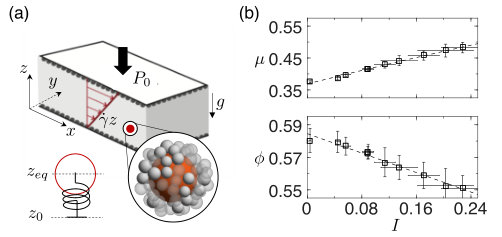 Figure 1
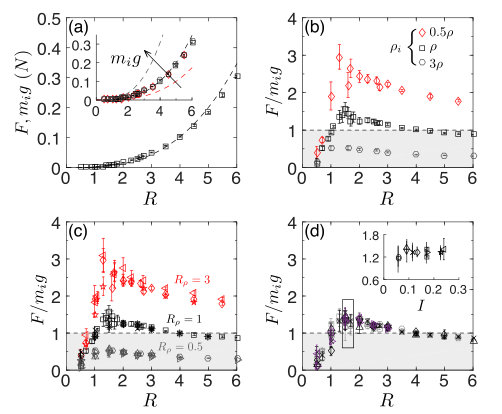 Figure 2
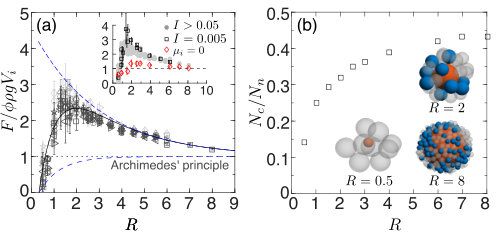 Figure 3
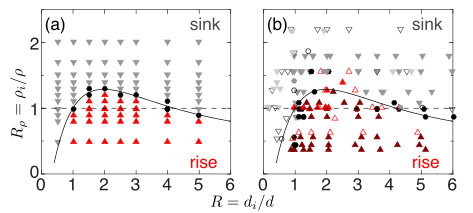 Figure 4
Peer Reviews
No public reviews on file for this paper yet. If you reviewed it on a platform where reviews are public (OpenReview, ICLR, NeurIPS, ICML), you can paste yours below so the community can read it here.
Videos
No videos yet. Explain this paper in a talk, walkthrough, or lecture? Add one.
Modified Archimedes’ principle predicts rising and sinking of intruders in sheared granular flows
Lu Jing
Department of Chemical and Biological Engineering, Northwestern University, Evanston, IL 60208, USA
Julio M. Ottino
Department of Chemical and Biological Engineering, Northwestern University, Evanston, IL 60208, USA
Department of Mechanical Engineering, Northwestern University, Evanston, IL 60208, USA
Northwestern Institute on Complex Systems (NICO), Northwestern University, Evanston, IL 60208, USA
Richard M. Lueptow
Department of Chemical and Biological Engineering, Northwestern University, Evanston, IL 60208, USA
Department of Mechanical Engineering, Northwestern University, Evanston, IL 60208, USA
Northwestern Institute on Complex Systems (NICO), Northwestern University, Evanston, IL 60208, USA
Paul B. Umbanhowar
Department of Mechanical Engineering, Northwestern University, Evanston, IL 60208, USA
(March 17, 2024)
Abstract
We computationally determine the force on single spherical intruder particles in sheared granular flows as a function of particle size, particle density, shear rate, overburden pressure, and gravitational acceleration. The force scales similarly to, but deviates from, the buoyancy force predicted by Archimedes’ principle. The deviation depends only on the intruder to bed particle size ratio, but not the density ratio or flow conditions. We propose a simple force model that successfully predicts whether intruders rise or sink, knowing only the size and density ratios, for a variety of flow configurations in physical experiments.
Intruder particles in fluidized or flowing granular beds tend to segregate (rise or sink) due to their size or density difference with the bed particles Duran et al. (1993); Knight et al. (1993); Shinbrot and Muzzio (1998); Möbius et al. (2001); Shishodia and Wassgren (2001); Hong et al. (2001); Breu et al. (2003); Huerta and Ruiz-Suárez (2004); Huerta et al. (2005); Tripathi and Khakhar (2011); van der Vaart et al. (2015); Guillard et al. (2016); Jing et al. (2017); van der Vaart et al. (2018); Staron (2018). Segregation in vibrofluidized systems, the Brazil nut effect Möbius et al. (2001), depends on various mechanisms Duran et al. (1993); Knight et al. (1993); Shinbrot and Muzzio (1998); Möbius et al. (2001); Shishodia and Wassgren (2001); Hong et al. (2001); Breu et al. (2003); Huerta and Ruiz-Suárez (2004); Huerta et al. (2005) including buoyancy. With sufficient fluidization, the buoyancy force on an intruder follows Archimedes’ principle Shishodia and Wassgren (2001); Huerta et al. (2005), thus explaining the phase transition between normal and reverse Brazil nut effects Hong et al. (2001); Breu et al. (2003). In contrast to this clear picture, the force driving segregation in sheared granular flows remains elusive. While extensive research has focused on segregation of flowing bidisperse mixtures from the continuum perspective Gray (2017); Umbanhowar et al. (2019), quantitative studies of the particle-scale segregation force are fewer and more recent. Guillard et al. (2016) proposed a virtual spring based force meter in numerical simulations that allows direct measurement of the segregation force in shear flows. They interpreted the force as summed contributions from normal and shear stress gradients. Van der Vaart et al. van der Vaart et al. (2018) applied a similar approach in chute flows and decomposed the measured force into lift and buoyancy-like forces. Despite these insights, a generalized characterization of the segregation force is still lacking in either size van der Vaart et al. (2015); Guillard et al. (2016); Jing et al. (2017); van der Vaart et al. (2018); Staron (2018) or density Tripathi and Khakhar (2011) segregation, as well as more complicated situations of combined size and density segregation. For example, Félix and Thomas (2004) found an interplay between size and density whereby segregation can change direction (rise or sink) more than once with the monotonic increase of intruder size. This raises the question whether intruder segregation is predictable knowing only the size and density differences.
This Letter solves the puzzle by providing a generalized force model that allows shear-induced segregation to be viewed as a result of the imbalance between the gravitational force and a modified Archimedes buoyancy force. The model successfully predicts segregation transitions in various experiments over a wide range of size and density ratios, which enhances prediction of size and density segregation in industrial and geophysical granular flows.
*Methods.—*We simulate single spherical intruders in sheared granular flows using a discrete element method code liggghts Kloss et al. (2012). As sketched in Fig. 1(a), bed particles of diameter and density are sheared in a streamwise () and spanwise () periodic box of length , height , and width to (varied as needed) in the presence of gravity ( ). We use , with uniform size polydispersity to avoid layering, , and the Hertz contact model with Young’s modulus , Poisson’s ratio , restitution coefficient , and friction coefficient . The top and bottom walls are roughened with randomly distributed stationary particles to prevent slippage Jing et al. (2016), and an overburden pressure is applied on the top wall. The shear flow is driven by moving the top wall and applying a stabilizing force to each particle in the -direction Fry et al. (2018); at each time step, for a particle with streamwise velocity and vertical position , a small force proportional to is added to maintain a linear velocity profile across all particles [Fig. 1(a)]. This allows us to conveniently generate a wide range of shear flows with \mathrm{P}\mathrm{a}\mathrm{P}\mathrm{a} and $1\leavevmode\nobreak\ $\mathrm{s}^{-1}$\leqslant\dot{\gamma}\leqslant 40\leavevmode\nobreak\ $\mathrm{s}^{-1}. As Fig. 1(b) shows, the inertial number ranges from to , where is the vertical normal stress, and the effective friction and packing fraction follow the rheology Jop et al. (2006).
An intruder of diameter and density is placed near the middle of the bed (initial height ), with size ratio varying from to and density ratio varying from to . The same streamwise stabilizing force applies to the intruder. To measure the vertical force driving segregation, we follow Guillard et al. (2016) and tether the intruder to a vertical spring (leaving free the other five degrees of freedom), which causes it to fluctuate about an equilibrium height [Fig. 1(a)]. In steady state, the net contact force exerted on the intruder by the neighboring bed particles, the bed force , is balanced by the spring force and the gravitational force, i.e., , where is the virtual spring stiffness and is the intruder mass. The spring acts as a virtual force meter and the measurement of is insensitive to Guillard et al. (2016); van der Vaart et al. (2018). Uncertainties (error bars) of are estimated considering temporal correlations Zhang (2006) of the fluctuations of the intruder height about .
Results.—Figure 2(a) shows that, for , (symbols) and (dashed curve) increase similarly with . However, subtle differences between and indicate imbalanced forces that drive segregation. To better visualize the differences, the ratio is plotted in Fig. 2(b). Focusing on , is less than one for , i.e., a small intruder is pulled down by gravity. As is increased above one, becomes greater than one, i.e, a large intruder is pushed up by the bed force. These scenarios are consistent with typical percolation and squeeze expulsion explanations for size segregation Savage and Lun (1988); Jing et al. (2017). Notably, falls slightly below one for , since increases more rapidly than as increases; thus, very large intruders sink. Such reverse segregation has been reported Félix and Thomas (2004) but not yet quantitatively addressed Guillard et al. (2016); van der Vaart et al. (2018).
Next, we vary by changing . The inset of Fig. 2(a) shows that remains unchanged as increases from to (different symbols), whereas obviously depends on (dashed curves). Therefore, the intruder density (and the weight) does not directly affect the bed force but alters segregation behavior by changing the ratio . As shown in Fig. 2(b), a sufficiently heavy intruder () sinks regardless of its diameter, as the bed force can never support its weight; a light intruder () rises for , as its weight is less than the force pushing it upward.
We also vary by changing at constant such that remains the same but varies significantly. Combined with the data in Fig. 2(b), plots for different and collapse on curves distinguished only by [Fig. 2(c)], i.e., whether an intruder rises or sinks is determined only by the relative diameter and density.
Finally, Fig. 2(d) shows that flow conditions , , and have no significant impact on over a wide range of variation. As illustrated in Fig. 2(d) inset, is essentially independent of for , a range encompassing typical inertial flows Azéma and Radjaï (2014). Reducing toward the quasistatic limit (typically ) may enhance the segregation force Guillard et al. (2016), a point we address below.
*Scaling.—*We now focus on the scaling of and test an Archimedes buoyancy-like force scale, , where is the intruder volume, viewing the flow as a “fluid” of bulk density with normal stress gradient . Figure 3(a) shows vs. for distinct simulations. All data collapse on a master curve, confirming that scales with the buoyancy force. However, the master curve deviates from ; it starts below one for , increases and reaches a maximum of about at , and approaches one as increases to large values.
The deviation between and appears to originate in geometric effects at the particle level. For relatively large intruders [e.g., in Fig. 3(b) inset], a large number of contacting neighbor particles (blue) transmit contact stress in a nearly uniform manner, consistent with the fluid buoyancy analogy van der Vaart et al. (2018). As is decreased to intermediate values (e.g., ), contact uniformity breaks down significantly; this is characterized by the time-averaged number ratio of contacting neighbor particles () to all “nearby” particles () defined within a distance from the intruder center, which decreases rapidly as decreases [Fig. 3(b)]. Consequently, noncontacting neighbor particles (gray) are more likely to lose connection in stress transmission, which in turn leads to more contact forces passing through the intruder and thus a higher net force compared to the uniform limiting case, i.e., . As is further decreased below one (e.g., ), brief collisions dominate Silbert et al. (2007) and the intruder tends to percolate through voids without enduring contacts Jing et al. (2017), resulting in a net contact force smaller than the uniform limiting case, i.e., .
The geometric effects are associated with the frictional nature of granular contacts. For frictionless intruders [ in Fig. 3(a) inset], collapses toward one, explaining previous observations that large intruders do not rise with low friction Jing et al. (2017); van der Vaart et al. (2018). In nearly quasistatic flows [ in Fig. 3(a) inset], is higher likely due to enhanced frictional resistance to deformation near yielding Kang et al. (2018). This effect tends to plateau above yielding, explaining the insensitivity of to in Fig. 2(d). A similar trend of enhanced segregation force only at very low was found in previous two-dimensional simulations Guillard et al. (2016).
*Model.—*The master scaling curve in Fig. 3(a) suggests a modified Archimedes’ principle of the form
[TABLE]
where is a dimensionless scale factor. Based on two geometric effects that dominate in different ranges of , i.e., percolation-induced force weakening for and nonuniformity-induced force strengthening for , we propose , where , , , and are fitting parameters. The first term [lower dashed curve in Fig. 3(a)] represents stronger percolation (thus smaller bed force) as decreases; its exponential form is chosen to reconcile the exponential dependency of percolation probability Savage and Lun (1988) and percolation velocity Khola and Wassgren (2016) on . The second term [upper dashed curve in Fig. 3(a)], which decreases toward one as increases, accounts for decreased uniformity of contacts around the intruder at small [Fig. 3(b)]. Fitting to the data in Fig. 3(a) gives , , , and , where and are characteristic size ratios for the two effects to dominate. The two terms together recover the continuum argument, , and the force balance in monodisperse flows, (i.e., at ). Although is case specific, the fitting results in , a value agreeing with Fig. 1(b), which further supports the model.
Despite the empirical formulation of , the model adopts a minimum number of parameters to describe the data over the full range of , clearly indicates two geometric effects, each associated with physically reasonable characteristic size ratios, and is appropriately constrained by limiting cases. Moreover, it provides a simple means to predict segregation based only on and . An intruder in a sheared bed is “neutral” when the bed force offsets its weight , i.e., , which describes a curve dividing the - space into “rise” (below the curve) and “sink” (above the curve) zones; see Fig. 4. To validate this phase diagram, we simulate single untethered intruders with varying and , observing whether they rise, sink, or neither (i.e., mean displacement less than ) over of simulation. The predictions are in excellent agreement with the simulation results [Fig. 4(a)].
To further demonstrate the generality of the segregation transition predicted by Eq. (1), we compare it with experiments by Félix and Thomas (2004), who studied segregation of tracer particles of different sizes and densities in various configurations, i.e., rotating drums, chute flows, and heap flows. Despite the different flow geometries, the segregation direction in the experiments agrees remarkably well with the predictions of our phase diagram [Fig. 4(b)], showing the capability of our model to predict segregation for varying size and density ratios as well as different flow conditions. The few mismatches occurring near the neutral curve are mainly from chute and heap flows, where only loose criteria for the segregation direction were applied in the experiments Félix and Thomas (2004).
Discussion.—Our segregation force model respects the continuum limit () in that whether an intruder rises or sinks depends only on its density relative to the surrounding flow (), noting . For intruders somewhat larger than the bed particles (), discrete particle interactions result in a positive deviation from Archimedes’ principle, an extra lift effect underlying the rise of large particles in many size segregation studies Gray (2017); Umbanhowar et al. (2019). The maximum deviation at explains the optimal segregation rate at and the saturation of segregation velocity for Golick and Daniels (2009); Schlick et al. (2015); Jones et al. (2018). The modified Archimedes’ principle described here bridges segregation mechanisms in noncontinuum situations with the continuum buoyancy force, suggesting a unifying framework for understanding forces in granular media. Indeed, Archimedes’ principle with appropriate corrections applies to dense granular shear flows (this work), creeping granular fluids Nichol et al. (2010), vibrofluidized granular gases Huerta and Ruiz-Suárez (2004); Huerta et al. (2005), and plastic granular solids near yielding Kang et al. (2018).
The model proposed here enables prediction of intruder segregation for various flow configurations based only on size and density ratios. The finding that is insensitive to external flow conditions is not to be confused with the known effects of shear rate and confining pressure on segregation velocity Fry et al. (2018); Fan et al. (2014); Schlick et al. (2015); Liu and McCarthy (2017). While the direction of segregation is determined by competition between the bed force and the gravitational force, the segregation velocity depends further on resistive forces (often viewed as drag). Understanding the drag force has proved challenging due to the difficulty in isolating driving and drag terms from contact forces Tripathi and Khakhar (2011); Staron (2018); Duan et al. (2019). Now with the generalized driving force model we provide, it is possible to calculate the drag force on moving intruders. It is also relevant to consider varying the particle species concentration around the tethered intruders to account for general industrial and geophysical settings Gray and Thornton (2005); Tunuguntla et al. (2014); Hill and Tan (2014); Gray and Ancey (2015); Xiao et al. (2016, 2017); Deng et al. (2018) where the segregation force depends on the particle species concentration van der Vaart et al. (2015); Jones et al. (2018).
The authors acknowledge Adithya Shankar for his contributions to preliminary stages of this work.
The reference list from the paper itself. Each links out to its DOI / PubMed record.
- 1Duran et al. (1993) J. Duran, J. Rajchenbach, and E. Clément, Arching effect model for particle size segregation, Phys. Rev. Lett. 70 , 2431 (1993) .
- 2Knight et al. (1993) J. B. Knight, H. M. Jaeger, and S. R. Nagel, Vibration-induced size separation in granular media: The convection connection, Phys. Rev. Lett. 70 , 3728 (1993) . · doi ↗
- 3Shinbrot and Muzzio (1998) T. Shinbrot and F. J. Muzzio, Reverse buoyancy in shaken granular beds, Phys. Rev. Lett. 81 , 4365 (1998) . · doi ↗
- 4Möbius et al. (2001) M. E. Möbius, B. E. Lauderdale, S. R. Nagel, and H. M. Jaeger, Brazil-nut effect: Size separation of granular particles, Nature 414 , 270 (2001) . · doi ↗
- 5Shishodia and Wassgren (2001) N. Shishodia and C. R. Wassgren, Particle segregation in vibrofluidized beds due to buoyant forces, Phys. Rev. Lett. 87 , 084302 (2001) . · doi ↗
- 6Hong et al. (2001) D. C. Hong, P. V. Quinn, and S. Luding, Reverse Brazil nut problem: Competition between percolation and condensation, Phys. Rev. Lett. 86 , 3423 (2001) . · doi ↗
- 7Breu et al. (2003) A. P. J. Breu, H.-M. Ensner, C. A. Kruelle, and I. Rehberg, Reversing the Brazil-nut effect: Competition between percolation and condensation, Phys. Rev. Lett. 90 , 014302 (2003) . · doi ↗
- 8Huerta and Ruiz-Suárez (2004) D. A. Huerta and J. C. Ruiz-Suárez, Vibration-induced granular segregation: A phenomenon driven by three mechanisms, Phys. Rev. Lett. 92 , 114301 (2004) . · doi ↗