Conics in Baer subplanes
S.G. Barwick, Wen-Ai Jackson and Peter Wild
Abstract
This article studies conics and subconics of PG(2,q2) and their representation in the André/Bruck-Bose
setting in PG(4,q). In particular, we investigate their relationship with the transversal lines of the regular spread.
The main result is to show that a conic in a tangent Baer subplane of PG(2,q2) corresponds in PG(4,q) to a normal rational curve that meets the transversal lines of the regular spread. Conversely, every 3 and 4-dimensional normal rational curve in PG(4,q) that meets the transversal lines of the regular spread corresponds to a conic in a tangent Baer subplane of PG(2,q2).
Keywords: Bruck-Bose representation, Baer subplanes, conics, subconics
AMS code: 51E20
1 Introduction
This article investigates the representation of conics and subconics of PG(2,q2) in the
Bruck-Bose representation in PG(4,q). The Bruck-Bose representation of PG(2,q2) uses a regular spread S in the hyperplane at infinity of PG(4,q). The regular spread S has two unique transversal lines g,gq in the quadratic extension PG(4,q2). There are several known characterisations of objects of PG(4,q) in terms of their relationship with these transversal lines.
Firstly, a conic C in PG(4,q) corresponds to a Baer subline of PG(2,q2) iff the extension of C to a conic of PG(4,q2) contains a point of g and a point of gq, see [13]. A ruled cubic surface V in PG(4,q) corresponds to a Baer subplane of PG(2,q2) iff the extension of V to PG(4,q2) contains g and gq, see [13]. Further, an orthogonal cone U corresponds to a classical unital of PG(2,q2) iff the extension of U to PG(4,q2) contains g and gq, see [16]. Hence the
interaction of certain objects with the transversals of S is intrinsic to their characterisation in PG(2,q2).
In this article we study conics and subconics of PG(2,q2), and determine their relationship with the transversals of S in the Bruck-Bose setting in PG(4,q). In particular, we characterise normal rational curves of PG(4,q) whose extension meets the transversals as subconics of PG(2,q2).
The article is set out as follows. Section 2 introduces the necessary background and proves some preliminary results. In particular, in order to study how objects of the Bruck-Bose representation relate to the transversals of the regular spread S, we formally define in Section 2.6 the notion of special sets in PG(4,q). Further, in Section 2.11, we consider a Baer subplane B tangent to ℓ∞, and give a geometric construction via PG(4,q) that partitions the affine points of B into q conics, one of which is degenerate.
In Section 3, we discuss how the notion of specialness relates to the known Bruck-Bose representation of Baer sublines and Baer subplanes.
In Section 4, we investigate non-degenerate conics of PG(2,q2) in the PG(4,q) Bruck-Bose representation.
In particular, we investigate the corresponding structure in the quadratic extension to PG(4,q2). We show that in PG(4,q2), the (extended) structure corresponding to a non-degenerate conic O is the intersection of two quadrics which meet g in the two points (possibly repeated or in an extension) corresponding to O∩ℓ∞.
In Section 5 we characterise the Bruck-Bose representation of conics contained in Baer subplanes. In PG(2,q2), let B be a Baer subplane tangent to ℓ∞, and C a non-degenerate conic contained in B. We show that in PG(4,q), C corresponds to a normal rational curve that meets the transversals of the regular spread. Conversely, we characterise every normal rational curve in PG(4,q) that meets the transversals of the regular spread as corresponding to a non-degenerate conic in a Baer subplane of PG(2,q2).
While the proofs in Section 4 are largely coordinate based, the proofs in Section 5 use geometrical arguments.
2 Background and Preliminary Results
In this section we give the necessary background, introduce the notation we use in this article, and prove a number of preliminary results.
2.1 Conjugate points
For q a prime power, we denote the unique finite field of order q by Fq.
We use the phrase conjugate points in several different settings. Firstly, consider the automorphism x↦xq for x∈Fqr, it induces an automorphic collineation of PG(n,qr)
where a point X=(x0,…,xn)↦Xq=(x0q,…,xnq). The points X,Xq,…,Xqn−1 are called conjugate. Secondly, let B be a Baer subplane of PG(2,q2), them there is a unique involutory collineation that fixes B pointwise, and we call this map conjugacy with respect to B.
Note that P,Q∈ℓ∞ are conjugate with respect to the secant Baer subplane B if and only if P,Q are conjugate with respect to the Baer subline B∩ℓ∞.
2.2 Spreads in PG(3,q)
The following construction of a regular spread of PG(3,q) will be
needed, see [15] for
more information on spreads. Embed PG(3,q) in PG(3,q2) and let g be a line of
PG(3,q2) disjoint from PG(3,q).
The
line g has a conjugate line gq with respect to the map x↦xq, x∈Fq2, and gq is also disjoint from PG(3,q). Let Pi be
a point on g; then the line ⟨Pi,Piq⟩ meets
PG(3,q) in a line. As Pi ranges over all the points of g, we obtain
q2+1 lines of PG(3,q) that partition PG(3,q). These lines form a
regular spread S of PG(3,q). The lines g, gq are called the (conjugate
skew) transversal lines of the regular spread S. Conversely, given a regular spread S
in PG(3,q),
there is a unique pair of transversal lines in PG(3,q2) that generate
S in this way.
2.3 The Bruck-Bose representation
We will use the linear representation of a finite
translation plane of dimension at most two over its kernel,
due independently to
André [1] and Bruck and Bose
[9, 10].
Let Σ∞ be a hyperplane of PG(4,q) and let S be a spread
of Σ∞. We use the phrase a subspace of PG(4,q)\Σ∞ to
mean a subspace of PG(4,q) that is not contained in Σ∞. Consider the following incidence
structure:
the points of A(S) are the points of PG(4,q)\Σ∞; the lines of A(S) are the planes of PG(4,q)\Σ∞ that contain
an element of S; and incidence in A(S) is induced by incidence in
PG(4,q).
Then the incidence structure A(S) is an affine plane of order q2. We
can complete A(S) to a projective plane P(S); the points on the line at
infinity ℓ∞ have a natural correspondence to the elements of the spread S. We call this the Bruck-Bose representation of P(S) in PG(4,q).
The projective plane P(S) is the Desarguesian plane PG(2,q2) if and
only if S is a regular spread of Σ∞≅PG(3,q) (see [6]).
We use the following notation in the Bruck-Bose setting.
S is a regular spread with transversal lines g,gq.
An affine point of PG(2,q2)\ℓ∞ is denoted with a capital letter, A say, and
[A] denotes the corresponding point of PG(4,q)\Σ∞.
A point on ℓ∞ in PG(2,q2) is denoted with an over-lined capital letter, Tˉ say, and the corresponding spread line is denoted [T].
The points of ℓ∞ are in 1-1 correspondence with the points of g; for a point Tˉ∈ℓ∞, we denote the corresponding point of g by T.
A set of points X in PG(2,q2) corresponds to a set of points denoted [X] in PG(4,q).
We will work in the extension of PG(4,q) to PG(4,q2) and to PG(4,q4).
Let K be a
primal of PG(4,q),
so K is the set of points of PG(4,q) satisfying a homogeneous equation f(x0,…,x4)=0, with coefficients in Fq.
We define K\mboxI to be the (unique) primal of PG(4,q2) which is the set of points of PG(4,q2) satisfy the same homogeneous equation f=0.
Note that if K=Π is an r-dimensional subspace of PG(4,q), then Π\mboxI is the (unique) r-dimensional subspace of PG(4,q2) containing Π.
Further, if V is a variety of PG(4,q), so V is the intersection of primals K1,…,Ks, then we define V\mboxI=K1\mboxI∩⋯∩Ks\mboxI.
Similarly, we can extend a primal K to PG(4,q4), and we denote the resulting set by K\mboxH.
The transversals g,gq of the regular spread S lie in PG(4,q2), and we denote their extensions to lines of PG(4,q4) by g\mboxH,gq\mboxH respectively.
2.4 Ruled cubic surfaces in PG(4,q)
A ruled cubic surface V of PG(4,q) consists of a line directrix t, a conic directrix C lying in a plane disjoint from t, and a set of q+1 pairwise disjoint generator lines joining the points of t and C according to a projectivity ω∈PGL(2,q). That is, let θ,ϕ∈Fq∪{∞} be the non-homogeneous coordinates of t,C respectively, and ω:(1,θ)↦(1,ϕ), then the generators of V are the lines joining points of t to the corresponding point of C under ω.
We will need the following result which shows how hyperplanes of PG(4,q) meet a ruled cubic surface.
Result 2.1
[17]** A hyperplane of PG(4,q) meets a ruled cubic surface in one of the following.
The line directrix; (q2−q)/2 hyperplanes do this.
The line directrix and one generator line; q+1 hyperplanes do this.
The line directrix and two generator lines; (q2+q)/2 hyperplanes do this.
A conic and a generator line; q3+q2 hyperplanes do this.
A twisted cubic curve (which meets the line directrix in a unique point); q4−q2 hyperplanes do this.
Corollary 2.2
Let Π be a hyperplane of PG(4,q) that meets a ruled cubic surface V in a twisted cubic N. Then N meets each generator line of V in a unique point.
Proof
If N meets a generator line ℓ of V in two points, then the 3-space Π containing N also contains ℓ, which is not possible by Result 2.1. Hence N meets each generator line in at most one point. As N contains q+1 points, each generator of V contains a unique point of N.
□
There are two ways to extend the ruled cubic surface to PG(4,q2), we show that they are equivalent.
The ruled cubic surface V is a variety whose points are the exact intersection of three quadrics, V=Q0∩Q1∩Q2 (see for example [3]). So extending this variety to PG(4,q2) yields V\mboxI=Q0\mboxI∩Q1\mboxI∩Q2\mboxI. Alternatively, we can
extend V to PG(4,q2) as in [13]: namely extending the line directrix t and conic directrix C to PG(4,q2) by taking θ,ϕ∈Fq2∪{∞}, and extending the projectivity ω to act over Fq2. We denote this extension by V′, thus V′ is the ruled cubic surface with line directrix t\mboxI, conic directrix C\mboxI, and ruled using the (extended) projectivity ω.
We show that these two extensions V\mboxI, V′ are the same. The surface V contains exactly q2 conics C1,…,Cq2, and these conics cover each point of V\t q times (see [2] for more details). Hence both sets V\mboxI,V′ contain the extended conics C1\mboxI,…,Cq2\mboxI. Moreover, these conics together with t\mboxI cover all the points of V′, and so V\mboxI contains V′. However, V\mboxI is the intersection of three quadrics over Fq2, whose intersection over Fq is a ruled cubic surface. By [5], all ruled cubic surfaces are projectively equivalent, hence V\mboxI and V′ are the same ruled cubic surface of PG(4,q2).
2.5 Coordinates in Bruck-Bose
We now show how the coordinates of points in
PG(2,q2) relate to the coordinates of the corresponding points
in the Bruck-Bose representation in PG(4,q). See [2, Section 3.4] for more details.
Let τ be a primitive element in Fq2 with primitive
polynomial
x2−t1x−t0
over Fq. Then every
element α∈Fq2 can be uniquely written as
α=a0+a1τ with a0,a1∈Fq. That is,
Fq2={x0+x1τ∣x0,x1∈Fq}. It is useful to keep in mind the relationships: ττq=−t0, τ+τq=t1, t0/τ=−τq=τ−t1 and τq2=1.
Points in PG(2,q2) have homogeneous coordinates
(x,y,z) with x,y,z∈Fq2, not all zero.
We let the line at infinity ℓ∞
have equation z=0, so affine points of
PG(2,q2) have
coordinates (x,y,1), with x,y∈Fq2.
Points in PG(4,q) have homogeneous coordinates
(x0,x1,y0,y1,z) with
x0,x1,y0,y1,z∈Fq, not all zero. We let the hyperplane at infinity
Σ∞ have equation z=0, so the affine points of
PG(4,q) have coordinates
(x0,x1,y0,y1,1), with x0,x1,y0,y1∈Fq.
Let A be an affine point in PG(2,q2) with coordinates A=(x0+x1τ,y0+y1τ,z), where x0,x1,y0,y1,z∈Fq, z=0.
The map
[TABLE]
is a bijection from the affine points of
PG(2,q2) to the affine points of PG(4,q), called
the Bruck-Bose map.
We can extend this to a projective map; for a point Tˉ=(δ,1,0)∈ℓ∞, write
δ=d0+d1τ∈Fq2, d0,d1∈Fq, then
[TABLE]
The transversal lines g,gq of S have coordinates given by:
[TABLE]
Recall that each line of the regular spread S meets the transversal g of S in a point.
The 1-1 correspondence between points of ℓ∞ and points of g is:
[TABLE]
that is, T=[T]\mboxI∩g and [T]\mboxI=TTq.
2.5.1 Coordinates and the quartic extension PG(4,q4)
We will be interested in non-degenerate conics of PG(2,q2), and one of the cases to consider is when a conic C is exterior to ℓ∞, and so meets ℓ∞ in two points which lie in the quadratic extension of PG(2,q2) to PG(2,q4).
That is, C meets ℓ∞ in two points Pˉ,Qˉ over Fq4. Note that Pˉ,Qˉ are conjugate with respect to the map x↦xq2, x∈Fq4, that is Qˉ=Pˉq2. There is no direct representation for the point Pˉ in the Bruck-Bose representation in PG(4,q). However, there is a related point in the quartic extension PG(4,q4). We can extend the 1-1 correspondence between points ℓ∞ and points of g to a 1-1 correspondence between points of the quadratic extension of ℓ∞ and points of the extended transversal g\mboxH in PG(4,q4), so
[TABLE]
If Pˉ=(α,1,0) for some α∈Fq4\Fq2, that is Pˉ∈PG(2,q4)\PG(2,q2), then in PG(4,q4), the corresponding point P lies in g\mboxH\g, and the conjugate point Pq=αqA0q+A1q lies on gq\mboxH\gq. As Pˉ∈/PG(2,q2), the line PPq is not a line of the spread S; PPq is a line of PG(4,q4) that does not meet Σ∞.
2.6 g-special sets
When studying curves of PG(2,q2) in the PG(4,q) Bruck-Bose setting, the transversals g,gq of the regular spread S play an important role in characterisations.
Let V be a variety or rational curve in PG(4,q),
we are interested in how V\mboxI meets g,gq
in the extension to PG(4,q2). Note that if V\mboxI meets g in a point P, then as V is defined over Fq, V\mboxI also meets gq in the point Pq.
A non-degenerate conic C in PG(4,q) is called a g-special conic if in PG(4,q2), C\mboxI contains one point of g, and one point of gq.
A twisted cubic N in PG(4,q) is called a g-special twisted cubic if in PG(4,q2), N\mboxI contains one point of g, and one point of gq.
A 4-dimensional normal rational curve N in PG(4,q) is called a g-special normal rational curve if in PG(4,q2), N\mboxI contains two points of g (possibly repeated) and two points of gq. Further, N is called g\mboxH-special if in the quartic extension PG(4,q4), N\mboxH contains two points of the extended transversal g\mboxH\g.
A ruled cubic surface V in PG(4,q) is called a g-special ruled cubic surface if in PG(4,q2), V\mboxI contains g and gq.
2.7 Representations of Baer sublines and subplanes
We use the following representations of Baer sublines and subplanes of PG(2,q2) in PG(4,q), see [2] for more details.
Result 2.3
Let S be a regular spread in a 3-space Σ∞ in PG(4,q) and consider the representation of the Desarguesian plane P(S)=PG(2,q2) defined by the Bruck-Bose construction.
-
A Baer subline of ℓ∞ in PG(2,q2) corresponds to a regulus of S.
2. 2.
A Baer subline of PG(2,q2) that meets ℓ∞ in a point corresponds to a line of PG(4,q)\Σ∞.
3. 3.
A Baer subplane of PG(2,q2) secant to ℓ∞ corresponds to a plane of PG(4,q)\Σ∞ not containing a spread line.
4. 4.
A Baer subline of PG(2,q2) that is disjoint from ℓ∞ corresponds in PG(4,q) to a g-special conic.
5. 5.
A Baer subplane tangent to ℓ∞ at a point Tˉ corresponds in PG(4,q) to a g-special ruled cubic surface containing the corresponding spread line [T].
Moreover, the converse of each of these correspondences holds.
Remark 2.4
The correspondences in parts 2 and 3 are not exact at infinity. The exact at infinity representation of a Baer subline that meets ℓ∞ in a point T is an affine line that meets the spread line [T] union with the spread line [T]. Similarly, the exact at infinity representation of a secant Baer subplane is a plane α not containing a spread line, union the lines of S that α meets.
2.8 Representations of subconics
The representation of non-degenerate conics contained in a Baer subplane was considered in [17].
Result 2.5
[17]**
Let C be a non-degenerate conic contained in a Baer subplane B of PG(2,q2).
-
Suppose B is secant to ℓ∞, then C corresponds to a non-degenerate conic in the plane [B] of PG(4,q).
2. 2.
Suppose B is tangent to ℓ∞, B∩ℓ∞∈C, and q≥3. Then C corresponds to a twisted cubic on the ruled cubic surface [B] of PG(4,q).
3. 3.
Suppose B is tangent to ℓ∞, B∩ℓ∞∈/C, and q≥4. Then C corresponds to a 4-dimensional normal rational curve on the ruled cubic surface [B] of PG(4,q).
In Section 5, we show that the 3- and 4-dimensional normal rational curves of Result 2.5 are g-special. Conversely, we show that every g-special normal rational curve in PG(4,q) corresponds to a non-degenerate conic contained in a tangent Baer subplane.
Remark 2.6
The correspondence in Result 2.5 parts 1 and 2 is not exact at infinity (compare with
Remark 2.4). For example, in part 2, the point Tˉ=B∩ℓ∞ is in [C], and the twisted cubic [C] meets Σ∞ in a point of [T]. The exact-at-infinty representation is:
the set [C] is a twisted cubic union the spread line [T]. We use the simpler, not exact-at-infinity correspondence given in Result 2.5 as it does not lead to any confusion.
**
2.9 The circle geometry CG(2,q)
Circle geometries CG(d,q), d≥2 were introduced in [7, 8], and we summarise the results we need here. Note that CG(2,q) is an inversive plane. We can construct CG(2,q) from the line PG(1,q2), in this case the circles are the Baer sublines of PG(1,q2). Equivalently, we can construct CG(2,q) from the lines of a regular spread S of PG(3,q), in this case the circles are the reguli contained in S.
Using the representation of CG(2,q) as ℓ∞≅PG(1,q2), we can use properties of the circle geometry to deduce several properties of the projective plane PG(2,q2).
If Pˉ,Qˉ are two distinct points on ℓ∞ in PG(2,q2),
then there is a unique partition of ℓ∞ into Pˉ,Qˉ and q−1 Baer sublines ℓ1,…,ℓq−1, where the points Pˉ,Qˉ are conjugate with respect to each Baer subline ℓi. Further, if
B is a Baer subplane secant to ℓ∞, such that Pˉ,Qˉ are conjugate with respect to B, then B meets ℓ∞ in one of the Baer sublines ℓi.
Of particular interest is an
application to conics.
Result 2.7
Let O be a non-degenerate conic of PG(2,q2) that meets ℓ∞ in {Pˉ,Qˉ}. Then there is a unique partition of the q2−1 affine points of O into q−1 subconics C1,…,Cq−1, lying in Baer subplanes B1,…,Bq−1 which are secant to ℓ∞. Further, the Baer sublines Bi∩ℓ∞ are either equal or disjoint
The properties of the circle geometry also lead to properties of a regular spread S in PG(3,q).
Let g,gq be the transversals of S, so g,gq lie in PG(3,q2).
Consider the set of lines of PG(3,q2) that meet both g and gq. This set is called
the hyperbolic congruence of g,gq in [14]. Note that if two distinct lines in the hyperbolic congruence meet, then they meet on g or gq. The hyperbolic congruence contains the extended spread lines [P]\mboxI=PPq for P∈g and the lines PQq for distinct P,Q∈g.
The lines PQq have an interesting relationship with the regular spread S.
Result 2.8
[8]** Let [P],[Q] be two lines of a regular spread S in PG(3,q), and denote their intersection with transversal g of S by P,Q respectively. Then there is a unique partition of S into [P],[Q] and q−1 reguli R1,…,Rq−1. Denote the opposite regulus of Ri by Ri′. Then the set {[P],[Q],R1′,…,Rq−1′} is a regular spread with transversals
PQq, PqQ.
We will show that the lines in the hyperbolic congruence of g,gq are related to the Bruck-Bose representation of non-degenerate conics of PG(2,q2) in PG(4,q).
2.10 Normal rational curves contained in quadrics
Next, we show that if a normal rational curve is contained in a quadric in PG(4,q), then the containment also holds in the quadratic extension PG(4,q2), provided q is not small.
Lemma 2.9
In PG(4,q), q>7, let N be a 4-dimensional normal rational curve and Q a quadric, with N⊂Q. Then in the quadratic extension PG(4,q2), N\mboxI⊂Q\mboxI.
Proof Without loss of generality, let N={Pθ=(1,θ,θ2,θ3,θ4)∣θ∈Fq∪{∞}}.
Let Q have equation g(x0,x1,x2,x3,x4)=0. Consider g(Pθ)=g(1,θ,θ2,θ3,θ4)=f(θ). As Q is a quadric, f(θ) is a polynomial in θ of degree at most 8. Now as N⊂Q, f(Pθ)=0 for all θ∈Fq∪{∞}. So if q+1>8, f is identically 0, and so
f(Pθ)=0 for all θ∈Fq2. Using θ=∞, this implies that the coefficient of θ8 is zero, thus the degree of f is at most 7. As f(θ)=0 for the q values of θ∈Fq, it follows that f has q roots, so if q>7 then f is the zero polynomial, thus f(θ)=0 for all θ in any extension of Fq, and so g(Pθ)=0 for all θ in any extension of Fq. So if q>7, the point Pθ, θ∈Fq2∪{∞}, lies on Q\mboxI, and so N\mboxI⊂Q\mboxI.
□
The bound on q in Lemma 2.9 is tight as shown by the following example. In PG(4,7), let
N be the normal rational curve N={Pθ=(1,θ,θ2,θ3,θ4)∣θ∈GF(7)∪{∞}} and let Q be the quadric with equation f(x0,x1,x2,x3,x4)=−x0x1−x32+x2x4+x3x4. First note that f(Pθ)=θ7−θ=0 for all θ∈GF(7). Further, P∞=(0,0,0,0,1), so f(P∞)=0. Hence N⊂Q in PG(4,7). Now extend GF(7) to GF(72) using a primitive element τ. The point Pτ=(1,τ,τ2,τ3,τ4) lies in the extended curve N\mboxI. However f(Pτ)=τ7−τ=0 as τ∈GF(7), and so Pτ does not lie on the extended quadric Q\mboxI, that is N\mboxI⊂Q\mboxI.
2.11 Baer pencils and partitions of Baer subplanes
In this section we investigate the representation in PG(2,q2) of a 3-space of PG(4,q). We use this to partition tangent Baer subplanes into conics.
Definition 2.10
A Baer pencil K in PG(2,q2) is the cone of q+1 lines joining a vertex point P to a Baer subline base b. An ℓ∞-Baer pencil K is a Baer pencil with vertex in ℓ∞, and base b meeting ℓ∞ in a point.
Let K be a Baer pencil, then every line of PG(2,q2) not through the vertex of K meets K in a Baer subline. Also note that an
ℓ∞-Baer pencil K contains ℓ∞, and a further q3 affine points.
It is straightforward to characterise the ℓ∞-Baer pencils of PG(2,q2) in PG(4,q).
Lemma 2.11
Let Π be a 3-space in PG(4,q) distinct from Σ∞.
Then Π corresponds in PG(2,q2) to an ℓ∞-Baer pencil with vertex corresponding to the unique spread line in Π. Conversely, any ℓ∞-Baer pencil in PG(2,q2) corresponds to a 3-space of PG(4,q).
We look at how ℓ∞-Baer pencils meet a tangent Baer subplane.
Theorem 2.12
Let B be a Baer subplane in PG(2,q2) tangent to ℓ∞ at the point Tˉ=B∩ℓ∞. An ℓ∞-Baer pencil with vertex Pˉ=Tˉ meets B in
either a non-degenerate conic through Tˉ; or in
two lines, namely the unique line of B whose extension contains Pˉ, and one line through Tˉ.
Of the ℓ∞-Baer pencils with vertex Pˉ, there are q2−1 of the first type, and q+1 of the second type (each containing one of the q+1 lines of B through Tˉ).
Proof In PG(4,q), let X be a point on the spread line [T], and let
α=⟨X,[P]⟩. Label the 3-spaces of
PG(4,q) (not equal to Σ∞) that contain the plane α by L={Π1,…,Πq}. By Lemma 2.11, each 3-space in L
corresponds to an ℓ∞-Baer pencil of PG(2,q2) with vertex P.
Result 2.1 describes how a 3-space meets the
ruled cubic surface [B].
As each 3-space in L meets [T] in one point, and the 3-spaces in L partition the affine points, we deduce that
one of the 3-spaces in L, Π1 say, meets
[B] in a conic and the generator line of [B] through X, and the remaining 3-spaces in L meet [B] in a twisted cubic Ni=Πi∩[B], i=2,…,q.
By Result 2.5, the twisted cubics Ni each correspond in PG(2,q2) to non-degenerate conics in B that contains Tˉ.
Note that there is a unique plane of PG(4,q)\Σ∞ that contains the spread line [P] and meets [B] in a conic; namely the plane that corresponds in PG(2,q2) to the unique line m_{\mbox{\raisebox{-0.25pt}{\scalebox{0.55}{{\boldmath{!P}}}}}} through Pˉ that meets B in a Baer subline.
Hence Π1∩[B] contains the generator line [m] of [B] through the point X, and a conic in the plane [m_{\mbox{\raisebox{-0.25pt}{\scalebox{0.55}{{\boldmath{!P}}}}}}]. This corresponds in PG(2,q2) to an ℓ∞-Baer pencil with vertex Pˉ that meets [B] in the two Baer sublines m_{\mbox{\raisebox{-0.25pt}{\scalebox{0.55}{{\boldmath{!P}}}}}}\cap{\mathscr{B}} and m.
As there are q+1 choices for the point X on [T], there are (q+1)(q−1) 3-spaces about [P] that meets [B] in a twisted cubic, and q+1 that meet [B] in a line and a conic, giving the required number of Baer pencils. □
The next result shows that a non-degenerate conic in B lies in a unique ℓ∞-Baer pencil, and describes the relationship between the conic and the vertex of the pencil.
Theorem 2.13
Let B be a Baer subplane in PG(2,q2) tangent to ℓ∞ at the point Tˉ=B∩ℓ∞ and let C be
a non-degenerate conic in B with Tˉ∈C.
Then C lies in a unique ℓ∞-Baer pencil K. Moreover,
the vertex of K lies in the extension of C to PG(2,q2).
Proof Let C be a non-degenerate conic in B, with Tˉ=B∩ℓ∞∈C. As ℓ∞ is not a line of B, it is not the tangent line of C at the point Tˉ. Let C\scalebox0.5+ be the extension of C to PG(2,q2), then
ℓ∞ is a secant to C\scalebox0.5+, so C\scalebox0.5+∩ℓ∞={Tˉ,Lˉ}. We will show that C lies in a unique ℓ∞-Baer pencil K which has vertex Lˉ.
We first show that any point X∈C\scalebox0.5+ projects C onto a Baer subline.
Without loss of generality, let C={Pθ=(1,θ,θ2)∣θ∈Fq2∪{∞}}, so
C\scalebox0.5+={(1,θ,θ2)∣θ∈Fq∪{∞}}.
Let ω∈Fq2\Fq, so the point
X=(1,ω,ω2) lies in C\scalebox0.5+\C. The projection of the point
Pθ, θ∈Fq∪{∞} from X onto the line ℓ with equation x=0 is Pθ′=(0,1,θ+ω). That is, the projection of C from X onto ℓ is the set {(0,1,ω)+θ(0,0,1)∣θ∈Fq∪{∞}}, which is a Baer subline.
We next show that C lies in a unique ℓ∞-Baer pencil.
By Result 2.5, in PG(4,q), [C] is a twisted cubic meeting the spread line [T] in one point, and [C] lies in a 3-space Π that meets [T] in exactly one point. Hence Π contains a unique spread line [P], with Pˉ=Tˉ. By Lemma 2.11, Π corresponds to an ℓ∞-Baer pencil K with vertex Pˉ, so C lies in the pencil K.
If C were in two ℓ∞-Baer pencils K,K′, then [C] would lie in two 3-spaces ΠK, ΠK′, which is not possible.
Hence C lies in a unique ℓ∞-Baer pencil K with some vertex Pˉ∈ℓ∞. Further, as argued above, the point Lˉ∈C\scalebox0.5+∩ℓ∞ projects C onto a Baer subline, and so C lies in an ℓ∞-Baer pencil with vertex Lˉ. Thus Pˉ=Lˉ as required.
□
The ℓ∞-Baer pencils give rise to partitions of the affine points of a tangent Baer subplane into
q conics: one degenerate and q−1 non-degenerate.
Corollary 2.14
Let B be a Baer subplane in PG(2,q2) tangent to ℓ∞ at the point Tˉ=B∩ℓ∞. For each line m of B through Tˉ and point Pˉ∈ℓ∞, Pˉ=Tˉ, there is a set of q ℓ∞-Baer pencils with vertex Pˉ that partition the affine points of PG(2,q2); and partition the affine points of B into q conics through Tˉ, one being degenerate. Moreover, the extension of each of these conics to PG(2,q2) contains the point Pˉ (see Figure 1).
Proof
The proof of Theorem 2.12
gives a construction for these partitions. The line m corresponds in PG(4,q) to a line [m] that meets the spread line [T] in a point X. Let L be
the set of q 3-spaces of PG(4,q)\Σ∞ containing the plane α=⟨X,[P]⟩. These 3-spaces partition the affine points of PG(4,q) and hence partition the affine points of [B].
As argued in the proof of Theorem 2.12, one of the 3-spaces in L gives rise in PG(2,q2) to two lines in B, and the remaining q−1 give rise to non-degenerate conics of B containing Tˉ. By Theorem 2.13, the extension of these conics to PG(2,q2) contains the point Pˉ.
□
3 Specialness and Baer sublines and subplanes
Parts 4 and 5 of Result 2.3 illustrate that the concept of g-specialness is important in the Bruck-Bose representation of Baer substructures. In this section we discuss how parts 1 and 3 of Result 2.3 relate to the notion of specialness.
Let b be a Baer subline of ℓ∞, then by Result 2.3(1), in PG(4,q), [b] is a regulus contained in the regular spread S. Hence in PG(4,q2), the transversals g,gq of S are lines of the regulus opposite to [b]\mboxI. That is, the regulus [b] is closely related to the transversals of S. There is another way to express this relationship.
Theorem 3.1
-
Let b be a Baer subline of ℓ∞ in PG(2,q2). Then in the Bruck-Bose representation in PG(4,q), each non-degenerate conic contained in the regulus [b] is a g-special conic.
2. 2.
Conversely, every g-special conic in Σ∞ lies in a unique regulus of S, and so corresponds to a Baer subline of ℓ∞.
Proof
Let b be a Baer subline of ℓ∞ in PG(2,q2). By Result 2.3(1), in PG(4,q), [b] is a regulus contained in the regular spread S. There are q3−q planes of Σ∞ that meet the regulus [b] is a non-degenerate conic, namely the planes that do not contain a line of [b]. Let α be such a plane, so α contains a unique spread line [L], and C=[b]∩α is a non-degenerate conic. In PG(4,q2),
the transversal g meets each extended spread line, and so g meets at least three lines of the extended regulus [b]\mboxI, hence g is a line of the opposite regulus. In particular, each point of g lies on one line of [b]\mboxI. Now
C\mboxI is the exact intersection [b]\mboxI∩α\mbox\scalebox1.0I, and α\mbox\scalebox1.0I meets g in one point, hence C\mboxI contains the points g∩α\mbox\scalebox1.0I, gq∩α\mbox\scalebox1.0I, and so C is a g-special conic.
Conversely, let C be a g-special conic in Σ∞. So C lies in a plane α, moreover, α contains a spread line [L], and in PG(4,q2), C\mboxI contains the points X=g∩[L]\mboxI, Xq=gq∩[L]\mboxI.
Let K be the set of lines of S that meet C, we need to show that K is a regulus. Let [P1],[P2],[P3] be three lines of K and let R be the unique regulus containing the three lines. By the argument above, D=R∩α is a g-special conic, and D\mboxI contains the points X,Xq. So C\mboxI, D\mboxI have five points in common, namely X,Xq,[Pi]∩α, i=1,2,3. Hence C\mboxI=D\mboxI and so K=R. That is, the points of C lie on lines of a regulus of S, which by Result 2.3 corresponds to a Baer subline of ℓ∞ in PG(2,q2).
□
Furthermore, the regulus [b] has a relationship to the lines in the hyperbolic congruence of g,gq.
Theorem 3.2
Let b be a Baer subline of ℓ∞, and let Pˉ,Qˉ∈ℓ∞ be conjugate with respect to b.
Then in PG(4,q2), the lines PQq, PqQ are lines of the regulus [b]\mboxI.
Proof
Let Pˉ,Qˉ be two points of ℓ∞ that are conjugate with respect to a Baer subline b⊂ℓ∞.
By Result 2.3, in PG(4,q), [b] is a regulus of S.
By Result 2.8, the unique partition of S\{[P],[Q]} into reguli contains the regulus [b]; and in PG(4,q2), the lines PQq,PqQ meet each line of the regulus opposite to [b]\mboxI. Hence the lines PQq,PqQ
are lines of the regulus [b]\mboxI.
□
Remark 3.3
Given a Baer subline b of ℓ∞, the points of ℓ∞\{b} can be partitioned into pairs of points {Pˉi,Qˉi} which are
conjugate with respect to b. Hence the q2−q lines PiQiq,(PiQiq)q are exactly the lines of PG(4,q2) in the regulus [b]\mboxI that are not lines of PG(4,q).
**
We now consider a Baer subplane B of PG(2,q2) secant to ℓ∞. By Result 2.3, [B] is a plane of PG(4,q), and the line [B]∩Σ∞ meets q+1 lines of S which form a regulus denoted by R. As noted above, in PG(4,q2), the transversals g,gq are lines of the regulus opposite to R.
Moreover, by Theorem 3.2
the extended regulus R\mboxI contains the line PQq where the corresponding points Pˉ,Qˉ∈ℓ∞ are conjugate with respect to B.
Corollary 3.4
Let B be a Baer subplane of PG(2,q2) that is secant to ℓ∞, and let Pˉ,Qˉ∈ℓ∞ be conjugate with respect to B.
Then in PG(4,q2), the lines PQq, PqQ meet the plane [B]\mboxI.
4 Conics of PG(2,q2)
In [4], it is shown that a non-degenerate conic O in PG(2,q2) corresponds in PG(4,q) to the intersection of two quadrics.
Moreover, this correspondence is exact-at-infinity: that is, an affine point A∈PG(2,q2)\ℓ∞ lies in O if and only if the affine point [A]∈PG(4,q)\Σ∞ lies in [O]=Q1∩Q2; and a point Tˉ∈ℓ∞ lies in O if and only if the spread line [T] is contained in [O]=Q1∩Q2. So the set [O]=Q1∩Q2 meets Σ∞ either in the empty set, or in 1 or 2 spread lines.
We determine the relationship of [O] with the transversals g,gq of the regular spread S.
The arguments used are coordinate based. A conic O has equation f(x,y,z)=0 where f is a homogeneous equation of degree two over Fq2. Using the Bruck-Bose map, this can be written as
f∞(x0,x1,y0,y1,z)+τf0(x0,x1,y0,y1,z)=0 where f∞=0, f0=0 are homogeneous quadratic equations over Fq, and so they are equations of quadrics Q∞, Q0 in PG(4,q), hence [O]=Q∞∩Q0.
Moreover, [O] is contained in the pencil of quadrics {Qt=tQ∞+Q0,t∈Fq∪{∞}} where
Qt has equation ft=tf∞+f0=0.
There is a natural extension to PG(4,q2) and to PG(4,q4), namely [O]\mboxI=Q∞\mboxI∩Q0\mboxI and [O]\mboxH=Q∞\mboxH∩Q0\mboxH.
In order to study subconics in Baer subplanes, we will need a full analysis of
how these sets meet the hyperplane at infinity, which we give in this section.
We first show that none of the quadrics Qt\mboxI, t∈Fq∪{∞}, contain g, and so [O]\mboxI does not contain g.
Theorem 4.1
Let O be a non-degenerate conic in PG(2,q2), so [O]=Q∞∩Q0. In PG(4,q2), the quadric Qt\mboxI=tQ∞\mboxI+Q0\mboxI, t∈Fq∪{∞}, meets g in [math], 1 or 2 points, according to whether O meets ℓ∞ in [math], 1 or 2 points respectively.
Proof
Consider first the case when O is tangent to ℓ∞. The group PGL(3,q2) is transitive on non-degenerate conics, and the subgroup fixing a non-degenerate conic O is transitive on the tangent lines of O. Hence we can without loss of generality, prove the result for the conic O of equation
y2=xz in PG(2,q2), which meets ℓ∞ in one (repeated) point Tˉ=(1,0,0).
The affine point (x,y,1)=(x0+x1τ,y0+y1τ,1) is on O if (y0+y1τ)2=x0+x1τ, that is
(y02+y12t0−x0)+(y12t1+2y0y1−x1)τ=0.
The solutions (x0,x1,y0,y1,1)∈PG(4,q) to this are the affine points in [O].
That is, [O] is the intersection of the two quadrics Q∞,Q0 with homogeneous equations f∞=0, f0=0 respectively, where
[TABLE]
Note that the intersection [O]=Q∞∩Q0 is exact on Σ∞: both Q∞ and Q0 contain the spread line [T]={(a,b,0,0,0)∣a,b∈Fq}, and these are the only points of Σ∞ contained in both Q∞ and Q0. Also note that in PG(4,q2), Q∞\mboxI and Q0\mboxI both contain the extended spread line [T]\mboxI, and so both contain at least one point of g, namely [T]\mboxI∩g=A0. Also, [O] lies in the pencil of quadrics {Qt=tQ∞+Q0∣t∈Fq∪{∞}} where
Qt has equation ft=tf∞+f0=0.
Recall that the transversal g of S consists of the points G_{\beta}=\beta A_{0}+A_{1}=\big{(}\beta\tau^{q},\ -\beta,\ \tau^{q},\ -1,\ 0\big{)} for β∈Fq2∪{∞}.
For β∈Fq2, we have f∞(Gβ)=τq(τq−τ) and f0(Gβ)=τ−τq. Let ft=tf∞+f0, then ft(Gβ)=(τq−τ)(tτq−1) which is never zero when t∈Fq. Hence G∞=A0 is the only point of g contained in the quadric Qt. Similarly, A0q is the only point of the (other) transversal gq contained in the quadric Qt.
That is, when O is tangent to ℓ∞, the quadrics Qt\mboxI each meet g in one point, namely [T]\mboxI∩g=A0.
A similar argument using the conic with equation f(x,y,z)=x2−δy2+z2, δ∈Fq2\{0} for q odd, and δx2+y2+z2+yx=0, δ∈Fq2 for q even completes the other cases.
□
The proof of Theorem 4.1, and the 1-1 correspondence between points Pˉ of ℓ∞ and points P=[P]\mboxI∩g of the transversal g, allow us to identify the points of the quadric Qt\mboxI on g.
Corollary 4.2
Let O be a non-degenerate conic in PG(2,q2), then
-
Pˉ∈O∩ℓ∞* if and only if in PG(4,q2), P∈g;*
2. 2.
Pˉ* is a point in the intersection of the extension of O and the extension of ℓ∞ to PG(2,q4) if and only if in PG(4,q4),
P∈g\mboxH\g.*
Next we consider the set [O] extended to PG(4,q2) and PG(4,q4), and determine the exact intersection with the hyperplane at infinity.
Theorem 4.3
Let O be a non-degenerate conic in PG(2,q2).
-
Suppose O is secant to ℓ∞, so O∩ℓ∞={Pˉ,Qˉ}, then
- (a)
in PG(4,q), [O]∩Σ∞={[P],[Q]};
2. (b)
in PG(4,q2), [O]\mboxI∩Σ∞\mboxI={[P]\mboxI,[Q]\mboxI,PQq,PqQ};
3. (c)
in PG(4,q4), [O]\mboxH∩Σ∞\mboxH={[P]\mboxH, [Q]\mboxH, (PQq)\mboxH, (PqQ)\mboxH}.
2. 2.
Suppose O is tangent to ℓ∞, so O∩ℓ∞={Pˉ}, then
- (a)
in PG(4,q), [O]∩Σ∞={[P]};
2. (b)
in PG(4,q2), [O]\mboxI∩Σ∞\mboxI={[P]\mboxI},
3. (c)
in PG(4,q4), [O]\mboxH∩Σ∞\mboxH={[P]\mboxH}.
3. 3.
Suppose O is exterior to ℓ∞, so in the extension to PG(2,q4), the extension of O meets the extension of ℓ∞ in two points {Pˉ,Pˉq2}. Then
- (a)
in PG(4,q), [O]∩Σ∞=∅;
2. (b)
in PG(4,q2), [O]\mboxI∩Σ∞\mboxI=∅;
3. (c)
in PG(4,q4), {[{\mathscr{O}}]^{\mbox{\tiny\char 72}}}\cap{\Sigma}_{\infty}^{\mbox{\tiny\char 72}}=\{\ell_{\mbox{\raisebox{-0.15pt}{\scalebox{0.55}{{{!P}}}}}},\ \ell_{\mbox{\raisebox{-0.15pt}{\scalebox{0.55}{{{!P}}}}}}^{q},\ \ell_{\mbox{\raisebox{-0.15pt}{\scalebox{0.55}{{{!P}}}}}}^{q^{2}},\ \ell_{\mbox{\raisebox{-0.15pt}{\scalebox{0.55}{{{!P}}}}}}^{q^{3}}\}, where \ell_{\mbox{\raisebox{-0.15pt}{\scalebox{0.55}{{{!P}}}}}}=PP^{q}.
Proof As noted above, [O]=Q∞∩Q0, for quadrics Q∞,Q0, and this correspondence is exact, so [O] meets Σ∞ in either the empty set, or in 1 or 2 spread lines (corresponding respectively to O meeting ℓ∞ in 0, 1 or 2 points).
The cases O tangent, secant and exterior to ℓ∞, q odd and even, are proved separately using the same conic equations as in the proof of Theorem 4.1.
We omit the calculations, noting that we rely on [11, Table 2] to show that the intersection of the two quadrics in the 3-space Σ∞\mboxI is a set of four lines, possibly repeated.
□
We have shown that in PG(4,q2), the set [O]\mboxI contains an extended spread line [P]\mboxI if and only if in PG(2,q2), the point Pˉ∈O∩ℓ∞. We will need the next corollary which considers whether the set [O]\mboxI can contain a point of any other extended spread line.
Corollary 4.4
Let O be a non-degenerate conic in PG(2,q2). Let Lˉ be a point of ℓ∞ not in O. In PG(4,q2), the corresponding extended spread line [L]\mboxI is disjoint from [O]\mboxI.
Proof If O
is secant to ℓ∞, so O∩ℓ∞={Pˉ,Qˉ},
then by Theorem 4.3, [O]\mboxI∩Σ∞\mboxI consists of the four lines [P]\mboxI,[Q]\mboxI,PQq,PqQ.
Let [L]\mboxI be an extended spread line, Lˉ=Pˉ,Qˉ. Then [L]\mboxI,[P]\mboxI,[Q]\mboxI,PQq,PqQ are all lines of the hyperbolic congruence of g,gq, and so do not meet off g,gq, and hence are mutually skew. So [L]\mboxI∩[O]\mboxI=∅.
If O is tangent to ℓ∞, then by Theorem 4.3, [O]\mboxI∩Σ∞\mboxI=[P]\mboxI. Hence [O]\mboxI meets no other spread line.
If O is exterior to ℓ∞, then by Theorem 4.3,
[O]\mboxI∩Σ∞\mboxI=∅, so
[O]\mboxI contains no point on any extended spread line, as required.
□
5 Conics of Baer subplanes
In this section we improve Result 2.5 by characterising the normal rational curves of PG(4,q) that correspond to conics of a Baer subplane of PG(2,q2). In particular, we show that if C is a conic contained in a tangent Baer subplane B of PG(2,q2), then in PG(4,q), the corresponding 3- or 4-dimensional normal rational curve [C] is g-special. Further, we show that any g-special 3- or 4-dimensional normal rational curve in PG(4,q) corresponds to a conic in a Baer subplane of PG(2,q2).
5.1 Fq2-conics and Fq-conics
In this section we show that the notion of specialness is also intrinsic to the Bruck-Bose representation of conics in Baer subplanes.
First we introduce some notation to easily distinguish between conics in PG(2,q2) and conics contained in a Baer subplane. An Fq2-conic in PG(2,q2) is a non-degenerate conic of PG(2,q2).
Note that an Fq2-conic meets a Baer subplane B in either 0, 1, 2, 3 or 4 points, or in a non-degenerate conic of B.
We define an Fq-conic of PG(2,q2) to be a non-degenerate conic in a Baer subplane of PG(2,q2).
For the remainder of this article, C will denote an Fq-conic. Further, we denote the unique Fq2-conic containing C by C\scalebox0.5+.
An Fq2-conic contains many Fq-conics.
Lemma 5.1
Let O be an Fq2-conic in PG(2,q2). Any three points of O lie in a unique Fq-conic that is contained in O, so there are q(q2+1) Fq-conics contained in O.
Proof
The Fq2-conic O is equivalent to the line ℓ≅PG(1,q2), and subconics of O are equivalent to Baer sublines of ℓ. Since three points of ℓ lie in a unique Baer subline of ℓ, three points of O lie in a unique subconic C.
As C is a normal rational curve over Fq,
by [15, Theorem 21.1.1] there is a homography ϕ that maps C to C′=ϕ(C)={(1,θ,θ2)∣θ∈Fq∪{∞}}. As C′ lies in the Baer subplane B′=PG(2,q), C lies in the Baer subplane ϕ−1(B′), that is, C is an Fq-conic. Straightforward counting shows that the number of Fq-conics in O is (q2+1)q2(q2−1)/(q+1)q(q−1)=q(q2+1).
□
Remark 5.2
Let C be an Fq-conic in PG(2,q2), q>4, so there is a unique Fq2-conic C\scalebox0.5+ with C⊂C\scalebox0.5+. Then in PG(4,q), [C]⊂[C\scalebox0.5+]. This is clearly true for the affine points. For the points at infinity, we recall Remark 2.6, if Tˉ∈C∩ℓ∞⊆C\scalebox0.5+∩ℓ∞, then [C] meets the spread line [T] in a point, while [C\scalebox0.5+] contains the spread line [T].
5.2 Conics in secant Baer subplanes
In this section we consider
the Bruck-Bose representation of Fq-conics in secant Baer subplanes of PG(2,q2), in particular looking at the relationship with the lines of the hyperbolic congruence of g,gq.
Theorem 5.3
Let C be an Fq-conic in a Baer subplane B secant to ℓ∞. The Fq2-conic C\scalebox0.5+ meets ℓ∞ in two points Pˉ,Qˉ (possibly equal). In PG(4,q), [C] is a non-degenerate conic in the plane [B], and [C\scalebox0.5+]∩Σ∞ is the two spread lines [P], [Q].
-
If Pˉ=Qˉ, then Pˉ∈B, and [C] meets Σ∞ in one point [P]∩[B].
2. 2.
If Pˉ=Qˉ and
Pˉ,Qˉ∈B, then [C] meets Σ∞ in two points
[P]∩[B] and [Q]∩[B].
3. 3.
If Pˉ=Qˉ and Pˉ,Qˉ∈/B, then [C] is a (PQq)-special conic.
Proof
By Results 2.3 and 2.5, in PG(4,q),
[B] is a plane, and [C] is a conic in [B]. Parts 1 and 2 follow immediately from the Bruck-Bose definition. For part 3, the set [C\scalebox0.5+] contains the spread lines [P] and [Q]. The set
[B] is a plane, and the line m=[B]∩Σ∞ meets q+1 spread lines, but does not meet the spread lines [P], [Q].
The set [C] is a non-degenerate conic in
[B] which does not meet m, and in the extension to PG(4,q2), [C]\mboxI meets Σ∞\mboxI in two points of the line m\mboxI=[B]\mboxI∩Σ∞\mboxI.
In PG(2,q2), we have C=B∩C\scalebox0.5+, and in PG(4,q), [C]=[B]∩[C\scalebox0.5+]. Moreover, in PG(4,q2), [C]\mboxI=[B]\mboxI∩[C\scalebox0.5+]\mboxI,
hence [C]\mboxI∩Σ∞\mboxI={[B]\mboxI∩Σ∞\mboxI}∩{[C\scalebox0.5+]\mboxI∩Σ∞\mboxI}. By Theorem 4.3, this is equal to {m\mboxI}∩{g,gq,PQq,PqQ}. Now m\mboxI does not meet g (or gq) as the only lines of Σ∞ whose extension meets g are the lines of S. Hence the two points of [C]\mboxI∩Σ∞\mboxI lie in PQq and PqQ, that is, [C] is a (PQq)-special conic of PG(4,q).
□
We now characterise Fq-conics in secant Baer subplanes by showing that the converse is true.
Theorem 5.4
In PG(4,q), let α be a plane not containing a spread line, and let N be a non-degenerate conic in α.
-
In PG(2,q2), there is a secant Baer subplane B with [B]=α, and an Fq-conic C in B with [C]=N.
2. 2.
If N meets Σ∞ in a point of the spread line [T], then Tˉ∈C.
3. 3.
If N is a (PQq)-special conic, then the Fq2-conic C\scalebox0.5+ containing C meets ℓ∞ in the points Pˉ,Qˉ.
Proof
Parts 1 and 2 follow from Result 2.3.
For part 3, in PG(4,q), let N be a (PQq)-special conic of PG(4,q) lying in a plane α that does not contain a spread line. By part 1, [B]=α and [C]=N where in PG(2,q2), B is a secant Baer subplane containing the Fq-conic C.
As N is a (PQq)-special conic, N∩Σ∞=∅, and in PG(4,q2), N\mboxI is a conic which meets the line α∩Σ∞\mboxI is two points, one lying on each of PQq and PqQ. As N∩Σ∞=∅, in PG(2,q2), the Fq-conic C does not meet ℓ∞, so the Fq2-conic C\scalebox0.5+ meets ℓ∞ in two points Aˉ,Bˉ∈/B. By Theorem 5.3, [C]=N is a (ABq)-special conic. Hence {Aˉ,Bˉ}={Pˉ,Qˉ}, so C\scalebox0.5+∩ℓ∞={Pˉ,Qˉ} as required.
□
5.3 Conics in tangent Baer subplanes
We now consider a Baer subplane B that is tangent to ℓ∞ and look at Fq-conics in B. There are two cases to consider, namely whether the Fq-conic contains the point B∩ℓ∞ or not. In each case we generalise Result 2.5 by showing that the corresponding normal rational curve of PG(4,q) is g-special. Further, we characterise all g-special normal rational curves in PG(4,q) as corresponding to Fq-conics in a tangent Baer subplane.
5.3.1 Conics in B containing the point Tˉ=B∩ℓ∞
We first look at an Fq-conic C in a tangent Baer subplane B, with B∩ℓ∞ in C.
Theorem 5.5
In PG(2,q2), q>5, let B be a tangent Baer subplane and C an Fq-conic in B containing the point B∩ℓ∞. Then in PG(4,q), [C] is a g-special twisted cubic.
Proof Let B be a Baer subplane of PG(2,q2) that is tangent to ℓ∞ in the point Tˉ=B∩ℓ∞. Let C be an Fq-conic of B that contains Tˉ. By Result 2.5, in PG(4,q), C corresponds to a twisted cubic [C] that lies in a 3-space denoted \Pi_{\mbox{\raisebox{-0.1pt}{\scalebox{0.65}{{\boldmath{{\cal C}}}}}}}. By Result 2.1, \Pi_{\mbox{\raisebox{-0.1pt}{\scalebox{0.65}{{\boldmath{{\cal C}}}}}}} meets the ruled cubic surface [B] in exactly the twisted cubic [C].
We show that [C] is g-special.
By Lemma 2.11, the 3-space \Pi_{\mbox{\raisebox{-0.1pt}{\scalebox{0.65}{{\boldmath{{\cal C}}}}}}} corresponds to an ℓ∞-Baer pencil K of PG(2,q2) that meets B in C. By Theorem 2.13, K has vertex Pˉ∈C\scalebox0.5+. Hence \Pi_{\mbox{\raisebox{-0.1pt}{\scalebox{0.65}{{\boldmath{{\cal C}}}}}}} contains the spread line [P] (and this is the only spread line in \Pi_{\mbox{\raisebox{-0.1pt}{\scalebox{0.65}{{\boldmath{{\cal C}}}}}}}).
Consider the extension of PG(4,q) to PG(4,q2).
Note that Lemma 2.9 can be generalised to a 3-dimensional normal rational curve when q>5. Hence as [B] is the intersection of three quadrics [3], we have [C]\mboxI⊂[B]\mboxI in PG(4,q2). Thus by Corollary 2.2, the twisted cubic [C]\mboxI contains a unique point of each generator line of the ruled cubic surface [B]\mboxI. By Result 2.3, [B] is g-special, so the transversal lines g,gq of the regular spread S are generator lines of the extended ruled cubic surface [B]\mboxI. Hence [C]\mboxI contains a point of g and gq. Thus [C]\mboxI contains the points corresponding to the vertex of K, that is, the point g\cap{\Pi_{\mbox{\raisebox{-0.1pt}{\scalebox{0.65}{{\boldmath{{\cal C}}}}}}}}^{\mbox{\tiny\char 73}}=g\cap{[P]^{\mbox{\tiny\char 73}}}=P and Pq.
That is, the twisted cubic [C] is g-special.
□
The converse of Theorem 5.5 is also true.
Theorem 5.6
A g-special twisted cubic in PG(4,q) corresponds to an Fq-conic in some tangent Baer subplane of PG(2,q2).
Proof
Let N be a g-special twisted cubic in PG(4,q), so in PG(4,q2), N\mboxI meets the transversal g of S in a point R, and meets gq in the point Rq. The line RRq meets Σ∞ in a spread line denoted [R], corresponding to the point Rˉ∈ℓ∞.
Let \Pi_{\mbox{\raisebox{-0.1pt}{\scalebox{0.65}{{\boldmath{{\cal N}}}}}}} be the 3-space containing N, and recall that a twisted cubic meets a plane in three points, possibly repeated, or in an extension. As N meets the plane \pi=\Pi_{\mbox{\raisebox{-0.1pt}{\scalebox{0.65}{{\boldmath{{\cal N}}}}}}}\cap\Sigma_{\infty} in two points, R,Rq over Fq2, N meets π in one point X over Fq.
Let [T] be the spread line containing the point X, so [T]\notin\Pi_{\mbox{\raisebox{-0.1pt}{\scalebox{0.65}{{\boldmath{{\cal N}}}}}}}. Let [A],[B],[C] be three affine points of N, and let α=⟨[A],[B],[C]⟩.
As α lies in the 3-space \Pi_{\mbox{\raisebox{-0.1pt}{\scalebox{0.65}{{\boldmath{{\cal N}}}}}}}, if α contained a spread line, it would contain [R]. However, if α contains [R], then the plane ⟨[A],[B],[R]⟩\mboxI would contain four points of N\mboxI, namely [A],[B],R,Rq, a contradiction.
If α contained the point X, then α would contain four points of N, namely X,[A],[B],[C], a contradiction.
Hence α corresponds to a Baer subplane Bα of PG(2,q2) that is secant to ℓ∞, with Tˉ∈/Bα.
Hence the points {Tˉ,A,B,C} form a quadrangle and so lie in a unique Baer subplane denoted B.
As Bα is the unique Baer subplane containing A,B,C and secant to ℓ∞, we have B=Bα, and B is tangent to ℓ∞ at the point Tˉ.
In PG(4,q), [B] is a ruled cubic surface with line directrix [T]. As X,[A],[B],[C] are points of N, no three are collinear, so [A],[B],[C] lie on distinct generators of [B]. Recall that \Pi_{\mbox{\raisebox{-0.1pt}{\scalebox{0.65}{{\boldmath{{\cal N}}}}}}} does not contain [T], so by Result 2.1, \Pi_{\mbox{\raisebox{-0.1pt}{\scalebox{0.65}{{\boldmath{{\cal N}}}}}}} meets [B] in a twisted cubic, denoted N1. The argument in the proof of Theorem 5.5 shows that in the quadratic extension, N1\mboxI contains the points
R and Rq. Hence N\mboxI and N1\mboxI share six points, and so are equal. That is, N is a g-special twisted cubic contained in a g-special ruled cubic surface, and N meets Σ∞ in one point.
Straightforward counting shows that in PG(2,q2), the number of Fq-conics in B that contain Tˉ is q4−q2. By Result 2.1, the number of 3-spaces of PG(4,q) that meet the ruled cubic surface [B] in a twisted cubic is q4−q2. Hence they are in one to one correspondence. That is,
N corresponds to an Fq-conic in the tangent Baer subplane B as required.
□
Further, the proofs of Theorems 5.5 and 5.6 show that the points of g on a g-special twisted cubic correspond to the points on ℓ∞ contained in the corresponding Fq2-conic.
Corollary 5.7
Let C be an Fq-conic in
a tangent Baer subplane B in PG(2,q2), q>5, with Tˉ=B∩ℓ∞∈C. The Fq2-conic C\scalebox0.5+ meets ℓ∞ in a point Pˉ=Tˉ if and only if in PG(4,q2), the twisted cubic [C]\mboxI meets the transversals of S in the points P, Pq.
5.3.2 Conics of B not containing the point Tˉ=B∩ℓ∞
We now look at an Fq-conic C in a tangent Baer subplane B, with B∩ℓ∞ not in C. The Fq2-conic C\scalebox0.5+ meets ℓ∞ in two distinct points (which may lie in PG(2,q4)). We show that if these two points lie in PG(2,q2), then [C] is a g-special normal rational curve. Further, if the two points lie in the quadratic extension of PG(2,q2) to PG(2,q4), then [C] is an g\mboxH-special normal rational curve.
Theorem 5.8
In PG(2,q2), q>7, let B be a Baer subplane tangent to ℓ∞ with Tˉ=B∩ℓ∞. Let C be an Fq-conic in B, Tˉ∈/C. In PG(4,q), [C] is a g-special or g\mboxH-special 4-dimensional normal rational curve.
Proof
Let C be an Fq-conic in B not through Tˉ=B∩ℓ∞, and consider the Fq2-conic C\scalebox0.5+ containing C.
Then either
(i) C\scalebox0.5+ is secant to ℓ∞ and C\scalebox0.5+∩ℓ∞ is two distinct points Pˉ,Qˉ; (ii) C\scalebox0.5+ is tangent to ℓ∞ and C\scalebox0.5+∩ℓ∞ is a repeated point Pˉ=Qˉ; or (iii) C\scalebox0.5+ is exterior to ℓ∞ and in PG(2,q4), the extension of C\scalebox0.5+ meets the extension of ℓ∞ in two points Pˉ,Qˉ which are conjugate with respect to this extension from PG(2,q2) to PG(2,q4), that is, Qˉ=Pˉq2.
By Result 2.5, as Tˉ∈/C, in PG(4,q), [C] is a 4-dimensional normal rational curve lying on the g-special ruled cubic surface [B], and [C] does not meet Σ∞. Thus it remains to show that in PG(4,q) [C] is a g-special or g\mboxH-special.
We will show that in an appropriate extension of PG(4,q), the extension of the normal rational curve [C] contains the points P,Q of the (possibly extended) transversal g, giving the g-special property.
Recall that a 4-dimensional
normal rational curve of PG(4,q) meets the 3-space Σ∞ in four points, possibly repeated or in an extension. As [C] is disjoint from Σ∞, either (a) in PG(4,q2), [C]\mboxI meets Σ∞\mboxI in four points of the form X,Xq,Y,Yq, possibly X=Y; or (b) in PG(4,q4), [C]\mboxH meets Σ∞\mboxH in four points of form X,Xq,Xq2,Xq3.
In PG(2,q2), we have C⊂C\scalebox0.5+, so as discussed in Remark 5.2, in PG(4,q), [C]⊂[C\scalebox0.5+]. By [4, Cor 3.3], [C\scalebox0.5+] is the exact intersection of two quadrics, so by Lemma 2.9: in PG(4,q2), [C]\mboxI⊂[C\scalebox0.5+]\mboxI; and in PG(4,q4), [C]\mboxH⊂[C\scalebox0.5+]\mboxH. Similarly, as [C]⊂[B] and [B] is the intersection of three quadrics [3], by Lemma 2.9,
[C]\mboxI⊂[B]\mboxI and [C]\mboxH⊂[B]\mboxH.
In PG(2,q2), we have C=B∩C\scalebox0.5+. As [C] is disjoint from Σ∞, in PG(4,q), we have [C]=[B]∩[C\scalebox0.5+].
We need to determine [C]\mboxI∩Σ∞\mboxI=[C\scalebox0.5+]\mboxI∩[B]\mboxI∩Σ∞\mboxI in PG(4,q2), and
[C]\mboxH∩Σ∞\mboxH=[C\scalebox0.5+]\mboxH∩[B]\mboxH∩Σ∞\mboxH in PG(4,q4).
First we determine [B]\mboxI∩Σ∞\mboxI and [B]\mboxH∩Σ∞\mboxH. In PG(2,q2), Tˉ∈B, so in PG(4,q), [T]⊂[B], and [B]∩Σ∞=[T]. Hence in PG(4,q2), [T]\mboxI⊂[B]\mboxI, and in PG(4,q4), [T]\mboxH⊂[B]\mboxH.
By Result 2.3, [B] is a g-special ruled cubic surface, so the transversal lines g,gq lie in [B]\mboxI. That is, {[T]\mboxI,g,gq} lie in [B]\mboxI, and using Result 2.1 in PG(4,q2), the 3-space Σ∞\mboxI meets the ruled cubic surface [B]\mboxI in exactly these three lines, so
[B]\mboxI∩Σ∞\mboxI={[T]\mboxI,g,gq}. Similarly, in PG(4,q4), the 3-space Σ∞\mboxH meets the ruled cubic surface [B]\mboxH in the three lines {[T]\mboxH,g\mboxH,gq\mboxH}.
Recall that Theorem 4.3 determines the intersection [C\scalebox0.5+]\mboxI∩Σ∞\mboxI and [C\scalebox0.5+]\mboxH∩Σ∞\mboxH for the three cases where C\scalebox0.5+ is (i) secant, (ii) tangent or (iii) exterior to ℓ∞ in PG(2,q2).
For each case we determine [C\scalebox0.5+]\mboxI∩[B]\mboxI∩Σ∞\mboxI in PG(4,q2)
and [C\scalebox0.5+]\mboxH∩[B]\mboxH∩Σ∞\mboxH in PG(4,q2).
In case (i), C\scalebox0.5+ is secant to ℓ∞, so by Theorem 4.3, [C\scalebox0.5+]\mboxI∩Σ∞\mboxI={[P]\mboxI,[Q]\mboxI,PQq, PqQ}.
Now
[B]\mboxI∩Σ∞\mboxI={[T]\mboxI,g,gq}, and by Corollary 4.4, [C\scalebox0.5+]\mboxI∩Σ∞\mboxI does not meet [T]\mboxI. Hence
[C\scalebox0.5+]\mboxI∩[B]\mboxI∩Σ∞\mboxI
consists of the four points P,Q,Pq,Qq. Similarly, [C\scalebox0.5+]\mboxH∩[B]\mboxH∩Σ∞\mboxH={P,Q,Pq,Qq}.
As [C]\mboxI∩Σ∞\mboxI=[C\scalebox0.5+]\mboxI∩[B]\mboxI∩Σ∞\mboxI, [C]\mboxI meets g in two distinct points, namely P,Q, and so [C] is a g-special normal rational curve.
In case (ii), C\scalebox0.5+ is tangent to ℓ∞, so by Theorem 4.3, \big{\{}[{\cal C}^{{\rm\boldsymbol{\raisebox{0.2pt}{\scalebox{0.5}{+}}}}}]^{\mbox{\tiny\char 73}}\cap{\Sigma}_{\infty}^{\mbox{\tiny\char 73}}\big{\}}\cap\big{\{}{[{\mathscr{B}}]^{\mbox{\tiny\char 73}}}\cap{\Sigma}_{\infty}^{\mbox{\tiny\char 73}}\big{\}}=\{{[P]^{\mbox{\tiny\char 73}}}\}\ \cap\ \{{[T]^{\mbox{\tiny\char 73}}},g,g^{q}\}=\{{P},P^{q}\}. Similarly, [C\scalebox0.5+]\mboxH∩[B]\mboxH∩Σ∞\mboxH={P,Pq}.
Hence
[C]\mboxI meets g in the repeated point P, and so [C] is a g-special normal rational curve.
In case (iii), C\scalebox0.5+ is exterior to ℓ∞, so in PG(2,q4), the extension of C\scalebox0.5+ meets the extension of ℓ∞ in two points Pˉ,Qˉ, where Qˉ=Pˉq2.
By Theorem 4.3,
[C\scalebox0.5+]\mboxI∩Σ∞\mboxI=∅ and [{\cal C}^{{\rm\boldsymbol{\raisebox{0.2pt}{\scalebox{0.5}{+}}}}}]^{\mbox{\tiny\char 72}}\cap{\Sigma}_{\infty}^{\mbox{\tiny\char 72}}=\{\ell_{\mbox{\raisebox{-0.15pt}{\scalebox{0.55}{{{!P}}}}}},\ell_{\mbox{\raisebox{-0.15pt}{\scalebox{0.55}{{{!P}}}}}}^{q},\ell_{\mbox{\raisebox{-0.15pt}{\scalebox{0.55}{{{!P}}}}}}^{q^{2}},\ell_{\mbox{\raisebox{-0.15pt}{\scalebox{0.55}{{{!P}}}}}}^{q^{3}}\}, where \ell_{\mbox{\raisebox{-0.15pt}{\scalebox{0.55}{{{!P}}}}}}=PP^{q}. Hence [C\scalebox0.5+]\mboxI∩[B]\mboxI∩Σ∞\mboxI=∅, and [C\scalebox0.5+]\mboxH∩[B]\mboxH∩Σ∞\mboxH={P,Pq,Pq2,Pq3}.
So in this case the normal rational curve [C] meets Σ∞ in four points over Fq4. As [C]\mboxH meets g\mboxH in two points (namely P and Pq2=Q) [C] is an g\mboxH-special normal rational curve.
□
We now show that conversely, every g-special or g\mboxH-special normal rational curve corresponds to an Fq-conic.
Theorem 5.9
Let N be a g-special or g\mboxH-special 4-dimensional normal rational curve in PG(4,q). Then N=[C] where
C is an Fq-conic in a tangent Baer subplane of PG(2,q2).
Proof Let N be a g-special 4-dimensional normal rational curve in PG(4,q). So there are two spread lines [P], [Q] (possibly equal) such that N\mboxI∩Σ∞\mboxI consists of the four points P=g∩[P]\mboxI, Pq=gq∩[P]\mboxI, Q=g∩[Q]\mboxI, Qq=gq∩[Q]\mboxI. Note that as N\mboxI meets Σ∞\mboxI\Σ∞ in four points, N is disjoint from Σ∞. There are three cases to consider.
Case (i), suppose first that [P]=[Q].
Let [A],[B],[C] be three points of N, so [A],[B],[C]∈/Σ∞. If the plane α=⟨[A],[B],[C]⟩ contained a point of the spread line [P], then the 3-space ⟨α,[P]⟩\mboxI contains five points of N\mboxI, namely [A],[B],[C],P,Pq, a contradiction. So α is disjoint from the spread lines [P] and [Q].
If α contained a spread line [X], then in PG(4,q2), ⟨α\mbox\scalebox1.0I,g⟩ is a 3-space that contains five points of N\mboxI, namely [A],[B],[C],P,Q, a contradiction. So α corresponds to a Baer subplane Bα of PG(2,q2) that is secant to ℓ∞, and does not contain Pˉ or Qˉ.
Consider the corresponding points Pˉ,Qˉ,A,B,C in PG(2,q2). So Pˉ,Qˉ∈ℓ∞ and A,B,C∈PG(2,q2)\ℓ∞. Now A,B,C are not collinear as α does not contain a spread line. So Bα is the unique Baer subplane that contains A,B,C and is secant to ℓ∞. As Pˉ,Qˉ∈ℓ∞\B and A,B,C∈B\ℓ∞, no three of Pˉ,Qˉ,A,B,C are collinear, hence they lie on a unique Fq2-conic C\scalebox0.5+ . By Lemma 5.1, A,B,C lie in a unique Fq-conic C contained in C\scalebox0.5+, and C lies in a Baer subplane B.
Suppose B=Bα, then by Corollary 3.4, in PG(4,q2), the plane α\mbox\scalebox1.0I meets PQq. Note that the line PQq contains two points of N\mboxI, namely P,Qq. Hence ⟨α\mbox\scalebox1.0I,PQq⟩ is a 3-space of PG(4,q2) that contains five points of N\mboxI, namely [A],[B],[C],P,Qq, a contradiction.
Thus B=Bα.
Hence
the Baer subplane B is tangent to ℓ∞. As C\scalebox0.5+ is secant to ℓ∞, we are in case (i) of the proof of Theorem 5.8, hence in PG(4,q), [C] is a g-special 4-dimensional normal rational curve and [C]\mboxI contains the seven points A,B,C,P,Pq,Q,Qq. As seven points lie on a unique 4-dimensional normal rational curve, we have N\mboxI=[C]\mboxI and so N=[C].
That is, the normal rational curve N corresponds in PG(2,q2) to an Fq-conic C in the tangent Baer subplane B as required.
Case (ii), suppose [P]=[Q], the proof is very similar to case (i). Let N be a 4-dimensional normal rational curve of PG(4,q) such that N∩Σ∞=∅, and N\mboxI∩Σ∞\mboxI consists of two repeated points P,Pq.
Let [A],[B],[C]∈N and α=⟨[A],[B],[C]⟩. Similar to case (i), α corresponds to a Baer subplane Bα of PG(2,q2) that is secant to ℓ∞, and does not contain Pˉ.
The points Pˉ,A,B,C lie in a unique Fq2-conic C\scalebox0.5+ that is tangent to ℓ∞ at Pˉ. By Lemma 5.1, A,B,C lie in a unique Fq-conic C contained in C\scalebox0.5+, and C lies in a Baer subplane B.
If B=Bα, then
Pˉ∈/C, and so C\scalebox0.5+ meets ℓ∞ in two points, a contradiction. Hence B=Bα and B is tangent to ℓ∞. As C\scalebox0.5+ is tangent to ℓ∞, we are in case (ii) of the proof of Theorem 5.8, hence in PG(4,q), [C] is a g-special 4-dimensional normal rational curve containing A,B,C, and
[C]\mboxI meets Σ∞\mboxI twice at P and twice at Pq. These conditions define a unique normal rational curve of PG(4,q2), and so N=C as required.
Case (iii), suppose N is an g\mboxH-special 4-dimensional normal rational curve.
As N is a normal rational curve over Fq, N meets Σ∞\mboxH\Σ∞\mboxI in four points which are conjugate with respect to the map x↦xq, x∈Fq. That is, points of form X,Xq,Xq2,Xq3 with X,Xq2∈g\mboxH and Xq,Xq3∈gq\mboxH.
Recalling the 1-1 correspondence between points of g\mboxH and points of the quadratic extension of ℓ∞ to
PG(2,q4), there are points Pˉ,Qˉ on the quadratic extension of ℓ∞ such that P=X, Q=Xq2.
The argument of case (i) now generalises by working in
the quadratic extension of PG(2,q2) to PG(2,q4); and the quartic extension of PG(4,q) to PG(4,q4).
□
Moreover, the proofs of Theorem 5.8, 5.9 show that the normal rational curve corresponding to an Fq-conic C meets the transversal g of the regular spread S in points corresponding to the points C\scalebox0.5+∩ℓ∞. The three cases when C\scalebox0.5+ is tangent, secant or exterior to ℓ∞ are summarised in the next result.
Theorem 5.10
In PG(2,q2), q>7, let B be a Baer subplane tangent to ℓ∞. Let C be an Fq-conic in B with B∩ℓ∞∈/C, so [C] is a 4-dimensional normal rational curve. The Fq2-conic C\scalebox0.5+ meets ℓ∞ in two points denoted Pˉ,Qˉ, possibly equal or in an extension. The three possibilities when C\scalebox0.5+ is tangent, secant or exterior to ℓ∞ are as follows.
-
Pˉ=Qˉ* if and only if, in PG(4,q2), [C]\mboxI meets the transversal g of S in the point P.*
2. 2.
Pˉ,Qˉ∈ℓ∞* if and only if, in PG(4,q2), [C]\mboxI meets the transversal g of S in the two points P,Q.*
3. 3.
Pˉ,Qˉ* lie in the extension PG(2,q4) if and only if, in PG(4,q4), [C]\mboxH meets the extended transversal g\mboxH in the two points P, Q.*

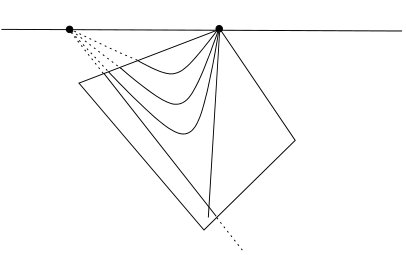 Figure 1