Hierarchical Event-triggered Learning for Cyclically Excited Systems with Application to Wireless Sensor Networks
Jonas Beuchert, Friedrich Solowjow, J\"org Raisch, Sebastian Trimpe,, Thomas Seel

TL;DR
This paper introduces a hierarchical event-triggered learning method for cyclically excited nonlinear systems, significantly reducing communication in wireless sensor networks while maintaining accurate state estimation.
Contribution
It proposes an automatic cyclic pattern recognition and hierarchical model update approach for event-triggered learning in nonlinear systems with changing cyclic excitation.
Findings
Communication load reduced by 70%.
Root-mean-square error less than 1 degree.
Effective in real-time neuroprosthesis applications.
Abstract
Communication load is a limiting factor in many real-time systems. Event-triggered state estimation and event-triggered learning methods reduce network communication by sending information only when it cannot be adequately predicted based on previously transmitted data. This paper proposes an event-triggered learning approach for nonlinear discrete-time systems with cyclic excitation. The method automatically recognizes cyclic patterns in data - even when they change repeatedly - and reduces communication load whenever the current data can be accurately predicted from previous cycles. Nonetheless, a bounded error between original and received signal is guaranteed. The cyclic excitation model, which is used for predictions, is updated hierarchically, i.e., a full model update is only performed if updating a small number of model parameters is not sufficient. A nonparametric statistical…
Click any figure to enlarge with its caption.
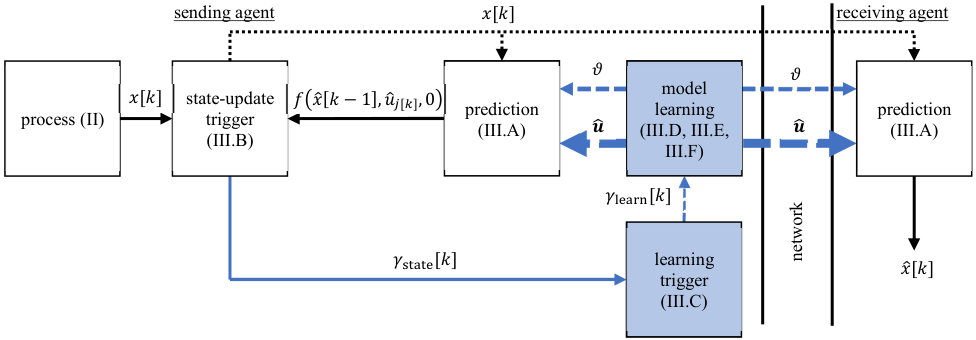 Figure 1
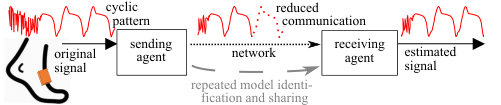 Figure 2
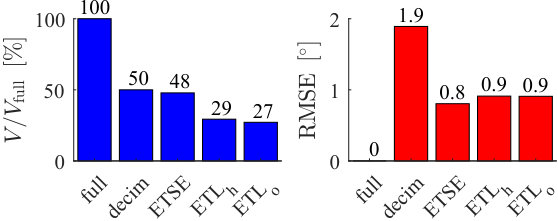 Figure 3
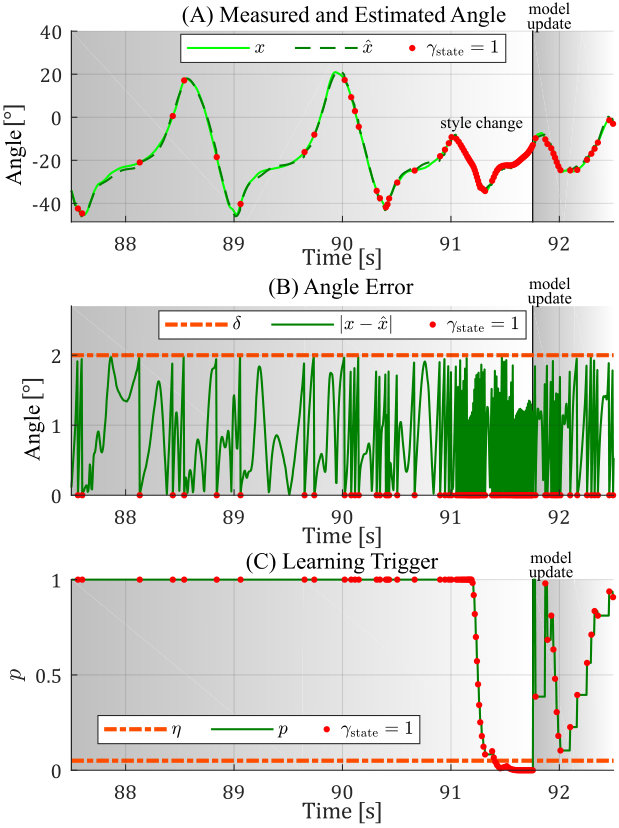 Figure 4
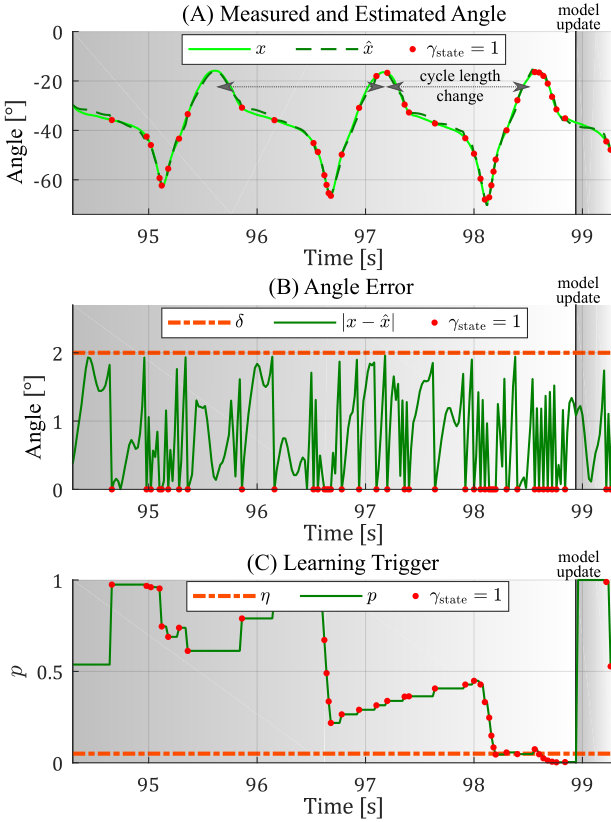 Figure 5
Peer Reviews
No public reviews on file for this paper yet. If you reviewed it on a platform where reviews are public (OpenReview, ICLR, NeurIPS, ICML), you can paste yours below so the community can read it here.
Code & Models
Videos
No videos yet. Explain this paper in a talk, walkthrough, or lecture? Add one.