Observation of electroweak production of a same-sign $W$ boson pair in association with two jets in $pp$ collisions at $\sqrt{s}=13$ TeV with the ATLAS detector
ATLAS Collaboration

TL;DR
This paper reports the first observation of electroweak production of same-sign W boson pairs with two jets at the LHC, using ATLAS data, with a significance of 6.5 sigma and measured cross section.
Contribution
It provides the first measurement and observation of same-sign W boson pair production via electroweak processes at 13 TeV with the ATLAS detector.
Findings
Observed 122 candidate events against 69 ± 7 background
Signal significance of 6.5 standard deviations
Measured fiducial cross section of 2.89^{+0.51}_{-0.48} fb
Abstract
This Letter presents the observation and measurement of electroweak production of a same-sign boson pair in association with two jets using 36.1 fb of proton-proton collision data recorded at a center-of-mass energy of TeV by the ATLAS detector at the Large Hadron Collider. The analysis is performed in the detector fiducial phase-space region, defined by the presence of two same-sign leptons, electron or muon, and at least two jets with a large invariant mass and rapidity difference. A total of 122 candidate events are observed for a background expectation of events, corresponding to an observed signal significance of 6.5 standard deviations. The measured fiducial signal cross section is fb.
Click any figure to enlarge with its caption.
 Figure 1
 Figure 2
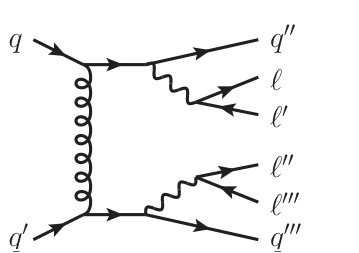 Figure 1
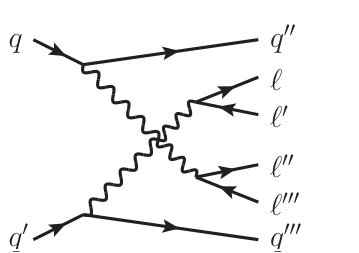 Figure 1
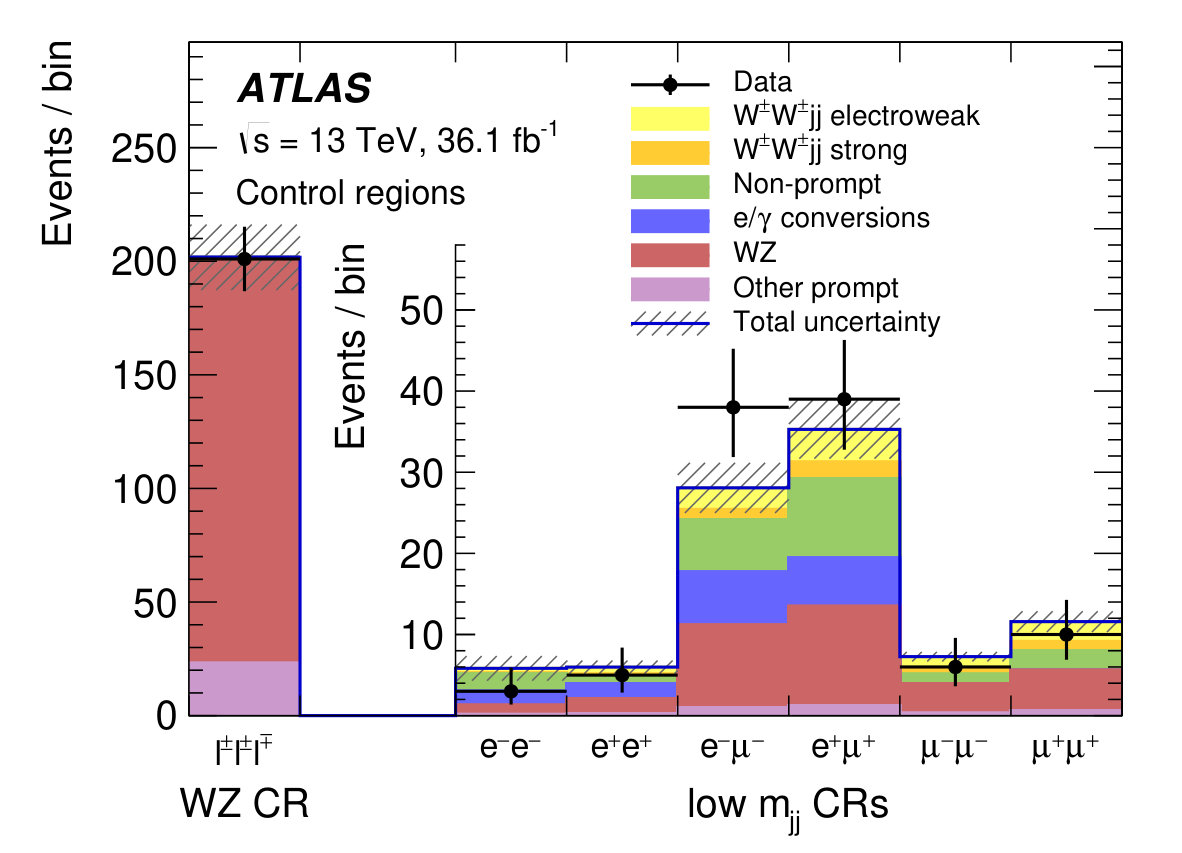 Figure 2
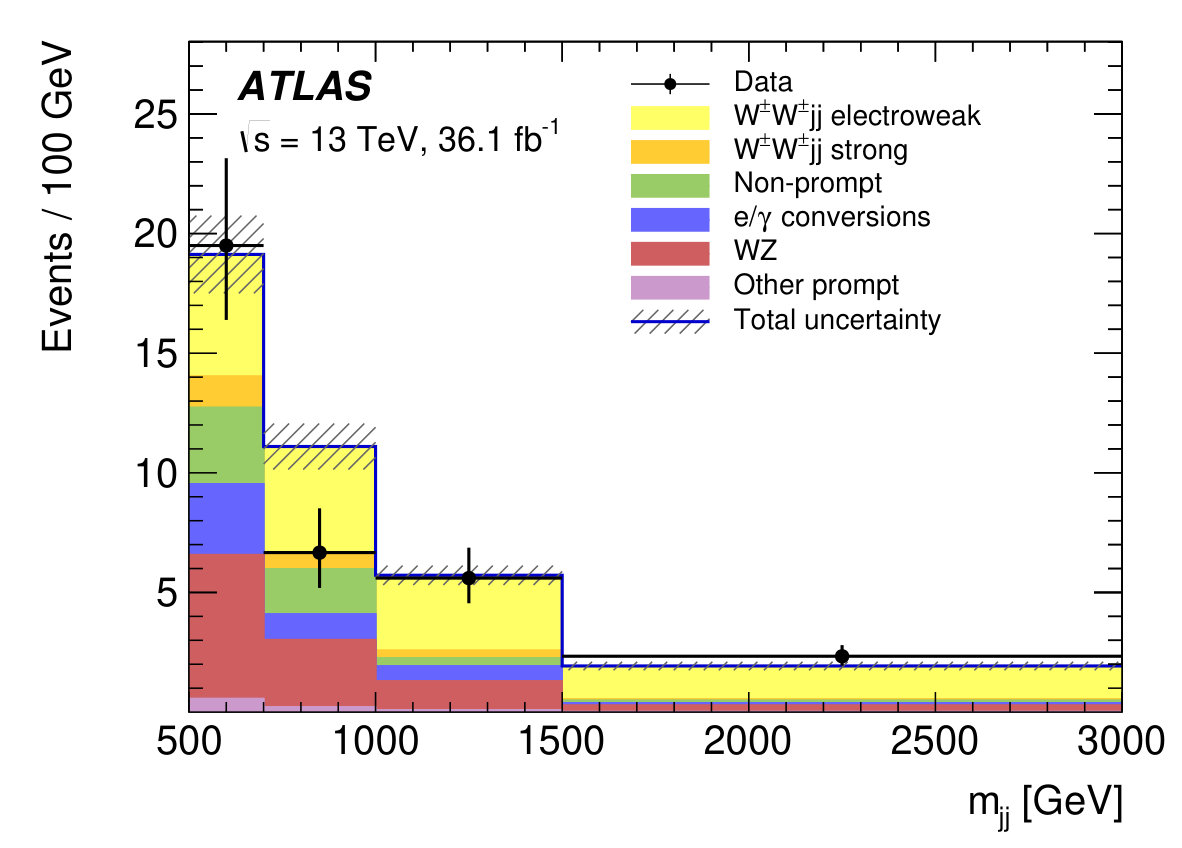 Figure 2
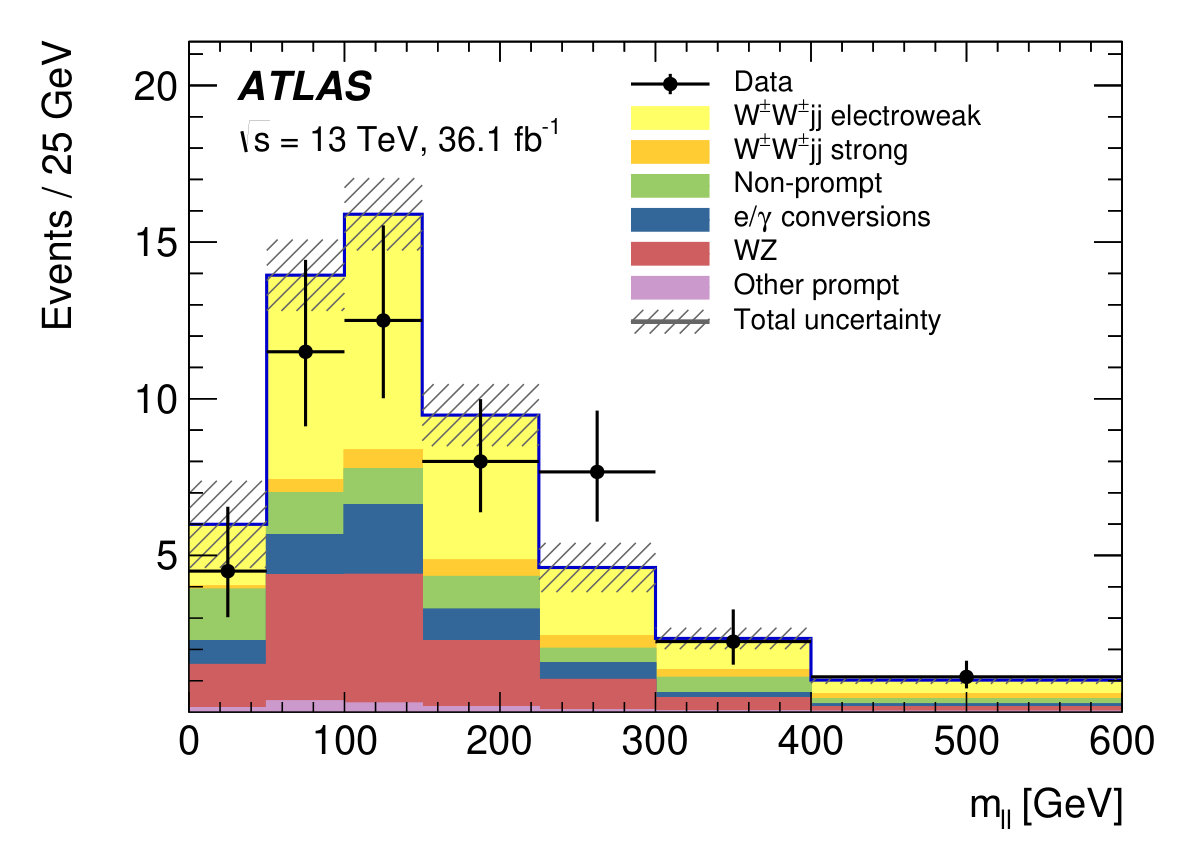 Figure 3
| Combined | ||||||||||||||
| Non-prompt | ||||||||||||||
| conversions | — | — | ||||||||||||
| Other prompt | ||||||||||||||
| strong | ||||||||||||||
| Expected background | ||||||||||||||
| electroweak | ||||||||||||||
| Data | 10 | 4 | 44 | 28 | 25 | 11 | 122 | |||||||
| Source | Impact [%] | |
| Experimental | ||
| Electron energy scale and resolution, and efficiency | ||
| Muon momentum scale and resolution, and efficiency | ||
| Jet energy and scale and resolution | ||
| -tagging inefficiency | ||
| Pileup modeling | ||
| Background, statistical | ||
| Background, misid. leptons | ||
| Background, charge misrec. | ||
| Background, other | ||
| Theory modeling | ||
| electroweak-strong interference | ||
| electroweak, EW corrections | ||
| electroweak, shower, scale, PDF & | ||
| strong | ||
| Luminosity | ||
Peer Reviews
No public reviews on file for this paper yet. If you reviewed it on a platform where reviews are public (OpenReview, ICLR, NeurIPS, ICML), you can paste yours below so the community can read it here.
Videos
No videos yet. Explain this paper in a talk, walkthrough, or lecture? Add one.
\AtlasTitle
Observation of electroweak production of a same-sign boson pair in association with two jets in collisions at TeV with the ATLAS detector
\AtlasRefCodeSTDM-2017-06 \AtlasNoteSTDM-2017-06 \PreprintIdNumberCERN-EP-2019-008 \AtlasJournalRefPhys. Rev. Lett. 123 (2019) 161801 \AtlasDOI10.1103/PhysRevLett.123.161801 \AtlasAbstract This Letter presents the observation and measurement of electroweak production of a same-sign boson pair in association with two jets using 36.1 fb*-1* of proton–proton collision data recorded at a center-of-mass energy of TeV by the ATLAS detector at the Large Hadron Collider. The analysis is performed in the detector fiducial phase-space region, defined by the presence of two same-sign leptons, electron or muon, and at least two jets with a large invariant mass and rapidity difference. A total of 122 candidate events are observed for a background expectation of events, corresponding to an observed signal significance of 6.5 standard deviations. The measured fiducial signal cross section is .
The scattering of two massive vector bosons (VBS), with or , is an important process for studying the mechanism of electroweak symmetry breaking [1, 2, 3]. VBS processes involve quartic gauge-boson self interactions, and the - and -channel exchanges of a gauge or Higgs boson. The Higgs boson regularizes the VBS amplitude by canceling out the divergencies arising from longitudinally polarized vector bosons at high energy [4, 5]. These cancellations depend on the gauge structure of the theory and are exact in the Standard Model (SM) [6, 7]. The present measurement of boson scattering thus serves as a fundamental probe of the SM electroweak theory.
At the LHC, the VBS final state of two gauge bosons and two jets () can be produced via two classes of mechanisms. The first class, referred to as strong production, involves both strong and electroweak interactions at Born level, and features diagrams where the incoming partons exchange color, as illustrated in Figure 1(a). The second class, referred to as electroweak production, involves only weak interactions at Born level [8] and includes VBS diagrams. Figure 1(b) shows a typical VBS diagram where the gauge bosons are radiated off the incoming quarks and then scatter via the quartic self interaction vertex. In VBS processes, the incoming partons do not exchange color and typically produce the two jets with a large invariant mass and with large rapidity difference [9].
The final state has the largest ratio of electroweak to strong production cross sections compared to other VBS diboson processes [3]; this is because at leading-order (LO) accuracy in perturbative quantum chromodynamics (QCD) quark-gluon and gluon-gluon initiated diagrams are absent and contributions from quark and (anti-)quark annihilation diagrams are suppressed. This ratio is of order five in the fiducial phase-space region of this analysis. The -channel VBS diagrams with trilinear self interactions are absent in this final state. In addition, electroweak diagrams not involving self interactions are suppressed [10], thus enhancing sensitivity of this final state to gauge-boson self couplings. Previously, an observation of electroweak production was reported by the CMS Collaboration [11] and evidence was reported by the ATLAS Collaboration using a smaller dataset [12, 13].
This Letter presents the observation and measurement of the electroweak production of events in which both bosons decay into an electron or muon and a neutrino. This study uses of proton–proton () collision data collected by the ATLAS detector at TeV. The ATLAS detector [14] is a multipurpose particle detector with a forward–backward symmetric cylindrical geometry and almost coverage in solid angle.111ATLAS uses a right-handed coordinate system with its origin at the nominal interaction point (IP) in the center of the detector and the -axis along the beam direction. The -axis points from the IP to the center of the LHC ring, and the -axis points upward. Cylindrical coordinates are used in the plane, being the azimuthal angle around the beam direction. The rapidity is defined as where is the energy of the particle and is the projection of the momentum along the -axis. The pseudorapidity is defined in terms of the polar angle as . The distance is defined as . The inner tracking detector (ID) covers in pseudorapidity and consists of a silicon pixel detector, a silicon microstrip detector, and a transition radiation tracker. The ID is surrounded by a superconducting solenoid magnet and an almost hermetic calorimeter system, which provides three-dimensional reconstruction of particle showers up to . The muon spectrometer (MS) has three air-core toroidal magnets: a barrel toroid and two endcap toroids. Three layers of precision tracking stations with drift tubes and cathode strip chambers allow precise muon momentum measurement up to . Resistive-plate and thin-gap chambers provide muon triggering capability up to .
Monte Carlo (MC) simulation is used to generate signal and background predictions. The generated events are processed through a detector simulation [15] based on Geant4 [16] and are reconstructed using the same algorithms as used for data. The simulation includes the effect of multiple interactions per bunch crossing as detailed in Ref. [17].
Processes producing four leptons were simulated using the event generator Sherpa v2.2.2 [18, 19, 20, 21] with the NNPDF3.0NNLO [22] set of parton distribution functions (PDF). Electroweak diboson production in association with two jets was simulated with diagrams including exactly six orders of the EW coupling [23]. The simulation of the strong production processes includes diagrams with exactly four electroweak (EW) vertices [24]. The simulation of both the electroweak signal and strong background processes includes up to one additional parton at LO in QCD. For and 4 final states, matrix elements include up to one parton at next-to-leading-order (NLO) and three partons at LO in QCD. All multileg processes were simulated combining the various final-state topologies with the MEPS merging algorithm [25, 21] and matched to the Sherpa internal parton shower, hadronization and underlying-event modeling [20, 26]. The renormalization and factorization scales were set to the invariant mass of the four-lepton system at the matrix-element level. A signal sample for alternative theoretical predictions was simulated with Powheg-Box [27, 28, 29, 30] and Pythia8.230 [31] at NLO QCD accuracy and employing the VBS approximation [32], the NNPDF3.0NLO PDF set, and renormalization and factorization scales set to the boson mass. The processes were simulated with exactly three EW vertices using Sherpa v2.1.1 at NLO (up to one parton) or LO accuracy (up to three partons) using the CT10NLO PDF set [33]. Electroweak processes were simulated using Sherpa v2.2.4 with the NNPDF3.0NNLO PDF set, with exactly five orders of the EW coupling, and at LO QCD accuracy. The triboson production processes were simulated with Sherpa v2.1.1 and the CT10NLO PDF set. Madgraph5_aMC@NLO [34] with the NNPDF3.0NLO PDF set and Pythia8.210 were used to simulate processes at NLO QCD accuracy.
The electroweak production cross section is measured in a fiducial region defined at particle level in MC simulation by requiring exactly two same-sign leptons with a transverse momentum, , greater than 27 GeV and ; leptons are defined as electrons and muons produced in boson decays and that do not originate from decays. The lepton four-momentum includes the four-momenta of photons inside a cone of size around the lepton. The two leptons must be separated by a distance of and must have an invariant mass, , greater than 20 GeV. The magnitude of the vector sum of the transverse momenta of the two final-state neutrinos with highest must be greater than 30 GeV. Jets are reconstructed using the anti- algorithm [35] with radius parameter and using all final-state particles, except for neutrinos and charged leptons from boson decays. Jets are required to have GeV and . Events with a charged lepton that is within a cone of radius around a jet are vetoed. The fiducial region requires at least two jets, including one with GeV and another with GeV. The two highest- jets must have an invariant mass GeV and a rapidity difference .
The fiducial cross section predicted by Sherpa for electroweak production is . The uncertainty includes independent variations of the renormalization and factorization scales by factors of 0.5 and 2 with the constraint which contribute ; it also includes uncertainties from the NNPDF3.0NNLO ensemble, as well as differences between the CT14 [36] and MMHT2014 [37] PDF sets () [38]. Uncertainties in the parton shower, hadronization, and underlying-event modeling are evaluated by varying the MEPS matching and resummation scales and amount to . Powheg+Pythia8 predicts a signal fiducial cross section of , with the uncertainties derived using the same procedures as for the Sherpa prediction, except for the uncertainty in the parton shower modeling, which is estimated as the difference relative to Powheg+Herwig7 [39, 40]. The Sherpa electroweak samples suffer from a non-optimal setting of the color flow, which leads to an excess of central jet emissions from the parton shower. Since up to one additional parton is included in the matrix element of the electroweak sample, the effect on its differential distributions is reduced but accompanied by a significant suppression of the predicted cross section [23].
Events are required to contain at least one reconstructed proton interaction vertex. The vertex with the highest sum of associated ID tracks is selected as the primary vertex. Electrons are reconstructed from energy clusters in the electromagnetic calorimeter that are matched to tracks reconstructed in the ID with the requirement of a hit in the innermost pixel layer [41]. Muon are reconstructed by combining ID and MS information [42]. Electron and muon candidates must satisfy loose identification criteria [41, 42], have , and and , respectively. The ID tracks associated to electron (muon) candidates are matched to the primary vertex by requiring their transverse impact parameter significance to satisfy ; the longitudinal impact parameter multiplied by the sine of the polar angle of the lepton candidates must satisfy mm. Electrons and muons passing these selections are further referred to as baseline leptons.
Jets are reconstructed from calorimeter energy clusters [43, 44] using the anti- algorithm with radius parameter . Jets are required to have GeV in the forward region () and GeV in the central region (). Central jets with GeV must be matched to the primary vertex [45]. Jets containing -hadrons (-jets) are identified in the range of with an efficiency of 85% using techniques described in Ref. [46]. Selected electron, muon and jet candidates are required to be non-overlapping using the procedures described in Ref. [17]. The missing transverse momentum, , is computed using selected electrons, muons and jets, and the track-based soft term defined in Ref. [47].
Events are selected online by single-electron or single-muon triggers [48]. Candidate events are selected by requiring exactly two same-sign baseline leptons, electron or muon, with GeV and by requiring GeV. They are required to contain at least two jets, including one with GeV and another with GeV. Events with at least one identified -jet are rejected in order to reduce background contributions from top-quark pair production (). The two highest- jets are required to have GeV and . These jet selection criteria were optimized to separate the electroweak process from the strong production and other background processes.
After these selections, the dominant source of background events is due to leptons originating from decays of heavy-flavor hadrons and jets misidentified as electrons, collectively referred to as non-prompt leptons. Additional selection criteria are applied to reduce their contributions. Signal electrons are required to satisfy tight identification criteria [41], to have GeV, and to be outside the calorimeter transition region (). Signal muons are required to satisfy medium identification criteria [42], and to have GeVand . Signal electrons and muons are further required to be isolated from nearby particles, with isolation criteria defined using calorimeter clusters and ID tracks. These isolation criteria are optimized to have an efficiency of at least 90% for GeV and at least 99% for GeV [42, 41]. For dielectron events, the electron pseudorapidity is restricted to and events with are discarded. These criteria reduce the background from electron charge misreconstruction described later. Candidate events with exactly two signal leptons are said to pass the full event selection.
The contributions from the , , , and triboson production are estimated using simulation. The predicted event yields of the and processes are normalized to data in dedicated control regions. The normalization of the background is determined using events with exactly three baseline leptons, two of which are required to pass the signal lepton selection, and that satisfy the dijet and selection criteria. Events from production enter the signal region when a photon is misidentified as an electron. The modeling of this misidentification process in simulation is corrected using events where a photon is emitted by a muon and then misidentified as an electron. These events are selected by requiring exactly two opposite-sign signal muons, one signal electron, GeV and a trilepton invariant mass satisfying 75\leavevmode\nobreak\ \text{Ge\kern-1.00006ptV}<m_{\mu\mu e}<100\leavevmode\nobreak\GeV. A normalization factor of is derived from this control region and used to correct the simulated events. To account for the differences between the and processes, the full effect of this correction factor is assigned as a systematic uncertainty, corresponding to of the estimated yield. The relative contributions from electroweak and strong production of and processes are estimated from simulation since this analysis is not sensitive to their different admixtures. Theoretical uncertainties in the predictions of the , , triboson, and backgrounds vary from to [24, 49, 50].
Background contributions with non-prompt leptons are estimated by weighting data events from dedicated control regions by scale factors. These scale factors are measured in dijet events containing exactly one lepton that is -balanced by a -jet. The -jet requirement enhances non-prompt lepton contributions and suppresses contributions from bosons, which are subtracted from data using simulation. The scale factor is defined as the ratio of the number of signal leptons to the number of leptons passing a dedicated background selection. The background leptons are required to pass the baseline lepton selection and fail the signal lepton selection, where background electrons are in addition required to satisfy medium identification criteria [41]. Moreover, the background electron (muon) is required to be greater than . Separate scale factors are computed for muons and for central and forward electrons. In order to reduce the dependence on the underlying spectrum of -jets that produce non-prompt leptons, the scale factors are measured as a function of the scalar sum of the background lepton and the additional activity around the lepton. This activity, , is quantified by the sum of the of ID tracks that are within a cone of size around the lepton and originate from the primary vertex.
Data events, that are weighted by the scale factors, are taken from control regions defined using the full event selection criteria except that one lepton is required to pass the background lepton selection and its is replaced with , with this sum required to be greater than GeV. A statistically independent control region is defined for each bin of the distribution. The uncertainty of the estimated non-prompt background yields is approximately 50% in final states and varies between 40% and 90% for and final states. It includes the systematic uncertainty of the scale factors and the statistical uncertainty of the control regions. The former uncertainty is derived from variations in the composition of the dijet control regions where these factors are measured, obtained by varying the selection criteria. The entire method is validated in regions enriched with non-prompt leptons from (jet) events selected by requiring exactly two same-sign leptons and exactly one (zero) -jet among a total of at least (less than) two jets. In these regions, the number of observed data events and the number of predicted background events agree within their uncertainties.
Opposite-sign lepton pairs pass the full event selection when an electron undergoes an interaction with the detector material resulting in incorrect charge reconstruction. The probability of this charge misreconstruction, , is measured in events [41] and it increases from about 0.1% in the central region to a few percent for . The background contributions from electron charge misreconstruction are estimated from data using opposite-sign lepton pairs that satisfy the full event selection criteria, except for the same-sign requirement; these events are weighted by and the electron energy loss due to the material interaction is corrected with -dependent factors derived from simulation [41]. The overall method is validated by comparing the number of observed same-sign electron pairs having with the predicted background yield, with the two numbers agreeing within the systematic uncertainty of . This uncertainty is dominated by the statistical uncertainty in the measurement of , which is less than for and up to in the central region. The charge misreconstruction of muons is found to be negligible.
The detector systematic uncertainties arising from the mismodeling of the reconstructed objects are estimated primarily from data and their impact on the analysis is assessed using simulated events. The dominant source is the uncertainty of the jet energy scale, which amounts to for the signal and for the background. The uncertainty in the measurement of the integrated luminosity is [51].
The theory modeling uncertainties of the distributions predicted by Sherpa for and processes are evaluated using the procedures described above. They account for uncertainties in the total cross section, the acceptance of the fiducial selection, the modeling of the event selection efficiency and the shape of the distribution. Only the latter two affect the measured fiducial cross section of the signal, since absolute normalization uncertainties cancel in this measurement. The uncertainty in the modeling of the event selection efficiency also accounts for extrapolations from the fiducial phase space to the detector level, in particular for the acceptance in dielectron events. Effects of the NLO electroweak corrections [52] and of the interference between electroweak and strong production [9] are assigned as an uncertainty in the shape of the signal, amounting to and , respectively. This approach is used because no event generator implemented the complete NLO calculation until recently [53] and because the interference contribution is defined only at the leading order [8]. The overlap of the photon radiation in the Sherpa parton shower model with the NLO EW corrections is found to be negligible.
Signal events are categorized by their lepton flavor and charge into six mutually exclusive channels: , , and , in order to exploit their different signal and background compositions. The signal region is defined as and further split into four bins, optimized to increase the expected signal sensitivity. Events with serve as additional control regions, dominated by contributions from non-prompt leptons and backgrounds. The resulting 30 bins of the distributions in the signal and control regions are combined in a profile likelihood fit [54] to extract the fiducial cross section.
The signal strength, a free parameter in the fit, multiplies the expected fiducial electroweak production cross section used to produce the signal template. The signal template of reconstructed electroweak events also includes candidate events with electrons and muons produced in decays into lepton. Since the fiducial cross section prediction does not include such events, their fractional contribution predicted by the simulation is removed from the fiducial cross section measurement. Systematic uncertainties are included in the fit as nuisance parameters constrained by Gaussian functions. The control region is also included in the fit as a single bin and the normalization of the background is included as a free parameter. The analysis choices maximize the expected significance for the electroweak signal predicted by Sherpa at 4.4. A significance of 6.5 is expected by the alternative signal sample simulated with Powheg-Box.
Table 1 compares the numbers of data events in the signal region with the background and signal event yields after the fit; the signal region contains 122 data events, compared with a best-fit yield of background events. By fitting the data and background events in the signal and control regions, the background-only hypothesis is rejected with a significance of 6.5. Figure 2 shows the control region events separated into categories and the distribution in the signal region after the fit. All nuisance parameters remain within their one standard deviation uncertainty after the fit. The normalization of the background is scaled by a factor of , constrained mainly by the observed number of data events in the control region. Figure 3 shows the distribution in the signal region after the fit.
A signal strength of is measured with respect to the Sherpa fiducial cross section prediction for electroweak production, where the systematic uncertainty also includes the absolute normalization uncertainty of this prediction. This corresponds to a fiducial signal cross section of:
[TABLE]
where the uncertainties correspond to the statistical, experimental systematic, theory modeling systematic and luminosity uncertainties, respectively. The experimental systematic uncertainty includes the detector systematic uncertainties and the uncertainties in estimating all background processes except for the and strong production processes that are accounted for in the modeling systematic uncertainty. Table 2 summarizes the impacts of different components of systematic uncertainty.
The measured fiducial cross section includes contributions from both the electroweak production and its interference with the strong production, estimated to be approximately 6% of the predicted fiducial cross section for electroweak production. The fiducial cross section for the electroweak production, without the interference effect, is predicted by Sherpa and Powheg+Pythia8 to be and , respectively. The impact on the measured fiducial cross section of using Powheg+Pythia8 instead of Sherpa to generate the signal template was tested and found to be smaller than the signal modeling uncertainty.
In summary, the electroweak production process was studied in the final state using of collision data recorded at TeV by the ATLAS detector at the LHC. This process includes VBS diagrams which probe the mechanism of electroweak symmetry breaking. An excess of events is observed and the background-only hypothesis is rejected with a significance of 6.5. The fiducial cross section for electroweak production is measured to be .
Acknowledgments
We thank CERN for the very successful operation of the LHC, as well as the support staff from our institutions without whom ATLAS could not be operated efficiently.
We acknowledge the support of ANPCyT, Argentina; YerPhI, Armenia; ARC, Australia; BMWFW and FWF, Austria; ANAS, Azerbaijan; SSTC, Belarus; CNPq and FAPESP, Brazil; NSERC, NRC and CFI, Canada; CERN; CONICYT, Chile; CAS, MOST and NSFC, China; COLCIENCIAS, Colombia; MSMT CR, MPO CR and VSC CR, Czech Republic; DNRF and DNSRC, Denmark; IN2P3-CNRS, CEA-DRF/IRFU, France; SRNSFG, Georgia; BMBF, HGF, and MPG, Germany; GSRT, Greece; RGC, Hong Kong SAR, China; ISF, I-CORE and Benoziyo Center, Israel; INFN, Italy; MEXT and JSPS, Japan; CNRST, Morocco; NWO, Netherlands; RCN, Norway; MNiSW and NCN, Poland; FCT, Portugal; MNE/IFA, Romania; MES of Russia and NRC KI, Russian Federation; JINR; MESTD, Serbia; MSSR, Slovakia; ARRS and MIZŠ, Slovenia; DST/NRF, South Africa; MINECO, Spain; SRC and Wallenberg Foundation, Sweden; SERI, SNSF and Cantons of Bern and Geneva, Switzerland; MOST, Taiwan; TAEK, Turkey; STFC, United Kingdom; DOE and NSF, United States of America. In addition, individual groups and members have received support from BCKDF, the Canada Council, CANARIE, CRC, Compute Canada, FQRNT, and the Ontario Innovation Trust, Canada; EPLANET, ERC, ERDF, FP7, Horizon 2020 and Marie Skłodowska-Curie Actions, European Union; Investissements d’Avenir Labex and Idex, ANR, Région Auvergne and Fondation Partager le Savoir, France; DFG and AvH Foundation, Germany; Herakleitos, Thales and Aristeia programmes co-financed by EU-ESF and the Greek NSRF; BSF, GIF and Minerva, Israel; BRF, Norway; CERCA Programme Generalitat de Catalunya, Generalitat Valenciana, Spain; the Royal Society and Leverhulme Trust, United Kingdom.
The crucial computing support from all WLCG partners is acknowledged gratefully, in particular from CERN, the ATLAS Tier-1 facilities at TRIUMF (Canada), NDGF (Denmark, Norway, Sweden), CC-IN2P3 (France), KIT/GridKA (Germany), INFN-CNAF (Italy), NL-T1 (Netherlands), PIC (Spain), ASGC (Taiwan), RAL (UK) and BNL (USA), the Tier-2 facilities worldwide and large non-WLCG resource providers. Major contributors of computing resources are listed in Ref. [55].
The reference list from the paper itself. Each links out to its DOI / PubMed record.
- 1[1] Michael S. Chanowitz and Mitchell Golden “Like-Charged Gauge-Boson Pairs as a Probe of Electroweak Symmetry Breaking” [Erratum: Phys. Rev. Lett. 63 (1989) 466] In Phys. Rev. Lett. 61 , 1988, pp. 1053 DOI: 10.1103/Phys Rev Lett.61.1053 · doi ↗
- 2[2] J. Bagger et al. “Strongly interacting WW system: Gold-plated modes” In Phys. Rev. D 49 , 1994, pp. 1246–1264 DOI: 10.1103/Phys Rev D.49.1246 · doi ↗
- 3[3] J. Bagger et al. “CERN LHC analysis of the strongly interacting WW system: Gold-plated modes” In Phys. Rev. D 52 , 1995, pp. 3878–3889 DOI: 10.1103/Phys Rev D.52.3878 · doi ↗
- 4[4] Benjamin W. Lee, C. Quigg and H.. Thacker “Strength of Weak Interactions at Very High-Energies and the Higgs Boson Mass” In Phys. Rev. Lett. 38 , 1977, pp. 883–885 DOI: 10.1103/Phys Rev Lett.38.883 · doi ↗
- 5[5] Benjamin W. Lee, C. Quigg and H.. Thacker “Weak interactions at very high energies: The role of the Higgs-boson mass” In Phys. Rev. D 16 , 1977, pp. 1519 DOI: 10.1103/Phys Rev D.16.1519 · doi ↗
- 6[6] Gerard ’t Hooft and M… Veltman “Regularization and Renormalization of Gauge Fields” In Nucl. Phys. B 44 , 1972, pp. 189–213 DOI: 10.1016/0550-3213(72)90279-9 · doi ↗
- 7[7] M… Veltman “Second Threshold in Weak Interactions” In Acta Phys. Polon. B 8 , 1977, pp. 475
- 8[8] Benedikt Biedermann, Ansgar Denner and Mathieu Pellen “Complete NLO corrections to W + W + scattering and its irreducible background at the LHC” In JHEP 10 , 2017, pp. 124 DOI: 10.1007/JHEP 10(2017)124 · doi ↗